Paying for the Privilege of Being Offline

It’s no big news that we as a species are becoming ever more glued to LCD screens of all sizes–from that big monitor to our little ‘wearables.’ The occasions we find ourselves offline are becoming fewer and farther between. And while this connection has some benefits, it also has some serious hazards: we are losing our ability to connect with others, our ability to focus on one thing, it’s making us horrible drivers and so forth. For these reasons and more, people are now searching for opportunities to be forced offline in the name of defragmenting their megabyte-addled minds.

A recent Wall Street Journal article highlighted families who purposefully chose vacation spots where cell phone and/or wifi connectivity was low or non-existent, either by design or geography. According to the article, in 2014 “American children ages 13 to 17 spend nearly four hours a day online…nearly an hour more than in 2012 [and] more than half have their own smartphones,” creating an imperative to get a bit of offline time. These families chose remote vacations spots like the Black Mountain Dude Ranch in McCoy, CO, whose website promises that “kids will spend a week electronics-free.” The article didn’t sugarcoat the families’ experiences. Some of kids had problems at first with putting down their devices, but after the initial digital DT’s, people–both young and old–realized there was more to life than checking their Facebook newsfeed.

camp-grounded-games

People who aren’t interested in lugging the kids should check out Camp Grounded, a summer camp for adults run by Digital Detox, a company that specializes in retreats for, well, detoxing from digital media. Camp Grounded, according to their website, is a place “Where Grownups Go to Unplug, Get Away, and Be Kids Again.” The camp promises 50+ playshops, arts n crafts, yoga, typewriters, capture the flag, color wars, meditation, swimming, talent show, camp dance, campfires, archery, rockwall, kickball, stargazing, hiking, healthy meals, sing-a-longs, face-painting and analog photography. More than what there is is what there is not: no networking, work-talk, ageism, drugs or booze, wearable and, importantly, dubstep or glowsticks (i.e. it’s not a latter day rave). Fittingly, Camp Grounded is located not too far from San Francisco and Silicon Valley in Mendocino, CA. They hold two weekend camps per summer, both starting in late May. Cost is around $600 for the weekend.

Lastly, if you’re looking for something a bit more exotic, throw yourself in the middle of the Caribbean for the digital detox in St Vincent and the Grenadines, where guests are asked to ‘de-tech’ and hand over their mobile phones and gadgets surrendering themselves to their lack of “connectivity.” It might seem like a lot of effort for something that could ostensibly be achieved by shutting down our computers/phones/tablets, but the fact is most of us don’t do that in our normal environments. It takes what it takes.

What is the Experience Economy?

If we are to believe a recent study by the company Eventbrite, there may be an emerging paradigm shift in terms of our relationship to stuff. Eventbrite, a ticket selling and event promotion site and service, is pretty invested in knowing how people prioritize experiences. Their study, conducted by Harris, looked squarely at Millennials, a population that make up a quarter of the US population and have $1.3 trillion of annual purchasing power. What they found was that Millennials place great importance on experiences. Here’s specifically what the study had to say about the Millennial’s relation to experiences:

  • 78% would choose to spend money on a desirable experience or event over buying a desirable thing, and 55% of millennials say they’re spending more on events and live experiences than ever before.
  • 82% attended or participated in a variety of live experiences in the past year, ranging from parties, concerts, festivals, performing arts and races and themed sports—and more so than other older generations (70%).
  • 72% say they would like to increase their spending on experiences rather than physical things in the next year, pointing to a move away from materialism and a growing demand for real-life experiences.
  • 77% of millennials say some of their best memories are from an event or live experience they attended or participated in. 69% believe attending live events and experiences make them more connected to other people, the community, and the world.
  • 69% of Millennials experience FOMO [fear of missing out]. In a world where life experiences are broadcasted across social media, the fear of missing out drives millennials to show up, share and engage.
  • Americans are dedicating more income to experiences: Millennials don’t hold the exclusive: the demand for live experiences is happening across the generational board. Since 1987, the share of consumer spending on live experiences and events relative to total U.S. consumer spending increased 70%. People want to experience more, and businesses are evolving and entering the market to meet that demand.

These findings support contentions made James Wallman, author of the book “Stuffocation” (who tipped me off to the Eventbrite survey). He sees a growing weariness of stuff as well as an emergent “experientialist” economy (as opposed to our current materialist one)–all of which supported by social media and mobile tech. Perhaps the parents of Millennials wanted to be seen driving down the drag in a GTO, their children want pics of themselves seen at the Taylor Swift show on Facebook or Instagram.

Of course, Eventbrite can’t be considered a neutral source of information. Experience is their chief product and they want to people to buy–the survey supports that end.

But anecdotally, the survey checks out. As more and more of our realities get outsourced to online repositories, the social capital of yore–cars, clothes, etc–loses some of its value. There’s also a stagnant economy, growing consciousness about the impact of stuff on the planet, a newfound definition of ownership, where the ability to use something is more important than possessing it, as well as a general weariness about the merits of having a ton of stuff. All of these factors could tip our collective consciousness toward an experience economy.

What do you think? Could the experience economy make appreciable inroads into the materialist one? Or is the survey market speak–a way for one company to make a buck off their core competency? Let us know what you think in our comments section.

Silhouettes of concert crowd image via Shutterstock

Creating Inspiration and Relaxation: No Tools Required

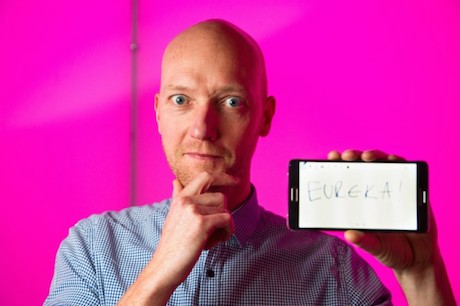
In celebration of its new Galaxy Note 4, the Samsung corporation has set up something called the Eureka! Room. The room, located in London’s Proud Archivist gallery/restaurant/event space and developed by O2 and London Science Museum’s Inventor in Residence Mark Champkins, channels all of the latest research into the ideal conditions for creative inspiration.

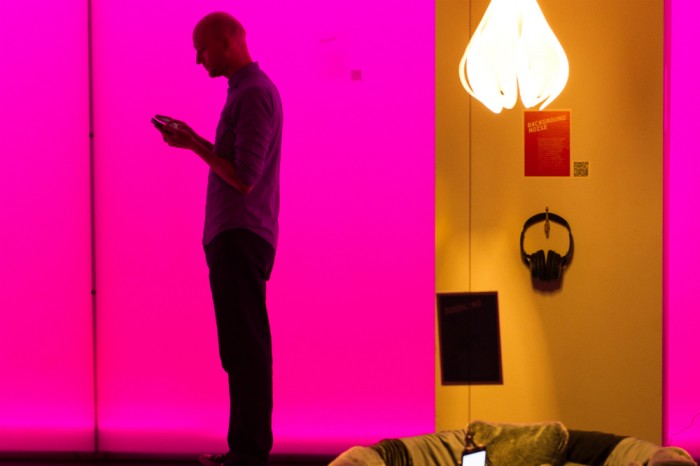
Inspiration has been shown to thrive when people are relaxed. Accordingly, the room’s wall are colored “Drunk Tank Pink,” a relaxing hue. There are two soundtracks available to visitors: either a non-repeating birdsong or straight up silence. There is soft lighting and the temperature is set to 71 degrees, the optimum “working” temperature based on analysis by The Lawrence Berkeley National Laboratory.

Attendees are also given “Thinking Gum,” since chewing gum has been found to increase alertness and reaction time by the National Institute of Radiological Sciences (NIRS). People are also given hot chocolate, which the American Association for the Advancement of Science found increases blood flow and oxygen to the brain. Finally, there’s a bath available, to get you totally inebriated on inspiration. In this state, you are encouraged to doodle on the Galaxy Note 4 “phablet.”

eureka-phablet

There’s a tinge of irony in an event designed to incite relaxation and inspiration being sponsored by a behemoth technology company. A few days ago, the NY Times published an op-ed entitled “The Joy of Quiet.” In it, novelist Pico Iyer describes how some of the most world’s most creative minds–people like Phillippe Starck and Stefan Sagmeister–see stillness–the kind that mobile tech and other devices featuring glowing screens have a propensity for shattering–as the chief activator of inspiration. Iyer writes how people are paying hefty premiums and taking many measures for the opportunity (imposition?) to be offline. He writes:

In barely one generation we’ve moved from exulting in the time-saving devices that have so expanded our lives to trying to get away from them—often in order to make more time. The more ways we have to connect, the more many of us seem desperate to unplug. Like teenagers, we appear to have gone from knowing nothing about the world to knowing too much all but overnight.

He continues:

The central paradox of the machines that have made our lives so much brighter, quicker, longer and healthier is that they cannot teach us how to make the best use of them; the information revolution came without an instruction manual. All the data in the world cannot teach us how to sift through data; images don’t show us how to process images. The only way to do justice to our onscreen lives is by summoning exactly the emotional and moral clarity that can’t be found on any screen.

He talks about his own (extreme) measures by which he stokes his creative process. He doesn’t use a cell phone (claims to have never used one), he doesn’t go online until he’s done writing for the day, he doesn’t use Facebook and, oh yeah, he moved from Manhattan to rural Japan. He also take regular retreats to a Benedictine hermitage, where he says he “just take walks and read and lose myself in the stillness, recalling that it’s only by stepping briefly away from my wife and bosses and friends that I’ll have anything useful to bring to them.” Sounds about right.

While we don’t want to poop on the Eureka! Room’s premise, nor make any declarations about the mutual exclusivity of technology and relaxation, we will give a plug for complete disconnection–that the formula for creating stillness and inspiration is not a complex one, but rather the simplest one: doing one thing–whether it’s walking, eating, writing, painting, reading, etc–and only that one thing.

via PSFK

Do One Thing, Write, with Hemingwrite

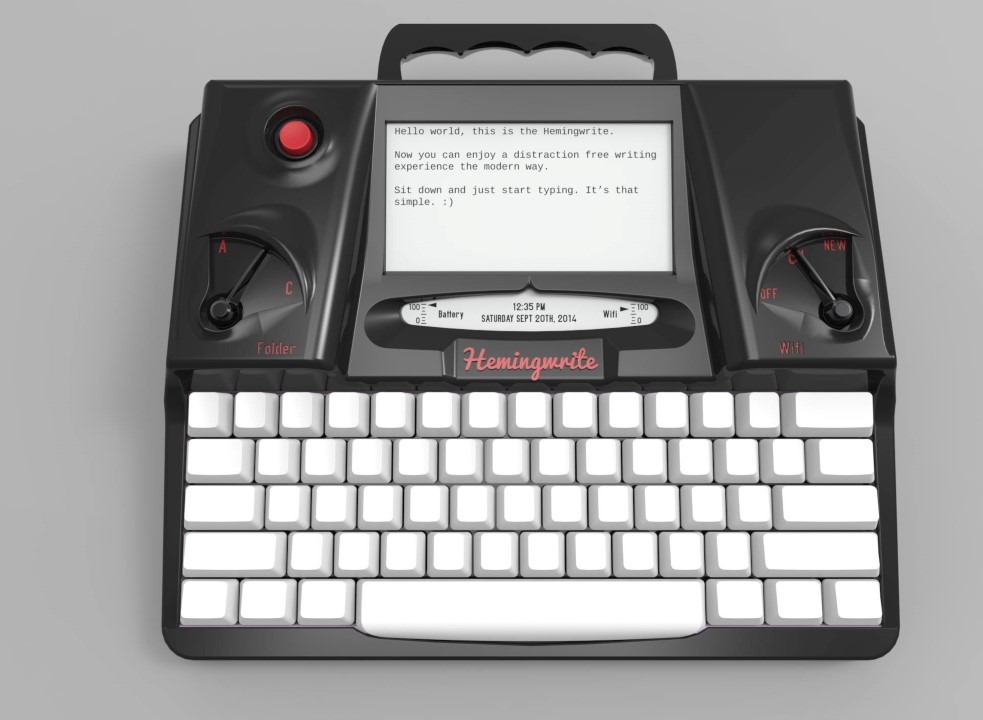
We wonder if Moby Dick, The Great Gatsby and many other canonical books would have been written in today’s technological distraction-fest? Would Melville spent his days clicking on threads linking off the various Wikipedia whale entries? Would Fitzgerald have spent his days posting things on Zelda’s Facebook wall? Many of us long for the days of monotasking technology: of notepads for writing, landlines for calling and not-so-smart TVs for watching. Hemingwrite was born in this spirit of simpler technology. It’s a word processor with a 6″ LCD screen and mechanical-feeling keyboard. It has no web browser, camera or MP3 player. It’s for writing and that’s it.

Despite its old school functionality, it does have wifi, which enables you to back up your words to Google Docs and Evernote. Their website claims you can store up to one million pages on the device itself as well. The battery can last up to six weeks on one charge.

The Hemingwrite is still in prototype mode and the company hasn’t indicated when it will be available or how much it will cost when it is.

While having a tool with such limited capability might seem to contradict the LifeEdited mission of doing more with less, sometimes–actually oftentimes–it’s a good use of space and resources to get things that allow us to do one thing really well. Find out more about Hemingwrite on their website.

Via the Guardian

Pop Up Apartment Defies Expectations, Physics

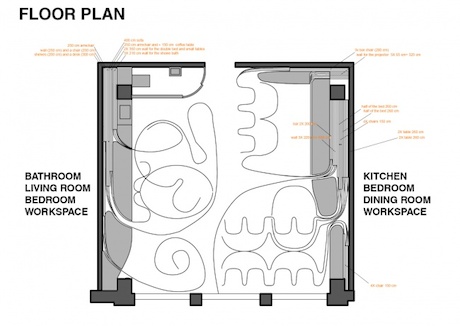
File this Dutch-university-student-designed Pop.up Apartment under the no-freaking-way category. Relying on polypropylene sheets that slide along motorized guides in the floor, the 50 sq m (538 sq ft) apartment can be configured in dozens of ways, giving it the functionality of a space twice its size. The sheets not only act as slide-out walls, but many of them bend to create much of the space’s furniture.

pop.up-apartment-floorplan

The project is the product of the Hyperbody design team at TU Delft University. The question the team sought to answer was how to fit more function into the modern city’s limited real estate. Like MIT’s CityHome, their answer is profoundly technical, replete with motors, app-controllability and lots of CNC cut panels. The team likens the space to a Swiss army knife, where only the desired tool is folded out, while the unused ones remain hidden.

I’m glad I watched the project’s four minute Youtube video. As I watched the computer modeling of the project, I thought “there’s no way this can be done in real life.” I was quite wrong. They made a full-scale, functional mockup in an empty office space.

pop.up-apartment-dining

For a simpleton like me, it’s important not to pass judgment too quick on the Pop.up Apartment. It seems too complicated by half. There are too many motors, too many things to go wrong. The curlycue  aesthetics aren’t my thing. I wonder how the plastic sheets’ resiliency will fare over time…and so on.

This is a concept and a bold one at that. And like all concepts, it’s going to be filled with many ideas that will end up on the edit-room floor. But some ideas might be useful, informing and improving on more conventional designs.

See more videos, drawings and images on the project’s website.

Via Fast Company

Never Bend or Upgrade Your Smartphone Again

Are you sick of constantly feeling tethered to your smartphone? Are you sick of feeling like you must have the latest and greatest model…that if your phone has beveled versus rounded edges, you are somehow out of pace with the times? Are you worried about bending your smartphone? Are you looking to kick your smartphone addiction, but fear you’ll miss the weight of the phone in your pocket or having something to clutch? Well, look no further, because the NoPhone has you covered (no matter where you might roam). According to its Kickstarter site, the NoPhone is a “technology-free alternative to constant hand-to-phone contact that allows you to stay connected with the real world.”

nophone-selfie

The NoPhone has no pesky battery to wear out, it never needs upgrading, it’s completely shatter and waterproof, we suspect it’d take a lot to bend (take that iPhone 6 Plus) and it’s totally unlocked. And best of all, the NoPhone can be yours for a mere $12 Kickstarter pledge. Another $6 will buy you a selfie upgrade, which allows you to share candid self-portraits with friends, assuming they’re standing right behind you looking over your shoulder.

Social Media Professor Bans Social Media in his Class

If you’ve been around the social media, new media sphere for a while, you probably know the name Clay Shirky. Perhaps best known for penning, “Here Comes Everybody: The Power of Organizing Without Organizations,” he is a Fellow at the Berkman Center for Internet and Society at Harvard, and was the Edward R. Murrow Visiting Lecturer at their Joan Shorenstein Center on the Press, Politics, and Public Policy in 2010. He holds a joint appointment at NYU, as an Associate Arts Professor at the Interactive Telecommunications Program (ITP) and as an Associate Professor in the Journalism Department. Shirky is about as authoritative and outspoken as they come regarding the power of new media–which makes his ban of technology in his classrooms all the more interesting.

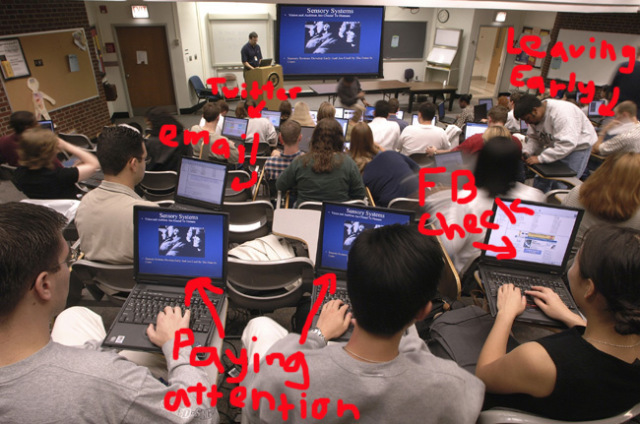
In a lengthy essay in PBS’s Mediashift, Shirky writes about precisely why he imposed the ban. For one of new media’s greatest proponents, it wasn’t a an easy decision. For many years, Shirky wrote that the inclusion of technology–specifically laptops, tablets and phones–seemed organic, as the devices related directly to the topic at hand. But he said, “The level of distraction in my classes seemed to grow…The change seemed to correlate more with the rising ubiquity and utility of the devices themselves.” In other words, a 2002 Sidekick in the hands of the few was like a musket compared to a Galaxy S5 in everyone’s palm, an AK-47 of distraction-inducing firepower.

Point by point, Shirky highlights the perils of ubiquitous tech, especially in the classroom, and why he decided to ban, not just admonish, their use in his classrooms. He points the myth of multitasking–how it negatively impacts our productivity, our ability to retain information and ability to choose what to focus on.

He writes about the uncontrollable gravitation toward certain emotionally triggering content. As an example, he writes: “‘Your former lover tagged a photo you are in’ vs. ‘The Crimean War was the first conflict significantly affected by use of the telegraph.’ Spot the difference?” One has an immediate emotional payout, the other is more slow-release. The coupling of this content with images makes it doubly distracting. He writes:

Our visual and emotional systems are faster and more powerful than our intellect; we are given to automatic responses when either system receives stimulus, much less both. Asking a student to stay focused while she has alerts on is like asking a chess player to concentrate while rapping their knuckles with a ruler at unpredictable intervals.

In one section, he uses the metaphor of the elephant and the rider, where the emotions represent the elephant and our intellect the rider. Traditionally, the classroom’s focused environment allowed the deliberate rider–i.e. the intellect–to lead. But more and more, the emotional elephant, spurred by a thousand emotionally-gratifying prods from technology, is leading the way and isn’t quite sure where he’s going.

And lastly, he talks about the contagious effects of technology–how studies have shown that not only do people who overuse technology in class perform poorer, but so too do the people who sit near the over-user. It’s second-hand distraction.

The essay is highly informative for people in and outside the classroom. Technology is a many splendored thing, but it also has the capacity to wreak a great deal of havoc on our ability to focus and get stuff done and even enjoy life. We might all take a cue from Shirky and consider not just the potential of technology, but its actual effects on our daily lives. Sure, our phones and other devices can theoretically connect us to vast troves of useful and empowering information, but if we use them in practice to read about the top ten plastic surgery disasters, a lot of the theory’s potential is nullified.  More than anything, Shirky’s mandate has one very obvious implication: that we should put away our tech and tech with greater frequency and pay attention to the subject at hand.

Image credit: the active class

Video: Signs You Have An Unhealthy Relationship With Technology

A couple months ago, we published a post called “Signs You Have An Unhealthy Relationship with Technology.” It was written in conjunction with research for a talk LifeEdited founder Graham Hill was giving at MindBodyGreen‘s Revitalize conference. The talk is about how our super-sizing tendencies are hardly limited to design and architecture. We are living in an era of unprecedented technological stimulation, taking in overwhelming amounts of information through our phones, computers and other devices–all of which have left many of us pretty strung out. Graham outlines the problem as well as ways we might start creating a balanced relationship with technology (because it’s unlikely to be going anywhere anytime soon).

Last week, MBG released the talk in its entirety. So sit back, turn your phone on airplane mode, close all of your open browser tabs and windows (other than this one) and enjoy.

A Smartphone for All Seasons

About a year ago, we reported on a concept smartphone called Phonebloks. It was made up of modular, replaceable, upgradeable blocks that contained the various components of the phone (battery, processors, screen, etc). We thought the phone a revolutionary idea. The average American replaces his or her cell phone every 18 months. Phonebloks would allow people to repair damaged phones or upgrade outdated ones without getting a whole new unit. But like many great concepts from small firms–especially ones that might significantly undermine the lucrative planned-obsolescence trade–we weren’t going to hold our breath waiting for its release.

Project Ara is a phone very much like Phonebloks with a couple big differences. There’s a functional (albeit still buggy) phone in existence and it’s being developed by Google’s Advanced Technology and Projects (ATAP), who plans to release a fully functioning prototype by January of 2015.

project-ara-pieces

The phone’s resemblance to Phonebloks is not coincidental. Project Ara began a few years ago over at Motorola, who was later bought by Google (who later sold Motorola to Lenovo, but retained the rights to Project Ara). Though Phonebloks released their project independently in September 2013, they started working collaboratively with the Motorola/Google team late last year.

Google’s intentions for the phone are twofold: 1. To offer an upgradeable phone that can last for several years, and 2. offer an inexpensive smartphone that can be both repaired and upgraded for the world’s vast populations. There’s no report on exact pricing, but Engadget reports that a “Grey Phone,” which includes a screen, wifi module and processor, will cost Google $50 to make. Compare that to a 16GB iPhone 5S, which costs Apple at least $199 to build according to CNBC. This basic phone would provide a platform for countless upgrades depending on user needs.

Google plans on making the phone in mini, medium and large sized versions, and because of the flexibility of its design, there will be the ability to add various different specialized “modules” like a credit card reader and pulse oximeter.

The smartphone has become an indispensable piece of equipment for billions of people, but with this ubiquity has come a major e-waste problem. While Project Ara might not be a cure-all to this problem, to us it represents a different type of design, where traits like repairability and longevity are ideals, not happy accidents. We hope to see many more products like this in the coming years.

The Last Password You’ll Ever Have to Remember

Securing your valuables looks a lot different in the digital age than it did in the analog one. You used to be able to stuff your gold doubloons in a chest, lock it up and you were all good. Nowadays, in order to have a truly safe existence–keeping your bank, credit card, email and other accounts safe from being hacked–you need to create many, complex passwords for every site you register with. It is very likely that one of the companies that you do business with will get hacked in the next few years. If you use different passwords, the fact that Crazy Bob’s Shack of Discount Fireworks got hacked won’t suddenly compromise your bank login.

But who has the time, the memory or the organizational capacity to keep track of so many passwords? Most of us just say screw it and use the same logins and passwords over and over again, hoping we’ll be spared when some cyber-attack hits.

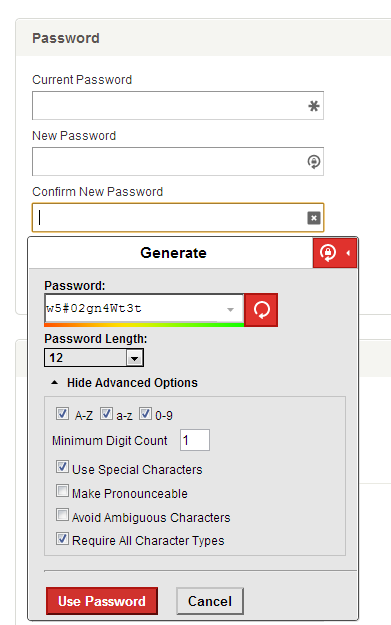
An app called Lastpass has an elegant solution for those of us who are too lazy and disorganized to properly protect our online existences. Lastpass will save all of your passwords in a cloud vault and autofill your login and password info when you visit a website. The only password you’ll need to know is the master password to access to Lastpass. Lastpass is fundamentally a security company, so the password vault has some very interesting security. If you are into technology, you might want to read Is LastPass Secure?

lastpass-gen

Lastpass will import all of the insecure passwords you have stored on your keychain (I had a shocking 171). Through a Lastpass extension which works with most browsers, a form will appear that will autofill existing logins and also allow you to create new complex logins and passwords for new sites, which Lastpass will save. To make new passwords for old sites, you will have to go into settings and replace passwords with new, Lastpass ones (which are infinitely better than “Petname1”); this is a little labor intensive, and might require you to update a few passwords on your phone (email, Facebook, etc) but once it’s done, it’s done and you’re far safer for it. The free version will autofill logins and passwords on your computer and there is a mobile-ready premium version that sells for $12/year.