Infographics Show Why Density is Necessary, But Not Sufficient

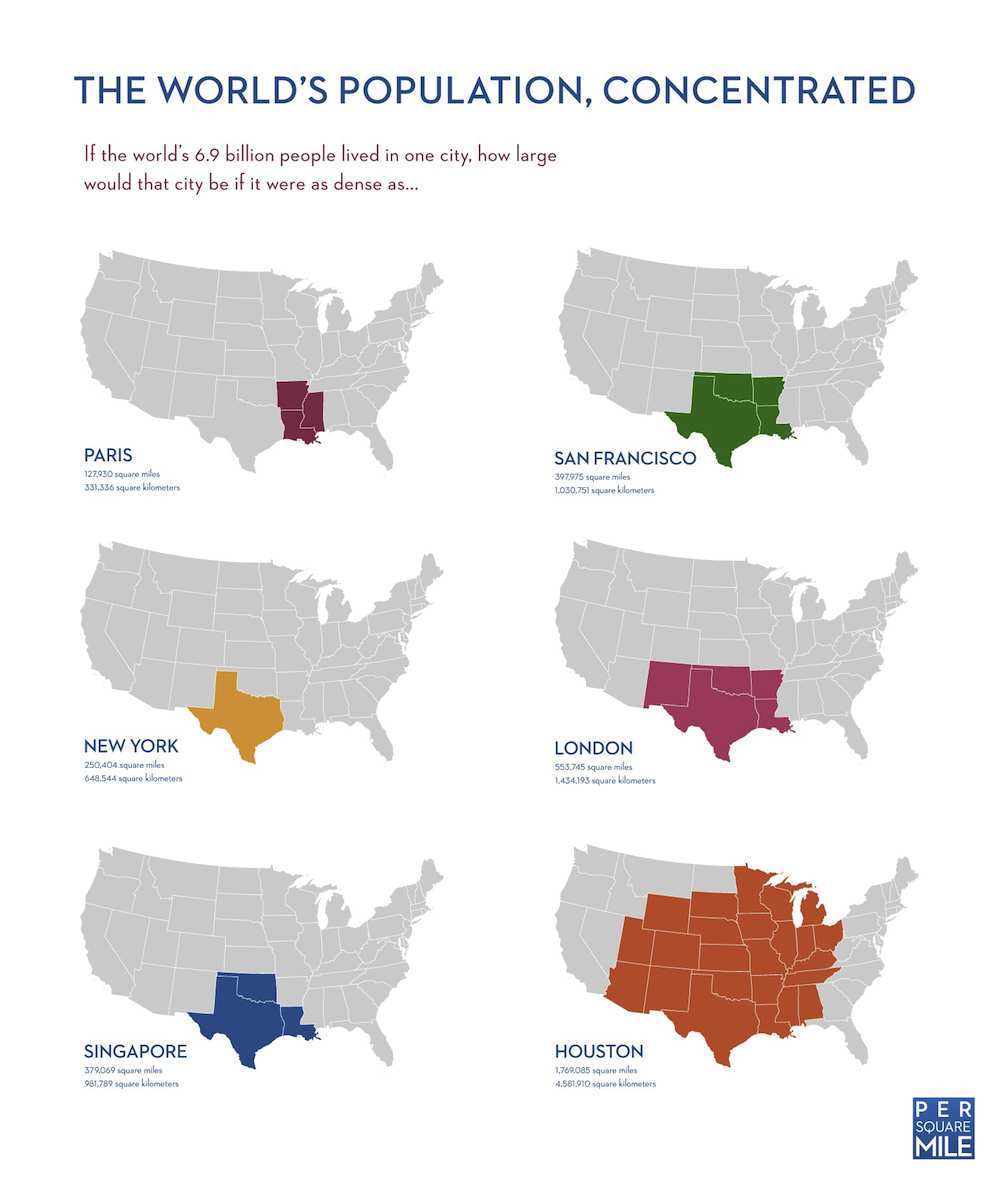
The above infographic from a project called Per Square Mile shows how much landmass the world’s 7B inhabitants would occupy if they achieved the housing density of various cities. Paris came in at #1; those 7B could live on a mere 128K sq miles of land–approximately the size of Arkansas, Louisiana and Mississippi. New York City achieved a competitive 250K sq miles–about the size of Texas. Houston–often the whipping boy of urban sprawl–fit the world’s population into a more spacious 1.8M sq miles.

Seven billion is a whole heck of a lot of people, but this infographic shows that there is room enough for everyone to live. Density is a great place to start.

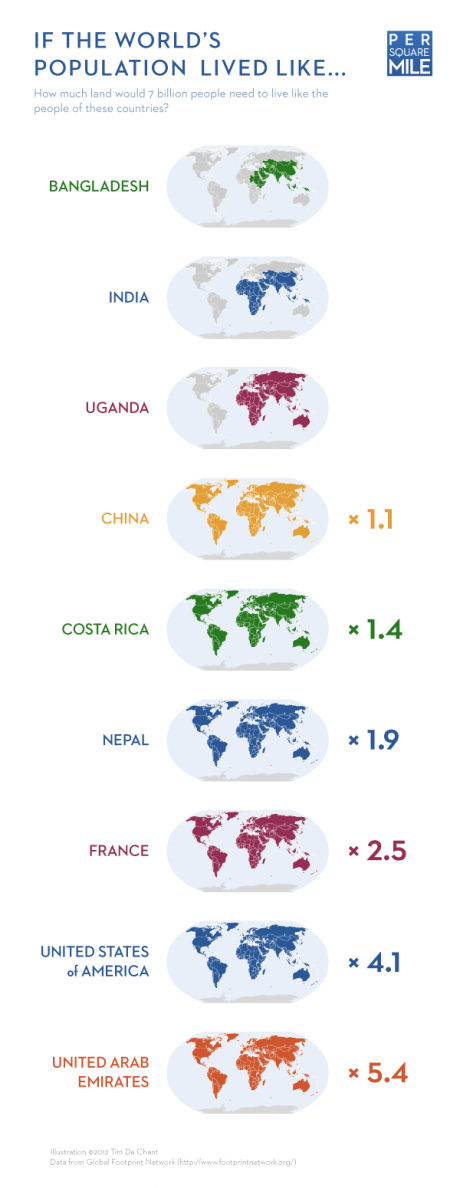
But density doesn’t tell the whole story. Tim De Chant, the man behind Per Square Mile, received a lot of comments about what the map doesn’t show: The landmass needed to support various populations based on their consumption of resources. De Chant made the below infographic to fix that missing information.

ecological-footprint-by-country

This shows a very different picture. It show that the “developed” world uses a crazy amount of resources–far more than the planet can sustainably provide. For example, the US uses four earths to fuel its lifestyle.

It’s probable that populations of areas where great density is achieved, like NYC and Paris, while achieving far greater levels of efficiency than their suburban countryman, still consume close to or more resources than the earth can provide (De Chant lacked data to tally individual city’s energy needs). In other words, density is necessary to fit everyone on the planet, but not sufficient. Architecture, design, planning and behavior must go hand-in-hand.

What do you think of these figures? Do you see flaws? Do you see a way out? We’d love to hear what you think.

via Per Square Mile

8 Resolutions for an Edited New Year

After a near-miss with a Mayan apocalyptic threat and a direct hit with the holidays, it’s time to resume life. As the new year demarcates new beginnings for many of us, we thought we’d offer a few resolutions for those of us looking to edit our lives. If you want to live more with less stuff, space and energy, consider making some or all of the following resolutions.

In 2013, I resolve to…

  1. Get rid of all unwanted holiday gifts. If you don’t think you’ll need something now, chances are you won’t need it later. What happens when we don’t dispose of–or redistribute–stuff immediately, it quickly transforms from novelty to clutter. Get rid of it now.
  2. Get rid of unwanted clothes. This is one of the easiest forms of editing your life. Ask yourself, “Have I worn this in the last year?” If not, there’s a good chance you won’t wear it in the next.
  3. Buy something of “heirloom quality.” Some of us might have a few holiday bucks burning holes in our pockets. Rather than getting something you’ll be semi-satisfied with, that’ll last you a little while, buy something that will last a long while–perhaps that you could hand down–and that you won’t tire of. Buy it even if this something is a bit more expensive than you might be comfortable or accustomed to spending. Remember: Something that is twice the price but lasts four times as long is effectively half-price.
  4. Sell or get rid of something big that I don’t use. Maybe it’s a massage chair you thought you’d use everyday or that treadmill you thought would kick-start your fitness regime. Sell it on eBayKrrb or Craigslist. If those fail, give it away. While our unused stuff seems passive, it is not. It takes us space and attention. Being free of it is worth a lot.
  5. Digitize one thing in your life. It’s amazing how much space you can create when you digitize. Try an eReader, scan your important documents, digitize your old photos, convert your CD’s to MP3’s. You’ll be glad you did.
  6. Try a sharing system. We know you’ve been meaning to, but you just haven’t got around to it. Well 2013 is the time. Maybe borrow something on Neighborgoods, catch a ride with Zimrides or rent a dress from Rent the Runway. Start enjoying the benefits of access without ownership.
  7. Downsize my home. Not everyone will be moving this year, but the US Census says one in six of us will. If that’s the case, consider moving to a smaller home whatever that looks like for you. If you’re currently in a 4K sq ft home, try 3K. If you’re in a 600 sq ft apartment, consider 500 sq ft, and so on. There is no magic number for square footage, but most American homes are far larger than necessary, leading to higher expenses, more resources expended and more headache.
  8. Focus on my happiness. Many of us accumulate stuff, work a ton and do many other things because we think they’ll bring happiness. But do they? This year, focus on the things that actually make you happy, not the things we’ve been led to believe will make us happy.

What are your resolutions to edit this year? Share them with us in our comments section.

Devotion to this Guru Saves Travel Time

In the next few days, many of us will find ourselves taking to the skies en route to family fun (or obligation). With winter weather and crowded airports to navigate, there are a host of variables that can add hours and stress to your travel plans. A free app called GateGuru for iOS, Android and Windows Phones takes a lot of the mystery–and headache–out of air travel.

GateGuru has several functionalities that allow you to confidently venture forth using the most current information about your flight and airport. One is the JourneyCard, which shows “high level” information like airport weather and scheduled departure times.

The FlightCard shows specific up-to-date info about your flight such as departure and arrival times, gate info, baggage carousel info and even estimated security wait times. This function is a great one-stop-shop where normally we call the airline for flight current flight info, write down–then subsequently lose–arrival time and terminal details, and have no idea how long security is until we arrive at the airport.

Other features include a list of amenities at your airport like restaurants and shops (spoiler: most of them are overpriced and not that good). GateGuru has a partnership with Avis rental cars, allowing on-the-fly bookings with that company via the app. And GateGuru will show your travel-stats–miles traveled, frequent-flyer info, etc.

Part of living an edited life is eliminating unnecessary steps wherever we can. While some of us find a certain serendipitous glee spending 10 hours in an airport waiting for our flight to leave, meeting new friends, eating Quiznos and so forth, most of us would rather be doing something–anything–else. GateGuru holds the promise of editing our travel times this holiday season and beyond.

Via Netted by the Webby’s

Will Napoleon Complex Usher in the Era of the Microburb

We love tiny houses, with their tiny, efficient layouts. They truly exemplify the idea of doing more with less. But just because you have a tiny house, doesn’t mean you have a tiny footprint. If you have a 140 sq ft house on a 10 acre lot in the middle of nowhere, your environmental footprint might rival a McMansion’s. Moreover, you might not be enjoying the social and material benefits of neighbors.

Jay Shafer, who recently left Tumbleweed Tiny Houses–the preeminent tiny house company–has an answer for this contradiction. His new company, Four Lights, has developed the Napoleon Complex, which fuses tiny houses with city-rivaling levels of density, efficiency and community potential. In fact, they expect 16-22 homes per acre. To compare, HUD states that median lot size across the US for single-family homes, including mobile homes, is 0.27 acres.

Napoleon-complex-housesThe complex, which will be located in Northern California, is a collection of 40 -70 houses ranging from 270-700 sq ft. Each house will have an individual plot and pay a fee similar to a coop common charge. The homes’ individuation gives them an intentional level of autonomy, explaining the project’s tagline of “Co-housing for the anti-social.” Other amenities include:

  • 800-1600 sq ft common house
  • Private gardens
  • 1.5 parking spaces per house (importantly, separated from the homes).
  • Shared outdoor space
  • Private storage units
  • Prominent pedestrian walkways.

Four Light’s website explains the rationale behind the complex:

In many ways, tiny houses work best in concert with other tiny houses and shared amenities. This is a dream long-shared by many including myself. The place will be zoned as an R.V. park, but will look and feel more like the concept drawings I’m presenting to the left [pictured above]. I’ve used the same design principles that go into each of my tiny house designs to create an environment that feels contained but not confining—vibrant but not at all crowded.

In other words, they’re giving people the best of the suburbs–privacy, quiet, greenery–without the downsides–inefficient homes, sprawl, isolation. Shafer is a master of bypassing building regulation and the complex’s RV designation will likely expedite the expected 2015 completion date. We can’t wait to see it.

Via Treehugger

Images credit: Four Lights

Meet The Minimalist Justin Bieber

While tween heartthrob Justin Bieber seems to affix his name to whatever product the cat drags in–“Justin’s World” Comforter & Sham Set, “One Less Lonely Girl” Nail Polish, etc–on the other side of the pond, a slightly older, most likely not-so-wealthy youth-oriented singer is promoting a quite different take on consumption. Alex Day, an English singer, prolific vblogger (video blogger) and Youtube phenom is the possessor of 72 items, giving Andrew Hyde a run for his money.

In the above video, Alex shows us around his flat where his few possessions reside. One of our favorite moments is when he talks about his jeans. He says that most of us have several pairs of jeans but only wear a few favorites. He asked, “Why not only have your favorite ones?” So he has only four pairs that he loves. Sounds like a perfect demonstration of the Dieter Rams maxim “Less, but better.”

His minimalist bent was apparently inspired by a trip to Zambia where he noticed people living simply and happily.  He said this in a blog post:

I went to Zambia in 2010 and the people there (as you can imagine) don’t have lots of clothes, but they also don’t need them to be happy (shocker). I was inspired when I got back to have a serious reduction on the clothes I have and started googling minimalist sites to see what was the least amount of clothes I could have and still maintain a functioning wardrobe. The search led me to the Six Items Or Less challenge, which is to go only wearing six basic items of clothing for 30 days (not including underwear, coats etc).

The most interesting thing Day does without–further differentiating himself from cosmetic-peddling Bieber–is soap and shampoo. He refers us to a Boing Boing article extolling the virtues of going soap and shampoo free. The author claims his skin and hair feel and look great and he does not experience BO.

Day is a refreshing personality in an era where many superstars seem to promote heedless consumption. Day is not anti-stuff. He shows off his stuff, but it’s stuff he needs and uses–this is a message we’d love to hear more of. We hope he’s a sign of things to come (and sorry Alex for the Bieber comparo ;-)).

Thanks Stephanie for the tip!

Own an Edited Version of Versailles (Some Assembly Required)

Have you ever wanted to own your own Versailles Palace but thought the 720K square feet of floor space just a tad excessive? Well, if you have $65M dollars burning a hole in your pocket, there’s a stateside version of the venerable Louis XIV palace for sale in Orlando, FL. The home can be outfitted with many modern features, and at a mere 67K square feet of floor space (i.e. 160 LifeEdited apartments), it’s a far more manageable space than its 300 year old French cousin.

If you’ve seen the movie “The Queen of Versailles,” you know the home we’re referring to. At the time, the home was to be the largest single residence in the United States. It was the brainchild of David and Jackie Siegel, a couple made rich–then subsequently made ruiness–via the largest privately held timeshare company in the world.

Few movies epitomize the housing boom and bust than the travails of the Siegels. The movie’s production began during the pinnacle of the housing boom and the Siegel’s wealth. When asked why David Siegel was building a house so big, he answered “because I can.” Here are some of the features the house was supposed to have:

  • 13 Bedrooms, 23 Bathrooms
  • 20 Car Garage
  • Grand Hall with 30-ft. Stained Glass Dome
  • 2 Grand Staircases
  • 37′ x 30′ Kitchen
  • 10 Satellite Kitchens
  • 2-Story Wine Cellar
A view from above
A view from above
The ballroom that never was

We say “supposed to have” because mid-production the housing boom busted. The Siegels lost most of the money and Versailles went into foreclosure. Now the incomplete house is for sale for $65M (we bet you could get it for less). So in addition to whatever you fork over for the house itself, you will have to augment that amount with considerable construction costs.

The movie also shows the unquenchable thirst for stuff. They were moving into the larger home because they were bursting at the seams of their tiny 26K home. One scene shows soda being stored in a shower because they lacked space elsewhere.

Have you seen the movie? Do you think the Siegels learned their lesson or will people always choose excess when they have the opportunity? What does it say–if anything–about all of our behavior?

image credit: floridalakefront.com

Kick Your Stuff to the Krrb

Selling stuff can be a pain. Most us use one of several channels: Word-of-mouth, yard/stoop sales, Craigslist or eBay. Word-of-mouth is okay for stuff we want to dump, but many us have issues selling stuff to friends, particularly if we want to make money. Yard/stoop sales are a pain in the butt (dragging your stuff in and out, weather, etc) and they hit a limited audience, most of whom want to pay pennies on the dollar. Craigslist has great outreach, but often buyers are super-bargain shoppers and then there are scammers galore. EBay, for most of us, is a intimidating bazaar filled with cutthroat dealmakers.

A site called Krrb provides an answer for the non-professionals and small local businesses to sell their stuff easily. The site describes themselves this way:

Krrb (pronounced ‘curb’) is a hyperlocal, curiously global classifieds made just for you. A most epic scavenger hunt at your fingertips where you can thrift, scavenge, rummage and discover local treasures – in your neck of the woods or over yonder.

With over 24K users in 1130 cities, it beats word-of-mouth and yard/stoop sales; you can also keep stuff posted as long as you want. Unlike Craigslist, there are thumbnail pics of objects to see what you might want to buy. Also, everyone on the site must become a member, which is a great scammer-deterrent. Unlike eBay, there is no bidding; members can civilly negotiate prices if they so choose, but none of that last-second-outbidding that turns so many folks off of eBay.

Other features include a mobile app that shows Krrb objects in your area, a digest of stuff for sale in your area and Krrb Meetups (only in Brooklyn and Paris right now). Posting works on credit system. One post is one credit. Credits cost anywhere from $.50-1.00 (depending on volume you buy) and there are numerous ways of earning free credits (you get 10 free just for signing up). Visit their site to sell your stuff or buy some preowned holiday gifts.

Ever Want Your Own Restaurant? Here’s Your Chance

We’re loathe to call things the “Airbnb of…” dog-biscuits, chessboards, whatever. We are sure peer-to-peer marketplaces have a prelapsarian past, but few enterprises have made purchasing services from your friends and neighbors as easy as Airbnb. So unfortunately, we have to designate a great new venture called Feastly the, ahem, Airbnb of restaurants.

Feastly allows chefs and gourmands to transform their homes into their own restaurants without all that overhead and investment of a traditional restaurant. Conversely, it allows diners an alternative to the traditional restaurant.

It’s pretty simple: As a chef, you register on Feastly’s site. You determine the menu, the price, the date, how many feasters you can handle, etc. Feastly fills the seats, handles money and takes a modest administrative 12% cut.

As a diner, you browse and sign up for dinners in your area (right now, their main markets are Washington DC, NYC and San Francisco). More than just a restaurant, the Feastly experience awards diners with home-cooked meals and a unique social experience, or as Feastly cofounder Noah Karesh put it, “The dining table is the optimal social network.”

We’ve been using Feastly chefs to cater the LifeEdited dinner parties and are very impressed with the quality of food and service.

We asked Mr Karesh some other questions about how Feastly started and how it works.

Why did you start Feastly?

Feastly came from my travels to Lake Atitlan,Guatemala. I was struck by my inability to find authentic, local food there and convinced a local to invite me over for dinner. Sitting around his family’s table, I had my “a-ha” moment realizing that it shouldn’t be so hard to eat local food and meet people when traveling. Feastly was born over Start-Up Weekend DC in November 2012 and a year later, we’ve hosted hundreds of meals for thousands of Feasters. One of my many goals with the platform is to bring Feastly to Lake Atitlan.

Do you know ahead of time what will be served? Can you make requests?

Yes, our chefs post menus online ahead of time so that Feasters can search for their favorite dishes or chefs. For those with food restrictions, our chefs do their best to cater to any food issues. Thanks to our feedback forms, chefs can receive immediate feedback on their meals and get ideas from Feasters for future meals and how to improve the overall user experience.

How much do dinners typically cost?

Our meals range from ice cream tastings to brunch to seven course dinners and may range from $5-200 with the average meal costing $38.50 [booze is sometimes, but not always, included in price.]

Do you think your approach could replace going out to a standard restaurant?

Yes, but even more than just replacing people’s reliance on restaurants to “eat out,” we are increasingly serving as a social network for our Feasters. Our users come for the food, but increasingly stay due to the positive relationships they are building around the dinner table. We’ve helped to introduce couples, business partners, friends and activity partners over meals.

What about markets you don’t serve yet? How can people get involved?

We’ve been excited to see so much positive feedback in NY and DC and soon SF, and we get emails daily from people around the world encouraging us to open in their cities. Like our peers at Airbnb, we are eager and working to expand globally, so that we can bring the best of Feastly everywhere. We are also eager to bring on more chefs, and like to work with local partners eager to bring Feastly to their communities. We’re always open to new ideas and partnerships and it’s best to reach out at info@eatfeastly.com.

My Genes Made Me Buy It

In this interview with Sociologist Gad Saad, he promulgates the idea that innate biological imperatives drive consumer behavior. Saad is the Professor of Marketing and the research chair in evolutionary behavioral sciences and darwinian consumption at Montreal’s Concordia University. He is also the author of the book, “The Consumer Instinct: What Juicy Burgers, Ferraris, Pornography, and Gift Giving Reveal About Human Nature.” His studies purport that consumer behavior has four primary, biologically-rooted drives:

  1. Survival
  2. Reproduction
  3. Kin Selection
  4. Reciprocal altruism

The survival instinct, he believes is the reason why the top restaurants across the globe–McDonald’s, KFC, etc.–sling high-fat foods. More fat = more calories = surviving on the tundra for an extra day.

The reproductive instinct, he claims, plays itself out differently with the different sexes: Women are wooed by high social value, while men focus on physical traits. He uses one case study as an example, where a man was placed in a beat up car as well as a Bentley. Women were to report on the physical attractiveness of the same man in each car. The man in the Bentley was consistently deemed more physically attractive, as the car–a sign of high social value–influenced their perception. Conversely, the same test administered to men with a woman in the car found the men indifferent to the type of car.

In the interview, Saad does not delve into the final two instincts: Kin selection and reciprocal altruism, described as the instinct to exchange gifts with family members and the instinct to offer gifts to close friends, respectively. But we can assume that these are the operative instincts during the holiday gift-giving season and the $253B gift-giving economy in North America, which accounts for 10% of all retail purchases according to Saad.

We’ve had various discussions about gift-giving and receiving, some of which have gotten pretty contentious. The explanation that any sort of prohibition or limiting of gift exchange is in direct opposition to a biological imperative does not seemed far-fetched.

What Saad does not do–at least here–is claim that marketeers intentionally exploit these instincts. Rather, he suggests these tactics are implemented because they appeal to instinctual motivation and are thereby effective. Another example he cites is a study that found young men were not dissuaded from smoking because it caused cancer, but were dissuaded when they were told smoking would make them impotent and hence compromise their reproductive capabilities. Behavior driven by instinctual drives like these, Saad suggests, win the day, and marketeers know that based on bottom lines.

The question we have is how do you promote sane consumer behavior–using what you got, buying what you need, buying quality–when the prevailing symbols of biological success are linked with excess? Can living with less be consistent with our survival or reproductive instincts? Can giving your family member a “One Less Gift Certificate” align with our kin selection instinct? Or are we hardwired to consume when the resources are available? What do you think? Let us know in our comments section.

Sign PDF’s, Ditch the Fax

Has anyone recently asked you to telegram a message because they want to make sure it gets to you safely? Perhaps a carrier pigeon or pony express? Of course not. But has someone asked you to send a signed document via fax machine? Probably so.

Different people have different tactics for getting around the Dodo-in-waiting that is the fax. For some, sending a fax involves printing the document, signing it, scanning that document, then sending that scanned version via email (you probably save the signed paper document “just in case,” creating more paper clutter). Or some of us keep an eFax number, so we can trick people into thinking the scanned PDF is coming from a real live fax machine…suckas! Except these numbers often cost us $10/month. Any way you spin it, this process is a pain that uses way too much time, paper, money and equipment–all to achieve a questionable level of security.

There are now many ways to sign PDF’s, Word Docs and any other signable document without scanning, paper, expense or hassle.

There are a number of fancy signers that create digitally encrypted signatures, many of which cost upwards of $15/month.  While these might be great for lawyers and mobsters who have some serious security issues, the LifeEdited team has been using the pretty budget PDF Signer app for a while now with great success. For $10, it allows your Mac to open any document and overlay your digital signature, which can either be made by scanning your signature or even taking a photograph. It also allows you to fill in boxes with standard text.

Options for other devices/operating systems:

  • LifeHacker recommends DocuSign Ink for iOS. This free app allows you to sign documents with your finger as well as fill in text.
  • For Android, there’s a highly rated app called Fill and Sign PDF Forms, which allows you to, um, fill and sign PDF forms ;-).
  • PD Fill works for PC’s and comes highly recommended by CNET. $19.99.