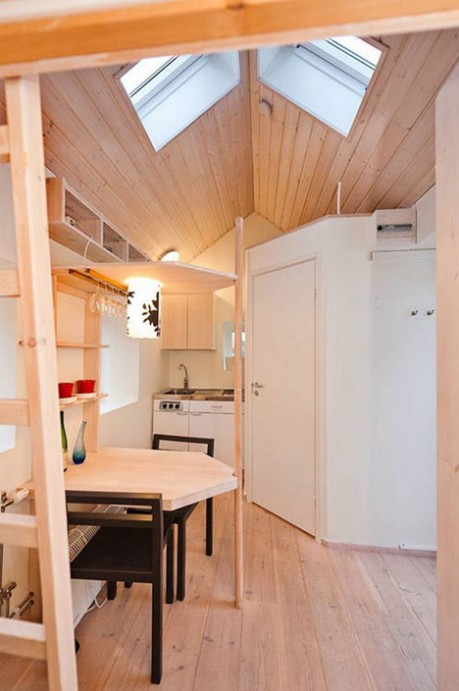
Collector of Moments Has Lots of Storage Space

Each week we are profiling real people who are editing their lives for more freedom and happiness. This week we hear from Lucy, a grad student and an active proponent of a new, sharing-based economy and showing how we can all do and live more with less stuff.

Tell us about yourself

I am a 21 year old business school graduate from Toronto, Canada. I work at a Canadian telecom company and for a start-up organization called Unstash, a peer-to-peer platform for collaborative consumption. I am a strong believer in creating social change through sharing and collaborative living.

What makes your life an ‘edited’ one?

I don’t feel the need to be obsessed with stuff anymore. I used to be a mindless shopper, but then I learned about access over ownership, the idea that we don’t need to own everything, in fact, we don’t need stuff, we need the utility it provides. If we can get that utility through sharing, we can also save money, create less waste, deepen our relationships and live happier lives.

Before, I used to dream of having a large library filled with books. But during my editing, I realized that a book sitting idle on a shelf has no purpose. I thought to myself, do I really need to own this book when it’s available to me at any time from the library? This prompted me to donate over 40 books to my local library. I felt great knowing each book could get maximum utilization as more people now had access to them, allowing their content to be constantly shared.
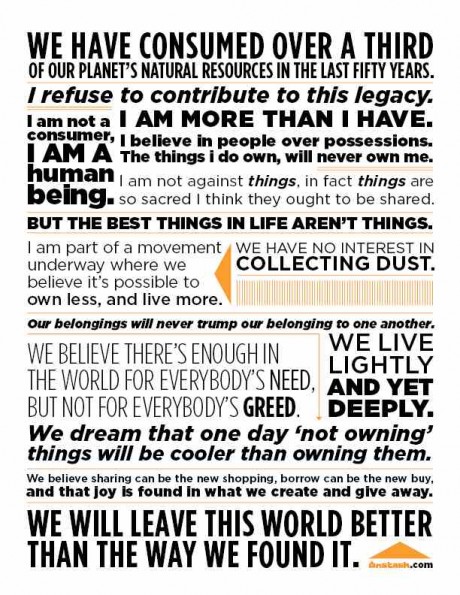
the Unstash Manifesto

Now, before I buy anything, I think to myself, do I really need this? Can I borrow it from someone else? For example, I borrowed a Halloween costume from a friend rather than buying one that I would only use once. And on the flip side, I am always open to lend or give my things to others. Sharing is a part of my life editing. Once I gather all the things that I can go without, I ask friends if they need any of the stuff I no longer need. I have given a dress to a friend who was looking for one to wear for her birthday. I gave away a large stack of post-its to a friend who uses them to organize her files. These actions allow me to share something that’s not useful to me with someone who needs them.

How long have you been living this way, and do see yourself continuing to live this way?

I started living this way in May of this year. I had watched the Ted Talks of Rachel Botsman and Graham Hill, where I began to learn about collaborative consumption and living minimally, namely, less stuff = more happiness. The ideas made a lot of sense to me, and I will definitely continue to live this way. Living an edited life is practical, efficient and a smarter way to live.

What are the biggest advantages of living this way?

The biggest advantage of living this way is being able to focus on experiences rather than things. I’m able to spend money I’ve saved on a night out with friends or on a memorable trip. I feel like I can spend my time on what really matters to me–with friends, family and doing things that make me happy. The less we are consumed with the stuff we own, the more time we have to collect those moments in life that really matter to us.

What are the biggest challenges?

For me, the biggest challenge is trying to explain the concept of sharing and minimal living to friends and family who don’t grasp the idea and label it as hippie, backwards thinking, or just a fad.

Do you think you could maintain this lifestyle with a family?

Definitely. With more stuff, there’s an even greater need for less clutter. There’s also a lot of stuff that can be shared when you have a family, like children’s clothes and toys.

What is the number one suggestion you’d give to someone looking edit their lives?

Start editing right away, even if it’s just a few things. Go through those old filing cabinets, closets and storage boxes. Once you actually get rid of stuff, you will feel amazing. That feeling will prompt you to continue editing and move towards a life edited lifestyle.

What item(s) have made your lifestyle easier?

My laptop and my smartphone, which include lots of easy-to-use apps like Airbnb and Orchestra. Everything is digitized, centralized and customized for my needs. Oh, and my library card 🙂

Do you have any design or architectural suggestions derived from your lifestyle?

Don’t buy a huge bookshelf or lots of storage because you will want to fill it and might end up hoarding or buying stuff just to fill those empty shelves or boxes.

Anything else?

Check out Unstash, a mobile app for life editing. Our belief is that every social circle has a huge overlap in consumer goods that don’t all need to be purchased, owned and maintained by every individual. We enhance the sharing experience, while helping people save money, deepen relationships and create a more sustainable future together.

Check out Unstahs’ blog as well as my personal blog, collaborativeliving.wordpress.com, where I write about anything collaborative that inspires me.
Fair Companies Turns Camera on LifeEdited Apartment

Fair Companies is by far the most comprehensive source for videos of great small space homes. That’s why we’re really excited to have the LifeEdited apartment featured on their site. Kirsten Dirksen, who runs Fair Companies, did this profile last month.

Some of the best parts are the “before” pictures of the space taken two and one years ago–the first as a beat-up four room apartment and then post-demolition when it the space was stripped to the joists. Contrasting those scenes with what it looks like now is pretty dramatic.

This is actually the most thorough tour of the space to date as it goes through every corner and most every feature of the apartment. It shows that a living/lived-in, peering into Graham Hill’s wardrobe and showing a recent 10 person dinner party.

Origami Makes Editing Your Outdoor Gear a Little Easier

One of the great appeals of living a pared-down, less distracted life is that it affords the time and mental space to engage in recreational activities. But there’s a catch for the minimalist recreational enthusiast: Unless you’re a runner, you’re activity of choice probably requires a bunch of gear. LifeEdited founder Graham Hill is a kiteboarder with a board, harnesses, etc. This author is a road and mountain biker and must negotiate two bikes and a ton of gear like tools, thermal bib knickers and so on. Storing all this stuff while trying to keep a pared down life can be a real challenge.

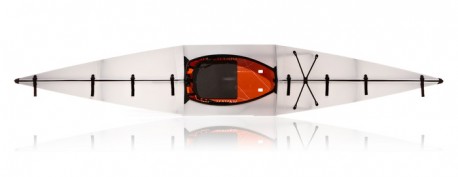
While we don’t have definitive answers for kiteboarders and cyclists (though the ThinBike technology might help slim your rides), there is good news for the edited kayaker. By incorporating origami principles, the Oru Kayak takes one of the most space-intensive outdoor sports and makes storage very manageable.

The 12 foot, 25 lb kayak folds up into a 33″ X 29″ X 10″ travel case. The kayak is rated to 260 lb load and can withstand at least 20K folds.

The Oru Kayak is available in spring 2013 for $800 through Kickstarter.

If you have any suggestions for storing your outdoor equipment, let us know.

Survey Shows Real Costs of City Life

In our quest to find the best place to live an edited life in the US, we came across this chart from The Atlantic. It shows what percentage of income is spent on housing and transportation by the middle class for every major metropolitan in the United States.

While this chart does not provide a definitive answer to our question (and of course there is no “one” answer), it does provide some useful data.

First, it looks at the middle for income; defined as people making 50-100% of median income for that city. And rather than looking at raw housing costs, it looks at housing costs as percentage of that income. So even though the average rent in the city of San Francisco is $3226, most San Franciscans use 33% of their income for housing; combine that figure with one of the lowest transportation costs in the country and San Francisco looks quite competitive in terms of affordability. Same story with New York City: High incomes in proportion to high housing costs combined with low transportation costs equal reasonable overall expenses.

Washington DC ranked the most affordable in this survey. The nation’s capital has relatively high housing costs, but also high relative incomes and very low transport costs.

On the other end of the spectrum are cities in Florida and California (San Fran excepted). Their low incomes relative to housing and high transport costs made them not-so-affordable places to live.

Unfortunately for all of the cities surveyed, the overall costs of housing and transport relative to income has gone up, as indicated in the graph at top.

via The Atlantic

Patagonia to Shoppers: Don’t Shop if You Don’t Need To

While most companies are dangling the carrot of ludicrous deals this week–one of, if not the, busiest shopping week of the year–outdoor clothing company Patagonia has another message: Don’t shop if you don’t need to. The company’s two year old “Common Threads Initiative” is trying to get people to think differently about when, how and why they buy.

The initiative has a sequence of suggestions and questions the potential shopper can run through:

  1. Reduce. Do I need this?
  2. Repair. Can I fix what I already have?
  3. Reuse. If I can’t repair the thing I want to replace, can it be sold to someone who wants it or used somewhere else like a charity?
  4. Recycle. Can the materials of my old thing be remade into something else?
  5. Reimagine. Can we change global consumer habits to create a sustainable planet?

Patagonia doesn’t just give good advice; they provide resources for how to carry out their plan. For “repair” there is an in-house repair service where you can send your torn clothes to, for “reuse” there is a link to the Patagonia eBay store and for “recycle” they provide an address to send your old Patagonia clothes so the materials can be used for new garments.

You can even take their pledge. The company pledges to “build useful things that last, to repair what breaks and recycle what comes to the end of its useful life” and you pledge to “buy only what I need (and will last), repair what breaks, reuse (share) what I no longer need and recycle everything else.”

We applaud this initiative. It’s very much in keeping with the LifeEdited ethos of “less but better.” And from what we know of Patagonia as a company, the initiative is more than just marketing jargon. It’s their way of conducting–and transforming–business.

What do you think? Is this an earnest effort to transform consumer habits or fancy marketing? This author, for one, feels much more inclined to buy Patagonia products…is that a bad thing? People do need stuff…why not make it the good stuff from people who care?

via Treehugger

When Life Gives You Leftovers, Make Leftoverade

Few things say Thanksgiving like uneaten leftovers. The vats of cranberry sauce, the innumerable pans of stuffing and of course the poor, eviscerated bird. You have the best of intentions of upcycling this bounty, but it is often left barely eaten and trashed–possibly with an optional six month stint in the freezer beforehand.

An NRDC study estimated that 40% of America’s food supply is thrown away. That amounts to $2,275 into the trash for an average family of four every year. So in the quest to do more with less, your kitchen and its edible contents are a great starting point.

A site called We Hate to Waste gives ideas about how avoid the trash solution to your leftover food, including the soup recipe below, which transforms your likely-to-be-trashed turkey carcass into a tasty soup with a few common kitchen ingredients. The site includes a number of other similar “waste-watching” (get it?) recipes and tips for reducing waste in your home.

Site contributor Jocelyn Deprez has even written a book called “The Refrigerator Files: A Guide To Creative Makeovers For Your Leftovers,” which, as the title suggests, is a guide for making great food from common leftovers.

A big part of doing more with less is working with what you already got. Recipes like this–and the intention behind them–are great way of doing that.

  • 1 turkey carcass
  • 1 cup turkey meat, cut into half-inch cubes, for garnish, optional
  • 16 cups water
  • Leftover giblet gravy, if any, optional
  • 1 cup coarsely chopped onion
  • 1 bay leaf
  • Salt and freshly group pepper to taste
  • 2 whole cloves
  • 4 springs fresh parsley
  • 2 springs fresh thyme or ½ teaspoon dried
  • 3 whole carrots, trimmed and scraped
  • 3 whole ribs celery, trimmed and scraped
  • ½ cup broken vermicelli, cappelini or spaghettini*
  1. Pick over the carcass and reserve any tender morsels of meat. Use this if desired, for the cup of meat indicated, adding more meat as necessary.
  2. Place the carcass in a kettle and set the meat aside. Add to the kettle any jellied gravy that ay be accumulated on the turkey platter or dish.
  3. Add the water to the kettle. Add the leftover giblet gravy if there is any. Add the onion, bay leaf, salt, pepper, cloves, parsley, thyme, carrots, and celery. Bring to the boil and simmer one hour, skimming the surface as necessary.
  4. Strain the soup through a sieve lined with a clean kitchen towel or a double thickness of cheesecloth. Discard all the solids except the carrots and celery.
  5. Pour about two cups of the soup into a saucepan and add the vermicelli. Cook until just tender.
  6. Add this to the soup. Cut the carrots and celery into half-inch cues and add them. Add the one cup of cubed turkey meat. Bring to the boil. Serve piping hot.

What are you doing with leftovers? Let us know in our comments section.

Photo Credit: AnnArbor.com

Swedish University Re-Thinks the Dorm

Lund, Sweden is experimenting with replacing its traditional student apartments with self-contained 12 sq meter (129 sq ft) micro-houses. AF Bostäder (AFB), who is behind the project, told The Local that the dwellings would have a distinct economic edge, renting “for 2500 kronor ($370) a month, compared to the average newly built student apartment in Lund which is rented for 4167” ($628).

The tiny houses have everything a student could need: A kitchenette, sleeping loft, bathroom and desk; and somehow it has that swank Swedish sheen that masks any motivations to achieve greater thrift.

The project is still an experiment though. In fact, the house doesn’t adhere to strict Swedish building regulation–the same regulation that AFB claims makes traditional student housing so expensive. The house received a three year permit to see how it works out.

AFB is taking applications for a student who is willing to live and blog about living in the apartment, and prove (or disprove) that this is a viable alternative to the status quo.

The house looks great and seems to have all the amenities a student requires. We do wonder about the social aspect of individuated housing. At least in America, the most important location for campus socialization is the dorm; it’s where many relationships are forged and ideas exchanged. We wonder how being separate from other students would affect that? That said, burdensome housing expenses can make people antisocial as well. What do you think?  Would you give up your dorm experience to save a few hundred bucks a month?

Photos by Jan Nordén

Via Dornob

Man Goes Into Deep End in Quest to Edit Life

Each week we are profiling real people who are editing their lives for more freedom and happiness. This week we hear from Mike, who is giving up his spacious Bath, England flat to live out his dream, living aboard a 42 ft “Gentleman Cruiser” motorboat, while creating a simpler, more financially sane life.

Tell us about yourself.

My name is Mike. I’m 52. I work as an IT consultant, part time film extra (you can see me briefly in Harry Potter and The Order of the Phoenix) and occasional performance artist (Captain Teapot, I took part in a project on the empty plinth in Trafalgar Square in 2009). I’m single and currently living in the UK in the Georgian city of Bath.

What makes your life an ‘edited’ one?

My life is becoming an edited one due to my imminent move from a large apartment in Bath, ceiling heights nearly 12 ft, living room and bedrooms are both 18 ft x 14 ft, built in the late 1700’s. I’m moving to London and I’ll be living on a motorboat that is only 42 ft x 12 ft with a ceiling height of 6 ft. There is no room for freestanding furniture, but there is some built in furniture, a table and 3 bunks and of course a shower and galley kitchen.

living rooms now and later

How long have you been living this way, and do see yourself continuing to live this way?

I’ve been living in houses and apartments all of my life. I’ve never lived on a boat before, but have sailed a little. I see my move to the boat as a long term one, perhaps a permanent one. It was motivated by a long held dream of a life afloat and by the fact that property prices in the UK are too high.

What are the biggest advantages of living this way?

Advantages are more money and time, as most of my work in the past has been in central London I’ll be able commute using public transport and on good days I’ll be able to walk to work.

What are the biggest challenges?

The biggest challenges are the reduced space, plumbing aboard a boat is not as straightforward as it is in an apartment, water has to be pumped aboard. Also I’ll probably have to move the boat on a regular basis, residential moorings in London are difficult to find so I’ll have to relocate every few months for a while until I can find one..

Do you think you could maintain this lifestyle with a family?

It could be done with a family, but I’d need a bigger boat.

What is the number one suggestion you’d give to someone looking edit their lives?

Look carefully at what you think you need. If its been sitting in a box out of sight for years, you don’t need it. I had many items that belonged to my youngest brother who died several years ago, a castle and soldiers I bought him for Christmas when he was 8 years old, and some of his personal items. I was keeping them for sentimental reasons but realised that he wasn’t in them. He’s in my heart, in me and always will be. The things are ultimately not important and now someone else can enjoy them. Items that belonged to him I gave to local charity shops and I had a home sale that enabled me to sell most of the furniture and other items I’ve accumulated over the years and a poster for the film ‘Charade’ has gone to an auction in London.

What item(s) have made your lifestyle easier?

A computer has made a big difference, CD’s, DVD’s and even books are no longer neccessary now that they can be stored on a laptop that fits into a small bag. Also the fact that I’m currently single has helped. I’m the only one that I have to consider, it wouldn’t be quite so easy with a partner or family.

Do you have any design or architectural suggestions derived from your lifestyle?

A boat is made for a purpose, size is limited and there’s a purity to it that I like, also there is a little romance about life on a boat. I intend to do a little work to her and will have good quality fabrics etc on board and I can do that because the boat is small. I’ve lived in many different places over the years but could never afford to decorate them properly, corners were cut and the sheer size of the places meant that decorating was almost a never ending task. With the boat I can decorate easily and afford to do it well.

Anything else?

If your looking for boats for sale in the UK www.apolloduck.com. For information about moorings www.bwml.co.uk.

San Francisco and the Micro Unit Controversy

This past June, San Francisco Supervisor Scott Wiener proposed a plan to allow the construction of 220 sq ft micro-apartments. The previous minimum square footage was 290 sq ft. Wiener’s plan included a 375 unit cap on the number of units that could be built. The other day, the SF Planning Commission voted on whether or not the city would impose that cap or if developers could start building micro-apartments at will. In a 6-1 vote, the cap was maintained. Micro-apartment development in San Francisco, for the moment, will remain small.

There are numerous of opponents to micro-apartments, some of whom call the apartments “Twitter apartments.” They charge that the apartments are designed for young, cash-flush tech-workers–a population whose willingness to pay higher rates will displace families and lower income individuals.

Sara Shortt, executive director of the Housing Rights Committee of San Francisco, told the San Francisco Chronicle that the apartments are designed as “crash pads for people who work 24/7 in Silicon Valley and need a place in the city to sleep and party….[that don’t] build a sense of community or neighborhood.”

We’ve discussed whether micro-apartments are hurting or helping our cities here before. Opponents like Shortt charge that these apartments put the needs of affluent, bar-hopping singles ahead of families and that those unstable populations degrade community.

The proponents (with which we include ourselves) charge that they fulfill a market demand. 40% of San Franciscans live alone already–likely in apartments that are bigger and more expensive than necessary. In fact, upcoming SF micro-apartments are believed to start at $1300/month against $2000 for the average price of a studio in that city. Additionally, many singles live in roommate situations in dwellings that actually deplete the family-friendly real estate inventory. Some have even argued that high percentages of singles actually serve families by increasing the local tax base, sending money to local schools without increasing their populations.

What strikes us as a bit revisionistic about the opposition’s thinking is the notion that micro-apartments are new phenomenon. Throughout history, there have been dwellings like bachelor apartments, women’s homes and even SRO‘s before they took on their current unseemly reputation. These homes were designed and priced for singles. They existed alongside, not instead of, family housing. Somewhere along the way, real estate developers decided that it was better–or more profitable–to shoehorn singles in larger dwellings.

This is far from the end of the line for micro-living in San Francisco. Wiener actually included the development cap because he didn’t believe the plan would be approved without it. In other words, micro-apartment building is moving forward because of the cap, not in spite of it. Once the units are there, the city can determine whether these dwellings work or not.

What do you think? Does the decision in San Francisco foretell a rocky future for the micro-apartment or a momentary blip in a positive housing trend? We’d love to hear your thoughts.

Transforming Apartments and the Custom Conundrum

We’ve looked at pictures of Robert and Rosa Garneau’s NYC transforming apartment in the past, but thanks to this video from Fair Companies, we get to see the apartment come to life. Of particular interest is seeing the movement of the 500 lb sliding wall, the pre-programmed, automated hydraulic table and the amazing amount of storage the apartment contains.

All of the furnishings were custom built for the apartment. Most of it contains storage; many pieces disappear and/or are modular (the video takes you through the whole space).

Customization like this raises an interesting question about these types of transforming spaces: Because all the pieces work in concert with one another, how do people who might want a home like this adapt their existing inventory of furniture to that space? Is that even possible?

Or is it better to start from scratch as the Garneau’s did? If the Garneau’s were able to squeeze approximately 40% more utility from their space because of their furnishings, might the extra investment be worth it?

Let’s take a look. Robert Garneau said he spent about $234K in renovations. NYC real estate costs around $800-$1000/square, so a 40% larger space (i.e. 910 sq ft), would be $208K-$260K more than the Garneau’s place (we know…it’s crazy). At that price it’s about a wash between the additional space and renovation costs. To make a truly fair comparison, we should add additional furnishings for the larger space, renovations and higher upkeep and maintenance costs. Also, consider you could probably go half as elaborate as the Garneau’s and have similar utility. Suddenly the math gets a lot more competitive.

What do you think? Would you be willing to start from scratch to have a small, transforming space that does everything you need? Do you think spaces like these with lots of custom, built-in furnishings could go mainstream? Or do you think they will remain curiosities–homes for eccentrics and architects, but no one else? Let us know in our comments section.