Get Everyone in Your Life a ‘One Less Gift’ Certificate

Gift giving/receiving season got you stressed? Not sure what to get people when you’re trying to promote simpler living? Not sure what to do about unwanted gifts that don’t fit with your less is more lifestyle? Francine Jay, aka Miss Minimalist, has a solution: It’s the “One Less Gift” Certificate.

Jay’s certificate (available to download as full-page PDF), promotes a “stuff-free holiday.” The certificate expresses appreciation for the receiver’s generous spirit, but says that the giver has everything she “could possibly want” and would prefer that both parties have one less thing to worry about, along with more time, money, stress and environmental responsibility.

The certificate is a two way proposition, saying both what the giver wants (no stuff) and what the receiver will get (no stuff). It then proposes to find other ways to enjoy this enjoy the wonderful season together. Jay gives examples of what that looks like: Volunteering, exchanging good deeds, protecting the environment and more.

Gift giving is a very touchy subject. For many, being told that they cannot give a gift is a grave offense. Who is anyone to say you can’t give what you want? Yet many of the gifts that are given–especially to people trying to simplify their lives–end up being immediately discarded. The gift is basically wasted time, money and resources. And yes, you can always donate, but that that seems like a quick fix, rather than a real behavioral shift.

How are you handling the upcoming gift season? And what do you think about Jay’s certificate? Would you give it to someone? What would you do if you received it? Let us know.

via Huffington Post

When DIY’ing Doesn’t Make Sense

The fact is many of us are not the best people to do the things necessary to make our lives work, nor is our time best spent learning how to do those things if we don’t know how. In many cases, we’re much better off outsourcing the operational aspects of our lives.

TaskRabbit allows you to do just that, offloading virtually any type of task–from washing windows to HTML coding–to someone who has the time and skill to do the task most efficiently.

It works by posting your task to their site. You can either say what you’re willing to pay or if you don’t know, they’ll give you a price range of what that task typically costs. The task is then bid out to a number of TaskRabbits (i.e. humans who will perform the task). The lowest bidder gets the job.

Criminal background checks are done on all of the Rabbits and ratings are shown from past clients. The task charge depends on its level of involvement–from $30 for a quick house cleaning to $1000 carpentry jobs. Popular tasks include IKEA assembly, pet sitting, dealing with customer service and heavy lifting. You can add in costs the Rabbits will incur while performing your task, for example the cost of dry-cleaning they’ll be picking up. You can also get Rabbits with cars. Right now, TaskRabbit is available in most (but not all) major metropolitan areas.

The LifeEdited team has used TaskRabbit on a number of occasions, mostly for cleaning. Beside being very friendly and helpful, what’s nice is that you hire a Rabbit for the job, and nothing more. When we needed one hour of cleaning the other night after a dinner party, we paid for one hour, not four.

Outsourcing daily life might seem like cheating, but consider a few things:

  1. Are you the best person to do the tasks in your life? Do you have the skill, time, inclination? Perhaps the reason you don’t do certain things is because the answer is no.
  2. What are your time and attention worth? If you have to spend an inordinate time doing something–time better spent doing something else (or even nothing else)–perhaps having someone else do it makes a lot more sense than doing it yourself.
  3. You are providing income to people who need it. You aren’t throwing money away, but rather supporting people happy to have flexible work.

Man Hits Road with Family, Doesn’t Look Back

Each week we are profiling real people who are editing their lives for more freedom and happiness. This week we hear from Mike, whose self-described pipe dream of living on the road with his family became a way of life. (If you have a story you’d like to share about your own life edit, email david@lifeedited.com)

Tell us about yourself.

I’m Michael Boyink. I am 45 years old. I am a web developer, teacher, and writer. I’ve been married to my wife for 21 years and have a 15 year old son and 14 year old daughter.

What makes your life an ‘edited’ one?

We had a pretty typical conservative homeschooler life going on. I have been self-employed for over ten years, and we had the house in the suburbs, the toy cars, and the routine.

At some point it occurred to us that between homeschooling and internet-based work our life was portable and we just weren’t taking advantage of it. We developed a “pipe dream” of a long RV-based road trip and talked it about it for a few years. Then my oldest turned 13 and we realized that if we didn’t do it soon we never would.

After roughly nine months of planning and prepping we set up a friend in our house and left in a truck and fifth wheel trailer with the intent to travel the US for a year.

About halfway through the year we realized we couldn’t see it all, and were having so much fun that we didn’t want to stop. So we finished out the year, returned home, and spent six months getting caught up on business and purging our belongings. We then sold our house, gave away what remained of our stuff, and hit the road again in May of 2012.

How long have you been living this way, and do see yourself continuing to live this way?

We’ve been on the road for roughly 18 months of the last two years. We will continue to live this way so long as it makes sense, but have no set plans or date to quit.

What are the biggest advantages of living this way?

By selling the house we became totally debt-free, so can now use our income to purchase experiences rather than paying off stuff. We’ve ridden horses in the Smokey Mountains, rented a houseboat for week on the Mississippi, and herded Alpacas in Texas. So much more fun than paying a mortgage…

What are the biggest challenges?

Decision fatigue. With the world almost literally at our fingertips deciding where to go and what to do is really hard sometimes. No matter what we choose it seems like there was probably a better choice or better adventure to be had.

Community can also be tough. It’s hard to develop deep friendships when you are constantly moving.

How has this lifestyle affected the other members of your family?

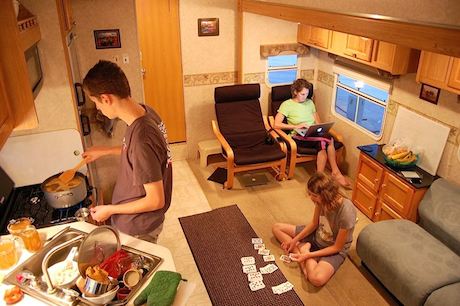
Our immediate family has grown closer. It’s almost impossible not to when you are all in a 30′ box that wiggles when someone rolls over in bed. We also dealt with puberty while in this mode–and it was easier since there is no room for elephants.

What is the number one suggestion you’d give to someone looking edit their lives?

Quit living the formulas others have created for you, figure out what life on your terms can be, and just do it. It’s a cliche but life really is too short.

What item(s) have made your lifestyle easier?

Definitely technology – iPhones, travel apps, Macbook Airs, GPS units. Also development of a personal uniform, which simplifies laundry and day to day dressing decisions.

Do you have any design or architectural suggestions derived from your lifestyle?

I’m surprised I couldn’t find anyone selling a wardrobe as a system, only pieces and parts that the end user must make sense of. I’d love to see someone develop a retail store that would sell a complete soup-to-nuts wardrobe that was based on lifestyle and job requirements, and all work together, layer, and coordinate.

Anything else?

A little self-promotion. Our web development business site is www.boyink.com, our training business site is www.train-ee.com, and our travel blog is www.boyinks4adventure.com. Check us out.

Skinny Living in Spain

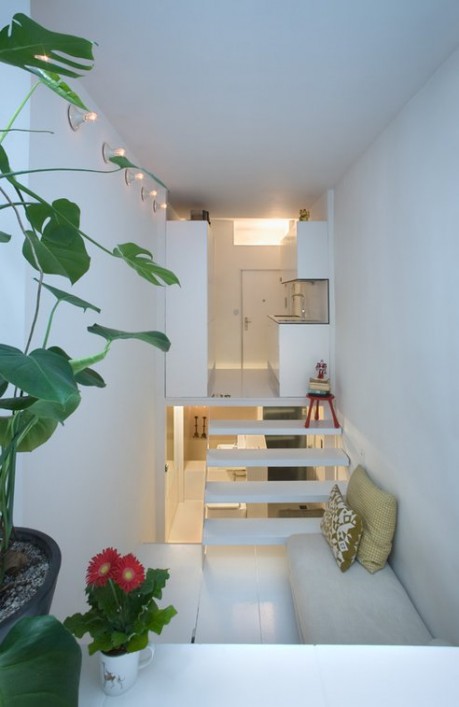
Compared to Europe’s narrowest house that we looked at a couple weeks ago, this home by MYCC Studio in Madrid feels downright palatial. The whole apartment is only 200 square feet and measures 6′ 10″ wide, with an 8′ 6″ office area. The design takes advantage of the large amount of vertical space, with rooms layered on top of one another.

We think the apartment is pretty gorgeous and has great division of spaces considering how small it is. It’s not exactly an ideal home for collectors and people with lots of furniture. And as it lacks a door to the bathroom, it’s not for the camera shy.

via Treehugger

image credit: © MYCC/ Elena Almagro

Design Lessons From Japanese Schoolchildren

At the beginning of a Japanese child’s elementary education, he or she is typically given a backpack called a Randoseru. The backpack has firm sides and measures 30 cm high,  23 cm wide and 18 cm deep. It is made of leather or high quality synthetic material. The bag is not emblazoned with the latest cartoon characters. Girls’ are usually red, boys’ black.

The bags are given with the expectation that they last throughout the child’s six year elementary education. This is a good thing, because the bags start around $100 and can exceed $350. The bags actually last beyond the child’s schooling.

In America, few children are given $350 backpacks. Our design philosophy says that children will abuse their stuff and should be given something that can be cheaply replaced. For example, by the time this author was out of elementary school, I had blown through countless $20 nylon backpacks. Preservation was not a priority.

The question is does a child’s backpack abuse stem from her inability to take care of the bag or the lack of value she has for it?

The example of the Randoseru seems to point to the latter point. Japanese children take care of their bags and make them last, not because they are less active, but because they place a high value on them. What if we took a cue from Japanese schoolchildren and gave more value to the objects in our lives, rather than perpetuate a disposable culture?

Spending more up front might make sense economically as well. What if we were willing to spend $120 for one backpack that could be handed over to another child versus $120 for six that will end up in landfills?

And what if we applied this philosophy to everything in our lives? What if our lives were filled with high quality stuff we loved? Where most of our items were worthy of being handed down to the next generation?

What is the Randoseru in your life? Let us know in our comments section.

image credit taopic.com

Get Ripped, Clear Clutter and Boogie Down

Many of us still lug around our CD collections despite the fact we stream our music or listen to MP3’s. We can’t bear to rid ourselves of these little mirrored disks that store music, memories and money. So we burrow them in the recesses of our closets or proudly display the jewelboxes in our living rooms–vestiges of days when visitors could size you up based on your Kraftwerk collection.

Though media storage is a valid form of decoration, the fact is most of us can carry our music library in our pockets nowadays. And while many of us have intentions galore for converting our CD collections into digital formats, the gap between intention and action is often a vast one.

Enter RipDigital. The service takes your old CD’s and converts them into one of three digital compression formats: 192kbps, 320kbps or Apple Lossless (ALAC) and FLAC formatting–basically good, great and audiophile qualities. Prices are $.99, $1.29 and $1.49 per disk respectively.

Send your CD’s to RipDigital and they will send the files back on a DVD or your device like an iPod or external harddrive. They also sell hardrives ($134-274) and iPods ($269-439).

If the prices sound high, consider that an iTunes song runs you around $.99. For a couple hundred bucks, you could convert a pretty sizable collection, adding tons of music you already like to your library as well as saving space and clearing clutter.

We realize that digitally compressed music, for some very discerning ears, doesn’t quite have the richness of CD’s (or vinyl, some would say). For these people–e.g. Gary Chang whose tiny house includes a wall of CD’s–keeping their CD’s and vinyl makes sense. The rest of us, who don’t do anything with our CD collections, we must concede that music that is not listened to has really low fidelity.

image via flickr/misterjt

Custom Make Your Life with CustomMade.com

One of the biggest problems with getting custom made stuff is finding a good person to make it. Most of us don’t have the bandwidth to find skilled craftspeople, much less bid the job out, particularly if it’s a small one. The hassle, combined with perceived expense, leads most of us to mass-produced items that aren’t what we want and with which we have minimal emotional connection to.

A site called CustomMade is changing all that. They claim to be the “world’s largest matchmaker for custom goods.” They connect people who want custom stuff with a network of 3500 skilled craftspeople from the US and Canada.

The site can be used in a few ways. You can bid out a job, specifying exactly what you want and how much you want to spend; you can search for craftspeople by region; and you can see and purchase already-made items. Categories include furniture, jewelry, leather goods, tableware, and carpentry.

Since their start in 2008, CustomMade had completed 2800 custom jobs. The site has 40,000 goods to peruse from, most of which you can customize; e.g. getting a wedding ring you see in your size or a table to your dimensions.

Prices for goods like furniture are higher than IKEA and other box stores to be sure. But so is quality. And though it’s hard to quantify exactly, the nature of putting a bid out to a large pool of prospective fabricators probably yields more competitive pricing.

We talk a lot about heirloom design–the ideal that the items in our lives are high quality enough to be passed down to the next generation. CustomMade makes this ideal that much easier to achieve, taking much of the hassle out of custom, hight quality fabrication.

via Core77

Debt Free and Loving It

Each week we are profiling real people who are editing their lives for more freedom and happiness. This week we hear from Sigrid, who shares her story of living simply, lightweight and debt-free.

Tell us about yourself.

My name is Sigrid. I am almost 40 years old. I am a medical technologist and getting my Master’s in healthcare administration. My husband, border collie mix and I live in Seattle in a 1800 sq ft 1914 bungalow, where we grow veggies, fruit and fresh flowers. We also make beer yearly from our hop vine. My interests include medicine, minimalism, gardening and crocheting.

What makes your life an ‘edited’ one?

I think I’ve been on the life edited path for a while, but it has taken back-steps at times. Throughout my life, I have found a tremendous pressure to live a conventional American life with its ideas of success like large houses, fancy cars and jewelry, and other forms of materialism. This way of life says you aren’t successful if you don’t make and spend a large income.

After college, I felt obligated to grow myself professionally which also meant monetarily. At first, this seemed a reasonable goal as, like most college grads, I had debt and little savings. There was no where to go but up. But after a while, I started to feel embarrassed when I didn’t have more clothes, better car, etc. So, despite the fact I was exhausted chasing this way of life, I felt I had to attain at least some of these items in order to be socially acceptable.

The seeds of living another way [expanded on below] were planted in my childhood. I was raised in a devout household, and always had an example of non-materialism to look at.

I spent my formative years living in a beautiful 4400 sq ft Victorian house, which made me realize at an early age the downsides of materialism. Although the house had gorgeous white oak floors and paneled doors with brass kick plates, it was an upkeep nightmare. I dreamt of living in the woods inside a hollow tree listening to the wind and rain falling instead.

How long have you been living this way, and do see yourself continuing to live this way?

The active process started about ten years ago. My husband and I became convinced that we didn’t want to spend our lives in the rat race. We made a goal of paying off his car and my student loans before our wedding. We did it, and then we made our next goal to pay off the house by age 40. We did this too. Then, we began saving money for a rainy day, other goals, and retirement.

For me, debt was a form of slavery, even though we ‘voluntarily’ acquired it. The more debt we had, the more a our lives existed to serve the debt. Shouldn’t money serve the needs of people, and not the other way around? The freedom of being debt-free is indescribable. The day we paid off our house was one of the happiest days of my life. I can’t see going back to the conventional way of life.

What are the biggest advantages of living this way?

Because we have so little overhead, we are free to do what we want when we want. This spring we decided to take some time off work before I started grad school. We loaded our small sedan with our suitcases and 10 year old border collie mix Lainie, and drove off into the wild blue yonder. We had a rough idea of what we wanted to do, visit the Grand Canyon and visit with family and friends, but no set itinerary. We covered six states, 7000 miles, and saw most of the national parks in the western US.

We lived in one room motel rooms, washed our clothes in the motel laundry, mostly ate at inexpensive restaurants or PB&J sandwiches from the local grocery stores. We couldn’t buy a lot of souvenirs because there was no room in the car for them. This automatically forced us to focus on the non-material aspects of the trip such as the large amount of free time we had to spend together. The trip was wonderful. It strengthened our relationship and created lasting memories.

What are the biggest challenges?

Even with the Great Recession, my husband and I deal with a lot of misunderstanding as to why we choose to be relatively frugal, which can be challenging. It just doesn’t fit with the American Dream or ideas of success endemic in our culture.

What many people don’t realize is that money saved is money earned toward living life more fully. Being disciplined can be difficult, and some people feel guilty and then angry when faced with this kind of self-limitation. They have been socially conditioned to feel deprived if they don’t spend money, rather than free from anxiety.

Do you and your husband think you could maintain this lifestyle with a family?

Yes, although raising children is a bigger drain on the family budget. It would take longer to save the money up for such a trip. It would probably also make more financial sense to buy a used camper to sleep in rather than motel rooms. The kids would probably enjoy it. If they had to be taken out of school for the trip, we would teach them ourselves so they wouldn’t fall behind in school.

What is the number one suggestion you’d give to someone looking edit their lives?

Set a goal and stick to it regardless of what other people think. After all, if you are burdened with debt, you are the one suffering from the debt and not the Jones down the street. Be creative in coming up with ways to get things done or have fun without spending money, but don’t skimp on important things like health insurance, or repairs to a home or car that could be dangerous if left undone. Spend wisely, not frivolously.

Remember, for every item you purchase you have to work some amount of time to pay for it. More money can always be acquired, but more time cannot. Once the time is spent, it is gone forever.

What item(s) have made your lifestyle easier?

We keep a few card or board games on hand to play. We substitute social interaction for material acquisition.

Do you have any design or architectural suggestions derived from your lifestyle?

Put size limits on your house, car, etc. It makes it easy to forgo impulse purchases. There is no place to put extra items. With no place to put things, you don’t go shopping without a list. We immediately throw catalogs in the recycling bin without looking at them.

Also, almost no one needs a 4400 sq ft house like I had as a child. Each room in your house can do double duty, kitchens and bathrooms excepted. Specific architectural style is less important than using the space inside the home wisely.

Anything else?

For anyone serious about getting out of debt or downsizing, I recommend reading “Your Money or Your Life” by Vicki Robin and Joe Dominguez. It very eloquently demystifies money and our relationship to it. Then, the book presents a 9 step program to get out of debt and live your life more fully. Following a frugal lifestyle is easier knowing that others have done the same thing.

After You Vote, Take a Break

After a hurricane, a seemingly never-ending election campaign and the miscellaneous stressors that attack us daily, you deserve a break (same goes for our readers not ravaged by hurricanes or campaign promises).

Actually, there countless reasons to take regular breaks. This infographic from www.learnstuff.com lists many of them such as increased productivity, reduced odds of contracting certain types of cancer, better sleep and vision and a bunch of other stuff. Take a look, then take a break.

Thanks Kayla!

Opinion: Where is the Best Place to Live an Edited Life in the US?

We are great advocates of cities: They’re walkable, bikeable and have public transport for easy mobility; the average city dweller uses approximately 14% less carbon than his non-urban counterpart according to the Brooking’s Institute study; their density facilitates easy interchange of resources and vibrant cultural lives.

But to use “city” as an abstract term might not be helpful if you are looking to move somewhere where you can best live an edited life–i.e. living a life with more money, health and happiness with less space, stuff and energy. The question becomes, which city supports that life best?

We talk a lot about New York City and San Francisco, as they both are very dense, have extensive public transport systems and have vibrant cultural lives. But consider the average rent in the New York metropolitan area is $2687. San Francisco is even more at $3226.

Perhaps you want to take economist Jed Kolko’s advice and buy a home, which he claims will save around 30% in living expenses. Well consider that the median home price in Manhattan is $1.14M. Want to slum it up in a borough like Brooklyn? Median price is $582K (the borough was recently deemed the second most expensive place to live in the US behind Manhattan). San Francisco is no slouch at $705K. That’s a lot money to fork over to save money! And buying small doesn’t necessarily save you a ton. Studio rents in both cities frequently exceed $2K. If you’re a family, expect to pay $3500+ rent or $800K for even a modest apartment.

Of course, with these prices come increased economic opportunities, but there’s a paradox: There are more jobs where you can make more money, but, in most cases, you work more, with less time to enjoy the benefits of the city.

There are middle-ground cities like Chicago, Boston, Philly, Seattle and Denver that enjoy more manageable living expenses along with decent economic situations, but they also tend to be less walkable and have less developed public transport.

Then there is Main Street USA. Many claim that small business and technology will allow people to work remotely will make them the “cities” of the future. But for the most part, this is still speculative. Most jobs are still in denser areas and these areas are usually quite car-dependent.

We realize this is not a simple question. The “right” answer might depend on living situations (single, couple, family), career situations, family connections, etc.

Imperfect as the answers may be, we’d love your opinion. Do you live–or have you lived–in a place you think facilitates the edited life–a place you think allows you to do the most with the least?

Please leave us your thoughts in our comment section below. Thanks!