What Happens When Beer and Transforming Apartments Mix

A couple weeks ago, we had Derek “Deek” Diedricksen and Paul Farr from Tumbleweed Tiny House Company stay at the LifeEdited apartment. The pair were in New York City leading a tiny house workshop showing people how to make their own tiny houses. We wanted to know what they thought of the place. They videoed this self-guided tour that gives their thoughts on the apartment (their enthusiasm might have been helped out by a beer or two).

Check out Deek’s blog Relaxshacks.com and Youtube channel for cool pics, videos and news about tiny house construction and living.

Thanks guys!

Have You Made a Life Edit? Let Us Know

Have you cut down the size of your home downsize or number of possessions? Do you have innovative architectural, design and product for optimizing your life? Have you experience making sharing an integral part of your life? Have you found ways of doing more with less? If so, we want to hear from you.

Nothing is better that hearing the experience of people walking the walk.

We’re looking for all demographics from young folks to seniors. We’d love to hear from families too.

Please email Ross Porter (info@lifeedited.com) to get the process started! We’d love to share your story.

LifeEdited: Hurricane Sandy Edition

Somehow doing a post on transforming design or architecture seems a bit beside the point in light of hurricane Sandy, whose impact has been staring us in the face for the last few days. Heck, the LifeEdited apartment was right in the storm’s path and is currently without power!

A few weeks ago, we talked about how to get happy spending money–on other people. We thought it a good opportunity to remind our readers that there are plenty of chances to be happy with the recent devastation on the east coast.

Millions of people have been affected by the hurricane, many of whom are in grave need of your support. If you don’t have a specific charitable organization in mind, consider checking out organizations like Charity Navigator and Charity Watch that evaluate charities to see how much of their money goes into relief efforts. The latter site listed the below organizations as highly rated charities serving hurricane victims; their respective ratings are in parentheses:

There are also numerous hands-on volunteer opportunities. Check out NY Observer’s list if you’re in the NYC area. Otherwise, Google your area and find who is accepting volunteers.

Lastly, if you want to dovetail your giving with life editing, many charities, particularly shelters, are asking for clothes and other goods. It’s a perfect time to unload your unused stuff to those in need. Don’t worry, we won’t tell anyone about your mixed motivation.

image by Spencer Platt / Getty Images

The Bicycle is the Official Vehicle of the Edited Life

We know there are many parts of the world where driving is extremely impractical, and we are not here to begrudge the multitudes for whom that is a reality. But make no mistake about it, no mode of transportation gets you around more effectively, efficiently and with minimal overhead than bicyling.

Consider the passenger mile per gallon of various modes of transport as a function of caloric energy expended over distance:

Nothing beside subways comes even close to a bicycle’s efficiency. But not everyone has a subway system in their area. And, as recent events are showing, even those who have great subway systems can be left at the mercy of repairs.

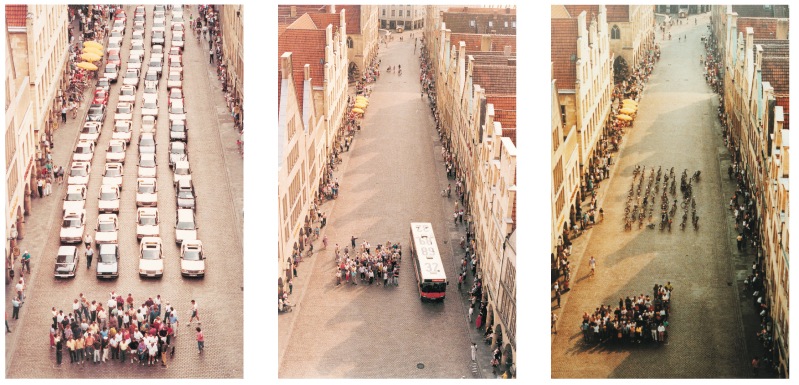
Then consider the sheer area consumed by bikes versus other modes of transport. The picture at top shows 50 people and 50 cars at left, 50 people and a bus in the center and 50 people standing by 50 bicycles at right. It’s a great illustration how cars make cities more crowded and cast suburbs further afield.

Biking may even reduce your personal area as a 150 lb bicycle commuters riding at 12-14 mph for 30 minutes burns 297 calories during his or her commute.

And even though walking takes the minimal volume prize, the 250% increase of efficiency compared to a slight increase in volume make bicycling a no-brainer for commutes longer than a mile.

Other benefits of ditching your car for a bike include avoiding costly car registration, repairs, insurance and fuel. An added bonus is that traffic becomes a thing of the past. Ridding yourself of managing these annoying details makes life simpler and happier.

So maybe you are considering commuting to work or doing more errands on your bike, but something is stopping you. Here are a few suggestions to help you get started:

  1. Get a bike you will ride. Some people think the Salvation Army is a bike shop. It’s not. Consider how much you will save by driving less, go to an actual bike shop, find something that fits your body and riding style and invest accordingly.
  2. Get some bike friendly clothes. We talk about Outlier a lot here, but there are many other commuter-friendly clothes out there such as Betabrand and even Levi’s that work too. It’s best to have clothes that are both durable and permit movement necessary to pedal.
  3. Get full fenders. Unless you live in the desert, you will deal with rain at some point. Few things are as gross as dealing with road grime all over your clothes after a light shower. Nothing helps avoid that like a set of wraparound fenders. Clip-on versions will work in some cases, but often leave you unprotected. When buying a new bike, make sure the frame is compatible with fenders.
  4. Learn how to take care of your bike. Get regular tuneups. Have a good floor pump. Get some decent chain lube (i.e. not WD40). Learn how to fix a flat (it’s not that hard). Many people avoid riding because they are afraid something will go wrong–it might! Learn how to deal with the situation rather than avoid it.
  5. Be flexible. Riding three out of five days is better than not riding at all. If there’s a blizzard, it’s okay to take public transport or drive. Going from two cars to one makes a big difference too. The key is just start riding!

Graph statistics by James Strickland, 2009

Four Tools to Replace Common Items with Your Smartphone or Tablet

50% of Americans own smartphones and 20% have tablets. While most, if not all, of the smart-phoners are the tablet owners as well, any way you look at it, that’s a lot portable technology.

Given that so many people have these devices, why not exploit them to their full potential? Beyond obtuse apps for blueprint design and augmented reality games, there are a number of apps that turn your smartphone or tablet into common household items, saving space and money. Here are a few:

  1. Scanner. After our post the other day about essential items, a couple commentors suggested using an app for scanning rather than a clunky machine. Camscanner and Scanner Pro allow you to take photos or screenshots on your smartphone/tablet and turn them into jpgs or PDF files (Scanner Pro is iOS only).
  2. Books. No matter where your eBook collection is (Kindle, Nook, iBooks), there is an app that allows you to read your from any smartphone or tablet. While the idea of reading on your phone’s tiny screen might seem strange at first, it’s quite easy to get used to and the convenience of always having a book on hand can’t be beat.
  3. Universal remote control. For $60 or so, products like UnityRemote by Gear4 (iOS) or Beacon by Griffith Technology (Android and iOS) will turn your smartphone and tablet into a universal remote for your entertainment system. Beyond consolidating devices, the more intuitive interfaces of smartphones and tablets make set up and use simpler than standard universal remotes. The one downside is you probably want to keep one of those devices by your entertainment system at all times. This might argue for having your device as a supplemental remote or having a dedicated device such as an old iPhone or iPod Touch; this is also a good place to send media from for Airplay-enabled stereo systems.
  4. Flashlight. Most of us keep one of these around for the odd hurricane. Then we look for the flashlight when that emergency arrives and find its batteries are dead. Since most of us have our phones on us and charged at all times, they make perfect flashlights for emergencies and occasional use. There are a number of flashlight apps for iOS and Android that use the screen and/or camera flash as a flashlight. Most include strobe lights for side-of-the-road breakdowns or impromptu discos.

What other apps replace common household items? Let us know in the comments section.

A Chair That Will Follow You From Cradle Till Long Time

Few things derail your editing schemes like children. Clothes often need to be changed multiple times a day. They grow out of those same clothes every few months. Most of their toys have a six month half-life. Then there are innumerable accessories from cribs to strollers to baby bathtubs that thwart the most earnest minimalist aspirations.

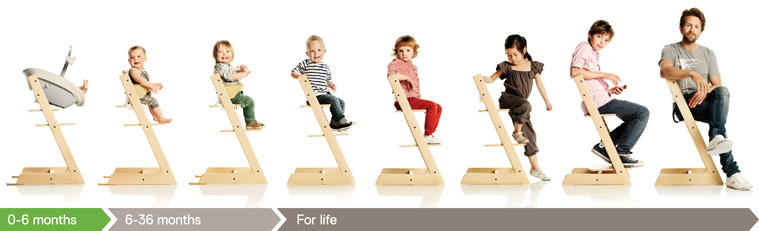
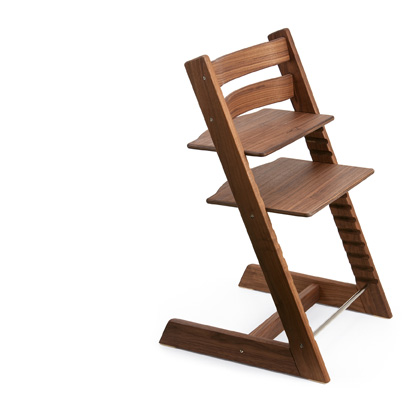
Given all of this, if you’re a parent and there are products that reduce the amount of stuff your child requires, you should probably get them. The Stokke Tripp Trapp high chair is such an item. Its simple, classic design allows it to be useful from infancy to adulthood.

The inverted seven shaped base has slots that accommodate either a seat or footrests. As your child grows, you lower the seat and footrests in the slots to the appropriate height. You can even remove the footrest and use it as an adult height chair, making this a great piece of furniture for people like grandparents who frequently have children visitors, but for whom a dedicated high chair takes up too much space.

The seats start around $200 and go up depending on the material. Oak and walnut version are available that are quite a bit more expensive; these options are worth considering as this could easily be an item kept for many years.

Do you have other tips for minimizing kid clutter? Let us know in our comments section.

Europe’s Narrowest House Saves Space, Fights Obesity

Many tiny houses we look at on this site show uncommon ingenuity and creative use of space. Others, like this house for Israeli author Etgar Keret, err on the side of ridiculous. At 5′ at its widest point and 3′ at its narrowest, it is thought to be the narrowest house in Poland and perhaps all of Europe.

To be fair, the home’s design was not purely driven by livability. Keret built the Warsaw home at the site of a former Jewish ghetto as a memorial to his parent’s family died in the Holocaust.

Keret says that he plans to live in it when he’s in Poland however, and the space is fully functioning, with a kitchen, bathroom and bedroom.

image credit: Yasuhiro Yamashita

The home’s sun-drenched interior reminds us of the Kyosho Jutaku homes like the one above, which use optical illusions to create space. Its ridiculously narrow dimensions remind us of NYC’s Spite House.

What are your thoughts on this house? Interesting architectural exercise? Practical living space?

5 Products That Make Our Lives Better

We are always on the lookout for products that do more, last longer and take up less space than their conventional counterparts. We’re not talking about things like a good laptop or phone, which might be indispensable, but will be outdated in six months. We’re talking about the products that won’t go out of date, whose utility proves itself through the years.

We’ve put together a short roundup of products we find ourselves unable to live without (not literally of course). It’s also a nice excuse to ask you what your list includes. What are the things that make your life or home work better–things that make life simpler and more streamlined? Let us know in our comments section below.

  1. Waffle-weave towels. We’ve talked about them before, but too much cannot be said about their merits. The longer we use them, the more they prove their superiority to terry cloth. We’ve been using Aquis microfiber towels and Gilden Tree cotton waffle towels. Both take up less storage and washing machine space, dry faster and avoid mold. If we were to choose one however, it’d be the Aquis; the synthetic material seems to grab moisture from your skin. It’s also softer than cotton. If you’re not into synthetic stuff, the Gilden Tree towels still work great and are available in more sizes and colors.
  2. Outlier pants. These things rock. They look like dress pants, feel like sweat pants, wick and repel moisture like mountaineering pants and wear like iron. Starting at $188, they are not cheap, but they will literally replace three pairs of conventional pants and outlast them as well. I have had several pairs for the last few years. My favorites are the 4 Season OG’s and Climbers, both of which have four-way stretch material (not all Outlier pants are as stretchy). Their shorts rule as well. Right now, they make one women’s variety.
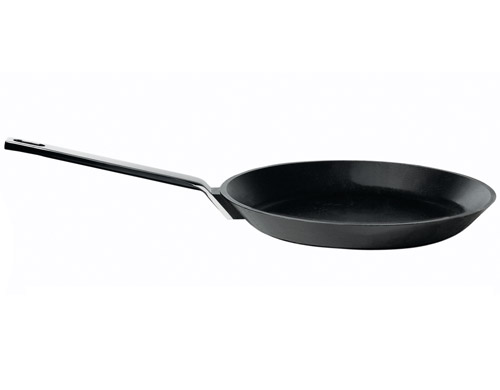
  3. A cast iron skillet. Nonstick skillets are great, but they wear horribly and have a dubious safety record. Copper and stainless steel wear great, but are temperamental, scorching and staining easily. Cast iron, on the other hand, wears like, well…iron. It distributes high and low heat great. With a little bit of use–i.e. ‘seasoning’–it can be almost as nonstick as a Teflon pan, without all the plastic bits in your food. You can clean them without water. And while enameled iron pans are nice, the bare cast iron versions are less fussy and prone to marring. I use a beautifully designed 12″ iittala Hackman Dahlström Tools for almost everything (pictured at very top. Discontinued, but available at various stores), but most any cast iron skillet work equally great. Get a size that’s big enough for the amount of cooking you do, but not so big that it takes ages to heat.
  4. A comfy couch that you can sleep on. I was at IKEA a few weeks ago and they had a 375 sq ft mock-up apartment featuring a huge, overstuffed sectional couch. I thought it a waste of space until I sat it in. Few things demarcate home like a comfy couch. In the LifeEdited apartment, the Resource Furniture Swing couch is the most used piece of furniture. A great couch can be your guest room in a pinch, and while convertible sofa-beds are great, sometimes it’s better to get a longer couch than invest in a substandard sofa-bed, which are often pretty uncomfortable.
  5. A scanner. We thought scanner technology was stable enough that it could be included on this list. Scanners are simple, can last ages, don’t require stupid, overpriced toners and, most importantly, allow you to dump tons of paper by scanning receipts and important documents. Scanners eliminate the need for a fax. You can also scan old photographs for posterity and digital display.

What would you include on this list? What items streamline your home and your life more than most? Let us know in our comments section.

OhSoWe.com: Like Having a Genie as a Neighbor

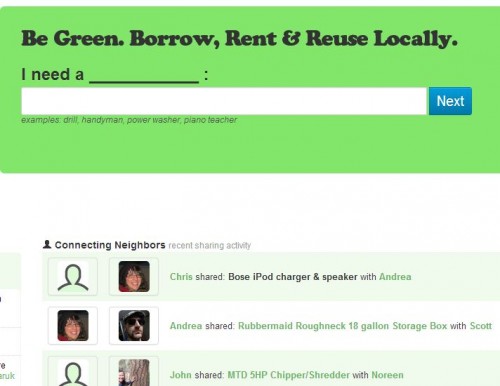
Ever wish you could wish for something and it magically appeared? The website OhSoWe attempts to make that wish its command. Site users can post their needs and/or “Shareables”–i.e. what you want or what you got–and both categories show up on a feed (you can also peruse them separately). The site hooks you up with your neighbors so you can either borrow or buy people’s stuff (including services), or give or sell them your stuff. It’s that simple.

Unlike Craigslist, OhSoWe is hyper-local and has a very streamlined user interface. Unlike Craigslist, there aren’t nearly as many users, so OhSoWe encourages users to invite your friends, which is accomplished via connecting to your Facebook profile or importing email contacts.

Like sites Front Porch Forums and NextDoor.com, OhSoWe doesn’t try to replace in-person contact, but rather uses online tools to connect people living very near you. Unlike those other sites, OhSoWe is not a free-for-all public forum; it is specifically for needs and stuff up for offer. This more singular focus and simple user interface make sharing stuff pretty easy and therefore more likely.

Have you or would you use a tool like this? Let us know in our comments section

High School Student Builds Own Tiny Home

Few things will make you feel less industrious and patient than watching this video of high schooler Austin Hay and his hand-built tiny house. The Fair Companies video shows two segments: The first when he was a high school junior with his partially complete Tumbleweed Tiny House-designed home; the second segment shows Hay, now a high school senior, giving a tour of the completed home.

Hay matter-of-factly describes how he built the house out of mostly salvaged materials (he shows off the three trash cans of waste generated during the build), how he scrimped and saved to put the place together (he says it cost him $12K), how he did it all without the aid of a shop class, how he built his own day bed, shelving and many other built in features. The place features a composting toilet, on-demand hot water and propane appliances.

One of the more poignent moments is an interview with Hay’s grandfather, who had given Hay a propane stove as a Christmas gift. The grandfather’s tears of pride show that building your own home not only cultivates a deeper connection with your own home, but for all those involved in making it. Kinda makes you want to build stuff.

via Fair Companies