Loosecubes and the On-Demand, Go-Anywhere Office

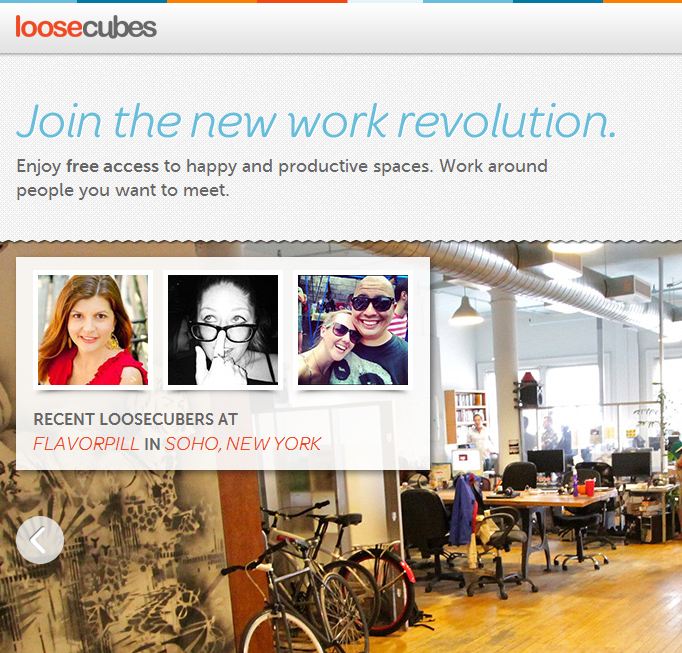
Loosecubes is a network made up of companies and individuals that swap and use desk space. We’d call it the Airbnb of offices, but we’re getting a little tired of comparing things to Airbnb.

You join the network either as a host or individual. Hosts are typically organizations that provide desk space; members of that organization can access desk space of the other network members–in other words, the whole company can tap into the network. Individuals can access the network and book desk space whenever they want. According to their site, Loosecubes got some solid funding and consequently, joining the network is totally free.

All members are required to connect their Loosecube profiles with their Facebook and LinkedIn accounts to avoid unseemly characters. There is a $50K protection policy for hosts against theft, and hosts can decide the level of guest access to their office. Hosts can impose a maximum number of days a guest can work at the space to avoid office squatters.

Wifi and a comfortable place to sit are what’s provided, which for many of today’s professionals is all you need. If you need a printer or conference room, you have to work that out with the host.

The network is huge with locations in most every major, and many not-so-major, cities in the world. If you’re on the road, all you need to do is book a desk in the city you’re visiting, meet with the host and start working.

Beyond the practical aspect of having a free, temporary office in most any city in the world, Loosecubes has the potential to transform offices from static, closed spaces into coworking spaces, filled with a stream of new faces and ideas. Likewise, it promotes getting maximum use of existing resources; office spaces that would otherwise be vacant are filled by people who need a place to work. This might be bad news for many coffee-shops, but it’s good news for today’s light-traveling professional.

Have you used Loosecubes? What was your experience? Let us know.

6 Simple Meditation Tips that Might Just Save Your Job

Many of us have many great intentions to meditate regularly, but we regularly find many great reasons why we cannot to do it–we’re tired, we haven’t had our coffee, we’re expecting a call. The biggest reason, of course, is there simply is not enough time. There are a million important things to do and sitting and doing nothing is not one of those things. We’ll intend to meditate tomorrow.

An article by Peter Bregman in the Harvard Business Review suggests that meditating and doing nothing might, paradoxically, be the best tool for getting stuff done.

Externally, meditation looks quite peaceful; we sit nice and still and quiet. Internally, however, meditation can be a mental war-zone: We are besieged by thoughts and impulses to do everything but sit still.

It is in the resistance to act on those thoughts and impulses where focus is forged. That focus can be applied throughout our day, whether that means resisting a trip to the kitchen, not checking your email every five seconds or foregoing that half-hour kitten video-watching spree.

Think about your day. How much would you get done without distraction? How much shorter could your day be if not protracted by distraction? If you believed you could get more done or that you could cut an hour or two off your day, wouldn’t you sit still for 20 minutes in the morning?

Editing your life is not just about editing possessions that don’t support your happiness, it’s about editing behavior that doesn’t support your happiness. And few things sharpen your behavior-editing skills as meditation.

Now that you know your livelihood depends on doing nothing, here are a few suggestions as to where to start:

  1. Meditate first thing in morning. Meditation is like airplane departures: The later the day gets, the less likely it is to happen. Do it first. Think of it as your mental shower.
  2. Don’t skip days. Excuses and reasons tend to have puppies when you skip days.
  3. Focus on your breath. While there are mantra-based meditations, counting meditations and Buddhist meditations on death and precious human life, paying attention to your breath is by far the easiest entry point for meditation (you can always make meditation more complicated later). If you find yourself lost in distraction, just return to your breath; it’s always there. If your breath is not there, do not continue to meditate. Call 911.
  4. Relax your body. Scan your body starting at the crown of your head, going through each and every part of your body down to the tips of your toenails. Bring attention to every inch of your body, breathe into them and let the breath open and relax them.
  5. Sit up straight. This author uses a zafu and zabuton and would highly recommend these meditation cushions, but not everyone has the back or knees to sit cross-legged. An upright chair works fine. Focus on your spine being straight. It makes a difference.
  6. Start where you’re at. Bregman sits for 20 minutes, but perhaps that’s too much. Oftentimes, I can only eek out 5 minutes. It’s at least 5 minutes better than nothing. I set a timer on my phone with a gentle ringtone to get me out of meditation.

Image Source-Getty Images

Tip of the Day: Lose the Shoes When You Roost

Here’s an exercise: Take some dog feces, antifreeze, herbicides, gasoline, motor oil and most any other common toxic substance you can think of, mix it all together, then rub it all over your home’s floors. While this might sound a bit dramatic, it’s exactly what happens when we wear our shoes in our homes.

The outside world, while filled with great people and opportunities, is a cesspool. And our shoes are the main point of contact with this wondrous cesspool, so it only makes sense that when we get home, we should take our shoes off.

Few single actions are as effective at keeping our homes sanitary as well as dirt, dust and stain free as taking shoes off every time we enter our home. It also has the benefit of preserving the finish of our floors.

Many countries, particularly in Asia, seem to get this. Most every Japanese home includes something called a Genkan (pictured above), which is an area by the front door where you keep your shoes. It is recessed so dirt and debris is quarantined to this front area.

So you know all of this, but you still don’t do it. Here are a few tips to lose the shoes forever:

  • Don’t make exceptions. This is the most important tip in maintaining a shoe-free home. Even if you’re popping in for a second, even if it’s your rambunctious nephew or new friend, get your shoes off.
  • Put a sign at the door asking guests to take their shoes off. Sometimes asking others is the hardest part of maintaining this rule. A sign lets people know the policy is universal, not personal. Put it in a few different languages if you have a lot of foreigner guests.
  • Have a place to remove your shoes such as a bench. Make it easy for people to get their shoes off.
  • Have a place to store shoes such as a rack or cubby holes. 
  • Keep slippers or some other type of footwear used only indoors. They’ll keep you feet warm, and protect your floors from bare feet, which often are dirtier than socks or slippers [Note: make a no-exception policy about slippers as well–they are only for indoors. No runs to the mailbox, etc.]. While slippers for guests might not be feasible, a few pair of nice, clean socks are.

What are your experiences or tips with keeping (or not) a shoe-free home? Let us know in our comments section.

Get Your Masters in Walkonomics

No form of transportation is more edited that walking. Tires are your shoes. Parking is your chair. Fuel is dinner.

We’ve looked at Walkscore.com in the past. The site is a great resource for assessing a neighborhood’s walkability, showing proximity to various pedestrian-friendly amenities like restaurants and public transport. What the site might not convey is a comprehensive picture of what that walk would look like. Is the walk a stroll in the park or an advance toward enemy trenches?

A new site called Walkonomics tries to fill in these gaps in knowledge. Rather than relying on statistical information, Walkonomics crowd-sources information about particular streets. It looks for information like “road safety,” pavement and “fear of crime,” as well as intangible but important qualities like “fun and relaxing” and “smart [the site makers are English] and beautiful.”

The site reminds us of Waze, which crowd-sources traffic data and gives you corresponding directions. Walkonomics is not nearly as robust as Waze, nor does it appear to have a mobile app, which would be indispensable for this type of information–helping you to decide on-the-spot whether to walk down that dark street or not.

The site is pretty beta and mostly covers major urban areas like London, San Fran and NYC. Even the latter city, arguably the most walkable in the US, has huge gaps in information. That said, users can take it upon themselves to enter data about their particular streets and beef up Walkonomic’s data.

Clean Up Without Toxic, Space-Hogging Cleaning Fluids

The e-cloth is a cleaning cloth that cleans virtually any surface without any cleaning fluids. The cloth has 1.6M threads/inch as opposed to most microfiber cloths, which have between 90K-200K and standard cloths, which have 25K-75K. The high density traps dirt, oil, dust and most any other particulate you put in its path. E-cloth also says the cloths remove 99% of bacteria from hard surfaces.

The company cites another interesting claim, saying:

‘Women who work at home have a 54% higher death rate from cancer than women working away from the home.’ A 15 year study concluded that it is directly linked to the toxic household chemicals in the home.

Eliminating cleaning products, they suggest, is a great way of reducing the presence of those chemicals (we suspect it’s healthier for men too).

In terms of durability, the company guarantees the cloths for 300 cleans and says that if you wash it once a week, a cloth should last you about six years.

All this would be a bunch of marketing BS if the things didn’t work. But they do. We picked up one of their “Kitchen Packs” from Green Depot for the LifeEdited apartment, not knowing what to expect.  They work great, cleaning glass, chrome and counters equally well, all without cleaning fluids.

Beyond the lack of toxicity and durability, they eliminate a cabinet full of various cleaning products, saving space and creating less waste.

We often think of technology as something applied to faster laptops and hydrogen fuel cells, but sometimes it’s the mundane improvements to things like dress shirts and rags that really make a difference in the way we live.

Do you have other products that streamline your home? Let us know in our comments section.

Salvaged Materials Make Up Super Slick NYC Studio

Check out this short video of Bill Di Paola’s 500 sq ft studio on Manhattan’s Lower East Side–aka “The Tron Apartment.” Though the polish and shine of the place make it look like everything was bought new, the space is mostly a collage of recycled and salvaged materials. For example, the kitchen shelves were purchased from Pan Am Airlines when they went out of business. Interesting touches like mirror-polished metal panels on the ceiling, illuminated plexiglass walls and a clear glass sink are designed to give the impression that the space is larger than it is.

Di Paola said he wanted to something super clean to contrast with what he does during the day, which is running a great bike advocacy group in NYC called Times Up. In other words, after a long day of bike grease, he wanted a bastion of cleanliness. He seems to understand that the aesthetic isn’t for everyone, but feels it perfect for himself.

The apartment demonstrates that with a bit of resourcefulness and creativity, you can do a lot with a small space.

Via SpacesTV

Opinion: Would Anyone Ever Aspire to Live in a Micro Home?

This last Friday, the Wall Street Journal launched a new real estate section called “Mansion.” WSJ managing editor Robert Thomson implied in a statement that it wasn’t just about the rich admiring their big homes, saying “We all like to think of our home as a mansion, even if it is a humble abode, and we all have the license to aspire.”

The section we saw featured homes like tax-shelter luxury apartments in Puerto Rico, 9500 sq ft modern homes in Napa CA, 17K sq ft Telluride ski lodges, a look at several “sky garage” condos (i.e. a car life allows you to park your Lamborghini or Ferrari in your unit) and the migration of tech moguls to multi-million dollar home in Los Angeles. Humble abodes these are not.

Truth be known, when we set about building the 420 sq ft LifeEdited apartment, we wanted to create a new variety of aspirational home–one that relied on great design and intelligent use of space rather than massive square footage and Olympic-sized hot tubs. While this aspirational model might work with select populations (and they’re probably all reading this post right now), we wonder whether a compact home would be something the greater public could get into?

What do you think? Will micro homes forever appeal to very select populations? Will the mainstream always consider them worst-case-scenarios or might they see them as something to aspire to? We’d love to hear your thoughts.

Photo Credit: Susan McWhinney/WSJ

Clear Up Clutter with Magic Magnetic Wall

This magnetic wall from Austrian company Magic Wall falls in the category of “why-didn’t they think of this sooner.” The company sells various sized panels with embedded magnets, strong enough to hold your pots, pans, knives, tools or any other ferrous object.

The panels are available in a laminate, wood and Terrazzo stone surfaces. They also offer shelves and other “Magic Tools” that affix to the wall surface. Watch their video above to see the wall in action.

At €269-€1079/$350-$1400 per panel, they’re not cheap. The company indicated that they will ship to the the US. While pricey, they’re extremely versatile, and because you can stick virtually any metal object on them, they will never lose their usefulness.

Via PSFK

Test Drive A Tiny House Today with Airbnb

Perhaps you’re considering ditching most of your possessions, going part time and remote at your job and swapping your clunky traditional home/apartment for a tiny house. But you’re not sure it’s the right move. You have your doubts about what it’s like to inhabit such a small space.

Airbnb can help you with your tiny hesitation. The site offers a number of tiny houses you can call home for a night or two, providing a taste-test for your would-be tiny life.

By far the most interesting that we found is  David Guilbault’s 68 sq ft Teeny Tiny Guesthouse in Seattle, WA (video above). The DIY paradise features a very clever “garage door Murphy bed” and in-floor, full-sized tub. David charges $75/night with a two night minimum.

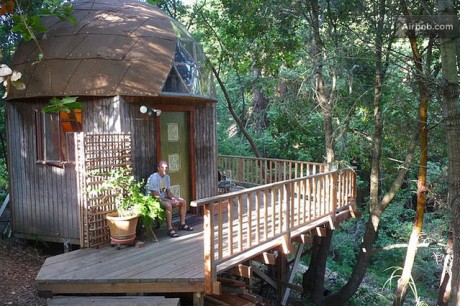
A little outside of Santa Cruz in Aptos, CA is the Mushroom Dome Cabin. The owners claim it’s the “number 1 listing on Airbnb”; with its cool design and beautiful setting, we can imagine why.

The tiny house sleeps 3, features a wraparound porch and a 22″ LCD TV. The $100/night charge includes breakfast.

If you live on the east coast, you can rent a more traditional tiny house right on beautiful Lake Champlain in Plattsburgh, NY (below).

This model is a more traditional, Tumbleweed-style, trailer-based tiny house. Nelson, who owns the place, includes access to kayaks, canoes and paddle boats. The place is $100/night with a 2 night minimum.

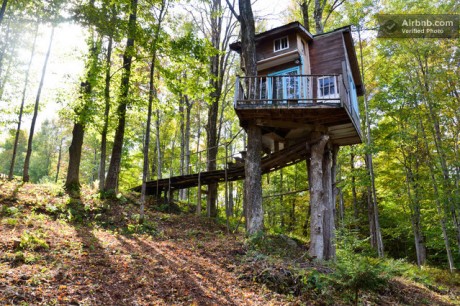
Also on the east coast is this awesome treehouse in Lincoln, VT. The structure rests 30 ft above a fern covered forest by the Green Mountain National Forest.

Lincoln is three hours from Montreal and four from Boston, so it’s a bit out of the way–for better or worse. Ellie and Harrison, who rent the place, charge $125/night.

While these stays might not perfectly replicate living full-time in a tiny house, they might give you a sense of what it’s like. Barring that, they look like great, relatively affordable places to spend your vacation.

via Tiny House Listings

Bottoming Out on Digital Media? Try a Digital Detox

Yes, it has come to this: “Digital Detoxes”–offline stays for those of us bottoming out on information overload. While we’ve looked at tools for combating the attention span crisis in the past, for many of us, the temptation to go online makes these tools insufficient for quelling information overload.

It seems evident that the pervasiveness of online use is reaching a saturation point.

  • A 2009 study found the average American spends 13 hours/week on the internet, not including email; 14% exceed 24 hours/week. Numbers that are surely getting bigger.
  • A Google study found that 72 percent of those surveyed use their smartphones while consuming other media and that 1/3 are on their smartphones while watching TV.

In one way shape or form, most of us are looking at glowing boxes for a good portion of our waking hours, including our vacations.

Young Island at St Vincent’s

A tour company called Black Tomato offers a nine day digital detox in the remote Caribbean islands of St Vincent’s and the Grenadines for $3800 (includes airfare from London and accommodations). The company strips you of your devices and offers a life coach to help you with the detoxification process.

Less remote, less financially taxing, is The Digital Detox, which offers personal and corporate retreats in Ukiah, California. For $450-950 for three, all-inclusive nights, guests surrender all of their devices, including watches. Days are spent hanging out at the hot springs, eating vegetarian cuisine and doing yoga. Instead of chronically their trip on their phones, are encouraged to journal.

In an interview with Buzzfeed, The Digital Detox founder Levi Felix “When people go on vacation and have the intention of unplugging, studies show that they spend 30% of the time working or on some kind of tech anyways” He even said that “people find themselves going on a camping trip, grabbing their phone and going on old emails,” even when there’s zero cell coverage.

In other words, it’s not enough to go off-grid. Many of us need our devices pried from out hands to get completely offline.

What do you think? Does being online represent freedom or repression? Is being online all the time–even on vacation–necessarily a bad thing?