Insta-Offices for the Remote Worker

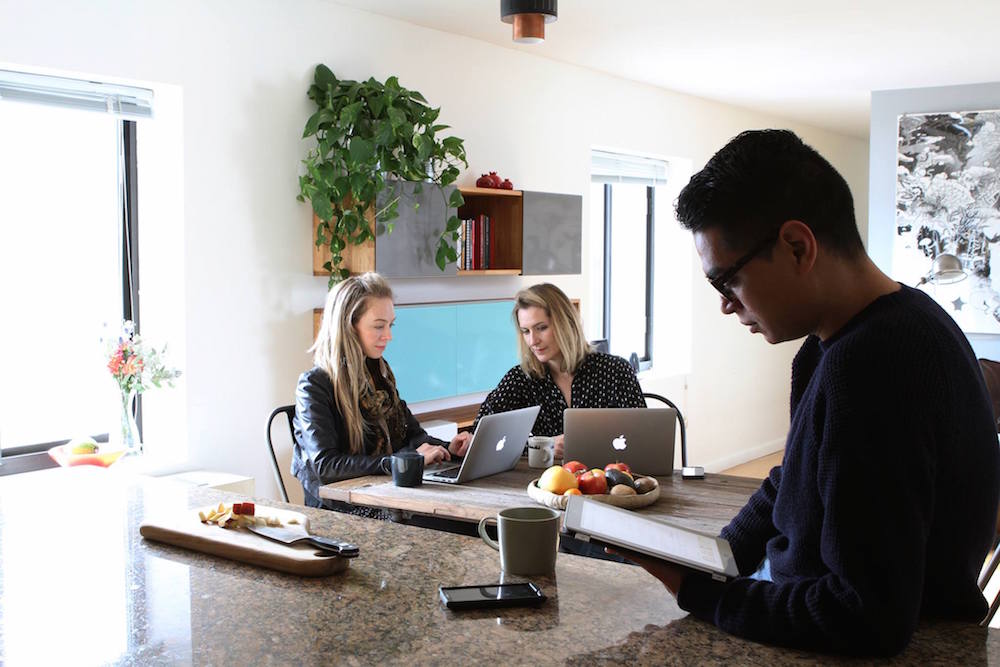
Working remotely is great because you can cut out commuting time, it makes you less bound to 9-5 workaday hours, it often allows you to work from anywhere in the world, you can spend more time with family and so on. But it can also be isolating, your home can be a minefield of distraction and even if you want to get out, you might not live near a coffee shop that’s cool with people hanging out all day after ordering a small coffee. A new venture called SpareChair is offering an alternative to work-from-home isolation and all-day Starbucks loitering, hooking you up with other remote workers to create insta-offices.

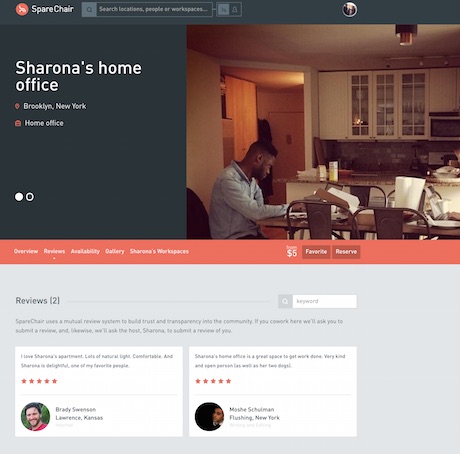
SpareChair works a lot like Airbnb, letting people open up their homes to the public for the purposes of coworking. Like Airbnb, SpareChair’s website has details about the space’s features (wifi, coffee, etc) and pictures of the space itself. There are peer reviews of both spaces and members to make sure everyone maintains a high level of quality and decorum.

spare-chair

To book a coworking session, you first make a profile with your personal info: profession, short bio, etc. Then search for a space and navigate to its page where there will be a schedule of available times and vacancies. From there, request a session (e.g. Tuesday, March 17 10am-1pm), enter payment info and check out. Like Airbnb, the site’s host has to confirm the reservation in case several people reserve at the same time or there’s an unforeseen scheduling conflict. Many of the private spaces are as cheap as $5 for an all day session and few are more than $15 (SpareChair charges a small fee). They also have numerous coworking spaces on their network; these tend to run around $30/day–still pretty cheap if this is your primary office.

SpareChair co-founder Sharona Coutts told us she started SpareChair because she needed it. “I work from home and while I like the concept of coworking spaces, I didn’t necessarily want to go into one every day, or even randomly, since you don’t necessarily get to interact with people when you’re there. Plus, at $35 a day, it can be pricey.”

SpareChair wants to be more than a space to work; they are out to create community and help people advance their careers. “We had a writer’s coworking session on Tuesday night, and our members were able to help each other work on drafts, refine ideas and focus on writing for three hours,” Coutts told us. “Because we know what field each of our members works in, we can curate specialized events like that, and we can also pair people with each other, and with the right host. So, for example, if you’re a freelance designer, you could search for hosts who are designers or design firms, and go and cowork with them for a day, week or month. It’s pretty potent networking, without the awkwardness.”

SpareChair is still in beta mode so you’ll need to request an invite, but the site is expanding quickly and already has locations in NYC, the Bay Area, Santa Cruz, LA, Chicago, Boulder CO, Nashville, Minneapolis and others. They’ve also got requests from more than 40 countries, including Brazil, Norway, the UK and Thailand. Coutts sees big things for this simple idea. “SpareChair will be the world’s biggest and most meaningful community–both online and off–of people who work from home. We are building a space for people to cowork and network, as well as to monetize under-utilized space. We haven’t paid for any marketing. Our community in the US has grown to 700 strong based solely on word of mouth and press!”

Paying for the Privilege of Being Offline

It’s no big news that we as a species are becoming ever more glued to LCD screens of all sizes–from that big monitor to our little ‘wearables.’ The occasions we find ourselves offline are becoming fewer and farther between. And while this connection has some benefits, it also has some serious hazards: we are losing our ability to connect with others, our ability to focus on one thing, it’s making us horrible drivers and so forth. For these reasons and more, people are now searching for opportunities to be forced offline in the name of defragmenting their megabyte-addled minds.

A recent Wall Street Journal article highlighted families who purposefully chose vacation spots where cell phone and/or wifi connectivity was low or non-existent, either by design or geography. According to the article, in 2014 “American children ages 13 to 17 spend nearly four hours a day online…nearly an hour more than in 2012 [and] more than half have their own smartphones,” creating an imperative to get a bit of offline time. These families chose remote vacations spots like the Black Mountain Dude Ranch in McCoy, CO, whose website promises that “kids will spend a week electronics-free.” The article didn’t sugarcoat the families’ experiences. Some of kids had problems at first with putting down their devices, but after the initial digital DT’s, people–both young and old–realized there was more to life than checking their Facebook newsfeed.

camp-grounded-games

People who aren’t interested in lugging the kids should check out Camp Grounded, a summer camp for adults run by Digital Detox, a company that specializes in retreats for, well, detoxing from digital media. Camp Grounded, according to their website, is a place “Where Grownups Go to Unplug, Get Away, and Be Kids Again.” The camp promises 50+ playshops, arts n crafts, yoga, typewriters, capture the flag, color wars, meditation, swimming, talent show, camp dance, campfires, archery, rockwall, kickball, stargazing, hiking, healthy meals, sing-a-longs, face-painting and analog photography. More than what there is is what there is not: no networking, work-talk, ageism, drugs or booze, wearable and, importantly, dubstep or glowsticks (i.e. it’s not a latter day rave). Fittingly, Camp Grounded is located not too far from San Francisco and Silicon Valley in Mendocino, CA. They hold two weekend camps per summer, both starting in late May. Cost is around $600 for the weekend.

Lastly, if you’re looking for something a bit more exotic, throw yourself in the middle of the Caribbean for the digital detox in St Vincent and the Grenadines, where guests are asked to ‘de-tech’ and hand over their mobile phones and gadgets surrendering themselves to their lack of “connectivity.” It might seem like a lot of effort for something that could ostensibly be achieved by shutting down our computers/phones/tablets, but the fact is most of us don’t do that in our normal environments. It takes what it takes.

Turn Your Bike Into a Lean, Mean, Small-Home-Storage-Friendly Machine

The Schindelhauer ThinBike–a specially designed bike that goes from conventional width into a super-slim, small-space-storage-friendly ride–is pretty awesome. But after we reviewed the bike, many of you asked, “how do I do that to my bike?” That’s what the FlipCrown is about.

flipcrown-use

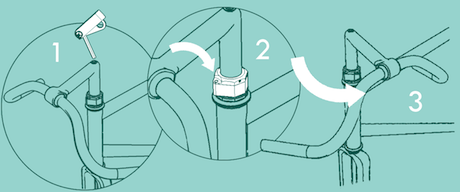
FlipCrown works by replacing the top locking nut of your headset. To turn the bars you do a half turn on your bike’s stem bolt with an included allen wrench; you then press a button on the FlipCrown and then turn the bars 90 degrees. Press the button again and twist the stem back to its initial position with handlebars centered and stem at proper height. Patrick Jacquet of Deltareference, the Ghent, Belgium-based design and development firm behind the product, said the whole operation takes about 10 seconds.

It’s not a revolutionary (or necessarily original) product, but it’s one that solves a vexing storage issue. One of the more useful places to use it is in crowded outdoor bike racks, where wedging your bike in is often impeded by handlebar width. Jacquet also notes that turning and locking the handlebars can be a theft deterrent.

The biggest drawback we see is that it’s only available for quill stems (both 1” and 1 ⅛”), which have fallen out of fashion in the last 20 years or so. Jacquet told us they have plans to make a threadless version that they hope to release later this year.

Deltareference is launching the product through the crowdfunding site Indiegogo. A $30 pledge will get you a FlipCrown. $60 will get you the FlipCrown plus some quick release pedals to make your bike super slim (we might opt for the MKS fold up pedals used on the Schindelhauer). And $450 will buy you their own SlimBike–a retro-styled fixie that should not be confused with the ThinBike. They also have a proprietary wallmount bike storage rack and deluxe, three-speed SlimBike by manufacturer Achielle in there as well.

Urban Infill Architecture that Doesn’t Suck

The late 19th and early 20th centuries were boom times for urban architecture in America. Street after street sprouted up with rowhouses, townhouses, brownstones and other medium-density architecture. These were solid, sensibly-sized, one-to-three family, logically-laid-out brick structures, many of which still stand today. But in many cities these houses fell into disrepair, leaving semi-ghosted neighborhoods with empty lots and derelict buildings. Often, these lots became/become the victim of infill architecture. In general, infill architecture can seem like an exercise in carelessness and making a quick buck, being cheaply made and ugly both in its own right and uglier still in relation to its neighborhood’s context. That’s why Postgreen Homes is so refreshing. For the last six years, the Philadelphia developer has been cranking out innovative, attractive, affordable and energy-efficient infill architecture.

Postgreen founder Chad Ludeman hit the ground running in 2009, with the “100K House” a 1100 sq ft, LEED platinum certified townhouse that only cost about $100,000 to build (hard material costs only). The project won the US Green Building Council’s 2010 House of the Year. They built a number of subsequent projects such as the 120K house (a little more expensive), just adjacent to the 100K House and the Skinny House (actually three houses in a row), which could fit into a lot as narrow as 13 ft wide, yet still felt quite spacious and airy. In recent years, their homes and projects such as the awesomely-name “Awesometown” or “Duplexcellence II,” look slightly more conventional than the first projects, but they still manage to keep things compact, design-centric, eco-friendly and amazingly affordable. The majority of their homes sell for less than $350K, which includes the cost of land.

Postgreen is able to make their homes so cheap by using simple, affordable materials as well as optimizing their designs for easy-building. For example, their homes use low-cost exteriors like corrugated steel, reclaimed brick or pre-cut standard insulated panels (SIPs), that latter cutting both labor costs and improving energy efficiency. On their Skinny House, they kept all mechanicals, plumbing and sewage in a four foot square, creating a consolidated area for the more expensive construction elements as well as leaving an open, unimpeded floorplan. Their homes seldom crest 2K sq ft and are more often around 1200, keeping overall built area to a minimum and keeping material and labor costs low.

Another key part of Postgreen’s affordability is their placement in less-expensive neighborhoods, which is a crucial part of making their innovative homes available to people who would otherwise only be able to afford fixer-uppers.

Thanks for the tip Tim!

New Company Offers Custom, On-Demand Furniture

One of the more difficult aspects of furnishing a small house or apartment is finding properly proportioned furniture. A good deal of what’s out there is designed for girthsome American homes: big tables, deep desks, huge hutches and so on. For example, when my wife and I were furnishing our home, it was tough to find a very shallow, medium-width desk designed for a laptop and nothing else. We ended up ordering a custom desk, but the end-product was both expensive and because it was a handmade one-off, it ended up being not quite what we wanted/expected. A new Kickstarter project called PARSONAL by design studio Arrister is trying to sidestep the expenses and perils of one-off furniture manufacturing by creating on-demand, custom furniture.

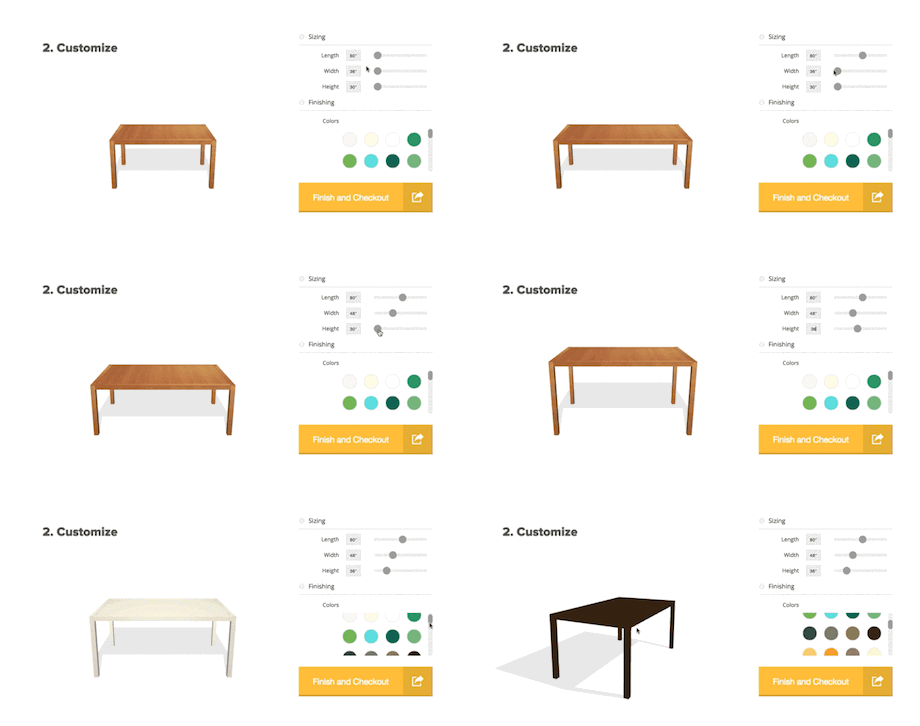
It’s probably more apt to call PARSONAL “semi-custom” as you choose from one of their basic designs, which at this point includes tables, desks, shelves and various stands. But from the basic design you can use PARSONAL’s web-based “Configurator” software and customize the size of the piece, shelf configuration (when applicable) and the finish of the tops and trim.

parsonal

PARSONAL’s pieces are attractive in a nondescript, lots-of-right-angles sorta way (this is actually a compliment). Make Magazine says of PARSONAL’s aesthetic, “The simplicity of the design makes it ideal for their first offering as it simplifies both the software and fabrication considerations.” The designs would fit in easily to a variety of modern interiors. All the furniture is made of solid wood sourced near Arrister’s Tennessee homebase, so this is actually stuff you might consider holding on to. And prices are decent. Their big ticket item is a dining table that comes with a $650 pledge–pretty reasonable considering you can tweak to your specifications.

The company told us that they plan to expand their catalog into more complex furniture in the future and once production is ramped up, they expect turnaround to be about three weeks from ordering to the furniture’s flatpack delivery. Check out their Kickstarter campaign page for more info.

UK’s The Collective Offers Whole System Design Living

London is one of the most expensive cities in the world, and like many such cities, incomes have not kept pace with the cost of living in general and housing costs in particular. As we saw when we checked out NYC’s Stage 3 Properties, the situation is squeezing many young people out of town or into marginal housing situations. Yet these same young people are less interested in the big places that cost so much; they are less interested in accumulating stuff; they are less likely to be (or get) married and/or have kids; and they are more open to a shared living experience. As we wrote the other day, many of them just “want a clean home near all the action with a good wifi connection”–a type of housing that wouldn’t cost so much if developers deigned to make them. London’s The Collective is one developer who deigns.

The Collective is probably easier to understand as a whole system design for living rather than mere real estate developer. Yes, they have four built buildings and one underway, all featuring minimal, furnished, design-savvy micro-housing with shared social spaces and included amenities. But they also have a startup incubator and coworking space called The Elevator that closes the social-professional loop. Both arms of the company embrace and support a new breed of highly mobile, tech-savvy, entrepreneurial, experience-thirsty urban living for Millennials.

We emailed The Collective’s founder Reza Merchant a few questions about the company’s past, present and future, which includes Old Oak, their first purpose-built housing complex that is opening this November:

David Friedlander: What inspired you to start The Collective?

Reza Merchant: I was inspired by my own experiences living as a student in London, faced with the struggle of trying to find decent accommodation at an affordable price. I set up London Student Rent, a student lettings agency, during my last year at the LSE and the company then evolved into The Collective as I became more attuned to what young professionals want and need from their housing. This is basically a high quality, hassle free way of life, which also allows you to meet like-minded people around you–all at an affordable price.

DF: How do you see what you’re doing–both in terms of housing and the Elevator–as meeting and perhaps predicting the needs of Millennials in the coming decades?

RM: Millennials represent ‘Generation Rent’. Whereas our parents’ goal was to own a property, and renting (in London) had a stigma attached to it, this is no longer the case. Renting is becoming a lifestyle trend and we cater to this increasing trend by providing purpose built rental accommodations. Young professionals work long hours and use their rooms as crash pads, which is why we don’t need excessive amounts of space–as long as it’s well designed. Millennials prefer to invest in experiences versus material possessions and are much more willing to share, which is why we focus on providing a high level of social amenity space with our Shared Living product. Also, we are ‘tech junkies’ and have grown to expect everything as a service. Netflix, Uber, the list goes on, and The Collective offers living as a service. We don’t have time to, nor want to, worry about life admin. So paying one monthly bill which includes everything from room cleaning and linen change, to concierge services and all utility bills and council tax, makes life a lot easier, giving people time to focus on more important things.

The-elevator

The same goes for our Elevator workspace product, which also focuses on enhancing the end-user experience. Entrepreneurs are passionate about building their business and their work environment is vital to helping them deliver it. We focus on proving a unique workspace, which focuses not only on providing services offices but also includes all the ancillaries a start-up needs to succeed, from an engaging events programme to access to a network of mentors and investors. The so-called boundaries between work and life are becoming ever more blurred–when you do something you love then it becomes your life. Entrepreneurs are happy to spend long hours in the office, but they also need the creative buzz and inspiration from their surroundings, so we aim to accommodate this.

DF: Your focus is squarely on Millennials. Do you see your model working with other demographics?

RM: Our model has been created specifically with 21-35 year old young professionals in mind, so it is tailored to suit their needs. There are definitely elements which would suit an older demographic, but essentially once you start settling down and thinking of a family your needs change.

[divider]

We are ‘tech junkies’ and have grown to expect everything as a service. Netflix, Uber, the list goes on, and The Collective offers living as a service.

[divider]

DF: What would you say to people who accuse micro-housing as exploitive, shoving people into overpriced shoeboxes?

RM: I would say that an increasing shortage of space, coupled with an increasing population means we are forced to come up with solutions to the housing crisis. Micro-housing is not exploitive if well designed. With the right, innovative design, use of space can be maximized efficiently–it’s little things, like clever shelves to partition the kitchenette from the bed that can also be used as storage space and are also a cool piece of furniture.
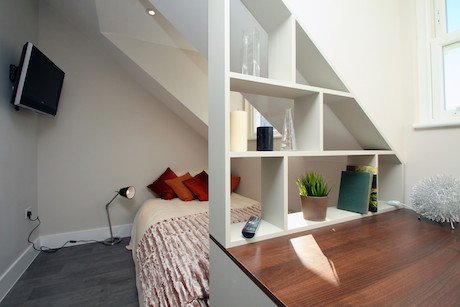
Collective-room

Also, if you can offer an all-inclusive service offering in the rent, plus a high level of social amenities, like our model does, then it’s not overpriced.

DF: How does Old Oak [pictured at top] expand on your previous endeavors?

RM: Old Oak is our first new build and the first true embodiment of our Shared Living product. Whereas our existing developments are refurbished building, this is the first time we’ve had a clean slate on which to deliver exactly what we want to. Our rent has always encompassed services including weekly room clean, weekly linen change, concierge services, 24/7 security, free Wi-Fi, plus all utility bills and council tax. However, although we also provided communal areas throughout our existing properties with Old Oak we’re taking it to the next level. The 11-storey building will have 1,000 sq ft of social amenity space on each floor: a gym, spa, rooftop terrace, cinema room, secret garden, themed private dining rooms. All are designed to facilitate interaction amongst our members, to create a real community feel within the building.

DF: What do you see as the future of both The Collective and housing in general?

RM: I see the future of The Collective as a leading lifestyle brand, which has redefined the way people live, work and play. Not just in London, but in global cities across the world. The shortage in space means that inevitably housing will become more dense, but hopefully this will just encourage more architects and developers to think outside the box and come up with innovative designs and solutions which mean that quality is not compromised. The use of technology will also shake up the housing market, both maximising space and creating the ultimate customer experience.

Add Privacy to Your Small Space with White Noise

Let’s say, theoretically of course, that you live in a small two-bedroom apartment with your wife and two children. One child is a not particularly deep-sleeping newborn, the other is a toddler with a voice that sets off car alarms when he finds out his fire truck pajamas are dirty. Light-sleeping baby + yelling toddler = parents wishing they had a floor or two more or very long hallway between bedrooms. If it weren’t for our white noise maker, we’d totally lose our collective s@#t.

While white noise is not as effective as distance, solid walls or special soundproofing in terms of eliminating sounds, it is very effective given how easy it is to employ. Rather than eliminating sounds, it adds a layer of flat, neutral sound that dulls sharp, disturbing sounds.

In my home, we use the aptly named “White Noise” app by TM Soft. We have it hooked up to an old iPhone and typically use the white or brown noise settings, though there is a huge range of sounds available including hairdryer and grandfather clock (we sprung for the $1.99 premium version with a huge catalogue of sounds).

marpacIf you don’t have an old iOS device or want something non-digital, the Marpac DOHM-DS is the go-to device for psychologist waiting rooms around the globe. It’s a small fan wrapped in a case with small vents that, depending how open or closed they are, allow you to modulate the sound. I’ve used the Marpac extensively in the past and like it, though I find my old iPhone gets considerably louder.

Though I don’t have experience with them, there are numerous white noise makers specifically for babies as well as countless other apps for both iOS and Android. Should the tinny sound of your phone’s speaker be bothersome, pipe the sound through a set of Bluetooth, Airplay or desktop speakers.

White noise is not just for parents with small children. Use it when you need to make a private phone call and your roommate is in the other room or to dull out the sounds of noisy neighbors. Living in small spaces near other people has many perks, but sound separation is typically not one of them. Cranking up the white noise (to less than 85 dB apparently) helps create some of that separation and a little bit of sanity.

One Shirt, 24 Different Looks

Forgive our recent obsession with clothes, but the topic seems to keep coming up. Whether it’s adding new clothes that do more or getting rid of existing clothes that don’t pay the proverbial rent for their closet space, there’s no shortage of ways in which we can refine and edit this space-hogging category of stuff. A new project/company called MORF is taking on the former category, making one shirt that can be worn 24 different ways. The shirt seems perfect for those looking to both maintain a minimal wardrobe while having a semblance of variation in their look (not that there’s anything wrong with uniformity).

The MORF shirt uses a patent-pending, double-fabric construction that allows it to take on many different forms…well, 24, to be exact. The shirt is mostly cotton and will be available in three different colors (get all three and have 72 shirts!). There are plans to make a dress and a men’s MORF shirt, both expected to be available in October.

Like pretty much every product we write about on this site, MORF is launching on Kickstarter to raise money to ramp up production (with $10K of $25K goal raised and 54 days left, MORF is looking like a slam dunk). A $49 pledge will get you a Blue MORF and will ship in May.

For This Family Simplicity is the End, Not the Means

Carmella Rayone McCafferty lives (purportedly happily) in a 665 sq ft Wyoming cabin with her husband and three kids. We could stop there and have a remarkable story, but the style and philosophical integrity of the home and manner in which the family lives makes the whole thing all the more impressive.

Like many great stories, the McCafferty’s were spurred by crisis in 2008-2009. Back-to-back job losses and a tanked real estate market put the family in financial and existential peril. The situation, Carmella writes in her blog, forced the couple to ask themselves, “What was most important to us in this life, really? The well-paying job in a city we didn’t love? The large mortgage payment and other debt? The compound stress of trying to make ends meet when the jobs went away?”

They realized that a simple life, close to nature was the kind they wanted to live. They set about building this life in a small Wyoming town. Rather than doubling down on another home and mortgage, they decided to build a 665 sq ft cabin on rented land. Its low cost is allowing them to save up to buy their own plot of land where they can build a new home in cash. Of their newly created situation, Carmella writes, “For us, financial security was no longer linked to the size of the portfolio or the potential of real estate holdings; financial security now meant zero debt and a job well loved.”

It should be said that this is no ordinary cabin. Carmella is a talented interior designer and the space has been featured in Remodelista. Recently, that same blog published “Carmella’s 7-Step Plan to Clutter-Free Living”–a solid list that includes such suggestions as “Envision your essentials by packing for a two-week trip in a camper” and “Whenever new goods come in, give some old goods the boot.” You can also go straight to the source with Carmella’s blog Assortment, which includes pictures, tips and lifestyle posts.

The McCafferty’s situation is reminiscent of a post we wrote called “The New American Dream Home” about the Kawabatas, a family of four that shared a modest 1300 sq ft home in Garrison, NY. With no disrespect to the Kawabatas, Garrison is a pretty posh town and the family was planning on adding a large addition to their modest home. The McCafferty’s on the other hand live in Wyoming, the nation’s least populous state, where, we suspect, land is dirt cheap. And while they are planning on building a larger home, they don’t seem to bemoan their current situation. For them, simplicity is the end, not the means. We find them heartening. We think people like the McCafferty’s, who place this premium on simplicity, responsible use of resources and financial freedom, are creating a different–and far more realizable–dream than the one of ceaseless expansion and consumption.

Overdue Book Review of “Just Ride: A Radically Practical Guide to Riding Your Bike

Yesterday’s post on the Hamper Test got me thinking about bike clothes. You see, back in the day, I worked at bike shops–five to be precise. The last one specialized in high-end road bikes and their ostensibly requisite gear. While I sold some stuff to racers, for whom shaving a half-pound off their ride might give a competitive advantage, the bulk of my customers were middle-aged men whose main sorties were medium-paced group rides and solo trips. You’d think, given how these guys used their bikes and their physiques (read: not lithe), they’d want fairly bomber, functional bikes. But no, these guys wanted super-skinny tires and obsessed about their gear as if they were Jan Ullrich making a podium push in Paris.

My last shop job was in the early aughts (hence the Ullrich allusion), when top-end bikes were titanium and the most cogs you could fit onto your freehub was nine. A top of the line bike–like the most expensive you could possibly make–would run around $8K. In following decade (let’s call it the Lance decade), things got entirely out of hand. Companies kept shoving cogs onto freehubs. Power-meters and electronic shifting became de rigueur. Everything became carbon fiber. It became totally normal for bikes to cost in excess of $10K–mid-level bikes with Ultregra! And who’s buying all this cool kit? It’s those same middle-aged guys (nobody else can afford it). It’s out of hand. The trusty bike, so purposeful and simple in spirit, has become a techno-overkill parody of itself.

Enter Grant Petersen. Petersen founded and runs Rivendell Bicycle Works, a frame-builder and retailer of no-nonsense bike gear–stuff designed, not for screaming up L’alpe d’huez, but for normal people who like to ride their bikes. And lucky for us, he wrote a book a few years ago entitled “Just Ride: A Radically Practical Guide to Riding Your Bike.”

grand-petersen

Petersen starts the compact, illustrated book by stating his mission: “To point out what I see as bike racing’s bad influence on bicycles, equipment and attitudes, and then undo it.” It speaks directly to the multitudes who have been led to believe they can’t mount a bike without a chamois on their asses.

just-ride-41

One by one, the Petersen debunks widely held assumptions about best practices for riding a bike. These include:

  • How the normal bike rider/enthusiast (the “Unracer” as he calls us) doesn’t need more than eight speeds, clipless pedals, cycling shoes, lycra shorts and many other “basics.”
  • Why most of us should be riding in an upright position, with our handlebars higher than saddle (see above).
  • The myth that cycling will get you lean strong and lean.
  • How blinking lights reduce safety.
  • How kickstands are cool.

For some people, these aren’t revolutionary ideas. Bikes are for riding. Who cares about weight and going fast? But for others indoctrinated in racer culture, for whom lighter is always better, these are, as the book’s name implies, radical propositions. They were for me. Suddenly, biking became a lot easier to do and prepare for. I haven’t worn my bike shoes since reading the book. When I put together a new bike, I built up a 30+ lb all-rounder with an eight-speed internal geared hub, bomb-proof wheels and full fenders (still no kickstand).

Petersen is clearly a very opinionated guy and not all of his opinions are to be treated as gospel, but one assertion is hard to contest: if you’re not a racer, why use the same bikes and gear they do? Racers, particularly pros, have sponsors giving them gear, they have lots of money on the line for them to succeed, they have masseuses and fitness levels a couple orders of magnitude greater than the casual rider (chemically enhanced or not). The vast majority of us are best served by solid, repairable and comfortable bikes (not cheap ones, mind you). For this latter category of rider, Petersen transforms biking into something it might not have been since we were small children: fun and simple.