3 Ways to Dry Clothes that Don’t Blow

Drying clothes in small spaces can be difficult. Either you have no dryer or a slow-drying condenser model. Hanging your clothes on a clothesline off your fire escape is illegal in many state. And even when you have a dryer–either your own or at a laundromat–you might not want to use this appliance that is neither kind to your clothes or the environment (standard dryers create about 4.4 lbs of CO2 per load).

With all that in mind, here are three products that provide space-and-energy efficient ways to hang dry your clothes in your small space.

I. Leifheit Rollfix Retracting Clothesline
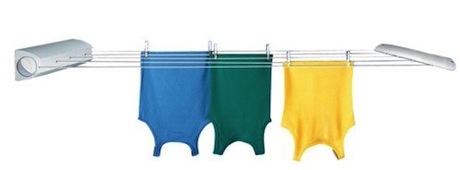
leifheit-rollfix

Rather than using a traditional clothesline that needs to be coiled and uncoiled and wrapped around some random object, the Rollfix has five lines that coil in a discreet case that mounts your wall. Just pull the lines out of the case and affix it to it’s mate on the other side of the room. Each line extends up to 13′ making for an incredible 69′ of drying line. We found this extremely useful product on Amazon for only $30.

II. Leifheit Telegant Mounted Clothes Dryer
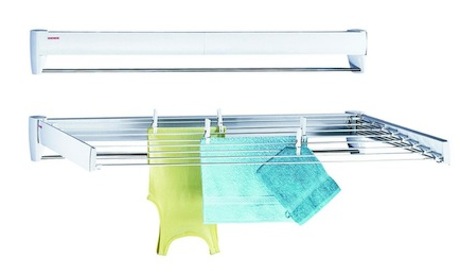
leifheit-telegant-clothesline

The Telegant is ideal for smaller loads. Available in either 28″ or 40″ wide versions, this wall-mounted rack is an ordinary towel rack when closed, but features a telescoping drying rack with eight lines totally 26′ of drying line when opened (five and 14′ for the 28″ version). Prices on Amazon are $32 and $43 respectively.

III. The New Clothesline Company LOFTi
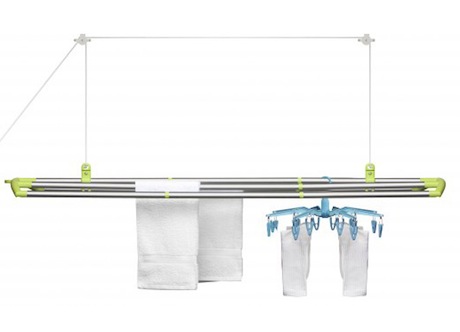
ceiling-laundry-drying

If you have high ceilings, this pulley mounted ceiling drying rack is pretty ideal. It has 22′ of drying rack space and a number of accessories such as a mobile-like sock hanger that help increase capacity. It’s available for $80 through IPPINKA.
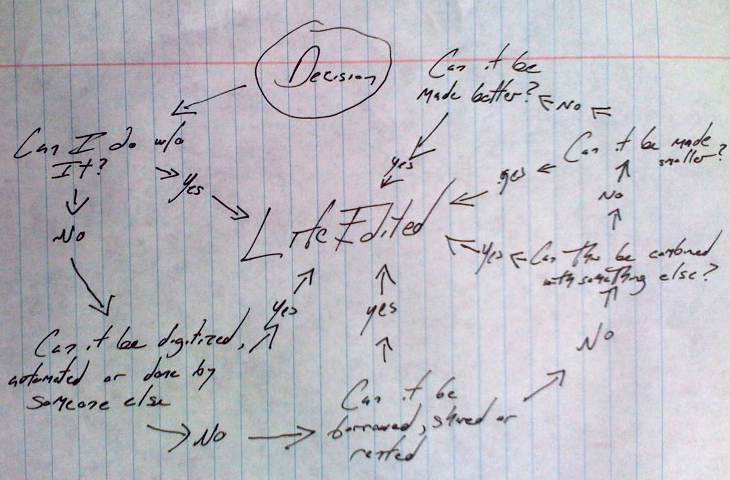
6 Questions to Ask Yourself Before Doing Anything

Life involves decisions: left or right, black or white, big or small, to be or not to be. While we don’t want to be too prescriptive as to what constitutes a “LifeEdited” decision consistent (it looks different for different people), we have some fairly universal questions to ask yourself when in decision mode.

Below are 6 questions that work for almost any decision–whether it’s about tasks, purchases, work, recreational activity, etc.

Note: the questions are sequential; if you answer yes to one question, you don’t need to answer the following ones. For example, question #1 is “Can I do without it?” If you answer “yes”, then it’s pointless to ask the following questions because there is no longer and decision to make.

Here they are:

  1. Can I do without it? This should be the gatekeeper for all decisions. Nothing simplifies like elimination. Do I really need this? Do I really want this? Do I really have to do this? Look at the full picture, e.g. you might want a Porsche, but don’t want to pay for it. You might want an opulent lifestyle, but don’t want to work so hard to get it. Doing without leaves us less to maintain, manage, clean, pay for, and so on. It also allows us to pay closer attention to the things we can’t do without.
  2. Can it be digitized, automated or done by someone else? This question removes spatial or temporal volume from our lives. You might need an item or something done, but ask if it can take up less space and time. Can your old tax returns be put on PDF’s? Can your bills be put on auto-pay? Might you be better off hiring someone to fix the toilet than doing it yourself? Our lives are often lost in teaspoons–small purchases and tasks that eventually create great mounds of clutter and confusion. Seize every opportunity to reduce volume.
  3. Can it be shared, borrowed or rented? For most of the 20th Century, ownership was the aim. But today, there are many great ways of accessing and using without the burden of owning. Ask yourself, is it totally necessary to have fulltime possession? If you only need a car once or twice a week, might it make more sense to use Zipcar rather than keeping a car on standby? Can you borrow a dress for that event? Possession requires maintenance, storage and money. Some things are worth that price. Many are not.
  4. Can this be combined with something else? Can that table also be my desk? Can I get a Murphy bed instead of a traditional one? Can I pick up my laundry and groceries? If we’re going to get or do something, why wouldn’t we make it as efficient as possible?
  5. Can it be made smaller? Assuming you need to have or do it, assuming it can’t be digitized, borrowed or be made multifuctional, can this be smaller–either spatially or temporally? Can I find bowls that nest or tables that stow? Can I spend less time paying bills, weeding through junk mail or email? Less space and less time equals more room to live.
  6. Can it be made better? You can apply this question to all fields. If you’re buying stuff, remember that something might be twice as expensive, but if it lasts 4 times as long, it’s half-priced. Wherever possible, get the good stuff you like. Same principle holds true for tasks. If you’re going to do a job, why not do a high quality job? It might take a little longer in the short-term, but save time and energy in the long. This question asks, “What would your life be like if everything you had and did was of excellent quality?”

This post was originally published on June 20, 2012

CitiBike + ThinBike = Less Space for Same Bikes

You might put this in the “who asked you” file, but we imagine some of the brouhaha that erupted over the recent release of the CitiBike bike share program might have been minimized had the bikes taken a cue from the ThinBike that founder Graham Hill designed with the help of Schindelhauer. The ThinBike has a quick release on its stem that easily allows its handlebar to turn and lock so it’s parallel with the rest of bike, rather than perpendicular. This set up cuts width in half or more, making storage far easier.

thinbike-specs-lifeedited

The CitiBike’s controversy stems (pun intended) from the girth of its docking stations, which people have complained are eyesores on New York’s historic streets. People have also complained that the stations hog up the city’s few parking spots (of course, some might consider this a bonus). If the overall width of a CitiBike could be cut in half or more, there would be a commensurate space savings in the overall docking station’s length. You could fit 60 bikes where 30 once were. More important, you could fit 30 in a space that might have only held 15. This smaller footprint on city streets might allay some of the complaints of CitiBike critics. If you think the extra step will invite the lawyers, know that when you straighten the bar on the ThinBike, there’s a bolt that makes a very positive engagement so you know the bar is locked.

Whether it’s fitting more bikes on a block or chairs in a closet, at LifeEdited, we’re always asking how can things be done smaller, better and using less space.

Take A Historical Tour of Space-Saving Design

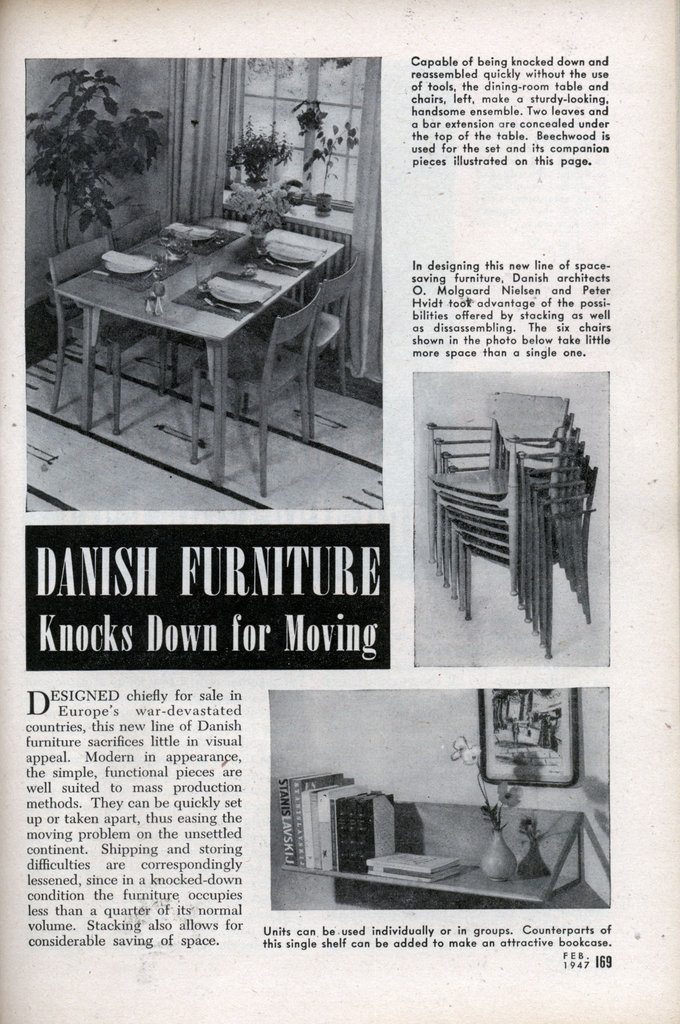
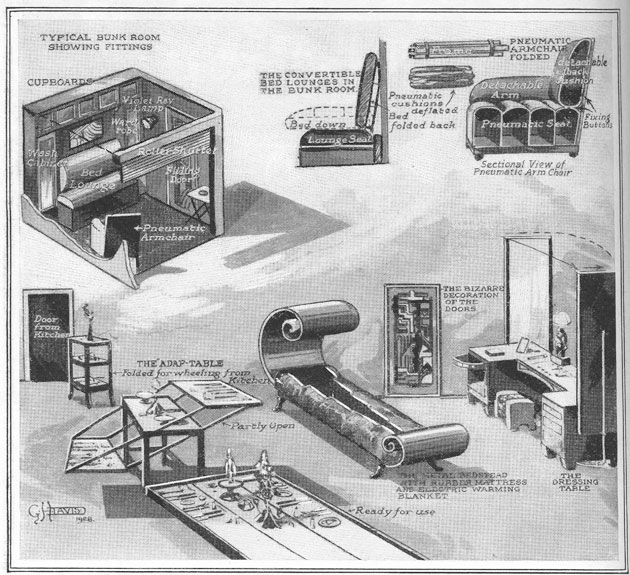
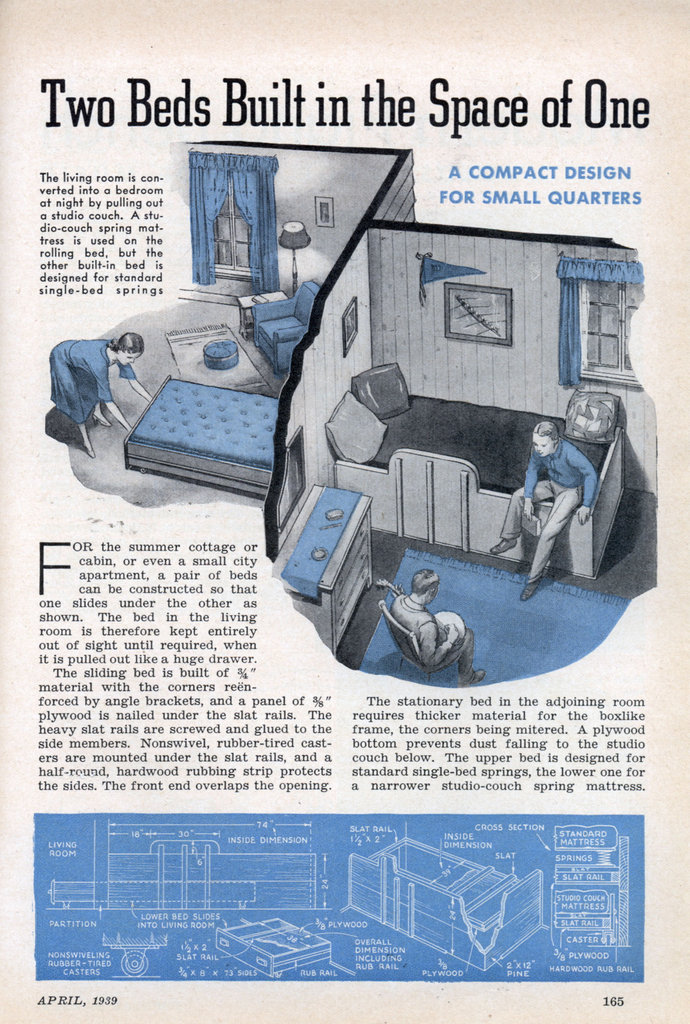
If you think space saving furniture, multifunctional design and tiny transforming spaces are a new idea, think again. As long as humans have tread the planet, they’ve been looking for ways to make their homes more space efficient and products more versatile. We went through the awesome website to Modern Mechanix and found several ingenious–and questionable–space saving designs dating all the way back to 1915.

click on images to expand

Via Modern Mechanix

This Little Italian Kitchen Has Spine

We were turned onto this innovative column-kitchen (not sure if that’s a proper term) that was released at the recent Milan Furniture Fair. It’s called ECooking, designed by Massimo Facchineti and, unlike many concept designs, will be manufactured by Clei, the same folks who make the Swing sofa/bed in the LifeEdited Apartment.

The little unit is packed with features:

  • Kitchen basics: Oven, fridge, induction cooktops, sink, dishwasher and espresso maker (an Italian basic)
  • Multi-stage water filtration
  • Herb garden that uses filtered grey water
  • Built in ventilation and UVA light for your herb garden
  • Counter surfaces that creates seating for six
  • Storage
  • Rendering shows a solar paneled back to power entire house (unconfirmed).

Ecooking-Clei-back

Again, the cool thing about this is the fact that: A. it was made and B. is going to be released. Resource Furniture says it should be available early to mid-2014 (no price or additional details available just yet). We suspect some of the features, like the solar panels, might not carry over from concept, but even the basics are pretty cool.

While ECooking might not be ideal for someone who regularly hosts large dinner parties, it seems like a perfect compliment for a micro apartment where it would significantly reduce the kitchen footprint while providing more than enough function for the small-scale gastronome.

Japanese Family of Six Thinks Inside the Box

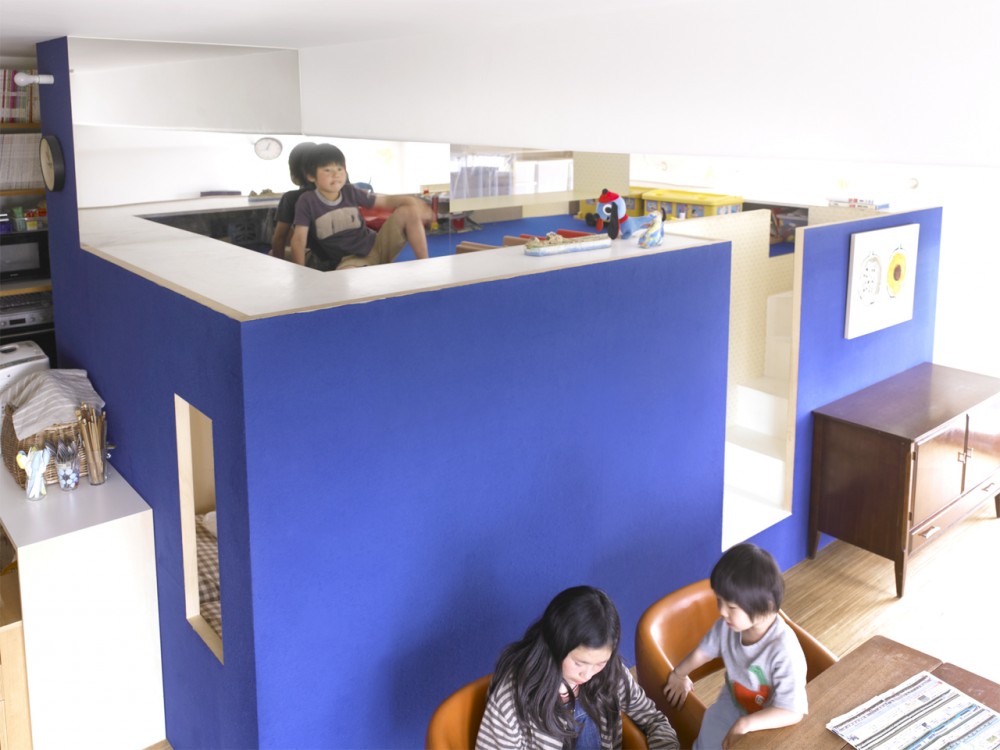
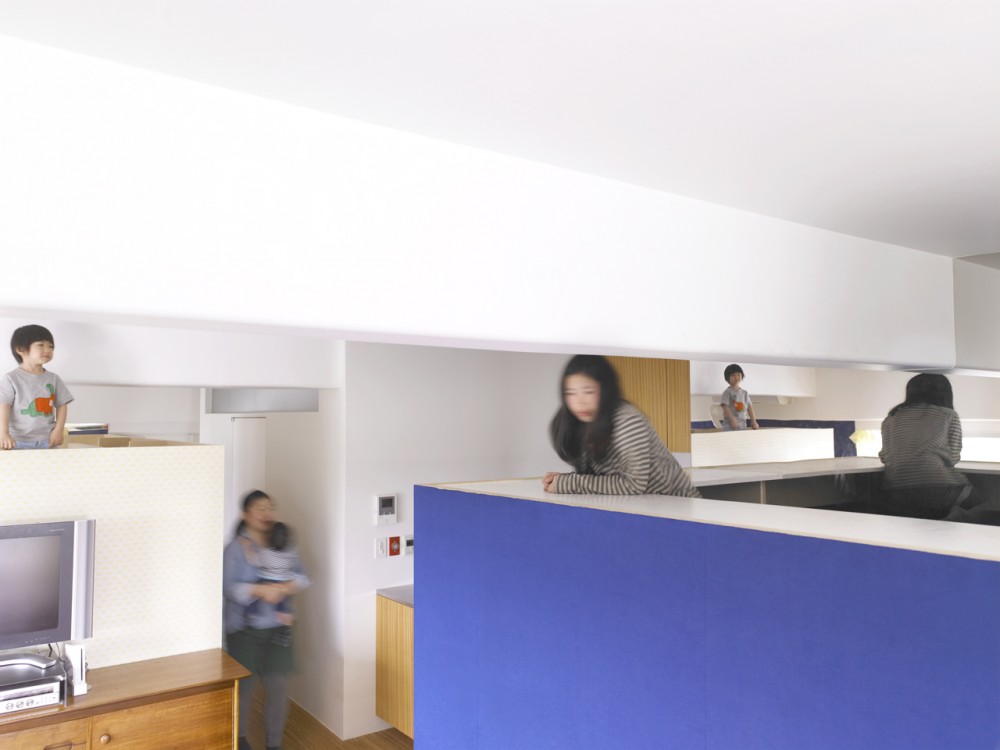
A few weeks ago, we saw how one man conveniently stashed his kid in a cubby in his tiny Warsaw apartment. Several thousand miles away, a husband and wife went a bit further, stowing their four children in little cubbies in their 770 sq ft Tokyo apartment.

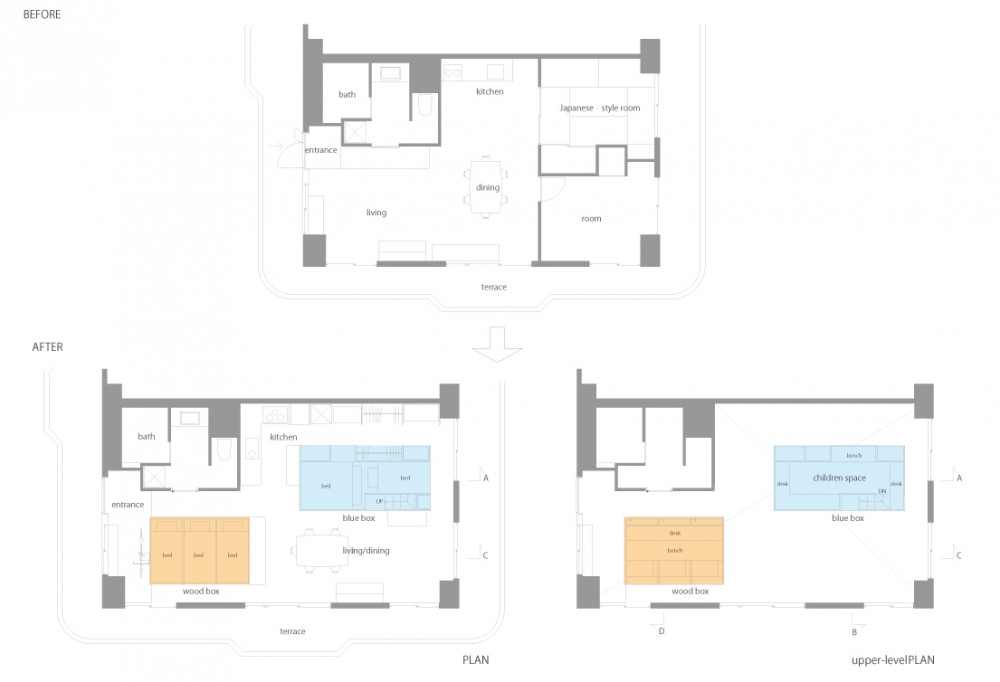
To do this, Miha Design, the firm responsible for the renovation, converted the original apartment, which included one bedroom and a traditional Japanese room, into an open floor plan.

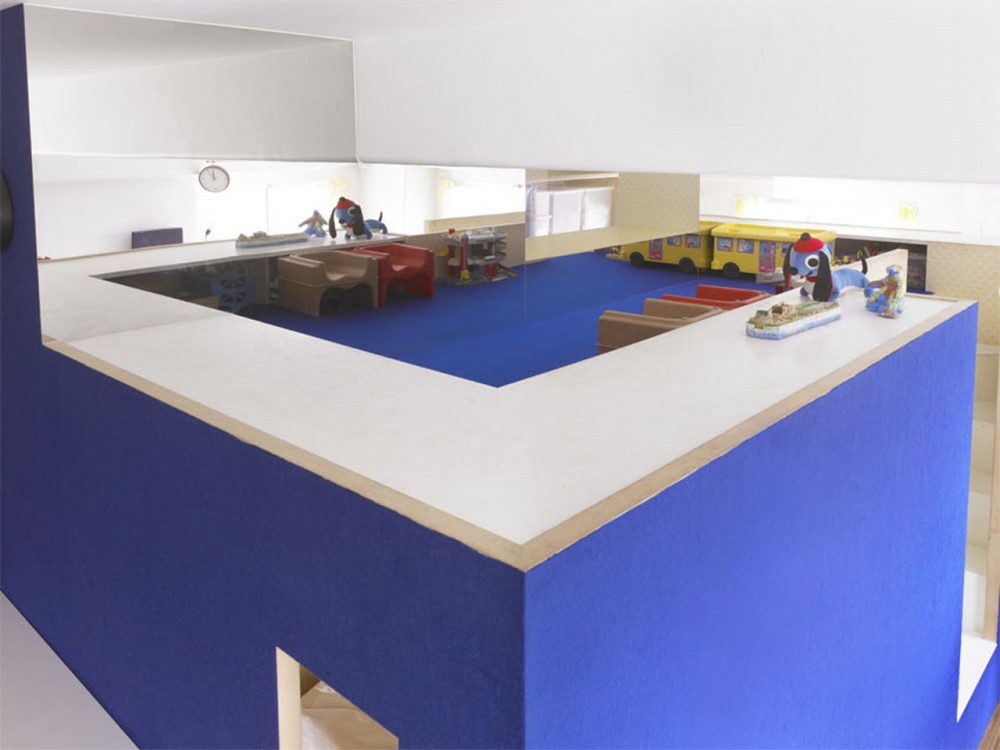
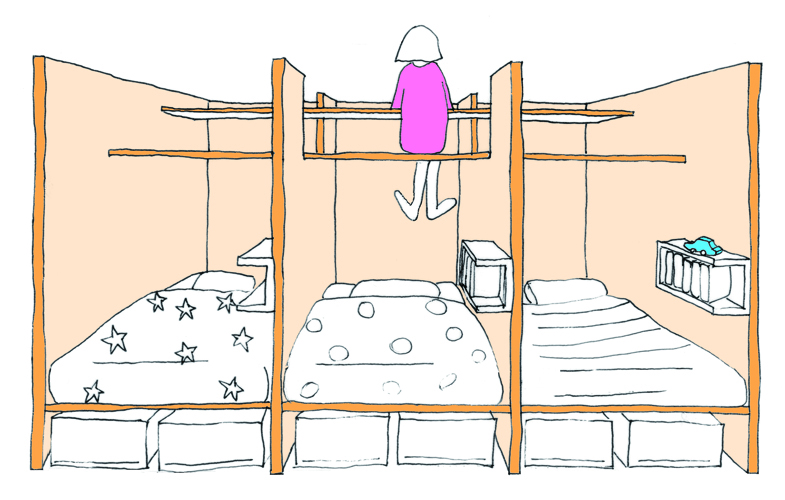
They created space separation by erecting two large boxes that house several discreet spaces. One box–covered with blue felt–contains three sleeping cubbies for the younger children; on its top is a 1.1m high play area–suitable for young children to scoot around. There are desks and benches on top as well; slots for legs allow the kids to sit upright. Under the beds are storage bins for the kids’ stuff.

The second box has a wood finish and beds for the parents and eldest child. The top has a similar desk and bench setup as the other box, albeit less blue.

The rest of the space is comprised of a dining/communal area, a galley kitchen, an entrance way and a storage area.

People are always asking us how to fit families in compact spaces. Miha Design’s space is one possible version, demonstrating a creative way to fit a large family in a small space in an expensive city–while still maintaining some semblance of separation for each family member. We do wonder what will happen when the kids grow up and cease to fit in their cubbies or start knocking their heads on the ceiling. We also suspect the dangling leg design might not fly with every parent.

All photos by © Sadao Hotta

Via Arch Daily

Tetris-Like Office Creates Space, Grants

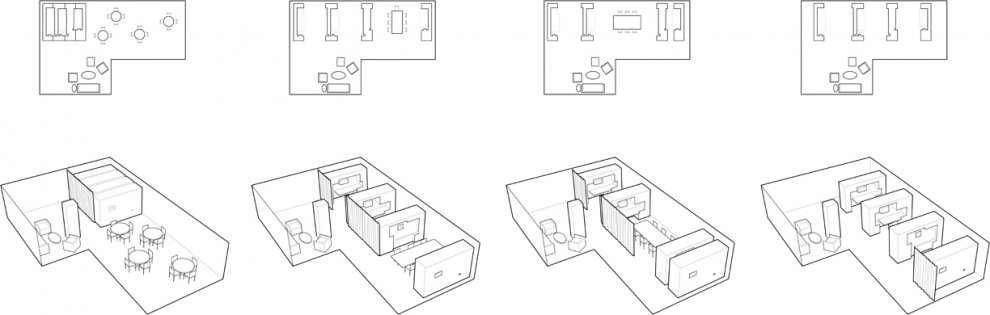
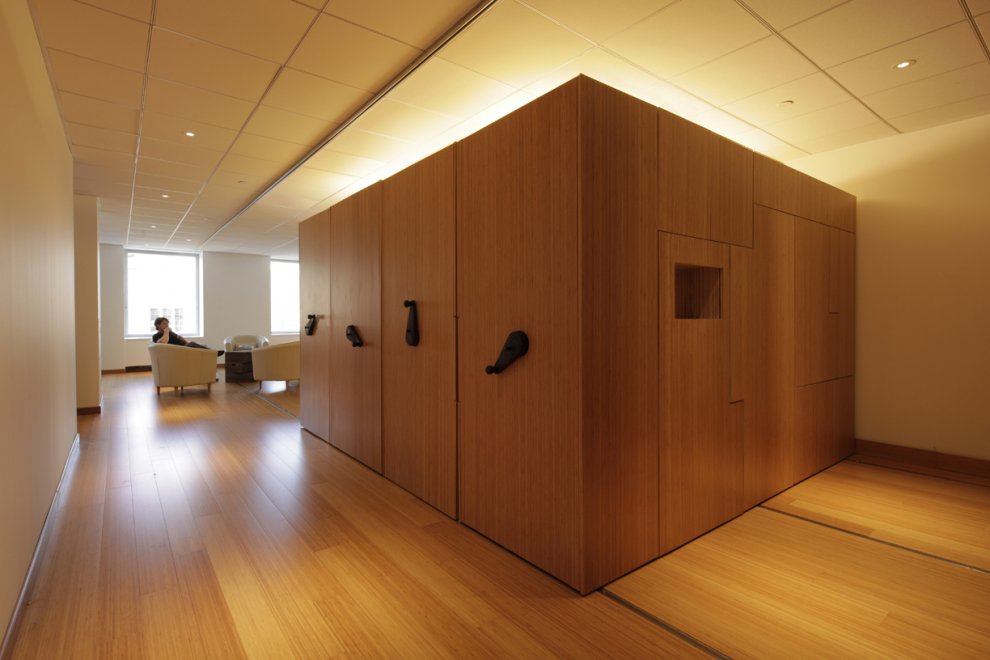
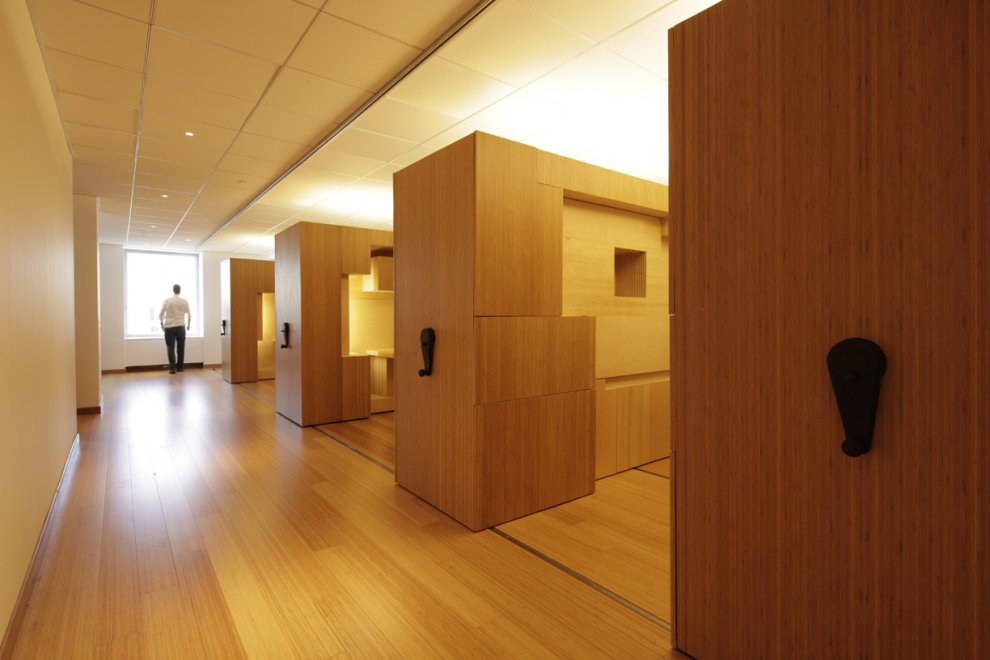
A couple weeks ago, we talked about how your office will disappear. Well, the office for Environmental Grantmakers Association (EGA) takes that concept literally. Its designers Taylor and Miller Architecture and Urban Design incorporated collapsible walls that make the office disappear.

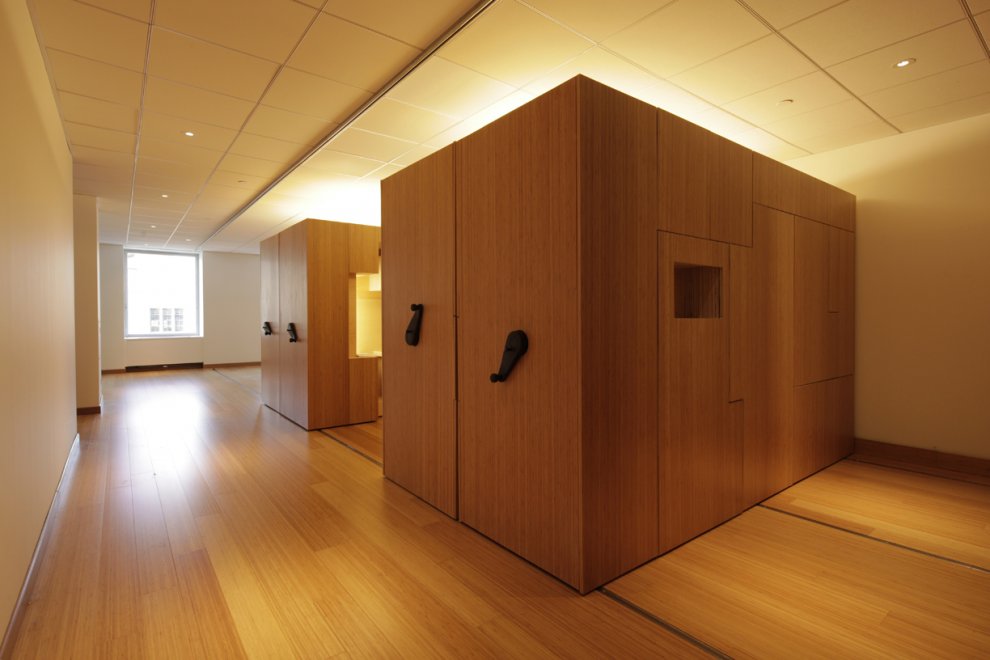
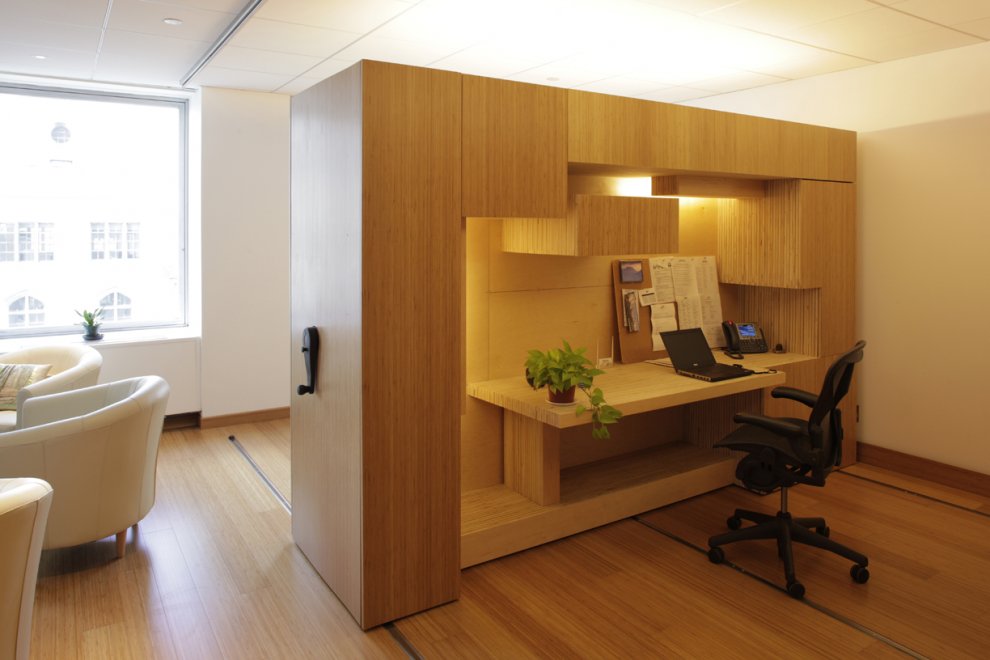
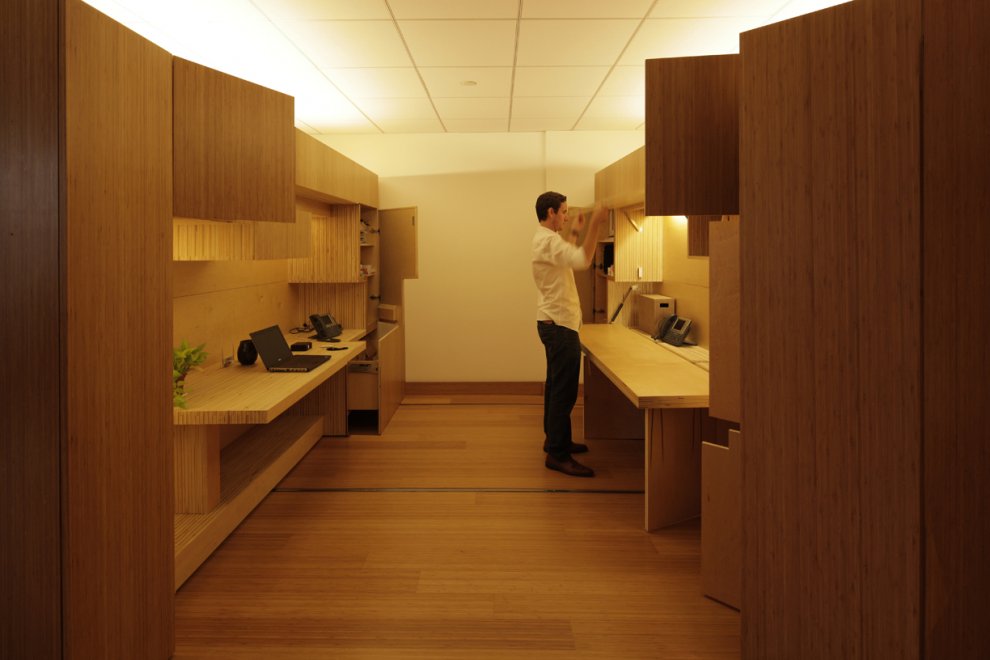
The office’s four interlocking walls house seven work stations and ample storage. When opened, they can be configured as workstations or even a boardroom. When compressed, they create an open floorplan for events and various other purposes. You can compress some of the walls and extend others to create a highly dynamic space.

The walls have an innovative way of working together. From Taylor and Miller:

When occupying the space between two partitions, one can see that the inward faces of each has been excavated with the same shape. In other words, what is a storage box protruding on one side is a recessed storage cubby hole on the other. In this manner, the partitions are bound together spatially; the relationship between them becoming stronger and stronger as they are compressed together… until finally they are collapsed completely concealing the carved space within.

The design is very similar to the LifeEdited Apartment‘s moving wall, which rests on a track and carriage manufactured by Modern Office Systems, whose primary business is large file storage systems. Taylor and Miller sourced their track from Pipp Mobile. Our unit cost about $4500 for just the track and carriage (i.e. not including the cabinet above). Additional reinforcements had to be made to the floors to support the concentrated weight of the wall. While this is a fair amount of labor and money, they’re invaluable in small spaces, where access to all the space all the time makes a huge difference. Why have a guest room 365 days a year when you only use it 20 nights? Why have a boardroom all the time when you only use it a few times a week for an hour or two? The financial and environmental costs of maintaining unused spaces quickly makes a compelling argument for incorporating more systems like these in our interior designs.

Photos by Emile Dubuisson

Via Architizer

10 Ways to Save Money When Furnishing Your Small Apartment

Finding the right furnishings and housewares for your small apartment can be a fun experience. Yet even in a small space this can get expensive fast if you don’t know how to save money on all the basics you’ll need. While apartments generally cost less to buy stuff for than larger homes, based on the limited space you are working with, you can still shop smart and frugally, allowing you to save as much money as possible. You can direct your savings to other needs like throwing your apartment-warming party.

Here are ten simple tips to save money on all your apartment furnishings, décor and other apartment needs:

  1. Buy adaptable pieces. One of the best ways to get more out of your apartment and your lifestyle is to stick to furniture and housewares that serve more than one purpose. This will allow you to adapt and move things around as your needs change, without having to buy more. Choose a high-end futon with a generous cushion to serve as a bed for guests, or benches that double as storage chests. Try adding an armoire for storing either clothes or entertainment items in cramped spaces.
  2. Choose quality over quantity. You are better off spending a few extra dollars on a high quality used piece of furniture for your apartment than buying a cheaply made newer piece. Look for sturdy hardwoods and metals, which offer flexible décor options. A well-made table with simple lines can serve as a desk, a dinette, or a place to tuck a television.
  3. Buy multiples. This might seem counterintuitive with a small apartment, but if you find a good deal on items you like such as dinnerware, bedding, or other apartment needs, it often makes sense to stock up. You’ll very often be able to buy box lots of items or come away with some great bargains buying several pieces from a container store or wholesaler. This will save money and keep you stocked for years to come.
  4. Shop locally. Chances are your neighborhood has several thrift stores or antique stores where you can pick up some amazing deals for pennies on the dollar. Visit these places with an open mind, and don’t be afraid to ask for what you need or for a break on a price if something catches your eye. Local retailers will work with you in ways big chain stores will not–plus it supports your community.
  5. Swap or trade. Have something you are looking to replace? Try putting an advertisement on a free community swap of website like Yerdle and ask for something in trade. You may be surprised to find that other people are trying to get rid of something that would be perfect for your place.
  6. Go for impact with art. When it comes down to buying for your apartment, there’s no better investment than a great piece of artwork. Shop your local community stores, head for auctions, and visit the local art colleges for unique artwork to adorn your walls. It will look like you spent a fortune.
  7. Avoid fads. When buying for your apartment, stay away from the latest styles in furnishings and instead opt for the classics in furniture and fabrics. You’ll usually end up with things that last longer and don’t cost as much.
  8. Buy post season. Sales occur after every major holiday, and this can be an opportune time to buy things for less than half of retail. Good things come to those who wait, for clearance sales!
  9. Shop with friends. Your friends are likely to have an eye for style, so be open to going in on deals with them. For example you may need a new living room set, but you don’t need all the pieces. Go with a friend who needs some new tables or a loveseat, and split the cost of a marked down set. You’ll both come out ahead.
  10. Be eclectic. Shopping for an apartment on a budget means that you may need to develop a décor style that mixes and matches pieces. Try adding a few modern things in with classic glamour, for a unique apartment that’s all you.

Decorating and buying for your apartment takes careful planning and strategic shopping. Think about all the ways you can save money and only bring in items that look good for your space, and are made well. Over time, you will want to repurpose these items in other ways, so think ahead as you furnish your place.

Mark Russell writes about apartment living and frugal apartment living tips at Apartment Guys.

Image credit: Shutterstock.com

Is it a Sleepy Living Room or Lively Bedroom?

In the coming months, we will be highlighting products and services we use in the LifeEdited apartment. Today, we’re looking at the Swing Sofa/Bed from Resource Furniture. 

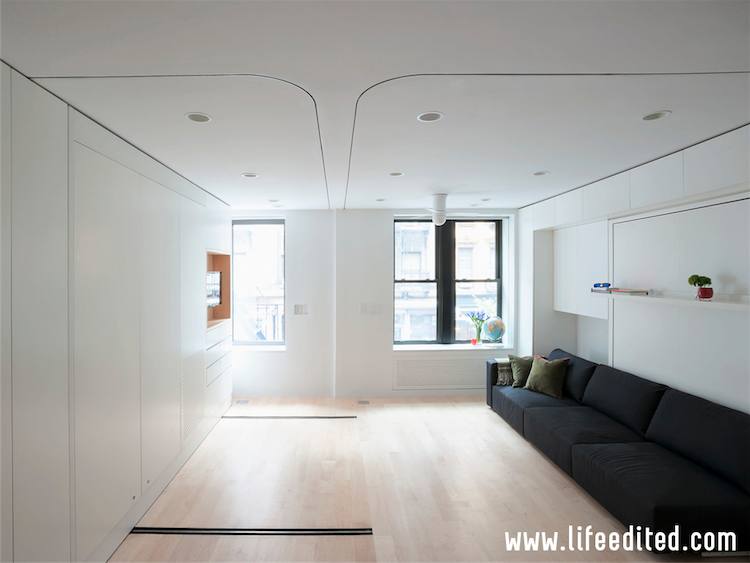
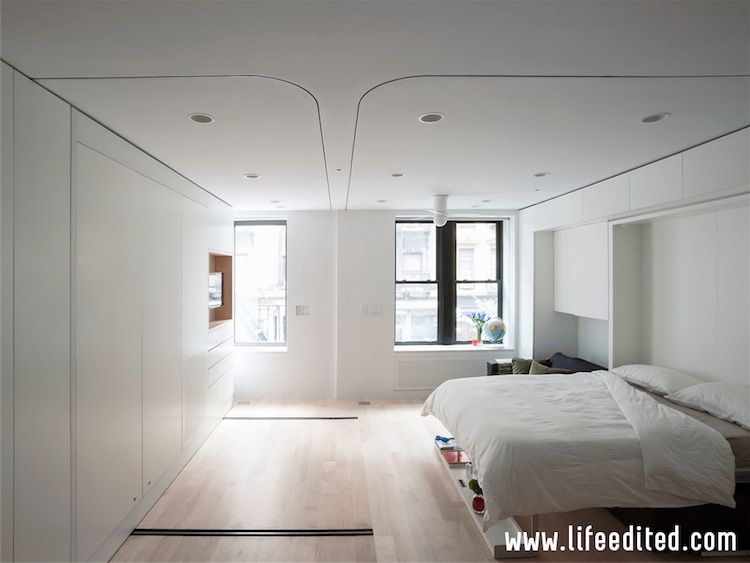
The Swing sofa/bed from Resource Furniture is probably the most important piece of furniture in the LifeEdited Apartment as the master bed and couch are arguably the two most important pieces of furniture in any home. It serves the vital function of easily converting our comfortable living room into a comfortable bedroom.

Standard Murphy beds require their front-sides to be clear before lowering their beds. The Swing utilizes this valuable frontal real estate because its bed, when lowered, is higher than the full-sized couch that sits flush with the frontside of the unit. This exploitation of all available space is crucial for small homes, where every unfilled gap cuts into valuable square footage.

The Swing is designed and manufactured by Clei in Italy. Here are some of its key features:

    • Easy, one-handed lowering of the bed.
    • An available chaise lounge, which can be attached to either side of the sofa. With the chaise, the sofa is 9′ 2″ wide.
    • The chaise version has an upper shelf that provides and additional 6′ of storage (note: The LifeEdited version does not include this feature).
    • An aluminum bedframe with steam-bent beech wood slat supports.
    • A bookshelf that holds up to 25 lbs and stays level when the bed is pulled down.
    • Storage under the sofa seat for bedding or other items.
    • A self-standing/self-supporting structure that requires no attachment to the walls or floor. It is a ‘wall-bed’ that makes its own wall and can be used as a room divider.
    • Available in more than 40 finishes, melamine, lacquer and wood veneers. Available in 30 CARB 2 compliant (California Air Resources Board) finishes.
    • Available headboard cushions that provide cushioning and eliminate the gap between mattress and backboard, ideal for reading or watching TV in bed.
    • Available in 100 different fabrics options.
    • Available LED interior lighting.

Amazingly, the entire depth of the system when open for sleeping is only 6.5” longer than a standard mattress.

Prices for the non-chaise version start at $9100 and $12,850 with chaise. Bank on an extra $800 or so for a mattress. No this is not cheap, but this is a quality piece of furniture you will have for years. Furthermore, consider the Swing could eliminate the need for a dedicated bedroom. How much does an extra bedroom cost? In a city like New York City, real estate can easily fetch between $500-$1000/sq ft. Let’s say a very small bedroom is 70 sq ft–in other words, 35K-70K!

The difference between a studio rental and a one bedroom, or between a one bedroom and two bedroom can easily be $1K/month difference. The Swing could pay for itself in a year and you’d have a great piece of furniture to take with you to your next place.

Looked at in either of these lights, the math becomes quite different.

For more information, visit www.resourcefurniture.com or stop by their New York City showroom.

Why You Should Give a Washit

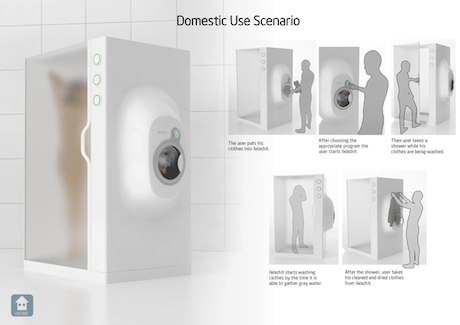
In an effort to reclaim some of the billions–probably trillions–of gallons of perfectly good water sent down the drain, a few Turkish designers created the unfortunately-named, brilliantly-conceived combination shower/washing machine/dryer Washit, which uses your filtered shower water to wash your clothes. It actually goes one step beyond most grey water systems, which will often have one-stage water recycling–e.g. using sink water to flush a toilet then onto the sewer. Washit continuously filters and reuses the same water, only replenishing when there is water loss.

washit-how-it-works

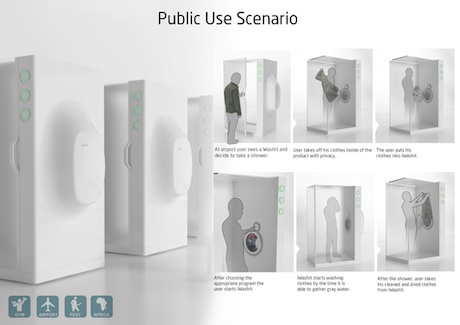
One of the more interesting ideas is the public version of the Washit, which allows people to step inside the unit, strip and load their clothes from the inside, then take a shower whilst their clothes are cleaned and dried. This would be great for airports, gyms and late-night partiers.

Washit-private

washit-public

There is no indication of how long a Washit cycle is. In fact there is no indication that the Washit is ever going to make it to market, though we hope it does. Most modern plumbing systems waste both water and space. By creatively combining water-consuming apparatuses as Washit does, we can cut down on space and water waste. Now about the name….