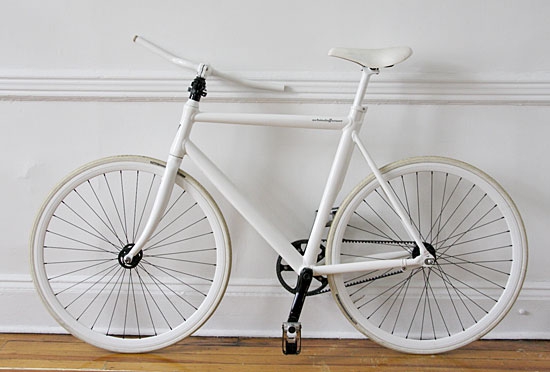
ThinBike Slices Your Bike in Half

Bike storage can be a hassle in small spaces. It’s bad enough that you have this big rectangle; but then you have handlebars and pedals jutting out, ready to snag a passerby. And while easy-to-stash foldable bikes are great, sometimes our riding habits and preferences demand a full size frame and wheels.

To solve this issue, LifeEdited founder Graham Hill put this “ThinBike” together with German company Schindelhauer. The bike features fold-up pedals by MKS and a quick release stem by Speedlifter that allow you to put the bars flush with the rest of the frame. All this allows the bike to go from a portly 21″ width, to a mere 6″.

While the $1800 package that Graham put together–replete with Gates Carbon Belt Drive and white rims to match the white tires–might be a bit steep for many, retrofitting your current bike with the stem and pedals can be done for about $200.

Could You Live in a 90 Square Foot Apartment?

New York City is filled with small apartments. With an average home price of nearly $1.2M, New Yorkers quickly learn how to live to with less space. But even in this squeezed city, Felice Cohen’s 90 sq ft apartment is extreme.

Cohen is a professional organizer, writer and artist (whose medium is appropriately Shrinky Dinks). She pays $700 rent for the micro-apartment, which might sound like a lot to non-New Yorkers, but consider that the average rent in her neighborhood is over 5 times that amount. By keeping her overhead low (literally and figuratively), she explains that she is able to be financially responsible while making a career through her creative pursuits.

This space might be too tight for many of us. In fact, it turned out to be too small–and illegal–for Cohen, who was evicted because the apartment was being illegally subletted. Nevertheless, she gives some great tips for living happily in a small space:

  • Regularly weed through possessions, getting rid of what you don’t need.
  • Her membership at a collective workspace is an economical way to expand effective real estate.
  • Using the city’s libraries, parks and cultural centers as extensions of her home.

Do you think you could live in such a small space? What tips would you add to Cohen’s for living more with less?

via Fair Companies

Density Atlas Asks How Many People Can You Pack in a City Block?

It’s no secret that we advocate an urban future here at LifeEdited. With a world population topping out over 7B people, cities offer the clearest route to a bright, sustainable future.

But cities are not created equally. A city’s urban density often reveals more about its resiliency than its population suggests. Dense cities can manage transportation, energy, distribution of goods and human capital better than their spread out, low-density counterparts.

The problem is that density is not a monolithic metric. It is generally measured in 3 ways:

  1. FAR (foot area ratio) divides usable square footage of a building, block or development by its lot size; e.g. if a 1000 sq ft building sat on a 1000 sq ft lot, its FAR is 1 (1000/1000).
  2. Dwelling units (DU)/acre measures how the space is divided; e.g. that building with an FAR of 1, could either be 1 luxury or 4 x 250 sq ft efficiency dwelling units.
  3. Population/acre. This metric is useful because the number of people living in a dwelling can greatly vary; e.g. a block in San Francisco with the same FAR and DU/acre as another in Hong Kong might contain 50% less population because more people live in the Hong Kong units. Pop/acre captures the gross population regardless of how the area is divvied up.

Started by a group from MIT, Density Atlas helps you understand various city developments and neighborhoods from all of these perspectives. For example, it shows how the author’s Brooklyn home compares to the Mumbai slum, Dharavi. Brooklyn averages a respectable FAR of 5.8, has 195 DU/acre and 369 people/acre. While Dharavi has a lower FAR of 2.0, it has 255 DU/acre and a whopping 1274 people/acre. In other words, even though Dharavi’s FAR is 1/3 of Brooklyn’s, it has 24% more DU and 350% more people/acre!

Whether you’re a professional or armchair urban planner, Density Atlas reveals the variability and complexity of global urban development. It shows how city-living means different things in different contexts. More developed countries often have great FAR’s, but low DU and pops./acre, while developing countries often have lower FAR’s, but astronomical DU and pops./per acre.

We suspect the future lies somewhere between these two camps–where the efficiency and amenities of modern cities is alloyed with the developing world’s willingness to get close to your neighbor.

We’d love to hear what you think.

via Density Atlas

Image via flickr

Amazing Single-Serving Dishwasher

It’s bad enough that your parents keep urging you to meet a nice girl/guy. You shouldn’t have to take grief from your appliances as well–that huge, perpetually under-filled dishwasher reminding you of your parents’ petitions. No longer.

The Instant Dishwasher by Robert Lange and Bosch honor your singleness. The experimental, space-saving design provides enough room to clean a couple place-settings, which for most bachelors/bachelorettes (or couples who don’t cook a lot) is all that’s needed on a daily basis.
Via Yanko Design.

How Much Space Do We Really Need?

When my parents were kids, their parents slept in the dining room. These were not poor people. They just figured the dining room was so seldom used, why not put it to use?

Fast forward 60 years and for many Americans it’s unimaginable for parents to be without their own room (or in many cases, a child). Suburban sprawl and cheap construction has changed our view of what constitutes an acceptable amount of square footage. The above figure shows the average new home size in the US near its peak in 2006, as well as sizes for several other modernized countries. Keep in mind that these other countries aren’t slumming it; many (if not most) of them are believed to have higher standard of living standards than the US. It’s clear that the space we need is as much cultural as functional.

What if we started fresh and looked at what we actually need from our homes? We would probably end up with much smaller homes, which have the advantage of being less expensive, consuming less energy and being easier to upkeep. Also, by incorporating smart architectural and product design, we can pack amazing utility in small footprints. See this gorgeous 620 sq ft apartment that houses a family of 4 for a perfect example of this new/old way of living (via Dwell).

Space and Energy Saving Kitchen Shelves

Dish Drying Closet Design

Design is a plan for arranging elements in such a way as best to accomplish a particular purpose. –Charles Eames

This cabinet with drying-rack shelves eliminates that awkward, space-hogging standalone rack that never quite fits in the sink or the counter. Clean dishes go directly from sink to storage versus sink to drying-rack to storage, reducing labor and arguments about whose turn it is to put away the dishes. It also proves that smart design is not rocket science. It’s a willingness to examine the way things are done and see if they can be done better (via Dornob).