What You Should Know Before Living in a Tiny Home

In a recent article, Dwell runs down ten things people should consider before making the jump to small living. Our man, Graham Hill, gets a feature sitting at #1 noting that consciously decluttering your stuff is paramount to living small but also to “buy less, but better”.

Another great tip mentioned in the article comes from tiny apartment designers, Nina Tolstrup and Jack Mama (pictured above) of Studiomama. If tiny living seems like a big jump, they recommend to “rent a small place on Airbnb to try out small-space living first”. It’s a great way to temporarily live the tiny house dream without the commitment. There’s also a side perk of getting a vacation out of it as well. Places like Getaway House, Caravan Tiny House Hotel and Tiny House Siesta are already capitalizing on the tiny rental market.

For the full rundown of Dwell’s 10 tips, click here

Photography is by Rei Moon of Moon Ray Studio


A Guide to Buying a Refrigerator for Small Apartments

For the most part, American appliances, including refrigerators, fall into two categories: Big and nice or small and cheap. In other words, it’s tough to get small and nice if that’s what you’re after. But doing nice and small can be done, even in America. After a few years of research, we thought we’d create a general guide that might help you select the right fridge for your small space.

The Basics

Stating the obvious, what makes small space appliances suitable for small spaces are their size. We’re going to limit our discussion to 18” and 24” wide refrigerators, which are the two most common widths available. 24″ is far more common than 18″. 27” and 30” models, while suitable for some small spaces, are not your most compact option.

There are far more variations in height. Broadly speaking, there are counter height and standard height fridges. The former tend to run around 32-34” so they can fit under a standard 36” countertop. The latter usually range from around 60” to 80”.

Most fridges are counter depth, meaning their overall depth is around 24”, give or take, so they don’t protrude too much beyond the counter,.

Fridges can be Energy Star rated, which means they are 9-10% percent more energy efficient than models that meet the federal minimum energy efficiency standard. Most middle to high end fridges will have this certification, but low ends will not necessarily.

integrated

Perhaps the most important consideration is how the fridge will fit the layout and aesthetic of your kitchen. Most people buy a new fridge because theirs died or they are doing a larger renovation. If you’re in the former category, you might consider finding a model that roughly fits the dimensions of your previous model. If you’re redoing your kitchen, you’ll want to think about how the fridge fits in with your cabinetry (more on sizing in a minute). Especially important is what, if anything, you’re doing above the fridge (keeping it open, more cabinets, etc).

If you have the money, we’d suggest a panel ready fridge, which means it’ll accept custom panels matching the rest of your kitchen’s cabinetry. This is generally only found on premium fridges and the panels aren’t necessarily cheap either. But it creates very streamlined looking kitchen.

Down from panel ready are stainless steel clad appliances, which tend to look and clean up better than painted models, which are how the least expensive fridges are clad. 

Counter Height Fridges

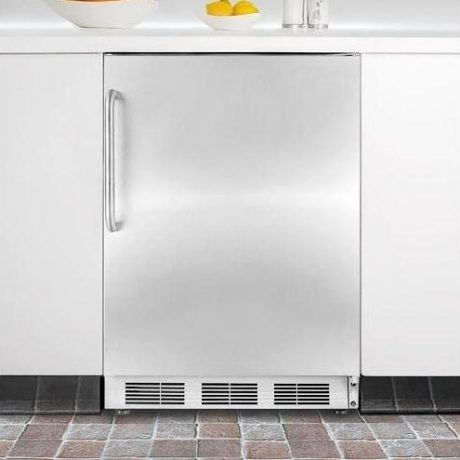
Counter height fridges are great if you want to save space. They take up minimal volume and permit more counter space as the surface isn’t interrupted by a fridge. But they have some notable drawbacks. The first is storage volume. A normal counter height fridge has around 5-6 cubic feet of storage. A fairly standard 60” high model will have two times that. This amount of volume might be fine for a single person who doesn’t cook often or shops every couple days, but for many people this amount of space quickly becomes limiting. 18″ models are available as well, but are mostly suitable for keeping last night’s leftovers cool.
summit-undercounter

The next issue is that most counter height fridges have manual defrost (all fridge models are available if you don’t need a freezer). This means every month or two you must let your freezer compartment thaw out. And up until that point, the compartment get smaller and smaller as layers of ice form around the interior of the compartment. It’s a pain. The Avanti RA3136SST is one counter height fridge with auto-defrost, but because of its size (3 cubic ft), it’s mostly suitable for people with Smurf-like appetites. The U-Line 1000 series will also do the trick…for $2K.

summit-interior

If you’re looking for other non-manual defrost fridge/freezer combo options, you can choose a drawer style fridge. We used the 27” wide Sub Zero 700 BCI in the first LifeEdited Apartment (pictured at top, since discontinued). It looked really nice as it accommodated custom panels. But its limited storage volume and height (you couldn’t stand a bottle of wine upright) limited its functionality. At around $2500, it was also very expensive. In fact, most drawer fridges are more expensive than their standard size equivalents, starting around $1500.

Our overall recommendation is to only go for a counter height if space is really limited and/or you are not a serious cook or you only like dealing with very fresh food. In terms of manufacturers, Summit probably makes the most number of models, though most manufacturers have counter height options.

Standard Height Fridges

If you have a bit more room to play with and you like keeping things on hand that you don’t cycle through very fast (condiments, wine, etc), we recommend going with a standard height fridge. With 10+ cubic feet of storage, they are far more practical for most people. And unlike counter height fridges, almost all have automatic defrost. Finding a model that works for you is mostly a matter of budget and aesthetics.
danby

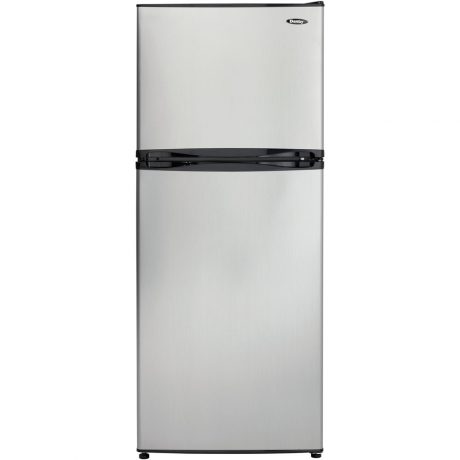
If you’re looking for an affordable 24” compact fridge, there are a number of options. You could pick up the Danby DFF100C1BSLDB for around $500. At 24” x 60”. These and others like it are the kind of fridges most landlords buy. They’re not sexy, but this level of fridge tends to have a reasonable 10 cubic ft of storage and it’ll keep your stuff cold. What more do you need?

Up from there you could get into some nicer stainless steel fridges like the LG LBN10551PS. It’s 24” x 68” and has 10 cubic feet of storage volume. At around $800-900, it’s a little more expensive, but it looks nicer than the Danby-level fridges.

Up from the LG are the more premium European style 24” models. These tend to be between 70-80” high and have more storage. They can be purchased panel-ready, allowing you to seamlessly integrate them into your kitchen.
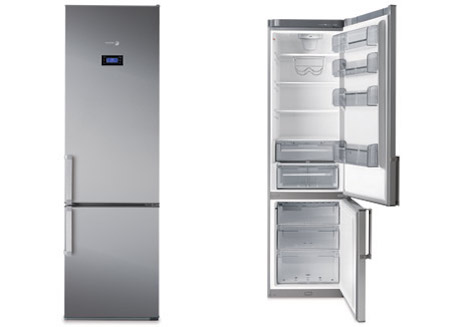
fagor

For one of our projects, we used a Fagor model and it’s worked out great. It measures 24” x 80” and has about 13 cubic feet of storage. Like most other tall skinny fridges, the freezer has pull out drawer which take a little getting used. For example, you can’t toss a big turkey in there and putting ice trays in there is can be trickier than one models with one open volume.

In this tier, there are a variety of nice options, though most will run quite a bit of money. On the bottom end is Blomberg BRFB1042WHN for around $800 (also available as panel ready for $1500) and on the high end is Liebherr BF1061, which is built in to custom cabinetry and will set you back $5700. For our next project, we chose the panel ready Smeg CB300U which retails for about $1900.

Don’t Call Me Murphy

The problem with most beds is that they do one thing: support your unconscious body for 6-13 hours a night depending on your employment situation. For the other 18-11 hours, mono-purpose beds just laze around the house, occupying a ton of space that could otherwise be used to good effect. And though we are unabashed fans of murphy beds, which can quickly transform a bed area into a something else area, they are not the only type of multipurpose bed. We ran across a couple different European bed manufacturers that pack a ton of utility in the same footprint that would otherwise be used for a bed alone.

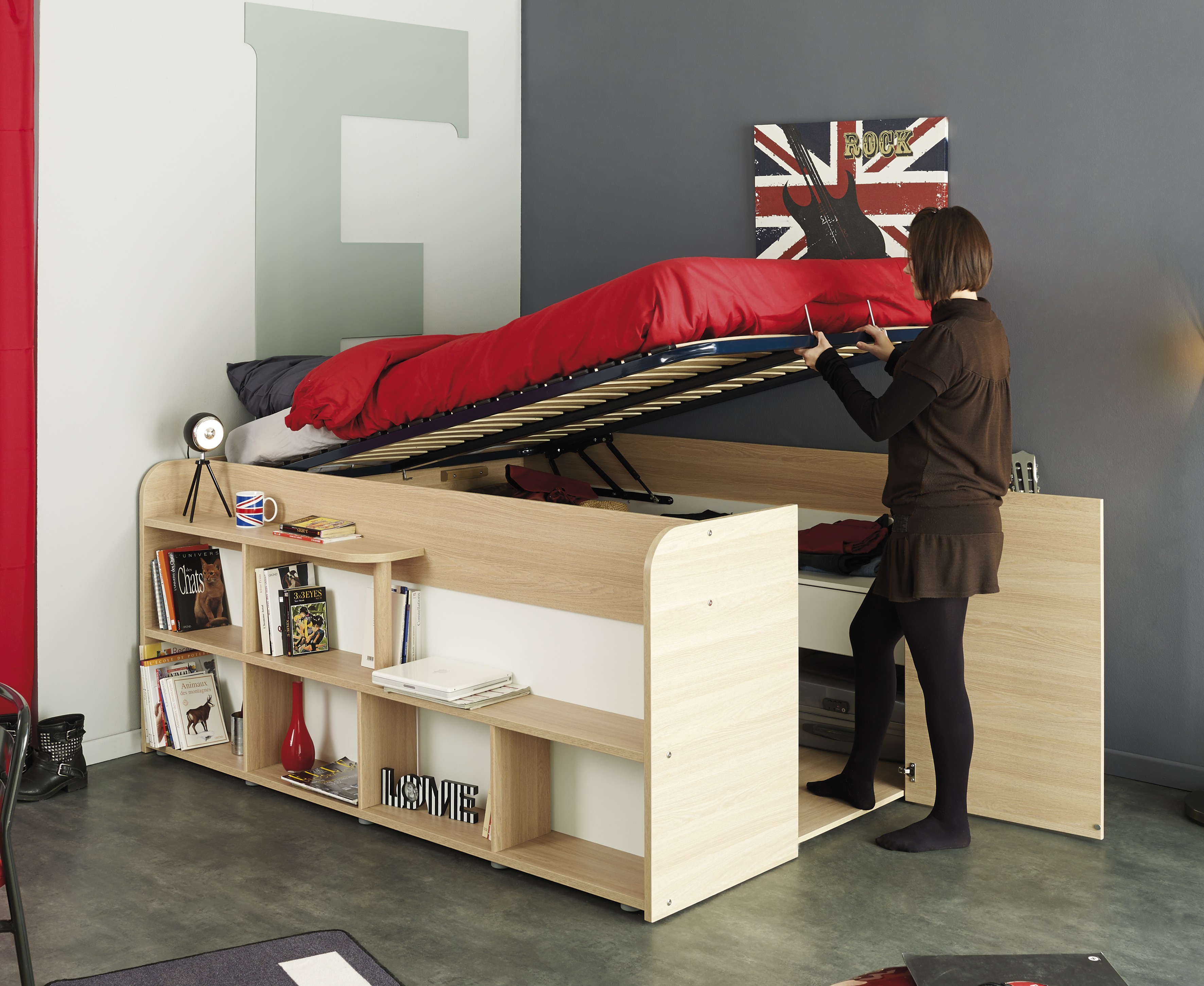
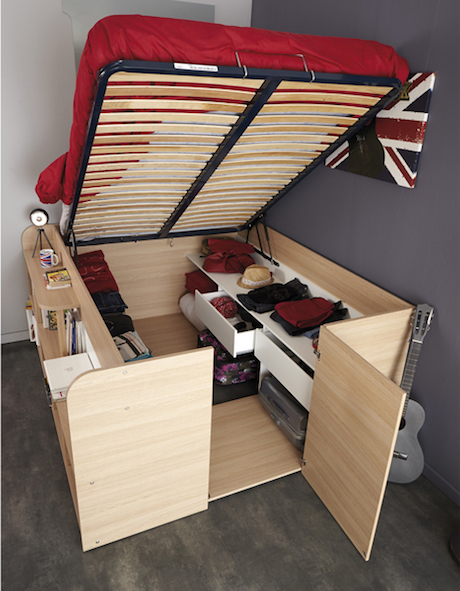
space-upThe Space Up bed (above) by France’s Parisot is a bed system with a closet’s worth of storage under its double-sized mattress. To access the storage, the mattress and its frame cantilever up, made possible by hydraulic pistons. The sides of the bed also features bookshelves, adding to its utility. With a low price point and no frills materials the Space Up seems mostly geared toward younger audiences.

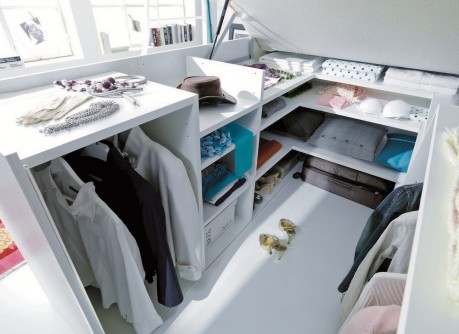
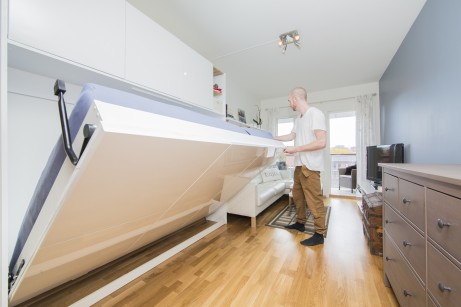
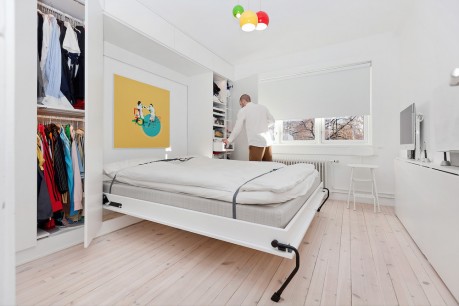
1347_z_Dielle Modus 0101350_z_Dielle Modus 012If you want something more high end, check out Italy’s Dielle Modus who takes the Space Up idea to 11. While they make a variety of bed and storage systems, the ones that caught our eye are their room systems featuring storage either under or above the bed. The storage volumes for both are considerably larger than Space Up. The below-bed systems work much like Space Up with a hydraulic lift for the mattress. The under-bed volume is big enough for a hanging rack storage; it’s also big enough to warrant stairs to access the bed. Those stairs double as drawers of course.

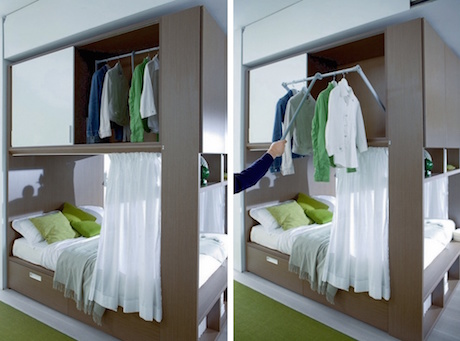
1252_z_Dielle Modus 002bdielleThe models featuring overhead storage are more practical than they might initially seem. The overhead cabinets have hanging racks that easily pivot down. There is captain bed type drawers underneath and tall cabinets at the head. The sleeping nook can also be closed off with curtains to fend off light and, we suppose, insects.

Norway’s Small Space Royalty

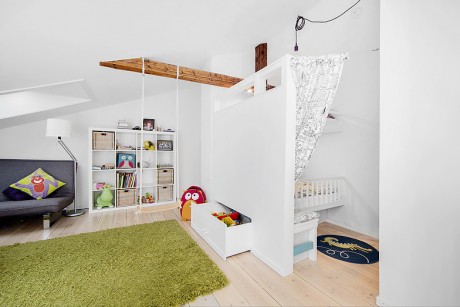
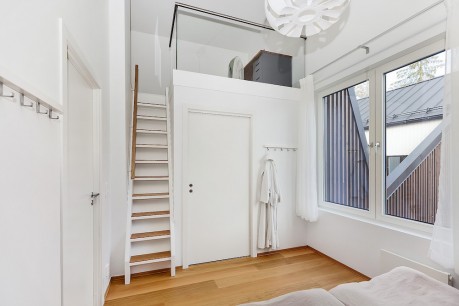
We recently ran across Norwegian company “Ett rom til” (One More Room) on one of our favorite design sites, Living in a Shoebox. They showed off one of the firm’s projects that placed a spare bedroom in an apartment’s entryway (pictured above). But checking out Ett rom til’s website revealed a whole universe of ingenious space-saving designs. The company are masters of chopping up small spaces and giving them tons of functionality. They have several wall bed designs, but their main tool is the loft: in living rooms, kitchens, bedrooms and, as mentioned, hallways. Take a look. 

ett rom til-kids-swing ett rom til-kitchen-loft ett rom til-studio ett rom til-murphyett rom til-desk ett rom til-girls-room ett rom til-loft

More at Ett rom til

Transforming Space You Might be Able to Make Yourself

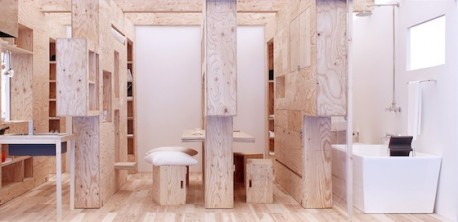
Question: What would happen if you combined the LifeEdited apartment and Gary Chang’s transforming Hong Kong apartment and made the fusion out of plywood and common hardware store materials?

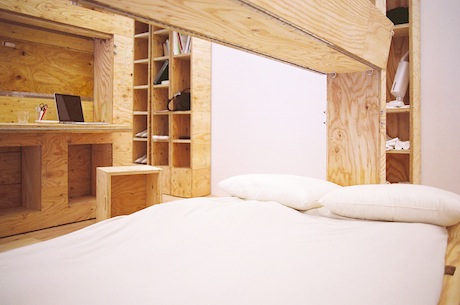
Answer: Studio_01‘s barcode room. The space was a winner of a design competition and was on display at Tokyo’s Designer Week 2012.

Studio_01 explains the concept:

barcode room is a concept studio apartment composed of product furniture-walls which move freely from side to side, permitting the resident to customize the size of space to fit a variety of uses. Placing functional elements such as storage and furniture into these walls, only to be pulled out when in use, also allows for more of the floor area to be used by the inhabitant and guests, thus creating a space where one is able to both comfortably live and entertain a different number of guests easily.

We like how all of the furniture is incorporated into the walls and how there are different settings that furniture can be used; like the main table that doubles as a desk when one side is elevated.

The most important thing it demonstrates is the fact that space-saving, transforming furniture need not be complicated or costly.

via Treehugger

image credit studio_01

The Hamper Test

Most of us live under the assumption that a decent percentage of our wardrobes are comprised of clothes that aren’t worn often. One closet expert (someone who knows closets, not someone hiding the fact she’s an expert) told the Wall Street Journal that most people only wear 20% of their wardrobes. This need not be the case. We can have wardrobes where every item is loved and worn on a regular basis, where we could reach into our closets blindly and be happy wearing whatever we pulled out.

If you want to reduce the volume of clothes you have while simultaneously increasing the overall quality of your wardrobe, consider doing the Hamper Test. Here’s how it works:

  1. Determine the normal interval between laundry loads. For some that’s five days, for others a week, for some two. For people who do laundry often, err on the side of making your interval long. It’s okay if your laundry interval is tethered to someone else’s, like a spouse; just determine your combined laundry interval.
  2. When you do laundry, look at the clothes not in the hamper (or laundry bag)–the clothes that are not in active rotation.
  3. Get rid of at least one item that didn’t make it into the hamper per laundry interval.
  4. Repeat until most of your clothes are in the hamper at the end of a laundry interval (some prudent reserve of unused, but wearable clothes can be forgiven).

There are a few notes to the Hamper Test:

  1. Don’t subject seasonal clothing to test when out-of-season. In other words, don’t ditch your shorts because they didn’t make it into the hamper in December. But do subject shorts to test in August (make appropriate hemispheric/seasonal adjustments). The test should be done for every season, i.e. conduct test in summer, then do separate test in winter.
  2. Clothes that are either infrequently or dry-cleaned won’t exactly fit into the Hamper Test. Just be honest about how often these things are worn.
  3. You can make some special clothes exempt: Formal wear and specialty clothes (ski pants, cycling shorts when not in season), for example. But do not abuse this exemption. If you haven’t worn that tux in the last twenty years, there’s a chance you won’t wear it in the next twenty.

Even people who think they have pretty pared down wardrobes (like this author) find dozens of things to give away: t-shirts at the bottom of the t-shirt stack, those “funky” neon green socks that are worn once a year (at most), cycling clothes that haven’t been worn for 12 years and so on.

Give it a shot and let us know how it works.

Washing fabric in Basket image via Shutterstock

The Best Way to Fold Shirts

I love folded clothes. I love how folding prevents wrinkles. I love how it optimizes space. I love how it makes it easy to see your inventory of clean clothes. But I loathe folding clothes. I find it tedious and time-consuming. In the past, I would gladly hand over $15 to have one of NYC’s ubiquitous wash-and-fold laundromats transform my dirty tangle into clean, orderly columns of ready-to-go clothes. But with an in-building washing machine and a son who tears through clothes at a breakneck speed, it’s tough to justify sending clothes out nowadays. And while my wife has less of an aversion (and more skill) to folding than I do, she’s not always available to fold, which means I often find myself folding.

Let me back up a bit, folding clothes is not uniformly difficult. I find folding pants, towels and mating socks pretty easy. It’s the dreaded shirt (any type) that is my laundro-nemesis. I learned my main technique watching a Gap employee fold a shirt I bought when I was a freshman in high school (i.e. a long time ago). It always served me and my shirts well, but it is labor intensive. The method involves laying a shirt face down, folding the sleeves toward the center, then folding the outside quarter of the shirt toward the center, then folding in half or thirds from top to bottom.

My method appears to be the correct (or at least common) way for folding a dress shirt and, to a lesser extent sweaters, which are bit more forgiving. The above video shows how it’s done. The more fastidious seem to prefer using a board in the center of the fold, which helps cinch the shirt against the board and create a standard size for the shirt.

tshirt-gif-step5

This method is not an ideal way of folding a t-shirt however. Surfing the internets, there were two popular methods of folding a t-shirt. The most popular is called the pinch method or Japanese method (see above video). It’s a seemingly magic way of folding a t-shirt in about three seconds (FWIW, it’s the way Martha Stewart recommends). I gave it a shot and couldn’t quite figure it out after a couple tries, though because of its speed, I might try harder.

The other way is the ranger-roll, so-called as it’s the preferred way military personnel fold their t-shirts. It involves folding clothes in toward a six inch center channel, rolling very tightly, then closing off the roll with a crease made at the hem of the shirt. This method is super simple and has a number of advantages: It compacts the shirts as much as possible; it allows various different storing methods, e.g. you could store your shirts butt side up; and it makes t-shirts very portable as there is little way they will come unfolded accidentally. It is however relatively slow to do compared to the pinch method.

This is by no means a definitive list of correct methods. We would love to know your preferred method of folding all clothes and shirts in particular. Let us know in our comments section.

Pile of colorful clothes image via Shutterstock

Mansions for All!

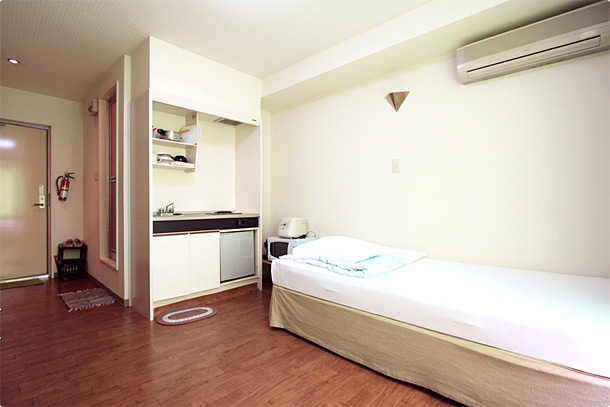
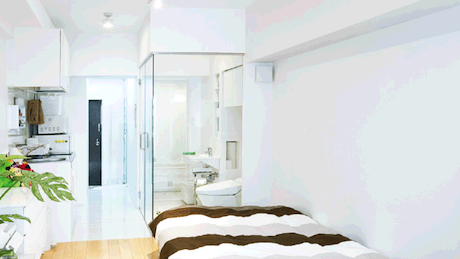
Inspired by yesterday’s post about residential hotels, we thought we’d look at how other nations handle clean, safe and affordable housing for single folks. In Japan, there is something called called the “wan rūmu manshon” or “one room mansion” (get it?). It’s a very small studio (~100 sq ft) with a bed, bathroom and kitchenette. They’re not fancy or architecturally that interesting. We found some with nifty glass-wall bathrooms (another living room?), but for the most part, they’re small, simple rooms to crash in. They’re designed for singles who don’t need, want or can’t afford anything more.

wan-rumu-manshon

Japan has 870 people per square mile, making it the 39th densest nation in the world (US has 84 people per square mile and is the 180th densest). Because of these geographic circumstances, Japan doesn’t have the space for one-size-fits-all housing. Single people use the space they need, which is less than couples. Couples use the space they need, which is less than a family, and so on.

The US’s surplus of land has led to many of us to occupy spaces well beyond our needs: singles live in two and three bedroom homes, empty-nesters have 4K sq ft homes and so on. The result is more money spent, more places to store stuff, more sprawl, more energy expended, more surfaces to mop, dust and upkeep. Perhaps it’s time we start using what we need, rather than what’s available. Perhaps it’s time we start building tiny mansions for everyone.

A version of this post first appeared on this site on April 24, 2012

The Best Products for Your Small Apartment Living Room

At LifeEdited, we often show some pretty far out design solutions for small home living rooms. Moving walls, app-controlled interiors, disappearing furniture. But the fact is most people who live in small spaces rent. They have neither time, inclination nor money to invest in spaces they don’t own. For them, finding the right items to make their small living rooms work involves a calculus of effort and expenditure weighed against their commitment to their homes.

For these multitudinous renters looking to optimize their living spaces, LifeEdited has paired up with The Wirecutter and The Sweethome to make a rigorously-tested product guide, specifically geared toward their needs (though the products will work great for those who own).

Since the living room is the hub of most small spaces–for studio apartments, it is the space–we thought we’d start there. The Sweethome compiled a list of products that will make your small living room (or “main room” in their parlance) work great without breaking the bank or requiring permanent installations. The list includes the best folding chair, inflatable bed, numerous storage solutions, stick vacuum, step stool, fan and more. All items were subjected to hours of testing and chosen because of their reasonable prices and space-saving capabilities. Follow this link to see the full guide. 

If you’re not familiar with The Wirecutter and The Sweethome, you should be. They spend many hours product testing electronics (Wirecutter) and household items (Sweethome). Rather than giving you a big list of items to choose from, they offer their recommendations for the best item in a given category, e.g. “The best set of headphones under $50.” We referenced them a while back when talking about the paradox of choice–both sites help simplify life, eliminating the often-bewildering array of choices available for any given product, and making singular and solid product recommendations. Continue to their site to see their “The Best Gear for Small Apartments” guide.

Multifunctional Sofa Will Blow Your Mind

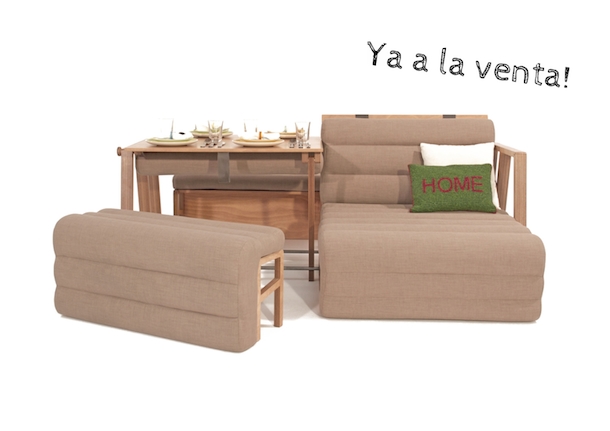
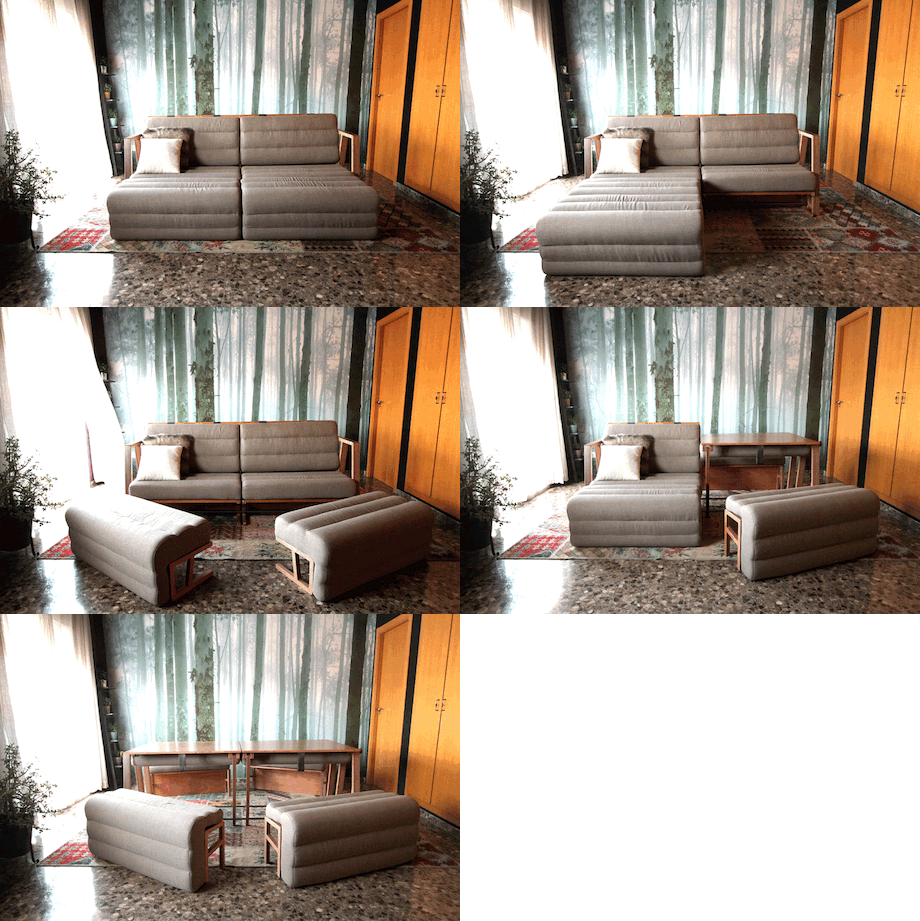
For some, hosting the ability to host dinner parties is a fairly important criteria to meet for their home. But if you’re living in 500 sq ft or less, it can be pretty tough to justify the space to house a proper dinner table, much less the chairs to surround it. Spanish designer Humberto Navarro, founder of UNAMO design studio, has a pretty slick solution for this most vexing problem. It’s called 3MOODS and it’s a sofa that hides a table and bench big enough for an eight person sit-down meal. The sofa is even big enough to sleep a compact person…somnolence being the third mood presumably.

3moods

The 3MOODS frame is made of sturdy bamboo ply and all the hardware is stainless steel. We think it looks relatively nice, though does bear a striking resemblance to your run-of-the-mill futon sofa.

UNAMO is offering the 3MOODs for €2400 ($3050) without tax and shipping (to non-Euros, they said they’ll ship anywhere). Not cheap, but for certain people, this could be a life-altering piece of furniture.

UNAMO is also running an Indiegogo campaign, whose motivation is explained in Google-translator-ese: “We need that 3MOODS is known worldwide, so we must be present in international exhibitions and fairs such as Milan and Paris; promote our product in shops, through advertising…” Basically, they’re trying to get their business together and make prototypes. Given that they’ve raised 75% of their $13K goal with 25 days left, I’d say their chances look good. We look forward to seeing more.

Via Tiny House Talk