Your Stuff or Your Life?

There are millions of reasons to stop over-consuming. It’s simpler, it’s greener, there’s less to dust. But as former Uruguayan president José Mujica–aka “the world’s poorest president”–reminds us, stuff costs money. For those of us not independently wealthy, our money has a pretty direct correlation with our labors. And unless your name is Tim Ferriss, our labors have a direct correlation with time. So each time we spend money, we are spending time. And once our time is spent, it’s gone. No refunds, no exchanges.

This doesn’t mean we shouldn’t buy stuff. We might decide that the things that are used, loved and add value to our lives are worth our time. This doesn’t mean that time spent working is bad either. If you love your work, knock yourself out. But ideally, we’d choose to do the work we love, not be bound to do it to pay for stuff. The reality is that if we became aware of the time-expense of our stuff, we’d probably do away with all the unnecessarily upgraded smartphones, the novelties, the status symbols. As Ben Franklin put it, “Dost thou love life? Then do not squander time, for that is the stuff life is made of.”

Do One Thing Right Already!

The smartphone is an amazing invention. With one device, you can make calls, send texts and emails, listen to music, read books, plan your day, shine light with its flashlight, level cabinets, time your hardboiled eggs, count your steps, etc. And it does all this stuff fairly competently. Technology’s ability to have so many foci might lead people to foolish assumptions about their own capacity to do the same. As executive coach Greg McKeown explains in this short video, often the best thing we can do toward higher performance is focus on doing one thing well. McKeown even has even written a book about his belief titled, “Essentialism–The Disciplined Pursuit of Less.”

Playing off the industrial designer Dieter Rams’ axiom “less, but better,” McKeown explains why trying to do everything too often makes us stress-out underperformers. He compelling argues that we need to create regular mental and physical space to step out of our busyness, even if it means saying no to a lot of things. In this space, we can start seeing what’s important and how it relates to the big picture. He also explains how being an essentialist can be an uncomfortable position to be in, saying no when others are saying yes, reigning in when others are striving to expand. But in the end, it’s about excellence: being great at one thing rather than being a hack at many (our words, not his).

Thoreau’s Walden, Made Readable

One of the–if not the–seminal texts of simple living is Henry David Thoreau’s Walden. It’s the tale of a man who moves alone to the woods, lives in a small cabin to find his truth. It’s also a treatise on simple living, connecting with the earth and oneself, of removing oneself from modern society’s misbegotten systems and ideals…or so we’ve heard. If you’re like us, you’re familiar with the many Thoreauvian axioms (“Most men live lives of quiet desperation [not the actual quote],” “My greatest skill in life has been to want but little” and so on), but, when pressed, must confess that you haven’t actually read the book. Take this passage from the first line of second paragraph of the book:

I should not obtrude my affairs so much on the notice of my readers if very particular inquiries had not been made by my townsmen concerning my mode of life, which some would call impertinent, though they do not appear to me at all impertinent, but, considering the circumstances, very natural and pertinent.

It goes on like this for 400 or so pages. It’s not a critique of Thoreau’s writing ability. The book was written almost 170 years ago. This was how people wrote and spoke back then. But its arcane prose–not to mention its sometimes offensive references–is damn near indecipherable to the modern reader. Good for soundbites, but not necessarily for sustained reading.

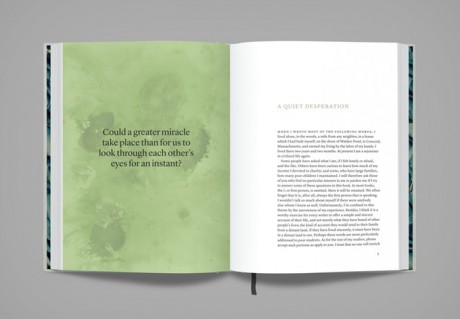
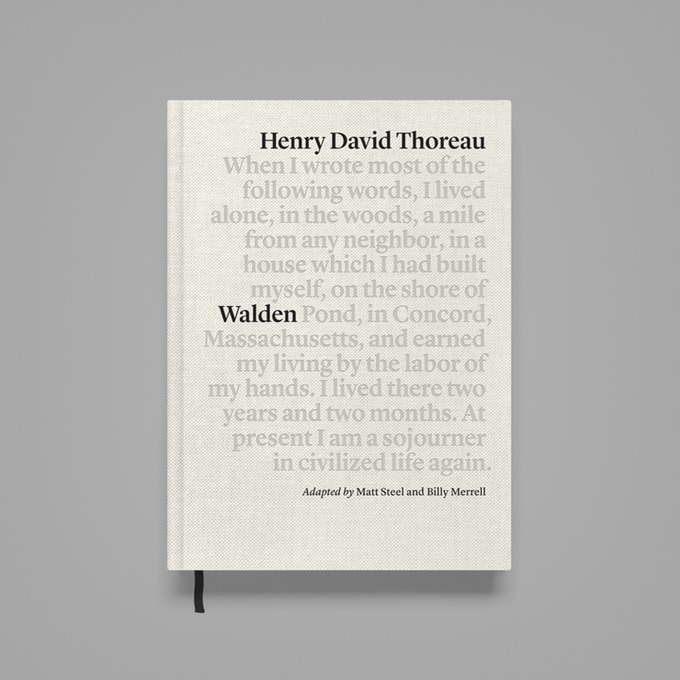
A new Kickstarter project seeks to translate Walden for the modern reader. Launched by designer Matt Steel along with writer and editor Billy Merrell and illustrator Brooks Salzwedel, The New Walden is a new take on Thoreau’s timeless wisdom.

In an essay on the site Medium, Steel explains his initial motivation:

The first time I tried to read Walden, I flunked out about halfway through the first chapter. Initially attracted by the concept of Thoreau’s experiment, I found myself quickly entangled in a dense thicket of language. I had expected to hear about the cabin he built in the first chapter; instead, I encountered an essay on economics and societal vice, with many twists and turns.

Eventually, he made it through the book and it rocked his world. He explains:

In Walden’s first chapter, Thoreau delivered the most eloquent and scathing criticism of consumerism that I’ve ever read. He saw that many of his fellow men and women were spending their best moments straining after far more than they needed; chasing after possessions and comforts that would never satisfy their deepest longings. He discovered that when we reject greed, simplify our lives, and pursue living in the present, a quiet revolution takes place inside the spirit and ripples outward into the lives of others.

The book’s impact inspired him to create a modern version, one that had updated language and was beautifully designed and illustrated.

walden-text

Steel is quick to point out that he is not changing the content of Walden, just the form. “This version will be neither abridged nor dumbed down,” he writes. “It will still read and feel like Thoreau; still set in the 1840s. I am not replacing telegraphs with emails, nor wagons with SUVs…Walden is dense, layered, and complex….So when I talk about removing literary obstacles from Walden, I’m only referring to structures, syntax, and words that have fallen out of use since 1854.”

The beautiful hardbound book will not only rework the text, but will be carefully assembled, designed and illustrated, in an attempt to make it appealing to readers of today and 100 years from now. 

The campaign started today. A $15 pledge will get you a PDF version and $38 will get you a signed and numbered early bird copy. Visit the campaign page for more information. 

4 Ways to Put Your Life on Automatic

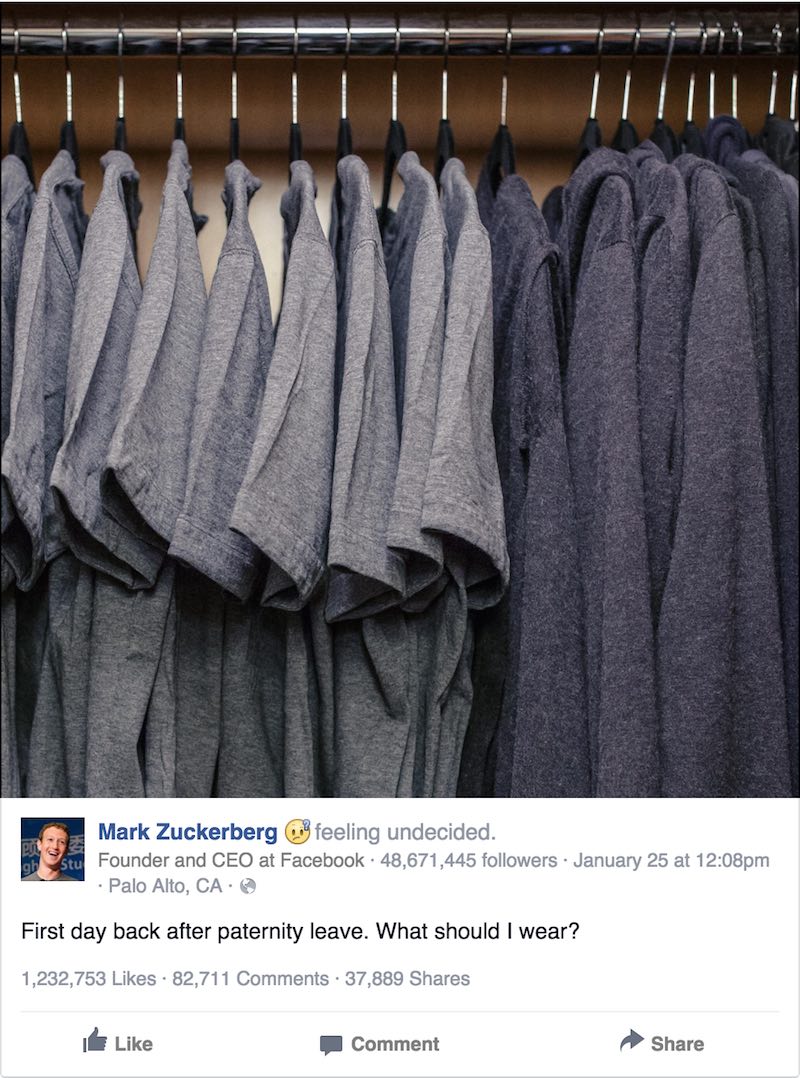
While Steve Jobs is perhaps the most famous uniform wearer of recent times, he is/was not the only tech billionaire with such a predictable wardrobe. Facebook founder and CEO Mark Zuckerberg is also fond of wearing the same thing day in, day out. In Zuck’s case, it’s a grey t-shirt and blue-grey hoodie matched to a pair of jeans. In a short talk he explains why:

I’m in this really lucky position where I get to wake up every day and help serve more than a billion people. And I feel like I’m not doing my job if I spend any of my energy on things that are silly or frivolous about my life, so that way I can dedicate all of my energy towards just building the best products and services.

Leaving aside whether you believe Zuckerberg is trying to help a billion plus people and whether you agree that the clothes we wear are “silly or frivolous,” the gist of his logic remains: we have a finite amount of time and attention for the things we find important. Any reduction in decisions surrounding unimportant things frees our time and attention for important ones. For him, the decisions he makes at work are more important than deciding what shirt to wear for the day.

While we have been known to over express our advocacy of uniforms, they are far from only way to streamline decision making. Our lives are filled with staple decisions and other attention-grabbing activities, ones that can be standardized without compromising the quality of our lives. Here are a few: 

  • Standardize food choices. Many of us eat food every day and some even eat three meals a day, which is three, sometimes agonizing, decisions. Aside from skipping meals (something this author frequently does), we can standardize our daily meal plans, either eating the same thing for several consecutive days or, if you want a bit more variety, choosing between a set amount of dishes, e.g. lunch is either pasta salad, turkey sandwich or avocado wrap. Even standardizing two of the meals (breakfast and lunch are the easy targets) helps to make our lives a lot smoother.
  • Autopay bills. Welcome to the 21st Century, a time when we no longer have to remember to pay our bills. Sure, it’s good to be aware of how much money we’re spending, but really, how often do we contest the gas or phone bill? Most bills can be both sent electronically (i.e. no snail mail) and put on autopay, automatically charging your credit card or withdrawing funds from your bank account at a set time. If it makes you feel better, glance at your account online to make sure everything is on the up and up. Imagine a world where you never have to think about overdue bills. What would that freedom permit you to do? 
  • Refine your daily routine. For better or worse, the vast majority of our days are filled with repetitive tasks: getting ready for the day, set tasks at work, cooking dinner, going to bed. Given the repetitive nature of our lives, why not get really good at our routines? Find the swiftest path to making coffee, working out, knocking out email at work, cleaning dishes at night, etc. If it can be done, it can probably be done better, faster and with less effort. 
  • Make standing appointments. Similar to the point about routine, most of our lives are filled with things we regularly want to and must do: go to the gym, go grocery shopping, do laundry, spend time with friends and family, get haircuts, etc. Rather than doing these things “when we have time”–a tack that often results in not doing the things we want to do and squeezing the things we must do in last minute–we might try scheduling our lives. What happens when we commit to doing something at a set time is we: A. stop wondering when we’ll do it, thereby freeing up mental space; and B. build our lives around the standing appointments, thereby greatly increasing the odds of not running out of time and accomplishing both our want to’s and have to’s. Ironically, having those free spaces between the fixed appointments actually allows more time for spontaneity.

What activities do you standardize or automate to make your life simpler? Let us know in our comments section.

So You’re a Minimalist. Now What?

Minimalism and tiny house living have really taken off as mainstream topics in the last several years. Marie Kondo’s book “The Life-Changing Magic of Tidying Up: The Japanese Art of Decluttering and Organizing” has become a cultural sensation and multi-year best seller. Our CEO Graham Hill’s NY Times Op-ed about living with less was one of that publication’s most read articles in 2013. And consider the numerous TV shows about tiny houses: Tiny House Nation, Tiny House Hunters, Tiny House Demolition and so forth. More than fascination with small spaces, people seem to be longing for the simplification needed to live in such small spaces. But here’s the thing about minimal living: after you’ve pared down and organized your stuff, after you’ve moved into an appropriately sized space, after you have become a minimalist in theory and practice, minimalism as a topic can start to seem a bit dull. Here’s why.

Minimalism can be described in two ways: negatively and positively. The negative description is that minimalism is a life free of unnecessary stuff. A minimalist doesn’t get rid of that 10 year old iPod rotting away in a closet, nor does she move out of that big house with a formal living room she never uses because these are the things minimalists do. She gets rid of these things because, at the end of the day, these things aren’t needed, and when lives are filled with lots of unnecessary things, it tends to distract us from the necessary ones.

This leads to the positive description of minimalism: it’s a life filled with the necessary. In its highest state, minimalism is about living a life where every possession, every square foot occupied, every activity, every everything is used and practiced with intention and appreciation.

Those new to minimalism tend to focus on the negative. They realize how burdened their lives were by useless stuff–stuff that occupies physical and mental space, stuff that costs money and time, stuff whose removal creates instantaneous liberation. It’s like someone who lost 150 lbs and marvels at how great it is to move faster and freer. 

But after a while, the novelty wears off. He might start asking, “What does this weight loss allow me to do?” Maybe he decides he wants to run or go rock climbing. 

Similarly, after the initial unnecessary stuff removal process, the minimalist will probably ask, “What is important? What can I do now that I am free of unimportant stuff…things that I couldn’t before?” And the answer isn’t, in all probability, downsize and get rid of stuff.

As our friends The Minimalists say, minimalism is a tool. It’s a means, not an end. Which is why Joshua and Ryan (the guys behind The Minimalists) focus a ton of energy on things like writing novels, writing workshops and film production. Another prominent minimalist blogger, Joshua Becker, recently launched the Hope Effect, a nonprofit dedicated to revolutionizing orphan care. While spreading the gospel of minimalism is something important in and of itself for these men, just as, or more important, is that minimalism has enabled them to pay more attention to other, non-minimalist-related stuff.

At a certain point, you can only downsize and declutter so much before it becomes fetishistic, before it distracts you from your life more than it enables you to focus on it. And when that point arrives, it’s up to you to define what important stuff you want your life to be about–is it your work, art, family, etc?

What has living with less allowed you to do? Let us know in our comment section.

Interview: Joshua Fields Millburn of The Minimalists

One of the clearest and most authoritative voices in the modern minimalist movement comes from The Minimalists. Through their the blog, books, social media, speaking and soon movie, lifelong friends Joshua Fields Millburn and Ryan Nicodemus spread the good word of living considered lives packed with rich experiences and meaning and devoid of superfluous stuff. The two do not preach from a hilltop–each know “the other side” intimately, having transitioned from auto-piloted lives characterized by paint-by-number corporate career tracks and ceaseless, thoughtless consumption. Through a variety of circumstances, they were compelled to ask themselves if a life filled with nonstop work and a bunch of toys (and debt) was all there was? For the last five years, they have been sharing their affirmative response.

I had the pleasure of meeting the two men during their “Everything that Remains” book tour. Both exuded a warmth and downright charm that lent a self-evident authority to their less is more message–a message that has been repeatedly buttressed by their entertaining, enriching prose found online and on paper.

Last week, I shot the guys a few questions via email and Joshua shot back some answers. Here they are:

David Friedlander: Your popularity–and that of the minimalist movement in general–seems to growing by the day. Why do you think that is happening now?

Joshua Fields Milburn: Simple living certainly isn’t a new idea. We can look back thousands of years—from the Stoics to every major religion—and find the same nuggets of wisdom. Minimalism takes many of those nuggets—what you and I might call “intentional living”—and applies them to a contemporary problem: nonstop, unabashed consumption. See, people are starting to realize that this meme of the American Dream isn’t making us happier. In fact, the opposite is true: even though the average American household contains more than 300,000 items, we’re more stressed, more discontent, more hungry for purpose. Compulsory consumption isn’t making us happy, and so many of us are looking for answers. Minimalism is one potential answer: it is a way to stop the madness, question what adds value to our lives, and live more deliberately with less stuff but more meaning.

DF: I often think that minimalism is like the environmental movement with a humanist spin. Rather than consuming less primarily for the sake of the environment as the environmentalist does, the minimalist consumes less for his or her own happiness. Do you think this is a fair portrayal and where do you see overlap between the environmental and minimalist movements?

JFM: Yes, that’s spot on. Ryan and I didn’t venture down this path for environmental reasons—not at first, at least. But we soon realized that when you consume less, you produce less waste, too. Obviously, there’s an inverse relationship between consumption and caring for the environment.

Now, to be clear: every human must consume, and so there’s nothing inherently wrong with consumption. It’s necessary. We must eat food, drink water. Plus, we all tend to purchase hygiene products, furniture for our homes, and other material possessions that bring us joy—books, music, etc. Shortly after the Industrial Revolution, though, corporations found themselves drowning in too much supply and not enough demand. So, via advertisements and various talking heads, people were told they needed to consume more. Even today, we are told to “keep the economy going” we must buy more stuff. But it’s easy to see that when we consume too much, we experience stress, anxiety, and depression. The key, then, is to consume responsibly by determining what possessions serve a purpose and bring us joy, and then eliminating that which is superfluous.

DF: You guys have a very strong web presence with your blog, Twitter, Facebook and Instagram. Many people have difficulty being minimal with the profusion of technology. How do you–or do you–stay minimal with your media consumption?

JFM: Our tools are only as good as the person using them: A chainsaw can cut down a rotting backyard tree, preventing it from impaling a neighbor’s house. Or, that same chainsaw can be used to hurt our neighbor, to chop him into tiny pieces. The same goes for technology. We can use Twitter and Pinterest and Google+ to enrich our lives and the lives of others, to communicate and share in ways we’ve never been able to communicate before. Or we can get stuck in social media’s Bermuda Triangle, careening from Facebook to Instagram to YouTube, lost in the meaningless glow of our screens. We can use our smartphones to photograph gorgeous landscapes, message loved ones, or map out directions to a distant national park (or—gasp!—to make phone calls). Or, we can use that same device to incessantly check email, thumb through an endless stream of status updates, post vapid selfies, or partake in any other number of non-value-adding activities, all while ignoring the beautiful world around us.

Bottom line: our tools are just tools, and it is our responsibility to ask important questions about how and why we use them. Because to become a Luddite is to avoid an entire world of possibilities, a better world that’s enriched by the tools of technology. If used intentionally, we can change the world with these tools. Or, we can do a lot of harm. It’s an individual choice, the world is at our fingertips, and it’s up to us to act accordingly.

jfm

DF: Speaking of the web, I read your recent post about how you essentially turned down hundreds of thousands of dollars in Google adword revenue in order to maintain your site’s integrity (my wording, not yours). This is a pretty ballsy move, but one I wonder if totally necessary. You guys have expenses. Your readers buy stuff–even if it’s less stuff than most–so them buying that stuff off your page is not necessarily promoting shopping. Why didn’t you guys rationalize the move based on these seemingly complementary interests?   

JFM: Personally I think most advertisements suck, but I also think you’re right: there’s nothing inherently evil about adverts. For us, however, it came down to our values and beliefs. Ryan and I constantly ask each other one question when it comes to our website: how can we improve the reader’s experience? And while I can’t speak for all readers, I can speak for myself: when I visit websites, listen to podcasts, or watch movies, most advertisements feel intrusive, unwelcome, and noisy. Ryan and I simply didn’t want to add to that noise.

DF: On a similar note, do you think that minimalism is intrinsically subversive in regard to traditional commerce? While you guys are all hugs and humility, isn’t it fair to say that your message undermines the market economy and the model of continual economic expansion?

JFM: Yes, minimalism is, by definition, subversive, and that’s a good thing because the system we’re subverting is the very thing that’s contributing to our discontent. True, if everyone immediately stopped spending their money, our economy would crash. Consequently, one of the biggest (supposed) arguments many people have against minimalism is that if everyone became a minimalist, then we’d all be doomed: the financial system as it stands today would collapse, and no longer would we have the wealth necessary to purchase cheap plastic shit from Walmart.

There are several problems with this point of view, some obvious, some a bit more abstruse.

First, no informed person would argue that we should stop spending money or that we must stop consuming. Consumption is not the problem; consumerism is the problem. Consumerism is compulsory, vapid, pernicious, impulsive, unfocused, misguided. Worst of all, it is seductive: consumerism’s shiny facade promises more than it can possibly deliver, because love, happiness, contentment, and satisfaction are all internal feelings that cannot be commodified, and the truth is that once our basic needs are met, the acquisition of trinkets does little for our lifelong well-being.

Using consumerism to stimulate the economy is like fixing a cracked mirror with a hammer. It only worsens the problem. Yes, trade is an important part of any society. Circumventing consumerism, however, doesn’t imply that minimalists sidestep commerce. Rather, minimalism is predicated on intentionality, which means we spend our money more deliberately. Minimalists invest in experiences over possessions. Travel, concerts, vacations, community theater, etc.: we can all spend money without acquiring a bunch of new material things.

Ultimately, minimalists aren’t interested in “stimulating” the economy. Stimulation is ephemeral. We’d rather improve our economy’s long-term health by making better individual decisions about consumption, getting involved in our community, and supporting local businesses who care. If more people do this, we’ll build a stronger economy, one that’s predicated on personal responsibility and community interaction, not a false sense of urgency and the mindless stockpiling of junk we never needed in the first place.

DF: LifeEdited.com features quite a bit of content about architecture and product design. I try to come from an angle of these things actually promotes lives with less stuff, but inevitably I find myself fetishizating them a bit, which runs a bit counter to minimalism. I guess I’m wondering: A. what is your general take on architecture and design, and B. how can we maintain an emotional distance from all the cool stuff that’s out there?  

JFM: I, too, enjoy architecture, especially the elegance of minimalist, brutalist, and mid-century modern structures, where, by stripping away the unnecessary elements, we’re left only with beauty. Aesthetics are an important because beauty adds appreciation and joy to our everyday lives; and so the lesson, at least for me, is to avoid attachment: we can appreciate beauty without desiring to possess it in perpetuity. My home in Montana, while appropriate for my needs, is also aesthetically pleasing; but I needn’t be attached to my home: it’s just a bunch of wood and stone and wires—it is not a permanent fixture that defines me as a person. The material has only the meaning we give it, and questioning the meaning we give to our stuff is the basis of minimalism.

DF: What’s your favorite part of living the way you do?

JFM: Without all the excess in the way, I can focus on what’s truly important: health, relationships, passions, growth, and contribution. Those are the bedrocks of a meaningful life—not material possessions.

DF: Any drawbacks?

JFM: Yes, it’s not always easy. Hell, sometimes it’s downright difficult. You see, when you commit to something in a public forum—especially when you call yourself a “minimalist”—you have to stick to your principles, even when it’s not pleasurable in the short-term. Sure, that impulse purchase might give me a rush of dopamine in the moment, but the consumption-high rarely lasts past the checkout line.

DF: What’s next for you guys?

JFM: Our film, Minimalism: A Documentary About the Important Things, will hit theaters in spring 2016. Until then, you can find a bunch of video excerpts at TheMinimalists.com.

The Fisherman and the Executive

A powerful executive was walking along the beach in a small coastal village, taking a much needed vacation. It was his first in more than 10 years. He noticed a small boat with just one fisherman pulling up to shore. Inside the small boat were several large fish. The executive complimented the fisherman on the quality of his fish and asked how long it took to catch them.

The fisherman replied, “Not very long.”

The executive then asked, “Then why didn’t you stay out longer and catch more fish?”

To which the fisherman responded, “I have enough to support my family.”

“But what do you do with the rest of your time?” the executive asked.

The fisherman said, “I sleep late, fish a little, play with my children, take a siesta with my wife, and stroll into the village each evening where I sip wine and play guitar with my amigos.”

The executive quickly interrupted, “I have an MBA from Harvard and can help you. You should start by fishing longer every day. You can then sell the extra fish you catch. With the extra revenue, you can buy a bigger boat. With the extra money the larger boat will bring, you can buy a second one and a third one and so on until you have an entire fleet. Instead of selling your catch to a middleman you could sell directly to the processor, eventually opening your own cannery. You would control the product, processing and distribution. You would then of course need to leave this village and move to the big city and eventually NYC where you will run your expanding enterprise.”

The fisherman then asked, “But how long will all this take?”

To which the executive replied, “Twenty, maybe 25 years.”

“And after that?” the fisherman asked.

“Afterwards? That’s when it gets really interesting,” answered the executive, laughing. “When the time is right you would announce an IPO and sell your company stock to the public and become very rich. You could make millions.”

“Millions? Really? Then what?”

“Then you could finally retire and move to a small coastal fishing village! There you would sleep late, fish a little, play with your kids, take a siesta with your wife, and stroll to the village in the evenings where you would sip wine and play guitar with your amigos.”

Clapboard image via Shutterstock

To Fix or to Replace?

If most of us are ashamed of shabby clothes and shoddy furniture let us be more ashamed of shabby ideas and shoddy philosophies….It would be a sad situation if the wrapper were better than the meat wrapped inside it.

–Albert Einstein

For the last several months, I have had a small crack on my two year old iPhone 5’s glass. Following an unexpected trip to the floor (glass side down) a few weeks ago, the small crack became a full on shatter. A couple days ago, the shattered pieces started falling out, leaving me with small glass shards swimming around my pocket. I went to the local mobile store to get it fixed. The clerk told me that a screen replacement would cost $75. I asked how much a new phone would cost. He said given that I was eligible for an upgrade, a 5S would cost $99 and a 6 would be $199. He also said he’d give $30 trade in value for the old phone. In other words, the 5S, which represents an upgrade from my first gen 5 would cost $5 less than getting my old phone’s screen replaced.

Now let me back up: aside from my screen and some issues with its battery life (issues that could always be handled with a modicum of foresight), I have no problems with my phone. It still occurs to me as a technological marvel. Even though it’s only 16 GB, I haven’t had any particular issues with storage. It has some superficial scuff marks on its aluminum, but these do not impact the performance whatsoever.

I weighed the pros and cons of replacement and fixing:

  • Pro replacement: cheaper by a few bucks; better battery according to sales dude; shinier, newer, thus inflating self esteem and esteem from people who care about having shinier, newer stuff.
  • Con replacement: I’d have to re-up my two year contract and use my once-every-two-year upgrade upgrading a perfectly good phone; I would be sending another perfectly usable phone to an early death, adding to the already-monumental amount of e-waste created we as a society produce.
  • Pro fix: not having to commit to two year contract; not using upgrade; not sending phone to premature death and creating unnecessary e-waste; not feeding into a culture of incessant upgrading and idealization of the new and unused.  
  • Con fix: not having latest and greatest (though the 5S, which is probably what I’d get, is no longer the latest or greatest).

Given these considerations, I am fixing the screen. The money is negligible. A better battery would be nice, but not nice enough to outweigh the other reasons not to upgrade. More than anything, doing a premature upgrade, to me, means submitting to the spurious logic of planned obsolescence and throwaway culture.

One of the concepts I have helped promote on this site is that we fill our lives with only the stuff we love and cherish. Sometimes this concept is misconstrued as living in some Dieter Ramsian ideal, where the few things that are left in our possession are immaculate. All furniture is clean and modern, all clothes fit perfectly and are plain and stain-free, all electronics are up-to-date. But this is an unrealistic, and often harmful, ideal. It’s one that can result in a “minimalist” sending as much stuff to the landfill as anyone else–not to mention depleting his or her bank account unnecessarily.

Rivendell Bicycle Works Grant Petersen coined the term “beausage”–a mashup of the words beautiful and useage. While he applies it to cool, often custom bikes, the term can apply to everything we possess. These are items we care for and maintain the best we can, but that also undergo the inevitable effects of age and use. If we can see things this way, we can see how an edited life can include the used, beat up and even outdated.

Data Driven Living

One of this site’s all time most popular posts is entitled “Residential Behavioral Architectural 101.” In it, we show that many families use a small fraction of their home’s usable area, leading to the question, “How would you design a home if based on your behavior, not architectural convention?” The implication being that we would, in all probability, design a lot smaller than the supersized norm.

But what if we allowed data to inform, not just how we design our homes, but how we design our lives? How would we live if we let data be our guiding force, rather the forces of: A. This is the way I’ve always done it, B. This is the way my parents/family have always done it, C. This is the way everyone else is doing it, or D. Some other non-data-related rationale?

Now let me be quick to say I’m not talking about controversial things like whether you should be a Believers or a non-believer, a Republican or Democrat or even whether you should live in a city or in the burbs. I’m talking about basic stuff. Stuff where there’s a hefty body of data to suggest that yes, this is something you should do frequently, because it will improve your life in tangible ways (feeling better, happier, living longer, etc).

If you’re anything like me, you probably do a lot of stuff that flies in the face of data. I do things that I know–both intellectually and experientially–that make me feel like crap. These behaviors are often rationalized by excuses such as:

  1. I’m going to do it this once because I had a hard day.
  2. It’s okay. I should go easy on myself.
  3. Screw it, live a little.

Of course, all of the above excuses are BS. Let me illustrate why. First, staying up late watching TV, cutting into my sleep is why I had a hard day–not the remedy for it. Second, getting regular exercise will make me stronger and give me more energy thus making things easier, while avoiding it gives me less energy, thus making my life harder. And third, “live a little?”–as if gobbling that piece of cake, setting in motion a massive sugar high, then low, is somehow the hallmark of a life well lived. Actually, it might be the hallmark of living a little, but what if I want to live a lot? Wouldn’t I care for my body in a way that reflected that?

A few days ago I asked myself these question and made a list of behaviors–either things to include or exclude–that are pretty incontrovertible in terms of their efficacy to improve life. I determined to incorporate these things into my life every day for a week, even if it was just in small doses. Here’s most of the list (follow links for more about the data):

On a practical level this looks like using an app to do 5-15 minute intense workouts at home, meditating 3-5 minutes once a day and choosing the kale salad over a bacon, egg and cheese sandwich at the cafe I work from. Baby steps. Perhaps the biggest benefit is a tingle of integrity–taking some comfort that I’m not knowingly doing things that undermine my health and well being.

My favorite quote about editing one’s life is still from 17th Century mathematician Blaise Pascal. He said, “I would have written a shorter letter, but I did not have the time” (or “Je n’ai fait celle-ci plus longue que parce que je n’ai pas eu le loisir de la faire plus courte”). Getting to the essence of something, whether it’s a letter or a life, is often a process of attrition, removing all that is not totally necessary. If you are wondering which things are removable, it’s important to check in with yourself, but there’s no harm in checking in with the researchers either.

Image via Shutterstock

The Unbearable Lightness of Being Average

“You are not special. You’re not a beautiful and unique snowflake. You’re the same decaying organic matter as everything else. We’re all part of the same compost heap. We’re all singing, all dancing crap of the world.”

Chuck Palahniuk

Have you had a time when you felt content with your life? A time when you had enough money in the bank, a body fit enough to get you through the day and a reasonably long life, a job that was interesting enough, a partner comely enough, friends interesting enough, a house big enough and a car fast enough. Nothing needed to change….until…you found out someone had a lot more money than you, was fitter and more attractive than you, had a much cooler job, had a much hotter partner, had far more interesting friends, had a much bigger (or perhaps for our readers, smaller) house and had a super fast car (ultra-efficient, no less). All of a sudden, you were discontented. Maybe you didn’t put state it as such, but deep down you felt deeply, profoundly average. But if we are to believe writer Mark Manson, average is not grounds for despair. In his brilliant essay “In Defense of Average,” he lays out a compelling argument for how we can be both average and extraordinary.

bellcurve

Manson starts with the cold, hard, somewhat obvious truth: statistically speaking, the vast majority of us are going to be average. He uses the bell curve to illustrate this point, stating that in any domain there are small populations of extremes: the high performers at one extreme–the Michael Jordans of basketball, the Warren Buffetts of finance–and low performers at the other extreme–the Mickey Roonies of basketball (I’m assuming), the 50 Cents of finance. In the middle is you and me–the great, average masses. Sure, we might be above average performers in some domains, and below in others, but for the most part, we populate the wide middle section of the curve, hitting neither high nor low in many, or perhaps any, domain.

This averageness can be grounds for despair, lamenting how we can’t live up to the performance of the high performers–a population that is, by its very definition, tiny (funny how we rarely rejoice that we aren’t the low performers). Or it can be a liberating realization, one that inspires us to accept statistical truths, that we may never be ungodly rich, dropdead gorgeous, hyper-intelligent, ultra-fit or extraordinary in almost any domain we desire to excel in. It’s not a personal thing. It’s just the law of averages. But it is a place we can learn to be happy and fulfilled.

Manson explains that the expectation of high performance is to some extent a recent phenomenon, one exacerbated by the internet. He writes:

Therefore the only [online information]…that break through and catch our attention are the truly exceptional pieces of information. The 99.999th percentile….All day, every day, we are flooded with the truly extraordinary. The best of the best. The worst of the worst. The greatest physical feats. The funniest jokes. The most upsetting news. The scariest threats. Non-stop.

Through repeated exposure, this becomes our expectation of ourselves. As Manson puts it, “exceptional” has become the new normal. But exceptional is exceptional–it’s the thing that happens to few, rarely. Meanwhile, most of life is average for many, often. Even many people who are extraordinary in one arena are horribly average or below average in others–juxtapose Tiger Woods’ golf prowess with his relationship skills.

Not only that, but the online highlight footage doesn’t even accurately portray high performers. Manson writes, “We are not exposed to those years of practice. Or those hours of drab and failed footage. We’re merely exposed to each person’s absolute finest moment–possibly in their entire lives.” Not featured are the clips showing the states that precede high performance: low and average performance (Ira Glass did a wonderful talk on this topic). Manson explains that the mindset of high performers is not even necessarily fueled by expectations of high performance. He writes:

The people who become truly exceptional at something do so not because they believe they’re exceptional. On the contrary, they become amazing because they are obsessed with improvement. And that obsession with improvement stems from an unerring belief that they are, in fact, not that great at all. That they are mediocre. That they are average. And that they can be so much better.

And herein Manson explains the key to living an extraordinary, average life: “Mediocrity [a proxy for being average], as a goal, sucks. But mediocrity, as a result, is OK.” Do your best, let go of results.

Manson’s thesis is very relevant in the context of this blog. So many of the issues we write about concern our collective obsession with being exceptional. We build houses larger than we need, lust after and buy more stuff than we need, do as many activities as we can, consume as much information as we can, travel to as many countries as we can and perhaps even try to be as ultra-minimal as we can–often fueled by the desire, conscious or not, of differentiating ourselves and proving ourselves more than average. But life might be a lot easier if we stopped trying to differentiate ourselves from our fellow humans, if we embraced the average (after all, it is a state that rivals death and taxes in terms of its inevitability). The choice is ours. Life is short.

Go here to read Manson’s full essay.

Photo credit: Lewis Tse Pui Lung / Shutterstock.com