Get Your Rocks In

Many of us have probably seen this before, but it’s a lesson worth sharing again and again. The above video shows Steven Covey as he demonstrates how prioritization can allow us to do everything we need to do in our lives, but only when the top priorities are handled first.  The below video from IKEA shows much the same demonstration, albeit as the principle relates to interior decoration (and in much higher resolution).

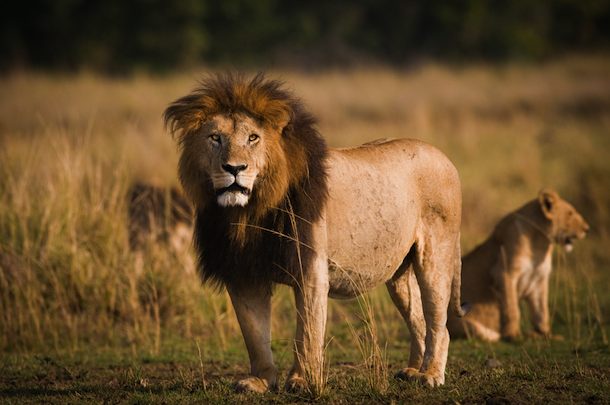
Much like the lion starving on a diet of field mice, many of us often put the small rocks–errands, extraneous web-surfing, needless expenses–in the finite container that are our days. When we do this, the big rocks–relationships, health, vacation expenses–are often crowded out. As IKEA shows in their video, this principle can extent to design, where the inclusion of less important stuff can leave little room for essentials.

Today, let’s take a tip from Stephen Covey and IKEA and focus on the big rocks first.
What Are You Hunting For?

Note: No animals were harmed in the publication of this post

A lion is agile enough hunt and eat field mice if it wanted to, but the energy to catch them is greater than the caloric content of the mouse. So, if a lion spent his whole day hunting and eating field mice, it would slowly starve to death.

A lion cannot live on field mice. Lions need antelopes. Antelopes are big. While they take more speed and strength to hunt, once successfully captured, they provide a huge feast for a lion and its pride.

A lion can live a long, happy life on a diet of antelope. It will die chasing mice.

Our world is filled with field mice: easy-to-achieve, short-term goals: obsessively emailing or checking our phones, mindless web-surfing, buying and maintaining stuff we don’t need. These tasks might even provide momentary satisfaction and pleasure, but they don’t give the nourishment necessary to make a meaningful life.

It’s the antelopes that make our lives great. Acts like cultivating and maintaining relationships, developing real skills and contributing to something greater than ourselves. These things take more time and effort to accomplish, but in the end, they are the things that constitute a well-lived life.

We have a finite amount of attention to give. Are we giving it to the field mice or antelopes?

Lion with Family Image via Shutterstock

The Joy of Breaking Down

Some time ago, I saw a programmer named Amit Pitaru give a talk about designing the ideal motorcycle to travel through South America on. He said that when asked, most people responded that they’d want the most reliable motorcycle possible for this task. The prospect of getting caught in the middle of Nowhere, South America was not an enticing proposition.

Pitaru went on to describe the worst thing that could happen on a trip to see South America on motorcycle: not breaking down. When you break down, you have to ask for help. You get to know the locals. You create bonds through your interactions that would have never been possible zipping by on a problem-free bike. You might witness a beautiful sunset fixing your clutch. You might meet a great family or friend fixing a flat.

He went on to say that on your never-break-down-bike, you zip past little towns never interacting with anyone you don’t pay to help you (restaurant, hotel and gas station attendants mostly). You attract thieves because your fancy bike probably makes you look like an easy target. You move through the country efficiently, but detached (by tobar at dresshead.com) . You have no problems, but you have no meaningful experiences either.

His point: life is not that interesting without breakdowns.

Most of us are obsessed with contingencies—the great “what if” scenarios. What if there’s not enough space? What if I run out of flatware for the dinner party? What if I have to sell my stuff? What if people can’t reach me? But what if the “what ifs” were our greatest opportunities to grow and to know ourselves? What if we gave up our need to know what happens after the what if? What if we saw that our journeys happen in the pitstops, not in spite of them? If we believed that, what could we do?

Vehicle Breakdown image on front page via Shutterstock