Look Good In and Feel Good About Your Fashion

Most of us are at least vaguely aware of what drives the excessive demand and supply of clothing. Constantly changing fashion trends drive demand, compelling people to exchange perfectly good clothes in favor of newer, slightly different, perfectly good clothes. In her book, Overdressed: The Shockingly High Cost of Cheap Fashion, Elizabeth Cline wrote that Spanish retailer Zara pioneered the practice of introducing new styles to its stores twice per week. Other stores like H&M and Forever21 quickly followed suit, often bringing in daily shipments of new styles. According to Cline at the time of writing, UK based retailer Topshop introduced a shocking 400 styles a week on its website–a practice that is meant to “deliberately make the customer feel off-trend after the first wear” according to the Huffington Post. Supply for this practice is made possible by deferred payments of our clothing’s real costs. That trendy new $18 shirt doesn’t include the price of living wages in safe conditions or responsible fabric sourcing. Instead, much of today’s mass-produced clothes are made by people working long hours in unsafe conditions for very low wages; they are almost always cheaply constructed with pesticide-laden cotton or other environmentally-destructive materials. In an ideal world, our clothes would be classically designed and well made, withstanding the often arbitrary fluctuations of fashion trends; we would feel good about, who, how and where our clothes were made. They are clothes that would enable us to have less, but better wardrobes. That’s the idea behind a new web-shop called Zady.

Zady carries a range of women and men’s clothing and shoes as well as accessories, jewelry and housewares. The raison d’etre for Zady is establishing what they call “The New Standard”–where retailers consider the environmental and human toll of the products they sell. They are trying to achieve as much supply-chain transparency as possible, allowing you to see–and presumably feel good about–every step of a product’s manufacturing process, from where raw materials are sourced to who and where your garments are assembled to every step in between.

zady-fashion

This new standard carries over to the style of clothes they offer. Their products, which are sourced from various manufacturers, embody the “slow fashion” ethic–classic designs in muted colors that are basically the antithesis of fast, trendy, cheaply priced and made clothes large retailers churn out. These are clothes that are designed to be worn frequently and for a long time–increasing longevity being the easiest way to reduce clothing’s impact on the planet.

Zady’s clothes are beautiful, but they don’t come cheap. Shirts are often more than $100 and sweaters routinely cost $300. The problem isn’t that their clothes are expensive–it’s that we’ve become so accustomed to not spending anything on clothing. This has hardly always been the case. According to a survey by the Bureau of Labor Statistics, in 1950, when most clothes were still made domestically, Americans spent 12% of their incomes on clothing. In 2003, we spent 4% despite the fact that the volume of clothes we purchased skyrocketed. Zady reports that there has been a fourfold increase in clothing production in the last 20 years alone.
zady-new-standard

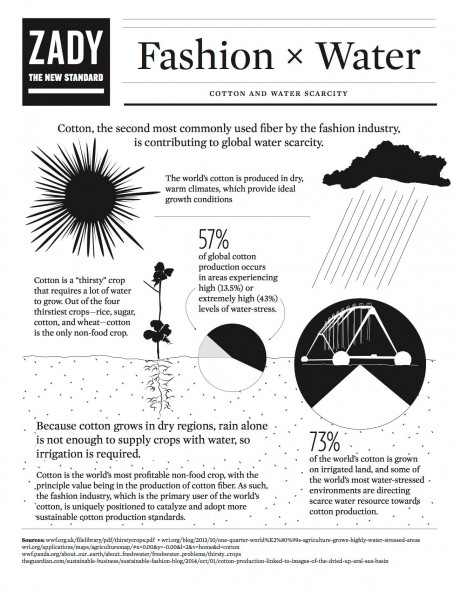
Zady is challenging us to think about our clothing purchases a lot more rigorously. Their site includes tons of (pretty damning) information about the costs of modern clothing production: how 99% of cotton is grown with chemicals and uses 25% of the world’s insecticides, how 250 million children, some as young as 5 years old, work in the fiber and apparel industry around the world, and so on. In light of these pretty awful facts (and there are many more), it’s probably time we started paying the real costs of clothes. Fortunately, Zady helps us do that while looking pretty sharp at the same time.

Via Treehugger

Fashion Week, Edited

If you live in New York City or are interested in fashion, you might be aware that this week is New York Fashion Week (NYFW for the cognoscenti). It’s a weeklong celebration of the fashion trends that will make your current clothes look inexplicably outdated in the not so distant future. The practice of continually refreshing and overhauling one’s fashion is, for many, one of the leading causes of accumulating way too much stuff. As I oft-quote, one expert estimates that only 20% of most wardrobes are actively worn. The rest is just filler–likely casualties of changing fashion.

Let me hazard to say that I am not a fashion basher. As much as I continually extol the virtues of having a few well-selected garments, I am pretty fussy about what those garments looks like. I am particular about the color, fit and function of my clothes. I believe fashion is one of the most practical mediums in which one can express him or herself.

But let’s face it, fashion has a super dark side. As mentioned, many people find themselves with way too many clothes, leading to stuffed closets and emptied bank accounts–all done in the name of staying au courant. And then there are the considerable environmental and human right tolls paid in order to keep our clothes cheap and plentiful (follow this innocent looking link if you are interested in knowing more about what I’m alluding to).

As with everything, less, but better wins the day. Those of us living above or below the tropics can’t very well live without clothes, but we can create wardrobes filled with necessary clothes that are worn and cherished. In honor of NYFW and looking spiffy all year long, here are a few posts from the past fashions that will help you create your edited wardrobe.

  • Project 333. Courtney Carver is like the minimalist Anna Wintour. But instead of yay or naying particular fashions, she challenges people–women and men–to put more thought into their wardrobes by selecting 33 items to wear for three months. What’s great about her approach is that it’s pared down, but no so much that you can’t achieve variety.
  • Outlier Tailored Performance. I know, I’m a bit of a fanboy, but this company is a great example of how you can sell folks (ok, mostly men) great-looking, responsibly manufactured and sourced clothes that allow you to do more with less.
  • Shapeshifting fashion. For those who might want to spice up their minimalist wardrobes, companies like MORF create clothing that allows several looks with the one garment.
  • Rent and shared clothing. If you are simply not someone who can wear the same thing too long, consider renting or swapping your clothes. It’s way friendlier to your pocketbook, the planet and will give your closets some breathing room.
  • Fall deeper in love with your existing clothes. Just like friends and family, sometimes we take great, but familiar things for granted. Patagonia’s Well Worn campaign urges us to fall back in love with the things we have. Love them, wear them, fix them if needed. Sometimes the fashion we seek is the fashion we already have.
  • Wear a uniform. Yep, I’m a broken record, because uniforms are so awesome! They’re the autopay system of fashion–select one and forget about it. There’s something so liberating about not thinking about what you have to wear on any given day.

Sam Aronov / Shutterstock.com

A Better Black Sock (More Interesting than it Sounds)

I can sometimes be a bit of a fanboy when it comes to Kickstarter. I’ve featured countless great projects here because I love the idea of products proving that they deserve to exist before they are manufactured, not after. As such, I get quite a few email solicitations from Kickstarter project managers asking me to write about their campaigns. But not every project is an Unbelievable Testing Laboratory shoe or GOBAG. Many of these folks are presenting products that invent solutions to problems that don’t exist, e.g. the artisanally crafted, leather six-pack holder (no joke). I’ve become pretty accustomed to ignoring most of these emails, which is exactly what I was going to do when a representative of “Oh My Sock” campaign contacted me. They are trying to fund a breathable, odor-resistant black sock. Big deal.

But then I thought again. As I’ve written about here before, I’m a fan of wearing a uniform. And while I’ve written about the more visible constituents of my personal uniform such as Outlier Tailored Performance pants and shorts, I have not written about things like socks. The fact is that even though I have a “sock uniform” my choice of socks isn’t that considered. I wear Champion brand sports socks in the spring, summer and fall (I have wool socks for the winter). I bought about three six packs of them from Target a while ago. I bought them because they’re no-show, which I like, and they come in XXL (I’m a 14), which helps keeps them from getting too stretched. Most importantly, they’re black. Unless your socks are an integral part of your color ensemble, I don’t understand buying anything other than black socks (or underwear, frankly)–white and other colored socks look old and dirty after a few wears, whereas black stays fairly fresh looking. But these socks aren’t especially soft and comfortable and despite the fact they are my size, they wear out very quickly.  

Anyway, the “Oh My Sock” sock does what I believe the best Kickstarter campaigns tend to do: it’s a simple, useful, well made and designed alternative to existing market offerings. In this case, socks. Rather than making their socks out of cotton, they’re making them out of Bamboo, which is soft as silk and will keep your feet 14% dryer than cotton and thus more odor resistant. They claim they are more durable than cotton and that most testers have had theirs for six months without any blowouts. They come in three sizes so they don’t bunch up for small feet or get too stretched out for big ones. And they’re the right color for avoiding staining and for perfectly matching up pairs post-laundry. The campaign socks are normal height, but a project representative told me they will offer other heights after the initial campaign is funded (also other colors, but I don’t think they should).

Speaking of funding, after one day of campaigning the project has met $5400 of its $7500 goal, so it looks like other folks are into the idea of a better designed sock. A pledge of $39 will get you seven pair, which is on par with a pair of middle-of-the-road dress socks. Delivery is expected for December. See their campaign page for more info. 

Product Review: Unbelievable Testing Laboratory Ninja Kick

Emptiophobia is the fear of shopping (well, it’s the disorder I invented based on a few minutes on Latin translation sites). It’s a condition, I fear, I suffer from. After keeping this blog for a few years, I have become so shopping averse, so worried I am getting something I don’t need or worried the thing I am thinking of getting is the wrong thing, that any non-food purchases are made months, even years, after my actual need presents itself. One of those needs has been shoes. For a long time now I have been walking around on busted shoes. I was waiting to replace them with the perfect do-almost-everything shoe–a shoe, it was starting to seem, did not, nor ever would, exist.

Before I get to the review, let me bore you a little with my shoe history, because it’s relevant. Several years ago, I got into minimalist shoes and running. As many do, I started out with Vibram Five Fingers KSOs. I eventually ditched them because they provided too little protection (read: fractured metatarsal), they fell apart on me fairly quickly, they smelled awful after a couple wears and I became a little tired of explaining my shoes to strangers. Overall though, I liked having my feet free of too much support and structure, so I traded the KSOs for Merrell Trail Gloves, a more conventional looking minimalist shoe that allowed me to wear normal socks, thus avoiding the stink issue. They had bomber construction and more rubber on the soles than the KSOs, providing more foot protection and durability–a good thing for an active 185 lb guy like me. The only issue I had were the looks. When I bought my first pair of Trail Gloves, I wasn’t too crazy about the looks–too many stripes and logos. Somehow, many minimalist shoe manufacturers think their buyers want tons of design and big logos emblazoned on their uppers. At least in my case, they are mistaken. As Merrell released the Trail Gloves 2 and 3, the looks and colors became even more elaborate making them inappropriate for anything other than kicking around or the gym.

In thinking of stylish replacements, I considered Vivobarefoot, but they run wide and voluminous. When you have long, narrow, low volume feet like I do, wide, high volume shoes tend to look like gunboats attached to your legs, so those were out.

Prior to all this minimalist shoe stuff, I wore Converse All Stars. I actually love their snug fit and they have zero drop from heel to toe, somewhat mimicking minimalist shoes. I also think they look great, even wearing them with formal attire on occasion. Following the Merrell’s, I started wearing an old pair of All Stars I had sitting around (actually, they were made by a company Ethletics, an ethically made All Star knockoff that Converse has since put out of business). But then I was reminded of why I stopped wearing them. Their heels wear out in weeks. Their uppers tear after a few months. They are pretty heavy. They absorb the slightest bit of moisture. And since becoming a father of two, tying their laces has become increasingly inconvenient.

So there I was, wearing my holes-in-the-soles Converse knockoffs, looking for a minimally structured, lightweight, simply-styled, low-volume, durable, ideally slipon shoe. I had been looking for the best part of a year with no luck.

A couple years ago, I wrote about a Kickstarter project called Unbelievable Testing Laboratory. They were trying to bring to market a high tech, Tyvek uppered, super light shoe. I liked their techiness and light weight, but wasn’t hot on their styling and they weren’t offered in a 14. I hadn’t really thought about them since then. But a couple weeks ago, I got a Facebook ad for their new Ninja Kick shoe (go cookies!). It appeared to be everything I was after. They weighed 130 grams per size 11 shoe (less than ½ pound per pair), they had a minimal, no drop sole, they were simply styled, they were available in slipon and in size 14. Hell, they were even machine washable! I immediately emailed them to get a free pair to demo.

They never responded, so in a testament to how promising I thought they were, I bought them. Full retail price!

I have been wearing them now for a week and I gotta say I really like them. In my experience, buying shoes online is a dodgy proposition, so I guess I lucked out. The size 14 was true to size and because they run on the narrow side and fairly low volume, so they fit great and don’t make my feet look any more sasquatchy than they already are. They are light as hell. Their outsoles are minimal but not so minimal that you feel every dirt particle underfoot like the KSOs; the soles are also substantial enough to use with bike pedals. And the outsole’s EVA rubber hasn’t shown any appreciable wear despite near constant use. They claim their insole is anti-microbial and anti-odor so I went sockless for a few days in very hot weather and amazingly they didn’t stink up (I went back to socks to be on the safe side). In contrast to Converse’s canvas, the suede-like microfiber outsole is water repellent and seems very durable. And probably more important than it should be, their minimal design is matched by a minimal look (take note Merrell and New Balance). I would feel totally fine matching them with slacks.

ninja-line

I’m not sure if I can cite any demerits. I’ve been reluctant to work out in them as I did with all the other shoes. While laces can be annoying, they are good at gluing foot to shoe and I’m not sure if I trust the Ninja’s foot-shoe connection. The Ninja actually comes in five different styles and I could theoretically get the lace-up Franklin style for workouts. I’m actually hankering for the Chukka’s for dressier ocassions (though 14s are not available yet).

At $64 for the Kick, the price is reasonable and less than all the aforementioned shoes, less the Converse. Moreover, UTL claims the Ninja line, all of which are constructed of only eight components, uses 60% less material than conventional shoes, so there’s that.

While it might be a little premature to say, given their combination of fit, weight, durability and style, I think the UTL Ninjas will become a permanent fixture in my uniform. Go to UTL’s site for more info.

The Business of Selling Less

In 2009 I attended a conference where I struck up a conversation with two guys who had recently launched a men’s fashion label. Their names were (and are) Abe Burmeister and Tyler Clemens and their company was (and is) Outlier Tailored Performance. At the time, they were focused primarily on making great looking men’s clothes that would work well for cycling. The line consisted of a few pairs of pants and a couple shirts made of fabrics normally reserved for mountaineering gear. Unlike most dressy, fashionable clothing, their stuff was wicking, water-shedding and stain resistant. Most of their pants used four-way stretch materials, making it super easy to pedal or perform any other activity. As an added bonus, their stuff was made in New York City by people earning living wages.

I mentioned that I used to be really into cycling and that I had a cool bike. They asked me if my bike and I wanted to do some modeling in exchange for some clothes (clearly they were bootstrapping it at the time. Thankfully, they now employ real models). I have since become something of an Outlier devotee. In the six years, I have replaced most of my pants, shorts and, to a lesser extent, shirts, with Outlier stuff. Their styles are super simple, which also happens to be my style. Their stuff fits great. I take comfort knowing it is not made in sweatshops. And it is the most durable clothing I’ve ever owned. I’ll regularly wear a pair of shorts or pants for four days straight and they won’t look or feel dirty (it’s why a guy who wore one outfit for one year chose so many Outlier garments). In short, their stuff allows me to do more with less.

In the last six year, some things have changed at Outlier, others have not. They have grown as a business. When we first met, their warehouse was in their living room and their stuff was perpetually sold out. Now they have a couple large spaces in Williamsburg, Brooklyn and a good sized staff. They have expanded their offerings considerably and are no longer focused just on cycling–though their stuff still works great for cycling. But unlike many companies that achieve a modicum of success, they have not sent their manufacturing overseas. They are also now a registered B-Corporation, a type of business that must adhere to rigorous social and environmental performance standards. And they are still committed to selling less, but better clothes. It’s a mission that greets you when you open their website: “Quite simply Outlier is about owning less.”

I shot Abe a few questions to talk about Outlier and the business of selling less, but better clothing:

DF: Tell our readers a little bit about Outlier and what you stand for.

AB: We are trying to invent the future of clothing. Basically we believe that what we wear should be liberating not constraining, and that means making clothes that let you do more while owning less. To put it in more concrete terms we make things like pants that are both more durable and more comfortable yet still look great so you are happy wearing them every day. Or shirts that stay cleaner and resist odors so that you can wear them longer, wash them less and carry less stuff when you travel. A lot of it is built around the idea that what you put on in the morning shouldn’t restrict what you do with your day, you can go to work or summit a mountain in the same clothes.

DF: How has your company evolved since you first started?

AB: Well when we started we only made a single style of pant, and now we are a full fledged clothing company making various shirts, pants and outerwear so it’s been a big evolution. We’ve also got a lot broader in our focus, the very first couple garments were oriented around bike commuting, but we very quickly realized that focus was constraining and there was WAY more you could do with our goods.

DF: You write on your site, “Quite simply Outlier is about owning less.” I feel like your site used to a be a bit more atmospheric. What prompted this overt mission declaration?

AB: We’ve had our basic philosophy posted on our site for a long time and two of the core tenets are “the world does not need more design it needs less” and “one well considered object can take the place of many cheaply made ones”. We just got those two sentences combined into one shorter and sweeter one now.

outlier

DF: Some people see some contradiction between minimalism and commerce. They think, “How can you sell more to have less?” What would you say to that charge?

AB: This makes zero sense to me. We are trying to sell higher quality goods, which means that they are actually putting more into economic circulation then a bunch of low margin goods produced by subsistence level workers. In GDP terms five cheap items at a 1x cost adds the same amount as 1 quality item at a 5x cost. But that ignores the sort of multiplicative effects you get when people are paid properly and thus able to participate in the broader economy in a real way. The less time people spent on subsistence level events the more time for more creative and interesting endeavors. And this reflects all the way through the lifecycle of an object, from the workers having more free time and money all the way through to the final buyer needing to spend less time thinking about what to wear.

DF: Do you see minimalism as a fad or a real alteration in the way people consume?

AB: We don’t really think about this sort of stuff, we just focus on doing what we see as the best path. We’re not out to judge other people’s lifestyles and paths, we provide an example and opportunity for people to live a certain way, but it’s up to them to decide how they want to proceed.

DF: By conventional standards, your clothes are pretty pricey. What would you say to someone who might not want to spend the kind of money you charge for your clothes?

AB: There is a massive difference between what something costs and what sort of value it delivers. We don’t believe in compromising, we make the absolutely best possible goods we can and then we spend a huge amount of effort trying to make them as reasonably priced as we can. This means they cost a lot more than the disposable type clothing that some many companies pump out nowadays, but if you extrapolate our prices over the lifecycle of a garment you’ll find that our stuff is actually a much higher value than most of the alternatives.

DF: What’s next for Outlier?

AB: We just try to keep learning and subtly improving the world around us.

Visit Outlier’s site to see their full line.

Image by Emiliano Granado

One Shirt, 24 Different Looks

Forgive our recent obsession with clothes, but the topic seems to keep coming up. Whether it’s adding new clothes that do more or getting rid of existing clothes that don’t pay the proverbial rent for their closet space, there’s no shortage of ways in which we can refine and edit this space-hogging category of stuff. A new project/company called MORF is taking on the former category, making one shirt that can be worn 24 different ways. The shirt seems perfect for those looking to both maintain a minimal wardrobe while having a semblance of variation in their look (not that there’s anything wrong with uniformity).

The MORF shirt uses a patent-pending, double-fabric construction that allows it to take on many different forms…well, 24, to be exact. The shirt is mostly cotton and will be available in three different colors (get all three and have 72 shirts!). There are plans to make a dress and a men’s MORF shirt, both expected to be available in October.

Like pretty much every product we write about on this site, MORF is launching on Kickstarter to raise money to ramp up production (with $10K of $25K goal raised and 54 days left, MORF is looking like a slam dunk). A $49 pledge will get you a Blue MORF and will ship in May.

The Hamper Test

Most of us live under the assumption that a decent percentage of our wardrobes are comprised of clothes that aren’t worn often. One closet expert (someone who knows closets, not someone hiding the fact she’s an expert) told the Wall Street Journal that most people only wear 20% of their wardrobes. This need not be the case. We can have wardrobes where every item is loved and worn on a regular basis, where we could reach into our closets blindly and be happy wearing whatever we pulled out.

If you want to reduce the volume of clothes you have while simultaneously increasing the overall quality of your wardrobe, consider doing the Hamper Test. Here’s how it works:

  1. Determine the normal interval between laundry loads. For some that’s five days, for others a week, for some two. For people who do laundry often, err on the side of making your interval long. It’s okay if your laundry interval is tethered to someone else’s, like a spouse; just determine your combined laundry interval.
  2. When you do laundry, look at the clothes not in the hamper (or laundry bag)–the clothes that are not in active rotation.
  3. Get rid of at least one item that didn’t make it into the hamper per laundry interval.
  4. Repeat until most of your clothes are in the hamper at the end of a laundry interval (some prudent reserve of unused, but wearable clothes can be forgiven).

There are a few notes to the Hamper Test:

  1. Don’t subject seasonal clothing to test when out-of-season. In other words, don’t ditch your shorts because they didn’t make it into the hamper in December. But do subject shorts to test in August (make appropriate hemispheric/seasonal adjustments). The test should be done for every season, i.e. conduct test in summer, then do separate test in winter.
  2. Clothes that are either infrequently or dry-cleaned won’t exactly fit into the Hamper Test. Just be honest about how often these things are worn.
  3. You can make some special clothes exempt: Formal wear and specialty clothes (ski pants, cycling shorts when not in season), for example. But do not abuse this exemption. If you haven’t worn that tux in the last twenty years, there’s a chance you won’t wear it in the next twenty.

Even people who think they have pretty pared down wardrobes (like this author) find dozens of things to give away: t-shirts at the bottom of the t-shirt stack, those “funky” neon green socks that are worn once a year (at most), cycling clothes that haven’t been worn for 12 years and so on.

Give it a shot and let us know how it works.

Washing fabric in Basket image via Shutterstock

The Best Way to Fold Shirts

I love folded clothes. I love how folding prevents wrinkles. I love how it optimizes space. I love how it makes it easy to see your inventory of clean clothes. But I loathe folding clothes. I find it tedious and time-consuming. In the past, I would gladly hand over $15 to have one of NYC’s ubiquitous wash-and-fold laundromats transform my dirty tangle into clean, orderly columns of ready-to-go clothes. But with an in-building washing machine and a son who tears through clothes at a breakneck speed, it’s tough to justify sending clothes out nowadays. And while my wife has less of an aversion (and more skill) to folding than I do, she’s not always available to fold, which means I often find myself folding.

Let me back up a bit, folding clothes is not uniformly difficult. I find folding pants, towels and mating socks pretty easy. It’s the dreaded shirt (any type) that is my laundro-nemesis. I learned my main technique watching a Gap employee fold a shirt I bought when I was a freshman in high school (i.e. a long time ago). It always served me and my shirts well, but it is labor intensive. The method involves laying a shirt face down, folding the sleeves toward the center, then folding the outside quarter of the shirt toward the center, then folding in half or thirds from top to bottom.

My method appears to be the correct (or at least common) way for folding a dress shirt and, to a lesser extent sweaters, which are bit more forgiving. The above video shows how it’s done. The more fastidious seem to prefer using a board in the center of the fold, which helps cinch the shirt against the board and create a standard size for the shirt.

tshirt-gif-step5

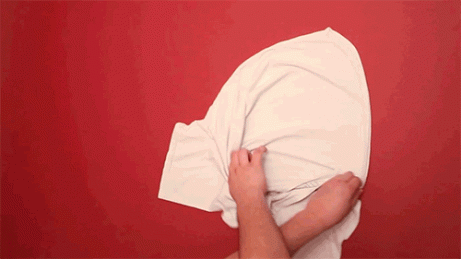
This method is not an ideal way of folding a t-shirt however. Surfing the internets, there were two popular methods of folding a t-shirt. The most popular is called the pinch method or Japanese method (see above video). It’s a seemingly magic way of folding a t-shirt in about three seconds (FWIW, it’s the way Martha Stewart recommends). I gave it a shot and couldn’t quite figure it out after a couple tries, though because of its speed, I might try harder.

The other way is the ranger-roll, so-called as it’s the preferred way military personnel fold their t-shirts. It involves folding clothes in toward a six inch center channel, rolling very tightly, then closing off the roll with a crease made at the hem of the shirt. This method is super simple and has a number of advantages: It compacts the shirts as much as possible; it allows various different storing methods, e.g. you could store your shirts butt side up; and it makes t-shirts very portable as there is little way they will come unfolded accidentally. It is however relatively slow to do compared to the pinch method.

This is by no means a definitive list of correct methods. We would love to know your preferred method of folding all clothes and shirts in particular. Let us know in our comments section.

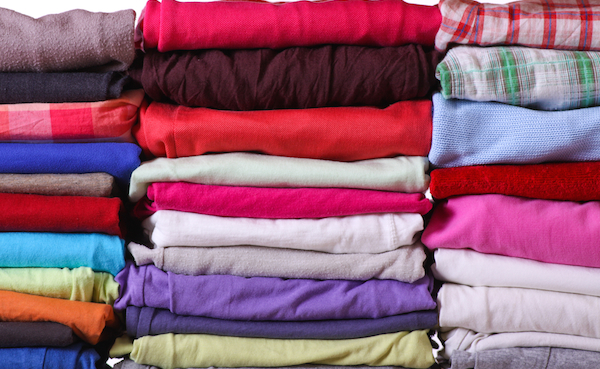
Pile of colorful clothes image via Shutterstock

Want to Simplify Your Life? Try a Uniform

My high school hallways were like a fashion show catwalk. With my classmates carefully scrutinizing my outfits, I made sure my clothes were up to date, that I had the right sneakers, the right cuffs on my stonewashed jeans, the right collar shape on my Gap button-downs and so forth. I carefully rotated my wardrobe to make sure there were no repeated outfits in a given week. I didn’t want anyone to think I didn’t care.

While no one ever accused me of not caring, no one cared that much either. All the anxiety, time spent assembling the right styles, laundry–all of it was for naught. I hovered through high school enjoying low-to-medium popularity, no portion of which was attributable to my clothing.

Most people just don’t care that much about what we’re wearing. In my experience, people will notice if our clothes aren’t clean, if they’re falling apart or if they are majorly out-of-date. They’ll notice if what we’re wearing is well made or fits us well. But people won’t care if the nice, clean, stylish thing we wore on Monday is the same nice, clean, stylish thing we wore on Friday.

The world is filled with a profound number of choices, but studies show that having fewer–not more–choices may be the path to greater happiness. Few places provide a greater opportunity for strategically eliminating choice than our clothing.

Rather than boring and imposed fashion, a uniform can be a great way to simplify your life and even express your style–there’s a reason Steve Jobs, one of the foremost design gurus of the last 100 years, wore the same outfit day in, day out.

With a uniform, dressing and life become much simpler and speedier, and with the right uniform, no one will accuse you of not caring.

If you are interested in creating your own uniform, here are a few tips to get you started:

  • If you don’t have a uniform, or don’t know what it would be, start with your favorite clothes as the basis of your uniform. This should be stuff that that fits you well and you feel comfortable wearing. The idea is to have a wardrobe of only your favorite clothes. If you don’t have favorite clothes or don’t don’t care about fashion, ask someone you trust to help select your uniform.
  • Try to find versatile clothing that will work for several different settings. For example my Outlier pants, a staple in my uniform, work for casual and dress occasions.
  • If you can’t make one thing work for several occasions, create separate uniforms, e.g. a work uniform and a casual uniform.
  • When you find something you like, buy multiples. Get a few colors of the same item if you’re worried about looking the same all the time (but remember no one cares).
  • Even if you don’t wear the exact same thing every day, choose high quality clothing staples like a particular skirt, pant or shirt. Choose classic cuts in muted and complementary colors that you’ll be less likely to tire of and that work well together. Ideally, every item in your wardrobe should look good together.
  • Add variety and style to your uniform by wearing accents like colorful undershirts, shoes or jewelry.

Do you have a uniform? Let us know your suggestions in our comments section below.

[This post originally appeared on this site on April 12, 2013]

The 10 Item Wardrobe Challenge

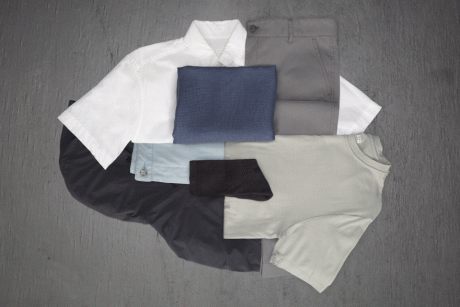
In the past, we’ve looked at Courtney Carver’s Project 333, a minimalist challenge that asks participants to wear only 33 items of clothing for 3 months. Well Canadian Matt Souveny’s 1 Year, 1 Outfit project makes Project 333 look like something out of Keeping Up with the Kardashians (we suspect the K’s have big wardrobes). The Royal Air Force pilot and men’s fashion blogger (interesting combo, eh?) has pared his wardrobe down to 10 items (not including socks, underwear and outerwear). The 10 items include one pair of pants, one pair of shorts, two T-shirts, one button-down, one sweatshirt, one pair of sneakers, one pair of boots, a blazer and a belt. That’s it. Every choice was derived from Reddit’s male fashion advice forum, a place where only the geekiest of dandies dare tread.

The specific items Souveny chose were an Outlier merino v-neck t-shirt, an Outlier merino crew neck t-shirt, an Outlier merino/Co Pivot dress shirt, Strike Gold Loopwheeled sweatshirt, Apolis Chore Jacket, Hollows Leather ‘The Rail’ belt, Outlier 60/30 Chinos, Outlier New Way shorts, Strike Mvmt Interval Runners and a pair of Viberg Service Boots. In case you’re curious, he wore Outlier Megafine merino socks and pullWool Merino Boxer Briefs (see full list with links here). Save for a couple items, Souveny sought to use North American made products.

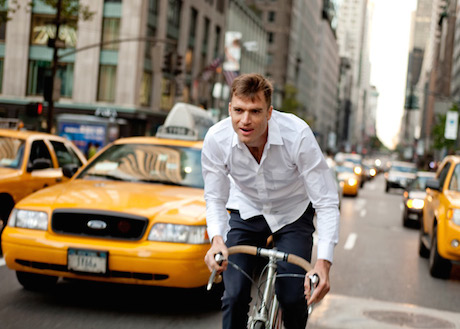
If it seems like Souveny has a disproportionate amount Outlier clothing on his short list, it’s not because he’s a spokesperson (so far as we know). Outlier, a small, Brooklyn-based clothier, makes clothes that use the latest in technical fabrics, all cut in fashion forward styles. Their stuff is as appropriate on multi-day backpacking trips as it is in boardrooms. For this reason, the brand has become a Reddit darling–it’s also a personal favorite of this author, who owns a number of items on Souveny’s list (Full disclosure: in more youthful times, I was one of their first models. That’s me below in a super sketchy photoshoot sprinting through traffic on 5th Avenue without a helmet).

outlier-heavy-traffic

I don’t have any personal experience with the other brands, though I’m a fan of merino wool in general for its wicking abilities and BO funk-resistance. Of the other brands, I’m confident their merits have been scrutinized and overanalyzed by Souveny and many others on Reddit.

thisstylishlife

Some note of Souveny’s circumstances should be made. He is on a nine months leave from work, living in a 600 sq ft cabin in the woods (for the record, his main place is 2500 sq ft and he claims no “minimalist” cred). And when he does go back to work, he wears a flight suit, which I suspect he won’t count as an additional item. While he might not have to contend with work attire, he will have to contend with Canadian winters–and summers for that matter–making the brevity of items all the more impressive. Ten items living in the tropics ain’t that big of a deal.

Laundry-620x412

Souveny is chronicling his experiment on his blog This Stylish Life. Here’s some of what he wrote about his first month:

What I have found is that choosing what I wear each day is dictated only by what is clean and the weather outside. If it’s hot it is a shorts day and if it’s not then pants it is. It is that simple, I don’t think about colours, social encounters, or situations that may warrant using a cheaper spare. I put on my American Trench raincoat if it is raining and my Apolis wool jacket if it is cold. It all works together because I designed it with that purpose, I coordinated my outfit once and that is all I have to do for the year.

I have stopped chasing sales online or thinking about how to fill this or that imaginary gap in my wardrobe. It has given me more free time away from the internet and I’ve actually started reading books again, which I haven’t had the time to do for years. I guess I was too busy shopping.

This sounds a lot like the post we wrote a while back about wearing a uniform. Eliminating choice in many situations is a liberating, not restrictive, act. And it does not mean eliminating style or comfort. In fact, when you have fewer things, there’s a greater imperative to make those few things the right things, the ones you love and look great. While we might not all be able–or want–to pare down to ten items, Souveny’s experiment that shows us how, with a little consideration, we can simplify our lives and do more with less stuff.

Image credits: This Stylish Life and Emiliano Granado for Outlier

Via CNN