Basic, Done Right

Have you ever noticed how difficult or expensive it is to get basic stuff done simply? A pair of pants in a classic cut with durable fabric. Sneakers without neon colors or a huge logo emblazoned upon it. Fashion tends to value timely over timeless design, thereby imposing planned obsolescence, replacement and greater profits. Designer Daniel Eckler and his company MIJLO (my-lō) seem to understand this situation, and have created a response in the form of a product called “A Better Backpack.” Rather than creating a crazily festooned pack with secret pockets made of kevlar reinforced recycled bamboo fibers, they are making a simple canvas bag, classically styled, with just enough features to get the job done.

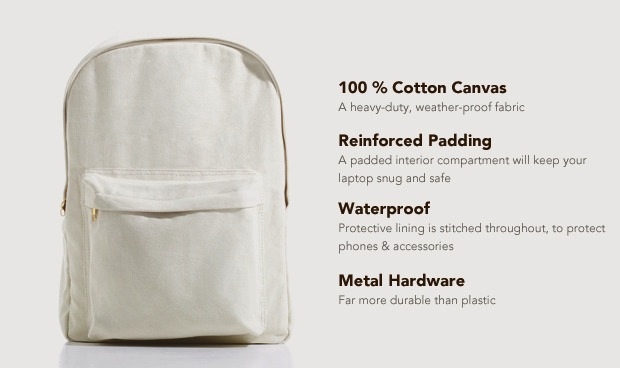
The bag’s exterior is made of 100% cotton canvas with a waterproof lining to protect electronics and paper. There is an internal padded sleeve for a laptop–a necessity nowadays. All hardware is metal to ensure durability. It is available in four muted, fad-resistant colors. There are not many more features than that.

MIJLO sees the bag as a response to “disposable design.” From their website:

In recent years, fashion retailers have been moving designs from the runway to the rack faster than ever before – feeding a fashion cycle that appears to have no end in sight. At MIJLO, we believe that fashion doesn’t have to be fast, or disposable, or temporary. We believe it should begin and end with a classic collection of well-designed essentials. And we’re starting that collection with a backpack – A Better Backpack. Since we believe a product’s lifespan should be as timeless as its design–simplicity and sustainability were an integral part of our design process.

While they want people to hold onto the bag forever, they also know sometimes people get rid of things, so they offer a 10% buyback for your old bag when you’re through with it. Materials are then recycled for future products.

Like many products we’ve been featuring lately, A Better Bag is being promoted and funded through a Kickstarter campaign. You can purchase a bag with a $39CAD ($37US) pledge. With almost 40% funding received in a day of campaigning, it seems as though a lot of people want things that last longer than a whim.

Love and Wear All the Clothes in Your Closet

In yesterday’s post about downsizing we gave the suggestion to have your stuff be “curated, culled and contained.” While we were referring to kid toys, it brought to mind Project 333 as an example of how this might look in the real world.

Project 333 is a minimalist fashion blog and experiment started by Courtney Carver. The idea is simple: Wear 33 articles of clothing (or less) for three months. According to the project’s website, those 33 items may include “clothing, accessories, jewelry, outerwear and shoes,” but not your “wedding ring or another sentimental piece of jewelry that you never take off, underwear, sleep wear, in-home lounge wear, and workout clothing (you can only wear your workout clothing to workout).” What’s left over is boxed up or given away.

Carver’s site includes detailed explanations about where to start, fashion news (insofar as it affects people with hardly any clothing) and personal accounts of women and men who’ve taken on the project.

The project is great because it makes a game and builds community around doing more with less. And rather than giving people new opportunities to criticize your bland wardrobe, Carver reports:

People will not notice that you are dressing with the same 33 items for 3 months, although they may notice there is something different about how you present yourself. You will likely get more compliments. That has been my experience and that of others on this journey.

Project 333 is not about excessive frugality, deprivation and monotony. It’s about being intentional about how we shop and dress (credit esteban at dh). With some experts guess that we only wear 20% of the clothes in our closets, Project 333 challenges us to wear 100% of the clothes in our closet and love every item.

Image via Project 333

Lighter, Better, Faster, Stronger

Forget Paris and Milan, Kickstarter is the new home of today’s cutting edge fashion. From wrinkle and odor free dress shirts to super socks and now ultralight shoes, the crowdfunding site has the world’s most interesting wearables. A new project called Unbelievable Testing Laboratory is making shoes out of DuPont Tyvek; the paper light, steel strong material allows a pair of shoes to weigh a mere 150 grams (5.3 oz) for a men’s size 11. The properties of Tyvek make the upper super strong, breathable and washable. If the rapidity of meeting its funding goal is any indication of market viability, UT.LAB has a big hit on their hands (or feet). They met 175% of their $15K goal in 48 hours! To date, they’ve raised $106K with 29 days left in their campaign.

UT.LAB has heavier ambitions than lightweight shows. Co-founders and partners Token Hu, Shaun Nath, and Joseph Constanty are out to change the way products are designed, tested, manufactured and marketed. Representative Gabriella Krichevsky says this about the company:

We are a company with a strong R&D foundation in China, have studied and mastered our cooperation with factories so that we can build fantastic footwear with vigorous product development through real-time prototyping at ultra-lean costs, and can bring these shoes to market via non-traditional e-commerce like Kickstarter. In a nutshell, we are not only trying to launch a new brand with an awesome cause [more on that in a second]. But, we are trying to fine tune the design, production, and channel selection for bringing products to market globally.

Basically, onsite R&D makes for a very efficient design-to-production transition. And marketing channels like Kickstarter, which provides realtime market feedback, allow UT.LAB to produce a shoe faster and cheaper that is far less likely to be a market flub.

The awesome cause in question is Teach for America, to whom UT.LAB is donating a portion of its profits with to promote math and science in schools.

While this is not always the case, lighter is usually better. With shoes, lightness adds spring to our steps, subtracts weight from our suitcases and may even have less embodied energy than its heftier competitors.

UT.LAB’s Kickstarter campaign is running through August 1st. A $65 pledge will get you a pair of limited edition ‘Pencil’ shoes (which will retail for $65) along with a Tyvek wallet.

Socks that Don’t Suck

When most of us hear the word technology, we think silicon, batteries and things with glowing apples on them. We don’t think socks–the tubular hosiery, less the infusion of nylon 70 years ago, seem relatively innovation proof. Not so, says Ministry of Supply. The same folks who are trying to reinvent the dress shirt are bringing to bear the latest in material technology and design to the lowly sock.

Here is some of the juice that makes the ATLAS sock so special:

  • Construction of 40% recycled polyester infused with carbonized coffee, 40% cotton, and 20% elastane. The blend is designed to be highly breathable and wicking. The coffee is an odor retardant,  important for a sock with such a high synthetic composition.
  • The sock underwent strain analysis to find out where our feet flex so the sock’s design moves with, not against our foot’s natural flexion points, thereby avoiding bunching and sagging.
  • MoS conducted “pressure mapping,” which helped them “visualize how you apply pressure and where you need extra support in your socks.” Areas are reinforced according to those pressure points.
  • Thermal mapping allowed MoS to see where hot spots most frequently occur and provide additional ventilation accordingly.

MoS told CNET that one of their biggest challenges was finding a facility that could handle the 3D knitting process necessary to manufacture the sock per their design. MoS reports that they “landed on one of the most advanced textile mills on the planet, who works with brands like Patagonia.”

The sock, like their shirt, is a Kickstarter project. They have already raised almost $70K of their $30K goal. A $28 pledge will buy you two pair of socks (loafer and full length version are available). Not cheap, but not ridiculous either. And if the socks live up to their claims, it could be a very worthwhile investment.

One thing MoS did not stress is the durability of the sock, which is a big question mark for us. Great fitting socks are, well, great. But if you tear a hole in them in your first few wears, they’re kinda useless. The resistance to bunching might help avoid strain that leads to holes, but we’re not sure.

We’ve said it once and we’ll say it again, but if designers and engineers exerted a fraction of the creative energy normally reserved for electronics to everyday items like socks, our everyday would be a lot smarter than it currently is. We applaud MoS for thinking outside the LCD box.

The Fungibility of Fashion

Fungible: Exchangeable or replaceable, in whole or in part, for another of like nature or kind.

Fashion: A: a prevailing custom, usage, or style; B: the prevailing style (as in dress) during a particular time.

Americans love their clothes–the average family spends $1700 annually on them, according to the Bureau of Labor Statistics. Girls and women average $663 dollars a year and men and boys $382. While these numbers are lower than years past, our affordable duds depend on cheap, often exploitive labor practices and lax environmental safeguards from the countries that provide them. According to the World Wildlife Foundation, “2.4% of the world’s crop land is planted with cotton and yet it accounts for 24% and 11% of the global sales of insecticide and pesticides respectively.”

But the expense and questionable origins of our clothes might be easier to overlook if we only bought what we needed. Such is not the case. A recent Wall Street Journal article claimed that most people only wear about 20% of the clothes in their closet (the percentage of unworn clothes is greater with women than men). If the utilitarian part of our wardrobe is only 20% of the total, what drives us to buy that other 80%?

Fashion–that ever-changing, impossible-to-pin-down look–is often what drives our decision to buy stuff we don’t need or quickly tire of. Granted, many of us follow fashion by professional necessity. But many times our desire to be fashionable is driven by a need to look good and, by extension, feel good. We might feel emboldened by our new, fashionable outfit…until that outfit is unfashionable.

There’s a reason people say they are “slaves to fashion”–they feel bound to keep hitting a moving target. Just when we think we hit the mark, it’s moved.

If you’re interested in escaping the shackles of fashion or just want to save money and natural resources, we have a couple suggestions:

  1. Try a uniform of mostly classic cut, muted clothing. We’ve covered that topic at length here before. Uniforms save time, space and money.
  2. Realize that confidence makes the outfit, not the other way around. We have seen few better treatises on this point than Mackelmore and Ryan Lewis’ “Thrift Shop” (G-rated video above). They show that both a $50 Prada t-shirt or a $5 thrift shop polyester button down can make you look and feel great when your right attitude is right. If either work, your pocketbook and planet might prefer you choose the button down.

The Funk-and-Wrinkle Free Dress Shirt

A fashion startup called Wool and Prince is offering the ideal dress shirt to include in your personal uniform. Their shirt, being launched on Kickstarter, is made of 100% wool that they say will not wrinkle or get all funked up after 100 wears–a claim the founder Mac personally verified through personal wear, sans undershirt. In fact, they gave the shirts to 15 dudes around the world who “did everything from backpacking in the Andes to dancing in ‘Tropical’ NYC clubs.” You can see some of their hijinks on the Wool and Prince’s website.

wool-and-prince

Other salient features include soft-to-skin fibers (they call the particular type of wool “Cotton Soft”), breathability and the availability of several colors and patterns.

The company’s beer-pong chic brand identity might be a bit off-putting to some (their tagline is the “Well Endowed Fiber”), but the shirt, like the Ministry of Supply shirt we looked at a while back, apparently has great appeal. At last check, they raised $299,354 of their $30K goal for the first run of shirts due in November. Before they sold out of their shirts, a $98 pledge would have got you one of their shirts, which isn’t a half-bad price  for a shirt that does double or triple duty (no indication how much they’ll be when they come to market).

What’s so smart about Wool and Prince is that they are thinking about how to make our everyday items better. Men have come to assume that button down shirts need to be washed and pressed after every wear, but maybe not. Maybe you can wear one shirt throughout the week and it’s still fresh enough for the Chris Farley movie retrospective on Friday night.

image via Wool and Prince

Is Swapping the New Shopping?

Part of the allure of shopping and getting new stuff is novelty. Humans like new things–it’s probably a neurochemical. The problem is that new stuff has consequences, some of which we elucidated yesterday.

A site called Swap.com gives a way of satisfying your new stuff jones without maxing out your credit, storage space or ailing planet’s resources.

As the name suggests, the site allows people to swap their stuff. The site has tons of useful items like cell phones, clothes and media. It’s a little like eBay insofar as people make offers on the swap–you wouldn’t trade your car for a cell phone after all. When a swap is agreed upon, the two parties work out the details like shipping and so forth. Swap.com does not take a cut (we’re not sure how they make money actually).

Security is a little dicey. There are user profiles, but the site’s security page suggests that buyer and seller beware to avoid “swap-lifting.” Like eBay, it’s a matter of establishing a good reputation and there are many users who do multiple swaps. They also suggest doing as much as you can locally, which is feasible for people living in places like NYC or SF.

There’s a subset of the swap economy that focuses exclusively on women’s clothes. Sites include Swapaholics, Clothing Swap and Swapstyle. The former two focus on live events and the latter facilitates online swapping.

Some might contend that this type of swapping is a watered-down version of pathological consumerism (a point made quite clear in Nightline feature above). This may be true to some extent, though the consequences of swapping are much fewer than buying new stuff. Just as important is habituating people to find other ways of getting the things we need.

Do you have experience swapping–either with these sites or informally? If so, we would love to hear your tips and experience.

image credit: postconsumers.com

Modular Shoes Make Repair a Breeze

How many times have you bought cool and comfortable shoes that are great until their soles wear out? Most shoes today have molded soles that are very comfortable but nearly impossible to fix, leaving us with closets filled with shoes with pristine uppers, but shot soles. And yes, you can buy traditionally-soled shoes that are repairable, but they are not nearly as comfortable as most modern footwear.

A couple shoe companies are doing something about this conundrum–making modular shoes that are easily customizable and whose soles are easily and cheaply replaced.

First is a brand called Urshuz, the brainchild of a Grant Delgatty, a former Vans and K-Swiss designer. Uppers and soles are sold separately (pun unintended). The uppers have multiple rings that loop over channels in the molded sole to bind the two parts (see above). There are multiple upper styles ranging from flip-flops to leather medium-tops. The soles are a uniform shape regardless of upper style; multiple colors are available.

Uppers range from $20-50 and all soles are $25. Considering you can keep the uppers for a much longer time than a standard shoe, and even a modest sole repair is $20, we think that’s a good deal. They look pretty good to boot.

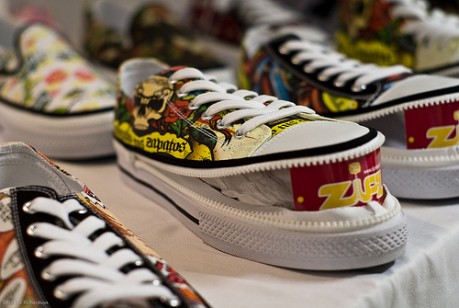
Zipz does a similar thing but with soles that are zipped to the upper. The Zipz styles are similar to popular canvas shoes like Converse, Keds and Vans.

Uppers are around $25-30 and soles are $28. Upper/sole combos are available for $45-50 and there are kids and toddler versions that are a little bit less expensive. As a new pair of Converse is around $30, and often the canvas wears out simultaneously with the soles, we’re not so sure on the value proposition on Zipz, but the idea is nice.

In a world of planned obsolescence and designs that preclude repair, it’s nice to see some companies are making practical products whose life-cycle does not hinge on one of its parts wearing out.

Reinventing the Dress Shirt with NASA Technology

In a certain way, men’s business suits are pretty great. They have barely changed in the last 100 years. A man can get away with wearing a decent suit over and over, washing it a few times a year.

Men’s dress shirts are different story. They wrinkle in moments. The nice ones tear like tissue. They stain easily–either getting the ring around the collar, pit stains or showing the slightest splash of coffee.

A company called Ministry of Supply is seeing if they can improve upon this fickle article of clothing. The company, which started as a Kickstarter project, has already raised $430K of its $30K goal–leading us to think that guys are looking for superior dress shirts.

The shirts use a “phase change material” similar to that used in NASA space suits. The material stretches, has an anti-microbial coating to cut the stink, resists stains, breathes and wicks moisture and is wrinkle free. The shirts are 100% made in the USA. They look pretty good to boot.

As they have exceeded their Kickstarter goal, Ministry of Supply is taking orders for August and September deliveries. Available are two dress shirts: the Apollo for $105 and the Agent, at $85. There is a t-shirt and base layer available as well; $40 and $30 respectively.

Like the Outlier dress pants we looked at a while ago, Ministry of Supply is bringing smart design and technology to products we all need and regularly replace. While both companies’ prices might seem expensive to some (Outlier pants range from $135-240), consider that their products will last much longer, can be worn more than once, will be more versatile and comfortable than traditional models. A little extra dough up front seems like a good investment to us.

Prêt-à-Louer: How to Get Your Couture by the Hour

Do you have a big occasion you want to look awesome for? Do you have limited closet space and/or budget? Are you incapable of wearing tacky, store-bought clothes? If your answer is yes to one or more of those questions, Rent the Runway might be for you.

RTR offers women the chance to rent from a rotating stock of top designer collections and accessories for a fraction of sales price. For example, a $1600 Missoni dress rents for $175 and a Kate Spade clutch rents for $40. Other designers include Elie Tahari, Vera Wang and countless labels that are so prestigious we don’t recognize their names (there are also many lower price point options too).

Because you only have a RTR dress for 4-8 days, the site helps reduce clutter that would come from clothes that are often only used once.

As there are some inherent limitations to “trying” a dress online, RTR sends a backup size with every order. If those don’t work, they’ll overnight you something else. If you need some help choosing, you can chat with one of their stylists.

The site also allows past renters to review dresses, saying whether they ran small, big or true to size, as well as commenting on how they fit their bodies (they state their body size for comparison sake).  Some renters even post pics of the dress in action.

RTR might be doing the impossible: i.e. making $1000+ wear-once dresses compatible with an edited life. What do you think? Are those things mutually exclusive or can ultra-lux items work with an edited life?