Smell Up Your Home for Lower Stress

A body of evidence has shown that interacting with nature reduces stress and increases our ability to pay attention. Research is now showing that smelling nature “lowers our blood pressure dramatically and increases anti-cancer molecules in our bloodstreams” according to a recent Atlantic Cities article.

Immunologist Qing Li at Tokyo’s Nippon Medical School suspected the positive physiological effects of being in nature weren’t only visual–i.e. looking at a forest or creek or whatever–but olfactory. For the last eight years, he’s been studying phytoncides, the natural aerosols emitted by plants, to see if and how they benefit humans.

To test his theory, he stuck subjects in a hotel room (probably the most unnatural environment imaginable); one group had cypress aromatherapy and the other without. The group with “experienced significant drops in stress hormones and boosted immune cell activity,” according to the Atlantic. Li helped found a Japanese group to further research in the forest medicine field, and a few years ago the International Society of Nature and Forest Medicine (INFOM) was founded.

What does this all have to do with living an edited life? Well many of the living situations we talk about on this site are urban. And while city life has many benefits–culture, great transportation, walking, etc.–it can also be pretty assaultive on our senses. While nothing replaces time in nature, a few small steps such as adding an essential oil diffuser with cypress or lavender oil (we suspect Febreeze and Glade Plugins won’t produce the same benefits) to your home might make a huge difference in offsetting some of the stressors inherent in city life.

Image Credit: Shutterstock.com

Via Atlantic Cities

The Tao of Fight Club

tyler-durden-owing

We at LifeEdited are staunchly nonviolent, but a recent viewing of, and subsequent reminder from our friends over at Unstash, revealed the many pearls of wisdom dispensed between bloody brawls in the movie Fight Club. The 1999 flick starring Brad Pitt, Edward Norton and Helena Bonham Carter, based on the Chuck Palahniuk (pronounced Paul-uh-nick, if you were ever wondering) novel of the same name, is a commentary on society’s obsession with a consumer lifestyle we can never quite attain–and the subsequent liberation through, well, fighting (it’s way more nuanced than it sounds).

Please note: The following quotes–most deliberately taken out of context–are not our endorsement of any or all ideas expressed in Fight Club.

Tyler Durden: You’re not your job. You’re not how much money you have in the bank. You’re not the car you drive. You’re not the contents of your wallet. You’re not your [expletive] khakis. You’re the all-singing, all-dancing crap of the world.

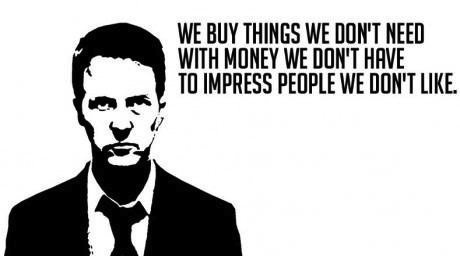
fight-club-things-we-dont-need

Narrator: You buy furniture. You tell yourself, this is the last sofa I will ever need in my life. Buy the sofa, then for a couple years you’re satisfied that no matter what goes wrong, at least you’ve got your sofa issue handled. Then the right set of dishes. Then the perfect bed. The drapes. The rug. Then you’re trapped in your lovely nest, and the things you used to own, now they own you.

[divider]

Tyler Durden: Reject the basic assumptions of civilization, especially the importance of material possessions.

tyler-durden-lifestyle

Narrator: Tyler, I’m grateful to you; for everything that you’ve done for me. But this is too much. I don’t want this.

Tyler: What do you want? Wanna go back to the [expletive] job, [expletive] condo world, watching sitcoms? [Expletive] you, I won’t do it.

[divider]

Marla Singer: I got this dress at a thrift store for one dollar.

Narrator: It was worth every penny.

Marla Singer: It’s a bridesmaid’s dress. Someone loved it intensely for one day, and then tossed it. Like a Christmas tree. So special. Then, bam, it’s on the side of the road.

The Things We Carry

Last night at 2:32am the fire alarm in my building went off. This is not one of those get-the-ladder-and-press-the-button alarms, but a building-wide system, whose blare penetrated every square foot and eardrum in the building and requires the super to turn off. My wife and I threw some clothes on ourselves and infant son, tossed the cat into his travel box, I made sure I had my phone and wallet and we headed out the door.

The building’s residents congregated in the outside doorway, clad in their winter coats and pajamas. The fire department eventually arrived. They reported that there was no danger. After their coast-is-clear confirmation, we shuffled back to our apartments.

Beyond gratitude for the safety for all parties concerned (we appreciate that these situations can turn tragic), the experience revealed a few things about our relationship to stuff:

  1. We didn’t really consider stuff until after the incident ended; we were only concerned about making sure the baby and cat were safe.
  2. If we could only take what we could carry, my wife, who is a designer, said she would take her old photos, her computer, whose harddrive contains most of her professional portfolio and a vintage teddy bear. I would take my harddrive which holds all of my non-cloud stored files and some sculptures my father gave us. These were the only items we considered irreplaceable.
  3. Useful stuff trumps “valuable” stuff. When contemplating the second tier of things we would take from our smoldering home, both of us thought of the stuff we use everyday. My wife, who has a fondness for nice eyeglass frames, intuitively grabbed her most versatile pair, the ones with the neutral style and whose lenses tint in the sunlight. She would also grab her diaper bag/purse, a few pair of her favorite jeans and the designer peacoat she’s had for years. I would grab the Outlier pants I wear daily, my EMS soft-shell winter jacket that keeps me dry and thermoregulated from 25-70 degrees, my yellow waterproof Ortlieb backpack, my vintage Basso that has become my main commuter bike (both pictured above) and, if I could lift it, our cast iron pan. Expensive cocktail dresses, jewelry, wool suits, even most of our artwork, took backseat to the things we use day in, day out.

How about you? What would you take with you? Have you a been in a situation where you had to flee your home? What did you take, if anything? What did you learn about your relationship to stuff? We’d love to hear.

Doing Laundry is Fun

Back in the day, washing clothes was a community-building experience. Folks would go down to the creek, hang out and connect, all while getting massively strong forearms. While this idealized version of the olden-times laundromat might not correspond with the reality (have you ever hand-washed a big load of laundry? In a freezing creek? Not fun.), doing laundry can be a great opportunity to connect with others who find themselves in the same soiled-clothing predicament.

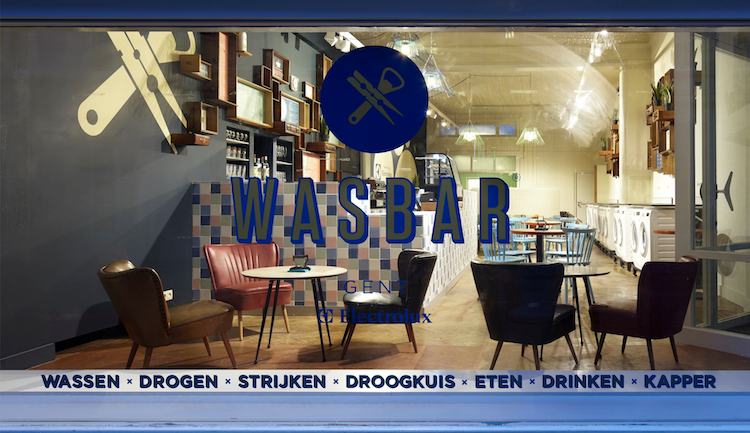
wasbar-interior

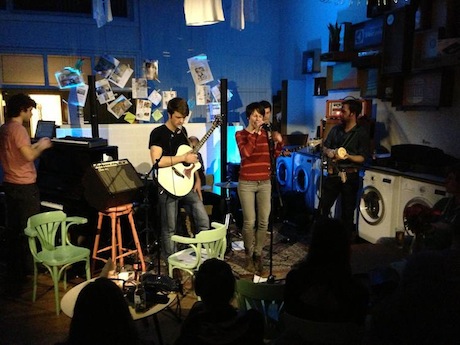
A laundromat in Ghent, Belgium called Wasbar seizes this opportunity, turning the otherwise tedious and time-consuming task of cleaning your clothes into an attractive, fun, social and gastronomically satisfying experience. Rather than the decor consisting of delaminated formica, linoleum and florescent lighting, Wasbar is filled with soft lighting, wood, tile and attractive furniture. Rather than a couple vending machines filled with Pepsi and Funyuns, Wasbar has a beer and espresso bar and buffets serving delicious food. Rather than watching muted episodes of Judge Judy on an overhead TV, Washbar has knitting classes, concerts and a bunch of other programming to keep you entertained while you wait for your laundry (you might not want your cycle to end before the class ends or the encore set).

wasbar-concert

Wasbar is sponsored by Electrolux appliances, Ecover cleaning products and a few other companies. It’s tough to tell whether it’s more than a promotional popup shop, but we like the concept. It plays into the “city as living room” idea we talk about here. It turns an otherwise dull, isolating tasks into an opportunity to connect with your community–all while maintaining your lithe forearms.

Via PSFK

Hong Kong’s Micro Madness

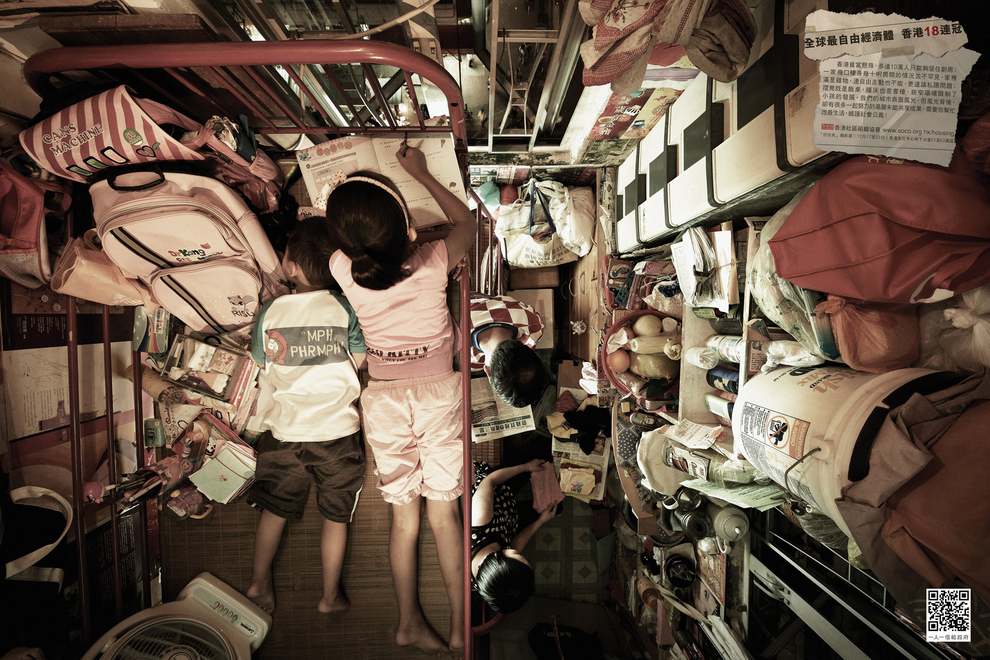
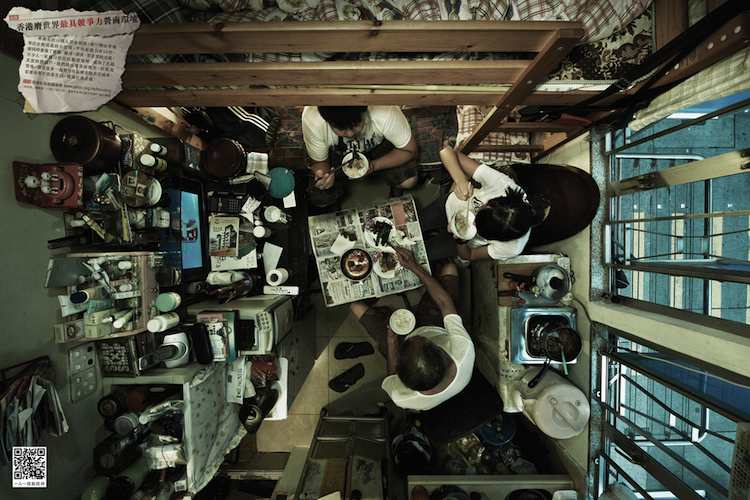
We’re big proponents of high-density urban living but there comes a point where small-footprint, efficient housing starts looking a whole lot like storage units for humans. Few places fit that bill like Hong Kong, which boasts the second highest density of any sub 1M person nation in the world.

Some pictures by photographer Benny Lam taken for the Society for Community Organization show the more unseemly side Hong Kong’s high density. The shots are part of a campaign meant to bring awareness to the shockingly cramped conditions many Hong Kong residents live in.

The shots bring to mind a series of photos from photographer Michael Wolf, who looked at many different facets of Hong Kong density–from squeezed interiors to seemingly unending high-rising apartment exteriors. Check out his website to see the full series.

We recently read an NRDC interview with our good friend and Treehugger managing editor Lloyd Alter, where he shared some of his thoughts on the limits of density. While there has been a recent battle-cry of “denser-is-better” that axiom can be a bit facile, as he explains:

Environmental writers and thinkers are piling on, all of them claiming that we need to fill our cities with 40 story buildings. A renowned architect can design a building that is essentially a pile of radiator fins but call it green because it packs 750 apartments on a third of an acre, saying that the most important thing we can do for the environment is live in compact cities with mass transit.
I am convinced that they are wrong, that there is a “goldilocks density” that is high enough to support a vibrant, walkable community, but not so high that you can’t walk up to your apartment when the power goes out, that needs expensive infrastructure like subways and huge underground parking garages. Dense enough to build a sense of community, but not so dense as to have everyone slip into anonymity.

We’re not intimate enough with Hong Kong to say whether their density is problematic (though a video we posted a while back seems to indicate that people in Hong Kong seem to think it’s a problem), but we can’t help think that these Hong Kong homes bear out Alter’s contention that greater density ain’t always so great.

Incidentally, Singapore is the both the densest and unhappiest nation in the world. While that’s far from proof that hyper-dense living causes unhappiness, anecdotally it might bolster the contention that maximizing density doesn’t maximize greater living.

Why You Should Give a Washit

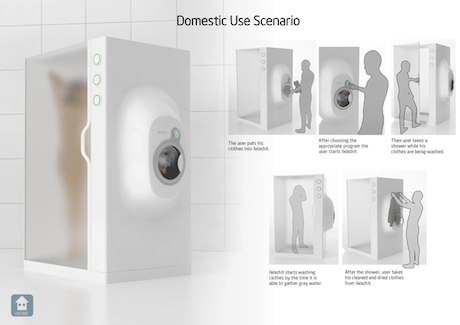
In an effort to reclaim some of the billions–probably trillions–of gallons of perfectly good water sent down the drain, a few Turkish designers created the unfortunately-named, brilliantly-conceived combination shower/washing machine/dryer Washit, which uses your filtered shower water to wash your clothes. It actually goes one step beyond most grey water systems, which will often have one-stage water recycling–e.g. using sink water to flush a toilet then onto the sewer. Washit continuously filters and reuses the same water, only replenishing when there is water loss.

washit-how-it-works

One of the more interesting ideas is the public version of the Washit, which allows people to step inside the unit, strip and load their clothes from the inside, then take a shower whilst their clothes are cleaned and dried. This would be great for airports, gyms and late-night partiers.

Washit-private

washit-public

There is no indication of how long a Washit cycle is. In fact there is no indication that the Washit is ever going to make it to market, though we hope it does. Most modern plumbing systems waste both water and space. By creatively combining water-consuming apparatuses as Washit does, we can cut down on space and water waste. Now about the name….

6 Future Blue Chip Companies in the Sharing Economy

A recent article in Forbes called “Airbnb And The Unstoppable Rise Of The Share Economy” gives a great overview of the nascent sharing economy. It tells stories of people like Frederic Larson, who brings in $3K/month renting his home to Airbnb and his Prius through Lyft, or Dylan Rogers, who makes $1K/month renting his BMW out and plans to buy a couple extra cars to make his own micro-rental car fleet. It explains how more and more average people are making and saving dough through resource sharing.

The article is a worthwhile read as it gives a balanced look at the opportunities–the millennials growing receptivity to renting and sharing versus ownership, a southbound economy–and challenges–getting people to share low-cost goods, restrictive commercial regulations–facing the sharing economy

The article also turned us on to a number of sites we didn’t know about. Stahlwarts like Zipcar, Zimride, Neighborgoods and Taskrabbit appeared in the article, but so too did some newer, more specialized sites. Here are a few of them:

  • Parking Panda is a peer-to-peer parking garage. Rent out your vacant parking spot as you would your unused room for Airbnb. PP also allows booking standard garage parking, using their mobile app.
  • Dog Vacay is like Airbnb for dogs. Give your dog to “one of thousands of vetted and insured dog lovers” when you leave town (or need a reprieve from your pooch) for “cage-free” boarding starting at $15/night.
  • EXEC is an on-demand cleaning and errand running service with a lovely web interface. An added bonus is that they use all organic cleaning products.
  • Liquid is a peer-to-peer bike rental service. Rent a bike for $20/day or let your bike out for some extra cash (note: the site is down for the winter).
  • Fon is an international peer-to-peer wifi network with over seven million Fon Spots (aka hot spots). Private wifi providers can make money off people accessing their signal.
  • Zaarly allows you to sell your homemade cookies and other shippable custom goods.

Most of the services seem to have a Left-Coast bias, though ones like Fon and Zaarly have national appeal. And of course, as the article mentions, Airbnb started in San Francisco and can now be found in Peoria, Il. You gotta start somewhere.

Do you have more sharing sites we should be looking at? Let us know in our comments section.

Image via Shutterstock.com

Check Out CO: LifeEdited’s Entry for the adAPT NYC Competition

LifeEdited, as part of a team with Jonathan Rose Companies, Curtis + GinsbergGrimshaw and Scape Studios, was honored to be chosen a finalist for the adAPT NYC Competition. Our design was called CO: Compact, Connected, Complete.

To break down the division of labor: As New York’s preeminent green real estate developer, Jonathan Rose Companies handled the development aspect of the project; Curtis + Ginsburg and Grimshaw were responsible for the building’s architecture; Scape was responsible for landscape design; and LifeEdited did the apartment interiors and a few other aspects of the overall design.

Grimshaw explains the overall architectural layout of the building:

The massing has four components: ground floor retail; micro-units; social and community spaces; and a northern circulation spine. The apartments feature south facing windows and private balconies angled toward the park. Indoor and outdoor communal spaces are sprinkled throughout. The south façade emphasizes light and air for each unit while the east and west facades serve as bookends that bring ample light into the corridors on every floor. The north façade features a green wall system and large windows to bring light into the stairwells.

The interior was designed to function as living room/lounge, bedroom and office. The video below shows the “semi-furnished option” which is outfitted with the Resource Furniture Atoll 000 bed/sofa and Paso table; the latter piece converts from coffee table to dining table for eight. We gave it triple duty by making it part of the workspace.

The building features a “Product Library” where residents can check out items like extra chairs and bulky, not-so-frequently-used items like a stock pot. Other cool features of CO included large terraces and rooms shared by the whole building and a “Potluck Restaurant” where residents could make impromptu dinner parties (or lunch parties we suppose).

The goal of the project was to create a compelling and livable micro-apartment building–and one that could be realized in New York City in today’s real estate climate. Having been chosen as finalists amongst a deep and very talented pool of competitors, we think CO achieved those ends. We were very happy with the end product and though we did not win the competition, elements of CO will sure find their way into future projects.

What do you think of CO? What worked? What didn’t? What more would you add? What would you take away?

Why Just Hang Out at the Mall When You Can Live There?

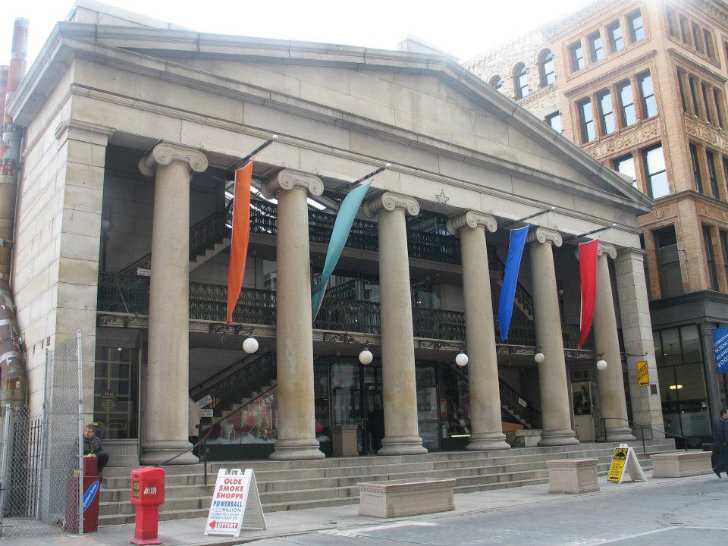
In one of the coolest repurposing projects we’ve ever seen, the Providence Arcade in Rhode Island is being converted from standard shopping mall into a retail and micro-apartment complex. The first floor of the arcade will remain retail, but the top two floors will be converted into 48 micro-apartments, averaging a mere 250 sq ft. Prices start at a very reasonably $550/month.

The mall, also known as the Westminster Arcade, is the nation’s oldest indoor mall, dating back to 1828. And unlike most malls we’re familiar with, features ample natural light (the malls of our youth were lit like Vegas casinos). The tiny apartments look out onto the courtyard, which is covered by a huge skylight.

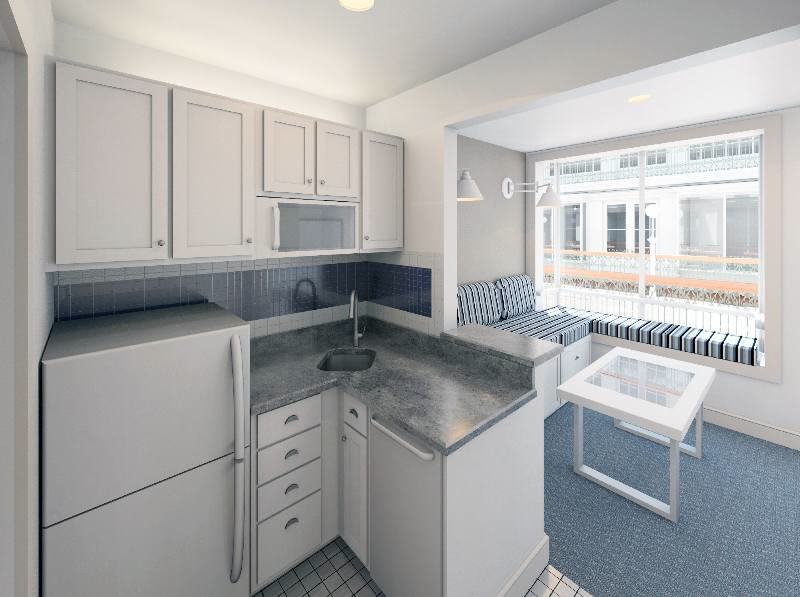
The little apartments will have many features including dishwashers, full bathrooms, built-in furniture with storage, additional lockable storage, common areas, a game room and more. The big walkways look like great places to interact with your neighbors–something surely abetted by a climate controlled environment.

The $7M conversion is being developed by Evan Granoff and the apartments are expected to be ready by May. It looks like a fun place to live and shows that making desirable, affordable micro-housing doesn’t require elaborate new buildings, but can be done with existing resources. Find more info at Arcade’s website.

Story and images via Inhabitat

Study Confirms that Big Houses Have Big Energy Needs

energy-information-administration

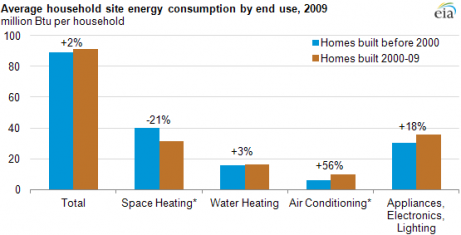
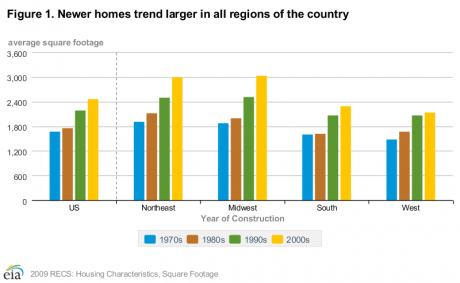
The recent Residential Energy Consumption Survey (RECS) by the Energy Information Administration (EIA) shows that homes have become slightly more efficient in the 2000s versus previous decades, but a 30% increase in home size has totally negated all of those gains. As the EIA reports:

As square footage increases, the burden on heating and cooling equipment rises, lighting requirements increase, and the likelihood that the household uses more than one refrigerator increases.

The average home of the 70s and the 80s was a mere 1800 sq ft, compared to 2200 of the 90s and 2465 of the 2000s. The increased area has brought along with it increased energy needs.

chart

But that’s not all. Here are some other findings from RECS:

  • Higher ceilings: “17% of homes built in the 1970s have higher than the traditional eight-foot ceilings, while that number increases to 52% in homes built in the 2000s.”
  • Coldest regions have biggest homes. “In the Midwest, where space heating accounts for half of home energy consumption, residents heat more space on average than any other part of the country. In Wisconsin, for example, the average heated square footage is nearly 2,100 square feet. By contrast, homes tend to be smaller in parts of the country where space heating is less intense. In California, where most of the population resides in mild or hot climate regions, the average heated square footage is 1,180.”
  • More A/C cooling bigger homes. “Central air-conditioning was installed in 85% of homes built in the last two decades, resulting in a dramatic increase in the amount of residential space that is cooled and contributing to a nearly two-fold increase in electricity consumed for air-conditioning.”
  • Some gains. “While overall home size and air conditioned space have been increasing, the likelihood that a home will have key energy efficient features rises as its square footage increases. Residents in larger homes consider their homes to be better insulated than those in smaller homes and these homes tend to have more efficient windows.”

We don’t often talk a lot about the environmental implications of an edited life. We believe the benefits of living with less, but better is its own reward. But, obvious as it sounds, smaller homes are greener.

Granted, there might have been a significant reduction in efficiency in smaller homes in the 2000s, but we suspect that many of the efficiency measures applied to larger homes were also applied to small ones. We don’t think it’s too conjectural to say that if the homes of the 2000s hadn’t grown so much, the more efficient appliances and better insulation, now applied to huge houses with high ceilings, would be applied to more modest homes with modest energy footprints and cheaper operating costs.

Via Lloyd Alter at Treehugger