Petite Apartment Packs Pivot Power

Robert Garneau is no stranger to ingenious small space design. The NYC-based architect’s Transformer Apartment, with its host of custom storage solutions and transforming elements, is one of the most publicized micro apartments in the last decade. Last year, Garneau’s new practice Architecture Workshop PC received an NY AIA Honor award for their Pivot Apartment, which takes an innovative approach to creating spatial divisions in a small NYC prewar studio.

pivot-apartment-dining

Similar to the MJE House by Spanish architects PKMN, the Pivot Apartment uses a pivoting wall to split the 400 sq ft space (yes, Garneau has a knack for descriptive naming). When the wall is closed, it creates an open space with enough room for a table with seating for ten (table collapses when not in use). When the wall is open, it reveals a wall bed and an array of cabinetry. The two cabinets skirting the bed extend out and include ample clothes storage.

pivot-apartment-livingpivot-apartment-storage

White walls, cabinets and blonde wood throughout the apartment keep the space looking bright and airy.

Photo credit: Robert Garneau

HT Robert T

Sell Stuff Now, Easily

We’ve given tons of tips for selling your stuff. You can get an eBay valet to do it for you, you can sell your stuff on CraigslistKrrb or Yerdle. And of course, you can just give stuff away. With the exception of using an eBay valet and donating stuff, most strategies generally leave the seller (you) to be your stuff’s shipping and inventory manager. For those looking to make rapid life edits, this can be an agonizing process, both waiting for your stuff to sell and dealing with it when it does sell, all serving as a protracted reminder of all your poor life purchase decisions. A new service called Stuffhopper does something different, relieving you of pretty much all responsibility aside from waiting for someone to pick up your stuff and making money.

Unlike an eBay valet, Stuffhopper accepts a huge range of stuff–from furniture to appliances to handheld electronics. You describe your stuff to give them a sense of what you’re selling (they understandably don’t want your broken junk). You then schedule a pickup (if the value exceeds $100) via their site or app. Stuffhopper then goes about creating listings for your stuff, photographing it, creating descriptions and then selling it on whatever channel(s) are most appropriate. Because they are expert sellers, they know how to price and market your products better than you ever would. When they sell the stuff, they take a 50% cut of the net sale and give you the rest. If stuff doesn’t sell in 60 days, they send it back free of charge or donate it with your blessing.

Stuffhopper claims that the average house contains $7K worth of unused stuff. But for many of us, the value proposition of accessing that money–the time and effort involved with selling–isn’t sufficiently compelling to motivate us to do anything about it. Stuffhopper could change that.

Unfortunately for most of us, Stuffhopper is only available in Seattle, but we think it’s an idea that has legs and hope it expands to other cities.

Via Geekwire

Smart, Small Studios Hit Canadian Campus

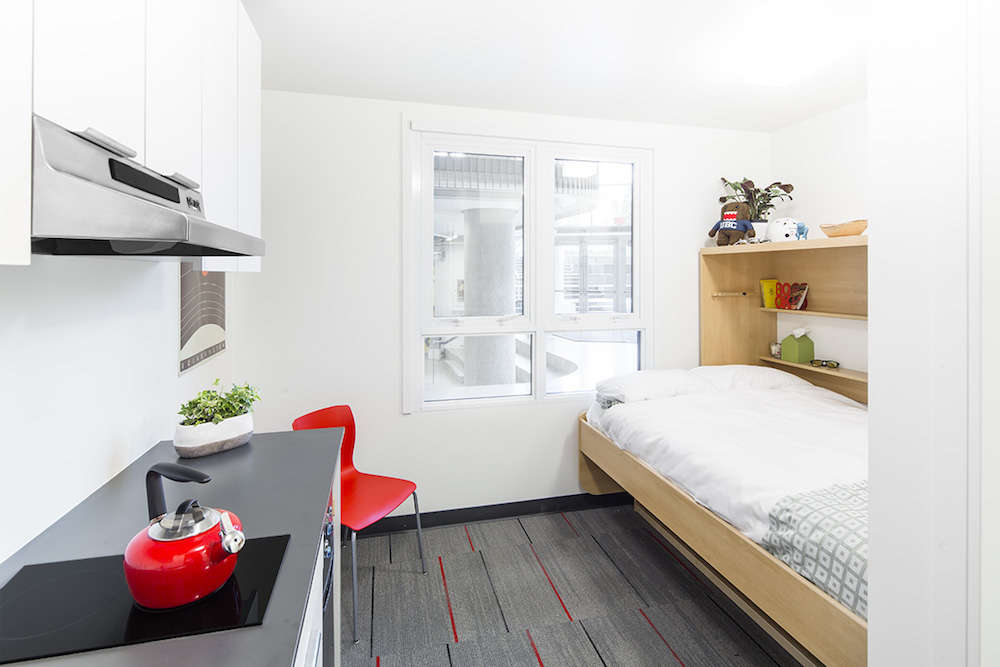
More than most North American cities, Vancouver has experienced a surge in housing costs. Apartments are up nearly 20% from a year ago, with the average price around C$450K (a modest uptick compared to single family houses, which jumped 28%, landing at C$1.83M). Needless to say, these kind of economic conditions are hostile to folks like students who might lack flush offshore bank accounts. As such, the University of British Columbia Vancouver is having an affordable housing crisis. The average monthly rent for student housing is C$1,000, but that’s if you can get it. UBC has a 6,000 deep waiting list. To alleviate some of this housing shortage, the school is now rolling out their Nano pilot housing program, which entails 140 sq ft, fully self contained units that will add a much needed bump in volume of campus housing and rent for a reasonable C$700.

nano_01

UBC is rolling out 70 Nano units in their Gage South Student Residence, which is slated to open in 2019. A demo unit is being displayed at the school’s student center through next month.

nano_05nano_06

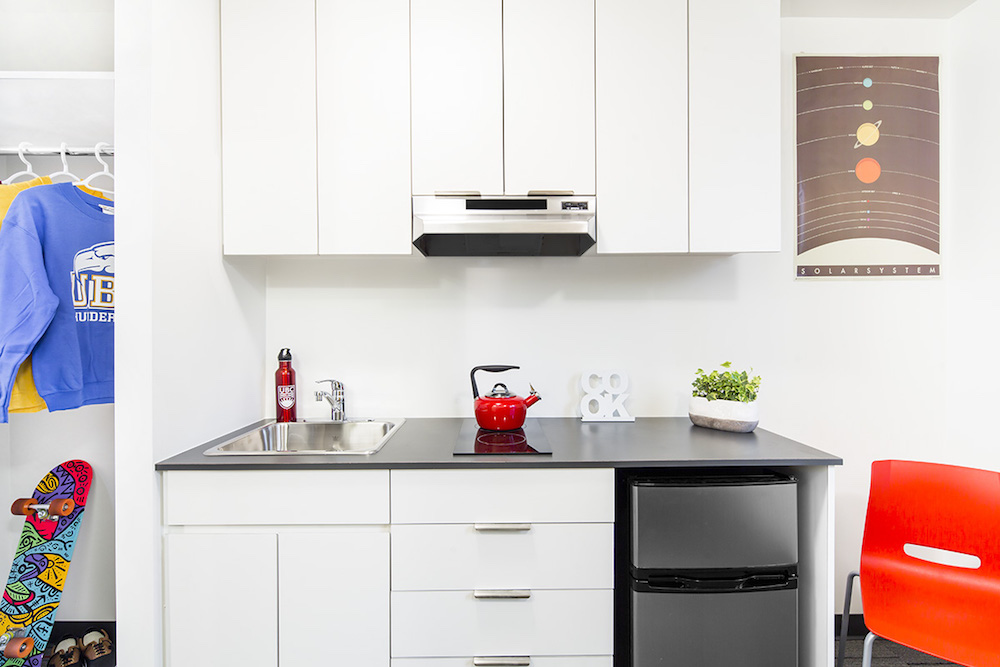
There’s nothing revolutionary about its design per se. It has a double bed that folds up to become a desk when not in use, a small kitchenette with cooktop, fridge and sink and a fairly commodious bathroom. There’s lots of white and light colors and windows that make the place seem pretty spacious relative to its actual dimensions.

While student housing isn’t a particularly guilty offender when it comes to making housing too large, the Nano studio addresses a need for a particular demographic, i.e. students who might be too mature for dorms with shared bedrooms, yet lack the need and expense of a larger, conventional off campus apartment. More than anything, the Nano brings us a little bit closer to destigmatizing tiny apartments, showing that they can be very livable and serve many populations who would otherwise be forced into unaffordable and/or substandard housing.

Via Inhabitat  

Awesome Furniture Company Makes Awesome Furniture

As we saw with the Yatno line, lightweight, compact and affordable furniture–the kind ideal for small space living–need not be disposable, poorly designed junk. We can now add furniture maker Greycork to this list. The startup is making a line of furniture that features elegant designs, super simple assembly, lightweight structures and affordable prices. And unlike Yatno, Greycork is US-based and taking orders.

greycork

On their website, Greycork is offering a sofa, chaise, bookshelf, coffee table and side table. All of items can be assembled without tools and are made of high quality materials such ash wood and powder coated steel. And despite their good looks, the prices are genuinely reasonable. You can buy all five pieces individually, with prices ranging from $125 for the side table to $700 for the sofa. Or you can get all five for $1500. The furniture is made in the US and flatpacked shipped to your door.

While we appreciate what stores like IKEA do provide for small space dwellers, it’s been said that the cost of throwing their furniture away and re-buying it is often cheaper than the cost of moving it. What companies like Yatno and now Greycork are doing is creating adaptable, lightweight and attractive furniture that’s worth holding onto.

Via Ippinka blog

Nature Inspired Panels Keep You Safe from Prying Ears

Lack of privacy is one of the more oft-launched attacks on small space living. In small dwellings where there are two or more people, people might not be afforded the room to retreat and be by themselves. But what is privacy really? Generally speaking, privacy has three varieties: spatial, visual and audio; all three can exist separately or together. In a small space, you might not be able to do a lot about spatial privacy as you will likely be near the person(s) you want a break from; in our experience, if you have visual and audio privacy, spatial is the least important type of privacy. Visual privacy is most often achieved with walls or curtains or, we suppose, masks and blacked out helmets (neither recommended for ongoing use). But in our experience, it’s audio privacy that trumps the other two. Quiet, more so than space or visual cover, is the thing that allows most people to feel a sense of retreat. We’ve discussed white noise and wall panels as tools for achieving this when space is tight. We just ran across these freestanding leaf-shaped panels by Japanese designer Jin Kuramoto which create flexible audio barriers for spaces small and large.

jin-kuramoto-room-dividers

Manufactured by Swedish company Offecct, who has a range of sound-canceling products, the “Wind” room dividers were inspired by natural shapes. They are constructed of noise-canceling fabric stretched across metal tubes. While Kuramoto mostly sees the panels as applicable to large “acoustically chaotic spaces” where noise travels unimpeded, we can’t see why they couldn’t be used in smaller spaces to create flexible audio dividers, creating the virtual space people seek when the actual space is lacking.

Via Dornob

Are RVs a Good Solution to Affordable Urban Housing?

We’re ever on the lookout for creative ways of making cities denser and more affordable. One way of doing that is filling up unused land gaps with housing. And one super simple form of housing that can do that are RVs. They’re small so can fit in the most miniscule parcel of land. And because they’re mobile, they can be inserted and removed on a moment’s notice, making them ideal for land that might be in transition. We’ve looked at how a couple New Yorkers live in their RVs, and recently the real estate site Zillow did a profile of Ellen Sims, an RVer living in Seattle.

Following the simultaneous departure of her two housemates in 2014, Sims pondered her options for an affordable alternative to traditional apartment shares. She decided to move into the RV, putting down $2K for a good sized Coachmen Freelander. She pays $540 in car payments, insurance and propane; all told, she figures it’s ⅓ to ¼ the cost of living in a normal apartment. She enjoys the RVs low cost, the autonomy it affords her and the imposed simplicity. She alludes to some of the less pleasant aspects, such as safety and finding good level ground to park upon.

We wrote a couple weeks ago about Seattle being a bastion of affordability. “Affordability” there referred to salaries being in line with the cost of living. While the city’s tech boom has beefed up many Seattleites’ salaries, many have not been so fortunate. Homelessness has increased a fairly shocking 19% in the last year alone and RVs have become a common solution to avoiding shelters and living exposed on the streets. Most of the 175-200 people who are living out of their vehicles in Seattle probably don’t have Sims’ sweet ride or relative good cheer about the situation.

Seattle’s mayor Ed Murray is now proposing the creation of two parking lots specifically for people living out of their cars and RVs. These lots will have waste management and other amenities.

Despite the unfortunate circumstances that drive (pun intended) many–though not all–to take up residence in RVs, it does present an interesting question about formalizing RV habitation in urban (and other) areas. While safety and sanitation concerns do exist, making RV living legal would go a long way to ameliorating these issues. The fact is many people who are not in danger of being homeless still want to spend less on housing or have greater flexibility as to where and how they want to live. By recognizing RVs as a valid form of housing and creating some infrastructure to support it–or allowing private parties to do so–we could possibly make strides in making our cities denser and more affordable.

Via Geekwire and Zillow

The Minimalist Mogul

There can sometimes seem to be an inherent opposition between commerce and minimalism. The former would seem to demand increase and the latter, well, reduction. But even the most pared down minimalist needs stuff. And sometimes people who love to decrease get the desire to start businesses that sell stuff, thereby increasing. But as F Scott Fitzgerald wrote, “The test of a first-rate intelligence is the ability to hold two opposed ideas in mind at the same time and still retain the ability to function.” Nick Martin, founder of The Pro’s Closet, is a nice example of this first rate intelligence. He doesn’t like stuff, but he sells a lot of it.

The Pro’s Closet is the world’s largest reseller of bicycles and bike equipment. The store’s website describes its origin’s thusly:

While living in his Volkswagen Bus and only the task of riding a bike on his to-do list, Nick Martin began a simple mission: sell all of his worldly possessions on eBay. Minus his bike and his bus, Nick sold everything. Fast-forward 8 years to today and we present to you, The Pro’s Closet. The Pro’s Closet has become the nation’s premier eBay store specializing in reselling new and used cycling gear.

In a profile by Anja Semanco in Under the Flatirons, Martin explains the story in greater detail. Following his initial purge, he was living out of his bus, racing bikes and selling kombucha mothers. But this wasn’t providing sufficient funds for survival. The racing contract did however provide a ton of swag he didn’t or couldn’t use–clothes, components, etc. Martin started selling all of this stuff on eBay, and soon friends were asking him to do it for them too. When he got married, he started to take the selling more seriously, renting out his first of five commercial spaces, each of which grew with the scale of the business. Eventually Nick took on a partner, Pete Lopinto, and the shop now inhabits a huge warehouse in Boulder CO, employs 16 employees and sells around 200 items a day.

But at his heart, Martin remains a minimalist. Martin said, “I think material things hold people back,” and he says that he has given away a possession a day for the last three years. And he sees his business as consistent with his minimalist tendencies. The stuff they sell are things that people or companies already have–used part, unsold inventory, etc. So in a sense, they’re not increasing the amount of stuff in the world at all, but finding ways of equitably–and profitably and sustainably–redistributing it. 

HT Tim F

Rethinking the American Dream Home

Whether manufactured or the reflection of a genuine desire, the American dream has long been a process of settling down with your family in your own single family house (ideally with white picket fence). To some extent, there is a shift away from this dream. One obvious reason is that many people are delaying or avoiding coupling up and having kids. 27% of all Americans live alone–a percentage that has continually increased over the years–suggesting there’s a movement away from nuclear family households and the single family homes they inhabit. Even for those who do have families, there seems to be a shift around the dream of homeownership, a shift that went into overdrive following the housing crisis in 2007. People are questioning whether owning a house means they’ve “arrived” in the world. How can carrying mountains of mortgage debt forcing homeowners to choose work based on whether it can pay the bills be a dream? How can managing and maintaining stuff and space homeowners seldom use be a dream? How can hour plus commutes to homes in lifeless cul du sacs be a dream? It’s not a stretch to say we need to rethink our dreams when they’re so out of sync with reality. This new dream is what real estate startup Acre is all about.

Acre’s mission “is to preserve the beauty and balance of of the environment, connect our homes to it, and give homeowners the freedom to enjoy it more fully.” Husband and wife founders Andrew and Jennifer Dicksen want to create “innovative, attainable, high-quality homes that are better for people and the planet,” according to their website. The way they do this is through easy to ship and assemble homes that are net zero, creating both reduced construction and operating expenses as well as minimal environmental impact.

On top of being more efficient than status quo housing, Acre wants to challenge the large house as status symbol. Not only does the size impact the efficiency of the home, but it often leads to homeowners serving their homes (cleaning, maintaining, paying for, etc) versus the other way around. Acre explains in their promotional video that the status that comes from owning one of their homes is that the owner shows off his or her intelligent, intentional existence (a more enlightened form of status seeking we suppose).

They are offering three sizes: small, medium and large, ranging from 1200-1800 sq ft and two to four bedrooms. The houses arrive in a shipping container, and once the foundations are set, take three months to construct. While homeowners must take care of buying the land and laying the foundation, Acre’s pricing includes the rest: from delivery in the continental US, construction costs, all materials and finishes, solar power systems, appliances and so on.

Speaking of pricing, the small house runs $400K, medium is $450K and the large is $500K–prices that will surely increase with land costs and foundation work. The prices, considering the homes’ quality and features, are not too surprising. Yet these prices are considerably higher than the median price of a single family home in America, which is about $226K, raising a thorny question: which would go further toward simplifying life, buying and improving a less expensive, lower quality home or going for something like Acre’s homes, which in the long run, might be a better investment?

Acre also doesn’t address the thing that can totally thwart a home’s attempts at being energy efficient, which is its location. These are still single family homes, which are ultimately best suited for suburban (read: driving intensive) living. Almost anyway you cut it, single family housing in the burbs is going to be less efficient than multi family housing in transit friendly locations

Those questions aside, we appreciate what Acre is trying to do, how they are trying to make a substantive change to how homes are designed and built and how they are making us think about how we relate to our homes financially, environmentally and psychologically. If you’re interested in an Acre, head over to their website

HT Jared J.

Loft Beds Grow Up

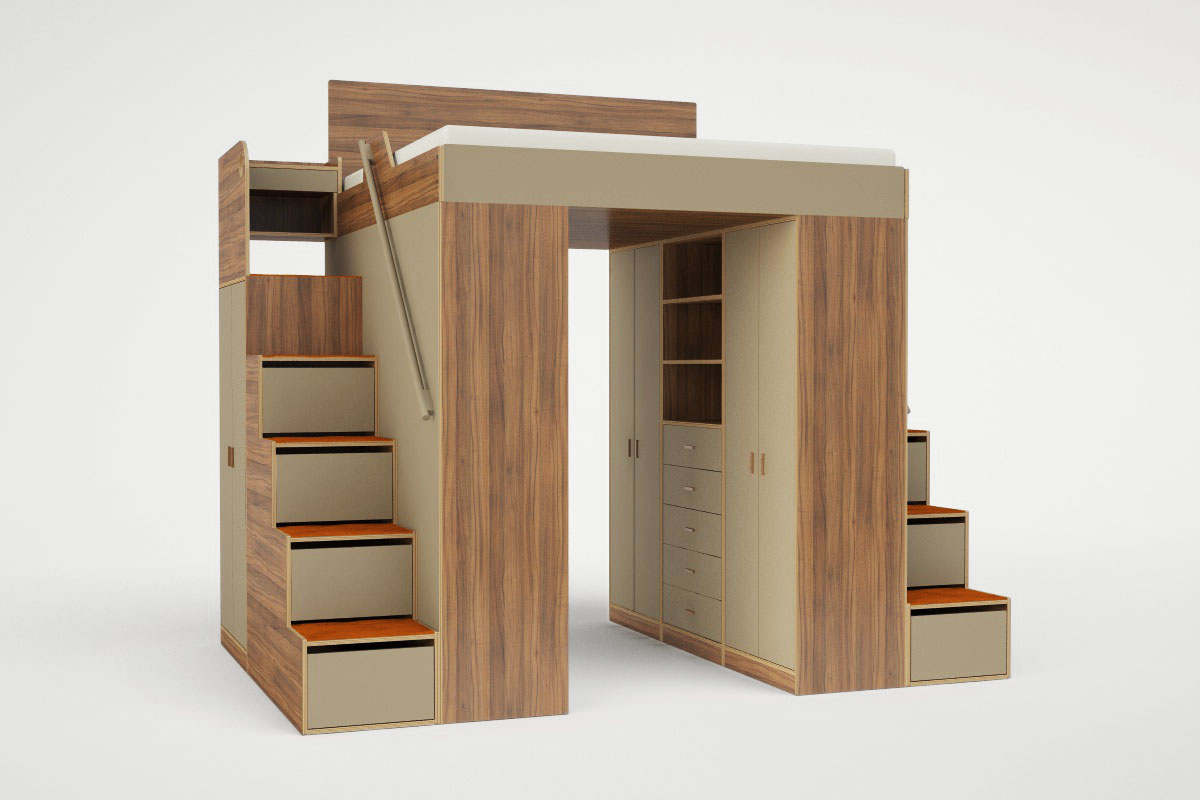
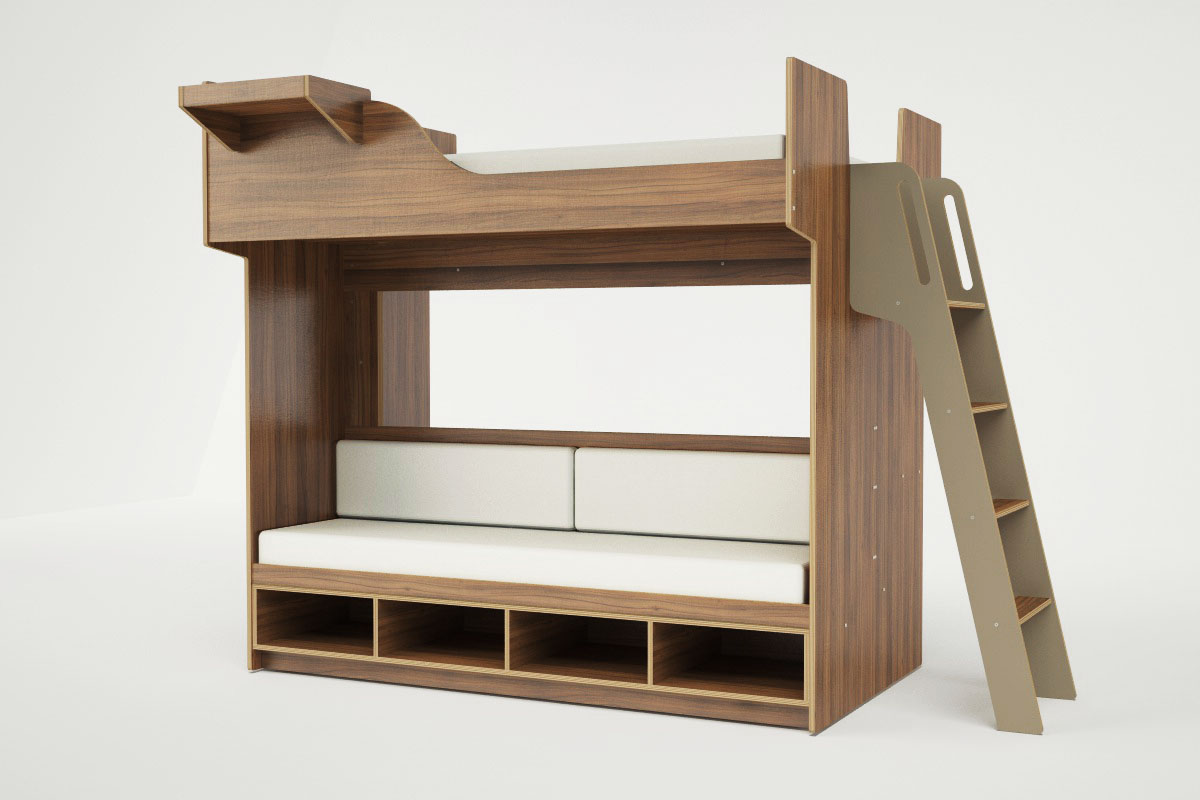
If you have the ceiling height to accommodate them, loft beds are great space-saving alternatives to wall beds. But typically when people conjure up images of loft beds, they think of improvised plywood structures filling out dorm rooms and illegally subdivided urban apartments. Or they’re for kids. Brooklyn based Casa Collection might be changing those stereotypes with their recently released Urbano Collection. Urbano brings adult-grade design and construction to a piece of furniture typically used by the whippersnapper set.

On their site, Casa shows two models. One has a queen bed on top, with a sofa and desk on its base. The other model has a king bed on top and what amounts to a walk in closet for its base; the stairs accessing this model all have build in drawers. All of the pieces are made in Brooklyn, primarily with FSC and CARB certified birch and walnut plywood, according to Casa’s website. Custom options are available.

The Urbano Collection also features adult prices, ranging from $7-20K. This is real money, but considering the furniture can replace several pieces of conventional furniture and theoretically increase the usable square footage of your home, the prices are a bit easier to digest. See more on Casa Collection’s site.

via Livinginashoebox.com

Get Space When You Need It Most

One of the core ideas behind living an edited life is access over ownership. The fact is that many of the things that are useful for certain times are liabilities most of the other ones. To illustrate, if you’re throwing a big birthday bash, having a room in your house that can hold 75 people is useful. But when the party is over, you’re left with a big room to maintain, heat, cool and pay for. Services like Airbnb create a great solution to these kind of problems, both allowing people to access sleeping accommodations when needed and making sure spaces are being used to their fullest potential. Now a site called Peerspace does for event spaces what Airbnb does for guest accommodations.

Peerspace’s tagline is “Connecting people with unique spaces.” The site is a peer-to-peer booking site that lets you rent spaces for events, photoshoots, concerts, etc. Spaces run the gamut from small boardrooms to massive event spaces. Each space’s profile provides high quality images of the space, its amenities, availability and rates. Of course, Peerspace can be used as a place to book a space or rent out yours.

If you’ve ever organized events, you know how difficult it can be finding, much less comparing, good spaces. Peerspace makes the process pretty damn simple. Right now, PeerSpace has networks in New York City, LA, San Francisco, Seattle and Austin.