10 Tips for Creating a Small Apartment You’ll Love to Live In

Today’s guest post is from Karen Krizanovich, a small-space dweller living in London. She recently shared her experience and philosophy in the The Times UK. Today, she gives pointers for how to create a no-fuss, reasonably-priced small apartment (aka apartment) you’ll love to live in. 

Yes, I would love to live in the Hong Kong apartment designed by Gary Chang, the architect who transformed 344 sq ft into 24 different living spaces. Unfortunately, my flat doesn’t have that kind of scope and neither do I. Still, I can adopt similar principles learned from my friend architect Professor Miriam Neet, LifeEdited and other resources to live in a streamlined, no-fuss, no-muss and non-neurotic fashion. I’ve found the following tips to be indispensable for making a small home you truly want to live in.

  1. Live in your place a few months before making complicated or permanent non-essential changes. Think you know everything already how you live–what’s important, what’s not? You’ll be wrong at least 25% of the time. Be patient. You won’t regret it.
  2. Be a simpleton. We all love innovative, automated designs. But what happens when they break? Who’ll fix it? What if the electricity goes off? What about the batteries? As much as I’d love to own, say, electric curtain rails, I know I’m asking for trouble. Remember that guy with the cool thing that didn’t work? Don’t be him.
  3. Follow your gut. I never liked the way my kitchen cupboard doors shut (stupid spring devices). I said I’d give them a try but, deep in my soul, I knew they’d irk me. And they still do. Little annoying things like this are accentuated in a small space and erode the comfort of your home. Fix things immediately that don’t feel right.
  4. With things you love, buy to last. Plan to repair them when needed. Like a great pair of shoes, your home should be serviceable, look great and fit perfectly.
  5. When the space is small, bad design really grates. Everything has to be just right. Settling for ugly solutions will do temporarily, but always keep on the lookout for the right one.
  6. Buy a cheaper version to roadtest. I’ve bought five different chairs and none of them really worked in the space. Now I’m testing an inexpensive version of another design. If it works, I’ll buy the expensive one eventually.
  7. Ask yourself what you really need. I don’t need a coffee grinder. I barely need a blender and I sure as heck don’t need a blender that is also a soup maker. Keep gadgetry to a basic level–and keep them off the kitchen counter. Clutter is your small flat’s supreme enemy.
  8. Make your home user-friendly. Like training a horse, you don’t want someone to get on and have to learn new techniques. You want anyone to be able to ride your horse right away. Same with your apartment. Keep things basic and obvious. I don’t care for murphy beds or complicated heating systems. Toilets should flush, not do tricks. You don’t want a flat that makes you or other occupants feel stupid.
  9. Love your neighbourhood. One of the big advantages of living in a small flat is that you can afford to live in a neighbourhood that would otherwise be out of reach. Know why you’re there and what’s great about it. That way, even if your apartment transformation is taking a long long time, you’ll remember the bigger picture.
  10. Decide a good want. When you’re considering buying something, imagine your day-to-day life with it. If something really makes you happy–if it is a delight to use, to look at, to own, then it’s probably worth it. If you can live without it, try to do that.

Clean Up Without Toxic, Space-Hogging Cleaning Fluids

The e-cloth is a cleaning cloth that cleans virtually any surface without any cleaning fluids. The cloth has 1.6M threads/inch as opposed to most microfiber cloths, which have between 90K-200K and standard cloths, which have 25K-75K. The high density traps dirt, oil, dust and most any other particulate you put in its path. E-cloth also says the cloths remove 99% of bacteria from hard surfaces.

The company cites another interesting claim, saying:

‘Women who work at home have a 54% higher death rate from cancer than women working away from the home.’ A 15 year study concluded that it is directly linked to the toxic household chemicals in the home.

Eliminating cleaning products, they suggest, is a great way of reducing the presence of those chemicals (we suspect it’s healthier for men too).

In terms of durability, the company guarantees the cloths for 300 cleans and says that if you wash it once a week, a cloth should last you about six years.

All this would be a bunch of marketing BS if the things didn’t work. But they do. We picked up one of their “Kitchen Packs” from Green Depot for the LifeEdited apartment, not knowing what to expect.  They work great, cleaning glass, chrome and counters equally well, all without cleaning fluids.

Beyond the lack of toxicity and durability, they eliminate a cabinet full of various cleaning products, saving space and creating less waste.

We often think of technology as something applied to faster laptops and hydrogen fuel cells, but sometimes it’s the mundane improvements to things like dress shirts and rags that really make a difference in the way we live.

Do you have other products that streamline your home? Let us know in our comments section.

Transforming Tables Handle Coffee and Dinner with Ease

If you live in a small space–or just don’t want to clutter up your big one–you might find yourself choosing between a coffee or dining table. Having both just takes up too much room. In an effort to sidestep this either/or situation, Resource Furniture and Duffy London offer tables that are as competent at hosting dinner parties as they are having afternoon tea service–or, the US equivalent, eating in front of the TV.

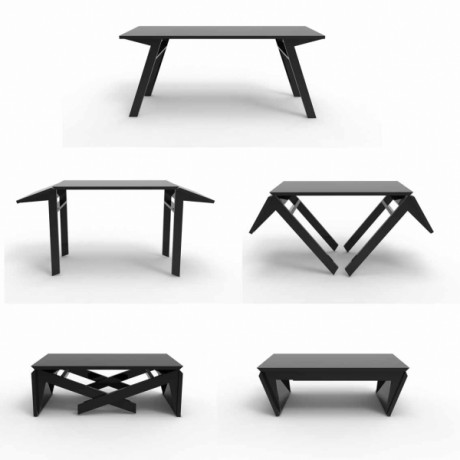
Duffy London’s Transforming Coffee Table MK1 (pictured below) has legs that fold underneath its base for  a very simple conversion. When the legs are in the elevated position, built-in leafs, which double as legs when in coffee table mode, add additional length to the dining room table surface.

The table is offered in a variety of finishes and three sizes–Mini, Large and X-Large. All three are 13″ high in coffee table mode and 30″ in dining. The two smaller versions are 29″ wide in coffee mode and 50″ and 57″ when extended; the X-large goes from 39″ to 67″ wide. Duffy’s website lists the prices at £395/$638, £445/$718 and £595/$961 respectively. Unlike a lot of cool Euro furniture we’ve found, they offer US shipping at £175/$282.

Resource Furniture has a full line of tables that have both coffee and dining table functionality. Here are a couple.

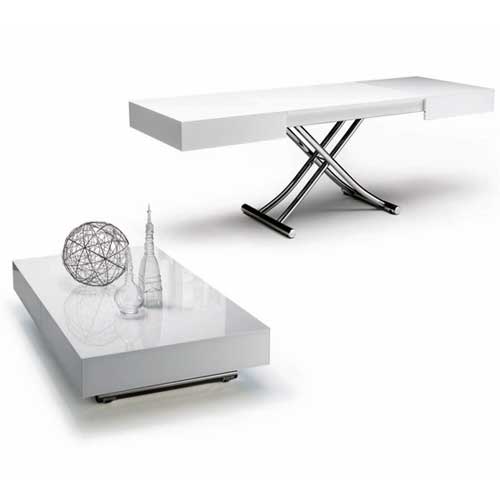
The Passo goes from a 10.5″ high coffee table to 30.75″ dining table. It’s 30″ deep and width goes from 48″ closed to 78″ when its built-in leafs are folded out from under the tabletop.

Resource Furniture Passo Table

The Box table (pictured at top of post) is similar to the Passo, though the leafs project from the ends of the table versus folding out from underneath. Fully extended, the Box is 87″ wide–sufficiently large for dinner parties for 8-10 people. Like the Passo, you can extend one, both or neither leaf, giving a ton of flexibility for its usage. For example, you could have a long coffee table or short dining table.

We’ve had a chance to use both of Resource’s tables and they work great. They are high quality, easy to raise, transform and moving around the house. Both are available in a variety of finishes and start around $3500.

These tables are great investments for many, combing great design, materials and saving space functionality.  That said, we understand they are out of many people’s price brackets. If you know of high quality, lower price alternatives, let us know.

Via Dwell and Mimi

2 Housing Concepts Take Different Tacks for Concealing Cars in the City

According to Wikipedia, parallel-parking spaces, the kind that predominate in cities, use a whopping 182 sq ft. If you regularly park in cities, you know where this huge footprint comes from: There’s the length of the car, the space needed to pull out of the space and the irregular gaps that form when various-sized cars come and go. This latter factor often leaves spaces that are one foot too short for your car, rendering large swaths of prime real estate useless.

Considering that the micro-units we’ve been talking about measure 160-300 sq ft, the amount of urban area devoted to parking is a huge issue. A couple decidedly experimental housing concepts are taking different tacts in dealing with parking and living in the city.

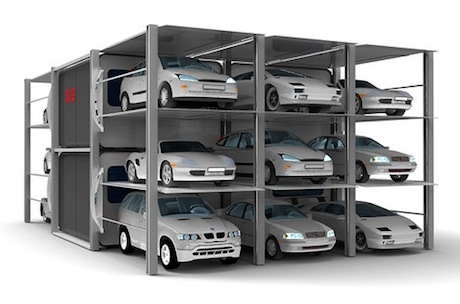
The first is Aaron Cheng’s Parking + Housing, which is an entry in the James Dyson Award. The idea is that urban workers are typically not at home during the day, leaving behind tons of unused real estate. Commuters, on the other hand, come into the city and need space for their cars. P + H reconciles these needs by having a pneumatic structure that compresses during the day to provide parking for commuter (above). During the days, the structure extends to reveal a single-unit apartment (below). Furniture moves with space in its transformation (see video below).

Parking + Housing at night. Credit: Aaron Cheng

The idea, while interesting, has some big gaps in logic like late nights at the office. Do the apartment dwellers have to wait til the project is done? Or sick days. Do commuters need to park elsewhere?

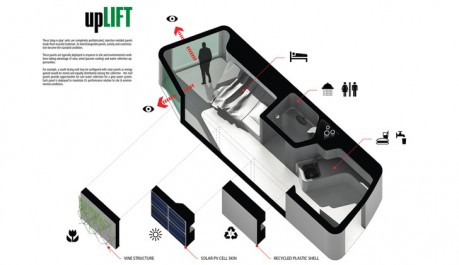
The other concept is called upLIFT, which inserts prefab housing units in existing parking structures, such as the parking elevators common in New York City (below). The project was part of the HOME competition run by Building Trust International, which sought to find single occupancy housing solutions for under $30K.

The panels of the structures are made of recycled material and designed to incorporate rainwater collection, solar panels and vine-walls.

What is interesting about upLIFT versus Parking + Housing is that it chooses to design around a less car-dependent future rather than accommodating commuters. Then again, it does little for the present, with it’s full lots and clogged streets.

Both of these concepts seem to dwell in possible futures more than suggest real solutions. In terms of real solutions, congestion pricing is a low-tech, yet effective way of keeping cities free of cars. What the often-unpopular-policy does is charge cars for entering certain zones of a city at certain times. London, a city who has instituted the policy since 2003, charges £10 ($16) for entering its congestion zone. One 2007 study found that traffic within the zone was reduced by 30%. While we couldn’t find parking statistics, it’s fair to say that there was a commensurate effect on parking as commuters who would otherwise park in the city leave their cars at home.

Of course, there are smaller cars and any form of two wheel transportation, both of which take up a fraction of the space that conventional car parking does.

What do you think? Should we design our cities with cars in mind or is that like laying new telegraph lines across the Atlantic?

The Home of the Future or Weird Curiosity?

The England-based Yo! Company is a branding and investment firm that brings Japanese-tinged enterprises to Western territories. Among its holdings are Yo! Sushi, a conveyor belt Kaiten sushi bar in London and Yotel, a Japanese-style hotel with compact-rooms that has locations in London, Amsterdam and New York City.

Now Yo! Co founder Simon Woodroffe is bringing his Japanglo magic to the home market with the Yo! Home. The 800 sq ft London concept home aims to take us out the “agricultural, primitive age” he believes we live in now and into the future–a time when people will ask “do you remember when they had one space and it couldn’t change around?”

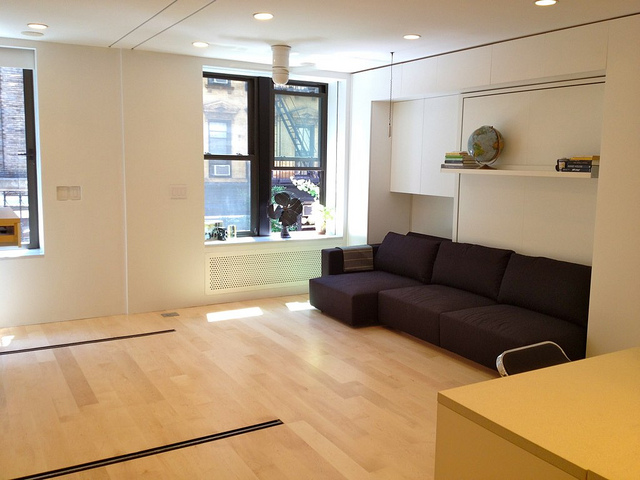
The Yo! Home changes around alright. There is a bed that descends from the ceiling and covers up a huge lounge area. There is a dining area that pops up from the floor; the same floor that hides a wine wine cellar. The kitchen hides completely. The guest room has a large sliding door that opens up to increase the area of the main room.

The space relies on a fair amount of automation, some of which broke down during his tour with Channel 4 News (above). To be fair, this is a prototype and breakdowns are to be expected. We do wonder about the long-term implications of an automated home. What happens if you’re really tired and can’t get you bed down?

Woodroffe spent £200K on the Yo! Home (~$325K US), which actually doesn’t seem like a lot seeing as how elaborate the space is. He thinks it’ll initially be for moneyed clients, but believes the technology and designs will eventually trickle down to the greater public.

Our hats are off to Woodroffe and his bold enterprise. Architectural thinking often gets fossilized because structures are imbued with a sense of permanency–so architects and designers avoid risky designs like these; ones that might look weird a few years from now. Concepts like Yo! Home loosen the noose of conventional thinking. They are invaluable idea-generators even if some of its features don’t make the final draft of the home of the future.

What do you think? Is this home the future or a curiosity–something that’ll look weird and overwrought 5 years from now? Let us know what you’re thinking.

Photography is by Ashley Bingham

Via Dezeen

3 Big Stores Get Into Small Spaces

There was a time, not so long ago, when furniture stores assumed their customers wanted items that would fit well in an over-sized dream home. Furniture was marketed with easy mortgages and cheap credit in mind. Well, those days are over.

With more people living in square-footage-starved cities, and more people renting, a growing population is reevaluating the dimensions of their dream home. A few furniture retailers are taking heed of this trend, marketing specifically to consumers living in small spaces.

Restoration Hardware released its “Small Spaces” collection earlier this year. It is, they claim, “A collection of epic proportions.” It’s sufficiently important to the company that it’s on their site’s main navigation bar. The collection is shown in 15 “small” spaces from around the world like the “Chelsea Penthouse” or “London Townhouse.”

These spaces don’t seem that small to us, and there are no dimensions to contradict our impression. The furniture looks suspiciously similar to other pieces in the catalog: the big space love-seat becomes the small space couch; the end-table becomes the coffee table. Perhaps it’s relative. Maybe RH is catering to people who are transitioning from 4K to 2K sq ft of living space.

IKEA has been in the small space fray for a while now. The video below shows a number of ways you can use their products to squeeze tons of utility from a small space. They claim small space living is “not about giving up your dreams. It’s about shrinking them, just a little bit”–whatever that means. The video is pretty creative and compelling.

Many of their stores feature 375 sq ft mock-up apartments. The author visited one the other day and found the layout pretty nice.

The furniture in the apartment, like RH, seemed like their normal furniture plugged into a small space. Unlike RH, IKEA seemed to understand the necessity for storage in a small space; there were shelves everywhere and two of the walls had large storage systems.

They made what seemed like a strange choice, decking the living room with a big couch. It was strange until you sat in it and realized that a comfy couch is pretty important to demonstrating a space’s livability.

West Elm also features a small space collection. A couple of their pieces actually seemed to be designed for small spaces–not just a normal piece with a small space sticker slapped on it. In particular, the Storage Bed Frame and Rustic Storage Coffee Table (below) would be useful additions to a small space. The latter model’s tabletop lifts to provide a desk space if you find yourself working on the couch.

What do you think of these collections? Are they marketing gimmicks or indicators of they way people will live in the future? Or both? Have you bought any of these products? What was you experience? Let us know.

4 Products that Disappear After You Buy Them

A recent article in the NY Times called “The Cult of Disappearing Design” reported on a growing movement toward invisible home furnishings. The “all-invisible aesthetic,” according to the article, “aims for a higher-minded goal: creating unified spaces that flow from room to room and place to place.”

They featured a couple items we’ve had here in the past like the Folditure “Leaf” Chair and the Bedup hiding bed. They also featured the Fisher & Paykel DishDrawer which is used in the LifeEdited apartment.

While there is an inherent challenge showing the invisible, we thought we’d add a couple items not included in the Times’ list.

1. Amina Invisible Speakers

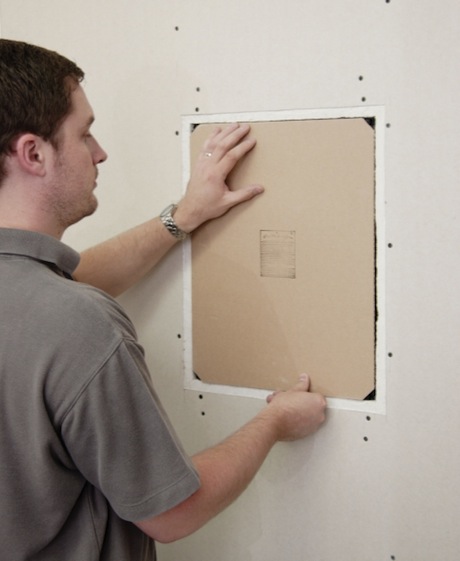
We used Amina high performance invisible speakers in the LifeEdited apartment. Their sound is easy to appreciate, though their beauty is not. The above picture has two large Amina speakers in the ceiling, but you’d never know. They are built into the drywall.

2. Induction Cooktops

In the LifeEdited apartment, we use Fagor portable induction cooktops, which are invisible in that we can put them in a drawer. Built in models are even more sleek (there’s a Fagor model pictured above). They sit virtually flush with the counter. They only conduct heat with ferrous metal, so they are cool to touch, which makes allows them to be used as additional counter space. They are also 12% more efficient than electric radiant burners.

3. Integrated Kitchen Appliances

While the Times mentions Fisher & Paykel DishDrawer as a disappearing design, there are many dishwashers and refrigerators on the market today are available as “integrated”–i.e. a panel that matches the rest of the cabinetry can be affixed to the front of the appliance. Sorta pictured below is the DishDrawer in the LifeEdited apartment. IKEA makes an integrated dishwasher for about $699. Panels cost extra.

For whatever reason, integrated fridges are more expensive. We used the Sub-Zero 700 BCI stacking drawer fridge, which retails for $3500 and up.

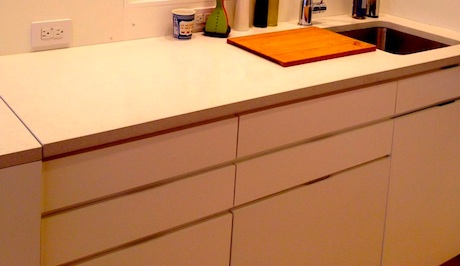
4. Blanco Crystalline Sink

The Blanco Crystalline Sink incorporates such a simple idea: cover you sink when you don’t need it, creating a cleaner look and more counter space. The sink comes with a removable glass cover (available in white or black). Unfortunately, due to code regulations a super-cool retractable faucet is only available outside the US.


More Mobile Living: Video of Couple’s DIY 3 Story School Bus

This video from Fair Companies takes an extensive tour of Richard and Rachel’s school bus home. Unlike René Agredano and Jim Nelson’s mobile living we looked at yesterday, this project is decidedly DIY; most evidenced by the decapitated VW Vanagon that makes up the top 2 stories. Just like the latter couple, Richard and Rachel tout the advantages of living mortgage-free as one of their principle motivations for living this way.

They also liken the project, which has taken them about 6 years so far, to the cardboard forts kids make. They fabricated most of their furniture and even included things like a projection “room” on the second floor. They claim there’s a level of connection and imagination that comes from a hand-built home not usually found when you buy something already built.

There seem to be some concessions to this hacker home, e.g. no plumbing; they use grey water to shower and wash their dishes every few days. They also don’t have RV status, which I suspect is why they didn’t specify their last names or location (though the bay they look upon looks suspiciously like San Francisco Bay).

The upsides they report are many. The have a minimal carbon footprint, using a composting toilet, solar power and even a solar-powered fridge. The bus only cost $12K to build, including a $1200 fridge. They live debt free with only $100/month living expenses. And they enjoy freedom that comes from not living to pay for their lifestyle. This is a common theme from yesterday’s couple and the Tiny House Family we looked at last week.

Do you think you could live on the road like either one of these couples? Have you? What was your experience? Is this something that can be done for longer than 6 years or is this more of a phase? Could a family live like this? Is a mortgage inherently a bad thing? We’d love to hear what you think in our comments section.

Awesome Space-Saving Furniture Made of Planks and Broom Handles

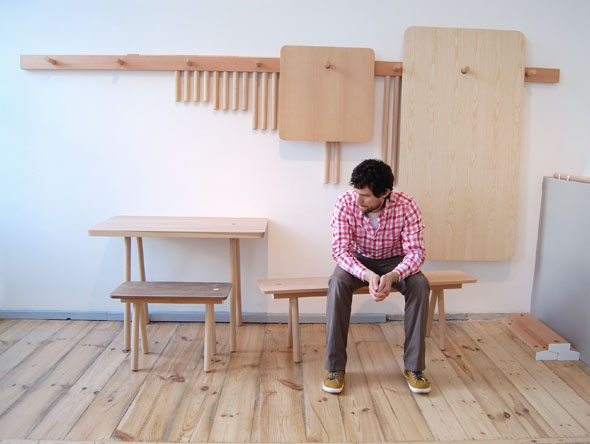
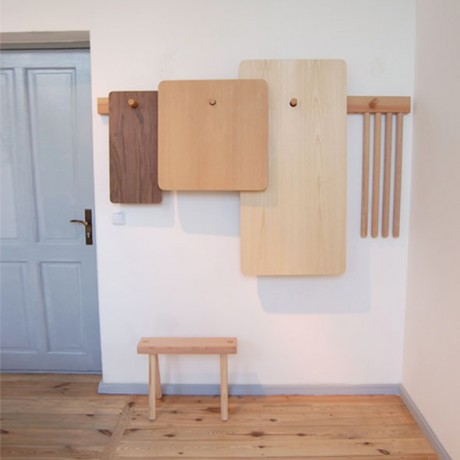
Oregon-based Studio Gorm made this simple, elegant design for transforming, adaptable furniture. There’s not much to the studio’s Peg line: some planks of hardwood with threaded recesses; several threaded legs that can be configured as benches, tables, stools, etc., depending on their lengths; and a hanging rack for storage that makes the assembly look like an objet d’art.

The studio’s site indicates that the collection is available in several types of woods and finishes, leading us to believe that it might be for sale (we are trying to confirm that now).

We have some question about how stable the units are, especially with the longer-legs, but suspect that the wider diameter legs can handle a decent load.

What’s lovely about the design is its mechanical and aesthetic simplicity. There are few moving parts, no hardware, everything is repairable or replaceable and infinitely configurable depending on your needs. It demonstrates that transforming furniture need not have a complicated hardware or a particular aesthetic.

all images by Studio Gorm

via Core 77

Airport Sleeping Pods Taking Over the World

You have long layover or delayed flight. You’re super spent and want to sleep. You:

  1. Knock your head back, causing drool to run down your face and irreparable neck damage.
  2. Take a nap on the floor–the same floor trodden by thousands of dirty soles, from thousands of lands.
  3. If there is no raised arm rest, you stretch out on some heavily canted airport seats, simultaneously getting marginal sleep and ensuring the growth of the chiropractic industry.

A few upstarts from around the world are tackling this issue of airport sleep deprivation with small sleeping cubes. While they haven’t exactly taken over the world (the 3 here are only in one airport each), they offer minimal sleeping quarters for the beleaguered traveler.

Napcabs (pictured above) is a German-based company with one outlet in the Munich airport (it had 2, but one is being serviced). It features a bed, soundproof walls, wifi, a multimedia screen with flight information and “anti-jetlag” lighting. Bedding is changed by an on-call cleaning staff.

At anywhere from 10-15€/hour, with a minimum 30€ charge, it’s not cheap, though consider if you’re flying overnight, this is a fraction of a hotel room’s cost.

Sleepbox is in the Moscow airport and has very similar features as Napcabs. The one edge Sleepbox has is that it features 2 beds, not 1. According to Wikipedia, they charge $15USD/hour.

Wikipedia also said there are concerns about bed-bugs. Unlike Napcabs, Sleepbox does not explicitly say how linens are dealt with. I am hardly a germophobe, but this seems like a major oversight. A post in Treehugger.com indicates that they originally wanted to use an automated linen changing system, but instead opted for traditional linen. We imagine/hope they have some sanitary setup.

Sleepbox is smartly trying to position itself as a space maximizer for hostels. While airports are a great application, I could imagine these units as replacements for real hotels and hostels, particularly for people who just need a place to sleep.

Snoozecube has 10 sleeping cubes set up in the Dubai airport. The company is from New Zealand, evidenced by the big fern leaf, similar to that of the All Black Rubgy team, emblazoned on their cubes and bedding. Like the others, they cost $16USD, are soundproof, offer wifi and connections to flight info. Their look is not quite as posh as the other 2, but the fact that they are clustered together in Dubai makes them like a makeshift hotel, which seems to make sense as you can have a standing staff and some isolation from the rest of the airport (something I think would be nice even if the cubes are soundproof).

High priced, hourly sleep cubes in airports might not be everyone’s bag. But similar to the Japanese sleeping pods we looked at a while back, these firms are showing an alternative to hotel rooms that feature more–and cost more–than most travelers would prefer.

Have you ever used any of these, or similar, sleeping boxes? What was your experience? We’d love to hear from you.