Take a Very Brief Tour of 105 Sq Ft Apartment

In this short piece from CCTV, we see the interior of Genevieve Shuler’s 105 Sq Ft NYC apartment. Shuler pays $800 for the packed-to-the-gills West Village mico-unit. She has lived there for 8 years and apparently feels there’s more than enough space for her, evidenced by the fact she has a roommate: her cat Ruby.

The tour was part of CCTV’s coverage of the adAPT NYC competition. The segment included Senior Policy Analyst of the Citizen’s Housing and Planning Council (CHPCNY) Sarah Watson. Spearheaded by executive director Jerilyn Perine, CHPCNY was one of the main initiators of the adAPT NYC competition and is the city’s biggest advocate for small-space policy reform.

One of the biggest hurdles facing building small is policy reform. As the segment indicated, the smallest you can build in NYC is currently 400 sq ft. As we see with Shuler and many others, a person can live quite comfortably in far less space. Similarly, no more than 3 unrelated persons can occupy the same space legally (though this author can attest that that policy is seldom enforced). Tenant advocacy is very important but, as is the case in New York, policy is often out of step with tenant needs and advancements in building design.

While Shuler shows that people can–if necessary–live happily in super tiny apartments, we think the best is yet to come in small living; where micro units will be designed from the ground floor to optimize the living experience. San Francisco’s SmartSpace is a great example of that. Before that happens, policy reform will have to take place in many regions. The adAPt NYC competition and CHPCNY are making that look like a likely reality.

Safe For Work Images Make You Want to Quit Your Job

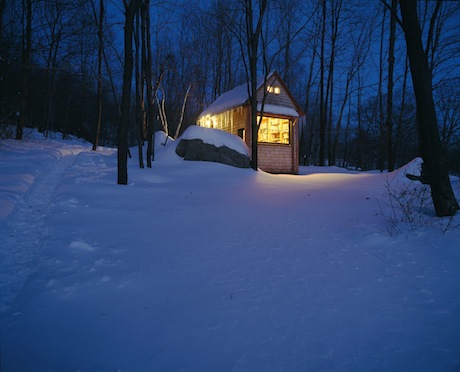
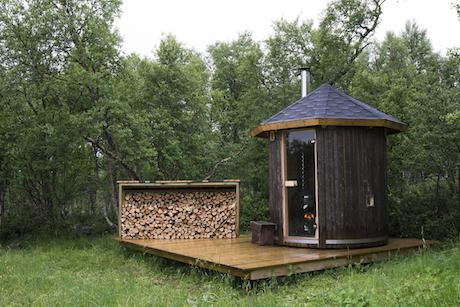
Do you lust after compact homes? Do you fantasize about retreating into nature? Do you love moss and wood beams? If you answered yes to any of these questions, the website Cabin Porn is for you.

image credit: Vegar Moen

The site is little more than an image bank of gorgeous cabins from around the world. Some are big, but the majority are quite modest in size. There’s little in the way of commentary, design motivation, etc.–simply images with which one constructs daydreams.

image credit: Tom Fowlks
Photograph by John Peden
image credit: Jason Warner

See more images on their website: www.freecabinporn.com.

What Can be Done with the McMansion?

Some things seem inherently unedited: SkyMall catalog, Big Gulps, Hummers. And in the housing world, nothing says unedited like a McMansion. Their flabby floor-plans, 4 car garages and 1K sq ft foyers epitomize more-is-less living. That said, now that they’re here, what the hell do you do with them?

A few people are thinking about alternatives uses for the McMansion. After all, nothing is inherently “unedited.” A 10K sq ft home that’s used all the time might be more efficient on a per-user basis than a 500 sq ft space that’s rarely used. A Big Gulp split between 20 is an appropriate treat.

Rainbow Mansion is an example of a smart exploitation of the McMansion’s girth. The house (so named because of its location on Rainbow Dr.) describes itself as “an intentional community of driven, international, passionate, and socially conscious people trying to change the world.” The home benefits from its location in Silicon Valley (Cupertino to be precise), where open-minded, creative folks abound. That said, it still shows the possibilities of re-purposing an otherwise misbegotten architectural conceit in any locale.

Inside Rainbow Mansion. Photo by alexandervandijk on Flickr

The 7 residents of the 5K sq ft space split a $7300 rent and are bound by their beliefs that they can change the world. Since its beginning in 2006, they have had “60 residents from more than 12 countries including 16 folks from NASA, 6 from Google and 5 from Apple.” The space features a library and hosts regular salons. The communal nature and shared philosophy have surely aided the home’s longevity.

Another example lies a bit east of Cupertino at the University of California, Merced, where students are opting out of dorms in favor of sharing foreclosed McMansions, according to an ABC news article. A home they profile houses 6 for $1800–i.e. $300 each, or half the money the dorms cost. While having undergrads in a residential neighborhood might not seem like the best fit, the town had been hit hard by the housing crisis and neighbors and realtors are happy to have the students.

Lastly, a project in Australia–a nation whose homes’ haunches rival the US’s–called Reincarnated McMansion is looking for people who have homes that exceed 360 sq m (3875 sq ft) to volunteer their homes so they can be tore down; two new homes will be made with the materials. While an enticing idea, there’s no indication that anyone has signed up to date.

There are of course limitations to converting these types homes. You can usually only have so many unrelated residents in the same home (code is probably more lax in CA where co-housing is popular). McMansions often have double height rooms that are tough to convert. Also, McMansions are not known for their build quality, so it might strike some as specious to do anything with these monstrosities; Grist suggested we make them wildlife habitats. Nevertheless, these examples show that even things that epitomize excess can be made efficient.

Do you or anyone you know have examples of re-purposing McMansions or other large dwellings? Let us know in our comments section.

[Correction: earlier version incorrectly stated that 5 UC Merced students paid $3300.]

top image credit: REUTERS/Kevin Lamarque

Coolest Small-Space Cans Come from Japan Yo

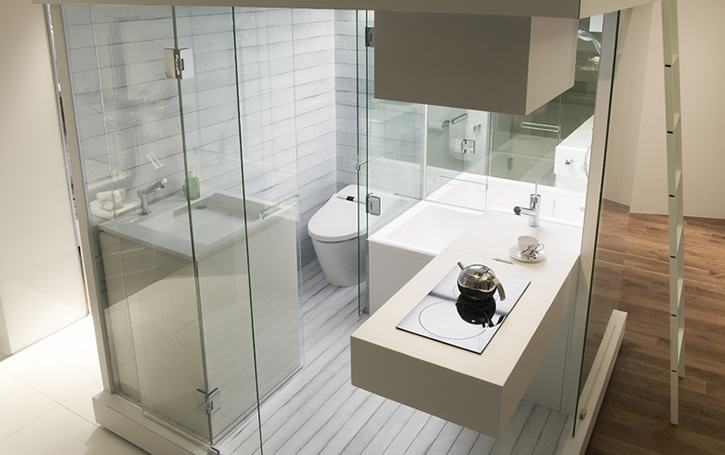
The Japanese have a knack for lending high-end design and materials to spaces Americans typically associate with dorm-rooms and halfway houses. Case in point is the Subaco Sanitary Unit from the Spiritual Mode corporation (we’re confident “spiritual mode” and particularly “sanitary unit” sound more elegant in Japanese). Subaco is an all-in-one bathtub, toilet, wash basin, kitchen, laundry and loft–all of which occupy a whopping 6 x 6 ft (2 x 2m) footprint.

It looks like they have at least a couple varieties: the peekaboo model with glass walls for the WC (don’t throw stones–or anything else–whilst using it) and a model with solid walls. We can see all the bathroom fixtures and induction cooktop, which because of its flat surface and cool-to-touch surface, doubles as a countertop. There even appears to be a fan for the cooktops. We’re curious to see what kind of laundry machine is used.

Presumably, these modular units can be plugged into any space; they look like they’re destined for the wan rūmu manshons we covered a while back.

Most small American apartments employ the Afterthought School of bathroom and kitchen design–knees often knock into tubs and doors while on the can; fridge doors refuse to open in the kitchen; prep space is a joke.

We wonder if Americans were given such sleek and elegant designs in their small-space living options, whether they might be more inclined to scale back on their living spaces?

Image credit: Spiritual Mode

Via Treehugger

Make it Pretty or Make it Disappear: 5 Tips for Tiny Living

We ran across this video from Daily Beast interviewing couple James Casey and Erin Boyle in their 240 sq ft Brooklyn Heights, New York apartment.

Even by Hong Kong standards, 240 sq ft–or 120 per person–is pretty damn small. Fittingly, the couple gave some advice for making the tiny space manageable.

  1. Creative storage. They use existing and nice objects for storage.
  2. Minimize waste. They minimize what comes in and out of the apartment.
  3. Go mini. Household supplies like their trash can and broom are on the small size.
  4. De-clutter. Even in a 240 sq ft space, the couple had a miscellaneous bin, but that bin was kept in a nice old wine box kept underneath their couch.
  5. Adaptability. They pointed to a couple Peshtemal Turkish towels that dry quickly (important when there are only two out at a time) and are pretty enough to be displayed.

Summed up, I’d say their advice is don’t have a lot of stuff and what stuff you do have make it nice, pretty or able to get out of sight.

The best part of the video is the practical demonstration that living an edited life requires no special equipment (there is not one piece of transforming furniture) or enormous budget.

Do you live in a tiny space? What advice would you add?

Via Daily Beast

Go High with DIY Storage System

Even if you’ve pared down your stuff considerably, it doesn’t mean you are stuff-free. You still need that abacus for tax-season or that cricket set for your anglophilic outings. In other words, most of us–save Andrew Hyde–need storage.

A lot of storage takes up valuable floor or wall real estate–a particular waste for stuff you don’t need to access all that often. Ideally, stuff you don’t need that often doesn’t occupy proverbial beachfront property.

We ran across this simple ceiling-mounted storage scheme from The Family Handyman that uses seldom-used vertical space, perfect for seldom-used items.

The site provides a step-by-step guide for constructing the system. The skill level required to make and install it is higher than something like an Elfa system, but it’s surely less expensive for comparably volume (~$100-500). And it’s more versatile; though they use big red bins, we could imagine affixing flanges to the rim of any box for easy sliding; this way you could make the system aesthetically suitable for any room.

Do you have creative storage solutions that use seldom-used spaces? Let us know.

via The Family Handyman

10 Folding Chairs to Look at and Sit On

Many people have reached out to us looking for solutions for making their own home an edited home. Often requested is a guide to folding chairs–chairs being a staple piece of furniture for most any home. With a little help from our friends over at Apartment Therapy, we’ve put together this list of 10 folding chairs, ranging from the super inexpensive to the super not-inexpensive.

Let us know what we might have missed in our comments section.

1. Terje Folding Chair from IKEA, $16.99

We’d be remiss to not include the big I. This is one of their several folding chair options. They’re not super sturdy, but boy are they inexpensive. We’ll leave it at that.

2. Mika Natural Wood Chair from World Market, $75 for 2

This chair has a nice look and works inside and out.

3. Cyclone Indoor/Outdoor Chair from Target, $123.89 for 2

If your aesthetic leans toward pop-art, this chair from Target might be your style. It works inside and out.

4. Muji Beech Folding Chair, $70

We really dig this chair. Simple, real-wood, good price.

5. Clarity Acrylic Folding Chair, $150 for 2

Like the Target chair, this one will appeal to a particular aesthetic. The translucency opens up visual space, but acrylic tends to scratch over time.

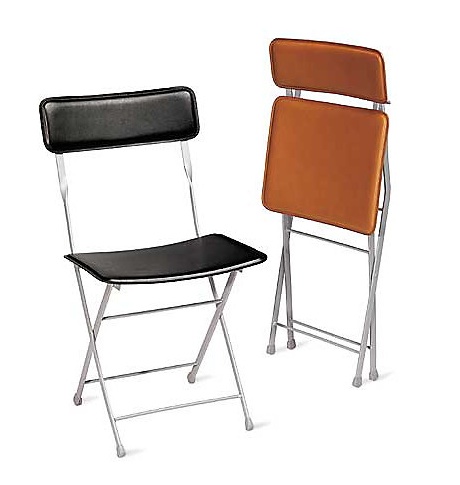
6. Lina Leather Folding Chair by Design Within Reach, $150

We quite like the look of these. They have a very light design, but the leather gives them a touch of luxury. Their legs don’t look super beefy, so might be best for the lither buyer.

7. Flux Chair, $199

We’ve been using a Flux chair for a while and they’re surprisingly comfortable. They work as a lounge or dining chair, but are too slack for an office chair. When unfolded, they lie completely flat. They’re available in several colors.

8. Resource Furniture Pocket Chair, $225-480

These high-quality, Italian-made folding chairs are 3/4″ deep when folded. Unlike a lot of folding chairs, they have a nice, substantial feel. Prices vary depending on finish.

9. Leaf by Folditure, $680-760

We’ll dispense of the alien jokes. In terms of raw functionality and portability, it’s tough to beat the Leaf. They hang in your closet and are built solid enough to withstand your heaviest friend. [Note: the Folditure site has stopped publishing these prices, so check with them to see current pricing.]

10. The April folding chair by Gae Aulenti, $1350

If your tastes lean toward mid-century modern, and your budget leans toward hedge fund manager after a bonus, this chair is probably for you. Solid construction, classic looks, big price tag.

Via Apartment Therapy

Folding Chair Stores Stealthily, Kills Aliens

We ran across this “Leaf” chair by Folditure back in May at the International Contemporary Furniture Fair. It’s made of an aluminum composite panel frame, features stainless steel hinges, aircraft grade stainless steel rivets, and other high quality materials. It can be used indoors or out. It is made with pride in Hoboken, NJ. It folds flat to an amazing 3/4″ and hangs like a jacket in a closet. It’s pretty damn comfortable to boot.

And it looks like something out of a science fiction movie.

The Leaf is an impressive piece of furniture–high quality, functional and very stowable. It just looks a little strange. Regarding the chair’s aesthetics, Folditure’s website claims that “the Leaf is equally at home in a fine parlor or dining room or on your patio. Or aboard your starship!” We couldn’t have said it better.

The Leaf is available on Folditure’s website for $680 with exposed backrest and $760 for the laminated version.

images via Folditure.com

LifeEdited on ABC World News in adAPT NYC Roundup

[If you are having trouble viewing video on this site, visit ABC World News homepage]

Check out the LifeEdited apartment in this ABC World News feature about small New York City living spaces. The story is related to Mayor Bloomberg’s adAPT NYC design competition, which is looking for great 275-300 sq ft apartment designs to better house NYC’s 1 and 2 person households.

Perhaps, as the feature suggests, the LifeEdited apartment will factor into the winning design. We’ll keep you posted!

3 Hiding Beds Not Named Murphy

We love transformable beds. The LifeEdited apartment would not be possible if not for our Resource Furniture ‘Swing’ sofa/bed and ‘Lollipop’ bunk beds. The former allows one room to be living room and master bedroom and the latter enables a couple feet of depth to be a disappearing guestroom.

The ‘Swing’ is ultimately a Murphy bed–albeit one that uses aircraft quality mechanisms and, unlike most Murphy bed’s, has a couch in front of the unit when not in use.

The Murphy bed is the invention of a man named (you guessed it) William L Murphy. He was a San Franciscan who, so the story goes, wanted to woo his wife-to-be but couldn’t bring her up to his bachelor pad, which was effectively a bedroom. A couple hinges and springs later, he was wooing away in his “parlor” and giving himself a prominent place in bedroom-furniture history.

The Murphy bed makes sense. It has one hinge, it can use fairly normal mattresses and stows away nicely. But it’s not the only type of hiding bed out there. Here are a few models that are trying to unseat old Murphy as the king of hiding beds.

1. Zoom Room

One of the bigger gripes with Murphy beds is that they require manual labor–i.e. you have to raise and lower the bed with you arms. This might sound like a petty complaint, but the truth is some of us can’t do this for whatever reason and more of us don’t want to. We want to go to sleep and wake up without lifting a finger.

Zoom Room eliminates this issue by being fully automated and remote controlled. And because the mattress slides out from the bottom, the front-side of unit remains vertical so you can use it for storage, an entertainment center, etc. Prices begin at $4,450.

Zoom Room also makes traditional Murphy beds.

2. Bedup by Decadrages

The self-explanatory Bedup is a French product that uses ceiling space to hide your bed.

Bedup allows you to use very little wall space–a good option for particularly small rooms. Unfortunately, it does not appear to be readily available in US.

3. Resource Furniture LGM

Okay, so it’s kinda a Murphy bed as the bed pivots from the base, but the LGM‘s rotating frame allows the front-side to remain vertical so it can be used for additional shelving or a table/shelving combo (called the LGM Tavolo).

[divider]As many of the above units are highly customizable, it’s tough to give pricing. We can say they are not cheap. Most start well north of $5K. Keep in mind though that if these types of beds allow you to avoid purchasing a home without a spare bedroom–or any bedroom–that cost is quickly offset. In NYC, for example, real estate is easily $800-1K/sq ft. Let’s say a small bedroom is 10′ x 10′–that’s $80-100K! Purchasing a $15K bed unit is the far more economical route.

Do you know of other innovative space-saving beds? Let us know.