Killing Le Corbusier’s Beloved Parking Spaces

With the possible exception of Frank Lloyd Wright, there is no architect more famous than Charles-Édouard Jeanneret-Gris, far better known as Le Corbusier. While rightfully lauded for his massive contribution to what we now know as “modern” architecture and design, one of his other legacies is something far less awesome. The “Ville Contemporaine,” or “contemporary city” for the non-francophonic, was a master urban plan that represented his vision for the city of the future. VC centered around the “tower in a park,” hulking, X-shaped towers that acted as residences, offices and elaborate transit hubs. These spread-out, ultra-high density towers would get rid of the tight, hard-to-drive-through streets lined with sidewalks and two-to-six story, medium-density architecture that had dominated urban landscapes for the previous 1000 years or so. These towers would leave wide corridors for nature and, importantly, highways. You see, Corby was a car nut. He said this about the future of urban planning (a description that sounds suspiciously like a suburb):

The cities will be part of the country; I shall live 30 miles from my office in one direction, under a pine tree; my secretary will live 30 miles away from it too, in the opposite direction, under another pine tree. We shall both have our own car. We shall use up trees, wear out road surfaces and gears, consume oil and gasoline. All of which will necessitate a great deal of work… enough for all.

While the grand vision of the Ville Contemporaine never came to pass, the idea did get some traction, particularly with a guy named Robert Moses. Moses, probably the most influential force in 20th Century urban planning, loved the tower in a park and its car-friendly character.

During his multi-decade reign as New York “master builder,” Moses sought to make New York City into a car centric paradise. Besides being responsible for the construction of countless bridges, tunnels, parkways and highways, Moses took on housing. In particular, he set about erecting public housing that fit more with the Corbusierian model. Over several decades following WWII, he destroyed countless gridded streets lined with row houses. In their stead, he put up large towers in parks. The building’s had the same cruciform shape as Le Corbusier’s VC models (pictured below are Le Corbusier’s unrealized model for Paris and a realized Moses public housing development).

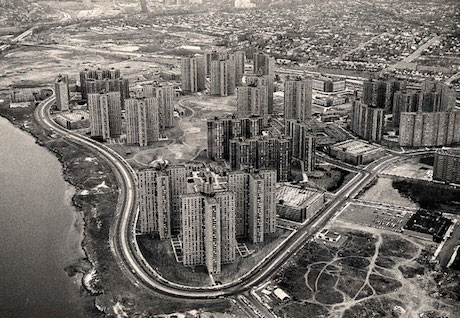
tower-in-park-le-corbusierrobert-mosesThere’s a healthy consensus that Moses destroyed countless vital neighborhoods. By replacing the doorstep, sidewalk and street-level small business with anonymous lobbies, hallways, elevators and meandering outdoor walkways, the towers served to effectively kill street life. Mosesian public housing often became vice-ridden community killers.

People finally came around to seeing the virtues of walkable, human scale neighborhoods–a view promulgated most notably by Jane Jacobs–but the towers very much still remain, mostly along Manhattan’s outer edges and throughout the Bronx. The odds of resurrecting the old streets and neighborhoods are, we suspect, pretty low, and some of the towers are even thriving as naturally occurring retirement communities (NORCs).

But just because the towers remain, doesn’t mean they can’t be improved upon. More specifically, the towers, in line with the Corbusier/Moses car-centric ideal, include a ton of parking, much of which is underutilized. Moreover, their land-gobbling nature take up much needed land for housing and community spaces. Now a group of urban planners and architects are looking at those spaces and asking what else can be done with them.

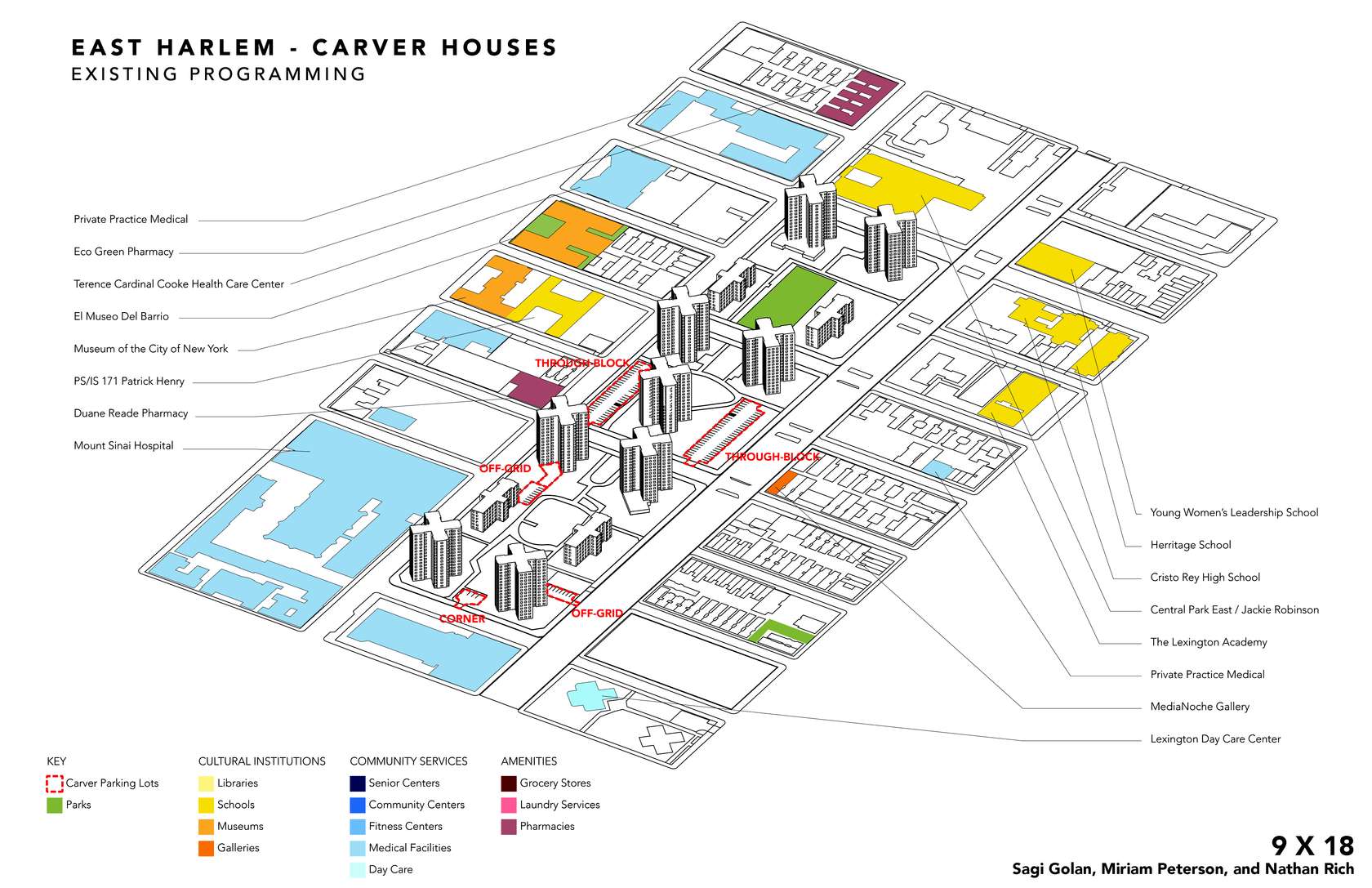
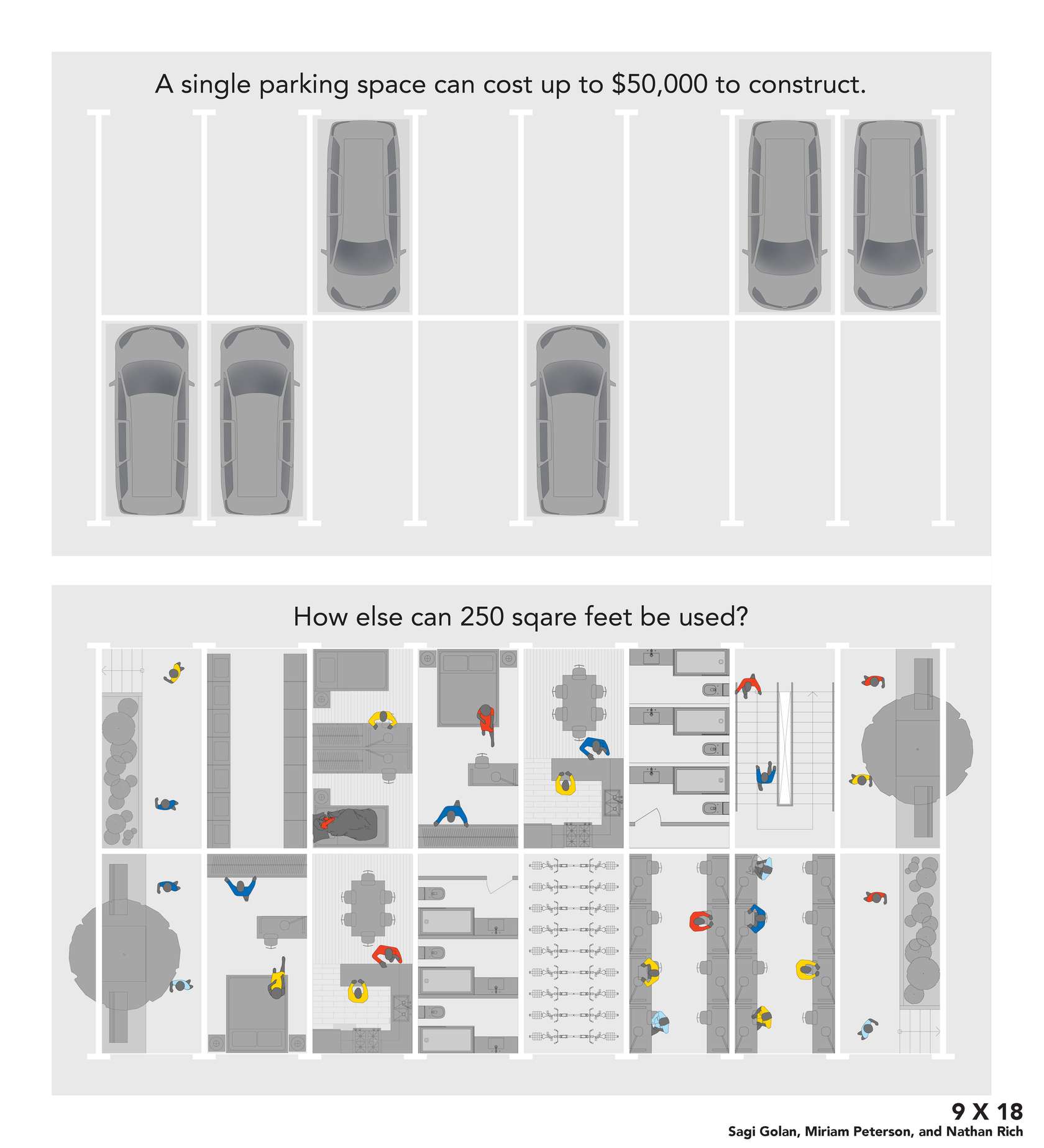
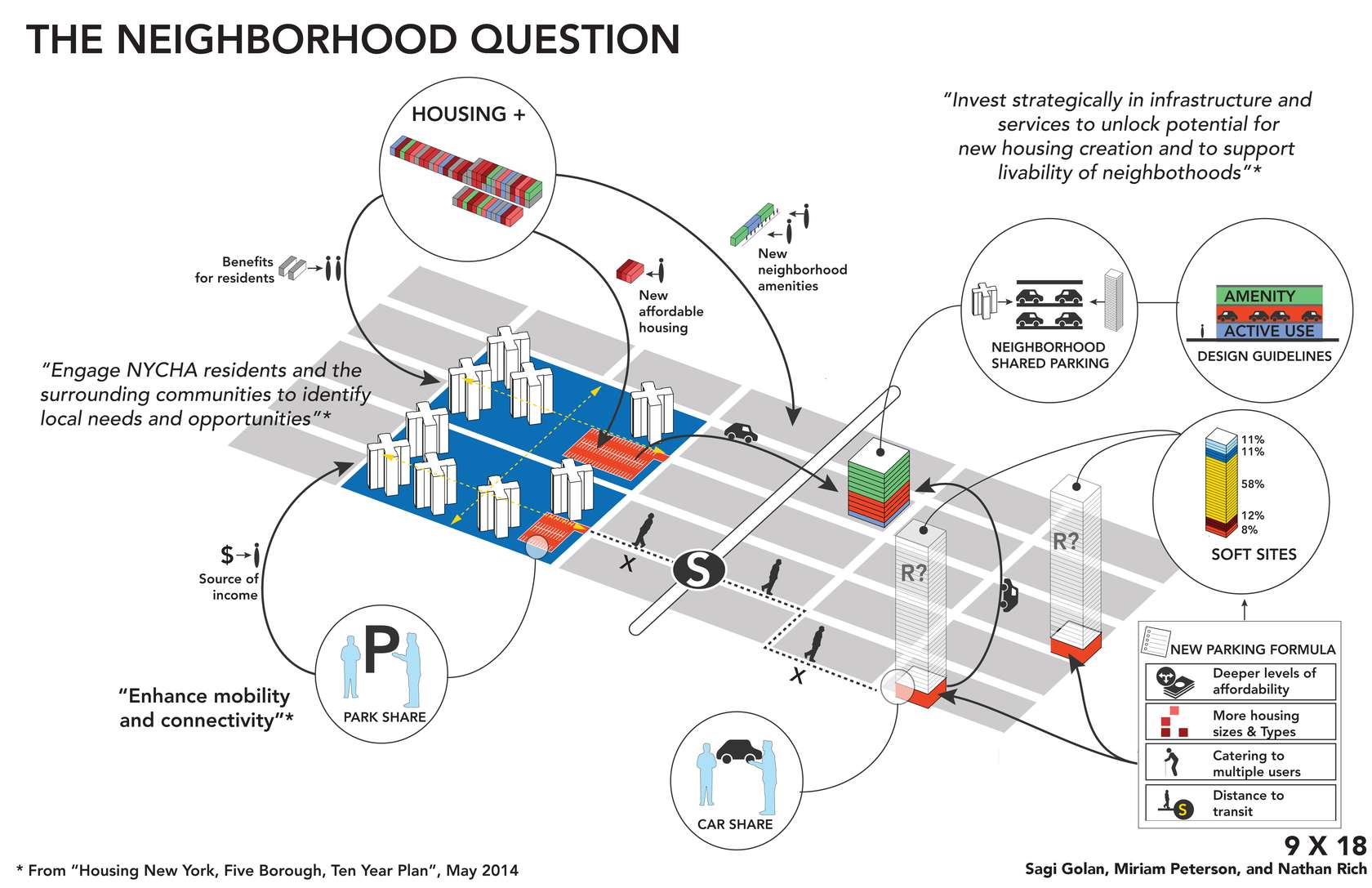
A design team called “9×18” (referring to the dimensions of a regulation-size city parking spot) has created some ideas that rethink the parking mandated for affordable housing–many of these mandates are vestiges from the car-loving days of Robert Moses.
More about the project from Architizer:

Taking a particular East Harlem neighborhood as a case study, fellows Nathan Rich, Miriam Peterson, and Sagi Golan, supported by the Institute for Public Architecture, generated a set of recommendations and interventions for the city’s current surface-level lots and the policy surrounding them.

Some of those recommendations include fairly earthbound ideas like relating parking spots to distance from public transit–i.e. the further from public transit, the more spaces and vice versa. Others are a bit more unconventional, such as putting shared housing, workspaces and other amenities where the parking spaces once resided.

The project is like many we’ve seen recently like Casa Futebol, Stephan Malka and WeLive that seek to take existing structures–ones that are either un-or-under-utilized–and through incorporating architectural interventions, allow them to address the needs of their cities. These creative exercises–some of which will see the light of day, others will simply inform discourse about urban planning and architecture–show that a lot can be done to right architectural wrongs.

Find out more about “9×18” Project on Architizer and on the Institute for Public Architecture’s website.
Cutting the Housing-Car Umbilical Cord

Whether you’re aware of it or not, most homes–or to be more precise, “dwelling units”–require parking. Meeting these requirements is not a big deal in low density suburbs with their copious amounts of space for driveways and garages. But it’s a big issue in high and medium density areas, where real estate developers might only be able to build as big as available parking spots permit. These requirements can put residents looking for affordable housing in a pinch. Making housing density low in desirable areas dwindles housing stock, driving housing prices higher. Alternately, developers must create off-street parking to satisfy requirements; the expense of those parking spaces trickles down to residents.

“The single biggest impediment to main street development, lower cost housing and midrise development is the parking requirement,” architect and Treehugger.com’s managing editor Lloyd Alter told us. “A parking spot costs a fortune to build and needs a big enough site to get all the ramps in,” he adds.

Portland, Oregon is one city that’s very familiar with this issue. More specifically, Portland’s recent crop of micro-apartments have created a situation where residential population density is outpacing available parking spaces, at least as that proportion relates to conventional dwelling unit to car ratios. Development has continued because of zoning loopholes, but like Seattle, existing residents have been up in arms; they are taking to the streets because those streets might have fewer parking spaces.

Some are proposing to cap the number of parking permits issued to micro-apartment buildings. According to the Portland Tribune who interviewed several Portland developers, this idea would solve the city’s parking woes. Alter agrees, “Limiting the number of parking permits is a perfectly reasonable strategy; The NIMBYs [not in my backyard] get to keep their spots, the NEWBEs know in advance that they don’t want to live here [Portland] and own a car without spending more money on some distant garage.”

On the surface, this solution might not seem like such a big deal. Many buildings have fewer parking spaces than dwellings. But these tend to be in high density places like San Francisco and NYC that have robust public transit systems. This is a bigger deal in a medium density city like Portland where 72% of residents still own cars. Implicit in the idea of a parking cap for micro-apartments is that how we live and how a neighborhood performs can be affected be housing type–by adding density and removing cars, micro-apartments might shift a neighborhood from being mostly low-density and car-centric, to higher-density and bike/walk/car-share/bike-share reliant.

But all of this requires new thinking on the part of regulators.

“I think that the extra density that comes with micro-apartments absolutely has to be accompanied by a revised concept about parking requirements,” Sarah Watson, Deputy Director of Citizen’s Housing and Planning Council (CHPC), a NYC housing advocacy group and think-tank, told us. She also said that “public transportation has to support those residents” or there should be “well-managed options for car sharing as part of the projects.”

Patrick Kennedy has been dealing with this issue for decades. He is the Bay Area developer behind SmartSpace as well as an upcoming, 160-unit micro-apartment building in the Mission district. “I think it is a fair compromise,” he says of giving up parking for high density, convenient living. “I did one development that had 6 parking spaces for 35 units and it didn’t cause any problems,” he told us.

Granted, most of Kennedy’s development were in places like Berkeley, which have a density twice that of Portland. But he sees the trend that Watson alluded to. “We’re moving in this direction [away from requisite parking]. In the age of Uber and bike-sharing, living without a car just isn’t that big of a sacrifice.”

Alter sees this shift away from car dependence and more reliance on alternative transportation strategies. “Fewer and fewer people who live downtown own cars. They don’t need them in their daily routines and Zip cars and car 2go are available when they do.”

He points to a new building in his Toronto hometown as a prime example of this trend. “They just built and sold a 300 unit condo without a single parking spot, in a part of town with no permit parking. They threw in 5 Zip car parking spaces and a bike locker. This is the future of development downtown.”

Watson noted something that goes beyond no permits. “I heard recently that a new micro-apartment building in DC that makes residents sign as part of their lease that they will not have a car…taking the idea even further!”

We’ve said it once and we’ll say it again: cars and the sprawl they support have costs. There are social costs, huge environmental costs, even costs to our economic wellbeing. Historically, these costs have been hidden by entitlement–that having a big home, car and the infrastructure to support these things are inalienable rights. But as we as a culture shift our ideals from space, stuff and privacy to convenience, mobility and connection, we realize we no longer want to foot the bill for these costs. It is our hope that regulators will make it easier to shift to this new way of living, removing parking regulations where and when they don’t make sense.

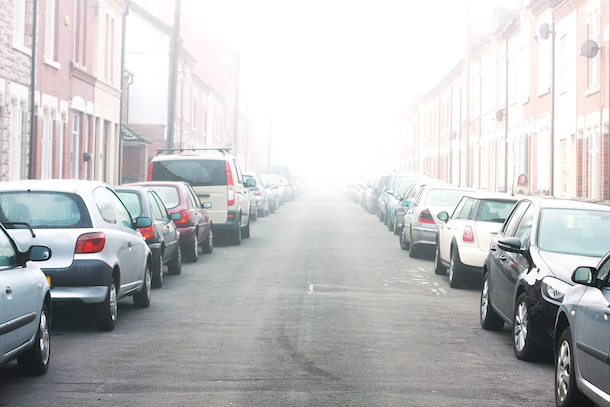
Misty street with parked cars image via Shutterstock

Park Your Life in These Repurposed Garages

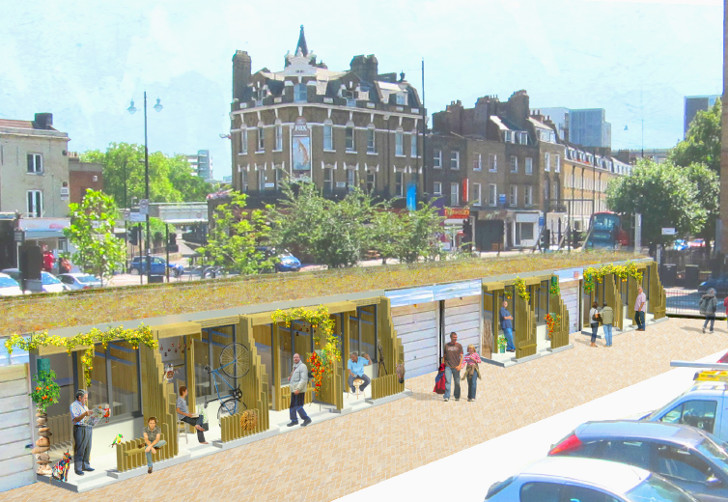
A design by architectural firm Levitt Bernstein that converts unused garages on London housing developments into popup homes was the winner of the Building Trust International’s HOME competition, which sought to provide “residents most at risk in developed cities with a safe place to live.”

The Levitt Bernstein units are part of a larger project they call HAWSE (Homes through Apprenticeships With Skills for Employment). The homes provide shelter for their occupants as well as trade skills as they are involved with the assembly of the unit. The house provides low cost housing (£11/week) for a year or two before the occupant moves on to other developments and the structure is demolished. We’re not sure why they wouldn’t remain as ongoing housing, though it likely has to do the fact they’re using someone else’s property.

The units are a mere 118 sq ft and feature their own bedroom, bathroom and living/dining area. We particularly like the wall-through sink between the bathroom and kitchenette. Each fifth garage will have a communal laundry, additional kitchen equipment and a dining area.

HAWSE is meant to use under-used spaces in expensive, high density areas, in this case East London. We’ve seen other garage-cum-homes with the same mission intended for New York City, but this one seems much more thought out. The other designs, particularly the upLIFT design (below), proposed using highly used, revenue-generating parking spaces as housing for the homeless, which seems like a tough sell. Focusing on using under-used spaces like HAWSE makes a lot more sense.

Uplift-concept

There was some controversy (possibly manufactured) reported in the London Evening Standard. An architect called pop-up housing “morally bankrupt” and not addressing the causes of homelessness. We think it’s a pretty great idea and a creative way to make increasingly expensive cities accessible to diverse populations.

What do you think? Is this smart design or a bandaid on larger social and economic woes?

2 Housing Concepts Take Different Tacks for Concealing Cars in the City

According to Wikipedia, parallel-parking spaces, the kind that predominate in cities, use a whopping 182 sq ft. If you regularly park in cities, you know where this huge footprint comes from: There’s the length of the car, the space needed to pull out of the space and the irregular gaps that form when various-sized cars come and go. This latter factor often leaves spaces that are one foot too short for your car, rendering large swaths of prime real estate useless.

Considering that the micro-units we’ve been talking about measure 160-300 sq ft, the amount of urban area devoted to parking is a huge issue. A couple decidedly experimental housing concepts are taking different tacts in dealing with parking and living in the city.

The first is Aaron Cheng’s Parking + Housing, which is an entry in the James Dyson Award. The idea is that urban workers are typically not at home during the day, leaving behind tons of unused real estate. Commuters, on the other hand, come into the city and need space for their cars. P + H reconciles these needs by having a pneumatic structure that compresses during the day to provide parking for commuter (above). During the days, the structure extends to reveal a single-unit apartment (below). Furniture moves with space in its transformation (see video below).

Parking + Housing at night. Credit: Aaron Cheng

The idea, while interesting, has some big gaps in logic like late nights at the office. Do the apartment dwellers have to wait til the project is done? Or sick days. Do commuters need to park elsewhere?

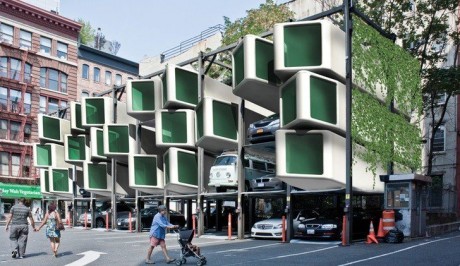
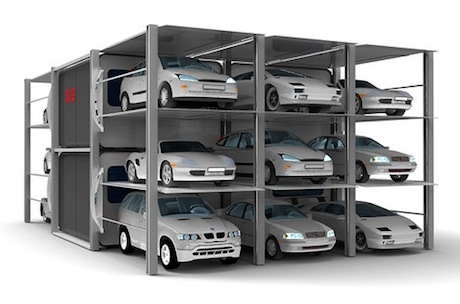
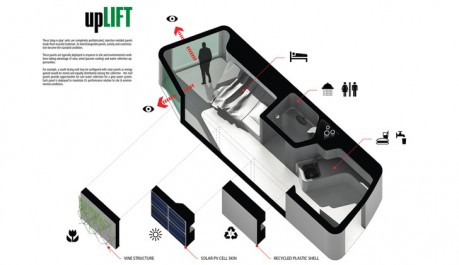
The other concept is called upLIFT, which inserts prefab housing units in existing parking structures, such as the parking elevators common in New York City (below). The project was part of the HOME competition run by Building Trust International, which sought to find single occupancy housing solutions for under $30K.

The panels of the structures are made of recycled material and designed to incorporate rainwater collection, solar panels and vine-walls.

What is interesting about upLIFT versus Parking + Housing is that it chooses to design around a less car-dependent future rather than accommodating commuters. Then again, it does little for the present, with it’s full lots and clogged streets.

Both of these concepts seem to dwell in possible futures more than suggest real solutions. In terms of real solutions, congestion pricing is a low-tech, yet effective way of keeping cities free of cars. What the often-unpopular-policy does is charge cars for entering certain zones of a city at certain times. London, a city who has instituted the policy since 2003, charges £10 ($16) for entering its congestion zone. One 2007 study found that traffic within the zone was reduced by 30%. While we couldn’t find parking statistics, it’s fair to say that there was a commensurate effect on parking as commuters who would otherwise park in the city leave their cars at home.

Of course, there are smaller cars and any form of two wheel transportation, both of which take up a fraction of the space that conventional car parking does.

What do you think? Should we design our cities with cars in mind or is that like laying new telegraph lines across the Atlantic?