The Not-So-Secret to Being Happy

The above video by Soul Pancake demonstrate the mind-altering effects of expressing gratitude–an act shown in positive psychology studies to be the supreme happy maker (30% more effective than Mentos).

The short video shows a group of test subjects asked to think of the most influential people in their lives. They were then asked to write a letter expressing why those people were important. The subjects, led to believe the writing was the end of the experiment, were then handed a phone to call their people and read the letter. The results are predictably schmaltzy…and tender and authentic and true. Watch it. It’s a good use of 7:14 minutes.

The video shows that sometimes the urge to add stuff to our lives is a reaction to forgetting the abundance of beautiful people and wealth that already exist in our lives. Sometimes we just need to remind ourselves of that fact.

Via GOOD

Go Here if You Want to be Happy

Man acts as though he were the shaper and master of language, while in fact language remains the master of man.

Martin Heidegger

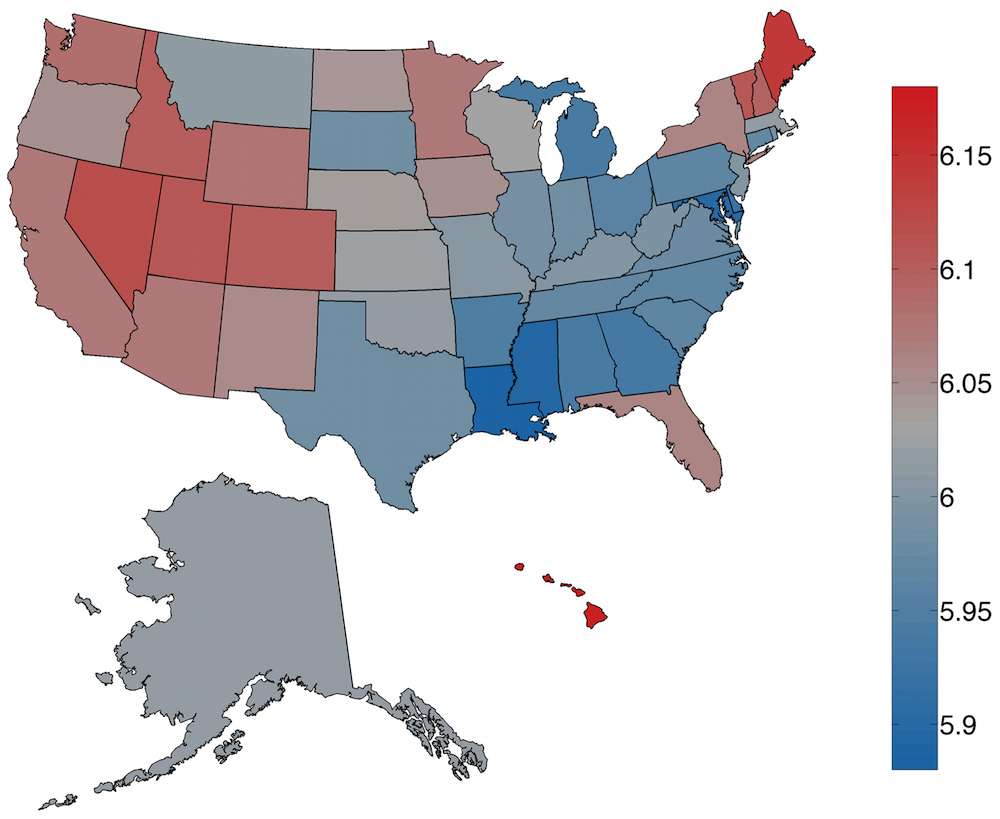
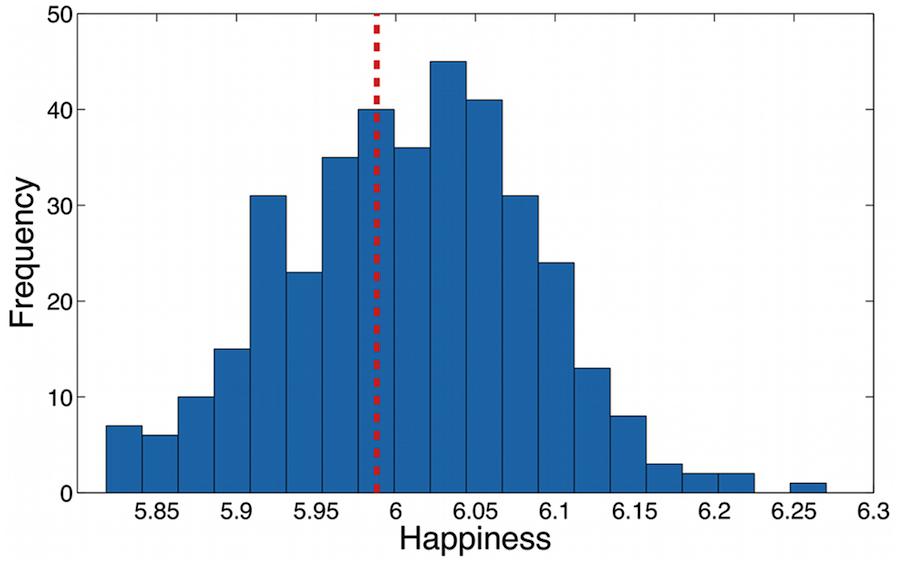
A study by University of Vermont researchers shows where the happiest people in the United States live based on an interesting metric: The language in our tweets. The study, entitled “The Geography of Happiness: Connecting Twitter Sentiment and Expression, Demographics, and Objective Characteristics of Place,” analyzed tweets from around the country, focusing on 10K words that were graded for their positive or negative connotation. The frequency of usage–positive or negative–was used as a gauge for happiness levels.

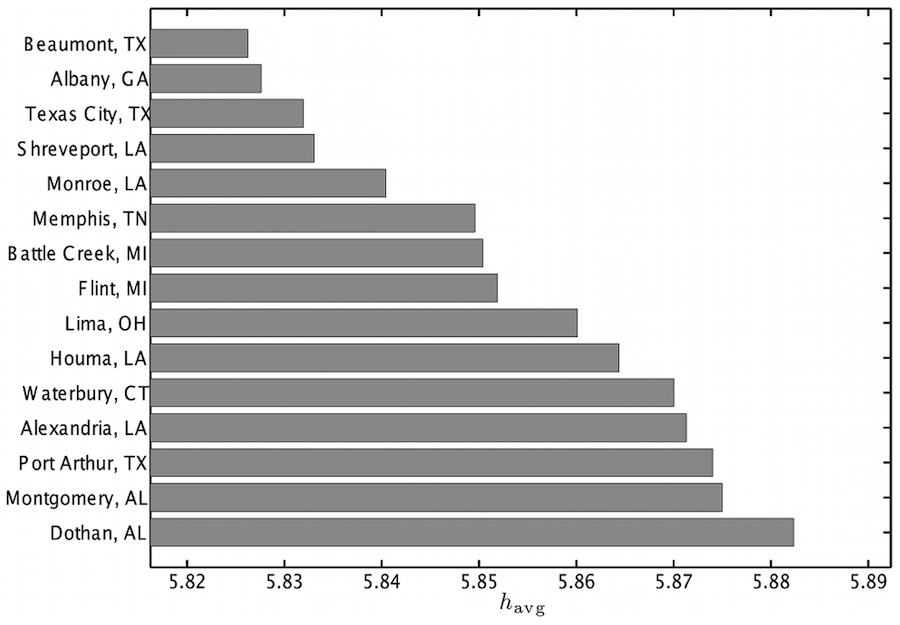
They found that the folks in Napa, CA tweeted the happiest, while the folks in Beaumont, TX sent 140 characters of misery. According to the study, “The happiest 5 states, in order, are: Hawaii, Maine, Nevada, Utah and Vermont. The saddest 5 states, in order, are: Louisiana, Mississippi, Maryland, Delaware and Georgia.”

Analyzing tweets might strike many as a dubious litmus test for assessing collective happiness or misery, but the study’s results are closely correlated with other wellbeing assessments like the Gallup Wellbeing Index. The latter study uses more traditional indicators like poverty, life-expectancy and violence to assess happiness and wellbeing.

The Twitter study tracked other correlations like happy tweets and obesity (inverse correlation), obesity and tweets about food (high correlation) and college education and tweets about cafés (again, high correlation).

This study sparks a couple questions. Assuming you could maintain a similar quality of life in one place as another, would you let a study like this affect your choice of where to live? (This assumes you are less than happy in an unhappy place–e.g. unhappy in Beaumont). If this study were true, why wouldn’t everyone want to live in Napa?

The other question is perhaps more metaphysical: Does language have any causal relation to our happiness? As the Heidegger quote suggests, might we be the servants of our language? And, assuming we can exert our will upon our language use, might we be able to affect levels of happiness via language modification?

What do you think? Would you move to a place because it was reported to be happier? And do you think we can affect our states through language, or does language merely mirror our states, having little or no ability to change our states?

Man Jumps Through Gap image via Shutterstock

Via Huffington Post

Be > Do > Have

Most of us want something. Maybe it’s a car, a super cool micro-apartment, a certain amount of money, a great job…whatever. We think that once we have this something, it will enable us to do something. Once I have money, I will get myself out of debt. Once I have a car, I will drive it down the street for my friends to see. And when we do that something, we will be a certain way. Once I’m out of debt, I will be secure. Once my friends see me in my new car, I will be respected. The formula is HAVE > DO > BE.

Have-do-be is the force that has launched a thousand ad campaigns. Buy (have) our deodorant > nail (do) that presentation > be confident. The ad folk don’t believe most of us will buy their products based on utility alone; e.g. you should buy our deodorant because it will make you smell better. No, their products have to change who we are in some fundamental way–if we are insecure, we will become confident.

But it doesn’t work, does it? The deodorant wears off and our insecurities return.

The difficulty is that nothing outside us will ever change our insides in any meaningful way. This is not an admonition for buying stuff. That deodorant might make us smell more pleasant, but don’t expect anything beyond that. If we as a society understood the limitations of our material goods to affect our state of being–whether it’s a stick of deodorant or a McMansion–we’d probably need to have a whole lot less.

There is an alternative model. It’s BE > DO > HAVE. Start from a place of existential wholeness. Realize you’re lacking nothing and be confident. Nail (do) the presentation, or whatever confident people do. Have whatever you need to support your state and the actions it entails. Rather than presupposing what will make us confident or the things we’ll do under the spell of that confidence, we can have things as-needed. Maybe that deodorant will help us nail that presentation, but maybe not. When we begin to understand the limitations of our material goods, we start acquiring stuff on an as-needed basis, not a this-will-change-my-life basis. This leads to a lot less stuff and, perhaps just as important, a lot less disappointment–we finally stop expecting our stuff to make us happy.

image via empowernetwork.com

Life, Liberty and the Pursuit of Property

As we quickly approach Independence Day here in the US, we thought it’d be interesting to reflect on the origins of the words “life, liberty and the pursuit of happiness.” This ever-so-elegant phrase found in the Declaration of Independence encapsulates the American ideal that you will be free to pursue your bliss without the obstruction of the government. The government might not provide you with happiness, but it won’t impede your pursuit either (we won’t delve into whether the US government has fulfilled on this ideal).

But like most famous statements, there’s a backstory. Thomas Jefferson, the principle author of the Declaration of Independence was a man with many influences, one of which was the the titanic 17th Century philosopher John Locke. In his “Two Treatises of Government,” Locke wrote that government existed for the sake of protecting “property”, which he defined as a person’s “life, liberty, and estate.” The phrasing similarities are uncanny, yet Jefferson chose happiness versus estate. Wikipedia explains some theories as to why:

According to those scholars who saw the root of Jefferson’s thought in Locke’s doctrine [there are alternate views], Jefferson replaced “estate” with “the pursuit of happiness”, although this does not mean that Jefferson meant the “pursuit of happiness” to refer primarily or exclusively to property. Under such an assumption, the Declaration of Independence would declare that government existed primarily for the reasons Locke gave, and some have extended that line of thinking to support a conception of limited government.

To be fair to Locke, his definition of property and estate was more expansive than protecting his condo. It could mean something as fundamental as our self-possession and wellbeing. That said, the word change was undoubtably an intentional one. It declared that the things we own are not synonymous with our happiness.

This view was apparently shared by Benjamin Franklin, who thought property a “creature of society” and therefore should be taxed as a way to finance civil society. In other words, the government should not/cannot tax the inalienable rights–i.e. life, liberty and the pursuit of happiness–but it could tax our stuff, which are accessories to life, not life itself.

Of course a modern interpretation of all this is that a bunch of propertied men (the “Founding Mothers” were few and far between) told the nation they intended to govern and control that their property wasn’t that big of a deal. Thanks guys.

But leaving aside socioeconomic, gender and racial biases, the Founding Fathers were products of the Enlightenment–a time when folks were trying to uproot the ancient, property-based class structures. They were striving for an ideal where equality reigned (however narrow that looked at the time), where property deeds and possessions were not the measures of human worth, where government could be something that supported humans, not their stuff.

Is this enlightened ideal evident today? Or has efficient production of property–something woefully lacking in 1776–allowed us to take on a more Lockesian American ideal, where property and estate are valued over happiness? Let us know what you think in our comments section.

American Flag image via Shutterstock

The Fun, Mobile Path to Enlightenment

For the stressed out Luddite, nothing beats meditation. Sit down, focus on your breath and let the peace ensue. No equipment or wires–just your thoughts, breath and butt. However, for the more technologically disposed, a new product called PIP might provide a great way to still your frazzled nerves.

PIP is a tiny Bluetooth enabled gaming device that allows you to manage stress. PIP achieves this through playing games on your iOS or Android mobile devices. The games reward the physiological state of relaxation as measured by the PIP device. These games can be played solo or against someone.

While stress might be induced by a psychological reaction, the manifestation of stress is quite physiological as the PIP creators describe:

When you are in a stressful situation your body’s flight or fight response is activated. As a result, blood is rushed to the periphery of the body which causes your sweat glands to activate. This activation changes the conductivity of your skin and is referred to as the Galvanic Skin Response (GSR).

PIP measures your GSR and the games provide a fun way to bring your stress levels down. Games include “Relax and Race”–a game played with another person, where the person who “out-relaxes” the other wins the game.

relax-and-race

PIP is a Kickstarter project by a Dublin-based company called Galvanic. They have raised $33K of a $100K goal with 25 days left to go (in other words, if you like PIP, support them now!).

PIP might strike some as a bit overly complicated. Why not just sit and meditate to relieve stress? But for longtime and aspiring meditators alike, the act of quantifying relaxation is much easier said than done. An hour of meditation might leave us feeling more agitated then when we began.

We realize the Buddha was not staring at his Galaxy S4, playing a game with flying dragons on his way to becoming an enlightened being. That said, we suspect the state of enlightenment has a correlative physiological state that can be induced and monitored. For those of us lacking a Bodhi tree to hang out under for a few months, the PIP might be a good tool achieving that state sooner than later.

6 Bits of Dorm Room Wisdom that Can Be Applied to Any Life

For many of us, college was one of–if not the–happiest time of our lives. It was a time when meeting people was easy. The world was full of possibility. We traveled light. Everything seemed new and exciting. We were unshackled from the chains of parental guidance.

Then something happened. We moved off campus. We graduated. We got jobs, donned suits, got married, had kids, bought cars, acquired homes with yards. We suddenly had little time for friends. We got stuff–lots of stuff. And endless possibility was replaced by endless routine. We became our own restrictive parent.

While many go back to school to recreate these halcyon days (read: MFA), there are lessons we might learn from our former, freer selves–lessons that can be applied without going back to school and to lives that include careers, children and regular bathing. Here you go:

  1. We live to connect. This is surely the most important aspect of college life. Many of us made lifelong friends in college, and studies have found that humans with high degrees of social interaction live happier, longer lives. It also found the converse to be true: For example, people who live with low social interaction suffer the same health hazards as someone who smokes 15 cigarettes a day. The beauty of the college experience is that connection is in the architecture: Long hallways, small rooms and compact campuses help create collisions of connections. Many corporate campuses nowadays try to replicate this phenomena.
  2. We don’t need that much living space. The typical American dorm room is around 180 sq ft, and often that space is shared with a roommate. The amount of space humans need is very plastic. In fact, the average American takes up three times as much as space as he did 60 years ago.
  3. Privacy is overrated. It’s funny how we often think fondly of our dorm days–days sharing a tiny room, traveling down the hall to go to the bathroom and eating in large cafeterias. Sure, there were times when the lack of privacy wasn’t so great. But many of these low spots trained us how to live with others. Despite the benefits of public living, many of us strove to make our post-grad homes into fortresses of solitude. Everyone needed their own space–all resulting in more isolation and less connection. Face it, you want to be around people–even when you think you don’t.
  4. You don’t need that much stuff. Remember all of that great stuff in your dorm room: The sandwich press, your 50 state silver spoon collection, your 10 speaker surround sound system? Of course you don’t, because you didn’t have that stuff. You had a clothes hamper and a boombox you cherished, and you were just fine.
  5. Learning is good. Sure, you might have not been the most attentive student, but we bet you learned something–even if it was unconsciously picked up while you slept in class. Research is showing that we can improve mental health and even ward off degenerative disorders like Alzheimer’s Disease through learning new ideas and skills such as a language or instrument in later life.
  6. Walk more, commute less. In our college days, everything was close and we walked everywhere. A growing body of evidence suggests that commuting makes us miserable. Take a tip from the student and ditch the car wherever possible.

College Student Image via Shutterstock.com

Child’s Play

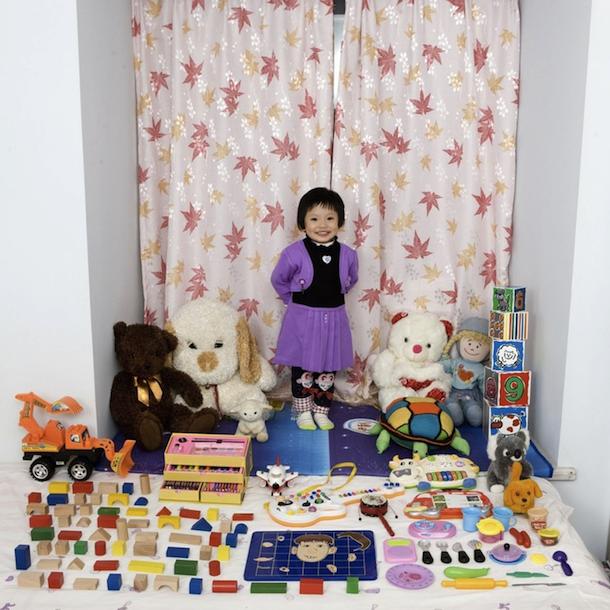
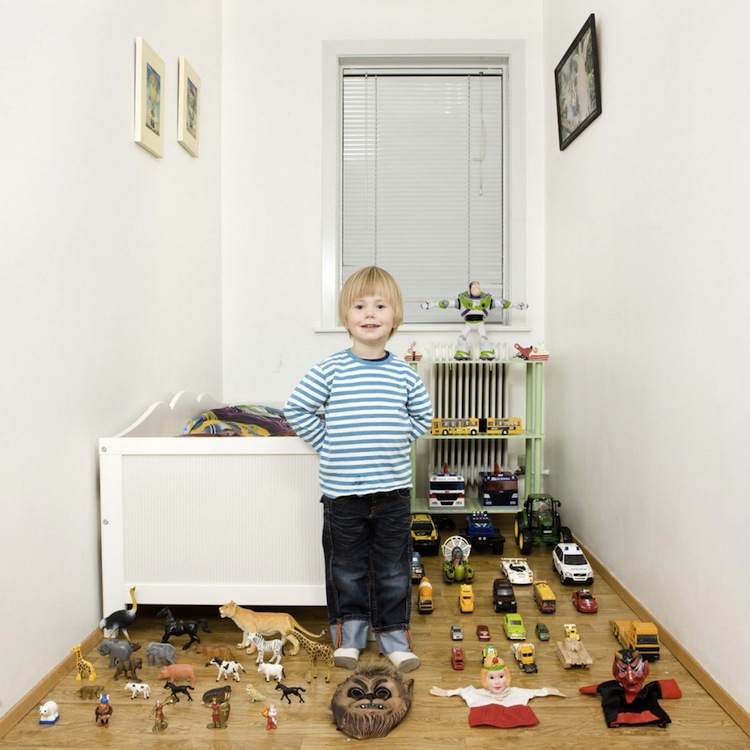
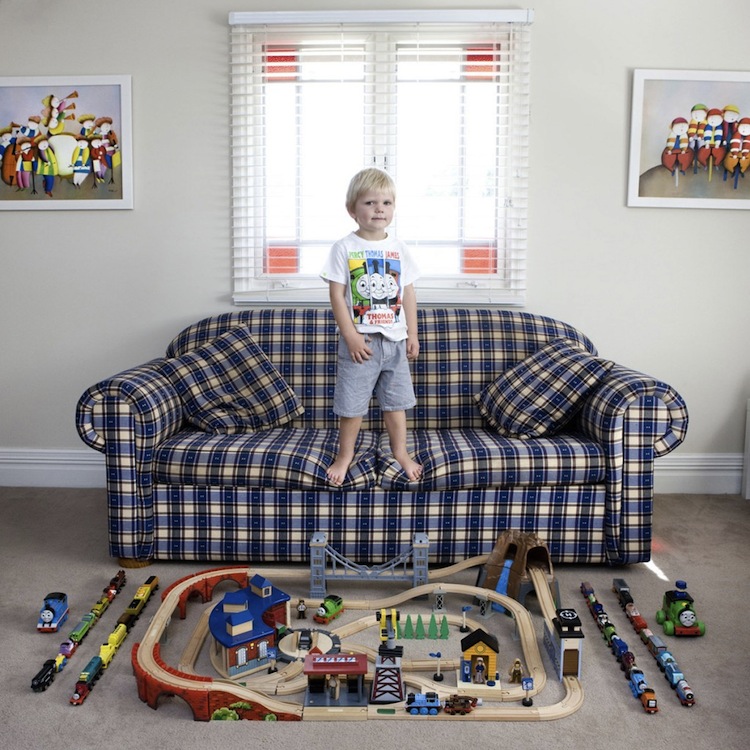
Over the course of 18 months, photographer Gabriele Galimberti traveled the world taking shots of children and their most valued toys, producing a series she calls “Toy Stories.”

What is visible in the series is very interesting. As most might surmise, the children from poorer countries are not only displaying their favorite toys, but their only toys, some of which, like Maudy from Zambia, aren’t even toys. On the other hand, children from richer nations often display acres of toys.

What’s not visible is equally–if not more–interesting. Galimberti said this about how the kids treated their toys:

The richest children were more possessive. At the beginning, they wouldn’t want me to touch their toys [she played with the children before shooting], and I would need more time before they would let me play with them. In poor countries, it was much easier. Even if they only had two or three toys, they didn’t really care. In Africa, the kids would mostly play with their friends outside.

A perfect example of this is Botlhe from Botswana, who displays her lone stuffed monkey–a display that seemed more obligatory than a sign of affection. Galimberti writes:

[She] has a lot of friends, and all of them live really close by to the small house where she lives with her family in a residential complex. In the complex, there is one toilet for every four families. Botlhe has only one toy, the monkey, but she almost never plays with it because she prefers to go out with friends and play with them.

Toy Stories reminds us of a study that reported who the most positive people on earth are (hint: it wasn’t the richest people with the most stuff). None of this should be construed as idealizing poverty, but these children might make us further question the relationship between the accumulation of stuff and happiness. Like Galimberti said of the children: “They just want to play”–and toys, we might guess, were not essential to achieve that end. We suspect adults aren’t much different.

The Difference Between Pleasure and Happiness

We at LifeEdited talk a lot about happiness. It’s in our tagline: Design your life to include more money, health and happiness with less stuff, space and energy. We see the word splattered across bestseller lists: “The Happiness Project,” “Stumbling on Happiness,” “Delivering Happiness” and so forth. People cannot seem to get enough happy. But what the heck is it? And what is the difference between pleasure and happiness? And why should we care?

To answer these questions, we looked to an expert: Buddhist monk, author of ‘The Happiest Person In The World’ and former molecular biologist, Matthieu Ricard. In a Huffington Post article entitled “Why Happiness is Not Pleasure“, he said this of happiness:

Happiness is a state of inner fulfillment, not the gratification of inexhaustible desires for outward things…genuine happiness may be influenced by circumstance, but it isn’t dependent on it. It actually gives us the inner resources to deal better with those circumstances.

Of the difference between pleasure and happiness, he says this:

Happiness is often equated with a maximization of pleasure, and some imagine that true happiness would consist of an interrupted succession of pleasurable experiences….There is no reason to deprive ourselves of the enjoyment of a magnificent landscape, of swimming in the sea or of the scent of a rose, but we must understand that the experience of pleasure is dependent upon circumstance, on a specific location or moment in time. It is unstable by nature, and the sensation it evokes can soon become neutral or even unpleasant.

In other words, pleasure is externally motivated and fleeting, while happiness is internally generated and constant.

Most of us know pleasure. It’s the sensation that drives us to eat a bag of chips even when we know it’s bad for our health; it’s the euphoric feeling of anticipation when waiting overnight to buy the new iPhone even though we know our current phone is perfectly adequate. Our pleasurable sensations are inextricable with the thing–the chips or the phone in this case. The things make us happy.

The trouble with equating pleasure with happiness is when the thing is gone, so too does our happiness. No chips, no happiness. Having last year’s phone can send us into a depression. Check out the movie “The Queen of Versailles” if you want to see the pleasure hunt play itself out to surreal proportions.

Conversely, happiness allows you to enjoy the chips, but not require them; use the phone, but realize it’s just a phone and a new one with slightly more power won’t make you happier in any meaningful way. Focusing on happiness is not better per se, but it’s more reliable.

One litmus test to distinguish pleasure from happiness is something a teacher once told me, “If something is a source of happiness, the more you do of it, the happier you will become.” Do more chips, phones, square feet or bacon (my personal fave) make us happier? Of course not. Sure, these things might be pleasurable, but after a while and in excess they lose their appeal and become “neutral or even unpleasant” as Ricard explains (any buffet-goer can testify to this).

If pleasure doesn’t make us happy, what does? One idea is that it’s experiences, not stuff that makes us happy–in other words internal states rather than objects. One theory promoted by Dr Sonja Lyubomirsky, author of “The How of Happiness” asserts there are three main factors that comprise our happiness:

  1. Set-point. This is essentially our biological level of happiness–it’s our happiness default setting. Some people might be literally hardwired to be less happy than others–or vice versa. This is thought to comprise up to 50% of our overall sense of happiness.
  2. Circumstances. Our physical circumstances do affect our happiness, but to a much smaller extent than most think (10% or so). Circumstances that can thwart happiness are things like no access to clean water, unsafe homes, etc. Circumstances that probably don’t thwart your happiness are having too large a tablet computer and too wide lapels on your blazer.
  3. Voluntary Variables. This is our behavior and thoughts. This makes up 40% of our overall happiness and can actually offset the set-point and circumstances.

The voluntary variables are what my teacher would say are the things that, when increased, promote happiness. These are behaviors and actions like generosity, kindness, love, gratitude, etc. The more we live in these states, the more we act in line with them, the happier we become.

How can LifeEdited be so bold as to say that we can help design your life to include more happiness? Full disclosure: We can’t make you happy. Sorry. But our mission to “edit” the things that don’t promote our happiness–the extraneous stuff and space–might help. No,  the best designed apartment, most awesome stacking bowl or greatest towel will never, ever make you happy, but this “less, but better” stuff might give you less to think about, affording you more mental space for the stuff–those experiences and voluntary variables–that do.

Image credit: Shutterstock.com

Let’s Talk About Stuff Baby

Yesterday LifeEdited founder Graham Hill had an op-ed published in the NY Times. The autobiographical essay entitled “Living with Less. A Lot Less” tracked  his progression from late-20s, flush-with-dot-com-cash, consumer extraordinaire to minimalist exponent. He writes:

My success and the things it bought quickly changed from novel to normal. Soon I was numb to it all. The new Nokia phone didn’t excite me or satisfy me. It didn’t take long before I started to wonder why my theoretically upgraded life didn’t feel any better and why I felt more anxious than before.

At present, the article sits atop the NY Times most emailed and most read lists. Like the TED Talk Graham gave almost exactly two years ago–a talk that has received over 1.7M views to date–the message of living more with less is clearly on peoples’ minds.

Rather than transcribing Hill’s piece, we dug through the comments, highlighting and commenting on some of the major themes.

Desertwaterlily writes:

My son, daughter-in-law and their baby live in Brooklyn in a 700 sq. foot condo. It’s very crowded and not functional. They know it can be made functional but they don’t (as yet) have the money or resources to do anything. I agree with you about living close to the bone, but it takes more than wishing to move walls, build new working kitchens, electrical, shelving, etc. Sometimes it takes money to live a “simpler” life.

Desertwaterlily check out 8 Tips for Editing Your Life that Work for Any Budget. While it’s true moving walls cost money, there are a ton of things to simplify your life that require little or none.

Sonja writes:

I’m 82 and live on and with the barest of necessities, for the less I have, the better I feel. I regularly go through my small house wondering what else I can get rid of. Minimalism is soothing, aesthetically appealing. I sometimes fantasize about living in a cell like a monk – a cot, a table, and a window.

Knowing what I know now, if I had my life to live over, at the age of 18, instead of sitting around devising plans for a cluttered life, I would put a knapsack on my back and with my dog I would leave the house and just start walking.

Thanks Sonja for showing that this is not just a young man’s game.

MJones writes:

Most of the people responding to this article appear to have no children….I think it’s hard to live in small places with other people – children and adults – without separate sleeping rooms for them. Old people snore. Children are distracted by adult activities and truly need their own space to develop fully in western culture. A baby can sleep in the corner, but as they get older and play sports or pursue their own interests, they need space for their stuff and friends.

And Larry L also writes:

I noticed that the author does NOT have children and is NOT married. His life choice is highly unlikely to be replicated under different circumstances.

The “you-don’t-have-kids” argument comes up a lot. Neither Graham, nor anyone at LifeEdited suggest that everyone should live in 420 sq ft. Nor do we suggest the needs of a single person are the same as a family’s. Living with less might look like having ten toys instead of fifty or living in 1200 sq ft instead of 2500. And yes, this is written by someone with children.

MGM writes:

Great. If the one percenters stop buying lots of stuff and stop building lots of big homes where will that leave the rest of us? Our economy is fueled by overconsumption. The middle class cannot do it by themselves!

We’re not sure if MGM was being serious, but this argument does occur to many as a potential problem. First, we’d respond by saying that if we destroy our environment, there will be big problems for every class. And because domestic manufacturing is almost extinct, most consumer dollars flow to top heavy corporations and overseas producers; this situation has been thwarting the American middle class for decades now. What if Americans started buying less stuff they could keep for much longer at fair market value? What if our stuff was made by skilled, well paid workers (foreign or domestic)? We don’t want to overstate our economic chops, but we think it’s fair to say the current system is patently unsustainable and we are due for another model.

imadeamesss

That’s a nice article and all but I still want the Omega single auger juicer. It is a thing that I want.

Please, keep your juicer. No one is saying get rid of all your stuff. But what if we cared about everything as much as imadeamess cares about his/her juicer?

Sam93

I believe your insights resonate only with people who have money and who are capable of owning stuff. You have come a full circle with consumption and then simplification. You are still financially capable to accumulate stuff. Thus, it is no longer a thrill for you. For people who are working hard, owning stuff(e.g house, car, etc) is an indication that they have arrived at a certain stage to acquire what they wish. It is not always easy when one couldn’t afford something other people discard regularly.

Sam93 brings up a very good point. In many articles that focus on Graham, he is often charged with “easy-for-you-to-say”–that most people don’t choose less, but are forced into it.

There are certainly many people who cannot afford even basic items and no one is trying to minimize their plight. However, as Graham tried to convey, the stuff issue–as well as the inflated home one–affects those with even very small incomes. Big box stores and 99 cent stores and cheap housing, fueled by easy credit, have made torrents of stuff and space available to almost any income level.

What Sam93 says about stuff-as-status is astute. We live in a culture where consumer goods are used to demarcate success–even if they undermine our happiness and wealth. Whether the mainstream will every “choose” less–rather than being forced into it–remains to be seen, but we’re optimistic!

en D

I realized how little meaning “stuff” has when our house was on fire and my husband and I were frantically trying to save the lives of our pets. I realized later that neither of us had stopped to try to rescue a single thing: not jewelry, not computers, not even money itself. Only life mattered. That was over 15 years ago, but the message remains as vivid to me as it did that day.

Well said!

Image via Shutterstock.com

Comments via New York Times

Smell Up Your Home for Lower Stress

A body of evidence has shown that interacting with nature reduces stress and increases our ability to pay attention. Research is now showing that smelling nature “lowers our blood pressure dramatically and increases anti-cancer molecules in our bloodstreams” according to a recent Atlantic Cities article.

Immunologist Qing Li at Tokyo’s Nippon Medical School suspected the positive physiological effects of being in nature weren’t only visual–i.e. looking at a forest or creek or whatever–but olfactory. For the last eight years, he’s been studying phytoncides, the natural aerosols emitted by plants, to see if and how they benefit humans.

To test his theory, he stuck subjects in a hotel room (probably the most unnatural environment imaginable); one group had cypress aromatherapy and the other without. The group with “experienced significant drops in stress hormones and boosted immune cell activity,” according to the Atlantic. Li helped found a Japanese group to further research in the forest medicine field, and a few years ago the International Society of Nature and Forest Medicine (INFOM) was founded.

What does this all have to do with living an edited life? Well many of the living situations we talk about on this site are urban. And while city life has many benefits–culture, great transportation, walking, etc.–it can also be pretty assaultive on our senses. While nothing replaces time in nature, a few small steps such as adding an essential oil diffuser with cypress or lavender oil (we suspect Febreeze and Glade Plugins won’t produce the same benefits) to your home might make a huge difference in offsetting some of the stressors inherent in city life.

Image Credit: Shutterstock.com

Via Atlantic Cities