LifeEdited Maui: A Quick Update

As we near the end of summer we’d like to provide you all with the first glimpses of our newest project, LifeEdited Maui. LifeEdited’s CEO, Graham Hill is currently on location in Hawaii overseeing the build. For the month of September we’ll be showing you the process of how we are designing our eco compound. As October rolls around, our construction updates will be in real time leading up to the big unveiling.

Site preparation

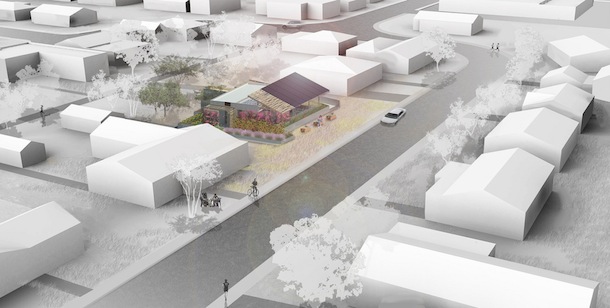
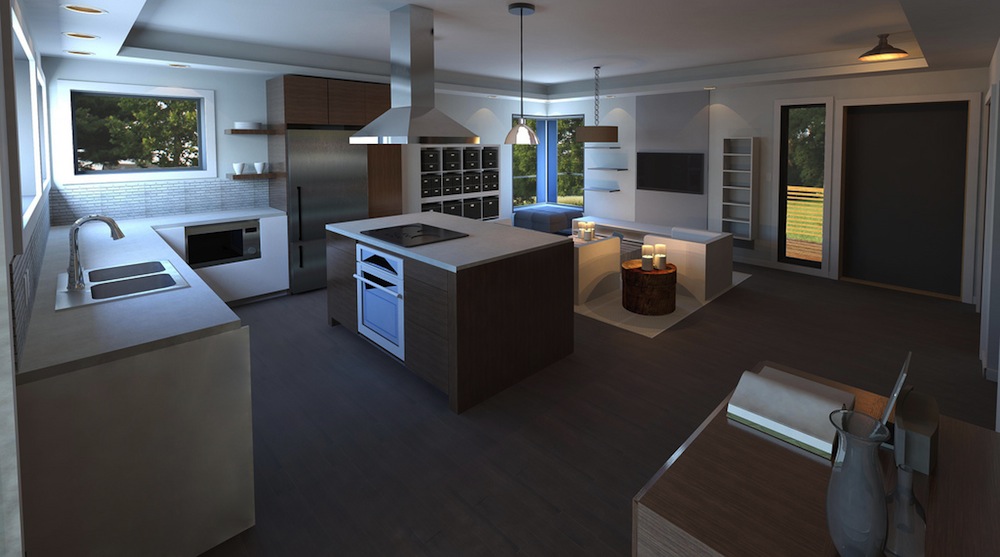
The goal of LifeEdited Maui is to build an off-grid, low impact, luxurious, space-efficient four bedroom house in 1000 sq ft. LifeEdited Maui is about finding the most innovative answers about how the future will live. We are presenting a version of the future that is sustainable, resilient and, frankly, awesome.

We believe in self sufficiency and tasty food, so we have already planted 30 different kinds of edible plants including bananas, mangos, and papayas. Our long term vision includes this fruit orchard, raised garden beds, some purely endemic Hawaii acreage as well as creating nurturing habitat for birds, bees and other local fauna. Walking paths, benches, hammocks and agriculture structures around the property will encourage engagement and connection with nature.

As the building process approaches completion, the applications of transforming design as exemplified from our previous projects will also take shape in LifeEdited Maui. Beds that fold into walls, tables that expand, rooms that do double and triple duty—serving to maximize available area for this live work space.

One of the guiding principles behind LifeEdited Maui is to have as light of a footprint on the environment as possible while still building homes that don’t make compromises in form or function.

Wood frame coming together

Stay tuned to our social media and newsletter for more updates!

This Tiny, Passive House Ain’t No Wimp

Don’t be fooled by its peace-loving name, few things will defend you from the elements like a Passive House. If you’re not familiar with the term, Passive House (aka Passivhaus) is a German-born set of rigorous building standards that make a dwelling extremely energy efficient. Passive House construction implements energy saving measures like super insulation, passive solar design (i.e. optimizing a structure’s orientation to put the sun to good use–either shielding it from the hot in warmer regions or adding solar heat in colder ones), triple or quadruple-glazed windows, an airtight building envelope and various natural or mechanical ventilation systems that keep fresh air circulating through the interior. The LifeEdited apartment, though not Passive House certified, employs a number of Passive House strategies such as a tight air barrier and the use of a heat recovery ventilator (HRV); this allowed us to super insulate the space such that we were able to reduce the number of radiators from five to one.

But just because a dwelling meets the Passive House standard doesn’t mean it’s required to be a particular size. In fact, many Passive Houses are quite large. And as we know, you can have the most energy efficient home, but if you have to drive a couple hours to get to it, it seriously affects the home’s overall resource consumption. The marriage of small, dense housing with Passive House levels of building efficiency would be a felicitous one. And that’s exactly what Mini-B Passive House is all about.

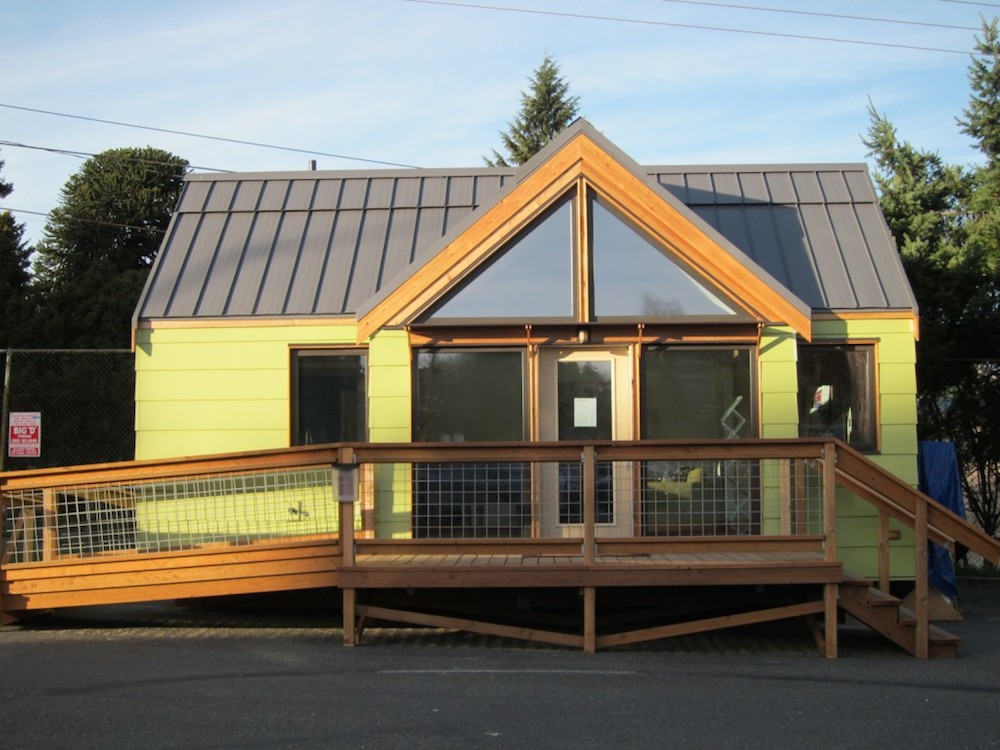
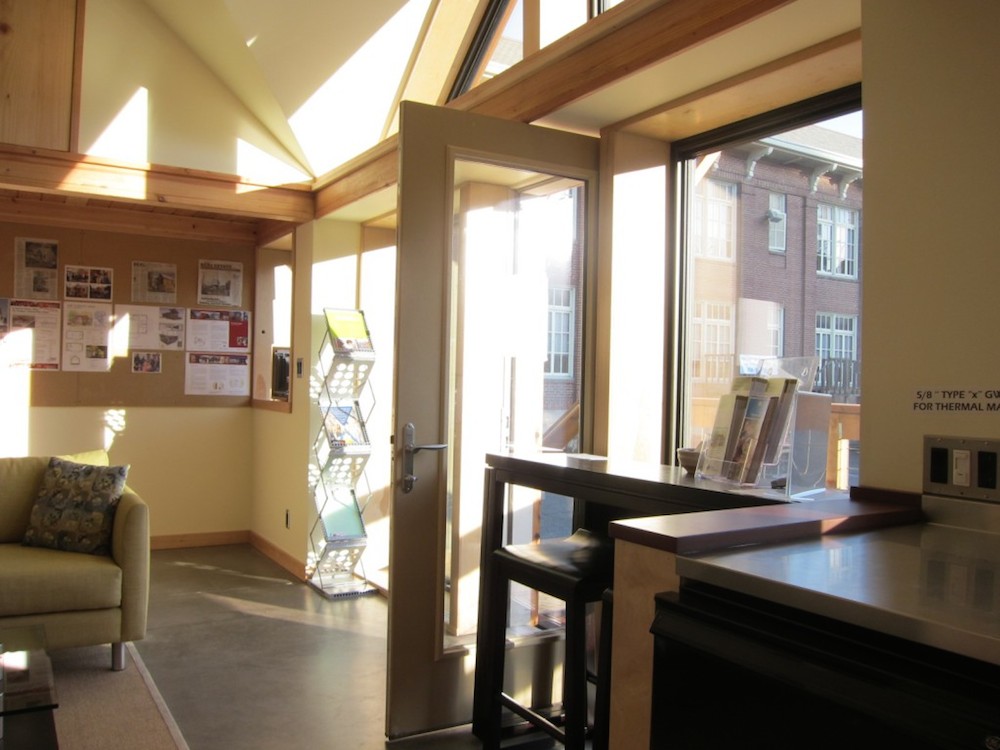
The 300 sq ft house is the brainchild of architect Joe Giampietro. It was designed to be used as a detached accessory dwelling unit (DADU) in the Seattle area, though we imagine it could be setup elsewhere. The house uses nine inches of foam insulation, a heat recovery ventilator and quadruple glazed windows among other things. Its insulation is so complete that the rare bit of Seattle winter sunlight or, in extreme cold, a tiny wall mounted heating panel, are all that are needed to make the place comfortable. It’s estimated annual heating bills would run about $30 and electricity a mere $100.

The house was built by students and used as a demo before eventually being auctioned off. On their website Giampietro says that Mini-B plans and constructed homes are available to purchase, details available upon request.

Forget Dumpster Diving. Try Dumpster Living.

“What’s the smallest space you can happily and healthily live in using the fewest resources?”–it’s a question that Professor Jeff Wilson is trying to answer. In his quest for that answer, he’s going beyond shipping containers and tiny houses–the frequent vessels for extreme tiny-living. His tiniest of resource-sipping homes is a lowly, 33 sq ft dumpster.

Wilson, aka Professor Dumpster, is an environmental science professor at Huston Tilloson University in Texas. He and a team of experts have started the Dumpster Project as a case study in how 10 billion people (the estimate world population in 2050) might sustainably coexist on this planet…and also have a little fun while doing research.

The yearlong project will be broken into three phases. Phase one is called “Dumpster Camping.” From February to June of this year, Wilson is living in a dumpster without any electricity or running water (i.e. camping). He uses a camp stove to make coffee. He is wheeling water that he filters from a nearby lake. He is trying to establish a minimal resource use baseline.

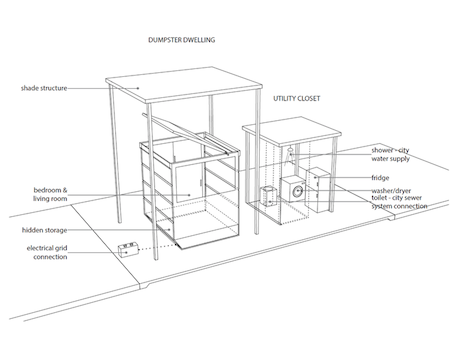
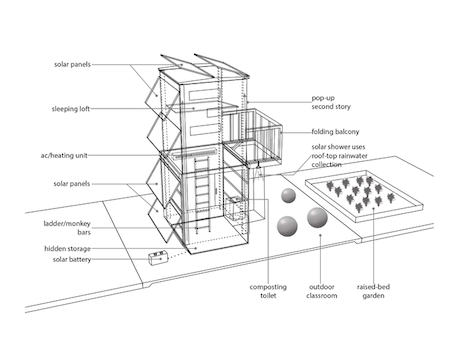
american-homeThe second phase is the “Average American Dumpster Home,” which will run from July to December of this year. In this phase, the dumpster will be decked out with the accoutrement most American homes enjoy: air conditioning, dishwasher, refrigerator, stove, toilet and more (note: he’ll be adding a separate “utility closet” to hold some of these bulky items). This will phase will be “establishing a data baseline—average levels of consumption for energy, water and waste,” according to the project.uberThe final phase is “Space Capsule Über Dumpster,” which is basically making the dumpster into the trickest, off-grid home possible. There will be a popup roof, PV panels, rain catchment, garden and more. This phase will use the dumpster as a laboratory for sustainable, minimal resource, livable housing. This is opposed to camping phase which, though not resource-intensive, is not livable either; the insulation free interior of the dumpster was 116 degrees the other day.

We asked Wilson “why a dumpster?” He said there were a number of reasons. One is it’s never been done before; doing the project in the dumpster has called more attention to it than if it had been in a tiny house or something more conventional.

Furthermore, in the mini-documentary above, he calls the dumpster a “conversation box”–one that has attracted a broad spectrum of followers as well as a band of experts from around the country to lend their science and design knowhow. He also thought that the juxtaposition of the home–for most the paragon of security–with the dumpster–something many people have a reflexive revulsion to–would make that conversation all the more fertile.

Ultimately, the dumpster is just a vessel. The project is an applied and earnest–though not self-important–investigation into space and resource consumption. Wilson et al are holding a Kickstarter campaign to raise money for the third phase. Check it out and lend your support.

The Home of the Future is Transforming

On October 3rd, 20 teams of college students from around the world will descend upon Irvine, California for the Solar Decathlon. On display will be some of the most innovative designs in energy efficient home building. The US Department of Energy sponsored event is looking for “the team that best blends affordability, consumer appeal, and design excellence with optimal energy production and maximum efficiency.” Fixtures of the SD designs include PV panels, rainwater catchment and grey water systems–things that help the overall structures be as energy positive as possible. This year, a third of the teams are sporting another, less obvious, but equally important energy saver: transforming furniture.

More specifically, Resource Furniture is sponsoring six of the 20 teams entered into the competition. RF President Ron Barth remarked, “After several teams approached us about the value we could provide to their projects, we sought out other teams that would benefit from our multi-functional solutions.” The company is sponsoring Arizona State University and The University of New Mexico; University of Louisville, Ball State University and University of Kentucky; Norwich University; Southern California Institute of Architecture and California Institute of Technology; Queen’s University, Carleton University, and Algonquin College; and the University of Southern California. See a full list of all the teams and links to their sites here and view more images at SD’s Flickr page.

Barth told us that when he approached some of the teams, not all had furniture selected. To us, this seems like a curious omission for a competition whose mission is to promote efficiency. SD’s guidelines dictate that the interiors of each structure be no smaller than 600 sq ft and no larger than 1000. The choice of furniture can make that 600 sq ft suitable for a family of four or, conversely, make the 1000 sq ft cramped for two.

It was also interesting to peruse many of the entries. Most were quite beautiful to look at and had ingenious strategies for energy production and retention. But many appeared to use the full 1000 sq ft interior limit as well as much of the 4680 sq ft lot space. Many of the team’s renderings showed their home designs sitting in far off fields or in the middle of the desert, leading us to wonder how rigorously setting was considered? As Lloyd Alter stated in Treehugger recently, “When it comes to green building, where you are is as important as what you build.” How do these homes fit into an increasingly urbanized, interdependent world population? A world with depleted natural resources? Is the Solar Decathlon looking for the home of the future or the suburban home of the future?

One of the cooler designs is called DALE, designed by the Southern California Institute of Architecture and California Institute of Technology team. It uses housing modules that can be expanded with shifting occupancy needs–e.g. couple to family to extended family. Check out the video above for an illustration (you can cut to the 1:00 mark for the juicy parts).

Our high-density-biased gripes notwithstanding, there are some very cool designs on display at the Solar Decathlon. And we hope the inclusion of more transforming furniture indicates a level of holistic design that includes interior functionality and setting as much as it does a home’s raw energy consumption.

3 Ways to Dry Clothes that Don’t Blow

Drying clothes in small spaces can be difficult. Either you have no dryer or a slow-drying condenser model. Hanging your clothes on a clothesline off your fire escape is illegal in many state. And even when you have a dryer–either your own or at a laundromat–you might not want to use this appliance that is neither kind to your clothes or the environment (standard dryers create about 4.4 lbs of CO2 per load).

With all that in mind, here are three products that provide space-and-energy efficient ways to hang dry your clothes in your small space.

I. Leifheit Rollfix Retracting Clothesline

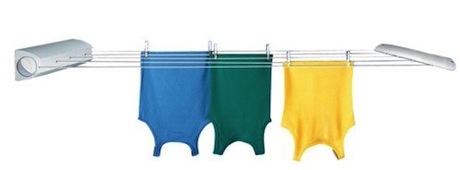
leifheit-rollfix

Rather than using a traditional clothesline that needs to be coiled and uncoiled and wrapped around some random object, the Rollfix has five lines that coil in a discreet case that mounts your wall. Just pull the lines out of the case and affix it to it’s mate on the other side of the room. Each line extends up to 13′ making for an incredible 69′ of drying line. We found this extremely useful product on Amazon for only $30.

II. Leifheit Telegant Mounted Clothes Dryer

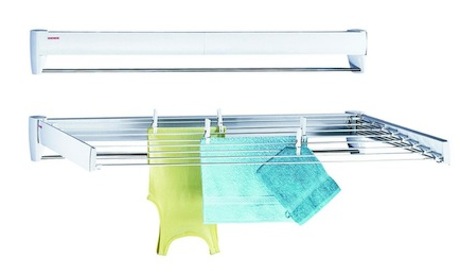
leifheit-telegant-clothesline

The Telegant is ideal for smaller loads. Available in either 28″ or 40″ wide versions, this wall-mounted rack is an ordinary towel rack when closed, but features a telescoping drying rack with eight lines totally 26′ of drying line when opened (five and 14′ for the 28″ version). Prices on Amazon are $32 and $43 respectively.

III. The New Clothesline Company LOFTi

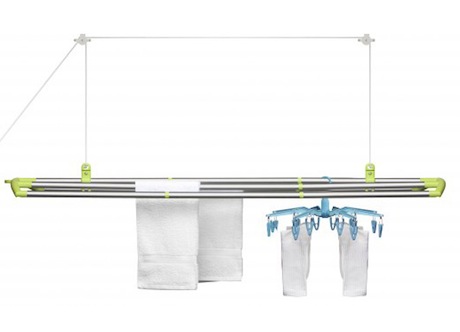
ceiling-laundry-drying

If you have high ceilings, this pulley mounted ceiling drying rack is pretty ideal. It has 22′ of drying rack space and a number of accessories such as a mobile-like sock hanger that help increase capacity. It’s available for $80 through IPPINKA.

6 Questions to Ask Yourself Before Doing Anything

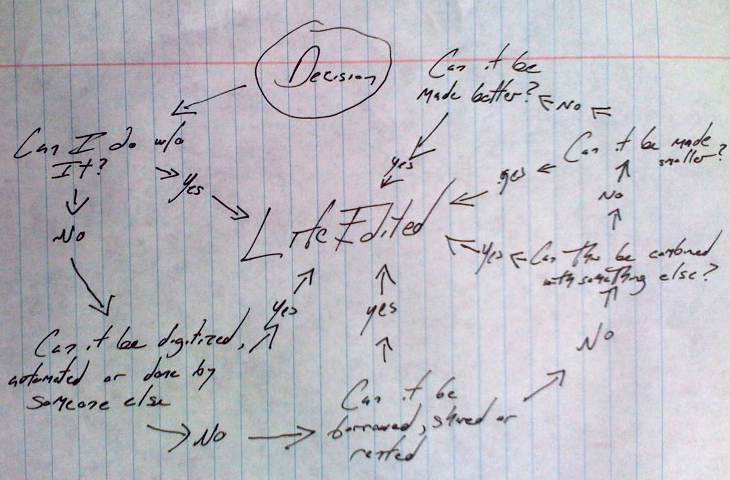
Life involves decisions: left or right, black or white, big or small, to be or not to be. While we don’t want to be too prescriptive as to what constitutes a “LifeEdited” decision consistent (it looks different for different people), we have some fairly universal questions to ask yourself when in decision mode.

Below are 6 questions that work for almost any decision–whether it’s about tasks, purchases, work, recreational activity, etc.

Note: the questions are sequential; if you answer yes to one question, you don’t need to answer the following ones. For example, question #1 is “Can I do without it?” If you answer “yes”, then it’s pointless to ask the following questions because there is no longer and decision to make.

Here they are:

  1. Can I do without it? This should be the gatekeeper for all decisions. Nothing simplifies like elimination. Do I really need this? Do I really want this? Do I really have to do this? Look at the full picture, e.g. you might want a Porsche, but don’t want to pay for it. You might want an opulent lifestyle, but don’t want to work so hard to get it. Doing without leaves us less to maintain, manage, clean, pay for, and so on. It also allows us to pay closer attention to the things we can’t do without.
  2. Can it be digitized, automated or done by someone else? This question removes spatial or temporal volume from our lives. You might need an item or something done, but ask if it can take up less space and time. Can your old tax returns be put on PDF’s? Can your bills be put on auto-pay? Might you be better off hiring someone to fix the toilet than doing it yourself? Our lives are often lost in teaspoons–small purchases and tasks that eventually create great mounds of clutter and confusion. Seize every opportunity to reduce volume.
  3. Can it be shared, borrowed or rented? For most of the 20th Century, ownership was the aim. But today, there are many great ways of accessing and using without the burden of owning. Ask yourself, is it totally necessary to have fulltime possession? If you only need a car once or twice a week, might it make more sense to use Zipcar rather than keeping a car on standby? Can you borrow a dress for that event? Possession requires maintenance, storage and money. Some things are worth that price. Many are not.
  4. Can this be combined with something else? Can that table also be my desk? Can I get a Murphy bed instead of a traditional one? Can I pick up my laundry and groceries? If we’re going to get or do something, why wouldn’t we make it as efficient as possible?
  5. Can it be made smaller? Assuming you need to have or do it, assuming it can’t be digitized, borrowed or be made multifuctional, can this be smaller–either spatially or temporally? Can I find bowls that nest or tables that stow? Can I spend less time paying bills, weeding through junk mail or email? Less space and less time equals more room to live.
  6. Can it be made better? You can apply this question to all fields. If you’re buying stuff, remember that something might be twice as expensive, but if it lasts 4 times as long, it’s half-priced. Wherever possible, get the good stuff you like. Same principle holds true for tasks. If you’re going to do a job, why not do a high quality job? It might take a little longer in the short-term, but save time and energy in the long. This question asks, “What would your life be like if everything you had and did was of excellent quality?”

This post was originally published on June 20, 2012

4 Reasons Why Less is More for Planet Earth

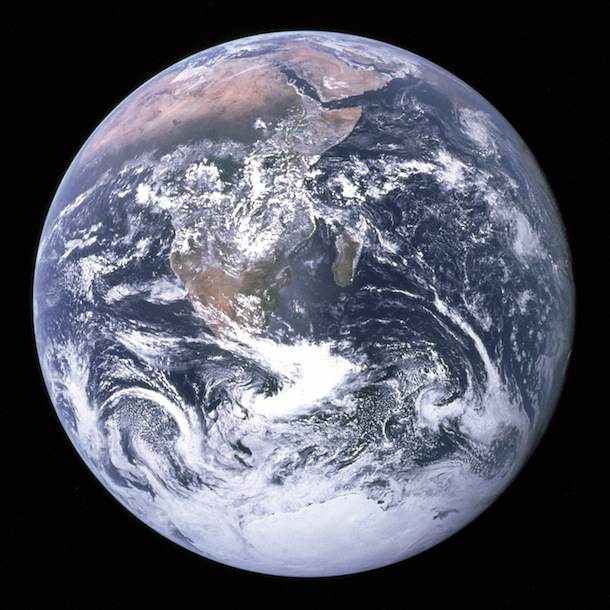
Happy Earth Day! We don’t talk about our beautiful host planet that much around here. Not because we don’t care. We do. Not because the “less, but better” lifestyle doesn’t have benefits for the planet. It does. But we think those benefits stand on their own legs. In other words, the environmental benefits are the happy byproduct of a simpler, better-designed life–not the reason to live it.

All that said, some reputable sources claim that our glorious planet has been pretty battered in the last couple hundred years and that we might want to consider changing the manner in which we live on it…like yesterday.

In consideration of these considerations, we put together a few compelling reasons why living a life with less stuff and space makes a lot of sense for the planet.

Less stuff = smaller carbon footprint

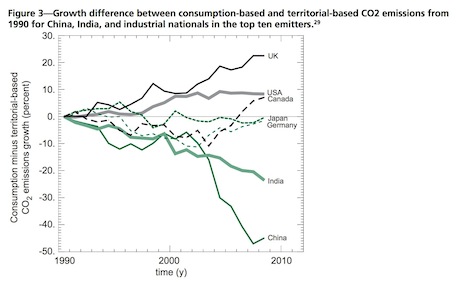
A recent article in Guardian UK made this point abundantly clear. Between 1990-2008, the UK boasted that it reduced its carbon emissions by an impressive 19% within its borders. The trouble was that when their carbon emissions were measured based on consumption, which includes the emissions of producing imported goods, their carbon emissions increased a whopping 20% over that same period. The US clocked an 8% increase. This lower rate is nothing to brag about–in that same period we increased our intra-border emissions by 17% for a 25% increase overall.
Carbon-emissions-terrestrial-consumption

China has blunted the impact of our carbon production. It’s estimated that 45% of China’s carbon emissions, which are the world’s greatest overall, are attributable to the production of exported goods. If we take away carbon emissions for exported goods, China’s carbon footprint has been steadily decreasing in the last 20 years.

Long story short: Fewer exports and less stuff = less carbon and greenhouse gases no matter where you are.

Are you dense?

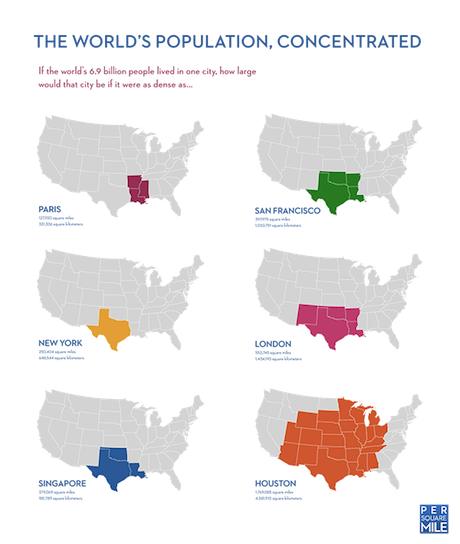
We’ve looked at this topic before with Per Square Mile’s infographics. Basically, if the planet’s 7 billion people enjoyed New York City levels of housing density, we could all live in an area the size of Texas. If those 7 billion were to be housed as densely as Texans–specifically Houston, Texans–the amount of area would occupy most of the continental US.
per-square-foot

We are quick to say this is not the whole story: How we consume plays a significant part in our area footprint. We might live in a 300 sq ft home, but our consumer behavior might require a square mile’s worth of resources–a square mile that is most likely in China (see above).

But density does matter. If everyone lived in larger homes on bigger lots, requiring more sprawl, more driving on more highways, it would create a bigger environmental impact and almost certainly encroach on nature.

As counterintuitive as it sounds, a life in the heart of the city, with its walkability and access to public transport,  might be the greenest thing you can do.

As economist Ed Glaeser put it, “The next time you want to fight for nature, leave [Thoreau’s] Walden Pond alone and start pushing for denser development.”

Big homes use more resources to build

According to the EPA, home construction, remodeling and demolition projects are responsible for a staggering 25-30% of the nation’s annual municipal solid waste. If the world were to start building small–both new construction and remodeling–there would still be a lot of waste, but here’s the thing: Building big homes creates a disproportionate amount of waste compared to smaller homes. In other words, a 2K square foot home doesn’t necessarily create twice as much waste as a 1K square foot home, as Greenbiz explained a few years ago:

The U.S. National Association of Home Builders (NAHB) estimates the materials used in building a 2,082-square-foot (193-m2) single-family house to include 13,837 board-feet of framing lumber, 11,550 square feet (1,073 m2) of sheathing, and 16.92 tons (15,350 kg) of concrete. One would expect that, relative to material use, there would be an economy of scale as house size increased…but that is not necessarily the case…because larger houses tend to have taller ceilings and more features, larger houses may actually consume proportionally more materials….a new 5,000-square-foot house will consume three times as much material as the 2,082-square-foot house NAHB has modeled, even though its square footage is only 2.4 times as large.

It’s not a major mental leap to say that if the size of homes were to decrease, the amount of waste and resources needed for construction would decrease in turn. Creative division of existing spaces would decrease that waste more still.

Big homes use more energy to maintain

It’s pretty common sense, but when you have a bigger home, not only do you need more building materials to make it, you more energy to maintain it.
energy-information-administration

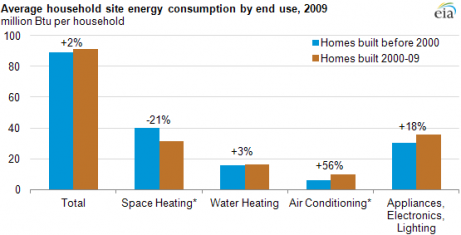
A study done by the Energy Information Administration found that homes made after 2000 use 2% more energy than pre-2000 ones. This tiny increase doesn’t tell the whole story though. These newer homes are considerably more efficient than the older ones, but because they are 30% bigger, all of those gains have been negated.

Those efficiency measures applied to smaller new homes and older homes could make a significant dent in our national energy consumption.

Why You Should Give a Washit

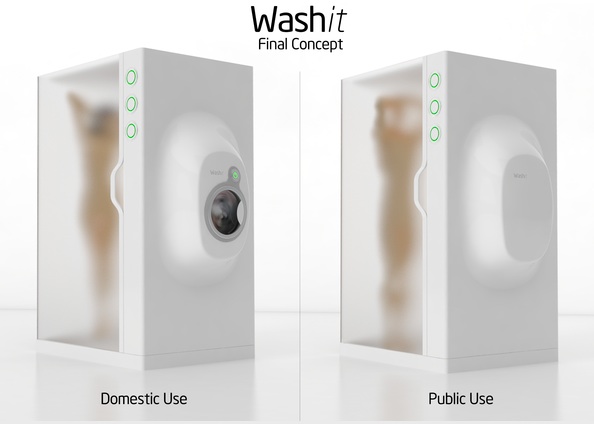
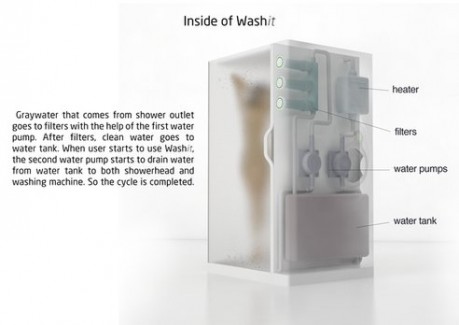
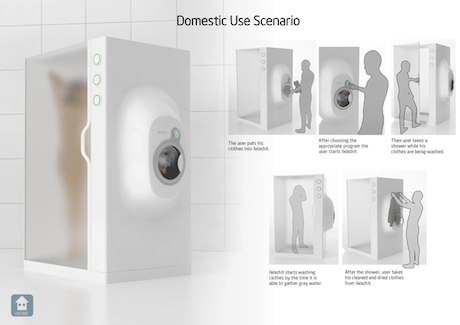
In an effort to reclaim some of the billions–probably trillions–of gallons of perfectly good water sent down the drain, a few Turkish designers created the unfortunately-named, brilliantly-conceived combination shower/washing machine/dryer Washit, which uses your filtered shower water to wash your clothes. It actually goes one step beyond most grey water systems, which will often have one-stage water recycling–e.g. using sink water to flush a toilet then onto the sewer. Washit continuously filters and reuses the same water, only replenishing when there is water loss.

washit-how-it-works

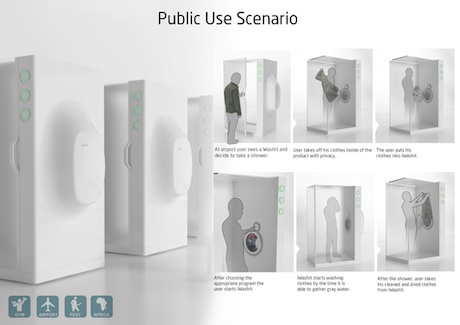
One of the more interesting ideas is the public version of the Washit, which allows people to step inside the unit, strip and load their clothes from the inside, then take a shower whilst their clothes are cleaned and dried. This would be great for airports, gyms and late-night partiers.

Washit-private

washit-public

There is no indication of how long a Washit cycle is. In fact there is no indication that the Washit is ever going to make it to market, though we hope it does. Most modern plumbing systems waste both water and space. By creatively combining water-consuming apparatuses as Washit does, we can cut down on space and water waste. Now about the name….

Study Confirms that Big Houses Have Big Energy Needs

energy-information-administration

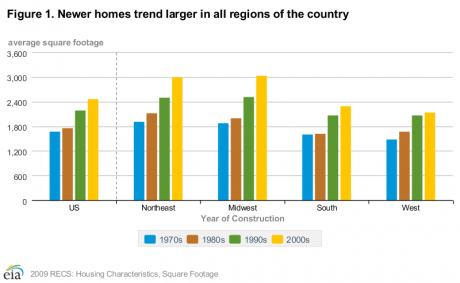
The recent Residential Energy Consumption Survey (RECS) by the Energy Information Administration (EIA) shows that homes have become slightly more efficient in the 2000s versus previous decades, but a 30% increase in home size has totally negated all of those gains. As the EIA reports:

As square footage increases, the burden on heating and cooling equipment rises, lighting requirements increase, and the likelihood that the household uses more than one refrigerator increases.

The average home of the 70s and the 80s was a mere 1800 sq ft, compared to 2200 of the 90s and 2465 of the 2000s. The increased area has brought along with it increased energy needs.

chart

But that’s not all. Here are some other findings from RECS:

  • Higher ceilings: “17% of homes built in the 1970s have higher than the traditional eight-foot ceilings, while that number increases to 52% in homes built in the 2000s.”
  • Coldest regions have biggest homes. “In the Midwest, where space heating accounts for half of home energy consumption, residents heat more space on average than any other part of the country. In Wisconsin, for example, the average heated square footage is nearly 2,100 square feet. By contrast, homes tend to be smaller in parts of the country where space heating is less intense. In California, where most of the population resides in mild or hot climate regions, the average heated square footage is 1,180.”
  • More A/C cooling bigger homes. “Central air-conditioning was installed in 85% of homes built in the last two decades, resulting in a dramatic increase in the amount of residential space that is cooled and contributing to a nearly two-fold increase in electricity consumed for air-conditioning.”
  • Some gains. “While overall home size and air conditioned space have been increasing, the likelihood that a home will have key energy efficient features rises as its square footage increases. Residents in larger homes consider their homes to be better insulated than those in smaller homes and these homes tend to have more efficient windows.”

We don’t often talk a lot about the environmental implications of an edited life. We believe the benefits of living with less, but better is its own reward. But, obvious as it sounds, smaller homes are greener.

Granted, there might have been a significant reduction in efficiency in smaller homes in the 2000s, but we suspect that many of the efficiency measures applied to larger homes were also applied to small ones. We don’t think it’s too conjectural to say that if the homes of the 2000s hadn’t grown so much, the more efficient appliances and better insulation, now applied to huge houses with high ceilings, would be applied to more modest homes with modest energy footprints and cheaper operating costs.

Via Lloyd Alter at Treehugger

Shocking Exposé on Where Our Stuff Comes From and Goes

We were going to do a post focusing on the “The Story of Change”–the latest video from the “The Story of Stuff” folks about building a movement around less stuff and responsible industrial practices. But then we realized that many people have not seen “The Story of Stuff.”

Directed by Annie Leonard in 2007, “The Story of Stuff” takes a deep and sobering look into the black hole that is our stuff. We talk a lot about the personal tax stuff takes on our lives, but Leonard goes much deeper into the global environmental and social tax our stuff takes. It’s not pretty or easy to watch, though Leonard’s jaunty tone and cartoon illustrations makes it somewhat palatable.

“The Story of Change” attempts to turn SOS’s message into a movement. SOC is not as hard-hitting as SOS, but it nonetheless shows possible pathways out of the consumer quagmire we find ourselves in, likening the call to action with the US Civil Rights Movement and Gandhi’s movement for Indian independence.

SOS.org features other stories about things like bottled water, cosmetics and electronics–all worth watching.

In creating new values and a new society–one that does not blindly adhere to the idea that more, newer and bigger is better–we need to cultivate awareness. Few people in the last decade have done more for bringing awareness to our Stuff-aholic tendencies than Leonard. If you haven’t watched “The Story of Stuff”, take some time to do so.