How to Stop Receiving Unwanted Mail

Are you trying to live a more edited life, but your mailbox teems with catalogs, serving as daily reminders of your former excessive ways? Do you receive multiple “Important Information Enclosed” envelopes a day–ones that never contain important information? Does your recycling bin teem with unopened junk mail? Do you want to get rid of it? Then a service called Catalog Choice may be for you.

The service provides 4 ways of combating junk mail:

  1. A free general membership allows users simply create an account and search for companies to opt-out of unwanted catalogs, coupons, credit card offers, donation requests, and other junk mail. You can also enter their zip code to get delisted from phone books. Catalog Choice then acts on users’ behalf to get their opt-outs processed by the senders.
  2. For $20/year they protect your name from being sold by data brokers–the guys who buy and sell your address to direct mail marketers.
  3. For $6.75, you can buy one of their self-addressed envelopes which handles up to 15 places to be unsubscribed from.
  4. MailStop™ Mobile is their free download in the iTunes store that  allows customers to use their mobile devices to take pictures of unwanted mail. Once uploaded, Catalog Choice will process and manage the opt-out requests.

While it might seem easier to just toss the stuff, these daily paper assaults create clutter and confusion in our homes, not to mention a significant amount of waste. By shelling out $30/year or so on Catalog Choice and switching all of your bills to paperless, you can probably achieve a mailbox that stays empty for weeks.

image credit: Smallbiztrends

Correction: Previous version of this post did not include “General Membership” or “MailStop™ Mobile” as part of Catalog Choices options. 

Home Goes Off Grid in Brooklyn

We don’t talk too much about “green” at LifeEdited for a couple reasons: 1. It’s the 21st Century and it should be a given in our conversation, and 2. Because small is green. All things being equal, a 500 sq ft home will be twice as efficient as a 1000 sq ft one.

The problem is all things are not equal. In New York City, for example, a good portion of the housing stock is old with crummy windows and connected to an inefficient electricity grid, so even though housing units are significantly smaller than the rest of the country, some of that advantage is lost in these inefficiencies.

A new building in Brooklyn, NY called the “Delta” is addressing these issues directly. The builder Voltaic Solaire has sheathed the building with photovoltaic cells and topped it with wind turbines to make it “net-zero”–i.e. it can create all the energy it consumes. Each of the building’s 5 units will be a LifeEdited-approved 450 sq ft and feature murphy beds and folding tables. It will be small and efficient.

The company is working on retrofitting a classic Brooklyn brownstone that will generate 18Kw/year–again, enough to power the building and possibly then some. While building new is often a great way of going green, using existing structures reduces embedded energy because you are using stuff that already exists.

Cities are very conducive to living an edited life. They are walkable, make sharing easy and support high-density living. But we don’t need to stop there. Voltaic Solaire and others are  showing how we can make cities even better.

If you know of other movements like this one, let us know.

image credit: Inhabitat

via NY Times

Walkscore.com Helps Locate Your Walkable Future Home

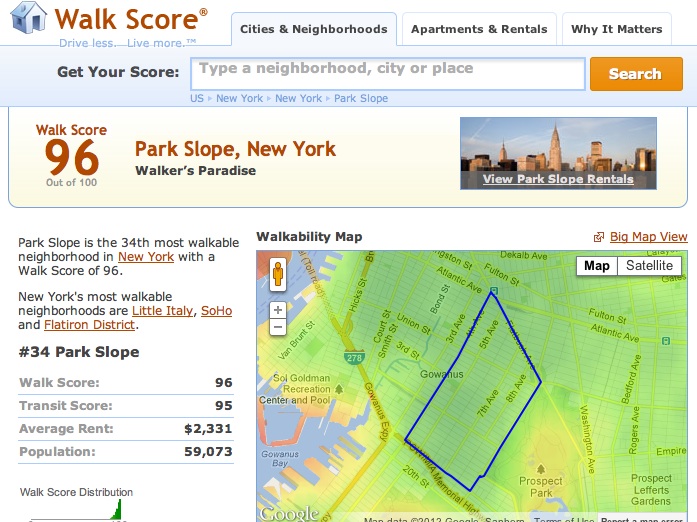
If you want to know the best places to live for simplifying and editing your life, check out walkscore.com. The site evaluates locations around the country for their walkability, using a scale of 0-100.

What’s unique about the site is that it breaks down scores by neighborhood, which often have very different profiles than their cities. The site lists average rents and other important demographic info to get the full picture of a place. This detailed information allows visitors to make highly informed decisions when comparing different locations. For example, I live in “walker’s paradise” of Park Slope, Brooklyn, which has a score of 96; but the average rent in my neighborhood is a discomfiting $2300. I can compare that to Minneapolis, whose overall walking score is a paltry 69, but whose Downtown West area is a competitive 91 with average rents of $1500. Hmmm…

Walkscore is mostly a real estate search engine, where you can look for properties based on your desired commute time. The site shows a Google-map highlighting all of the amenities in an area, including LifeEdited staples like car-sharing garages (info valuable for anyone). There are several other filters which allow you to find your ideal spot; for example, you could say you want to be within 10 mins of a swimming pool. The site finds the pool and all of the properties within walking distance of it.

Here are few other compelling benefits the site lists for choosing a walkable area:

  • Health: The average resident of a walkable neighborhood weighs 6-10 pounds less than someone who lives in a sprawling neighborhood.
  • Cities with good public transit and access to amenities promote happiness [citation].
  • Environment: 82% of CO2 emissions are from burning fossil fuels. Your feet are zero-pollution transportation machines.
  • Finances: Cars are the second largest household expense in the U.S. One point of Walk Score is worth up to $3,000 of value for your property.
  • Communities: Studies show that for every 10 minutes a person spends in a daily car commute, time spent in community activities falls by 10%

Have you used Walkscore.com? If so, let us know what you think or if there are other resources we should know about.

Thanks for the tip @noncellulose

Fat Pad!!! How Much Does it Weigh?

The American citizen is not the only victim of an obesity epidemic. Since 1950, the American home has more than doubled in size, even though the number of people living in them has shrunk! And we’re packing these houses to the rafters, a fact made clear a $22B personal storage industry that stores all we can’t fit at home.

In 1927, visionary Buckminster Fuller asked the question, “How much does your house weigh?” He was defending his prefab Dymaxion House against his critics–probably the same folks who would one day bring us the McMansion. His house weighed an amazing 3.75 lbs/sq ft, which made the 1600 sq ft home only 3 tons; compare that to the approximately 60 lbs/sq ft for most homes. At ~2K sq ft, the average American home weighs around 60 tons–20 times heavier than the Dymaxion!

Even though it incorporated airplane manufacturing techniques, Bucky’s super-efficient, super-light home never took flight. But we might think about Bucky’s question again. What if we put our existence–homes, possessions, vehicles–on a scale? Would we be bathing beauties or porkers?

Do you want a better life, more money and a cleaner environment? If so, imagine your life in terms of its weight. In general, compact, lightweight homes use less energy to maintain and heat; lighter cars use less fuel; fewer possessions weigh less, cost less and use up less physical and mental space.

Space and Energy Saving Kitchen Shelves

Dish Drying Closet Design

Design is a plan for arranging elements in such a way as best to accomplish a particular purpose. –Charles Eames

This cabinet with drying-rack shelves eliminates that awkward, space-hogging standalone rack that never quite fits in the sink or the counter. Clean dishes go directly from sink to storage versus sink to drying-rack to storage, reducing labor and arguments about whose turn it is to put away the dishes. It also proves that smart design is not rocket science. It’s a willingness to examine the way things are done and see if they can be done better (via Dornob).