WeLive Goes Live, Sorta

A while back we reported about WeLive, the residential arm of the coworking giant WeWork. That post gave some of the spec’s for their Crystal City project, which converted a 12 story office building outside of DC into massive complex filled with micro apartments, communal recreational and coworking spaces. Well, unbeknownst to many, WeWork was developing another project at 110 Wall Street in Manhattan’s financial district (also the site of an existing WeWork coworking space). The project will eventually house 600 folks on 20 floors. They recently announced a beta launch at the building, which will house 80 WeWork members in 45 units.

Similar to Ollie in New York, The Collective in the UK, CommonSpace in Syracuse and other such developments, WeLive (not the official name for the record) seeks to create a whole universe for its residents. The pictures released by WeWork show handsome apartments designed by ARExA Architecture, whose principal and Creative Director Darrick Borowski designed one of our favorite micro-apartments. The interior incorporates Resource Furniture space saving beds. There will be studios and one and two bedroom units. The pictured unit is a two bed studio separated by a curtain (a setup that will probably not appeal to everyone). 
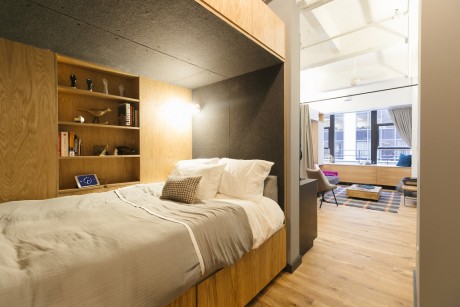
Welive-second-bedroom

The private units will be supplemented by common areas on every floor. There will be social directors, who, according to Fast Company, “Will help plan Sunday-night suppers, game nights, karaoke, and fitness classes.” Additional services like wifi, cable and cleaning are also included. You could, theoretically, never have to leave the building if you so chose.
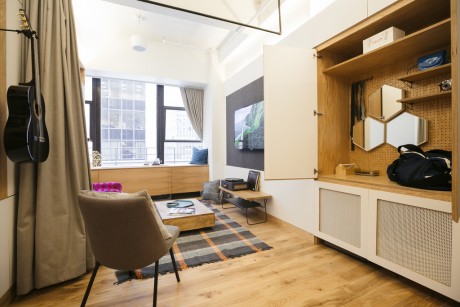
welive-dresser

The whole concept raises a somewhat thorny question: would having your coworking space share a building with your apartment be a good thing? Or might it create a somewhat insular existence, where work and and personal lives have no division, where you run into the same (somewhat homogenous) crowd day in, day out? These are somewhat academic questions–literally. What WeWork is doing is creating something akin to an academic campus, albeit with a professional twist, a model that seems to work just fine. Which is good, as WeWork sees their residential endeavors making up 21% of their revenue by 2018. 

Via Fast Company
Spanish Architects Reimagine the Not-So-Empty Nest

Back in the day, at least in many industrialized nations, there was an expectation that children graduate from school, leave home to go to school or get a job. After that, maybe they’d live and work in the city for a while before finding a nice guy/gal to settle down with and have their 2.7 kids. Rinse, repeat. In the last decade or two, these expectations have been pretty much upended. Ever-weakening job markets coupled with high housing costs around the globe have led many Gen-Y’s and Millennials to never leave their folk’s home or return there at regular intervals due to limited economic resources and opportunity (the latter often referred to as the “boomerang generation”). Spain, like many countries, has nearly half of its young adults (18-29 year olds) living with their folks. Putting aside the sociological implications of this situation, there is a definite design challenge here: many of these people are occupying childhood rooms designed for childhood or adolescent needs. Spain’s PKMN [pacman] Architecture (the firm behind the All I Own House) in collaboration with the Tricontinental Master Degree program thought they’d to try and tackle this latter challenge with HOME BACK HOME. They are reinventing the “kid’s” room in a way that reflects the specific needs of their occupants’ advanced station in life as well as the general change in household demographics.

The old model viewed leaving the proverbial nest as an emancipatory act. But that emancipation is currently difficult or impossible for many young people. HOME BACK HOME turns the current model on its head. It is a study in how to design spaces for what they dub “de-emancipation”–a rite of (re)passage of children moving back home. Rather than being a burden, PKMN wanted to present this passage as an opportunity to create new supportive, intergenerational housing.

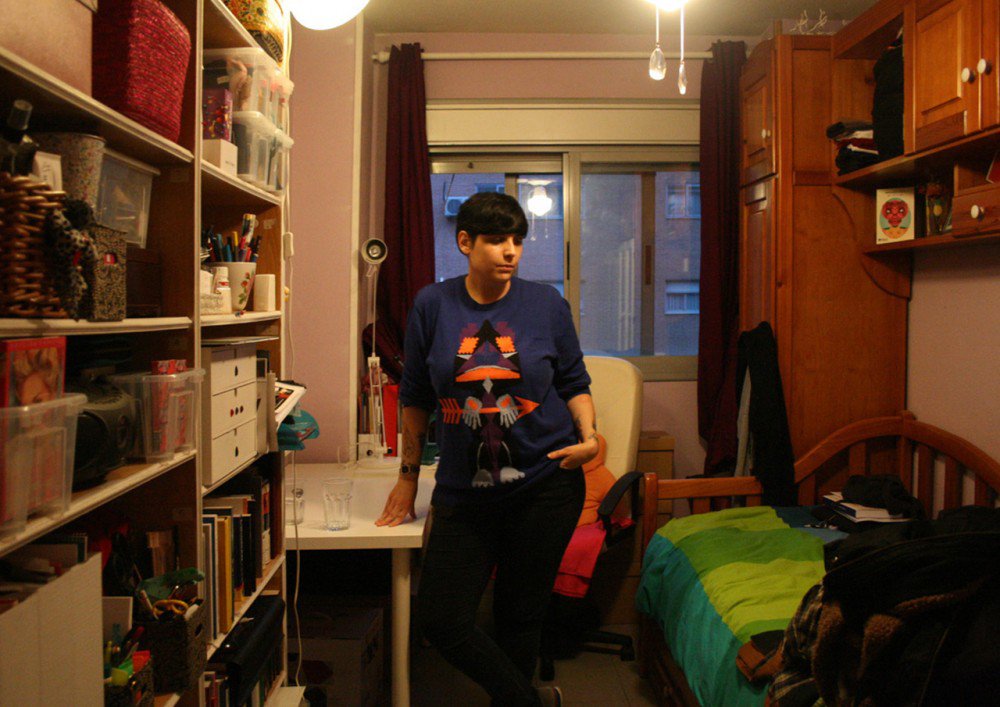
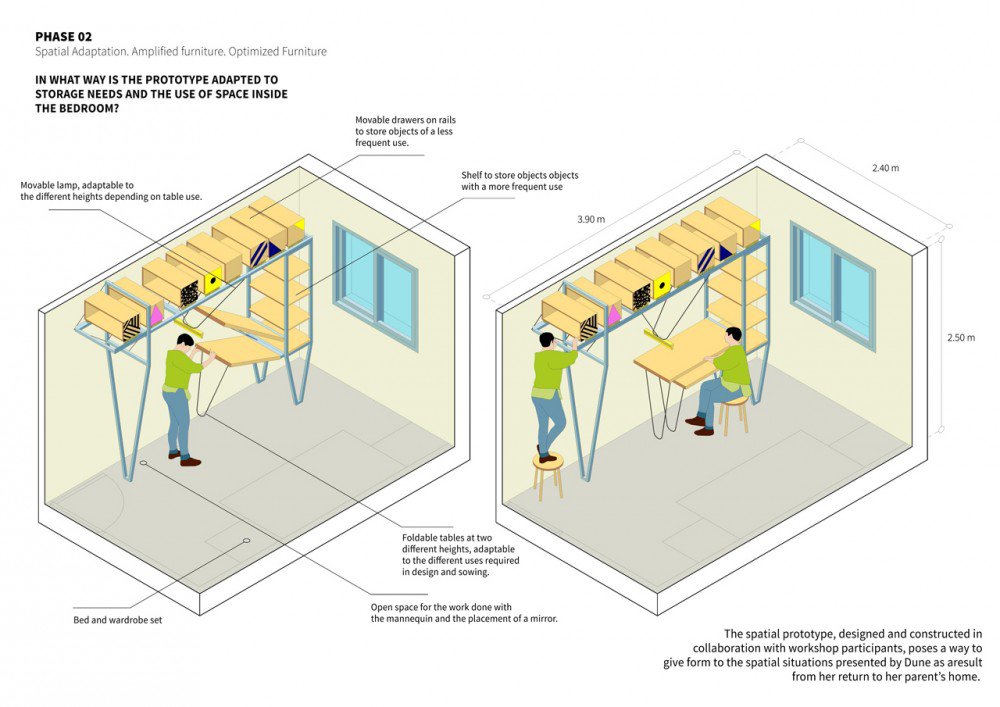
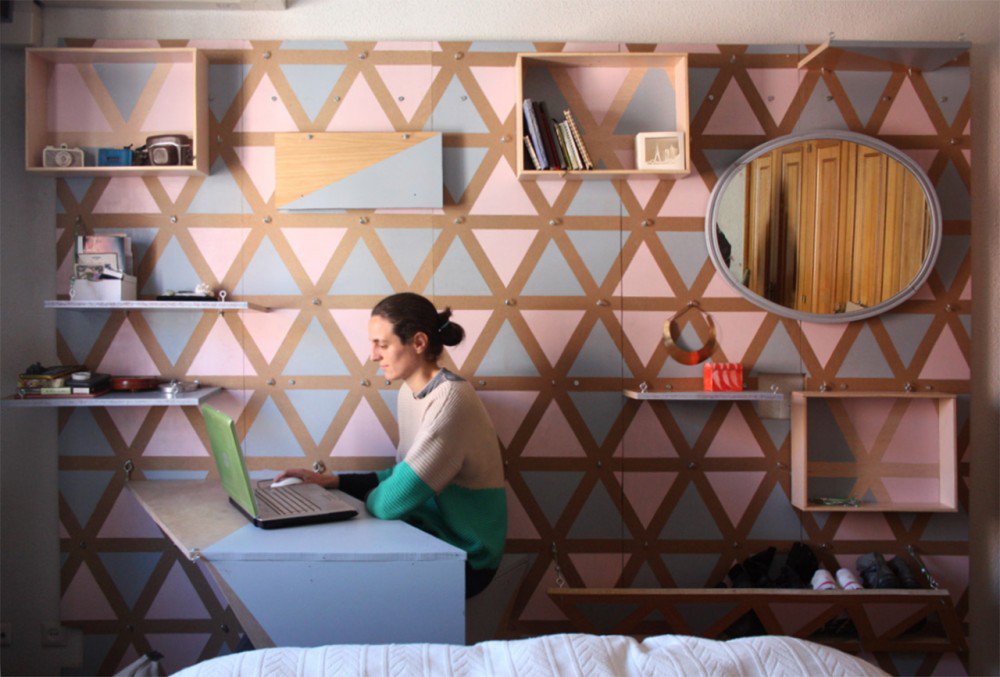
In creating this new model, PKMN used two returning-home women–Dune and Edal, a fashion designer and artist respectively–to demonstrate their concept. They gave both of the women’s childhood rooms programmatic makeovers to better suit the women’s current needs, be those professional, practical (e.g. storage) or aesthetic. Modular, flexible, low-cost furniture components were added to both rooms to suit each woman’s needs.

Beyond the designs themselves, what’s most interesting about the project is the idea of transforming a situation that is often considered unfortunate into an opportunity and even something that could be a positive addition to the architectural cannon.

The project also begs the question: what if architects and designers started making spaces that reflect current demographic realities? Might there be more spaces for singles, for adult children who cannot afford to move out of their parent’s home, for divorced parents with partial custody rights, for how people live today?

See more on ArchDaily and PKMN’s site (mostly Spanish).

What Would You Do If Money Weren’t An Issue?

The above question is one few of us feel the space to contemplate. Mortgage and rent, car payments, groceries, electric, gas, cell phone, internet, etc–the collective pool that we sum up as “bills” tends to keep us in a loop of work, pay, work, pay…pay funeral bill. Most people’s biggest bill is housing. One rule of thumb says that housing is about 30% of our income–a number that is higher for many. The number two expense is transportation, which is usually inextricable with housing. So it could be argued that if 40-60% of our living expenses were somehow magically paid for, we might be less inclined to take jobs that “pay the bills.” We might start doing things we love or that help people or that bring us satisfaction or all of the above. This housing-is-no-object equation is one of the main ideas behind unMonastery.

UnMonastery, as the name suggests, harkens back to monastic traditions–the monastery acting as a refuge to support a monk’s life of contemplation and service. UnMonastery has a technological and secular twist however. According to their site, they want to “recreate the best social functions of the traditional monastery: by giving the participants a collective purpose, a chance to develop deep relationships with one another and a reduced need to generate personal income so time can be dedicated entirely to serving the local community and contributing to global efforts in creating new digital tools.” UnMonastery finds as much inspiration from hackerspaces and coworking spaces as they do monasteries. The main point is that residents can eliminate or reduce living expenses as to live a life devoted to serving their community and the world, mostly, though not exclusively through digital tools.

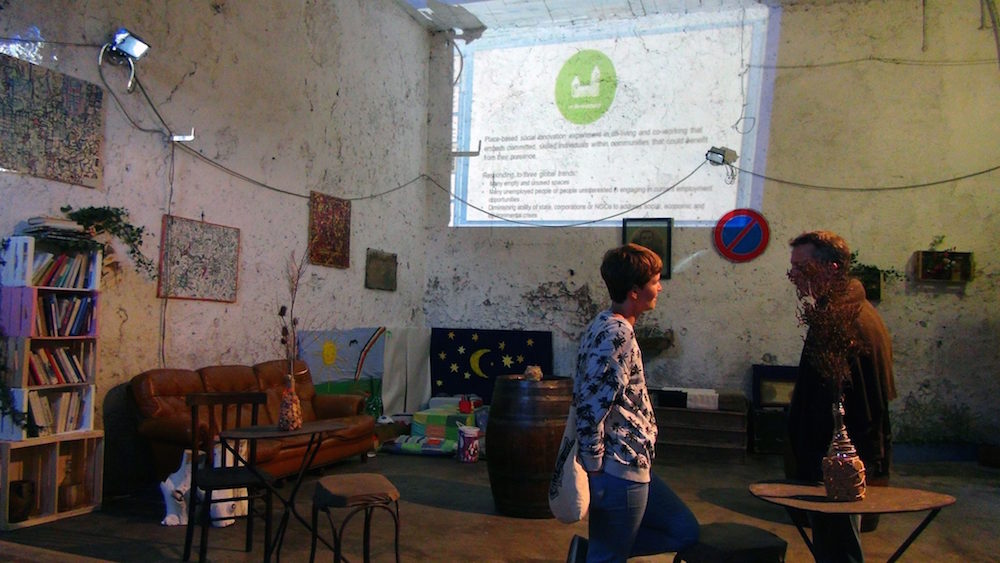
Though the unMonastery idea is not location dependent per se, they would like to build a network of communities around the world that “work together…autonomously…[and] prototype new solutions to common problems.” An initial unMonastery house was established early last year in the ancient southern Italian town of Matera (above pic is from their space); the unMonasterians set about addressing a number of local and global challenges. For reasons not entirely clear, that location was shut down. Currently, a new unMonastery is forming in Athens, a city whose citizens unMonastery claims “have a strong affinity to hacking of all sorts; be it with internet connectivity, food sharing, reactivating abandoned spaces, or just simply taking the metro.”

The modern world does not necessarily reward lives governed by purpose–unless that purpose is making money. As unMonastery posts on their website:

When it comes to work it is increasingly difficult to reconcile making money with making sense. People do work to make a living. Others do work to make meaning. But the two works are not the same work.

While unMonastery is a little too new (and unstable) to be recognized as a sign of things to come, it does point to one way things could be: a world where people are not working to live, a world where service to the greater good is valued above all else.


Co-Living for the 21st Century and Beyond

As we’ve seen recently with Stage 3 in NYC, The Collective in London and the expansion of the micro-apartment movement in general, there’s a growing market for minimal, all-inclusive, affordable, community-centric housing. For the most part, these developments are aimed squarely at the lighter-living, typically-single, experience-hungry urban Millennial (sorry for all the dashes). Today, we’re checking out another player in this genre called Campus, a movement/real estate startup with 30 houses, buildings (or portions of buildings) in the Bay Area and New York City.

Campus “communities,” as they like to call their houses, bear some resemblance to living in a dorm on a college campus. They have ample communal spaces and compact private ones. Most communities feature talks, shared meals and other programming to spur relationship building and philosophical waxing.

But the similarities stop there. Campus’ raison d’etre is both more mature and evolved than anything you’re likely to find at a University of Arizona dorm. For example, all houses are connected by a set of shared values that include being:

  • Open to having new experiences and forming new relationships.
  • Respectful of other’s differences, needs, and privacy.
  • Supportive of each other’s well-being and growth.
  • Respectful to the neighbors and existing culture of the area.
  • Valuing personal freedom.
  • Recognizing that everyone has the need for private space and alone time

In other words, the antithesis of most college campus living we know about (save Evergreen State or someplace like that).

In terms of nuts-and-bolts, each room is private and lockable. Rents are month-to-month and each member can opt out at his or her discretion–i.e. you are not tied to the other community members. Rent includes common space furniture, kitchen supplies, common space cleanup and several other amenities (utilities are additional so far as we can tell). Prices depend on community location, room size and a few other variables. For example, a ~70 sq ft room in Park Slope Brooklyn cost about $1200 whereas a space twice that size in the SoMa district of SF costs the same amount.

Campus hardly sees itself as mere purveyor of fun, convenient housing for Millennials. Their mission is to “build better living environments, and…build better housing and cities that are more attuned to people’s needs,” and they have an ambitious, two-phase master plan. Phase one consummates in the formation of 5000 communities in ten cities (they announced locations in LA, Boston and DC will be popping up in the near future). Phase two goes into utopia-production, with an eventual goal of making 100 cities, each with tens-of-thousands of people (see full vision here).

In many ways, Campus is a modern, formalized (but hardly stodgy) and ambitious take of co-living. Like most things, the latest and greatest is part of a continuum of thought. But originality isn’t a condition for doing something useful and cool.