It’s Your House on a Bike

We feature a number of homes that sit on internal combustion vehicles. Despite what you might think, these homes can be extremely green. First off, standard homes have fuel needs too, from heating hot water heaters to keeping stoves alight to keeping furnaces firing. Stationary homes consume gas, just not for locomotion. More importantly, there’s a dire need for efficiency when you’re moving your home around; everything that isn’t totally needed, whether it’s water for showering or an extra pair of pants, is sacrificed due to very limited space and keeping weight down so your vehicle can keep moving.

But if you’re like me (and I shouldn’t suspect, or hope, that you are) there’s the dream of the nomadic home that doesn’t rely on fossil fuels. In the past, we’ve looked at the Tricycle House as well as the Taku Tanku house–both were bicycle-powered housing options (the former somewhat plausible in its execution, the other not). We can now add a couple more HPNMs (human powered nomadic home…you heard it here first) to the mix.

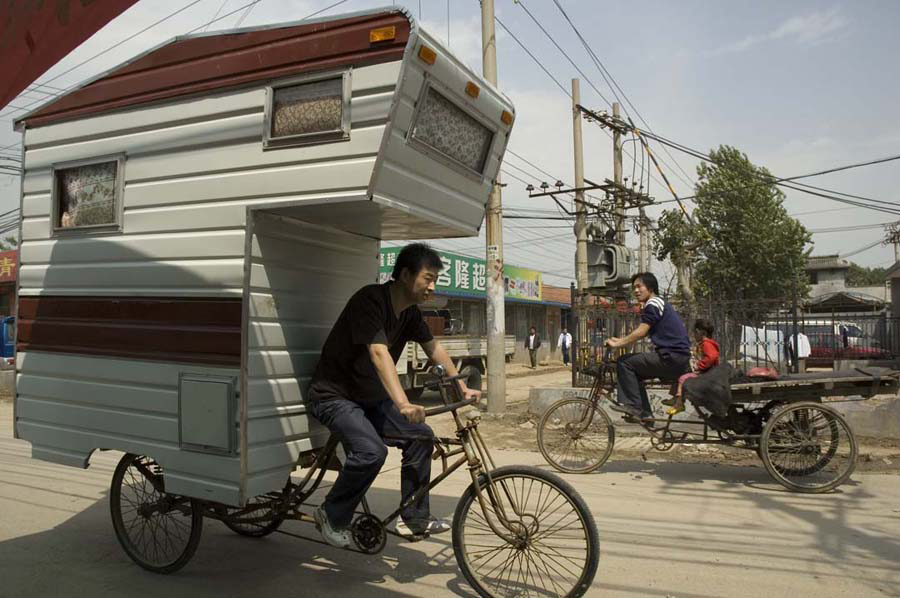
The first is the Camper Bike by artist Kevin Cyr, which resembles a 70s over-cab pickup truck camper. While there are no detailed images of the inside, a sketch shows the over cab portion containing a bed (for a medium sized cat, it appears), a dining table, a TV, some storage and a picture of Mao.
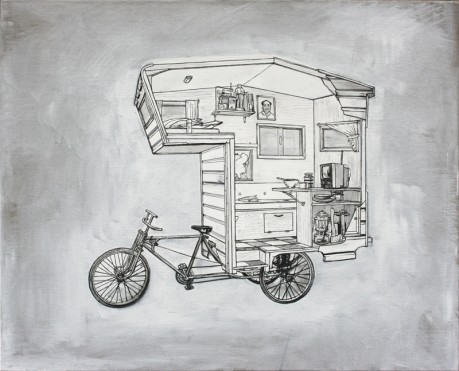
camper-bike-interior

In an interview on Icebike.org, Cyr explains the project:

The idea first came to me while I working in Beijing. I was joking with a friend that the only thing not on the back of bikes in China are houses. I had been seeing people, mostly working class men hauling goods on three wheeled bikes—rickshaws with bamboo flat beds. They were carrying huge loads of foam and plastic for recycling, furniture, and building materials. There were also a lot of food venders at open markets cooking meals on the backs of these bikes, it was very interesting. They seemed to use them in every way imaginable much in the way Americans use pick-up trucks.

He built the Camper Bike, which he describes as a sculpture, over the course of three trips over three years.

Cyr made few concessions to practicality. He used an old, rickety government issue bike as the camper’s host vehicle. The camper is mounted on a wood frame, which is significantly heavier than an aluminum or composite one–Cyr suspects the whole thing weighs a very portly 200 kgs (440 lbs). Cyr said when he climbs up to the bed area, the camper sways and feels as though it’ll fall over. He says if he were to make it again, that’d he rectify these design flaws.
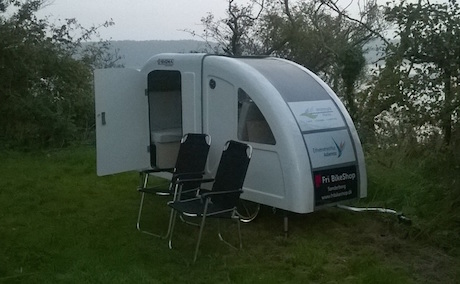
WPC

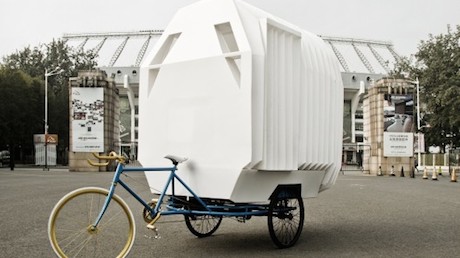
Rectification of those issues is what Dane Mads Johansen has done with his Wide Path Camper (Johansen said he was inspired by Cyr’s project). Unlike the Camper Bike, the WPC is a trailer, so you can choose which bike you want to affix it to. It also uses lightweight materials keeping weight down to a very reasonable 45 kgs (100 lbs). The camper, which has two sections that nest on top of each other when being towed, features a seating area that converts to a bed and offers around 11 cubic feet of storage (a little less than the trunk of a Honda Civic).
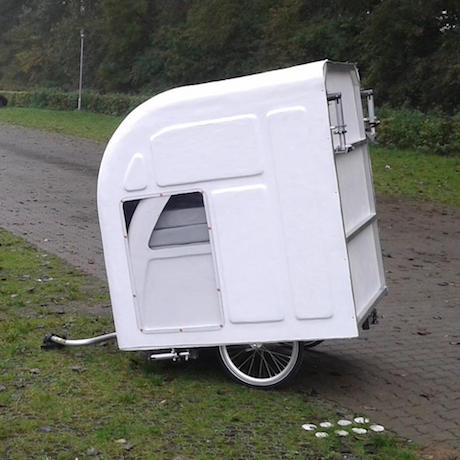
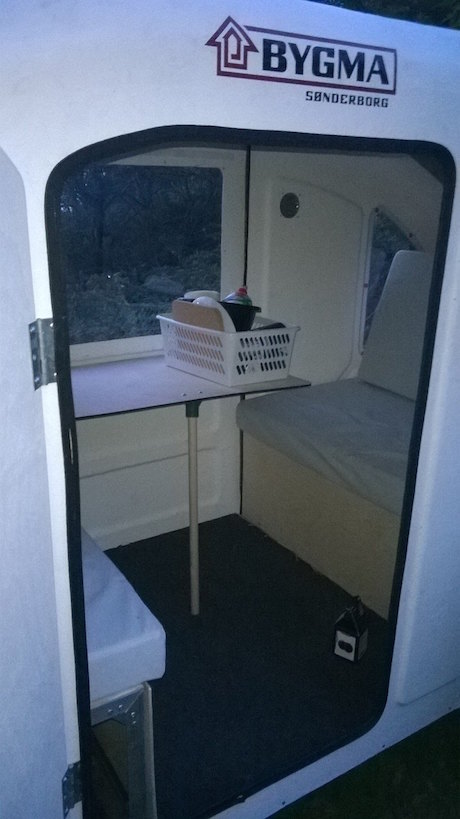
WPC-folded WPC-interior

Unlike every other bike-camper we’ve seen, the WPC is not vaporware. Johansen is taking pre-orders and expects to start delivering next month. The basic camper sells for €2000 ($2200 USD) and there are a number of available upgrades like a €600 solar package.

Some of you might be thinking, “Why not just load panniers or a trailer with camping gear, achieve the same result as the camper and save money and weight.” This is a nice idea, but belies the hard truths of bike touring, which often includes inclement weather and a deep desire for comfort at the end of a long day of biking (I’ve bike toured the world extensively including riding 1.5 times across US, so I feel I can speak on the matter with some authority).

At 100 lbs without gear, the WPC is still pretty heavy (my cross-country rig weighed a little over 50 lbs with full camping gear), so I think its best application is limited geography tours or a quasi-living situations–i.e. setting up at a campground or in someone’s yard where there’s access to a toilet and running water. However you use it, it’s a very cool piece of gear.

Many thanks to Mads for the tips!

Turn Your Bike Into a Lean, Mean, Small-Home-Storage-Friendly Machine

The Schindelhauer ThinBike–a specially designed bike that goes from conventional width into a super-slim, small-space-storage-friendly ride–is pretty awesome. But after we reviewed the bike, many of you asked, “how do I do that to my bike?” That’s what the FlipCrown is about.

flipcrown-use

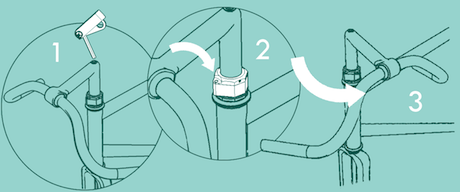
FlipCrown works by replacing the top locking nut of your headset. To turn the bars you do a half turn on your bike’s stem bolt with an included allen wrench; you then press a button on the FlipCrown and then turn the bars 90 degrees. Press the button again and twist the stem back to its initial position with handlebars centered and stem at proper height. Patrick Jacquet of Deltareference, the Ghent, Belgium-based design and development firm behind the product, said the whole operation takes about 10 seconds.

It’s not a revolutionary (or necessarily original) product, but it’s one that solves a vexing storage issue. One of the more useful places to use it is in crowded outdoor bike racks, where wedging your bike in is often impeded by handlebar width. Jacquet also notes that turning and locking the handlebars can be a theft deterrent.

The biggest drawback we see is that it’s only available for quill stems (both 1” and 1 ⅛”), which have fallen out of fashion in the last 20 years or so. Jacquet told us they have plans to make a threadless version that they hope to release later this year.

Deltareference is launching the product through the crowdfunding site Indiegogo. A $30 pledge will get you a FlipCrown. $60 will get you the FlipCrown plus some quick release pedals to make your bike super slim (we might opt for the MKS fold up pedals used on the Schindelhauer). And $450 will buy you their own SlimBike–a retro-styled fixie that should not be confused with the ThinBike. They also have a proprietary wallmount bike storage rack and deluxe, three-speed SlimBike by manufacturer Achielle in there as well.

Overdue Book Review of “Just Ride: A Radically Practical Guide to Riding Your Bike

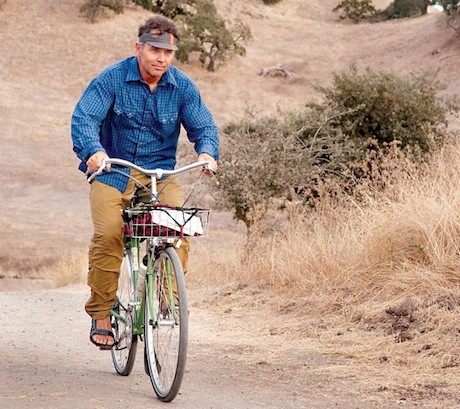
Yesterday’s post on the Hamper Test got me thinking about bike clothes. You see, back in the day, I worked at bike shops–five to be precise. The last one specialized in high-end road bikes and their ostensibly requisite gear. While I sold some stuff to racers, for whom shaving a half-pound off their ride might give a competitive advantage, the bulk of my customers were middle-aged men whose main sorties were medium-paced group rides and solo trips. You’d think, given how these guys used their bikes and their physiques (read: not lithe), they’d want fairly bomber, functional bikes. But no, these guys wanted super-skinny tires and obsessed about their gear as if they were Jan Ullrich making a podium push in Paris.

My last shop job was in the early aughts (hence the Ullrich allusion), when top-end bikes were titanium and the most cogs you could fit onto your freehub was nine. A top of the line bike–like the most expensive you could possibly make–would run around $8K. In following decade (let’s call it the Lance decade), things got entirely out of hand. Companies kept shoving cogs onto freehubs. Power-meters and electronic shifting became de rigueur. Everything became carbon fiber. It became totally normal for bikes to cost in excess of $10K–mid-level bikes with Ultregra! And who’s buying all this cool kit? It’s those same middle-aged guys (nobody else can afford it). It’s out of hand. The trusty bike, so purposeful and simple in spirit, has become a techno-overkill parody of itself.

Enter Grant Petersen. Petersen founded and runs Rivendell Bicycle Works, a frame-builder and retailer of no-nonsense bike gear–stuff designed, not for screaming up L’alpe d’huez, but for normal people who like to ride their bikes. And lucky for us, he wrote a book a few years ago entitled “Just Ride: A Radically Practical Guide to Riding Your Bike.”

grand-petersen

Petersen starts the compact, illustrated book by stating his mission: “To point out what I see as bike racing’s bad influence on bicycles, equipment and attitudes, and then undo it.” It speaks directly to the multitudes who have been led to believe they can’t mount a bike without a chamois on their asses.

just-ride-41

One by one, the Petersen debunks widely held assumptions about best practices for riding a bike. These include:

  • How the normal bike rider/enthusiast (the “Unracer” as he calls us) doesn’t need more than eight speeds, clipless pedals, cycling shoes, lycra shorts and many other “basics.”
  • Why most of us should be riding in an upright position, with our handlebars higher than saddle (see above).
  • The myth that cycling will get you lean strong and lean.
  • How blinking lights reduce safety.
  • How kickstands are cool.

For some people, these aren’t revolutionary ideas. Bikes are for riding. Who cares about weight and going fast? But for others indoctrinated in racer culture, for whom lighter is always better, these are, as the book’s name implies, radical propositions. They were for me. Suddenly, biking became a lot easier to do and prepare for. I haven’t worn my bike shoes since reading the book. When I put together a new bike, I built up a 30+ lb all-rounder with an eight-speed internal geared hub, bomb-proof wheels and full fenders (still no kickstand).

Petersen is clearly a very opinionated guy and not all of his opinions are to be treated as gospel, but one assertion is hard to contest: if you’re not a racer, why use the same bikes and gear they do? Racers, particularly pros, have sponsors giving them gear, they have lots of money on the line for them to succeed, they have masseuses and fitness levels a couple orders of magnitude greater than the casual rider (chemically enhanced or not). The vast majority of us are best served by solid, repairable and comfortable bikes (not cheap ones, mind you). For this latter category of rider, Petersen transforms biking into something it might not have been since we were small children: fun and simple.

Hipster-ific, Human-Powered Automobile Alternative

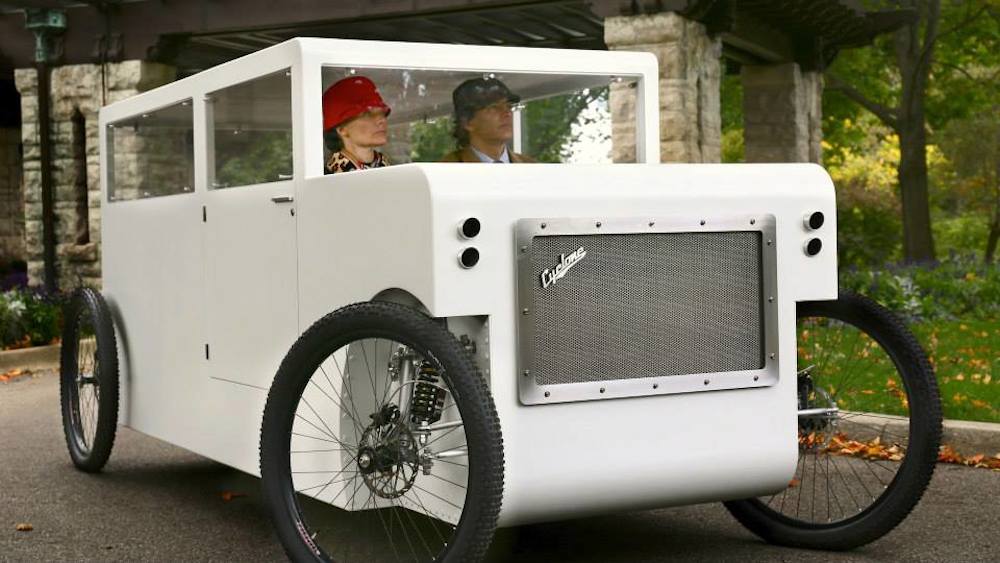
We are forever on the lookout for great ‘edited’ transportation options. Bikes, walking and public transport are the ostensible ideal modes of transit, but for many they lack the protection, carrying capacity and range to make them feasible daily transport. Conversely, car-shares, trikes and other minimal ways of getting around using internal-combustion engines and 1K lb + masses of metal are overkill for many. A company called The Future People is striking a nice middle ground. Their Future Cycles are lightweight, human powered vehicles that, for some, could be real replacements for the personal car.

TFP is a design collective, principally made up of husband and wife Cameron and Rachael Van Dyke. According to their website, they are out to “test alternative value systems related to housing, transportation, and community.” They unveiled two Future Cycle models at the recent Detroit Auto Show (TFP’s hometown), wanting to “propose an alternative set of values in relation to transportation,” according to a press release.

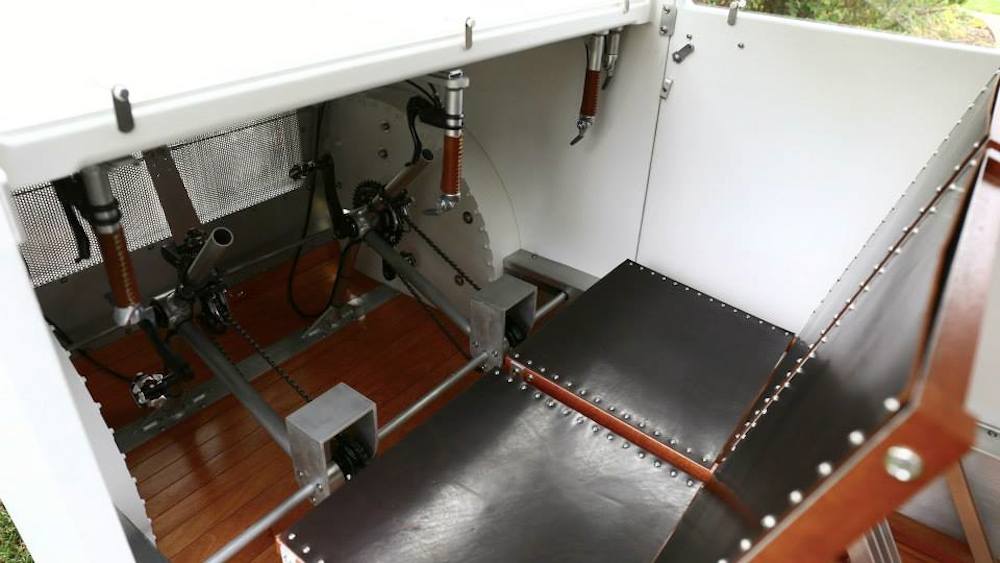
One model is named the Cyclone. It’s powered by two peddlers up front and seats four. According to TFP, it takes design cues from the Model T and the iPod. With its mahogany floors and leather seats, it is painfully stylish, however I suspect it’s boxy shape is like doing a bellyflop with the wind (not cool when efficiency is the name of the game) and I might trade those amazing-looking mahogany floors for something lighter (though, to be fair, it is a concept).

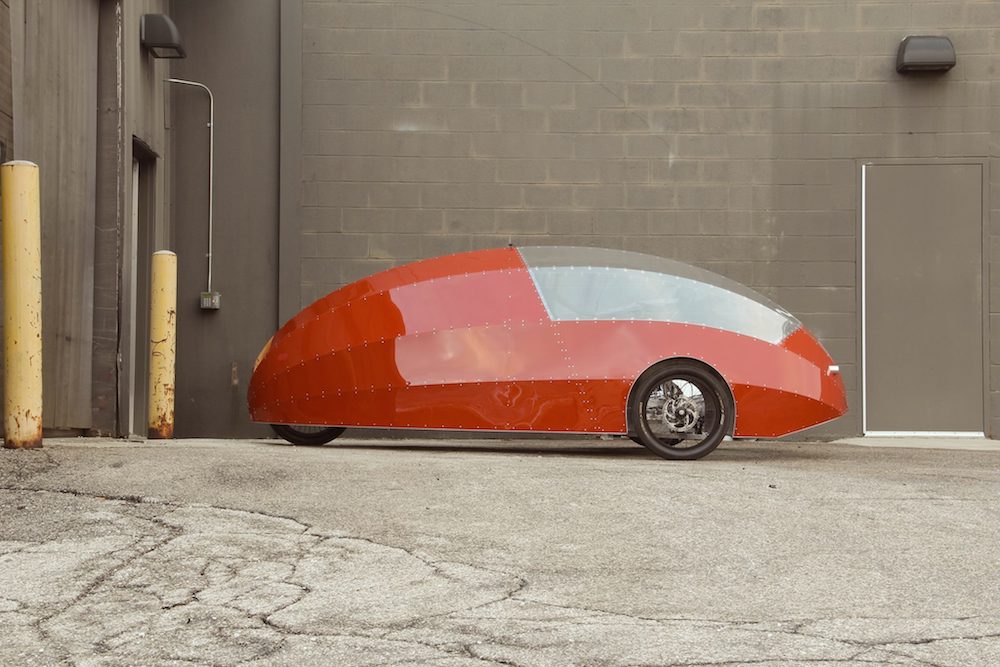
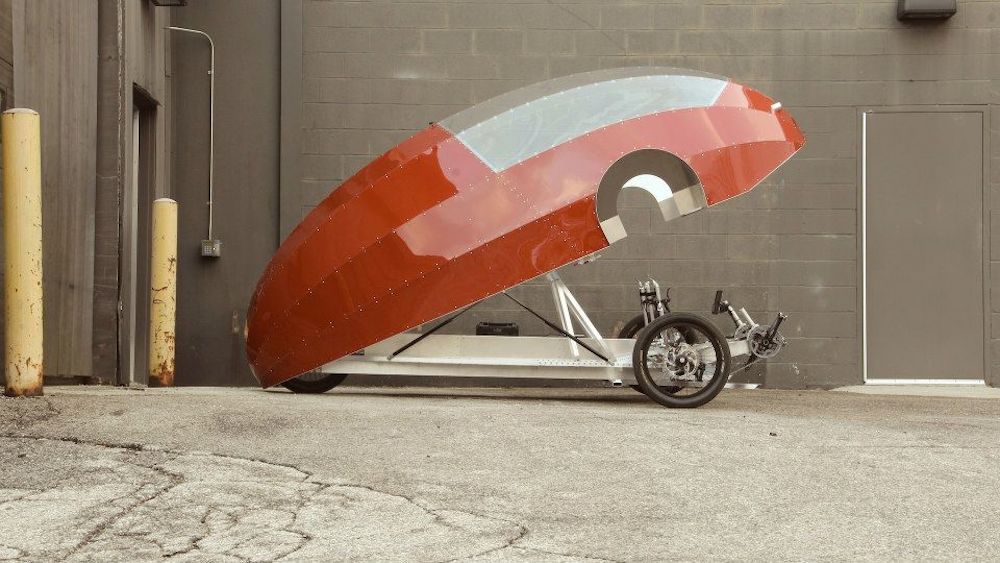
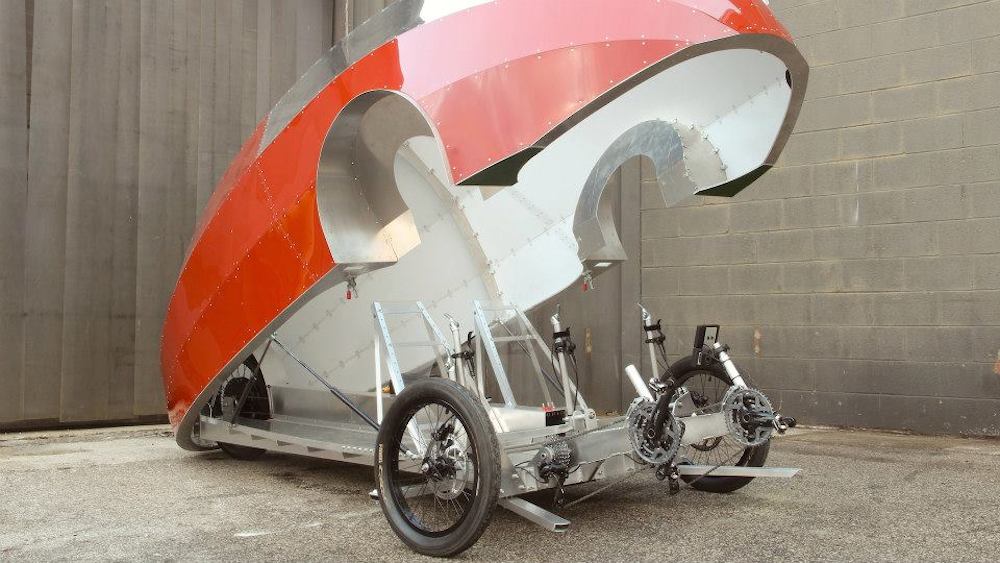
Far more interesting is the Zeppelin, a slug-shaped two-seater with pedals and a 750w electric rear motor with a 20 mile range. It only weighs 270 lbs, has a big boot for lugging stuff and can cruise at 25 mph on flat ground. The shape, unlike it’s boxy brother, looks like it would slice through the wind. It meets the federal bicycle classification and therefore requires no license, registration or insurance.

“The goal with the Zeppelin was to find an ideal point at which a bicycle and car could coexist within the same object,” according to Cameron Van Dyke, “creating a truly hybrid design.”

If you want one of these vehicles, you are probably going to have to wait. Unfortunately, unlike the Organic Transport ELF that we looked at last year, the The Future Cycles don’t appear to be for sale. We hope that changes.

Via PSFK

Bicycle-Powered Nomadic Housing

Maybe it’s the cooling temperatures, or the fact this author has been hanging out at home too much as of late, but there’s been a ton of talk about nomadic living on this site as of late. Last week, we looked at Foster Huntington, a full-time-camper-pickup-living-nomad and bon vivant. While I definitely dig his lightweight setup, one question has always troubled me about his and all petrol-fueled mobile living arrangements: what do you do in the event of a complete societal meltdown? Really, when SHTF, it’s going to be tough to move your ICE-powered home to more favorable environs if gas costs $20/gallon or is simply unavailable. (C’mon, I can’t be the only one thinking these things).

Resilient nomad housing would have to have minimal grid-dependence, which is why we dig the Taku Tanku concept by Japanese design firm Stereotank so much. It’s a trailer that’s minimal enough to be towed by foot or bicycle. If we were ever to face a Mad Max dystopian reality, we’d want this as our home way more than some 454 V8-powered behemoth.

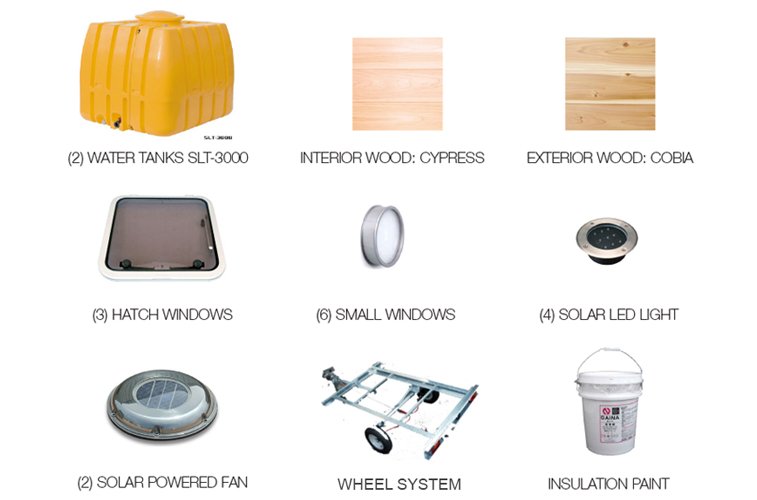
The Taku Tanku is designed to sleep 2-3 people and carry a bit of luggage. It can be made of lightweight, off-the-shelf materials; its main structure being two 3K liter water tanks. There’s really not that much more to it.

tricycle_house

This is not the first time we’ve seen human-powered nomadic housing. The Tricycle House, was, as the name implies, a house affixed to a tricycle. Unlike Taku Tanku, a Tricycle House was built. Each house has its merits. We suspect the Tricycle House’s flexible folding, accordion structure, while lightweight, might not be as durable at Taku Tanku’s. The Tricycle House is smart because it’s designed to be used in tandem with a trike-powered garden, making sure you can tow your food source in case things get nasty. If S really did HTF, it’d be good to work through these important considerations ahead of time…just saying.

Via Gizmag


Haul Big Stuff on Your Bike

One of the bigger, more valid, reasons why a bicycle cannot replace the car is its inability to handle large loads. Sure, you can load up your bike with panniers, or you can get a special, long wheelbase cargo bike, but the former makes your bike handle weird and puts heavy stress on wheels, and the latter requires a special (expensive) bike.  For handling bigger jobs without getting a new bike, you really need a trailer. Burley, known for their excellent kid carriers, is probably the first name in trailers. They offer a couple cargo trailers: one flatbed model based on their kid carrier, and another (the Travoy) that is more upright and suited for tight, urban riding.

But if you’re looking for something a bit more substantial, something to really compete with a car or truck’s carrying capacity, you should check out Bikes At Work. The company makes platform trailers that will give your gas-guzzling rig a run for its money.

64ad-side-view 96a-bike-trailer-for-midsize-loads

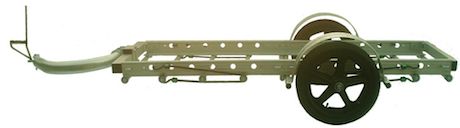
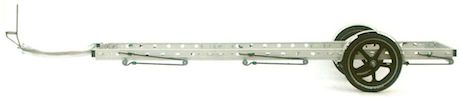
The length for cargo areas for a Bikes At Work trailer start at 32″ and go to 96.” Cargo widths range from 19.25″ to 27.25″. You can, of course, go longer, wider and higher with your load as the bed is very flexible. Cargo capacity for their smallest unit is an amazing 300 lbs–enough to carry lumber, major appliances and much more. Their larger, heavier duty unit is rated to an even more amazing 600 lbs!

Cargo weight is limited to available horsepower, but if you have a multi-speed bike and don’t live on Lombard St, we imagine that in a low gear the loads are pretty doable for someone of average fitness.

Prices range from $600 to $1025 depending on the size and strength of trailer. We won’t indulge, as we are wont to do, why this is not that much money. Suffice to say, these trailers, without purchasing a new bike, would allow you to haul 90% of the things your car does–all while getting a great workout and cutting your carbon footprint. Okay, it might not be the best thing for carrying stuff cross country or really anything over 15 miles, but for those smaller trips carrying big stuff, Bikes at Work trailers make a lot of sense.

Via Mr Money Mustache

These Machines Might Solve Energy Crisis and Obesity Epidemic

As we’ve looked at here in the past, one of the chief ways of staying trim and live longer is to avoid sedentary behavior and remain active. And as we should all know by now, we are burning through our natural resources at an alarming/scary rate. What if there were products that kept us active while reducing or eliminating our need for dirty energy? Wonder no more, because a couple products are making it possible for us to get our bodies moving while generating the energy needed to do the stuff we need to do.

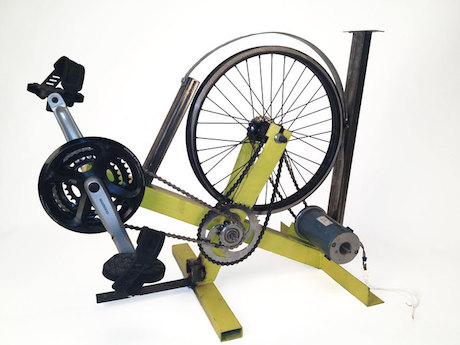
The first of those products is the Big Rig by company called Pedal Power, which addresses the fact that much of our sedentary behavior happens at work while at our desk on computers. The Big Rig is a stationary recumbent bicycle with a work surface attached. The bike’s cranks power a generator, which can used for a number of purposes according to Pedal Power’s website:

An average adult can use it [the Big Rig] to generate 100 watts of electricity [more than enough to charge a laptop], pump 5 gallons of water per minute, grind a variety of grains, as well as operate an air compressor, a hydraulic pump, most any hand-cranked machine, and a variety of small shop tools. It has been found to be particularly suitable for small scale agricultural applications such as cracking grains, churning butter, and pumping water.

Pedal Power also offers the single-purpose Pedal Genny, which has an optional seat, but lacks the desk. They say it can be configured to power most any mechanical device requiring less than one horsepower.

pedal-genny

While these items can certainly be used for sedate desk jockeys, unfortunately electricity is just too cheap right now to affect any significant migration away from the much-love wall socket. The Pedal Power founders see them as particularly well suited for off-grid and developing world situations where electricity is either unavailable or extremely expensive.

The Big Rig is available starting at $2000 and the Pedal Genny starts at $350. Prices increase depending on configurations. Pedal Power launched and successfully funded a Kickstarter campaign last year to fund R and D to make the units cheaper.

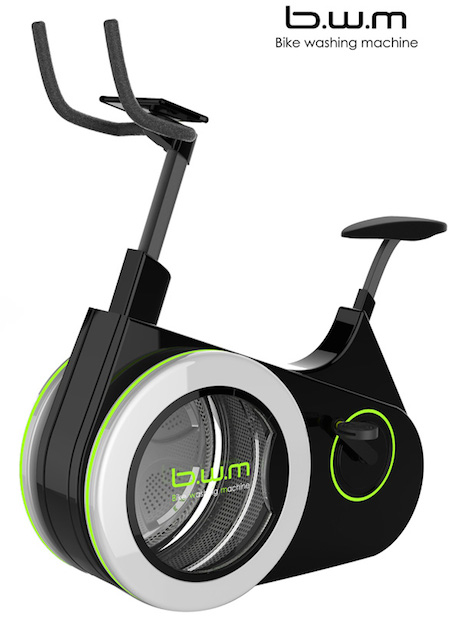
bike_washing_machine

The other product uses much the same concept, but is applied to clothes washing. The BWM (Bike Washing Machine…not to be confused with Bavarian Motor Works) was designed by Li Huan and is an upright bike whose front wheel is replaced by a washing machine drum. The idea is very simple, though we’re not sure the same can be said about spinning your clothes manually.

The BWM looks to be still very much in the concept stages of development. We might suggest to Huan a collaboration with Pedal Power so you wouldn’t need two separate machines.

Designing the Perfect City Bike

What would the perfect city bike look like? It’d be compact to fit into small apartments. It’d be thief proof. It’d have electric assist for longer commutes or when you might be too lazy to pedal after a day’s work or evening drink. It’d be relatively upright and grease free so as not to ruin your freshly pressed Men’s Warehouse suit. Well you can stop waiting for this mythical, two-wheeled wonder. The Gi-Bike has all of those things and more.

gi-bike-function

Here are some of the Gi-Bike’s features:

  • Folds from 6′ 6″ L x 3′ 4″ H into 3′ L x 3.4′ H in three seconds.
  • Wheels that lock up if your smartphone is more than ten feet away from bike; you can also give friends access to the bike via its smartphone app.
  • Electric assist with a lithium-ion battery that can go 40 miles between charges.
  • Available in manual (pedal-powered) version.
  • Gates Carbon belt drive for greaseless operation.
  • Smartphone holster and USB port to charge on the go.
  • Weighs 17 kg (37.4 lb) for the electric version and 12 kg (26.5 lb) for the manual.
  • Integrated rear LED light and LED front wheel lights.
  • 26″ wheels that quell typical folding bike squirreliness.
  • A mudguard and briefcase holders are in the works.

What could make it a better city bike? (Note: we have not seen or ridden a Gi-Bike in person).

  • Fenders. Hard to have serious commuter outside the dessert without em.
  • Why no LED headlight?
  • A little flashy. Thieves might be prevented from stealing by its locking wheels, but they’ll probably sniff around before being deterred.
  • They might consider handlebars that turn like the Schindelhauer ThinBike of pivot down for better storage.
  • The one-available-size, in this 6′ 3″ author’s opinion, will likely not fit all.

Like most interesting products nowadays, the Gi-Bike is launching through Kickstarter. Their campaign starts today. A pledge of $2590 gets you a manual Gi-Bike and a pledge of $2990 gets you the e-bike (only 10 available at that price. Normally $3390). We realize many people can’t wrap their heads around spending more than $75 for a bike, but as we’ve noted here before, making a bike that legitimately replaces a car or other motorized transport might cost some coin. If the Gi-Bike serves your transport needs–and we think it might do so for many–we can think of much worse ways of spending $3K.

The Better Bike Lock

Now that you can get into your house without a key, why not do away with your clunky bike lock and key? A new Kickstarter project called Lock8 wants to replace your awkward and archaic cable or u-lock with their keyless, smartphone-activated bike lock.

Lock8’s compact lock fits in your bike’s rear-dropout and has a coil lock that extends from its base. The lock has several innovative features:

  • Its built in geo-locator tells you where your bike is at all times.
  • If the lock is tampered with, cut, sawed, torched or cooled with freon, sensors in the lock will set off an alarm and a push notification will be sent to your phone.
  • You can send notifications to friends in case you’re not near your bike.
  • You can walk away from the bike unlocked, and push notifications will be sent if your bike is moved.
  • You can connect with Facebook to give your friends an e-key to borrow your bike.

The whole unit will only weigh about a pound. A built-in battery will charge via induction. There is no subscription charge unless you rent your bike to multiple parties (+5). They expect that charge to be around $2/month.

Lock8 is available with a £79 ($126) pledge and they will ship to the US and Europe. With £42K pledged of a £50K goal and 21 days remaining of their campaign, Lock8 will surely get its funding, which makes a lot of sense to us. If you’re spending a lot of dough on your bike, why not give it the best, most advanced, protection you can?

Via Engadget

Living in a Bicyclists Paradise

We don’t hide our ardor for bicycles. They are the most efficient form of transportation known to humans. They don’t take up a lot of room. They are relatively affordable and make us fit and happy. But we admit, they simply aren’t practical in a lot of places. Amsterdam is not one of those places. As this short movie called “Bicycle Anecdotes from Amsterdam” attests, bike culture is simply culture to Amsterdamers.

One thing we learned watching the movie is the city’s history with the car. In the 50s and 60s, regulation and urban planning were supportive of cars. But a subsequent increase in congestion and automotive fatalities–coupled with the 1973 oil embargo–led to the car’s decline and the bicycle’s ascent.

There are many reasons bicycle culture flourishes in Amsterdam. The pancake flat city has vast networks of bike lanes, bike parking and bike-friendly laws. The scenes from the movie make cars look anomalous. Dutch bikes are very utilitarian, lacking the fanfare they do in the States; they are heavy, somewhat anonymous and have an upright position that prohibits high speed. Amsterdamer children begin riding young and by adulthood are very competent riders.

There’s the suggestion in the movie that the Dutch’s adoption and subsequent rejection of the car might influence Americans, who are still pretty tethered to their cars. We think this parallel holds up to a certain extent. Amsterdam is a historic city, whose core was conceived long before cars or even bicycles. For older American cities like New York, Boston and San Francisco, which were planned prior to the advent of the car, a widespread adoption of the bicycle as primary transport seems feasible. But for other cities like Houston and Los Angeles, who came about in the age of the automobile, this adoption might prove more challenging. Like most things, necessity will be the key factor–when gas becomes prohibitively expensive, many people will discover a love of the bicycle as deep as the Dutch.

Via Treehugger