The Perfect Friday Night Date Movie

Prep the popcorn and get ready for some hardcore entertainment. “Consumed,” a recently-released movie by Journeyman Pictures (not affiliated with the Journeyman featured on this blog recently), is sure to be this summer’s blockbuster hit.

Or not.

Unlike most (or any) blockbusters, Consumed is a thought-provoking documentary that tries to unearth the root causes of pathological consumerism. Through narration and interviews with consumer and psychology experts, Consumed drives home the point that consumption and the marketing that fuels it is the byproduct of misplaced evolutionary imperatives. The psychological emphasis is what really separates Consumed from other movies on the topic like The Story of Stuff, which focus primarily on the environmental and human rights impact of consumerism.

True to its subject, the bulk of the movie is a real downer, with some experts saying we as a species are hardwired to consume until we run out of things to consume (see Easter Island).

But there are sunnier perspectives expressed in the film; chiefly that our unsustainable consumer culture is but a drop in the bucket of human evolution; that for millions of years we have lived in a state of equilibrium with the earth and this last 70 years or so will be a temporary “what-the-hell-were-we-thinking” period of species maturation (our words, not theirs).

Whether the future holds a consumer heaven or hell remains to be seen. Either way, something’s gotta change. Hopefully, movies like Consumed will move the conversation forward, expressing both the self-evident perils of the present as well as the potential for a future not characterized by mindless and lethal consumer behavior. Give it a watch.

Via Treehugger

Save Time, Be Happier, Eliminate Choices

Thewirecutter.com is an electronics buying site that presents what they consider the best option for various categories. You want a laptop? Buy a Macbook Air 13″. Want a cheap digital camera? Buy the Panasonic Lumix DMC-SZ7. And so on.

The site runs counter to the notion that more choices leads to more happiness. Whether we’re choosing a TV, car, job, home, husband or wife, there’s an assumption that more options means we can get the thing that’s just right for us. When we have that right thing, all of problems will disappear.

But what happens? There are 30 different 30″ flat-screen TV’s at the same price; 10 mid-sized sedans, all about the same price and performance; several attractive partners. Because there’s such a bounty of options, many of us get what is called analysis paralysis (also called option or choice paralysis). We either make no choice at all or take ages to choose. When we do choose, we are often beset with doubt, wondering whether we chose the right thing. In this way, more choices can lead to wasted time and misery, not a trouble-free, tailor-fit, happy life.

This phenomenon was made popular with Barry Schwartz’s book and subsequent TED talk called the “Paradox of Choice: Why More is Less.” In a nutshell, Schwartz asserts that the myriad choices modern life presents us more often lead to anxiety than liberation.

This phenomenon holds true even when the increased choices do deliver a better, more personalized product. In his TED talk, Schwartz uses fitted jeans to demonstrate the paradox of choice. Sure, the newer, tailored jeans fit better than the stiff, ill-fitting, one-size-fits-all variety of his youth, but the amount of time spent finding the new variety, the amount of mental energy used choosing them and the amount of money spent paying for them undermines, if not negates, their benefits. In other words, psychological expenses often outweigh material gains.

In the ever-changing, option-laden world of electronics, The Wirecutter is a great tool for sparing yourself from analysis paralysis. The items are curated by expert reviewers who do a ton of analysis and know this stuff way better than most of us. They do present alternatives in case their main suggestion is way off base for a particular user.

The fact is that with any choice, there will be multiple “right” choices. An iPhone or a Galaxy S III will both ably fulfill your smartphone needs. There is no one right choice. At a certain point we must accept opportunity costs and make the best decision based on the information we have at our disposal.

Are you confronted with a choice? Here are a few suggestions to avoid getting trapped in vicious choice circles:

  1. If what you currently have works, consider staying with that. Sometimes the best choices are the ones we already made. Like a particular type of shoes? Get another of the same type. Like your laptop, get the newer version. Sure, there might be better ones out there, but finding them might be more trouble than it’s worth.
  2. Consult the experts. If you don’t know what to choose, find a reliable, robust source of data like The Wirecutter or Consumer Reports. Amazon reviews can be helpful, though not always; be sure to check out the one and two star reviews to see why people don’t like something. Remember, nothing will ever be perfect.
  3. Decide a set amount of time you have to decide. This is important. Sure, bigger decisions might require more time. You might wait more than a week to propose to that girl. But eventually decisions must be made.
  4. Make a choice and live with it. As with any choice, there will be better options we can’t make for whatever reason (insufficient information, finances, etc.). All we can do is make the best choice we can in the moment and get on with our life. Often the best choice is the one that is made.

Via PSFK

This post originally posted October 24, 2012

A Shop That Sells Stuff Worth Buying

At LifeEdited, we have a funny relationship to stuff. On the one hand, we tend to think there’s too much of it, and that most of it is poorly designed and hardly worth buying or owning for any considerable period of time. On the other hand, we love when stuff is done right; when it’s made to last; when it’s designed to extract as much function with using as little space as possible; when it’s sourced responsibly; when its manufacturer seems to be genuinely motivated by offering a great product–not simply some piece of junk to overload your closet and increase their bottom line. This fickle relationship with stuff is why we’re so excited by a web-store called IPPINKA.

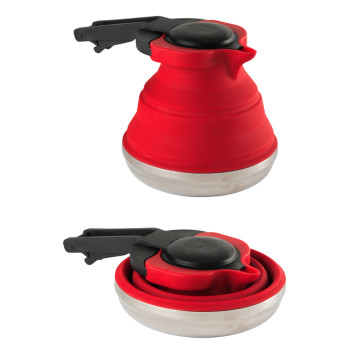
pack-away-kettle-1-350x350

IPPINKA (pronounced ee-pink-eh) has one of the highest concentrations of useful, well-thought-out and designed products of most any store we’ve seen. Much like LifeEdited, the shop has a paradoxical relationship with stuff. The Dieter-Rams-inspired company describe their ethos like this:

IPPINKA wants you to consume less. We want to help you choose products that will serve you for a long time, instead of constantly buying similar products to replace each other.

Based on the stuff they carry, we believe them. We recently picked up a few products for the LifeEdited Apartment including a collapsible latex kettle (above), reusable, biodegradable Abeego food wraps (replaces plastic wrap) and a pour spout that acts as instant strainer for any pot.

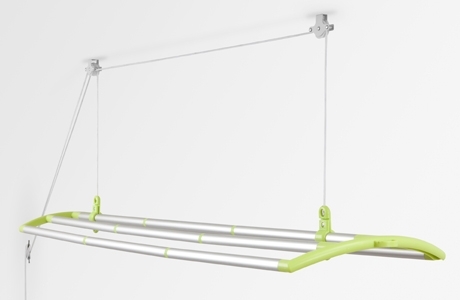
Other objects we’ve coveted are the thin Japanese KONTEX towels, some gorgeous Lithuanian linens, a ceiling mounted drying rack and a clever tea mug that allows you to steep whole leaves without a separate strainer. I say “coveted” as IPPINKA stocks limited quantities and if you don’t buy something when you see it, it might be gone the next day. It’s sort of like a daily menu for products.

The site also gives its visitors the opportunity to vote on upcoming products to gauge whether they’re worth carrying or not.

To us, IPPINKA represents an ideal form of consumerism. Rather than urging its customers to spend as much as possible on stuff useful or not, IPPINKA humbly offers up their products saying, more or less, “If you must buy something, it should probably be this.” Check out more at www.ippinka.com.

[Full disclosure: the author received a complimentary set of the Abeego food wraps from IPPINKA…but that was it.]

10 Ways to Save Money When Furnishing Your Small Apartment

Finding the right furnishings and housewares for your small apartment can be a fun experience. Yet even in a small space this can get expensive fast if you don’t know how to save money on all the basics you’ll need. While apartments generally cost less to buy stuff for than larger homes, based on the limited space you are working with, you can still shop smart and frugally, allowing you to save as much money as possible. You can direct your savings to other needs like throwing your apartment-warming party.

Here are ten simple tips to save money on all your apartment furnishings, décor and other apartment needs:

  1. Buy adaptable pieces. One of the best ways to get more out of your apartment and your lifestyle is to stick to furniture and housewares that serve more than one purpose. This will allow you to adapt and move things around as your needs change, without having to buy more. Choose a high-end futon with a generous cushion to serve as a bed for guests, or benches that double as storage chests. Try adding an armoire for storing either clothes or entertainment items in cramped spaces.
  2. Choose quality over quantity. You are better off spending a few extra dollars on a high quality used piece of furniture for your apartment than buying a cheaply made newer piece. Look for sturdy hardwoods and metals, which offer flexible décor options. A well-made table with simple lines can serve as a desk, a dinette, or a place to tuck a television.
  3. Buy multiples. This might seem counterintuitive with a small apartment, but if you find a good deal on items you like such as dinnerware, bedding, or other apartment needs, it often makes sense to stock up. You’ll very often be able to buy box lots of items or come away with some great bargains buying several pieces from a container store or wholesaler. This will save money and keep you stocked for years to come.
  4. Shop locally. Chances are your neighborhood has several thrift stores or antique stores where you can pick up some amazing deals for pennies on the dollar. Visit these places with an open mind, and don’t be afraid to ask for what you need or for a break on a price if something catches your eye. Local retailers will work with you in ways big chain stores will not–plus it supports your community.
  5. Swap or trade. Have something you are looking to replace? Try putting an advertisement on a free community swap of website like Yerdle and ask for something in trade. You may be surprised to find that other people are trying to get rid of something that would be perfect for your place.
  6. Go for impact with art. When it comes down to buying for your apartment, there’s no better investment than a great piece of artwork. Shop your local community stores, head for auctions, and visit the local art colleges for unique artwork to adorn your walls. It will look like you spent a fortune.
  7. Avoid fads. When buying for your apartment, stay away from the latest styles in furnishings and instead opt for the classics in furniture and fabrics. You’ll usually end up with things that last longer and don’t cost as much.
  8. Buy post season. Sales occur after every major holiday, and this can be an opportune time to buy things for less than half of retail. Good things come to those who wait, for clearance sales!
  9. Shop with friends. Your friends are likely to have an eye for style, so be open to going in on deals with them. For example you may need a new living room set, but you don’t need all the pieces. Go with a friend who needs some new tables or a loveseat, and split the cost of a marked down set. You’ll both come out ahead.
  10. Be eclectic. Shopping for an apartment on a budget means that you may need to develop a décor style that mixes and matches pieces. Try adding a few modern things in with classic glamour, for a unique apartment that’s all you.

Decorating and buying for your apartment takes careful planning and strategic shopping. Think about all the ways you can save money and only bring in items that look good for your space, and are made well. Over time, you will want to repurpose these items in other ways, so think ahead as you furnish your place.

Mark Russell writes about apartment living and frugal apartment living tips at Apartment Guys.

Image credit: Shutterstock.com

Kick Your Stuff to the Krrb

Selling stuff can be a pain. Most us use one of several channels: Word-of-mouth, yard/stoop sales, Craigslist or eBay. Word-of-mouth is okay for stuff we want to dump, but many us have issues selling stuff to friends, particularly if we want to make money. Yard/stoop sales are a pain in the butt (dragging your stuff in and out, weather, etc) and they hit a limited audience, most of whom want to pay pennies on the dollar. Craigslist has great outreach, but often buyers are super-bargain shoppers and then there are scammers galore. EBay, for most of us, is a intimidating bazaar filled with cutthroat dealmakers.

A site called Krrb provides an answer for the non-professionals and small local businesses to sell their stuff easily. The site describes themselves this way:

Krrb (pronounced ‘curb’) is a hyperlocal, curiously global classifieds made just for you. A most epic scavenger hunt at your fingertips where you can thrift, scavenge, rummage and discover local treasures – in your neck of the woods or over yonder.

With over 24K users in 1130 cities, it beats word-of-mouth and yard/stoop sales; you can also keep stuff posted as long as you want. Unlike Craigslist, there are thumbnail pics of objects to see what you might want to buy. Also, everyone on the site must become a member, which is a great scammer-deterrent. Unlike eBay, there is no bidding; members can civilly negotiate prices if they so choose, but none of that last-second-outbidding that turns so many folks off of eBay.

Other features include a mobile app that shows Krrb objects in your area, a digest of stuff for sale in your area and Krrb Meetups (only in Brooklyn and Paris right now). Posting works on credit system. One post is one credit. Credits cost anywhere from $.50-1.00 (depending on volume you buy) and there are numerous ways of earning free credits (you get 10 free just for signing up). Visit their site to sell your stuff or buy some preowned holiday gifts.

Patagonia to Shoppers: Don’t Shop if You Don’t Need To

While most companies are dangling the carrot of ludicrous deals this week–one of, if not the, busiest shopping week of the year–outdoor clothing company Patagonia has another message: Don’t shop if you don’t need to. The company’s two year old “Common Threads Initiative” is trying to get people to think differently about when, how and why they buy.

The initiative has a sequence of suggestions and questions the potential shopper can run through:

  1. Reduce. Do I need this?
  2. Repair. Can I fix what I already have?
  3. Reuse. If I can’t repair the thing I want to replace, can it be sold to someone who wants it or used somewhere else like a charity?
  4. Recycle. Can the materials of my old thing be remade into something else?
  5. Reimagine. Can we change global consumer habits to create a sustainable planet?

Patagonia doesn’t just give good advice; they provide resources for how to carry out their plan. For “repair” there is an in-house repair service where you can send your torn clothes to, for “reuse” there is a link to the Patagonia eBay store and for “recycle” they provide an address to send your old Patagonia clothes so the materials can be used for new garments.

You can even take their pledge. The company pledges to “build useful things that last, to repair what breaks and recycle what comes to the end of its useful life” and you pledge to “buy only what I need (and will last), repair what breaks, reuse (share) what I no longer need and recycle everything else.”

We applaud this initiative. It’s very much in keeping with the LifeEdited ethos of “less but better.” And from what we know of Patagonia as a company, the initiative is more than just marketing jargon. It’s their way of conducting–and transforming–business.

What do you think? Is this an earnest effort to transform consumer habits or fancy marketing? This author, for one, feels much more inclined to buy Patagonia products…is that a bad thing? People do need stuff…why not make it the good stuff from people who care?

via Treehugger

5 Products That Make Our Lives Better

We are always on the lookout for products that do more, last longer and take up less space than their conventional counterparts. We’re not talking about things like a good laptop or phone, which might be indispensable, but will be outdated in six months. We’re talking about the products that won’t go out of date, whose utility proves itself through the years.

We’ve put together a short roundup of products we find ourselves unable to live without (not literally of course). It’s also a nice excuse to ask you what your list includes. What are the things that make your life or home work better–things that make life simpler and more streamlined? Let us know in our comments section below.

  1. Waffle-weave towels. We’ve talked about them before, but too much cannot be said about their merits. The longer we use them, the more they prove their superiority to terry cloth. We’ve been using Aquis microfiber towels and Gilden Tree cotton waffle towels. Both take up less storage and washing machine space, dry faster and avoid mold. If we were to choose one however, it’d be the Aquis; the synthetic material seems to grab moisture from your skin. It’s also softer than cotton. If you’re not into synthetic stuff, the Gilden Tree towels still work great and are available in more sizes and colors.
  2. Outlier pants. These things rock. They look like dress pants, feel like sweat pants, wick and repel moisture like mountaineering pants and wear like iron. Starting at $188, they are not cheap, but they will literally replace three pairs of conventional pants and outlast them as well. I have had several pairs for the last few years. My favorites are the 4 Season OG’s and Climbers, both of which have four-way stretch material (not all Outlier pants are as stretchy). Their shorts rule as well. Right now, they make one women’s variety.
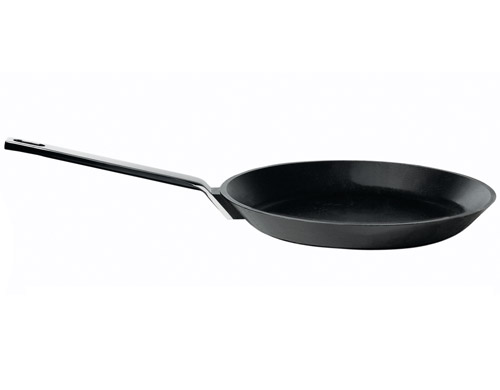
  3. A cast iron skillet. Nonstick skillets are great, but they wear horribly and have a dubious safety record. Copper and stainless steel wear great, but are temperamental, scorching and staining easily. Cast iron, on the other hand, wears like, well…iron. It distributes high and low heat great. With a little bit of use–i.e. ‘seasoning’–it can be almost as nonstick as a Teflon pan, without all the plastic bits in your food. You can clean them without water. And while enameled iron pans are nice, the bare cast iron versions are less fussy and prone to marring. I use a beautifully designed 12″ iittala Hackman Dahlström Tools for almost everything (pictured at very top. Discontinued, but available at various stores), but most any cast iron skillet work equally great. Get a size that’s big enough for the amount of cooking you do, but not so big that it takes ages to heat.
  4. A comfy couch that you can sleep on. I was at IKEA a few weeks ago and they had a 375 sq ft mock-up apartment featuring a huge, overstuffed sectional couch. I thought it a waste of space until I sat it in. Few things demarcate home like a comfy couch. In the LifeEdited apartment, the Resource Furniture Swing couch is the most used piece of furniture. A great couch can be your guest room in a pinch, and while convertible sofa-beds are great, sometimes it’s better to get a longer couch than invest in a substandard sofa-bed, which are often pretty uncomfortable.
  5. A scanner. We thought scanner technology was stable enough that it could be included on this list. Scanners are simple, can last ages, don’t require stupid, overpriced toners and, most importantly, allow you to dump tons of paper by scanning receipts and important documents. Scanners eliminate the need for a fax. You can also scan old photographs for posterity and digital display.

What would you include on this list? What items streamline your home and your life more than most? Let us know in our comments section.

Is Pinterest Making You Miserable?

A recent article in Canada’s Globe and Mail suggests North Americans are increasingly going on never-ending online searches for the perfect bedroom mirror and losing sleep over the colour of front doors. In other words, they are décor-obsessed. This phenomenon, they believe, might be ignited and fueled by TV makeover shows and online tools such as Pinterest, a site whose meteoric growth–3rd most trafficked site after Facebook and Twitter, with 20M new users in last year alone–is mainly attributable to home décor pinning. Pinterests boards of beautiful objects and interiors may inspire, but they might also remind you how deficient your home is.

The article goes on to blame blogs like DesignSponge, Remodelista and Apartment Therapy. The latter blog, one of our personal faves, put the subject out to its readers in a post called “Decorating Your Home: Hobby or Unhealthy Obsession.” Most comments resolutely declared their decorating habits were not problematic. They agreed that their desire to decorate was an issue of creating a great living environment, not an obsesssion. However, one comment astutely remarked, “I don’t think we are the right people to comment on this article, given that we are all here :)” [his emoticon, not ours].

This décor-dysmorphia may be the symptom of a larger societal issue–one the article suggests is more acute in women. The article reports:

The more social pressures women face, ‘the more likely they are to actively try to control the things they can, like the body or the home,’ says Joyce Davidson, an associate professor at Queen’s University who has studied how women express themselves through their home environments.

The evidence bolstering the G & M piece is anecdotal at best, but the thesis is logical: the more we see of great stuff and architecture, the more we realize our stuff sucks. If we have self-esteem issues (be honest), we’re going to try and get better stuff to bolster our feelings about ourselves. That works until that stuff is sucky too. This pattern is typically called a hedonic treadmill.

Of course this phenomenon, as people noted in both G & M and Apt Therapy’s comments, is not limited to home décor or women. The same thing could be said about gadgets, cars and food. It’s just that the recent growth of Pinterest makes it an easy target.

What do you think? Are home makeover shows, sites like Pinterest and blogs useful (or at least benign) tools for inspiration? Or are they shaking our self-worth, producing obsession through comparison and manufactured discontent? Let us know your thoughts?

3 Big Stores Get Into Small Spaces

There was a time, not so long ago, when furniture stores assumed their customers wanted items that would fit well in an over-sized dream home. Furniture was marketed with easy mortgages and cheap credit in mind. Well, those days are over.

With more people living in square-footage-starved cities, and more people renting, a growing population is reevaluating the dimensions of their dream home. A few furniture retailers are taking heed of this trend, marketing specifically to consumers living in small spaces.

Restoration Hardware released its “Small Spaces” collection earlier this year. It is, they claim, “A collection of epic proportions.” It’s sufficiently important to the company that it’s on their site’s main navigation bar. The collection is shown in 15 “small” spaces from around the world like the “Chelsea Penthouse” or “London Townhouse.”

These spaces don’t seem that small to us, and there are no dimensions to contradict our impression. The furniture looks suspiciously similar to other pieces in the catalog: the big space love-seat becomes the small space couch; the end-table becomes the coffee table. Perhaps it’s relative. Maybe RH is catering to people who are transitioning from 4K to 2K sq ft of living space.

IKEA has been in the small space fray for a while now. The video below shows a number of ways you can use their products to squeeze tons of utility from a small space. They claim small space living is “not about giving up your dreams. It’s about shrinking them, just a little bit”–whatever that means. The video is pretty creative and compelling.

Many of their stores feature 375 sq ft mock-up apartments. The author visited one the other day and found the layout pretty nice.

The furniture in the apartment, like RH, seemed like their normal furniture plugged into a small space. Unlike RH, IKEA seemed to understand the necessity for storage in a small space; there were shelves everywhere and two of the walls had large storage systems.

They made what seemed like a strange choice, decking the living room with a big couch. It was strange until you sat in it and realized that a comfy couch is pretty important to demonstrating a space’s livability.

West Elm also features a small space collection. A couple of their pieces actually seemed to be designed for small spaces–not just a normal piece with a small space sticker slapped on it. In particular, the Storage Bed Frame and Rustic Storage Coffee Table (below) would be useful additions to a small space. The latter model’s tabletop lifts to provide a desk space if you find yourself working on the couch.

What do you think of these collections? Are they marketing gimmicks or indicators of they way people will live in the future? Or both? Have you bought any of these products? What was you experience? Let us know.

10 Folding Chairs to Look at and Sit On

Many people have reached out to us looking for solutions for making their own home an edited home. Often requested is a guide to folding chairs–chairs being a staple piece of furniture for most any home. With a little help from our friends over at Apartment Therapy, we’ve put together this list of 10 folding chairs, ranging from the super inexpensive to the super not-inexpensive.

Let us know what we might have missed in our comments section.

1. Terje Folding Chair from IKEA, $16.99

We’d be remiss to not include the big I. This is one of their several folding chair options. They’re not super sturdy, but boy are they inexpensive. We’ll leave it at that.

2. Mika Natural Wood Chair from World Market, $75 for 2

This chair has a nice look and works inside and out.

3. Cyclone Indoor/Outdoor Chair from Target, $123.89 for 2

If your aesthetic leans toward pop-art, this chair from Target might be your style. It works inside and out.

4. Muji Beech Folding Chair, $70

We really dig this chair. Simple, real-wood, good price.

5. Clarity Acrylic Folding Chair, $150 for 2

Like the Target chair, this one will appeal to a particular aesthetic. The translucency opens up visual space, but acrylic tends to scratch over time.

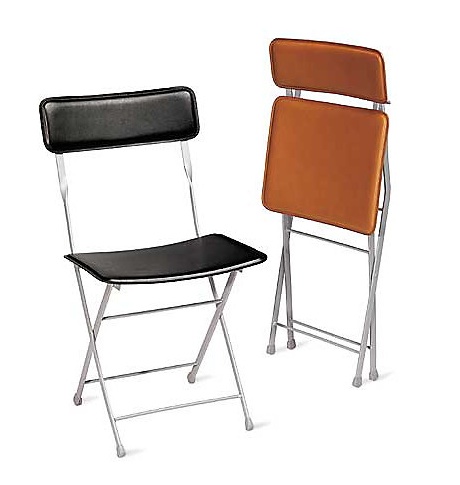
6. Lina Leather Folding Chair by Design Within Reach, $150

We quite like the look of these. They have a very light design, but the leather gives them a touch of luxury. Their legs don’t look super beefy, so might be best for the lither buyer.

7. Flux Chair, $199

We’ve been using a Flux chair for a while and they’re surprisingly comfortable. They work as a lounge or dining chair, but are too slack for an office chair. When unfolded, they lie completely flat. They’re available in several colors.

8. Resource Furniture Pocket Chair, $225-480

These high-quality, Italian-made folding chairs are 3/4″ deep when folded. Unlike a lot of folding chairs, they have a nice, substantial feel. Prices vary depending on finish.

9. Leaf by Folditure, $680-760

We’ll dispense of the alien jokes. In terms of raw functionality and portability, it’s tough to beat the Leaf. They hang in your closet and are built solid enough to withstand your heaviest friend. [Note: the Folditure site has stopped publishing these prices, so check with them to see current pricing.]

10. The April folding chair by Gae Aulenti, $1350

If your tastes lean toward mid-century modern, and your budget leans toward hedge fund manager after a bonus, this chair is probably for you. Solid construction, classic looks, big price tag.

Via Apartment Therapy