REI Is Making Black Friday a Bit Brighter

There is no single day that better represents the scourge of compulsive, compulsory consumption than Black Friday–historically the biggest shopping day of the year. The day compels many to camp out in front of stores in frigid temperatures to nab limited time offers on retail goods; it sends workers to work extra long hours that would otherwise be spent partaking in post-thanksgiving revelry; and it brings out some pretty nasty human behavior: in the last decade, seven people have died and 98 have been injured in Black Friday related shopping incidents. These are not people shopping for life-saving serums–these are people pursuing deals on flatscreen TVs and remote control cars for their kids. Well, outdoor retailer REI is taking a stand against this insanity. Its #Optoutside campaign will close all 143 REI stores on this most lucrative shopping day.

Not only will REI stores be closed, but the company will give its employees a paid day off to spend outside. REI president and CEO Jerry Stritzke says this about the campaign:

For 76 years, our co-op has been dedicated to one thing and one thing only: a life outdoors…We believe that being outside makes our lives better. And Black Friday is the perfect time to remind ourselves of this essential truth…We’re a different kind of company—and while the rest of the world is fighting it out in the aisles, we’ll be spending our day a little differently. We’re choosing to opt outside, and want you to come with us.

The cynic in me wants to say it’s just a big PR stunt to get them attention (I’m writing about it, aren’t I?), but the other part of me thinks it’s pretty cool. While the prevailing retail culture is still very much set up to encourage consumption at all cost, there are signs of a new culture emerging. Whether it’s Patagonia, Outlier, Zady or REI, we are starting to see companies that consider their social and environmental impacts. They are creating a new way to buy the stuff we actually need. This new way might require a little bigger initial investment and it might not be as convenient (you’ll have to wait until November 28th to shop at REI…or shop online), but it might make us a bit more conscious and careful of how and why we consume.

HT Sarah L

Do You Buy Stuff to Feel Accomplished?

I spend a good deal of time outside and since it’s typically sunny in New York (it really is), I usually wear sunglasses. And when not in the sun, my sunglasses are either on my head or hanging from the collar of my shirt–perfect locations for either of my two boys to grab and throw onto the ground (don’t suggest a strap. I tried one and they either strangled me with it or tore the glasses off the strap, sending it to the ground all the same). My lenses are fairly scratched up right now–not horrible, but they need to be replaced sooner than later.

This morning I was looking at my to-do list feeling a little overwhelmed. There were long-term projects where I felt stuck. There were several tasks that require phone calls or lining up other people or putting together materials before I can even begin to check them off the list. But then I saw it: “buy lenses.” Stop everything. I could accomplish that!

I once went to workshop that taught me how to use the Franklin Planner. One of the most basic tools of the planner is prioritization. Tasks are assigned one of three values: A, which is urgent and important (think deadline tomorrow and putting out fires); B, which is not urgent but important (think working on that novel that doesn’t have a publisher yet); and C, which is not urgent or important (think rewatching the Godfather Trilogy). There are nuances inside these assignations and some include “Urgent but not important,” but that’s general overview.

In the context of my life, buying lenses was a solid C. They’re scratched, but I can see quite well out of them. Yet I felt the impulse to put the purchase ahead of many A’s and B’s.

The reason I, and many of us, prioritize shopping might be neurochemical. Studies have shown that shopping–impulse shopping in particular–releases dopamine, a neurotransmitter associated with feelings of pleasure and satisfaction released when we experience something new, exciting or challenging. In other words, our brains might use purchases as a proxy for real accomplishment. Why climb a mountain or help a friend when we can buy some NOS high flange Campagnolo Nuevo Record track hubs? And unlike those difficult-to-accomplish things, shopping requires little skill or preparation. All we need is money…or credit.

The trouble is the sense of accomplishment doesn’t last. When the dopamine wears off, we want to re-up, which is how compulsive shopping is perpetuated.

Now I shouldn’t oversimplify the topic. Most readers of this blog are not likely to be compulsive shoppers. And not all purchases are made at the behest of neurochemical impulsive desires. Or if they are, they are alloyed with genuine need. Sometimes we just need to buy stuff and it might happen to feel good–neurochemically that is–to buy this needed stuff. I felt pretty good after we bought our apartment–a purchase that was the antithesis of impulsive.

But even the most ardent minimalist can find him or herself obsessing about a purchase–whether it’s the perfect pair of shoes or a composting toilet. In those moments, it might be good to remember that we could be in the throes of our physiology. It might be time to step back and remember that rich, meaningful lives are seldom defined by purchases made (and no, I don’t think Imelda Marcos counts). They’re defined by the relationships we tend, the contributions we make, the experiences we have–things that might not be acquired with one-click shopping, but things have a far more enduring impact on creating lasting happiness.

August_0802 / Shutterstock.com

Seven Headlines From The Onion About Shopping that Kinda Sum It Up

  1. Child Entertained For 5 Minutes By Plastic Toy That Will Take 1,000 Years To Biodegrade
  2. Consumers Say Recession Changed Way They Blow Paycheck On Crap
  3. New Denim Jacket Bolsters Consumer Self-Confidence
  4. Cost Of Living Now Outweighs Benefits
  5. Study Finds Americans Lead World In Ability To Justify Unnecessary Purchases
  6. New Apple Campaign Urges Consumers To Buy iPhone For Other Hand
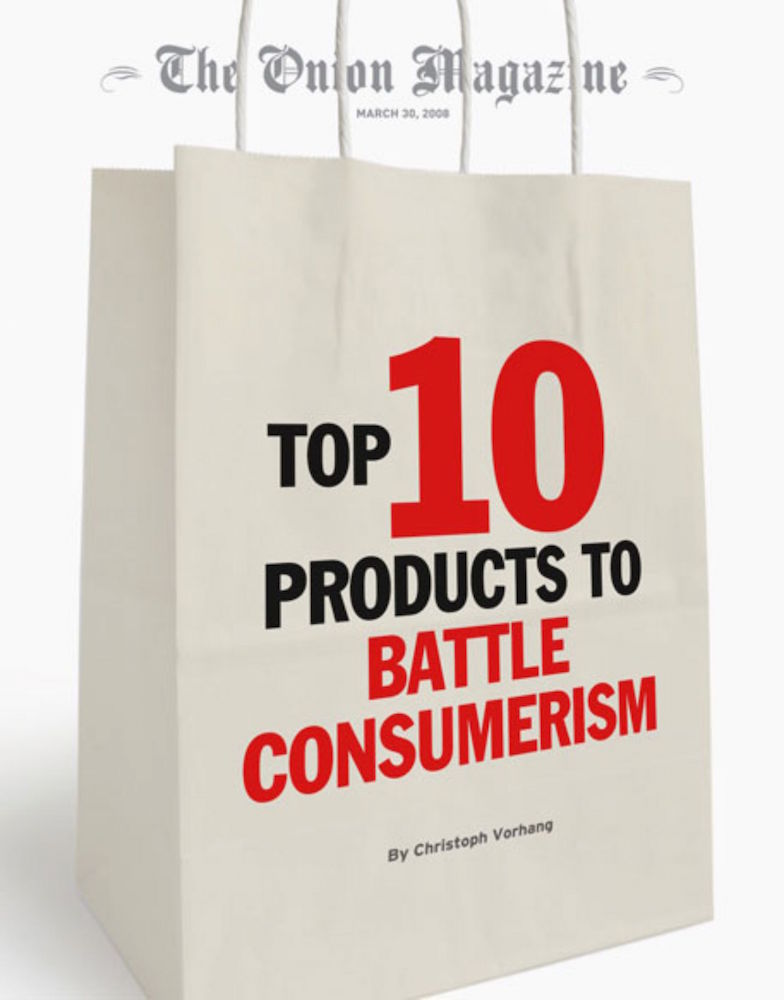
  7. Top 10 Products to Battle Consumerism

Editor’s Note: The opinions of The Onion do not necessarily reflect those of LifeEdited.com.

Is Online Shopping Bad for the Planet?

For those who, like this author, loathe shopping, Amazon Prime is a major life-editor. It allows us to get the majority of non-perishable items sent to our houses in a day or two (and yes, Amazon Fresh and Fresh Direct can do the perishable stuff). It saves massive amounts of time, hassle and often money. But even though I love the convenience, I often wonder how online shopping compares in terms of carbon footprint to conventional, brick-and-mortar shopping? The extra packaging, the idling, diesel-gulping delivery truck–it can seem like my need to get a two-pack of pacifiers is trumping my stewardship of the planet. But is it?

A couple years ago, a paper written by MIT’s Center for Transportation & Logistics attempted to answer this question. Their study used three purchase scenarios: a laptop with lots of packaging and low return rates, a Barbie doll with medium packaging and medium return rate and a t-shirt with little packaging and high return rate. According to the Environmental Defense Fund, who wrote about the paper’s findings, the study “took into account the environmental impact of packaging, transportation and energy consumption associated with the different stages of the retail process, whether warehouse, sorting and collecting centers, retail store, computer use or data center.”

What they concluded is that people who conducted every phase of a transaction online–i.e. they didn’t snoop out the product at a local store before purchasing online–created half the carbon footprint of a brick-and-mortar purchaser.

The reasons were fairly obvious. While delivery vehicles are easy targets for the pollution the generate, they’re far more efficient than the alternative: every recipient of a package traveling by his or her self to a store to pick up that package in a car. Delivery drivers also optimize their routes for time and fuel savings–not something you and I think about very hard most likely. Apparently, these efficiencies trump the extra packaging.

There are some caveats to this formula. Proximity to a store and mode of transportation used to get to store matters. Walking down the street to buy some wood-screws will probably be more efficient than getting them sent from a warehouse and being packaged in such a way to make it fit for delivery.

The other thing the paper didn’t address is how the convenience of online shopping affects our purchase volume? We might have half the carbon footprint, but if we’re shopping twice as much, we might be canceling out any gains.

All that said, assuming we’re not buying a ton of crap we don’t need and the things we want aren’t available in walking/biking/public-transport distance, the chances are our online purchase will the greener choice.

How to Know if You Should Buy Something

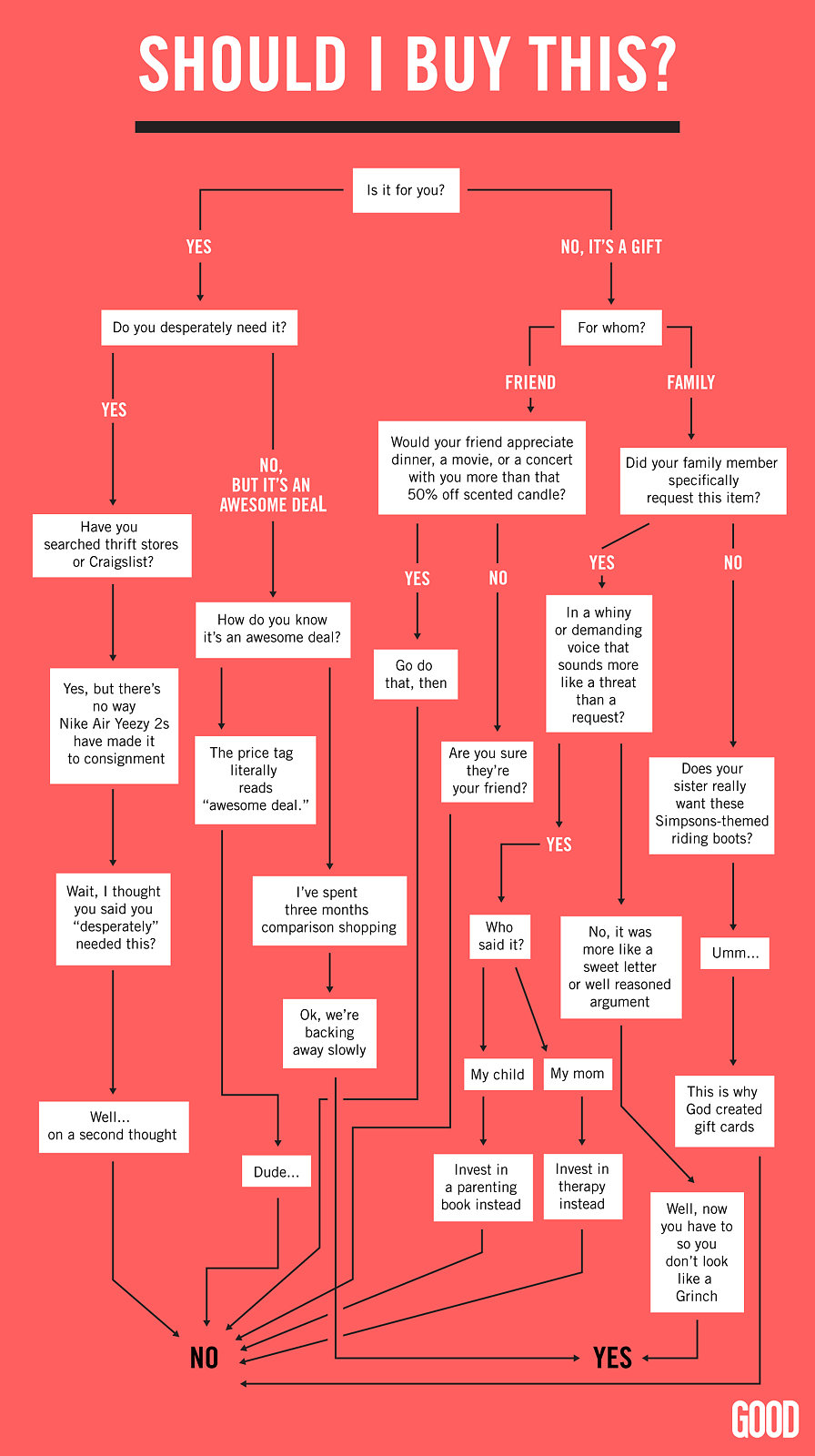
The good folks over at GOOD Magazine made this handy flowchart that provides various questions to ask oneself before buying something. It’s decidedly more polished and complex than the one we did a couple years ago–though that’s probably the point. Answering the Byzantine circuit of questions will compel most people to scrap their purchase decision–a good idea much of the time.

What the chart does is flip consumer mindset on its head. Rather than idealizing and assuming that we need certain stuff, it creates many hurdles for stuff to clear before it justifies its inclusion in our lives.

Via GOOD Magazine

New Online Store Built Around Small Space Living

When we were putting together the first LifeEdited Apartment, we scoured countless stores looking for housewares that would perfectly fit into the space. We were looking for necessary things, compact things, classic things and, on occasion, offbeat things, which led to some failed experiments with sporks. The search was sort of a pain in the butt. We spent a lot of time sifting through retail haystacks looking for those few small space appropriate houseware needles.

A new online store called Mijlo (pronounced my-lo) is trying to save the small-space dweller and design aficionado some time. They have created a store focused on housewares–and eventually, other goods–that work well in the compact home.

We shot Mijlo founder Daniel Eckler a few questions via email about the store, how it came to be and where he plans to take it.

David Frieldander: What inspired you to start the Miljlo small space living store?

Daniel Eckler: I’ve spent the last 10 years of my life developing digital products to help people appreciate beauty and be more creative, and I’ve had a great time doing it, but I’ve also always wanted to do something tangible. What motivates me most is the emotional connection to objects, and their ability to bring joy to people–you can do this on screens, but it’s a different and more compelling experience to me with objects.

I’ve always loved the idea of design that helps people, especially design with difficult constraints. Even as a kid, I remember going to IKEA and being fascinated with the small home design/merchandising. Later, as an adult I discovered MUJI in New York, then soon after again in Tokyo, while living in 150 sq feet with two friends for a month. This solidified my love for small spaces.

I was even more interested in why I felt lonely after my friends left, especially as someone who enjoys their personal time. There’s a great quote from Ralph Waldo Emerson, “The ornament of a house is the friends who frequent it”–after this experience, I was especially interested in voluntary simplicity, collaborative consumption, and started to deepen my exploration of urban design, product design, interior design, and architecture.

I realized that besides MUJI, there are no big retailers focused on helping people in small spaces live well. With urban areas becoming more dense every year, the average home-size is shrinking, and I think there are going to be a lot of people living in small homes needing solutions that exist in the market today, but kind of at the fringes. I want to do everything I can to make sure these people live just as comfortably as if they were in a big space, and more importantly start to appreciate the benefits of living with less.

DF: How did you select your products?

DE: Because we’re a start-up, we had to focus our attention in a particular category, and for us, the most sensible choice at the beginning was small housewares. I can’t wait until we stock murphy beds and other “large” small space furniture, but in the meantime, I want to curate the best offering of small housewares that are suitable for small spaces.

Small space home decor obviously means modular, multi-functional, and small pieces, but I think it’s just as important to seek simple/quality/neutral pieces that complement each-other and that will last a long time. We’re inspired primarily by Danish and Japanese design, in white/grey/beige with splashes of color and personality throughout the collection.

DF: What is your favorite product and why?

DE: The Mr and Mrs. Tea Towels from Ferm Living are my favorite products currently in our collection [pictured below]. My visual sensibilities are influenced mostly by minimalism, but also by my mom who was a quirky Dutch homemaker that spent her days sculpting and painting strange characters that look similar to the ones printed on these towels.
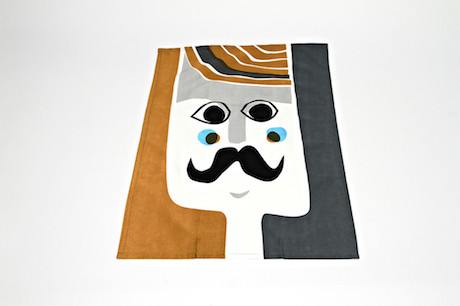
ferm-living-mr-tea-towel-2_1024x1024

I really like the simplicity and warmth that both of these prints exhibit, and I’m especially interesting in humanizing design, so I love the idea of a set of tea towels that are a married couple.

DF: What does Mijlo mean?

DE: Bringing my Dutch heritage into the company was really important to me. My mom’s family in Holland has been running an auction house specializing in home decor for generations. The Netherlands is the most densely populated country in the EU, and Amsterdam is the cycling capital of the world. All of these features are natural influences for MIJLO and our mission.

I was looking for a Dutch name that would be a fit for the company. I was considering KIKO (which my mom wanted to name me), but there is a large cosmetics brand with the same name. I also like YOPI (my uncle’s name), but that is taken by a Dutch company with a similar name. I looked around for other names that had the same spirit as those–MILO is a popular name in Holland, and it resonated with me as soon as I found it. We added the J because IJ replaces Y in Dutch. De Stijl, Rijks Museum, etc.

DF: Where do you see yourself taking the store?

DE: Our goal for now is to help as many people in small spaces live simple and live well, with a collection of well-designed, quality goods. This goal actually doesn’t start with selling products. It starts with education. I believe deeply that living a simple life, in a simple home, with simple things, can dramatically increase people’s quality of life. A lot of people don’t agree with that, so it’s our job to show them why we think that way, and hopefully encourage them to give it a try. As long as we’re engaged in exposing people to the benefits of living simply, we’re doing our job, and hopefully we will sell a few (or a bunch of) products along the way.

DF: Do you live in a small place yourself?

DE: I’m currently living in a medium sized house with my father, but I spend 90% of my time at home in less than 250 square feet, which includes my bedroom, office, closet, and bathroom.

[divider]

Check out the Mijlo store yourself.

My Genes Made Me Keep It

From the perspective of evolutionary psychology, there’s a certain logic to being materialistic. In the olden days, folks couldn’t just run to Target and pick up a hypo-allergenic full-sized duvet. You had a few shots a year to hunt and skin that buffalo, otherwise you’d freeze the rest of the year. Accumulating more than we need and keeping those accumulated objects to ourselves, thereby providing for lean times, makes intuitive sense. In other words, we might be hardwired to accumulate. The only difference is that now our objects of accumulation do not stand between life and death.

This logic might not be true however. A recent study suggests that people living closer to subsistence levels might be less inclined to accumulate. The study in question sought to test something called the “endowment effect”–the overvaluing of the personal objects. Psychologist Tom Wallsten at the University of Maryland told NPR the effect is similar to the man who won’t drop the price of his house even though it’s not selling for months. He needs to sell it, but because he values it more than others think it’s worth, he holds onto it. NPR science correspondent Shankar Vedantamit, said that the effect dictates that it “feels worse to lose something than it feels good to gain something.” We would say it’s also like people who do not rid themselves of stuff they do not use because they are “too valuable” to get rid of, despite the expense and headache associated to holding onto them.

Coren Apicella, a researcher at the University of Pennsylvania, realized that the endowment effect was mostly proved by testing the behavior of college students–a demographic whose cultural biases might blare out any meaningful information about innate dispositions toward accumulating stuff. She observed the patterns of the Hadza people of northern Tanzania, some of whom were nomadic hunter-gatherers living at subsistence levels; other Hazdas observed lived in villages with market economies.

What she found was that the nomadic Hadza, people with virtually no possessions, rather than being highly acquisitive, were very easily induced to give up their stuff. Apicella explains why:

If you think about, you know, you’re a hunter-gatherer, you’re living a hunter-gatherer life, one possible reason why it doesn’t hurt as much to give things up is that you’re constantly having to give things up all the time. People are asking them for–from you, you know, demanding them from you, demanding that you share. Things come and go in hunter-gatherer life. You don’t even own that much to begin with.

Vedantam expanded to say that in a nomadic society, it is essential to give things up because the person you give to might have something valuable tomorrow to give to you.

Meanwhile, the village-dwelling Hazda who bought stuff from markets were more acquisitive than their nomadic relatives. Vedantam said of the villagers that they “were more like us [Westerners presumably]. They fell in love with their possessions because modern economies allow people room to be selfish.”

Same genes, different cultures, different attachments to stuff.

Sometimes changing the patterns of consumer behavior seems nearly impossible. Not only are we up against a behemoth economic system whose mission is to compel us to buy more stuff than we need, we are up against the culture that has sprouted around this system–a culture that accepts hyper-consumerism as the way thing are and will be. The Hazda example might be a glimmer of hope, suggesting that while we are battling marketers, bankers, politicians and even our friends and neighbors, we are not battling our biologies.

Via NPR

image credit:  Matej Hudovernik / Shutterstock.com

Freeze Funds for the Holidays

According to one source, money spent on Christmas gifts make up 3-4% of people’s total annual income. And few modern mechanisms make this yuletide spending–and overspending–easier than credit cards. The greater ease of spending is, at least in part, due to how convenient cards are to use. But there is also a psychological phenomenon called “credit card premium,” which is our willingness to spend more whilst using a credit card than we would with cash (have you ever paid $4 for a small bag of chips at a vending machine because it took cards?). A study that came out a couple years ago showed that people who spend with credit cards focus more on the benefits of their purchases (me want yummy chips!). Cash spenders focus more on costs ($4 for a small bag of chips! Are you nuts?).

Cash, perhaps because of its physical tangibility, activates emotional pain in the spender in a way credit cards don’t. Handing over cash is a physical representation of outgoing funds–something our brains can comprehend. The esoteric credit card transaction has no such representational value, thereby dulling the pain of spending and facilitating paying more than something is worth and buying things we can’t afford.

But just because you can’t feel the purchasing pain doesn’t mean the injury has not been inflicted. According to one source, the average American household carries around around $7K of interest bearing credit card debt; that same number increases to $15K if we only look at households that carry credit card debt.

If you’re one of the many Americans who struggle to keep your credit card spending in check, Trent Hamm from the Christian Science Monitor, has a few suggestions for creating barriers to use:

  1. Freeze your card. He means this literally: put the card in a block of ice to prevent throwing it in your pocket on the way out the door.
  2. Hide your card. Hamm put his cards in the attic, which required getting a ladder from the garage to get into. The point is to make it hard to retrieve.
  3. Wrap your card in pictures. Hamm made an envelope for his cards with pictures of his kids, who are the inspiration for his spending moratorium. This is the emotional barrier.

Unfortunately, none of these tactics handle online credit spending, where your card is usually on file (Hamm’s article is part of a series, so maybe he has some suggestions in the coming weeks). For that, we might suggest clearing your autofill settings and purchasing as a guest rather than registering for an online store; this way, you’ll need to enter all of your information every time you visit a site…let your laziness shape better habits.

But really, most of us won’t get rid of our cards, and after we’ve melted the block of ice, and after we’ve fetched them from the attic, we’ll probably just stick them back in our pockets. So the objective should become cultivating a relationship between spending and costs. Here are a few suggestions on how to do that:

  1. Spend cash wherever possible. Groceries, gas, coffee, etc. There are still plenty of places to use cash.
  2. Buy quality, sometimes expensive items. At least in this author’s experience, overspending tends to happen more often with small purchases than big ones. Paradoxically, buying less, but better stuff tends to curb the spending jones for smaller, insignificant purchases.
  3. Look at your credit card statements. Many of us (this author included) simply pay our credit card bill without looking at it. Take a sober look at where our money goes. We don’t necessarily have to do anything different, just start becoming aware of what’s happening.

Honor Your Holey Relics

If most of us are ashamed of shabby clothes and shoddy furniture let us be more ashamed of shabby ideas and shoddy philosophies….It would be a sad situation if the wrapper were better than the meat wrapped inside it.” ― Albert Einstein

If we were to think the world dressed like TV characters, we might think everyone wears freshly-pressed, perpetually clean clothes. But TV-reality and real-reality seldom intersect. Real-reality is fraught with stains, scuffs, holes, worn-out soles and all varieties of wear. Patagonia, the folks who brought us Common Threads, not only recognizes the reality of wear, they celebrate it. They have produced a movie (below) and launched a website called Worn Wear. Here’s how they describe it:

Worn Wear is an exploration of quality – in the things we own and the lives we live. This short film takes you to an off-the-grid surf camp in Baja, Mexico; a family’s maple syrup harvest in Contoocook, New Hampshire; an organic farm in Ojai, California; and into the lives of a champion skier, a National Geographic photographer, and a legendary alpinist. It also features exclusive interviews with Patagonia founder Yvon Chouinard.

Released as an antidote to the Black Friday and Cyber Monday shopping frenzy, Worn Wear is an invitation to celebrate the stuff you already own.

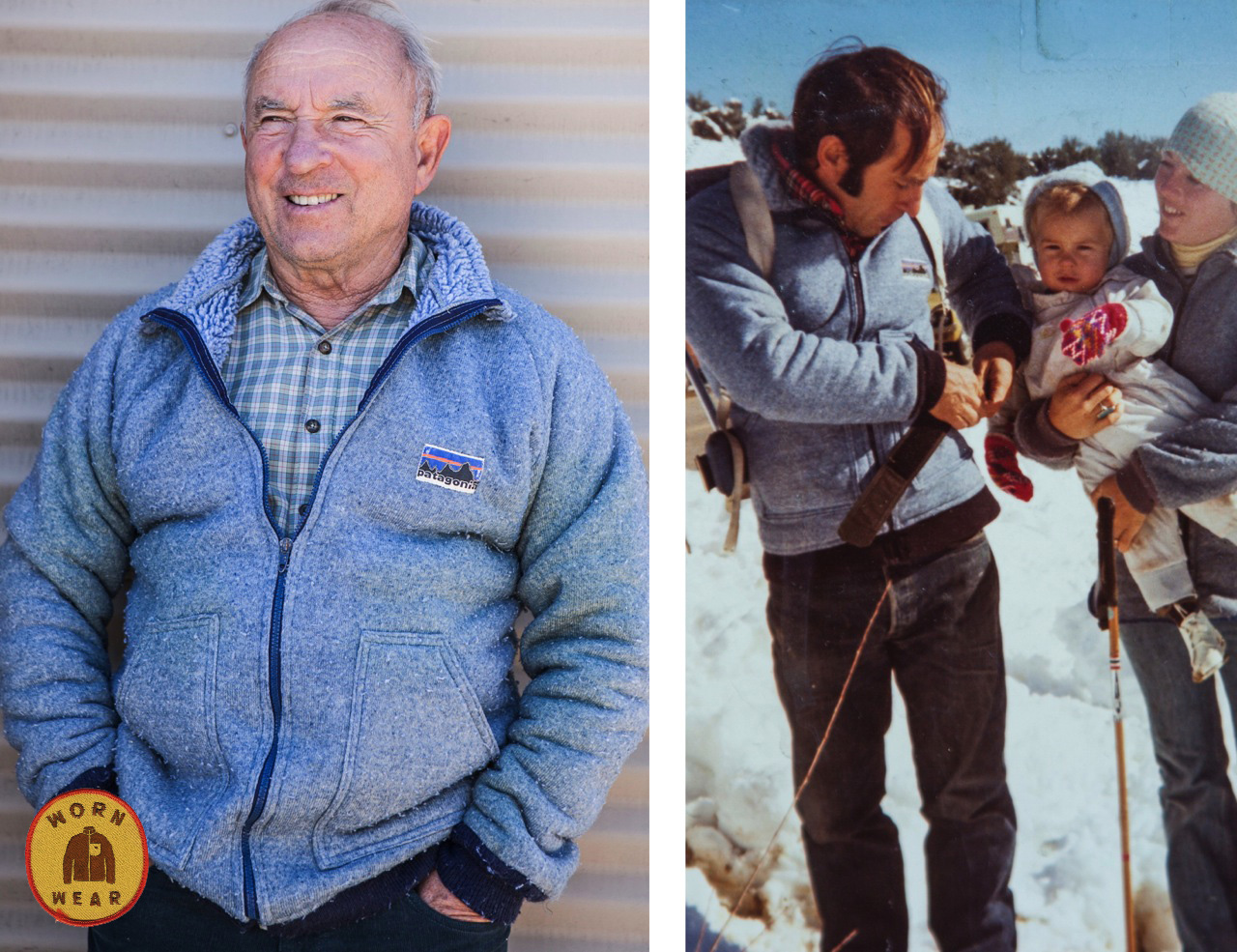
Their website features a dozen or so folks sporting Patagonia clothes, along with short stories about how the clothes were worn over the course of their lifetimes. The pictures are not of the latest Patagonia clothes, but old, torn and tattered ones. One picture of Patagonia founder Yvon Chouinard has him rocking a vintage, pilled-up fleece in the present day–couple with him wearing the same jacket 30 or so years earlier.

While you’re out not shopping this Friday, November 29th, Patagonia stores across the US will be celebrating Worn Wear (day?), with movie screenings, repair clinics, food and beer. See list of event locations here.

To the cynical eye, Worn Wear might seem like a clever way to lure people into a Patagonia store. This may be true to a small extent, but Patagonia really does seem to be earnest about creating a new breed of capitalism. With numerous programs like Common Threads, Worn Wear, and Footprint Chronicles (a site that allows people to follow the lifecycle of Patagonia garments) as well as a policy of donating 1% of all sales and 10% of all profits to environmental causes–the company seems serious about only selling the good stuff you need, and making that stuff last as long as possible.

What Will You Buy this ‘Buy Nothing Day’?

While large swaths of the American population ready their sleeping bags for Black Friday, with its midnight store openings and 99 cent flat-screen TV’s, another population is sleeping through the night, honoring Buy Nothing Day (AKA “Occupy Xmas”).

BND is an anti-consumerism response to Black Friday, the Friday after Thanksgiving often regarded as the busiest shopping day of the year (November 29rd this year). Wikipedia says this about the BND’s origins:

The first Buy Nothing Day was organized in Mexico in September 1992 “as a day for society to examine the issue of over-consumption.” In 1997, it was moved to the Friday after American Thanksgiving, also called “Black Friday”, which is one of the ten busiest shopping days in the United States. In 2000, advertisements by Adbusters promoting Buy Nothing Day were denied advertising time by almost all major television networks except for CNN. Soon, campaigns started appearing in the United States, the United Kingdom, Israel, Austria, Germany, New Zealand, Japan, the Netherlands, France, and Norway. Participation now includes more than 65 nations.

Adbusters, a subversive anti-consumerism magazine with serious design chops, is promoting a number of BND activities such as Credit Card Cut Up, where you stand in a mall and cut up credit cards (yours and anyone else who’s game); Zombie Walk, a walk around a mall dressed as a zonked-out consumer zombie; and Whirl Mart, a listless conga line scooting around big box stores, driving empty shopping carts.

A less incendiary way of celebrating BND is to, well, buy nothing for that one day that you are expected to buy.

For the less-activist leaning, BND might seem like a middle finger to the status quo. This is true to some extent. Even if you don’t want to extend that longest of fingers, another way to look at the event is an opportunity to question your consumer habits. This holiday season, before we purchase, we can ask ourselves do I need to buy this? What is the impact of this purchase (for my own finances, for the environment, etc.)? Can I give another way like SoKind or Francine Jay’s “One Less Gift Certificate“?

One of the major issues with consumerism–one that BND tries to counteract–is not that shopping is intrinsically bad, but that we have been programmed to consume by advertisements. BND, Jay and others are trying to say that the holidays and even gift-giving are not inseparable with shopping and stuff.

How are you celebrating the holidays in non-shopping ways? Or what are you shopping for that takes shopping and gift giving off auto-pilot into a meaningful exercise? Let us know in our comments section.

This post originally published November 21, 2012. The dates have been updated to reflect this year’s BTD.