Stylish Little House Fit For a Family

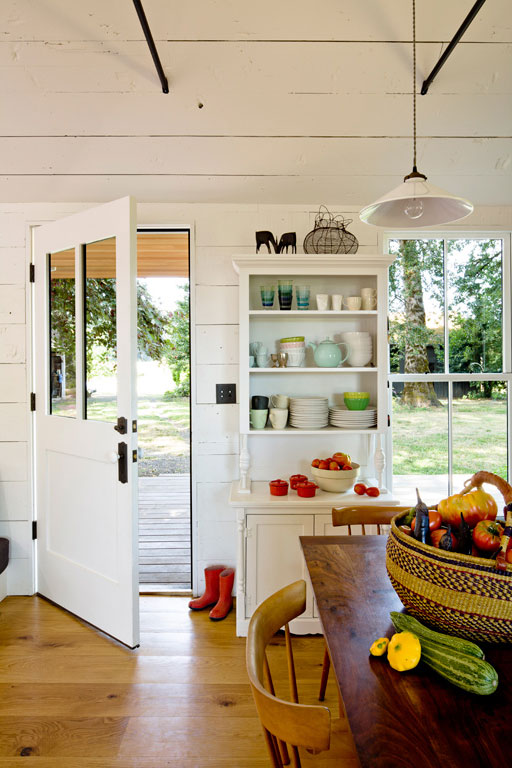
While it’s a nice idea to think a family could live in a sub 300 sq ft tiny house, the reality is that at a certain point you have to concede you can only downsize so much before quality of life is seriously compromised. That said, there are many options between tiny house and McMansion. Interior designer Jessica Helgerson’s home is a great example of one such option. At 540 sq ft it’s small, but not microscopic. And its thoughtful layout and great material choices make it seem like a great place to live and raise a family.

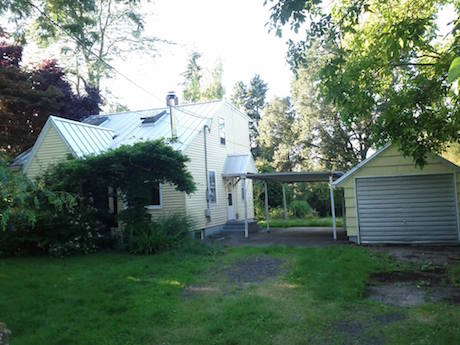
Located right outside Portland, OR, the house is an exercise in creative reuse. Nearly all of the materials used were reclaimed. And the structure itself has seen many lives. From Helgerson’s website:

It was first built in the early 1940s as part of Vanport Village; a quickly erected development built to house shipyard workers. When Vanport Village flooded in 1948 this particular little house was floated down the river to Sauvie Island, where it became the goose-check station. Years later it was remodeled to become a rental house.

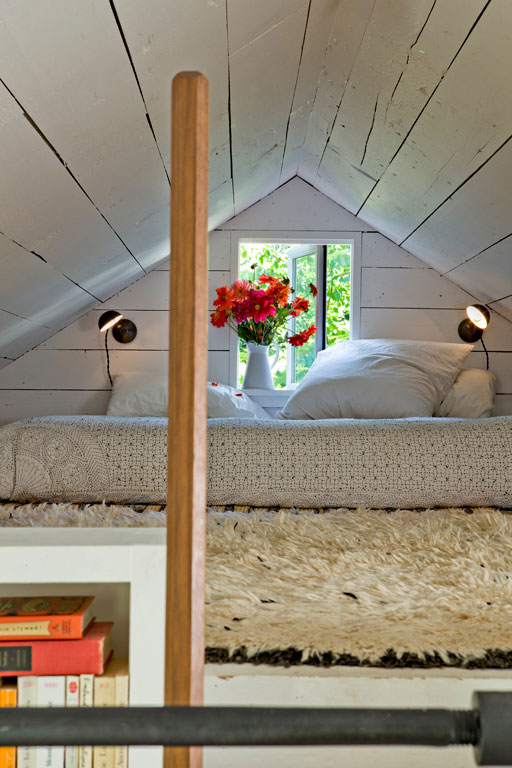
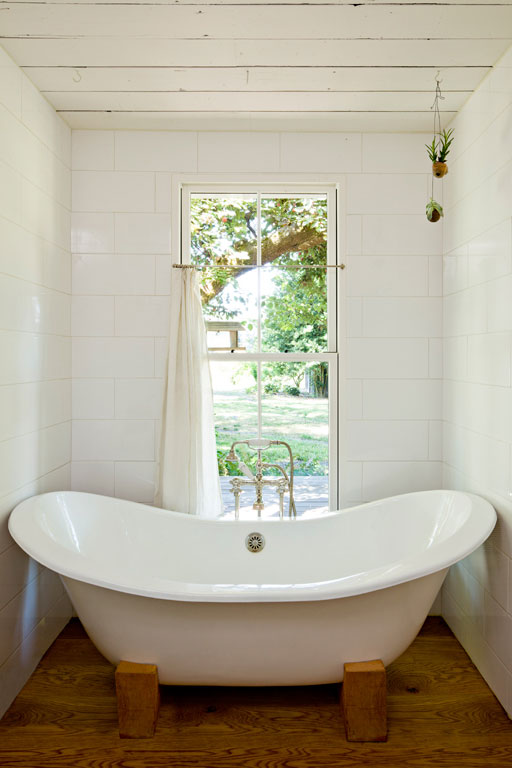
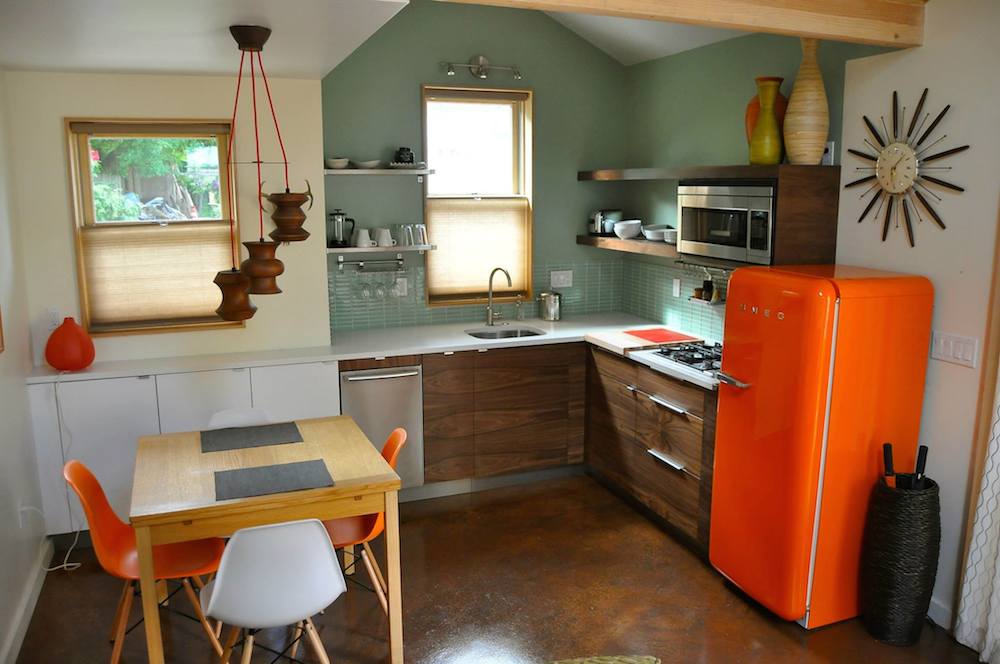
The house centers around a great room, which has the kitchen, a dining area and lounge area with two custom built sofas that double as guest beds and have storage in their bases. The house’s one bedroom is occupied by the kids, who have built in bunk beds. Both the kids’ room and bathroom have low ceilings to accommodate an overhead loft where the parents sleep.

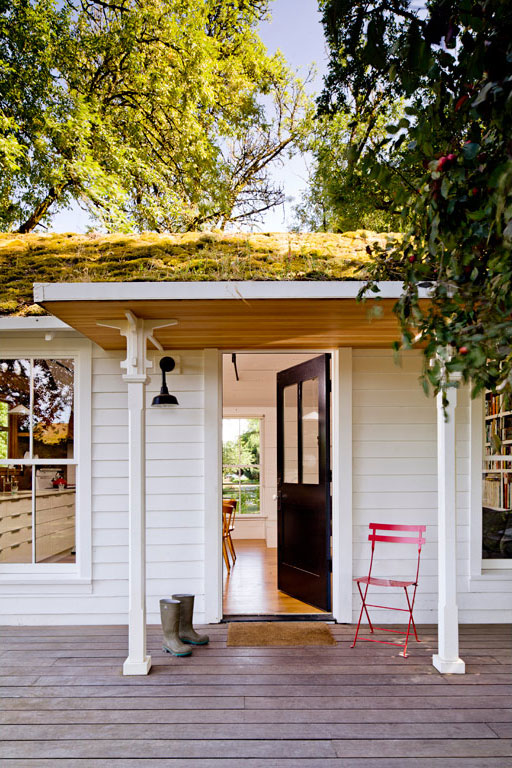
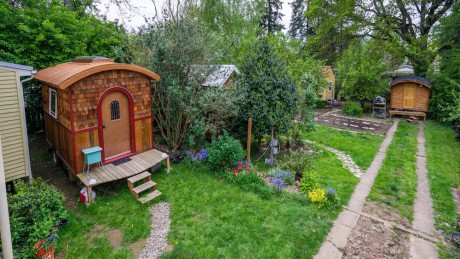
Outside, Helgerson and her husband installed a lush green roof and they are also trying their hands at food self-sufficiency with a large outdoor garden as well as a 1200 sq ft greenhouse on the property.

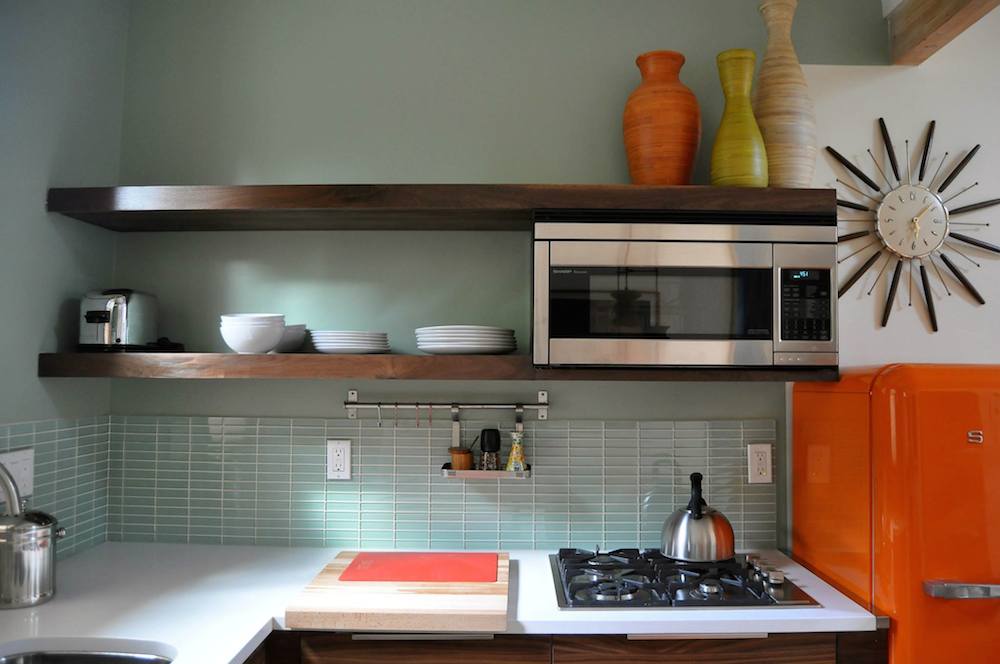
With its space efficient design and cohesive, but unfussy, furniture and material choices, Helgerson’s house is a great example how, with a bit of thought and consideration, a little space can go a long way.

There Is More than One Way to Skin a Tiny House

One of the bigger charges against tiny living is the lack of variance in style. You either have your stark and modern high end micro apartment in the city or your hyper-traditional, wood-clad tiny house out in the sticks. Well, if you want your micro with a little bit of spice, look no further than Anita Flower’s Moroccan-flavored tiny house in Portland, OR (where else?). The 248 sq ft, trailer mounted home is brimming with color and personality.

Anitas-Lilypad-Tiny-House-stairsAnitas-Lilypad-Tiny-House-caravan

The house, which was built by Small Home Oregon, has 11’ high ceilings at its highest point, making it feel spacious, but also permitting split levels on both ends of the of the house–one side being split between the bathroom on first floor and sleeping loft on top; the other side split between an office on the first floor and a Bedouin tent style lounge area on the top. In the house’s center are the kitchen, dining area and storage.

The place is way more than funky looks. It was constructed from 30% salvaged materials and is designed to be used either as on or off grid. There’s a host of eco-friendly features including a rain catchment system with 55 gallon reserve tank. There’s also 35 gallon freshwater storage tank over the sleeping loft that sends food-grade water to the kitchen. Electricity is generated by a 980W solar array on an elevated rack. Heat either comes from high efficiency, 450W Envi electric heater or a tiny stainless steel Dickinson Solid Fuel wall-mounted heater. And of course there’s a Nature’s Head composting toilet.

lily-pad-exterior

Flower is using the home, which she has dubbed Lilypad, as both residence and educational tool, running tours and workshops about low-impact living. Find out more at lilypadplanet.com.

A Very Big Idea in Tiny House Living

Make fun of Portland all you want, but few American cities (probably none) are showing more creativity with their zoning in order to provide affordable, transit friendly housing options. Their liberal policy about setting up tiny houses in backyards as ADUs is particularly unique. For all the hype surrounding tiny houses, actually living in one is near impossible in most cities, at least if you want to keep Johnny Law off your tiny doorstep. Without worrying about legal issues, it’s a lot easier to start thinking about how to best exploit the merits of tiny house living, which is exactly what Portland’s Simply Home Community is all about. With the help of tiny houses, seven people have figured out an ingenious way to convert a standard single family home into a highly efficient, community-centric living situation.

What’s most interesting about Simply Home is the obviousness of the idea (albeit one that’s typically sidelined by zoning issues). The idea is to park a bunch of tiny houses in the backyard of a single family home. The home will both house people and provide common spaces for the tiny house dwellers. The format provides a fair degree of privacy and autonomy (at least for the tiny house dwellers) and the big house provides shared amenities for all.

simply-home-house

At 1450 sq ft, the big house isn’t all that big, but it still houses three people and provides a communal kitchen, living, dining and guest rooms, laundry and bathroom. In the backyard, there are four tiny houses along with a community garden and there are plans to build a hot tub.

The community is rooted in the co-housing model, where several houses band together to share resources and make a distinct community. There are weekly meetings, rules and so forth. There are also community potlucks, movie and game nights. The house and property are owned by two of the community residents, though there are plans to convert it to an LLC structure.

Simply Home seems like one possible solution for transforming the low density, inefficient living that more or less defines American housing. By creating micro-communities inside existing housing stock and infrastructure, we can add density, reduce carbon footprints, save money, meet more people, have more fun.

See and read more on Treehugger

Images via Tiny House Giant Journey

Tiny House Conference Coming to Portland Later This Month

There’s little doubt that tiny houses have caught the public imagination, if not widespread municipal zoning board approval. One place where the approval–both in its citizenry and legislative bodies–is Portland, Oregon. So it’s only fitting that the city would be hosting this year’s Tiny House Conference April 18th and 19th.

Tiny-house-conference

Because tiny house construction, zoning and living is such a tricky proposition, it makes sense that those interested in taking the tiny plunge would want to share their collective wisdom. The two day conference has a program that covers the practical aspects of tiny house construction with sessions like “Designing Your Own House” and “Finding Land”. Also covered are more lifestyle-y topics like “Tiny Living” and “Small Space Organization.” I suspect that tiny house enthusiasts–i.e. those enamored with the lifestyle and are considering it for themselves–will far outnumber tiny house dwellers–i.e. those who are actually living in one of the little places. The program seems to be shaped accordingly. Of course there will be tiny houses on display as well, and you can get comped if you bring your tiny house.

The conference costs $300. If that’s too rich for your blood, there’s also an “Tiny House UNconference” on April 17 that only runs $12 for a whole day–because, well, the other conference was too big.

H/T to Gm.

via Bizjournals

Small, Stylish Home Takes Over Garage

We’ve expressed our love of the accessory dwelling unit (ADU) in the past. To us, they represent a great solution for adding density to more spread-out, car-intensive, suburban areas–a vitally important conversation in the micro-housing world. We ran across this little Portland ADU on Tiny House Talk, which to us demonstrates how nice these little places can be. The 508 sq ft home, dubbed PDX Eco Cottage (not to be confused with the workout routine) began its life as a garage. With the help of Jack Barnes Architect, owner Susan Moray converted the space into a very stylish, usable, sustainable home.

The house features a full kitchen, bathroom and separate bedroom. It achieved an Earth Advantage Platinum certification, a point system that evaluates a home’s indoor air quality, responsible use of natural resources, land protection and low water usage. The whole project cost $110K plus quite a bit of Susan’s labor, according to Jack Barnes. While not necessarily cheap, it’s less expensive than comparable quality homes in the area (the cheapest thing we could find was $444K, though it was much larger).

Susan built the home using Portland’s new short term rental permit for ADUs and you can stay at the place as a vacation rental. She told us that she built the cottage with the idea of living there when she’s older, with her daughter living in the front house where she currently resides. The home seems more than adequate for full time residency and we hope places like this start punctuating suburban landscapes, providing sensible housing in otherwise underutilized spaces.

Via Tiny House Talk

Is Portland Getting Ready for a Tiny House Revolution?

Necessity, as the saying goes, is the mother of invention. The necessity in Portland–not to mention many other places–is housing the homeless and other economically marginalized citizens. The invention is the formation of low-cost tiny house communities throughout the city to house them. Ok, perhaps they didn’t “invent” the idea per se–we’ve seen it before with Quixote Village in Olympia, WA–but doing it on the scale Portland is thinking is novel.

The conversation about creating low cost tiny house communities has been building for a while now. For the last several months, a nonprofit initiative called Micro Housing Concepts has been trying to find a home for its tiny house communities, which calls for 192 sq ft tiny houses manufactured by a company called TECHDWELL. According to TECHDWELL’s website, the houses can be built in two to four days and assembled with basic hand tools and little to no construction background. They can be made of reused and recyclable materials and upgraded with features like composting toilets and PV cells.

Michael Withey, founder of MCW, has developed a plan where 25 of the TECHDWELL tiny houses could be built on about half an acre, with each unit costing $15,000 to $35,000, sums that include land costs. He contrasts this with the Bud Clark Commons, a recent low income housing development built in Portland, which had a per unit cost of $253K.

Monthly rents at the tiny house communities would only be $250 to $350, making them affordable, Withey believes, for people making $7,000 and $21,000 per year. Withey told us that half the rents collected will go back into the micro community for maintenance and improvements while the other half would fund the next community, making them not only self sustainable, but self replicating as well.

Withey told Willamette Week that the communities are “not necessarily a homeless project,” but “a homeless prevention project,” saving people who earn small incomes from hitting the streets; though their very modest rents would likely make them accessible to homeless populations as well. Renters would not be required to furnish income verification, though they would undergo background checks and the community members, like those at Quixote Village, would have to abide by agreed upon rules.

The big news is not necessarily architectural or even economic, but legislative–this latter factor is typically the biggest hurdle to building tiny. Portland mayor Charlie Hales is reportedly “infatuated” with the idea, and his director of strategic initiatives, Josh Alpert, told the Oregonian that it’s not a matter of if the communities will happen, but when. City representatives say they are putting the project “on the front burner” and there are plans to ask TriMet, Portland Public Schools and Multnomah County to share their surplus land inventories for possible sites for the communities. The mayor’s office has also organized a task force to investigate the legal and zoning challenges of making the micro-communities a reality, according to the Oregonian.

The communities would help some of the more than 2K known homeless Portlanders, but Withey sees the them expanding to include all types of demographics, telling the Oregonian that there could be veteran, family, single mother and senior communities as well–not to mention people who might want a simple, affordable home. With their low cost, quick startup times (Alpert hopes the first micro-community can be in place by as soon as February 2015) and supportive government, it’s easy to think that the tiny house communities could quickly proliferate. We’ll keep you posted as this story unfolds and check out Micro Community Concept’s Facebook page for more regular updates.

Cutting the Housing-Car Umbilical Cord

Whether you’re aware of it or not, most homes–or to be more precise, “dwelling units”–require parking. Meeting these requirements is not a big deal in low density suburbs with their copious amounts of space for driveways and garages. But it’s a big issue in high and medium density areas, where real estate developers might only be able to build as big as available parking spots permit. These requirements can put residents looking for affordable housing in a pinch. Making housing density low in desirable areas dwindles housing stock, driving housing prices higher. Alternately, developers must create off-street parking to satisfy requirements; the expense of those parking spaces trickles down to residents.

“The single biggest impediment to main street development, lower cost housing and midrise development is the parking requirement,” architect and Treehugger.com’s managing editor Lloyd Alter told us. “A parking spot costs a fortune to build and needs a big enough site to get all the ramps in,” he adds.

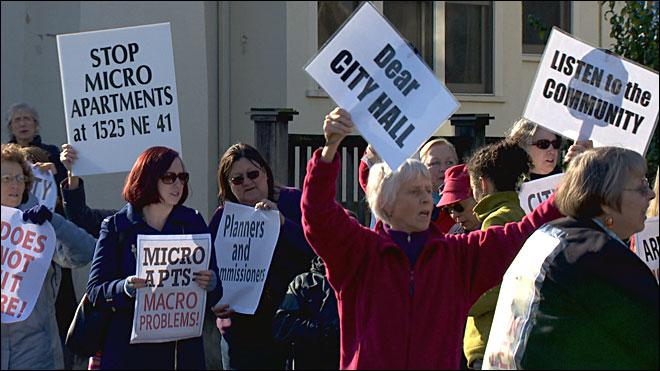
Portland, Oregon is one city that’s very familiar with this issue. More specifically, Portland’s recent crop of micro-apartments have created a situation where residential population density is outpacing available parking spaces, at least as that proportion relates to conventional dwelling unit to car ratios. Development has continued because of zoning loopholes, but like Seattle, existing residents have been up in arms; they are taking to the streets because those streets might have fewer parking spaces.

Some are proposing to cap the number of parking permits issued to micro-apartment buildings. According to the Portland Tribune who interviewed several Portland developers, this idea would solve the city’s parking woes. Alter agrees, “Limiting the number of parking permits is a perfectly reasonable strategy; The NIMBYs [not in my backyard] get to keep their spots, the NEWBEs know in advance that they don’t want to live here [Portland] and own a car without spending more money on some distant garage.”

On the surface, this solution might not seem like such a big deal. Many buildings have fewer parking spaces than dwellings. But these tend to be in high density places like San Francisco and NYC that have robust public transit systems. This is a bigger deal in a medium density city like Portland where 72% of residents still own cars. Implicit in the idea of a parking cap for micro-apartments is that how we live and how a neighborhood performs can be affected be housing type–by adding density and removing cars, micro-apartments might shift a neighborhood from being mostly low-density and car-centric, to higher-density and bike/walk/car-share/bike-share reliant.

But all of this requires new thinking on the part of regulators.

“I think that the extra density that comes with micro-apartments absolutely has to be accompanied by a revised concept about parking requirements,” Sarah Watson, Deputy Director of Citizen’s Housing and Planning Council (CHPC), a NYC housing advocacy group and think-tank, told us. She also said that “public transportation has to support those residents” or there should be “well-managed options for car sharing as part of the projects.”

Patrick Kennedy has been dealing with this issue for decades. He is the Bay Area developer behind SmartSpace as well as an upcoming, 160-unit micro-apartment building in the Mission district. “I think it is a fair compromise,” he says of giving up parking for high density, convenient living. “I did one development that had 6 parking spaces for 35 units and it didn’t cause any problems,” he told us.

Granted, most of Kennedy’s development were in places like Berkeley, which have a density twice that of Portland. But he sees the trend that Watson alluded to. “We’re moving in this direction [away from requisite parking]. In the age of Uber and bike-sharing, living without a car just isn’t that big of a sacrifice.”

Alter sees this shift away from car dependence and more reliance on alternative transportation strategies. “Fewer and fewer people who live downtown own cars. They don’t need them in their daily routines and Zip cars and car 2go are available when they do.”

He points to a new building in his Toronto hometown as a prime example of this trend. “They just built and sold a 300 unit condo without a single parking spot, in a part of town with no permit parking. They threw in 5 Zip car parking spaces and a bike locker. This is the future of development downtown.”

Watson noted something that goes beyond no permits. “I heard recently that a new micro-apartment building in DC that makes residents sign as part of their lease that they will not have a car…taking the idea even further!”

We’ve said it once and we’ll say it again: cars and the sprawl they support have costs. There are social costs, huge environmental costs, even costs to our economic wellbeing. Historically, these costs have been hidden by entitlement–that having a big home, car and the infrastructure to support these things are inalienable rights. But as we as a culture shift our ideals from space, stuff and privacy to convenience, mobility and connection, we realize we no longer want to foot the bill for these costs. It is our hope that regulators will make it easier to shift to this new way of living, removing parking regulations where and when they don’t make sense.

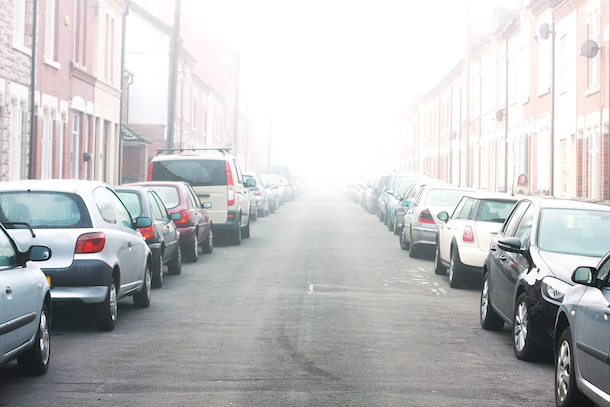
Misty street with parked cars image via Shutterstock

Small Rooms Lead to Big Row

Apparently, strong coffee and grey skies aren’t the only commonality between Seattle and Portland. Like its northern neighbor, Portland has jumped on the micro-apartment bandwagon. More specifically, Portland is mirroring Seattle’s boarding-house style micro-apartments (often known as aPodments, which are actually the name of apartments developed by Calhoun Properties, not a general term). These apartments typically feature very small units (150-300 sq ft), a kitchenette, a shared kitchen and a personal bathroom rented at a low, all-inclusive price (often below $1000).

Just like Seattle, some Portlanders are up in arms about the perceived effects of these dainty digs. The issue, once again, is parking. Right now there are two developments causing the stir, both being developed by Snohomish, WA’s Footprint Investments. One is under construction in northwest Portland and another is looking for city approval in the northeastern Hollywood neighborhood. The apartments, enjoy a “group living” designation–the same as dormitories, monasteries and convents. As such, they are not required to provide a set amount of parking spaces. The threat of lost parking in the neighborhoods has spurred protests.

We can’t help but think this is another case of NIMBY-itis. Everyone loves the idea of more walkable and bikeable neighborhoods. They love the idea of housing that supports public transportation (both developments are close to transit hubs). And they love the idea of building space and energy efficient housing. But when these ideas include the possibility–not the reality, mind you–of fewer or further afield parking spaces, people seem all too willing to squash those ideas.

From the outside, it seems like micro-apartments are a decent solution for a city with 3% vacancy rates for rentals and whose rents have increased 6-7% in the last four years. They also seem like a decent solution given the fact that even though there was a big hullaballoo about parking in Seattle, there were few reports of parking being a real issue. Most people live in micro-apartments to save money; the buildings are situated in central locations, making it easy to get around by foot, bike or public transport, thereby avoiding costly car ownership. Most Seattle micro-apartment developers claim that only 10-20% of their residents have cars.

Just so we don’t seem like blind advocates to micro-apartment living, some regulation is probably in order. Most of the residents of these developments will not be monks and nuns. And while Portland’s public transportation is probably great for a city of its size, it’s not on par with larger metropolises like NYC or Seattle; cars, for some, are a practical necessity. In short, there should be some accounting for parking. But this can be a future-based conversation. Why not wait to see if any problems actually crop up? The city of Portland seems to think this a sound tack. Elizabeth Hovde of Oregon Live reported this:

When I asked Joe Zehnder, a chief planner for the Bureau of Planning and Sustainability, about whether the definitions will be updated to better accommodate micro-housing, he said, “We need to see how this type of building performs. So we have nothing underway.”

Not to seem too insensitive to the plight of these Portlanders, but what if the micro-apartments reduce the number of available spaces in these neighborhoods? What if people had to walk a little further to and from their cars? As someone who has owned a car in NYC, I know that making parking difficult makes you far less inclined to drive. It makes walking, biking and using public transport far more attractive. These consequences, which support personal and planetary health, seem like questionable foes to fight.

Take a Tiny House Vacation

You’re not a true minimalist if you don’t have a tiny house fantasy. You have it all mapped out: You’ll quit your job. Next, you’ll get rid of your current home and all your possessions except a spoon, pocket knife and a pair of convertible shorts. You’ll build your own tiny house out of scrap materials, except for that  top-of-the-line composting toilet you’ve been lusting after. You’ll set up on some kindly benefactor’s unused land. You’ll raise chickens and your own produce. You’ll make the paltry sum of money you need to survive by fishing out pennies at local fountains.

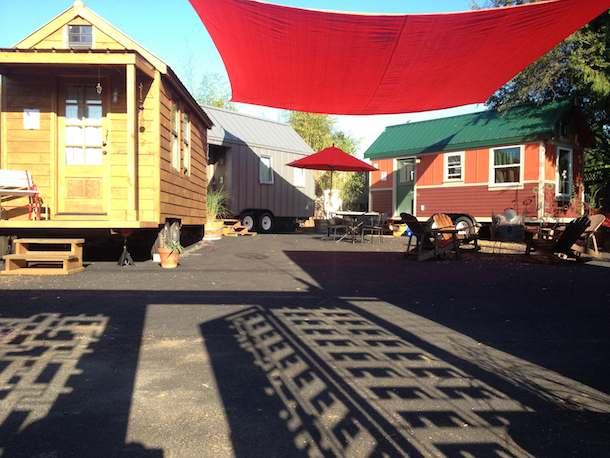
If this is your fantasy, a new hotel called Caravan in downtown Portland, OR (where else?) is giving you the opportunity to test-ride tiny house living before selling your home and kids. All of its three “rooms” are actually 100-200 sq ft tiny houses.

The rooms are not off-grid; they are outfitted with municipal electric and sewer service. And the short stay and concrete lot are not chicken-hatching or produce-raising friendly. And it’s a bit too steep to pay for with scavenged pennies: Nightly rates are $125/night, which includes your tiny house, cooking equipment, bedding and ear plugs (they warn that their central location can be noisy until 2am).

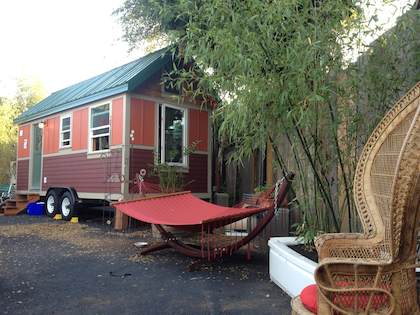
caravan-tiny-house-hammock

Two of the houses are big enough to fit 2-4 people and the other 1-2. There is a big courtyard at the center of the Caravan complex for chilling out and the occasional performance.

Like the rentable Airbnb tiny houses we looked at a while ago, Caravan gives you a low-commitment opportunity to affirm or squash your tiny house fantasy.

Find more info at Caravan’s website.

They Don’t Get Any Tinier Than This…But No Solar Panels?

We love tiny houses. The trailer-mounted dinky digs, often less than 100 sq ft, epitomize the spirit of doing more with less. This video shows off one woman’s tiny house that’s a wonder of sustainability and the tiniest we’ve ever seen.

The 2 minute parody was actually made by Dawn Jones for the Portlandia Film Festival in Portland, Oregon (not affiliated with the TV Show FYI). While it pokes fun at the tiny house movement, while “made with great affection for the movement.” The affection shows.

via Treehugger