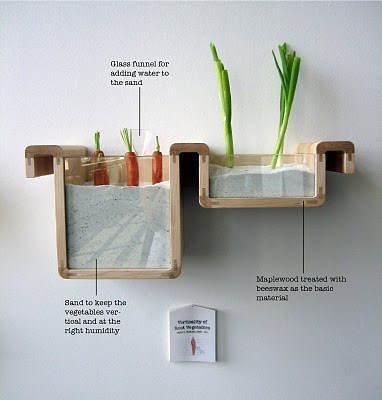
Korean Designer’s Simple Solutions for Ditching the Fridge

Refrigeration for small kitchens can be tricky. Typically, you have your choice of a humongous full-size fridge or tiny dorm-room model. The former tend to be around 80″ and the latter 30″. Often people trying save space opt for the smaller one, whose size, if you cook a lot, is maxed out quickly.

In the quest to preserve perishables, the question may not be how to increase refrigeration capacity, but how to do without it. An article in Treehugger shows Korean designer Jihyun Ryou‘s systems for preserving food without refrigeration.

Many of her solutions are designed around how perishables actually behave–behavior that often runs counter to our suppositions about the need for refrigeration. For example, many fruits release ethylene when they ripen. When we put them in a refrigerator’s sealed box, it actually traps the ethylene and accelerates spoiling. Accordingly, Ryou’s apple storage system exposes apple tops to the open air so they release ethylene. The ethylene serves the other purpose of preventing sprouting in potatoes, so the bottom half of the apple faces a dark box where potatoes are stored.

According to Ryou, “keeping roots in a vertical position allows the organism to save energy and remain fresh for a longer time”–so she puts carrots and scallions in wet sand to keep them vertical and maintain optimal moisture.

Americans are about the only people who refrigerate eggs; Ryou’s egg storage leaves them out and features a bowl to submerge eggs to test their freshness (a fresh egg will sink).

In days of yore, necessity dictated that people learn how to preserve food without refrigeration. While refrigeration is a great thing for many varieties of food, there are many instances where traditional food preservation techniques are equal or superior to refrigeration. Now Ryou gives these techniques a modern spin. She shows how a dorm fridge might suffice for even the most ardent gourmand.

Do you have other suggestions for doing without refrigeration? Let us know.

This post originally published June, 5 2012.

Via Treehugger

Image credit Jihyun Ryou

My Genes Made Me Keep It

From the perspective of evolutionary psychology, there’s a certain logic to being materialistic. In the olden days, folks couldn’t just run to Target and pick up a hypo-allergenic full-sized duvet. You had a few shots a year to hunt and skin that buffalo, otherwise you’d freeze the rest of the year. Accumulating more than we need and keeping those accumulated objects to ourselves, thereby providing for lean times, makes intuitive sense. In other words, we might be hardwired to accumulate. The only difference is that now our objects of accumulation do not stand between life and death.

This logic might not be true however. A recent study suggests that people living closer to subsistence levels might be less inclined to accumulate. The study in question sought to test something called the “endowment effect”–the overvaluing of the personal objects. Psychologist Tom Wallsten at the University of Maryland told NPR the effect is similar to the man who won’t drop the price of his house even though it’s not selling for months. He needs to sell it, but because he values it more than others think it’s worth, he holds onto it. NPR science correspondent Shankar Vedantamit, said that the effect dictates that it “feels worse to lose something than it feels good to gain something.” We would say it’s also like people who do not rid themselves of stuff they do not use because they are “too valuable” to get rid of, despite the expense and headache associated to holding onto them.

Coren Apicella, a researcher at the University of Pennsylvania, realized that the endowment effect was mostly proved by testing the behavior of college students–a demographic whose cultural biases might blare out any meaningful information about innate dispositions toward accumulating stuff. She observed the patterns of the Hadza people of northern Tanzania, some of whom were nomadic hunter-gatherers living at subsistence levels; other Hazdas observed lived in villages with market economies.

What she found was that the nomadic Hadza, people with virtually no possessions, rather than being highly acquisitive, were very easily induced to give up their stuff. Apicella explains why:

If you think about, you know, you’re a hunter-gatherer, you’re living a hunter-gatherer life, one possible reason why it doesn’t hurt as much to give things up is that you’re constantly having to give things up all the time. People are asking them for–from you, you know, demanding them from you, demanding that you share. Things come and go in hunter-gatherer life. You don’t even own that much to begin with.

Vedantam expanded to say that in a nomadic society, it is essential to give things up because the person you give to might have something valuable tomorrow to give to you.

Meanwhile, the village-dwelling Hazda who bought stuff from markets were more acquisitive than their nomadic relatives. Vedantam said of the villagers that they “were more like us [Westerners presumably]. They fell in love with their possessions because modern economies allow people room to be selfish.”

Same genes, different cultures, different attachments to stuff.

Sometimes changing the patterns of consumer behavior seems nearly impossible. Not only are we up against a behemoth economic system whose mission is to compel us to buy more stuff than we need, we are up against the culture that has sprouted around this system–a culture that accepts hyper-consumerism as the way thing are and will be. The Hazda example might be a glimmer of hope, suggesting that while we are battling marketers, bankers, politicians and even our friends and neighbors, we are not battling our biologies.

Via NPR

image credit:  Matej Hudovernik / Shutterstock.com

What Will You Buy this ‘Buy Nothing Day’?

While large swaths of the American population ready their sleeping bags for Black Friday, with its midnight store openings and 99 cent flat-screen TV’s, another population is sleeping through the night, honoring Buy Nothing Day (AKA “Occupy Xmas”).

BND is an anti-consumerism response to Black Friday, the Friday after Thanksgiving often regarded as the busiest shopping day of the year (November 29rd this year). Wikipedia says this about the BND’s origins:

The first Buy Nothing Day was organized in Mexico in September 1992 “as a day for society to examine the issue of over-consumption.” In 1997, it was moved to the Friday after American Thanksgiving, also called “Black Friday”, which is one of the ten busiest shopping days in the United States. In 2000, advertisements by Adbusters promoting Buy Nothing Day were denied advertising time by almost all major television networks except for CNN. Soon, campaigns started appearing in the United States, the United Kingdom, Israel, Austria, Germany, New Zealand, Japan, the Netherlands, France, and Norway. Participation now includes more than 65 nations.

Adbusters, a subversive anti-consumerism magazine with serious design chops, is promoting a number of BND activities such as Credit Card Cut Up, where you stand in a mall and cut up credit cards (yours and anyone else who’s game); Zombie Walk, a walk around a mall dressed as a zonked-out consumer zombie; and Whirl Mart, a listless conga line scooting around big box stores, driving empty shopping carts.

A less incendiary way of celebrating BND is to, well, buy nothing for that one day that you are expected to buy.

For the less-activist leaning, BND might seem like a middle finger to the status quo. This is true to some extent. Even if you don’t want to extend that longest of fingers, another way to look at the event is an opportunity to question your consumer habits. This holiday season, before we purchase, we can ask ourselves do I need to buy this? What is the impact of this purchase (for my own finances, for the environment, etc.)? Can I give another way like SoKind or Francine Jay’s “One Less Gift Certificate“?

One of the major issues with consumerism–one that BND tries to counteract–is not that shopping is intrinsically bad, but that we have been programmed to consume by advertisements. BND, Jay and others are trying to say that the holidays and even gift-giving are not inseparable with shopping and stuff.

How are you celebrating the holidays in non-shopping ways? Or what are you shopping for that takes shopping and gift giving off auto-pilot into a meaningful exercise? Let us know in our comments section.

This post originally published November 21, 2012. The dates have been updated to reflect this year’s BTD. 

Is Your Home Just a Place to Store Stuff…While You’re Getting More Stuff?

In this lecture, philosopher George Carlin expounds on such topics as the meaning of life (A: finding a place to put our stuff) and the nature of residential architecture (A: creating a place to put our stuff). He even makes the bold declaration that if we didn’t have so much [expletive] stuff, we wouldn’t need homes. We “could just walk around all the time.”

In this it’s-funny-because-it’s-true riff, Carlin highlights how our lives are often centered around the stuff we accumulate, begging the question: what would your life look like without so much stuff? If you had less stuff, could you have a smaller, more manageable, less expensive home? With that less expensive home, might you be able to choose the type of work you want rather than the type needed to afford the house and all its stuff? Might you have more savings and free time? As Tyler Durden from “Fight Club” puts it, might the stuff that you own, own you?

What do you think?

This post originally was originally published in March 2012.

The Perfect Friday Night Date Movie

Prep the popcorn and get ready for some hardcore entertainment. “Consumed,” a recently-released movie by Journeyman Pictures (not affiliated with the Journeyman featured on this blog recently), is sure to be this summer’s blockbuster hit.

Or not.

Unlike most (or any) blockbusters, Consumed is a thought-provoking documentary that tries to unearth the root causes of pathological consumerism. Through narration and interviews with consumer and psychology experts, Consumed drives home the point that consumption and the marketing that fuels it is the byproduct of misplaced evolutionary imperatives. The psychological emphasis is what really separates Consumed from other movies on the topic like The Story of Stuff, which focus primarily on the environmental and human rights impact of consumerism.

True to its subject, the bulk of the movie is a real downer, with some experts saying we as a species are hardwired to consume until we run out of things to consume (see Easter Island).

But there are sunnier perspectives expressed in the film; chiefly that our unsustainable consumer culture is but a drop in the bucket of human evolution; that for millions of years we have lived in a state of equilibrium with the earth and this last 70 years or so will be a temporary “what-the-hell-were-we-thinking” period of species maturation (our words, not theirs).

Whether the future holds a consumer heaven or hell remains to be seen. Either way, something’s gotta change. Hopefully, movies like Consumed will move the conversation forward, expressing both the self-evident perils of the present as well as the potential for a future not characterized by mindless and lethal consumer behavior. Give it a watch.

Via Treehugger

3 Principles from Burning Man for Living An Edited Life

Unless you’ve been living under a big, not-so-black rock, you know at least something about Burning Man. Beginning the last Monday in August in the desert of northern Nevada, the week-long extravaganza has become synonymous for all things crazy and spontaneous.

But underneath the irreverence and incomprehensibility are lessons we can all take home–lessons that make life simpler, more functional and happier. Here are a but a few:

  1. Use what you need.  You think different about consumption when you have to port a week’s worth of stuff in and out of the desert. Ask yourself, “What if I had to pack everything I needed to live for a week into a car?” Would you take that apple peeler or might you use a pocket knife? On the other hand, we might decide that we can’t live without that 104 ft effigy. This use-what-you-need principle also applies to the amount of space we need. Personal space is a joke at BM, yet people live joyfully together. This is not to suggest we give up personal space altogether, but it might suggest that we often put too high a premium on it and undervalue personal connection via physical compression.
  2. We have what we need when we share. Burning Man is almost totally non-commercial, relying on a “gift economy.” People exchange food and wares (and many other things) without a single dollar changing hands. Back at home, your neighbors might get sick of you mooching dinner every night, but they might not mind lending you their muffin pans or power drill. Sharing enables human connection and less stuff to be used more.
  3. Architecture is anything you want it to be. You don’t necessarily want to live in a 120 ft hexagonal temple, but looking at the Burning Man structures shows that anything is possible with a little imagination. We are not bound to particular architectural rules and orthodoxies. We can create where and how we want to live in the future.

Are you a Burner? What have you learned from BM that makes your life simpler and happier?

image via JoJo Electro

This post was originally published on April 20, 2012  

This Hamster Should Win Nobel Prize in Economics

The Impossible Hamster is one of the most articulate treatises on economic growth and resource depletion we’ve ever seen.

At LifeEdited, we try to stay happily apolitical. We think living a less, but better way of life has self-evident benefits. Our lives are simpler, less expensive, more manageable and so on.

But there are global benefits as well. Not to over-simplify a complicated topic, but if every member of the world’s population started lining up his and her consumer behavior with actual needs and priorities, we might start a course-correction from the current trajectory of economic and environmental meltdown. The model of never-ending growth of consumption–whether that takes the form of consumer goods or housing or natural resources–will, in all probability, lead to a situation as dangerous as a 9 billion ton hamster.

Let’s Talk About Stuff Baby

Yesterday LifeEdited founder Graham Hill had an op-ed published in the NY Times. The autobiographical essay entitled “Living with Less. A Lot Less” tracked  his progression from late-20s, flush-with-dot-com-cash, consumer extraordinaire to minimalist exponent. He writes:

My success and the things it bought quickly changed from novel to normal. Soon I was numb to it all. The new Nokia phone didn’t excite me or satisfy me. It didn’t take long before I started to wonder why my theoretically upgraded life didn’t feel any better and why I felt more anxious than before.

At present, the article sits atop the NY Times most emailed and most read lists. Like the TED Talk Graham gave almost exactly two years ago–a talk that has received over 1.7M views to date–the message of living more with less is clearly on peoples’ minds.

Rather than transcribing Hill’s piece, we dug through the comments, highlighting and commenting on some of the major themes.

Desertwaterlily writes:

My son, daughter-in-law and their baby live in Brooklyn in a 700 sq. foot condo. It’s very crowded and not functional. They know it can be made functional but they don’t (as yet) have the money or resources to do anything. I agree with you about living close to the bone, but it takes more than wishing to move walls, build new working kitchens, electrical, shelving, etc. Sometimes it takes money to live a “simpler” life.

Desertwaterlily check out 8 Tips for Editing Your Life that Work for Any Budget. While it’s true moving walls cost money, there are a ton of things to simplify your life that require little or none.

Sonja writes:

I’m 82 and live on and with the barest of necessities, for the less I have, the better I feel. I regularly go through my small house wondering what else I can get rid of. Minimalism is soothing, aesthetically appealing. I sometimes fantasize about living in a cell like a monk – a cot, a table, and a window.

Knowing what I know now, if I had my life to live over, at the age of 18, instead of sitting around devising plans for a cluttered life, I would put a knapsack on my back and with my dog I would leave the house and just start walking.

Thanks Sonja for showing that this is not just a young man’s game.

MJones writes:

Most of the people responding to this article appear to have no children….I think it’s hard to live in small places with other people – children and adults – without separate sleeping rooms for them. Old people snore. Children are distracted by adult activities and truly need their own space to develop fully in western culture. A baby can sleep in the corner, but as they get older and play sports or pursue their own interests, they need space for their stuff and friends.

And Larry L also writes:

I noticed that the author does NOT have children and is NOT married. His life choice is highly unlikely to be replicated under different circumstances.

The “you-don’t-have-kids” argument comes up a lot. Neither Graham, nor anyone at LifeEdited suggest that everyone should live in 420 sq ft. Nor do we suggest the needs of a single person are the same as a family’s. Living with less might look like having ten toys instead of fifty or living in 1200 sq ft instead of 2500. And yes, this is written by someone with children.

MGM writes:

Great. If the one percenters stop buying lots of stuff and stop building lots of big homes where will that leave the rest of us? Our economy is fueled by overconsumption. The middle class cannot do it by themselves!

We’re not sure if MGM was being serious, but this argument does occur to many as a potential problem. First, we’d respond by saying that if we destroy our environment, there will be big problems for every class. And because domestic manufacturing is almost extinct, most consumer dollars flow to top heavy corporations and overseas producers; this situation has been thwarting the American middle class for decades now. What if Americans started buying less stuff they could keep for much longer at fair market value? What if our stuff was made by skilled, well paid workers (foreign or domestic)? We don’t want to overstate our economic chops, but we think it’s fair to say the current system is patently unsustainable and we are due for another model.

imadeamesss

That’s a nice article and all but I still want the Omega single auger juicer. It is a thing that I want.

Please, keep your juicer. No one is saying get rid of all your stuff. But what if we cared about everything as much as imadeamess cares about his/her juicer?

Sam93

I believe your insights resonate only with people who have money and who are capable of owning stuff. You have come a full circle with consumption and then simplification. You are still financially capable to accumulate stuff. Thus, it is no longer a thrill for you. For people who are working hard, owning stuff(e.g house, car, etc) is an indication that they have arrived at a certain stage to acquire what they wish. It is not always easy when one couldn’t afford something other people discard regularly.

Sam93 brings up a very good point. In many articles that focus on Graham, he is often charged with “easy-for-you-to-say”–that most people don’t choose less, but are forced into it.

There are certainly many people who cannot afford even basic items and no one is trying to minimize their plight. However, as Graham tried to convey, the stuff issue–as well as the inflated home one–affects those with even very small incomes. Big box stores and 99 cent stores and cheap housing, fueled by easy credit, have made torrents of stuff and space available to almost any income level.

What Sam93 says about stuff-as-status is astute. We live in a culture where consumer goods are used to demarcate success–even if they undermine our happiness and wealth. Whether the mainstream will every “choose” less–rather than being forced into it–remains to be seen, but we’re optimistic!

en D

I realized how little meaning “stuff” has when our house was on fire and my husband and I were frantically trying to save the lives of our pets. I realized later that neither of us had stopped to try to rescue a single thing: not jewelry, not computers, not even money itself. Only life mattered. That was over 15 years ago, but the message remains as vivid to me as it did that day.

Well said!

Image via Shutterstock.com

Comments via New York Times

Kick Your Stuff to the Krrb

Selling stuff can be a pain. Most us use one of several channels: Word-of-mouth, yard/stoop sales, Craigslist or eBay. Word-of-mouth is okay for stuff we want to dump, but many us have issues selling stuff to friends, particularly if we want to make money. Yard/stoop sales are a pain in the butt (dragging your stuff in and out, weather, etc) and they hit a limited audience, most of whom want to pay pennies on the dollar. Craigslist has great outreach, but often buyers are super-bargain shoppers and then there are scammers galore. EBay, for most of us, is a intimidating bazaar filled with cutthroat dealmakers.

A site called Krrb provides an answer for the non-professionals and small local businesses to sell their stuff easily. The site describes themselves this way:

Krrb (pronounced ‘curb’) is a hyperlocal, curiously global classifieds made just for you. A most epic scavenger hunt at your fingertips where you can thrift, scavenge, rummage and discover local treasures – in your neck of the woods or over yonder.

With over 24K users in 1130 cities, it beats word-of-mouth and yard/stoop sales; you can also keep stuff posted as long as you want. Unlike Craigslist, there are thumbnail pics of objects to see what you might want to buy. Also, everyone on the site must become a member, which is a great scammer-deterrent. Unlike eBay, there is no bidding; members can civilly negotiate prices if they so choose, but none of that last-second-outbidding that turns so many folks off of eBay.

Other features include a mobile app that shows Krrb objects in your area, a digest of stuff for sale in your area and Krrb Meetups (only in Brooklyn and Paris right now). Posting works on credit system. One post is one credit. Credits cost anywhere from $.50-1.00 (depending on volume you buy) and there are numerous ways of earning free credits (you get 10 free just for signing up). Visit their site to sell your stuff or buy some preowned holiday gifts.

My Genes Made Me Buy It

In this interview with Sociologist Gad Saad, he promulgates the idea that innate biological imperatives drive consumer behavior. Saad is the Professor of Marketing and the research chair in evolutionary behavioral sciences and darwinian consumption at Montreal’s Concordia University. He is also the author of the book, “The Consumer Instinct: What Juicy Burgers, Ferraris, Pornography, and Gift Giving Reveal About Human Nature.” His studies purport that consumer behavior has four primary, biologically-rooted drives:

  1. Survival
  2. Reproduction
  3. Kin Selection
  4. Reciprocal altruism

The survival instinct, he believes is the reason why the top restaurants across the globe–McDonald’s, KFC, etc.–sling high-fat foods. More fat = more calories = surviving on the tundra for an extra day.

The reproductive instinct, he claims, plays itself out differently with the different sexes: Women are wooed by high social value, while men focus on physical traits. He uses one case study as an example, where a man was placed in a beat up car as well as a Bentley. Women were to report on the physical attractiveness of the same man in each car. The man in the Bentley was consistently deemed more physically attractive, as the car–a sign of high social value–influenced their perception. Conversely, the same test administered to men with a woman in the car found the men indifferent to the type of car.

In the interview, Saad does not delve into the final two instincts: Kin selection and reciprocal altruism, described as the instinct to exchange gifts with family members and the instinct to offer gifts to close friends, respectively. But we can assume that these are the operative instincts during the holiday gift-giving season and the $253B gift-giving economy in North America, which accounts for 10% of all retail purchases according to Saad.

We’ve had various discussions about gift-giving and receiving, some of which have gotten pretty contentious. The explanation that any sort of prohibition or limiting of gift exchange is in direct opposition to a biological imperative does not seemed far-fetched.

What Saad does not do–at least here–is claim that marketeers intentionally exploit these instincts. Rather, he suggests these tactics are implemented because they appeal to instinctual motivation and are thereby effective. Another example he cites is a study that found young men were not dissuaded from smoking because it caused cancer, but were dissuaded when they were told smoking would make them impotent and hence compromise their reproductive capabilities. Behavior driven by instinctual drives like these, Saad suggests, win the day, and marketeers know that based on bottom lines.

The question we have is how do you promote sane consumer behavior–using what you got, buying what you need, buying quality–when the prevailing symbols of biological success are linked with excess? Can living with less be consistent with our survival or reproductive instincts? Can giving your family member a “One Less Gift Certificate” align with our kin selection instinct? Or are we hardwired to consume when the resources are available? What do you think? Let us know in our comments section.