Legalize Tiny

In December we posted about Walsenburg, Colorado, a tiny town that created a building ordinance to allow for the construction of a tiny house subdivision. As we’ve long noted, zoning is the biggest hurdle for tiny houses taking off as a widespread housing option. While most tiny houses are designed as permanent dwellings, they are treated as RVs in the eyes of building code; this classification means that the houses can’t be parked in a residential area indefinitely. While the Walsenburg news represented a step in a great direction, the fact that it was done in a town of 3000 people made it a bit easier to dismiss. But when a city of a half million people does effectively the same thing, it might harder to ignore. Fresno, California–the half million person city in question–recently passed an ordinance specifically permitting tiny house on wheels (THOW) as permanent dwellings.

The move is pretty unprecedented. “We are the first city in the nation to actually write into its development code authorization for ‘tiny homes,’ ” the city’s mayor Ashley Swearingen said. While tiny houses have cropped up in various places around the country, their existence was shoehorned into existing code, typically regulations concerning accessory dwelling units (ADUs). Making code that treats THOWs as a distinct housing typology might go a long way to legitimizing tiny houses across the country.

What’s also notable about the ordinance is its lack of restrictions. Here are the main criterion a Fresno tiny house must meet as pulled from the Tiny House Association of America:

  1. Is licensed and registered with the California Department of Motor Vehicles and meets ANSI 119.2 or 119.5 requirements;
  2. Is towable by a bumper hitch, frame-towing hitch, or fifth-wheel connection. Cannot (and is designed not to) move under its own power. When sited on a parcel per requirements of this Code, the wheels and undercarriage shall be skirted;
  3. Is no larger than allowed by California State Law for movement on public highways;
  4. Has at least 100 square feet of first floor interior living space;
  5. Is a detached self-contained unit which includes basic functional areas that support normal daily routines such as cooking, sleeping, and toiletry; and
  6. Is designed and built to look like a conventional building structure.

Aside from point #1, which Lloyd Alter at Treehugger says might cut out a number of DIY-built homes, the rules allow for real deal tiny houses–i.e. really small and self-contained. And unlike most of the California counties that permit tiny houses currently, Fresno does not restrict their use to caregivers. The tiny houses can be used by homeowners for their personal use or as rental property.

One thing that does not seem to be a part of this code is building only a tiny house or tiny houses on a lot of land (the tiny houses must share a lot with an existing home). That said, there is no shortage of single family homes that can play host to tiny houses. In fact, adding density to the existing, sprawled out single family housing infrastructure is probably the greatest promise for tiny houses movement.

All in all, this is great news and we look forward to continued deregulation of tiny houses and other innovative forms of housing that are aligned with how we live today.

Image via California Tiny House

It’s the Little Things That Make A Difference

Unless you’re living in some self-sustaining, off-grid detached house, the fact is that multifamily, multi-storey housing in dense, urban settings–ones that are walkable and have access to public transit–are going to be your best bet for green, low impact living. But here’s the deal: most Americans don’t live in this type of housing–single family homes make up 70% of the American housing stock, and while people may be migrating back into the cities, the vast majority of them can or will not move for various reasons. Which leaves the question: how can we make the single family housing–and the sprawl that tends to come along with it–greener?

A reader tipped us off to the east bay town of Albany, California, which, like its neighbor to the south, Berkeley, has become increasingly hospitable to accessory dwelling units (ADU’s), both as a way to increase density as well as creating an “aging in place” strategy; ADUs can let older, emptied nest adults inhabit small dwellings behind the big homes that they might have once used for their full houses. We found this nice example in Albany on Tiny House Listing of how one family, through the addition of an ADU, turned a fairly typical single family house into a mini compound that housed three generations.

While ADUs are often used to house older generations, this particular one, at least initially, was used to house younger ones. The house owner of 30 years, Judy, invited her daugher and her daughter’s partner and child to come back and live at home. Rather than shacking up in the main house, they built a simple, 442 sq ft L-shaped home where a detached garage and patio once stood.

judys-garden-cottage-1 Judy worked with New Avenue Homes to construct the home (they seem to do a lot of ADUs). Tiny House Listing said this about its construction:

The family considered sustainability and stylishness during design development. They opted for reclaimed and recycled materials, non-toxic paints, solar panels, a large bay window, stained cedar siding, bamboo flooring, and an exposed wood ceiling. The structure is L-shaped and sits in a far corner of their backyard. A garden and walkway connects the main home to the cottage. Construction took around 6 months.

For reasons not explained, the home is now used as a rental investment property, though Judy plans to move in when she retires in a few years, presumably to have a low fuss home with a large rental property helping to keep living expenses very low.

judys-garden-cottage-13

While inserting compact, multi storey housing in the millions of underutilized lots of American single family housing would be ideal, there’s pretty much no way that’s going to happen…at least any time soon. In the meantime, ADUs offer an elegant, livable way of increasing density in areas that might seem like they are immune to density. While Albany might not epitomize the American suburb (it’s near a BART station), Judy’s example shows how this can look, which, with its little pathway and garden, looks pretty good to us.

Dorm Living for Grown Ups

In the mid-aughts, Professor and architect Hector Perez of Woodbury University pooled together several faculty members to purchase lots of land in the Barrio Logan neighborhood in San Diego. Their hope was to create an extension to the school’s campus. But a variety of circumstances–crashing economies, the school’s decision to move to another part of town–derailed the plan. Rather than selling the land, the group decided to create something they thought would support the community. The result is a building with compact units that mix the privacy of a conventional apartment with the socially porous infrastructure of campus living.

7048hector_barriologan7022hector_barriologan

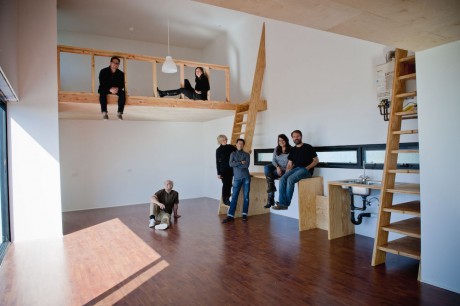
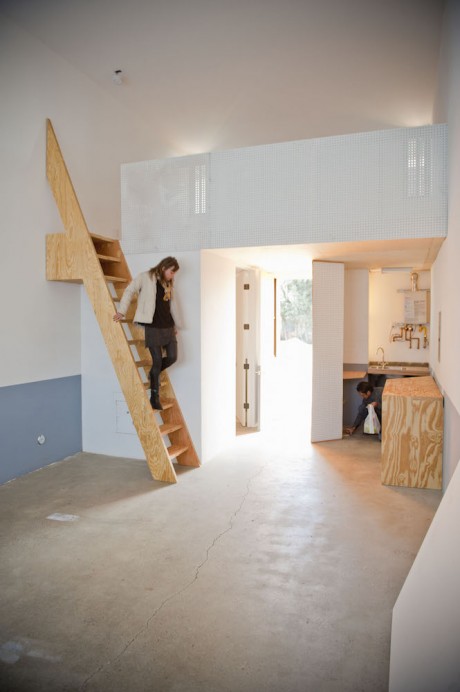
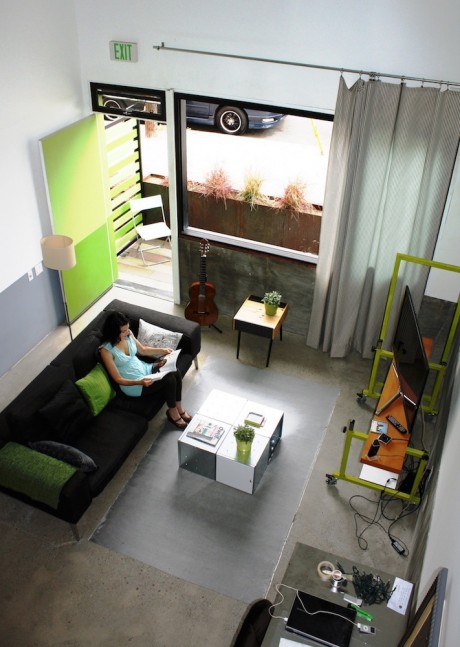
The building, dubbed La Esquina, has a total of eight live/work units making up only 4K sq ft of floorspace across two levels. The units, which are basically artist lofts with very high ceilings, range from 450 to 595 sq ft. They have a large main room that adjoins the kitchen and bathroom, above which is a sleeping/work loft. Some units feature a second loft. First floor units have street-level patios accessed by large sliding glass doors, making good use of San Diego’s weather. The upper level units have both shared terraces and their own private patio spaces.

La Esquina unit5a

The building was built for $130 a square foot, which is about $50 less than San Diego’s average cost for building multi-family homes. Perez and co achieved this by using simple, inexpensive materials such as board-formed concrete walls and plywood paneling. The interiors have a cool industrial chic look that is brightened up well by the ample windows.

IMG_0256

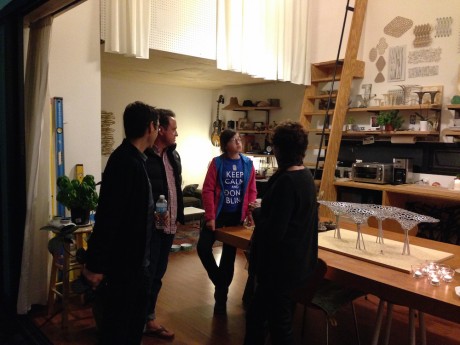
The tenants of the La Esquina are all current students, graduates, and instructors from Woodbury. According to a Dwell Magazine article about the building, tenants “meander into one another’s spaces to share meals, to collaborate, or to spontaneously gather in the afternoon,” making it ripe for creative collaborations.

IMG_9860

Many people speak of their days living in college dorms as some of their happiest. What dorms gave up in space and privacy was made up by built in social programming and conviviality. But as years progress, personalities and habits are forged, and people develop preferences as to how they want to live. The charms of shared living are supplanted by the desire for more control of their living environments. What’s great about La Esquina, from what I can see, is it retains many of the charms and infrastructural characteristics of dorm life, while providing the space and autonomy adults crave, all in a compact, efficient format. 

What’s Right With This Picture?

From above, this picture shows a fairly normal suburban neighborhood. There are large, single family homes, each with their own driveways, front and back yards. But if you look closely, right between N St and Lessley Pl, there’s a group of homes with irregular yards. Trees from one property cascade over onto the next. There’s some weird walkway system that flows unimpeded from one property to another. It’s tough to tell where one property ends and the others begins. These are the homes that make up the N Street Cohousing community of Davis, CA.

N Street began in 1986 when Kevin Wolf and his wife Linda Cloud purchased and brought together two adjoining houses. Eventually additional houses were purchased by other parties and brought into the community.

247328_178590218864666_4080711_n

In 1999, the Davis city council recognized N Street as a planned development (PD). According to the N Street website this had a number of community-building implications: “Sideyard setback easements were slightly more relaxed while the backyard setback was extended from ten feet to 30 feet. Construction of larger second unit apartments were allowed.” This permitted the melding of backyards as well as the subdividing of existing houses. Today N Street contains 19 houses with over 60 adults and 5-10 children depending on the year.

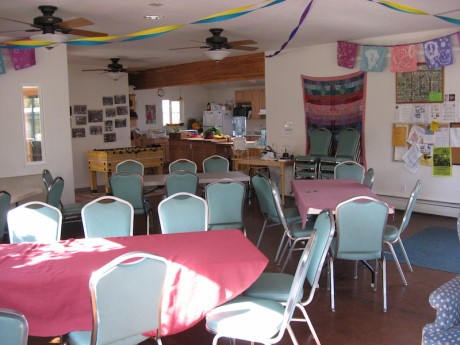
The initial house purchased by Wolf was made into a communal house, which has “a four bedroom-two bathroom apartment upstairs and the downstairs includes the community’s dining room (sitting 50 for dinner and 70-80 for concerts), a large kitchen, a TV/meeting room, a bathroom and a shared laundry room.”

IMG_0062

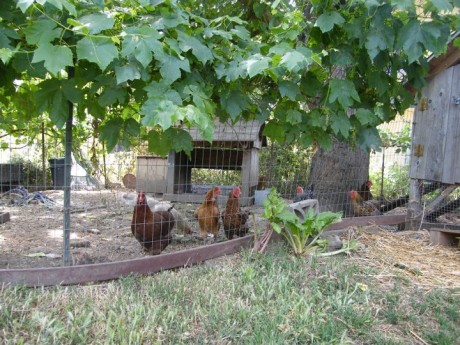
Though it might seem like a commune, all houses are individually owned and occupied, though some owners rent their houses out. And while there are no backyard fences, each house has its own yard that it maintains. Many, if not all, of the yards are landscaped and farmed. There are gardens, chickens coops and more.

Chickens

The main thing driving N Street is its culture of shared living and mutual support, of which the community says:

N Street Cohousing has all the attributes of a classic cohousing community. We live together as an intentional community, sharing much of the joys and pains of our lives with each other. We support each other in difficulty and celebrate in success. We sometimes vacation together. We have even been known to fall in love and marry each other. However, we live in our own homes and have our own yards (though without any fences). Each of us can be private when we want to be and each household sets its own culture for visiting, borrowing, and participating.

In cohousing parlance, N Street is deemed “retrofit cohousing”–which is to say the architecture and layout were never designed to be community oriented as they are in developments like Pocket Communities and other purpose built cohousing developments.

This retrofit solution is one of the reasons why N Street is so interesting. In the coming decades, suburban living might present large economic, environmental and social challenges. Without cheap fuel, people might not be able to access their suburban homes in an economically viable manner (this, to a large extent, is already happening across the country where many suburbs are becoming slums). Even with cheap fuel, the carbon production of suburban living–stemming from both large homes and related mobility–will become ever harder to reconcile with the dire need to curb carbon production. And as the population ages, having large, individualized homes that are tough to pay for and access (i.e. drive to and from), will present major issues for a growing older adult community. Despite these challenges, there’s a huge suburban infrastructure that’s not going anywhere anytime soon.

N Street presents one possible way of meeting many of these challenges. Because it has a built-in community, it might reduce the need to drive to see friends and access services. Because it has some agricultural capacity, it might provide a model for self-contained, sustainable living. And because community members look out for one another, and because the houses have the flexibility to be further divided into individuated apartments, allowing for more affordable housing as well as possibly creating ad hoc retirement communities, communities like N Street might provide a supportive housing model for aging populations. All of these things working within the existing suburban infrastructure. One can hope!

Is LA the Next City to Go Micro?

In the US, high density cities like New York, San Francisco and Boston are the likely candidates for micro-apartment booms. Their steep property values, limited land and solid public transportation infrastructures make them ideal for small housing. But other large cities are increasingly entertaining compact living as a solution for growing their housing capacity in a cost effective and environmentally responsible manner. Two exhibitions that just opened in Los Angeles, a city that has become synonymous with car-fueled sprawl, are looking at how that city might include micro-apartments in its future.

An exhibition at the WUHO Gallery called “How Small Is Too Small?” is presenting Los Angelinos the opportunity to discuss and evaluate the viability of micro-living. The show is organized by the LA Forum and curated by architects Katrina Stoll Szabo and Takako Tajima. Like the Making Room exhibition in NYC and the What’s In? exhibition in Boston, How Small features a mockup 300 sq ft apartment where visitors can experience firsthand what micro living feels like. Unlike those two other shows, How Small’s mockup is a bit rough around the edges. An LA Times article describes the structure like this:

To create a feeling of transparency and an understanding of the structure, the micro-apartment has no drywall; instead, untreated dimensional lumber frames the elements, and fixtures such as toilets, sinks and counters have been made from fiberboard, helping to illustrate the flexible nature of the layout. Visitors can move about the floor plan, which feels spacious with sparse white Ikea furnishings.

It also seems like a much cheaper way of building a temporary exhibition (not that anyone asked us). In fact, the minimally furnished space was intentionally designed to be highly customizable. Szabo told Architizer “We’re trying to show an alternative, so that if someone has their grandmother’s chair and their cousin’s full-size bed, that’s something they can bring to the unit.”

This ability to bring existing furnishings to small spaces is something we’ve discussed before, and strong arguments can be made for a more open floorplan like How Small’s.

A concurrent exhibition at WUHO called BY-Right/BY-Design explores the relationship between built design and high design. From the LA Forum site:

Created by Liz Falletta, the exhibition pairs common, basic residential types by builders and real estate developers with examples of projects designed by noted architects working at similar scales, times, and locations. The pairings are then linked to contemporary examples that bridge lessons from the past with ideas for how L.A. can further densify and develop to meet new challenges.

The exhibition looks at examples of architecturally significant multifamily housing in the LA area that might point toward the future of smart, high-density growth.

The pairing of the two exhibitions creates an interesting conversation. On on hand, How Small looks at general trends in building, asking what constitutes an adequate home and how small housing might fit into the context of Los Angeles’ future. BY-Right/BY-Design looks at how the injection of high design might inform new building, as housing size is just one part of growing the city in a smart way. Design does matter.

The shows run through August 4th.

Photos by: Luke Gibson for Architizer