Oops! We Just Destroyed Affordable Market-Rate Housing. Our Bad.

This site has long followed Seattle’s ongoing micro-apartment saga. Here’s a somewhat quick summary: for the last several years, Seattle developers had been fast and furiously building low to medium rise buildings filled to the gills with micro-apartments. These buildings were generally in desirable, transit-friendly neighborhoods–neighborhoods the micro-apartment residents would not have been able to afford if their apartments weren’t so darn small. Many of these neighborhoods were low-to-medium density and historically reserved for families and folks who make more than $15/hour.

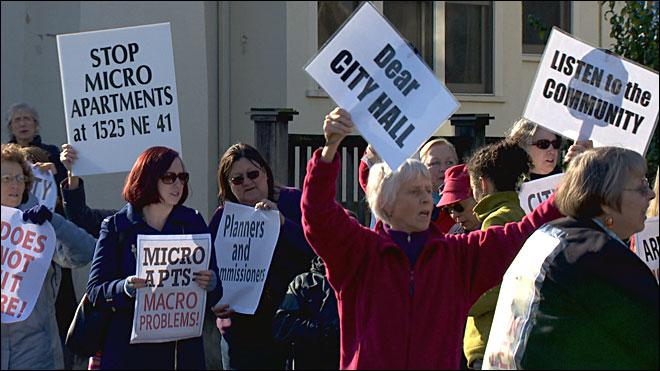
The existing residents of these neighborhoods had a bunch of issues with these new micro-apartment buildings. They weren’t subject to neighborhood approval and many of the buildings didn’t jibe with existing architecture. There weren’t enough parking spots to support the residents (even though many/most micro-residents didn’t have cars). These buildings brought a more transient element to these family-friendly neighborhoods. And lastly, the very existence of the Seattle-style micro-apartment was the result of a loophole. You see, some of the micro-apartment buildings were designated as “congregate housing”–a designation normally used by college dorms. And presumably, college dorms didn’t belong in good neighborhoods. So last fall, the Department of Planning and Development decided to close this loophole, limiting congregate housing construction to “Neighborhood Commercial Zones”–dense mixed-use areas designated for heavy pedestrian traffic where buildings are generally allowed to be six stories or taller. In other words, the NIMBY crowd would get the densest micro-housing buildings out of their backyards.

While this might not sound like a big deal to the non-developer, this regulation change effectively killed congregate housing construction. Here’s the reason as stated by Seattle Weekly:

For financial reasons, investors are rarely willing to build below height limits [in the Neighborhood Commercial Zones]. Yet congregate apartment buildings make sense only if they are short enough not to need an elevator—up to four stories, says [architect David] Neiman. “If you build an elevator in, then every one of these rooms has to be fully [wheelchair-] accessible..by the time [we’re] done making them accessible…we can’t offer people smaller, cheaper housing because we have to make it twice as big.

Attesting to Neiman’s theory is the number of congregate unit permits. In 2014, there were 400. As of May, 2015 there were zero.

Now it should be said that permits for SEDU’s (small efficiency dwelling units) doubled in this same period. But because SEDU’s underwent their own regulatory reform last year, having to adhere to larger size minimums (220 sq ft), they represent a pricier form of housing than congregate housing. Last year’s regulations probably killed the $600 all-inclusive rental with a decent location.

This assassination has not gone unnoticed. Seattle Mayor Ed Murray’s Housing Affordability and Livability Agenda (HALA) task force has proposed relaxing the zoning restrictions put into place just a year ago–a proposal that has not been welcomed by other governmental factions. Seattle Weekly reported, “Councilmember Mike O’Brien, who sponsored the ordinance that restricted microhousing, says he’s not interested in rehashing an acrimonious debate [about congregate housing] that concluded just last year.”

Neiman, an advocate of micro-housing, sees this as kowtowing to the affluent neighborhood base that protested micro-housing in the first place. O’Brien’s stance does not consider that micro-housing–while perhaps an imperfect solution that could have withstood a bit more regulation–was providing unsubsidized, clean, safe, functional and affordable housing in desirable locations for many people. This vacancy is a damn shame in this author’s opinion. While I don’t want to wax too libertarian on the topic, it seems to me that the people with the strongest objections to micro-housing in Seattle were always from the people not living in it. It seems to me that Seattle was an innovator is providing affordable housing to economically prosperous cities. Instead, the reform and subsequent lack of course correction augers more of the same: more people getting pushed to the margins, geographically, economically and politically. Perhaps the Council should have had a slightly more laissez faire approach to micro-housing regulation, letting developers create housing that works for the people living in them.  

via Seattle Weekly

What It’s Like to Live Near a Micro-Apartment Building

Much of the controversy surrounding the addition of micro-apartments in Seattle involved what might happen should the micro-apartment dwellers move into neighborhoods that had theretofore been the habitat of dwellers of single-family and other more conventional housing types. While we’ve heard one account of what it’s like to live in a micro-apartment, we have not heard as much about what it’s like to live near one of the buildings. Were the protesters right?

After a couple years of living next to a micro-apartment building in Seattle’s popular Capitol Hill area, one of those more conventional house-dwellers, Jason Weill, decided to report whether the fears had any basis in truth. His account is something of a mixed bag. In many ways, he confirmed many of the concerns, but in other ways, he seemed untroubled about their impact–at least weighed against the benefits the building brings.

Fittingly, the first point he brings up is parking. He writes, “A corner of my building’s parking lot has been turned into an impromptu aPodment [micro-apartment] loading zone, annoying some of my neighbors.” That said, he writes that parking was a problem before the building moved in and it’s unclear whether the situation got any worse. It should be noted that he is: 1. a single male from all we can gather, and 2. a non-car owner. If he had a family or a car, his perspective might be different.

Since Seattleites don’t typically have air conditioning, he reports that there’s been an uptick in noise from the building’s roof deck and balconies in the summer months. Though again, he doesn’t sound especially troubled by it.

His last point–and perhaps most important one–is that the building has maintained the neighborhoods “class diversity.” Beyond the fear of diminished parking, many of the micro-apartment protests seemed tinged with a “I don’t want those type of people affecting my property values.” The stereotypical micro-apartment dweller is younger and less settled than the typical single family or condo dweller. In fact, Weill thinks this stereotype worked in his favor. He was able to purchase his place easier because of fears about what type of people the building–which was going up when he bought–would bring to the neighborhood. And Weill confirms that the building, whose rents range from $600-1200 and have three month leases available, has “attracted a surprisingly broad mix of students, full-time workers, and recent college grads saving up for their first real apartment.” Rather than seeing these different types of folks as a blight, he seems encouraged that there is an opportunity for the non-well-heeled to get into a nice neighborhood.

What Weill gets that many don’t is that having a diversity of housing types–and resident types–is something to embrace, not fear. He also grasps the greater context of Seattle’s housing market. He writes, “As of 2013 the city had added 15,000 jobs year-over-year while only 9,000 housing units were expected to become available for each of the next five years.” These people–many of whom don’t have the resources for conventional housing–have to live somewhere they can afford. The micro-apartments provide that somewhere. Weill asks, why shouldn’t they be in my backyard?

Read Weill’s full post on his website.

Via Capitol Hill Seattle Blog

Small Rooms Lead to Big Row

Apparently, strong coffee and grey skies aren’t the only commonality between Seattle and Portland. Like its northern neighbor, Portland has jumped on the micro-apartment bandwagon. More specifically, Portland is mirroring Seattle’s boarding-house style micro-apartments (often known as aPodments, which are actually the name of apartments developed by Calhoun Properties, not a general term). These apartments typically feature very small units (150-300 sq ft), a kitchenette, a shared kitchen and a personal bathroom rented at a low, all-inclusive price (often below $1000).

Just like Seattle, some Portlanders are up in arms about the perceived effects of these dainty digs. The issue, once again, is parking. Right now there are two developments causing the stir, both being developed by Snohomish, WA’s Footprint Investments. One is under construction in northwest Portland and another is looking for city approval in the northeastern Hollywood neighborhood. The apartments, enjoy a “group living” designation–the same as dormitories, monasteries and convents. As such, they are not required to provide a set amount of parking spaces. The threat of lost parking in the neighborhoods has spurred protests.

We can’t help but think this is another case of NIMBY-itis. Everyone loves the idea of more walkable and bikeable neighborhoods. They love the idea of housing that supports public transportation (both developments are close to transit hubs). And they love the idea of building space and energy efficient housing. But when these ideas include the possibility–not the reality, mind you–of fewer or further afield parking spaces, people seem all too willing to squash those ideas.

From the outside, it seems like micro-apartments are a decent solution for a city with 3% vacancy rates for rentals and whose rents have increased 6-7% in the last four years. They also seem like a decent solution given the fact that even though there was a big hullaballoo about parking in Seattle, there were few reports of parking being a real issue. Most people live in micro-apartments to save money; the buildings are situated in central locations, making it easy to get around by foot, bike or public transport, thereby avoiding costly car ownership. Most Seattle micro-apartment developers claim that only 10-20% of their residents have cars.

Just so we don’t seem like blind advocates to micro-apartment living, some regulation is probably in order. Most of the residents of these developments will not be monks and nuns. And while Portland’s public transportation is probably great for a city of its size, it’s not on par with larger metropolises like NYC or Seattle; cars, for some, are a practical necessity. In short, there should be some accounting for parking. But this can be a future-based conversation. Why not wait to see if any problems actually crop up? The city of Portland seems to think this a sound tack. Elizabeth Hovde of Oregon Live reported this:

When I asked Joe Zehnder, a chief planner for the Bureau of Planning and Sustainability, about whether the definitions will be updated to better accommodate micro-housing, he said, “We need to see how this type of building performs. So we have nothing underway.”

Not to seem too insensitive to the plight of these Portlanders, but what if the micro-apartments reduce the number of available spaces in these neighborhoods? What if people had to walk a little further to and from their cars? As someone who has owned a car in NYC, I know that making parking difficult makes you far less inclined to drive. It makes walking, biking and using public transport far more attractive. These consequences, which support personal and planetary health, seem like questionable foes to fight.

What is a Micro Apartment?

Amidst its turmoil, the City of Seattle has drafted a proposal for establishing citywide micro-apartment (aka “micro-unit” and “micro-housing”) regulations. The good news is that “DPD [Dept. of Planning and Development] has found that micro-housing provides an important lower-cost housing option that is appealing to many renters, and we recommend that it continue to be allowed to meet this demand.”

But before you approve of something–particularly as it pertains to governmental policy–you must define what that something is. And define Seattle did. According to the proposal, a micro-apartment cannot:

  • Be larger than 285 sq ft.
  • Have an oven or cooktop.
  • Be without one 120 sq ft kitchen for every eight residents.
  • Have a sink outside the bathroom.
  • Have “no more than 8 micros (or 8 unrelated individuals)…located in a micro dwelling unit.”
  • Have less than one bike parking station per four micro-unit residents.
  • Be built in single family zones.

The proposal also makes a clear distinction between a micro-unit and a “Congregate House,” which has more than eight micros in a dwelling unit. They site larger developments like dormitories and senior homes as examples of the species, Though “Some recent forms of development with similarities to the form of housing referred to as micro- housing are classified as congregate residences,” according to the proposal. The two respective housing types will undergo different levels of design review; the larger the development, the more rigorous the review.

The proposal suggests a very regional interpretation of what a micro-apartment is. Seattle has had friction when micro-apartments encroached into single family home neighborhoods; they’ve dealt with parking issues and lax design oversight. All of these issues are addressed in the document (available here in its entirety).

The document begs the question of whether there is a universal definition for a micro-apartment? For the adAPT NYC competition, micro-apartments meant an apartment that was between 275-300 sq ft, but these included kitchens and ADA bathrooms. In San Francisco, legislation last year granted an allowance for building dwelling units as small as 220 sq ft, with 70 sq ft for bathroom and kitchen. In Boston, they nervously authorized the construction of 450 sq ft “Innovation Units.” In Providence, RI, they’re making apartments as small as 225 in the Arcade Providence. On the other side of the planet in Japan and Hong Kong, many of these numbers would be shockingly large. In other words, for every region, there’s a different definition of “micro.”

Being confused, we turned to the all powerful Wikipedia for answers. And wouldn’t you know it, they have a definition:

A microapartment, also known as an apodment or microflat, is a one-room, self-contained living space, usually purpose built, designed to accommodate a sitting space, sleeping space, bathroom and kitchenette within around 150–350 square feet (c. 14–32 square metres). Residents may also have access to a communal kitchen, patio and roof garden.

While we aren’t so bold as to question the Authority of Wikipedia, we would submit that “aPodment” is the name of a particular developer’s (Calhoun) properties in Seattle. Other than that, the size parameters are fairly in line with what most people call a micro-unit. (Technically, “micro” (µ) denotes something that is 10-6 or 1/1,000,0000. Given that the average new US home is 2505 sq ft, a micro home might be .0025 sq ft).

What this varied definition shows is the inherent relativity of the micro designation–most often relative to the availability of affordable real estate: Less affordable real estate, smaller homes overall, more micro micros. More affordable real estate, larger homes overall, less micro micros. In some cases, the designation can be a way of re-branding small apartments in areas where there is ample housing stock; Providence and Chicago come to mind. This is not necessarily a bad thing, as the new micro-apartments are often nicer and more affordable than their more girthsome neighbors.

We consider the Seattle micro-apartment definition a bit prescriptive. In fact, it more closely resembles a boarding room or efficiency apartment (not bad things per se). Though we understand that much of their policy choices are reacting to an existing situation.

How would we define micro-apartment? Perhaps, “A small, typically urban, self-contained apartment that is between 150-350 square feet.”

image via SmartSpace

Seattle’s Micro Apartment War

Add micro apartments to wind turbines and public bike stations to things people don’t want in their backyards. Seattle’s micro-apartment controversy continues as news headlines and this letter we received from Seattle resident Connie Ann Innis suggests. Here’s what she wrote:

Dear LifeEdited,

I own a condo next door to one of the aPodments in Seattle’s Capitol Hill neighborhood.

Last evening I spoke with a young woman who lives in one of these micro-apartments (I stopped to thank her for picking up curbside litter left by pedestrians and tossed out of car windows). This woman was shaking as she told of complete strangers stopping to scream at her in a threatening manner as she smoked in a designated outdoor area, cruel comments directed at the micro-apartment tenants as a whole and scathing prejudice voiced at neighborhood meetings (meetings that she actually bothered to attend).

This woman is working and studying at a nearby community college; the micro-apartments proximity to mass transit and excellent “walk score” preclude the need for expensive car ownership and the relatively low rent allows her to work toward her dreams.

Everyone is entitled to their opinion, of course and it’s true there are plenty of ugly, cheap apartments being built in Seattle without regard for impact. The developers who stand to gain wealth from these buildings are appropriate targets for dissent and complaints re: zoning laws and structure; the inhabitants of these structures are NOT.

Yes most of us love to look at gracious, old brick buildings with stunning landscaping, but this is an urban neighborhood and those mansions often come with $4 million price tags and the need for “staff” [see above video for an example of what Innis is referring to].

A neighborhood that prides itself on creativity, acceptance and diversity has in many cases become hostile and disrespectful to “poor people”.

Innis touches on most of the objections to micro-apartments: illegal zoning, inadequate community approval, rapacious developers. But her tale also alludes to a less technocratic objection: that many residents don’t want what they perceive to be mostly young, single, less-permanent, lower-income micro-apartment dwellers to change the character of their mostly middle-age, family-oriented, more permanent, middle-to-upper-middle class neighborhoods. This objection withstands the obvious demand for affordable housing in centrally located neighborhoods; the questionable veracity of the arguments about the demographic makeup of the micro-apartment dwellers; or their actual impact on the character of the neighborhoods.

Fortunate for the micro-apartment advocates, Seattle Mayor Mike McGinn is decidedly less conflicted on the issue, focusing on the apartments’ affordability, central locations that curb the need for cars and that their appeal to all ages. Here’s what he told KIROTV:

What we’ve seen is the rise of these micro apartments because it’s affordable living for people who don’t want to own a car and want to use transit and ride a bike. And they’ve been very popular. And it’s an affordable way for a young person or an older person to live in the neighborhood where they work.

While this pro-con polarity is getting most of the media attention, there are less public, more nuanced opinions in many Seattle neighborhoods that find themselves host to micro-apartment complexes.

One Seattle Life-Editer says that he was encouraged to sign a petition opposing a micro-apartment building by an online neighborhood forum, but this same forum routinely has postings seeking reasonably-priced apartments for friends and family just moving to the city.

He believes that Seattle is a very civil place, so the density debate is sometimes framed by the practical realities of finding places where schoolteachers, Starbucks workers and young families can live. But when this practical question is tempered with economic interests–for the resident looking for an affordable place to live, for the developer looking to capitalize on this demand and for the citizen trying to preserve the integrity and value of his or her neighborhood–there’s a lot of room for disagreement and debate.

There are no easy answers, so feel free to continue the debate in the comments below. We’d love to hear you thoughts.

Sunset View of Seattle Skyline image via Shutterstock

Micro-Apartments Stir Not-so-Micro Controversy in Seattle

Lest we think all micro-apartments are high-end, high-tech, highfalutin, transforming thingamabobs, one should go to Seattle to see another, decidedly modest and analogue take on tiny living. That city has seen a great deal of development–and controversy–surrounding the spread of affordable micro-apartment developments. In particular, a couple companies, aPodment and Mini-Suite, have been making high-density apartments with shared amenities, with rents starting around $500.

One aPodment development, the Solana, has units that average 170 sq ft according to Seattle Mayor Mike McGinn, who has expressed his support of the developments (some units in other building are as small as 100 sq ft). The units come furnished (with no murphy beds so far as we know) and have their own bathroom and shower. Instead of a proper kitchen, they feature a fridge and microwave, with available communal kitchens. All utilities including wifi are included.

There are 47 such developments currently permitted throughout Seattle and their popularity seems to be growing. And herein lies some of the controversy: Neighbors are complaining that because the buildings are so dense, they are bringing in more people than the neighborhoods can support. One oft-cited fear is that the influx will result in inadequate parking. There is also the complaint that the buildings are not subject to a “design review” which would entail greater bureaucratic and community scrutiny; developers only need a building permit to build these buildings.

Though not always explicit, critics seem to imply that the micro-apartment demographic–often young, low-to-moderate income singles–might not jive with some of the more family-oriented communities they’re infiltrating (note: the communities they’re moving into are zoned for multi-family development, but most buildings are far less dense than the micro-apartment buildings). One man trying to sell his home near an impending micro-apartment development was a bit more blunt, telling The Stranger:

Anyone who can scrape up enough money for month-to-month rent can live there…I don’t think most people want to live next to a boarding house with itinerant people living in it.

While we don’t live in these communities ourselves, the micro-apartment trend in Seattle has a tinge of NIMBY (not in my backyard), with threats seeming more imagined than real. The various articles we scanned reported of young Microsoft employees, recent college grads and divorcees on a fixed income occupying these apartments–not thugs looking for launchpads for heists. In terms of parking, Jim Potter, chair of Kauri Investments who owns Mini-Suites, says that only 10% of his tenants own cars. Most of the developments are located along transit lines, making cars less essential.

One commenter on The Stranger put it more starkly:

Either we embrace affordable housing close to downtown Seattle…or we embrace suburban flight, with the cultural and environmental ramifications thereof. I applaud Mulhair and Calhoun properties [aPodment] for providing private-sector solutions to public/governmental policies.

What do you think? Is this true? Can there be smart growth in our cities without major neighborhood demographic shifts? Do neighbors have legitimate complaints or a case of xenophobia that might inhibit a more affordable, sustainable city?

images by Mariana Kajlich for Seattle Magazine

Edited Housing Guide: A Look at 4 Compact Housing Developments in North America

While building small is big in many places around the world, it’s still pretty novel in North America. Our abundance of space and affection for cars have made our architectural disposition similar to a big yawn after Thanksgiving dinner.

New American home footprints have been north of 2K sq ft for a while, and have even spiked to 2550 sq ft in the last year because credit scarcity has limited new home ownership to the cash-flush.

But that’s not what we’re going to talk about today. We are going to talk about the little guys. These are developers at the vanguard, building small, efficient, awesome homes.

And if we missed anyone, please let us know in the comment section.

1. Cubix SF (née Cubix Yerba Buena)

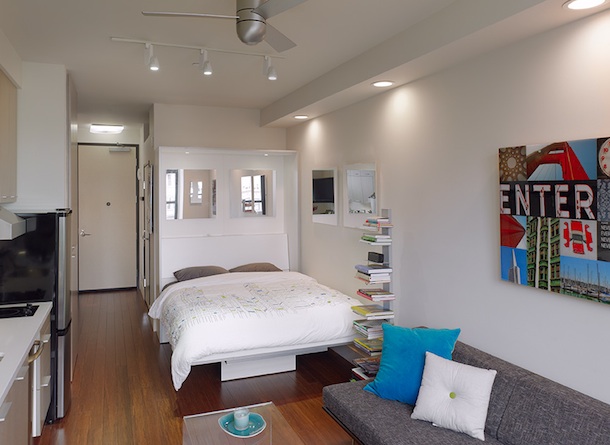
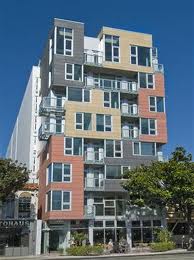
If you go to San Francisco’s SoMa district and see a Rubik’s-cubey-looking building, it’s probably the Cubix SF. The 98-unit building has floorplans ranging from 250-350 sq ft. Prices are in the low-to-mid $200’s, which is about a 1/3 of the area’s median price.

The building features nice finishes (see main image above for interior pic), modern appliances, a big roofdeck and groundfloor cafe. Their focus is on creating a low purchase price for people who still want a high quality, stylish apartment in a great neighborhood.

2. Vancouver Micro Lofts

Okay, so it’s not the US, but these micro units epitomize edited living. There are 30 units, which range from 226-291 sq ft and average $850CAD/month rent, which includes cable and internet.

The tasteful decors feature folding beds and tables, big windows and small, high quality appliances. With considerably lower rents than neighborhood average, the building proved very popular and rented out almost immediately.

via cbc

3. Apodments

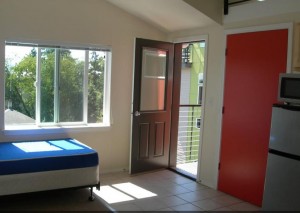
In Seattle, Calhoun Properties has developed 9 building featuring their Apodments™, which are more like boarding rooms than standard apartments. Buildings have shared kitchens and living rooms. Some rooms have shared bathrooms and can be as cheap as $350/month including utilities, while the majority have private bathrooms, kitchenettes and some furniture and are as cheap as $495/month including utilities.

The units themselves are as small as 90 sq ft with fairly spartan decors compared to the other developments in this profile. Calhoun seems to be focused on young people who make low, hourly wages and/or don’t spend much time at home.

image via Facebook

4. Olympic Studios and Studio Lofts

In posh Santa Monica, CA, NMS Properties offers compact living for moderate income households (<$60K/year for singles and <$68/year for couples).

The units range anywhere from 360-448 sq ft. One of the cooler features is their furniture organizer, which allows you to drag and drop furniture pieces to pre-configure your furniture to the spaces somewhat tight quarters. We particularly like the loft layout, whose high ceilings give the small footprint a cavernous feel.

image via Olympic Lofts

graph via treehugger and Builder Online