Small Studio Fits Family of Four

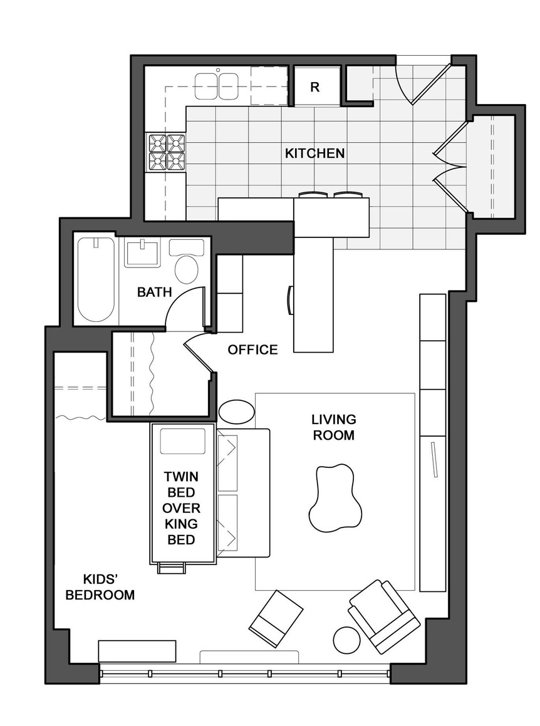
A common charge against the “edited” way of living is that its philosophy is hard to apply to a family. The Wagner home, a 630 sq ft Brooklyn studio shared by a couple and their two small children, demonstrates a creative contradiction to this charge.

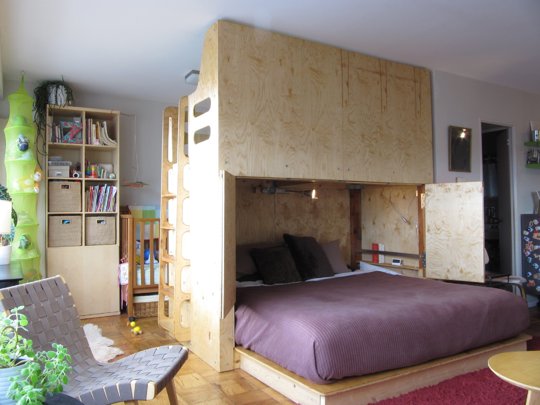
The centerpiece of the apartment is a bed module that houses a single loft bed for the couple’s then four year old (the apartment was featured in Apartment Therapy in 2009) and a king sized bed that doubles as a sofa. The king size bed does not cantilever like a Murphy bed but remains stationary; a set of doors bisect the bed with the front portion serving as the sofa base. The whole thing is made out of plywood whose materials we imagine cost well less than $1000. The construction appears to have required a decent amount of labor, skill and access to tools (the bed ladder looks like it was CNC cut).

Since the module goes all the way to the ceiling, it makes the studio space into two rooms, providing some privacy for the kids. On the opposite side of the living room is a where their then eight month old baby had a crib.

In New York, space and financial constraints often breed inventive solutions like these. We’re not sure if the Wagners stayed in this apartment as their children got older (we imagine it’d get a bit tight with older kids), but we think it shows that smaller spaces with the right furniture can work for different phases of a family’s growth.

Via Apartment Therapy

Only One Pea to this Pod Hotel

Nothing will hide the fact that the “rooms” at Singapore’s new The Pod hotel are not presidential suites at the Ritz Carlton, but they do demonstrate how design and amenities go a long way toward making tiny spaces feel inviting.

The hotel, designed by Formwerkz Architecture (the firm’s founder also started The Pod) has 83 beds, which occupy the top three floors of a five story building in central Singapore–the densest country in the world. The hotel’s website touts its proximity to great shopping, though we’re unsure where you’d store your wares.

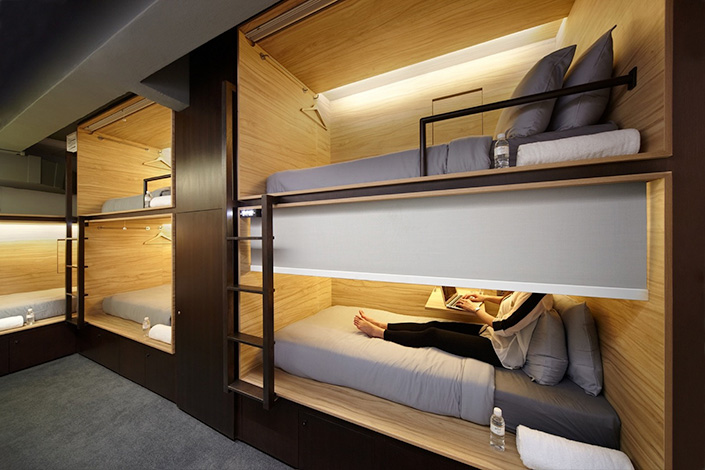
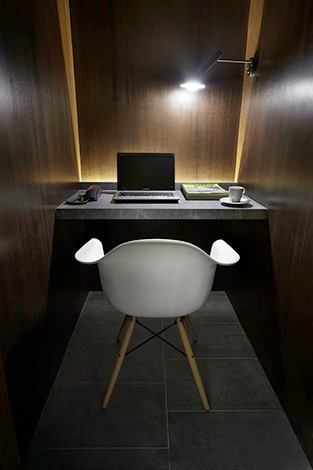
There are front and side access single pods as well as queen pods; the pods are also available as male and female only. Each pod has sateen bedding, towels, a hanging rack and its own storage cubby. Other features of the hotel include free laundry, breakfast, wifi, private bathrooms and a “business center” (which look like wood-clad toilet stalls with desks).

The idea behind The Pod was to combine the high design of a boutique hotel and the affordability of a hostel. Rates start at US $45 for a low season single to $85 for high season queen–prices that, upon quick inspection, are about twice as much as a hostel bed, but 30-50% less than a private hotel room.

The idea and the execution are quite nice. As a frequenter of many hostels in my youth, the biggest question I have is “what about the snorers?” With a rolling shade acting as the main barrier for each pod, we imagine there is little audio separation from other guests. Other than that, we applaud The Pod’s efforts at making stylish, affordable, minimal accommodations in a fairly expensive city.

Visit The Pod’s website for more info.

5 Ways to Think Less in 2014

Michelangelo is famously quoted as saying about his David statue that he made it by removing all the stone that didn’t look like David. Implicit in this remark is that underneath extraneous layers, a thing has an essential, irreducible quality. 17th Century scientist/philosopher Blaise Pascal said, “I would have written a shorter letter, but I did not have the time.” Pascal understood that editing, i.e. getting to that essential, irreducible quality (in his case, the essential message) is something that takes time and great effort.

This is a bit counterintuitive. Humans tend to be impressed with “more”–more space, money, bling, etc. But addition is the easiest math (at least in the short term); it involves throwing more distractions and stuff in our lives to avoid confronting life’s toughest questions. What would my life look like in its most essential form? What kind of company would I keep? What kind of work would I do? Where and how would I live? What would I focus on?

For 2014 we suggest continuing to ask those tough questions–to continue removing all that is not David (insert your own name to make the metaphor work). Here are five areas where we might direct our figurative chisels in the coming year.

  1. Attention. It’s been shown that the more we attempt to multitask, the less we are able to pay attention to anything. Multitasking might even make us dumber insofar as our intelligence is applied to those multiple tasks. In 2014, become a master monotasker. Practice doing one thing at a time–whether it’s work, driving, reading or talking with a friend. Keep asking ourselves, “Am I doing and paying attention to my essential task?”
  2. Space. We suspect that our readers are better than most in terms of editing their spaces, but there is almost always room to reduce. We’ve seen before that many Americans use a small percentage of their floorspace. If we’re considering a move, we might consider how much space we truly need, not just what we can afford or what other people have decided is the right amount of space for them. If we’re staying put, ask ourselves how we can make the most of the existing space and how we can remove any elements that don’t support how we live.
  3. Clothing. It’s been estimated that most people only wear 20% of the clothes in their wardrobes. An essential wardrobe would be one where 100% of our clothes are regularly worn (seasonal and specialty clothing notwithstanding). In 2014, let’s get rid of the clothes we don’t wear and don’t bring in ones that won’t be worn. Create a wardrobe where every item is our favorite.
  4. Food. For many, eating is a recreational activity more akin to zoning out in front of the TV than reading a great book. Rather than jumping on the latest fad diet, for 2014 let’s eat less, but better–healthy, fresh food that supports longterm health, not immediate gratification.
  5. Stuff. With the holidays over, it is a good time to take stock of our stuff. For 2014, we might continually ask whether we need the stuff we have. Do we use it? Does our frequency and quality of use justify its residency in our lives? If not, can we be willing to let go of it? Can we let go of the things that prevent us from living an essential life?

Image via Asier Villafranca / Shutterstock.com

Top 10 Posts of 2013

As 2013 draws to a close, we wanted to take a trip down memory lane (propelled by Google Analytics) to see what you thought was interesting in the last year. The conclusion: many different things. You wanted to edit your life, change the world, pack lots of folks in your small place and do it all for not a lot of money (among other things).

If you have editorial suggestions–things you’d like to see more of in the coming year–let us know in our comments or email me at david@lifeedited.com. Thanks!

  1. 8 Tips for Making Your Own Micro Apartment
  2. The World Changing Ten Foot Cube
  3. Transforming Furniture on the Cheap
  4. Comfortably Seat Ten in Your Micro Apartment
  5. 10 Tips for Selling Stuff on Craigslist
  6. 500 Square Feet of East Village Form and Function
  7. Want to Simplify Your Life? Try a Uniform
  8. The Smartest Space in San Francisco
  9. 5 Tips for Breaking Up With Your Stuff
  10. Is it a Sleepy Living Room or Lively Bedroom?

Football Goal Post image via Shutterstock

Happy Holidays! Share Your 2014 Edits

We at LifeEdited would like to wish one and all a happy holiday and new year. With a growing readership and the launch of a couple amazing projects this year, we are grateful for all that 2013 has wrought.

In the coming week, we will be having an edited editorial schedule, but we’d love to make a request in the meantime: please share how you plan to edit your life in 2014 in our comments section below. Let’s help each other make the coming year the most concise, enjoyable one yet.

Proofreader image via Shutterstock

Extreme Risk of Stuffocation

Forgive us if we’ve been harping on about the experience versus stuff subject. Tis that time of year. Every scene of our lives seems set to the drunk-on-eggnog caroling of marketeers, urging us to get more stuff. And we talk about it so much because we believe it’s one of the most important topics of our times. This tightly wound knot, where retail value has become inseparable with emotional value, must be undone–for the sake of our planet, wallets, closets and lives. Anyway….

This leads us to James Wallman, a British trend forecaster who has defined and named this global material and existential crisis. He calls it “Stuffocation”–an apt name for the asphyxiating quality our addiction with stuff has produced in our planet and lives. He has penned a book of the same name, and in this short talk at the Royal Society of Arts, he outlines some of its concepts (note: the actual talk is the first 20 mins or so of video).

stuffocation

He touches on the now-familiar ecological and psychological problems that stem from stuffocation. But he also provides solutions. Rather than dissolving the world economy and moving to primitive, agrarian societies, Wallman suggests the movement from materialist to experientialist values. He envisions and predicts a new economy that supports the experience of living great lives, not the accumulation of the symbols we’ve been trained to believe denote them. To give an idea of what an experientialist economy would look like, he challenges the RSA audience to spend the same amount of money they would normally spend on stuff on experiences. E.g. take that money you’d spend on a Rolex and go on a vacation.

The book is already available in the UK. It’s US release is January 20, 2014 (full review coming soon). In the meantime, watch Wallman’s talk, check out his website and let us know what you think.

Kickstarter and the Future of Shopping

Earlier this last year, I found myself at a Macy’s department store. As I walked through the aisles lined with polo shirts, twinsets and butter dish cozies, a big sign flashed overhead, urging me to “Be Impulsive.” Apparently, this was a campaign to promote their Impulse line of clothes–a play on words, but also a message: don’t think, buy. The definition of impulsive is, “acting or done without forethought”–surely a great strategy for making a satisfying, useful purchase.

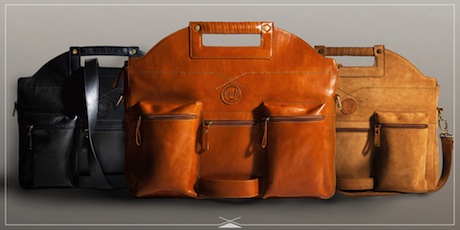
Because we have featured a number of products that are being developed through Kickstarter, several new projects have contacted us to promote themselves. The other day, a new venture called Chivote let us know about a plain leather bag they are trying to bring to production. The bag, dubbed the “Boombox” because of its resemblance to 80s-era portable stereo equipment, acts as clutch, handbag, shoulder bag or backpack. It is classically styled, has all the features a modern bag should have (laptop and tablet sleeves, charger pockets, additional space for your sundries), is handmade in England and available in subtle, timeless colors. It’s simple, useful, classic and brilliant.
chivote

Chivote’s multi-functional design makes it a decent fit for the LifeEdited ethos of doing more with less. But a number of other Kickstarter ventures have reached out to us that don’t have an obvious place on our site, which is not to say they aren’t good ideas.

There was Huckleberry, which makes affordable, American made, customized shirts; Upstate Stock, which makes handmade woolen accessories; and Ledge stainproof pants, which makes, um, pants that don’t stain. All three successfully met their funding goals without our help. They did so because they were well made, smartly designed, stylish products. Presumably, the products that are not so well made, smartly designed or stylish do not get funded (though we’re sure some slip through the Kickstarter cracks).

What does this have to do with Macy’s “be impulsive” cri du guerre?

Kickstarter takes the exact opposite tack as traditional retail. It presents a product idea. It lets people decide whether this product needs to be made at all. It communicates with the people who might use the product. It lets those people invest in the product. If enough people invest and think it’s worth existing, you wait several months to receive the product. If not enough people think it’s a good idea and do not invest, you get your money back sans product. It’s a slow, deliberate process. It’s anything but impulsive.

Unfortunately for holiday shoppers, Kickstarter does not offer gift certificates (though you could give successfully funded projects as gifts). Much more important than addressing the temporal concerns of holiday shoppers, Kickstarter offers a different way to approach shopping any time of year. It begs us to ask whether something needs to exist. It asks us to invest time and money. It ties us to a greater body to determine something’s usefulness to the world, not just ourselves. More than anything, it discourages us from being impulsive (doesn’t the world have enough impulsively purchased products?). If Kickstarter were a store, it’d urge us to “be patient.” This is a good thing.

photo © Arno Mayorga

4 Ways to Get Off the Misery Train

Have you ever experienced a time when you were perfectly content with your life? A time when you had a sense of wholeness about your home, job, relationships, financial situation and everything else. No, things were not perfect, but they were sufficient and alright.

Then something happened.

You went online and saw a really cool house on Pinterest you wished your’s looked like. You talked to a friend you hadn’t connected with in a while. She got a promotion, and you realized you deserved a promotion. You saw a commercial and realized how much static cling your clothes had. These things made you realized just how much your life sucked. Whatever term you affix to it–jealousy, envy, keeping up with the Joneses–few things have the capacity to rob us of satisfaction like comparing ourselves to others (also known as “social comparison”).

The phenomena works like this: we take a comprehensive understanding of our own lives (personal struggles, financial woes, etc.); we hold that up against a superficial understanding of our others’ lives (pictures, tabloids, interviews); we realize how little we have, how hard our lives are, how fat we are and so on.

Social comparisons affect both our emotional and material sense of satisfaction. We compare our emotional trials and tribulations to the self-evident ease of living others enjoy–our evidence typically being derived from pictures, People Magazine articles, Facebook status updates and the like. In fact, one study about the effects of Facebook found that “passive following [i.e. not contributing content] exacerbates envy feelings, which decrease life satisfaction.” (It should be noted that people who actively engage on Facebook, contributing content and posting on friends’ walls reported greater life satisfaction).

And nothing reminds us of our material deficiencies like brief glances at the abundance of others. We never realized how crappy our iPhone 3S was until the iPhone 5 arrived. We never realized we needed three car garages until our neighbors had one. We never realized how ill-fitting our jeans were until Miley Bieberlake showed up at the AMAs with a perfectly fitting pair.

In all cases, trouble originated from comparing our internal wellbeing and satisfaction of needs to another’s external circumstances. Few strategies are as effective as this one for making us consistently miserable.

There are things we can do:

  1. Determine what’s important to you and live accordingly. If you need a three car garage or faster phone or bigger home, get them. But if those desires are the products of comparative deficiency–i.e. we want them because someone else has them, and we perceive them to be happier because they have those things–we will forever be on the losing team. We will be chasing the next best thing, aka the “hedonic treadmill.”
  2. Get real. Nothing dispels romantic notions about how easy people have it, or how satisfied they are, like getting to know people. We’re all fighting our own battles. No car, house, amount of money, etc has ever made anyone happy. Sure, these things might get us from place to place, they might house us and pay for certain things, but they don’t make us happy. The guy or gal with the fastest car, biggest house and largest bank account is–nine times out of ten–dealing with the same boring problems you are (though it might look a little different).
  3. Shield yourself. If you know you tend to get envious looking at certain websites, magazines, TV shows or even talking to certain friends, don’t engage in those things. This is not the bliss of ignorance–it’s selective attention; it’s choosing to focus on the fullness of one’s own life rather than the supposed grandeur of others.
  4. Practice gratitude. Place focus on what you do have and what does work in your life. Nothing fends off of comparative despairing like rejoicing in our own good fortune.

Three Car Garage image via Shutterstock

BAM North Site II

The BAM North Site II will be a mixed-use, mixed-income building in the heart of the Downtown Brooklyn Cultural District. The building, to be called “EyeBAM,” will be home to Eyebeam and Science Gallery–bold new cultural uses that will enrich and diversify the district with a focus on the intersection of art, science, and technology. Above will be 109 affordable and market-rate apartments in the 12 story structure. The mix of apartment units will accommodate a range of modern urban households and include 40% affordable and 60% market rate units.

Each unit has been carefully laid out to create light filled spaces with high-quality finishes and thoughtful furnishing options. A rich array of social and amenity spaces enhance the residential experience. Extensive glazing at the lower floors highlights the cultural components and activates the pedestrian experience. In-set balconies and double-height terraces articulate the upper base and tower. The building is designed to meet or exceed Enterprise Green Communities and LEED Gold criteria. The result is a dynamic form that reflects the truly mixed-use program and creatively expressing the arts and cultural district.

This project is being developed by Jonathan Rose Companies. The architects are Dattner Architects and Bernheimer Architecture. LifeEdited was part of the overall team that won the project. LifeEdited is an interior design specialty consultant to Dattner Architects.

Make it Simple, Add Magnets

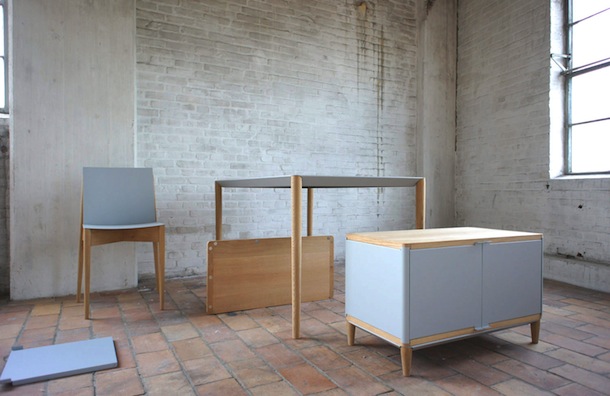
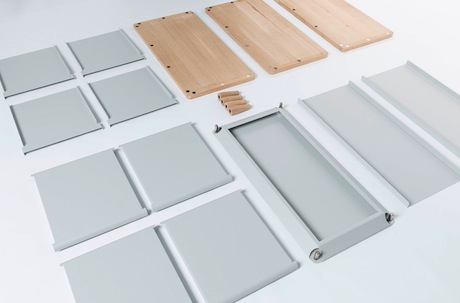
Perhaps it’s because this author recently had to put all of his furniture in storage while his future home is being renovated–whatever the reason, I’ve become very fond of furniture that’s easy to disassemble and store. First it was the IN A BOX collection by TRUE. Today, it’s Benjamin Vermeulen’s MAG (Magnetic Assisted Geometry) collection. Rather than relying on screws or traditional joinery, the MAG’s flat-packing furniture comes together via (you guessed it) high power magnets.

Vermeulen correctly asserts that flat-packing furniture is more economical and eco-friendly than traditional furniture, but most of it is tough to assemble and suffers from crappy materials and construction (not naming any names of who he might be referring to). MAG, on the other hand, is made entirely of solid wood and steel. Almost all of the furniture’s parts are held in place by magnets (we imagine they’re the extremely powerful, rare earth variety); additional support is added with stanchion fittings at critical stress points. MAG requires no tools and assembles in minutes. This type of construction is not only convenient, but it makes all of the furniture customizable and easily repaired.

MAG_cabinet_2

The furniture’s convenience would be far less appealing if it was ugly. But it is not. Vermeulen’s simple and light designs match the unfussy nature of its construction. Vermeulen is working on getting the chair produced for Q1 2014 with the rest of the collection following shortly thereafter. Shipping worldwide will be a breeze because of its flat-packing design, he reports. No pricing information just yet. We’ll keep you posted.

Via Dezeen