Think Globally, Heat Locally

In his text “The Way of the Bodhisattva,” Buddhist master Shantideva said it is easier to cover your feet with shoes than it is to cover the world in leather (I’m paraphrasing a little). With much of the country experiencing major cold-spells, Shantideva’s statement might offer guidance and comfort to the chilled masses. Why blast central heating everywhere, when we can warm our bodies?

Throughout history, humans have known that an extra layer of clothes is the simplest, most efficient way of bumping our body temperatures. But the advent of the thermostat made possible the reality of the constant-temperature-environment. Never were people to be too cold or hot again. The little mechanism would keep us enveloped in the constant comfort of 70-73° F no matter what was happening outside.

The only problem with this strategy is that it is extremely inefficient. Even factoring in improvements in insulation over the years, easing off the temperature is still the most effective way of curbing our household heating use, as Kris De Decker of Low Tech Magazine says:

The reduction in energy use for space heating thanks to more efficient homes was less than 20 percent from 1993 to 2005. Lowering the thermostat by 2°C (or 4°F) would thus result in energy reduction comparable to that. Turning down the thermostat from 22° to 18°C  [72° to 65°F] would initiate an energy savings of at least 35 percent.

This would suggest that if it gets colder outside, consider letting it get colder inside as well to save valuable natural resources and money.

Along the lines of Shantideva’s thinking, here are a number of planet and pocketbook friendly ways to keep comfortable in the cold season:

  1. Put on a sweater. This should be your first line of defense from the cold. Think about it: insulate the 1/2″ of air between our skin and clothing or countless cubic feet of our building interiors? Sweaters should be of a thermal material, e.g. wool or a synthetic fleece.
  2. Thermal underwear. De Decker says, “One layer of thermal long underwear allows you to turn down the thermostat at least 4° C, saving up to 40% on space heating energy.”
  3. Stay active. De Decker says “each increase of 30 watts allows the comfort temperature to go down by about 1.7°C [sitting uses ~60W and walking ~110W].”
  4. Try an electric blanket. Today’s electric blankets little in common with thick-wired covers of the past. Many are made of thin micro-fiber with virtually undetectable wiring. They have different climate zones for couples who might want different temperatures. And on the lower settings, they pull as much power as a single light bulb. As an added bonus, when unplugged, they make good regular blankets the rest of the year–something that can’t necessarily be said about heavy down duvets.

Low Tech Magazine Via Treehugger

Boy in Red Pajamas image via Shutterstock
Make Any Surface a Table

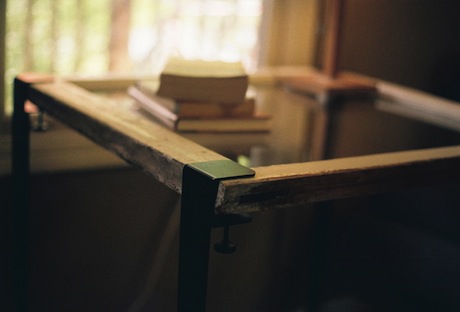
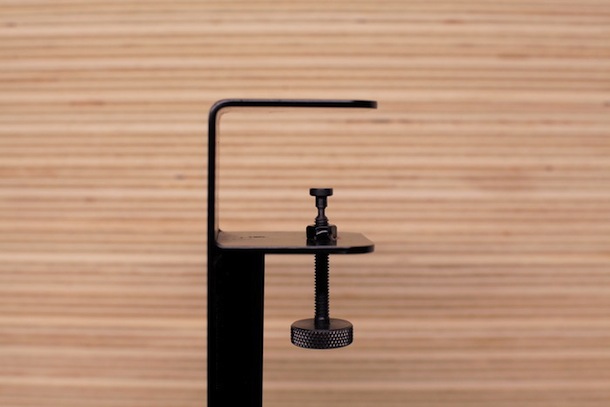
One of the marvels of Kickstarter is that successful products tend to be either: A. common products done well (backpacks, dress shirts, etc) or B. products whose usefulness is so profoundly obvious, you wonder why no one made it up until now. The Floyd Leg is an example of B. It’s a table leg that clamps onto any board to make an instant table.

floyd-leg-detail

There’s not a whole heck of a lot to say about the Floyd Legs. They will be available in both 29″ dining and 16″ coffee table heights. They feature a clean design and will be available in multiple powder-coated colors. They will have a machined F-clamp attached to an 11 gauge cold-rolled steel leg shaft. Kyle Hoff and Alex O’Dell, the guys behind the project, say they are ideal for light to medium use, such as a desk or planter table. Because of a lack of cross-bracing, they say that making them into a dining table is not ideal, though we suspect it’d work if the surface wasn’t too big.

We see the Floyd Leg as a perfect compliment to small space living. Because of their svelte size, you can hide them away if you don’t need a table most of the time. You could keep a couple easy-to-store boards around to suit whatever function you needed on a particular day. If you move to a larger space–or a smaller one for that matter–all you need to do is switch out the surface to make an appropriate sized table.

The project has has met an amazing $165K of its $18K funding goal. A $189 pledge will get you a set of 16″ or 29″ legs. Projected delivery is late April of this year. See more on their Kickstarter page.

Dutch Hotel Bares All

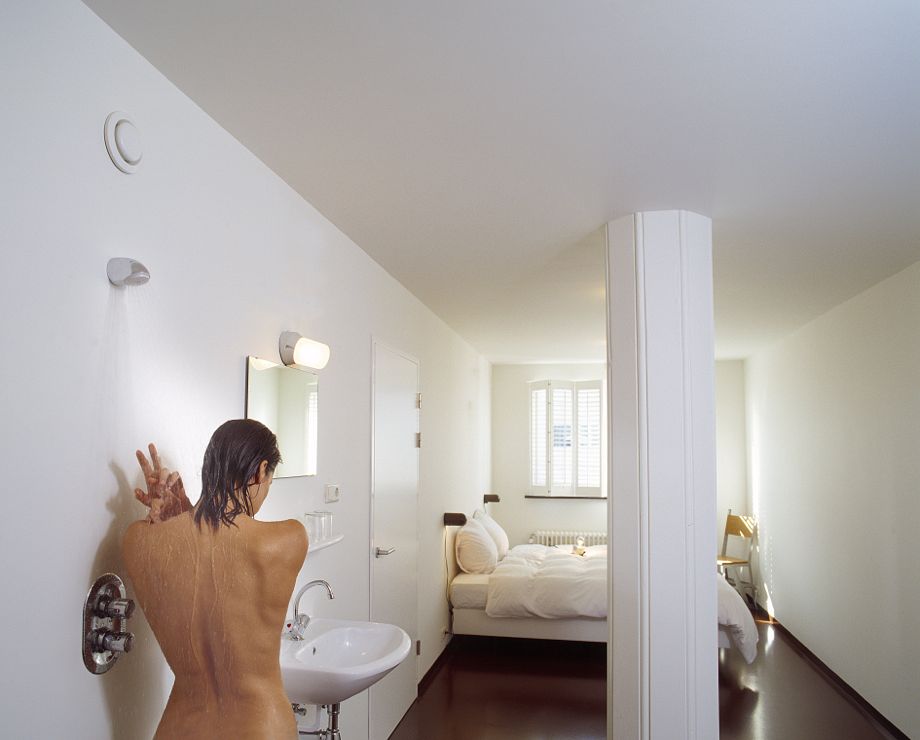
There are many rooms that are worthy of being on the cutting-room-floor of architectural orthodoxy: the formal dining room, the foyer and some might even argue the bedroom. But the bathroom? The Lloyd Hotel of Amsterdam seems to think so. Some of their room’s bath, um, “zones” break down those fascist, water-repellant borders separating sleep and suds.

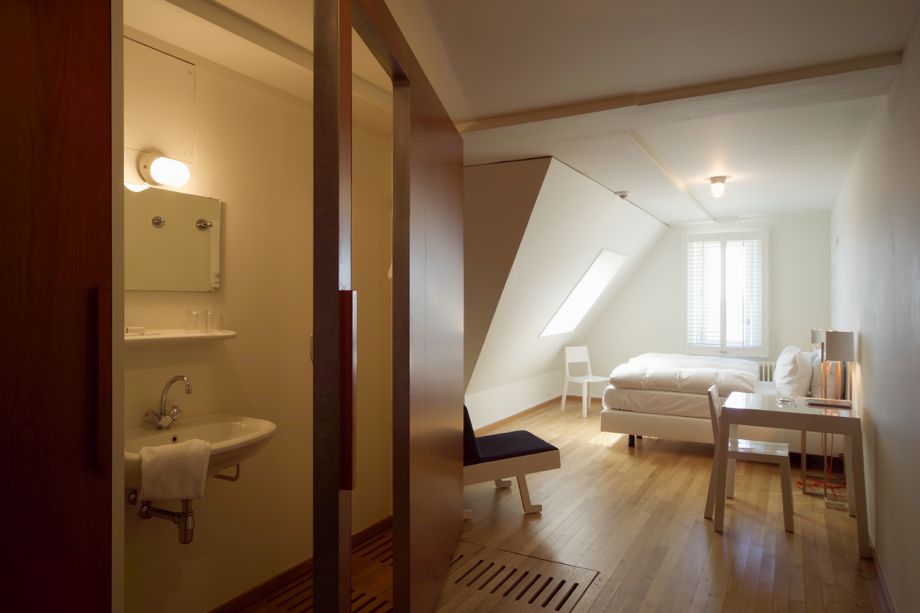
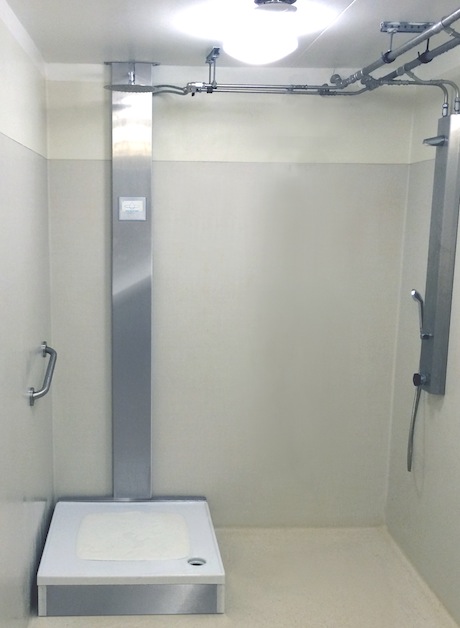
Granted, the Lloyd is a hotel, a place where the penalties of failed experiments in architecture are negligible (or easy to endure for a few days). Also, there is a modicum of privacy with some of the designs such as the pivoting bathroom divider, whose door separates the shower from the rest of the room. Others, like the open plan bathroom (pictured at top) leave nothing to the imagination, and it would seem to have the spray protection of a front row seat at a Gallagher show (squeegees are included with the room).

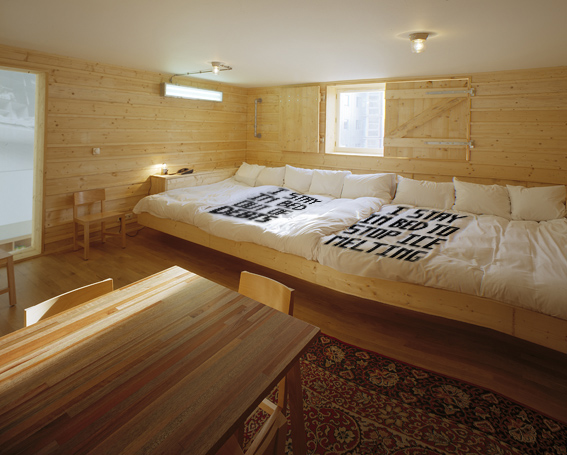
It also should be noted that the Lloyd is a haven of unconventional temporary accommodation. With some rooms featuring things like side-by-side queen beds (ready for your Eyes Wide Shut parties), it should be no surprise that your room might have a shower in the middle of the room.

Via Slate

My Genes Made Me Keep It

From the perspective of evolutionary psychology, there’s a certain logic to being materialistic. In the olden days, folks couldn’t just run to Target and pick up a hypo-allergenic full-sized duvet. You had a few shots a year to hunt and skin that buffalo, otherwise you’d freeze the rest of the year. Accumulating more than we need and keeping those accumulated objects to ourselves, thereby providing for lean times, makes intuitive sense. In other words, we might be hardwired to accumulate. The only difference is that now our objects of accumulation do not stand between life and death.

This logic might not be true however. A recent study suggests that people living closer to subsistence levels might be less inclined to accumulate. The study in question sought to test something called the “endowment effect”–the overvaluing of the personal objects. Psychologist Tom Wallsten at the University of Maryland told NPR the effect is similar to the man who won’t drop the price of his house even though it’s not selling for months. He needs to sell it, but because he values it more than others think it’s worth, he holds onto it. NPR science correspondent Shankar Vedantamit, said that the effect dictates that it “feels worse to lose something than it feels good to gain something.” We would say it’s also like people who do not rid themselves of stuff they do not use because they are “too valuable” to get rid of, despite the expense and headache associated to holding onto them.

Coren Apicella, a researcher at the University of Pennsylvania, realized that the endowment effect was mostly proved by testing the behavior of college students–a demographic whose cultural biases might blare out any meaningful information about innate dispositions toward accumulating stuff. She observed the patterns of the Hadza people of northern Tanzania, some of whom were nomadic hunter-gatherers living at subsistence levels; other Hazdas observed lived in villages with market economies.

What she found was that the nomadic Hadza, people with virtually no possessions, rather than being highly acquisitive, were very easily induced to give up their stuff. Apicella explains why:

If you think about, you know, you’re a hunter-gatherer, you’re living a hunter-gatherer life, one possible reason why it doesn’t hurt as much to give things up is that you’re constantly having to give things up all the time. People are asking them for–from you, you know, demanding them from you, demanding that you share. Things come and go in hunter-gatherer life. You don’t even own that much to begin with.

Vedantam expanded to say that in a nomadic society, it is essential to give things up because the person you give to might have something valuable tomorrow to give to you.

Meanwhile, the village-dwelling Hazda who bought stuff from markets were more acquisitive than their nomadic relatives. Vedantam said of the villagers that they “were more like us [Westerners presumably]. They fell in love with their possessions because modern economies allow people room to be selfish.”

Same genes, different cultures, different attachments to stuff.

Sometimes changing the patterns of consumer behavior seems nearly impossible. Not only are we up against a behemoth economic system whose mission is to compel us to buy more stuff than we need, we are up against the culture that has sprouted around this system–a culture that accepts hyper-consumerism as the way thing are and will be. The Hazda example might be a glimmer of hope, suggesting that while we are battling marketers, bankers, politicians and even our friends and neighbors, we are not battling our biologies.

Via NPR

image credit:  Matej Hudovernik / Shutterstock.com

Store Your Books in the Cloud

Books are great. They are instigators of imagination, chroniclers of the ages, companions in meditation and erudition. They are also some of the clumsiest, heaviest, most space-intensive objects most of us carry. When this site first started, we presented what we called the “bibliophiles dilemma,” which explained the resistance many of us have in giving up our paper bound books for ebooks, a format where hundreds of volumes can fit on a device that fits in our pocket. The good news is that we don’t have to choose: we can have hybrid collections, retaining some of our favorite paper books while regularly circulating through ebooks.

Oddly enough, one of the ebook’s bigger drawbacks is expense. Because companies like Amazon are the gatekeepers of protected book files, it’s tough to buy titles for cheaper than retail without resorting to extra-legal tactics. Similarly, it’s near-impossible to share in the way you can with a physical book.

For the ebook-reading book lover, here are a few options for getting your book fix without breaking the bank.

  1. Amazon. The Kindle Owners’ Lending Library is offered as part of an Amazon Prime membership. With it, you can access one title per month from a library of 350K titles. It’s only available on Kindle devices, which for many is not a problem. There’s is also a loaning program, where you can send a title once in its lifetime to a friend for 14 day period (kinda lame). This program works on any Kindle app enabled device (iOS, Android, desktop). Amazon also has tons of free titles.
  2. Scrbd. For $8.99/month, this service gives access to “thousands of best-selling books” as well as user uploaded articles, stories, etc. They have been called “the Netflix of books.” Scrbd is browser and app based, so you can read on your desktop, iOS or Android devices (i.e. not Kindle or Nook).
  3. Public Libraries. Many libraries like the NYC public library are offering ebook checkouts to local members. Overdrive.com is a portal for over 27K libraries to see if your local library provides ebook lending.
  4. We ran across a number of other sites such as Open LibraryeFling and ManyBooks, but titles were often ones with expired copyrights (i.e. old). There were also sites like Lendle, an Amazon affiliate that makes Kindle lending easier, but the functionality didn’t seem that much better than Amazon’s lending program.

If you have further suggestions for great, legal, book sharing services, let us know in our comment sections.

Pile of books image via Shutterstock

Your Living Room Away from Home

For those of us who work from home, the need to get out of the house is essential to maintain productivity and sanity. And while co-working sites are great, they often cost in excess of $300/month–pretty steep for people who are normally quite content at home. The café has always been the go-to destination for finding this temporary office space, but it can get kind of weird (i.e. inappropriate) hanging out there for four-plus hours after ordering your small, half-caff cup of drip.

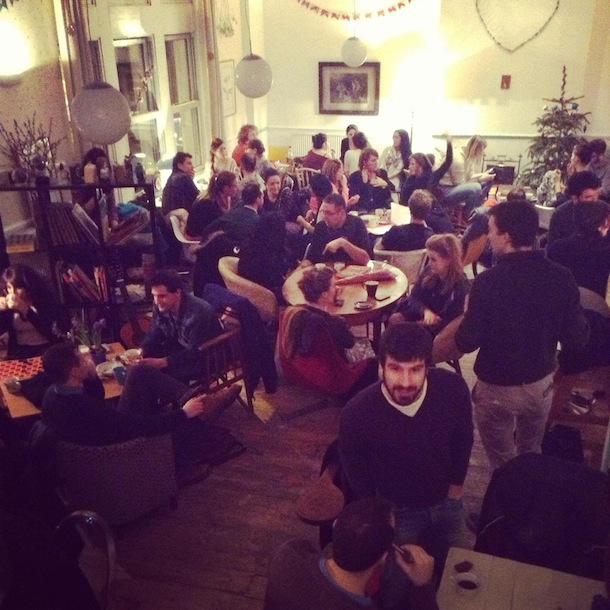
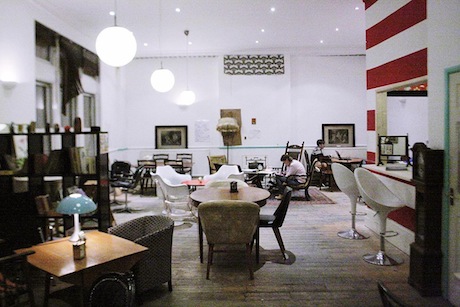
Rather than charging for a cup of coffee, London cafe Ziferblat charges customers for the thing they really want: real estate. The café charges 3p/min (~$.05) to hang out in the space, which has unlimited self-service coffee; there’s even a self-service espresso machine. There are complimentary snacks and even a kitchen where you can prepare your own food. There is also the “opportunity” to wash your own dishes whilst there, but no obligation to do so.

ziferblat-living

Ziferblat, a Russian concept that it is trying to go global, keeps track of customer’s tenancy with alarm clocks it gives upon arrival. There is no minimum or, we presume, maximum time limit. The space’s décor looks like a bunch of people donated furniture–in other words, it looks like a real living room, which is a good thing.

Living in a smaller space is made much easier with lots of places to escape. These places, like Ziferblat, have the added benefit of being far more social than our living rooms. We wish them the best of luck and hope their outlets come to the States and beyond very soon.

Via PSFK and The Guardian

What’s So Damn Important Anyway?

According to one survey, the average American “consumer” spends 2 hrs 38 mins on his or her smartphone and tablet per day. If you think that time is spent working and moving the wheels of progress forward, you’d be wrong. 80% of that time is spent inside apps, with games and Facebook making up the bulk of the app time–50 and 30 of total minutes respectively. The other 20% is spent on mobile web browsers. And as much flack as it tends to get, email makes up a mere three minutes of the daily total (no figure is given for time spent speaking to others on the phone, though we imagine it’s a similarly small amount).

The above video gives a great illustration of what a world looks like when people spend 2:30 hours+ on their smartphones. It’s a world of distractedness, extraneous documentation and general lack of presence. For many of us, it is our world.

Today, before we reach for our smartphones, before we interrupt our conversations, before we take a picture or video to “save” a moment, before we check in with our friends on Facebook or fly with Angry Birds, we might ask ourselves, “is what is on my smartphone or tablet more important than what’s in front of me?”

Handheld, Mobile Enlightenment

Even the most edited lives can be packed with stress. Work, family, ubiquitous technology and all the other stressors of modern life can make us feel like we’re floating in a sea of anxiety. And while many of us have the best of intentions to remedy this feeling with regular meditation, the opportunity to put butt to mat or chair and get present often alludes us. Meanwhile, most of us are seldom without our smartphones. An app called Buddhify 2 does the unthinkable: marrying our desire to be more mindful with our constant clutching of cell phone.

The mobile app features a wheel with various categories of guided meditations, e.g. one for connecting after being online or one to use after waking up. Each category has various types and times for the meditation. There is a solo feature for a general, self-guided mediation. The app also allows users to track their state, time and various other metrics for tracking progression toward Buddhahood (watch video for more details).

We’re not sure if a Buddha would use a mobile app on the path to enlightenment, but we suspect he or she would not object to it–anything, app or otherwise, used with the right intention, can be the right tool for achieving bliss. Moreover, many of us need all the help we can get, battery-powered or otherwise.

The app is available for iOS for $1.99  on the iTunes Store (an older version is also available for Android).

Via Lifehacker

The Shower that Cleanses the Planet

Of the 100 gallons the EPA estimates an average American consumes daily (Europeans are half that), 17% is lost going down the shower drain. And the water is just the start. In most American homes, our shower water is typically sitting around all day in a gas or electrically heated tank on standby mode, waiting for our 5-15 minutes of daily rinsing. Conventional showering might cleanse our bodies, but it does little to clean the planet.

A new project called Orbital Systems wants to change that. The idea is simple: have 1.3 gallons of water that is continuously filtered and re-heated to create a virtually closed water and energy loop. Orbital claims the filtered water is higher than tap quality. They estimate the system uses 90% less water and 80% less energy than conventional showers. And because so little water is lost, the shower can emit a generous four gallons per minute (most shower heads today emit 2.5 GPM), making it more comfortable.

The base includes an easily replaced filter that is sent back to the company, which is based in Malmö, Sweden (though presumably other locations when they expand).

orbital-systems-Shower-at-Kallis

The system is still in development (a prototype pictured above). But with NASA engineers on board, big name investors like Skype founder Niklas Zennström and features in place like CNN, the project appears to be the real deal–something we can’t say about the Washit shower we saw a while back, which sought to use shower water for its attached washing machine. We look forward to using one.

6 Tips for Creating an Edited Kitchen

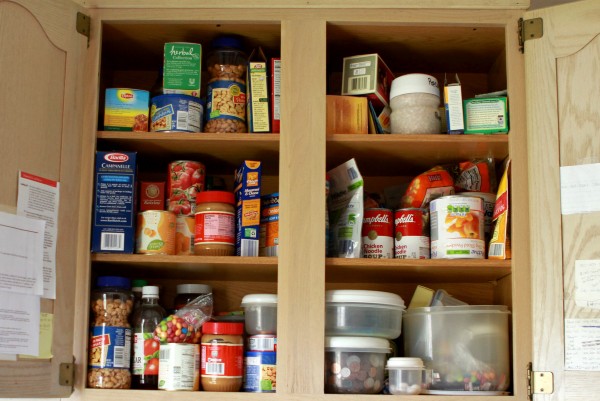
When we think about clearing out excess stuff, we tend to think about durable goods like clothes, electronics, furniture and so on. A cassette tape player we haven’t used in 15 years is an easy target for excision and reducing clutter. But there is another, more edible source of residential overcrowding: food. We might be far less likely to get rid of those 15 year old canned peaches crowding our pantries than we are the cassette player. We say to ourselves, “I might eat that someday.” But do we?

Many modern fridges, cupboards and pantries buckle under the strain of excess food stocks–food that takes up valuable household space; food that uses resources and money to produce and purchase; food that often gets tossed after a long, uneventful stay in our kitchens. Consider these food facts:

  • It’s estimated that 40% of America’s food supply ends up in the trash.
  • 10% of greenhouse emissions from developed countries is generated by the production of food that is never eaten.
  • According to the USDA, “In 2008, the amount of uneaten food in homes and restaurants was valued at roughly $390 per U.S. consumer–more than an average month’s worth of food expenditures.”
  • According to ABC news, between the years 1974 and 2004 the average American home’s kitchen doubled in size from 150 to 300 sq ft.

Cutting down on food waste can make it easier to live in a smaller space, reduce clutter in any kitchen, save money and reduce our carbon footprints. It may even improve our health. If you’re interested in editing your food stock, here are a few tips.

  1. Buy only what you need. This is a pretty obvious one, but try to buy the food and the quantities you know you’ll consume from one shopping trip to another. It’s okay to have an empty fridge before you go shopping. If feasible in your area, make more frequent, smaller shopping trips.
  2. Avoid “precious” food. How many times have you bought special cheese, meat, heirloom tomatoes–whatever–and waited to use it for a special occasion, only for that food to end up rotting? Have a plan for your food–either eat it at an appointed time or immediately. Food spoils. Make every day a special occasion.
  3. As a rule, try to purchase most food from the perimeter of the grocery store. Grocers put all of their perishables–fruits, veggies, fresh meat, dairy–on the outside of the store. Aside from their greater nutritional value, perishables have a finite amount of time you need to consume them, creating an urgency for consumption. On the other hand, food from the store’s interior can sit on their (and our) shelves for millennia–food that is often bereft of nutritional value or filled with preservatives. Real food goes bad. Eat more real food.
  4. If you’re trying to get rid of food you already have, create recipes using existing food and schedule meals. If you need to buy extra ingredients, go ahead, as long as it doesn’t add another wave of new, unused food. Not sure what to make? Try the Su Chef app. If there is food you’re sure you’ll never eat, drop it off at a local shelter.
  5. Compost wherever possible. Many local green markets and community gardens have drop off compost bins. Put food scraps in your freezer between drop offs to avoid bugs. Consider your own composter such as the NatureMill automatic composter used in the LifeEdited apartment.
  6. Don’t be afraid to toss. If something is not fit for eating, giving away or even composting, don’t be afraid to toss it. This is especially true of junk food. Some food is healthier in the trash bin. Just resolve to not buy the same stuff again.

image credit My Cooking Magazine