Ever Want Your Own Restaurant? Here’s Your Chance

We’re loathe to call things the “Airbnb of…” dog-biscuits, chessboards, whatever. We are sure peer-to-peer marketplaces have a prelapsarian past, but few enterprises have made purchasing services from your friends and neighbors as easy as Airbnb. So unfortunately, we have to designate a great new venture called Feastly the, ahem, Airbnb of restaurants.

Feastly allows chefs and gourmands to transform their homes into their own restaurants without all that overhead and investment of a traditional restaurant. Conversely, it allows diners an alternative to the traditional restaurant.

It’s pretty simple: As a chef, you register on Feastly’s site. You determine the menu, the price, the date, how many feasters you can handle, etc. Feastly fills the seats, handles money and takes a modest administrative 12% cut.

As a diner, you browse and sign up for dinners in your area (right now, their main markets are Washington DC, NYC and San Francisco). More than just a restaurant, the Feastly experience awards diners with home-cooked meals and a unique social experience, or as Feastly cofounder Noah Karesh put it, “The dining table is the optimal social network.”

We’ve been using Feastly chefs to cater the LifeEdited dinner parties and are very impressed with the quality of food and service.

We asked Mr Karesh some other questions about how Feastly started and how it works.

Why did you start Feastly?

Feastly came from my travels to Lake Atitlan,Guatemala. I was struck by my inability to find authentic, local food there and convinced a local to invite me over for dinner. Sitting around his family’s table, I had my “a-ha” moment realizing that it shouldn’t be so hard to eat local food and meet people when traveling. Feastly was born over Start-Up Weekend DC in November 2012 and a year later, we’ve hosted hundreds of meals for thousands of Feasters. One of my many goals with the platform is to bring Feastly to Lake Atitlan.

Do you know ahead of time what will be served? Can you make requests?

Yes, our chefs post menus online ahead of time so that Feasters can search for their favorite dishes or chefs. For those with food restrictions, our chefs do their best to cater to any food issues. Thanks to our feedback forms, chefs can receive immediate feedback on their meals and get ideas from Feasters for future meals and how to improve the overall user experience.

How much do dinners typically cost?

Our meals range from ice cream tastings to brunch to seven course dinners and may range from $5-200 with the average meal costing $38.50 [booze is sometimes, but not always, included in price.]

Do you think your approach could replace going out to a standard restaurant?

Yes, but even more than just replacing people’s reliance on restaurants to “eat out,” we are increasingly serving as a social network for our Feasters. Our users come for the food, but increasingly stay due to the positive relationships they are building around the dinner table. We’ve helped to introduce couples, business partners, friends and activity partners over meals.

What about markets you don’t serve yet? How can people get involved?

We’ve been excited to see so much positive feedback in NY and DC and soon SF, and we get emails daily from people around the world encouraging us to open in their cities. Like our peers at Airbnb, we are eager and working to expand globally, so that we can bring the best of Feastly everywhere. We are also eager to bring on more chefs, and like to work with local partners eager to bring Feastly to their communities. We’re always open to new ideas and partnerships and it’s best to reach out at info@eatfeastly.com.

Collector of Moments Has Lots of Storage Space

Each week we are profiling real people who are editing their lives for more freedom and happiness. This week we hear from Lucy, a grad student and an active proponent of a new, sharing-based economy and showing how we can all do and live more with less stuff.

Tell us about yourself

I am a 21 year old business school graduate from Toronto, Canada. I work at a Canadian telecom company and for a start-up organization called Unstash, a peer-to-peer platform for collaborative consumption. I am a strong believer in creating social change through sharing and collaborative living.

What makes your life an ‘edited’ one?

I don’t feel the need to be obsessed with stuff anymore. I used to be a mindless shopper, but then I learned about access over ownership, the idea that we don’t need to own everything, in fact, we don’t need stuff, we need the utility it provides. If we can get that utility through sharing, we can also save money, create less waste, deepen our relationships and live happier lives.

Before, I used to dream of having a large library filled with books. But during my editing, I realized that a book sitting idle on a shelf has no purpose. I thought to myself, do I really need to own this book when it’s available to me at any time from the library? This prompted me to donate over 40 books to my local library. I felt great knowing each book could get maximum utilization as more people now had access to them, allowing their content to be constantly shared.

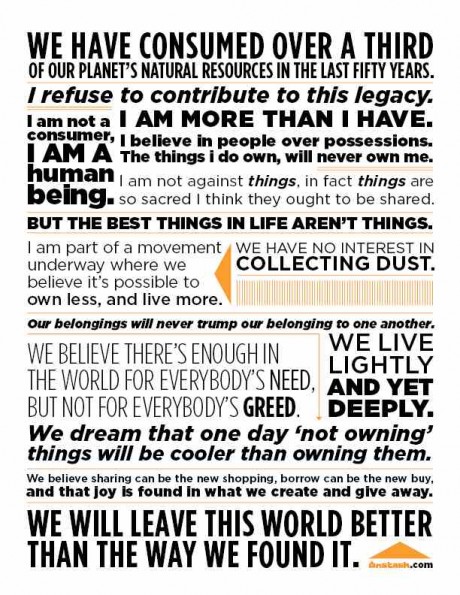
the Unstash Manifesto

Now, before I buy anything, I think to myself, do I really need this? Can I borrow it from someone else? For example, I borrowed a Halloween costume from a friend rather than buying one that I would only use once. And on the flip side, I am always open to lend or give my things to others. Sharing is a part of my life editing. Once I gather all the things that I can go without, I ask friends if they need any of the stuff I no longer need. I have given a dress to a friend who was looking for one to wear for her birthday. I gave away a large stack of post-its to a friend who uses them to organize her files. These actions allow me to share something that’s not useful to me with someone who needs them.

How long have you been living this way, and do see yourself continuing to live this way?

I started living this way in May of this year. I had watched the Ted Talks of Rachel Botsman and Graham Hill, where I began to learn about collaborative consumption and living minimally, namely, less stuff = more happiness. The ideas made a lot of sense to me, and I will definitely continue to live this way. Living an edited life is practical, efficient and a smarter way to live.

What are the biggest advantages of living this way?

The biggest advantage of living this way is being able to focus on experiences rather than things. I’m able to spend money I’ve saved on a night out with friends or on a memorable trip. I feel like I can spend my time on what really matters to me–with friends, family and doing things that make me happy. The less we are consumed with the stuff we own, the more time we have to collect those moments in life that really matter to us.

What are the biggest challenges?

For me, the biggest challenge is trying to explain the concept of sharing and minimal living to friends and family who don’t grasp the idea and label it as hippie, backwards thinking, or just a fad.

Do you think you could maintain this lifestyle with a family?

Definitely. With more stuff, there’s an even greater need for less clutter. There’s also a lot of stuff that can be shared when you have a family, like children’s clothes and toys.

What is the number one suggestion you’d give to someone looking edit their lives?

Start editing right away, even if it’s just a few things. Go through those old filing cabinets, closets and storage boxes. Once you actually get rid of stuff, you will feel amazing. That feeling will prompt you to continue editing and move towards a life edited lifestyle.

What item(s) have made your lifestyle easier?

My laptop and my smartphone, which include lots of easy-to-use apps like Airbnb and Orchestra. Everything is digitized, centralized and customized for my needs. Oh, and my library card 🙂

Do you have any design or architectural suggestions derived from your lifestyle?

Don’t buy a huge bookshelf or lots of storage because you will want to fill it and might end up hoarding or buying stuff just to fill those empty shelves or boxes.

Anything else?

Check out Unstash, a mobile app for life editing. Our belief is that every social circle has a huge overlap in consumer goods that don’t all need to be purchased, owned and maintained by every individual. We enhance the sharing experience, while helping people save money, deepen relationships and create a more sustainable future together.

Check out Unstahs’ blog as well as my personal blog, collaborativeliving.wordpress.com, where I write about anything collaborative that inspires me.

When DIY’ing Doesn’t Make Sense

The fact is many of us are not the best people to do the things necessary to make our lives work, nor is our time best spent learning how to do those things if we don’t know how. In many cases, we’re much better off outsourcing the operational aspects of our lives.

TaskRabbit allows you to do just that, offloading virtually any type of task–from washing windows to HTML coding–to someone who has the time and skill to do the task most efficiently.

It works by posting your task to their site. You can either say what you’re willing to pay or if you don’t know, they’ll give you a price range of what that task typically costs. The task is then bid out to a number of TaskRabbits (i.e. humans who will perform the task). The lowest bidder gets the job.

Criminal background checks are done on all of the Rabbits and ratings are shown from past clients. The task charge depends on its level of involvement–from $30 for a quick house cleaning to $1000 carpentry jobs. Popular tasks include IKEA assembly, pet sitting, dealing with customer service and heavy lifting. You can add in costs the Rabbits will incur while performing your task, for example the cost of dry-cleaning they’ll be picking up. You can also get Rabbits with cars. Right now, TaskRabbit is available in most (but not all) major metropolitan areas.

The LifeEdited team has used TaskRabbit on a number of occasions, mostly for cleaning. Beside being very friendly and helpful, what’s nice is that you hire a Rabbit for the job, and nothing more. When we needed one hour of cleaning the other night after a dinner party, we paid for one hour, not four.

Outsourcing daily life might seem like cheating, but consider a few things:

  1. Are you the best person to do the tasks in your life? Do you have the skill, time, inclination? Perhaps the reason you don’t do certain things is because the answer is no.
  2. What are your time and attention worth? If you have to spend an inordinate time doing something–time better spent doing something else (or even nothing else)–perhaps having someone else do it makes a lot more sense than doing it yourself.
  3. You are providing income to people who need it. You aren’t throwing money away, but rather supporting people happy to have flexible work.

Have You Made a Life Edit? Let Us Know

Have you cut down the size of your home downsize or number of possessions? Do you have innovative architectural, design and product for optimizing your life? Have you experience making sharing an integral part of your life? Have you found ways of doing more with less? If so, we want to hear from you.

Nothing is better that hearing the experience of people walking the walk.

We’re looking for all demographics from young folks to seniors. We’d love to hear from families too.

Please email Ross Porter (info@lifeedited.com) to get the process started! We’d love to share your story.

OhSoWe.com: Like Having a Genie as a Neighbor

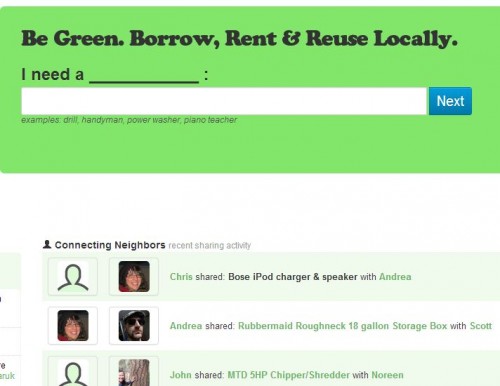
Ever wish you could wish for something and it magically appeared? The website OhSoWe attempts to make that wish its command. Site users can post their needs and/or “Shareables”–i.e. what you want or what you got–and both categories show up on a feed (you can also peruse them separately). The site hooks you up with your neighbors so you can either borrow or buy people’s stuff (including services), or give or sell them your stuff. It’s that simple.

Unlike Craigslist, OhSoWe is hyper-local and has a very streamlined user interface. Unlike Craigslist, there aren’t nearly as many users, so OhSoWe encourages users to invite your friends, which is accomplished via connecting to your Facebook profile or importing email contacts.

Like sites Front Porch Forums and NextDoor.com, OhSoWe doesn’t try to replace in-person contact, but rather uses online tools to connect people living very near you. Unlike those other sites, OhSoWe is not a free-for-all public forum; it is specifically for needs and stuff up for offer. This more singular focus and simple user interface make sharing stuff pretty easy and therefore more likely.

Have you or would you use a tool like this? Let us know in our comments section

Loosecubes and the On-Demand, Go-Anywhere Office

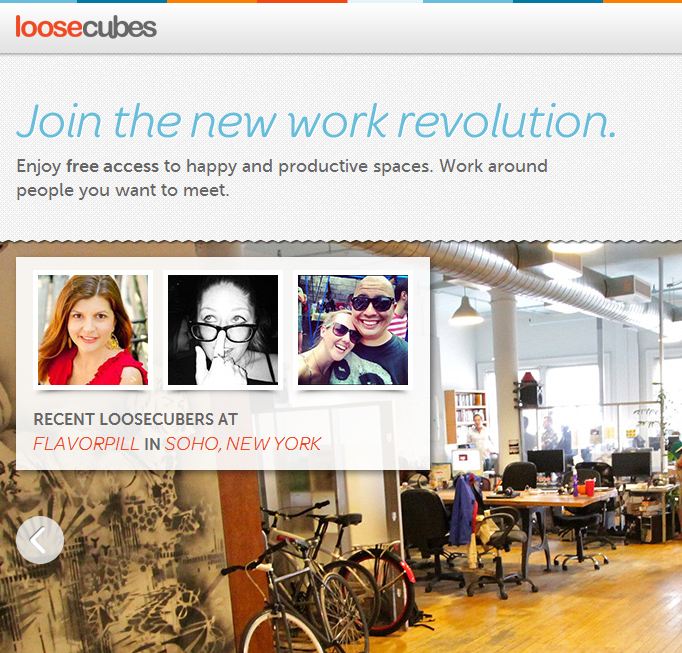
Loosecubes is a network made up of companies and individuals that swap and use desk space. We’d call it the Airbnb of offices, but we’re getting a little tired of comparing things to Airbnb.

You join the network either as a host or individual. Hosts are typically organizations that provide desk space; members of that organization can access desk space of the other network members–in other words, the whole company can tap into the network. Individuals can access the network and book desk space whenever they want. According to their site, Loosecubes got some solid funding and consequently, joining the network is totally free.

All members are required to connect their Loosecube profiles with their Facebook and LinkedIn accounts to avoid unseemly characters. There is a $50K protection policy for hosts against theft, and hosts can decide the level of guest access to their office. Hosts can impose a maximum number of days a guest can work at the space to avoid office squatters.

Wifi and a comfortable place to sit are what’s provided, which for many of today’s professionals is all you need. If you need a printer or conference room, you have to work that out with the host.

The network is huge with locations in most every major, and many not-so-major, cities in the world. If you’re on the road, all you need to do is book a desk in the city you’re visiting, meet with the host and start working.

Beyond the practical aspect of having a free, temporary office in most any city in the world, Loosecubes has the potential to transform offices from static, closed spaces into coworking spaces, filled with a stream of new faces and ideas. Likewise, it promotes getting maximum use of existing resources; office spaces that would otherwise be vacant are filled by people who need a place to work. This might be bad news for many coffee-shops, but it’s good news for today’s light-traveling professional.

Have you used Loosecubes? What was your experience? Let us know.

Get Your Masters in Walkonomics

No form of transportation is more edited that walking. Tires are your shoes. Parking is your chair. Fuel is dinner.

We’ve looked at Walkscore.com in the past. The site is a great resource for assessing a neighborhood’s walkability, showing proximity to various pedestrian-friendly amenities like restaurants and public transport. What the site might not convey is a comprehensive picture of what that walk would look like. Is the walk a stroll in the park or an advance toward enemy trenches?

A new site called Walkonomics tries to fill in these gaps in knowledge. Rather than relying on statistical information, Walkonomics crowd-sources information about particular streets. It looks for information like “road safety,” pavement and “fear of crime,” as well as intangible but important qualities like “fun and relaxing” and “smart [the site makers are English] and beautiful.”

The site reminds us of Waze, which crowd-sources traffic data and gives you corresponding directions. Walkonomics is not nearly as robust as Waze, nor does it appear to have a mobile app, which would be indispensable for this type of information–helping you to decide on-the-spot whether to walk down that dark street or not.

The site is pretty beta and mostly covers major urban areas like London, San Fran and NYC. Even the latter city, arguably the most walkable in the US, has huge gaps in information. That said, users can take it upon themselves to enter data about their particular streets and beef up Walkonomic’s data.

Hitchhiking Enters the 21st Century with Zimride

In his youth, my father’s primary mode of cross-country transport was hitchhiking. A thumb and a clean shave were the currency for a ticket anywhere.

A few well-publicized stories about rides gone wrong, the introduction of cheaper, more reliable cars for the masses and some states banning the practice more-or-less killed hitchhiking in America.

San Francisco-based Zimride has a 21st Century answer for this once-loved, now-maligned institution. On their site, people post where they are going, how many seats they have and how much money they want for those seats. Potential riders opt into the ride, which the driver accepts or not. Riders buy a seat and drivers receive the money via PayPal. A sample fare is $35 to get from LA to Vegas; this is not too much more than gas share for a similar ride. While it doesn’t seem to be the primary motivation, drivers can make a little money if they pack their cars.

There are connections to Facebook and profiles of drivers and riders in order to weed out sketchy chauffeurs and passengers alike. Motor-vehicle and criminal records are checked for all drivers.

Zimride’s other features include an iPhone and Android app for booking on the go, and a large university and corporate network, which is focused more on commuting. Midwesterners might be waiting a while for a ride as most of the rides are on one or the other coast.

Zimride has also launched a beta version of an app called Lyft, which searches for nearby non-professional drivers who are willing to give you a ride. As this is system is of somewhat specious legality, riders are expected to “donate” 80% of what they’d pay for a comparable cab ride. If they don’t honor that, drivers can flag riders as a deadbeat. A Techcrunch article reported there are about 100 drivers in San Francisco using Lyft, so it might be a while before you use it.

The average commuter car carries a measly 1.1 passengers according to a 2009 DOT study. Cars everywhere are begging to be filled, but unfortunately informal hitchhiking has acquired too much baggage over the years. And though Zimride doesn’t have that devil-may-care spontaneity of old-school hitchhiking, it does fill cars, giving people lifts to places they need to go for not too much money.

via Netted by the Webbys

Meeting People is (Not) Easy

We talk a lot about living a life focused less on stuff and space and more on relationships and other things that truly make us happy. The epoch in most of our lives that best embodies that way of life is our college dorm days: days when rooms were small, the conversations were nocturnal and hopelessly interesting, when meeting people and making (and even retaining) friends was easy.

Fast forward a few years. The time spent wiling away hours is spent at work or recovering from work. The once-open hallways, resplendent in conversational possibility are replaced with lawns or vacant hallways in apartment buildings. Neighbors go unknown for years. College friends move to Portland, OR. All of a sudden, we find ourselves with few friends and having a hard time meeting new ones.

A recent post in Apartment Therapy based on a NY Times article called Friends of a Certain Age: Why Is It Hard to Make Friends Over 30? breaks down why meeting people is not that easy for many in the post-post-graduate set. This passage from the latter article explains some of the problem:

As external conditions change, it becomes tougher to meet the three conditions that sociologists since the 1950s have considered crucial to making close friends: proximity; repeated, unplanned interactions; and a setting that encourages people to let their guard down and confide in each other, said Rebecca G. Adams, a professor of sociology and gerontology at the University of North Carolina at Greensboro. This is why so many people meet their lifelong friends in college, she added.

There are other issues. As we get older, we tend to focus on emotional quality of relationships, versus quantity and novelty. That’s great, but what often happens–because of a move, divorce, new job, child, etc.–is the circumstances that foster deepening existing relationships evaporate. In other words, we find ourselves living away from the people we want to go deep with. Many adults find themselves isolated and with few resources to make new friends.

The Times article leaves off on a not-so-optimistic note, though it does point to a big part of the answer for ending isolation: get over yourself and get out. Isolated adults must try new things and meet new people if they want to connect.

They point to a guy who, after a recent move to New York City found himself so lonely that he’d walk his cat in Central Park to initiate conversations. To deal with his isolation, he started a site called The New York Social Network that hooks fellow social New Yorkers around activities. Activity-based social networks are distinct from networks like Facebook, who provide social narrative more than social directives.

Apartment Therapy suggests a few other, non-romantic online resources for meeting friends:

  • Girlfriend Network is a pretty self-explanatory site. It hooks up women looking to connect as friends.
  • Companion Tree connects people looking for friends. Connections are based on your specified interests.
  • Meetup.com is the granddaddy–and probably still the most robust–activity-based social networking.

We would add, Front Porch Forum, which we’ve covered in the past. There is also Nextdoor.com. Both of which connect people based on proximity–still one of the most effective bases of connection.

Google and Yahoo groups are good too as they tend to coalescence real networks.

Take caution though: none of these resources will work if you don’t use them. Meeting people takes effort and a little bit of humility–the willingness to admit we want companionship and taking actions aligned with that desire.

Are you older than 30 and have successfully made and kept new friends? We’d love to hear what you did in our comments section.

image credit: wikipedia

Is Swapping the New Shopping?

Part of the allure of shopping and getting new stuff is novelty. Humans like new things–it’s probably a neurochemical. The problem is that new stuff has consequences, some of which we elucidated yesterday.

A site called Swap.com gives a way of satisfying your new stuff jones without maxing out your credit, storage space or ailing planet’s resources.

As the name suggests, the site allows people to swap their stuff. The site has tons of useful items like cell phones, clothes and media. It’s a little like eBay insofar as people make offers on the swap–you wouldn’t trade your car for a cell phone after all. When a swap is agreed upon, the two parties work out the details like shipping and so forth. Swap.com does not take a cut (we’re not sure how they make money actually).

Security is a little dicey. There are user profiles, but the site’s security page suggests that buyer and seller beware to avoid “swap-lifting.” Like eBay, it’s a matter of establishing a good reputation and there are many users who do multiple swaps. They also suggest doing as much as you can locally, which is feasible for people living in places like NYC or SF.

There’s a subset of the swap economy that focuses exclusively on women’s clothes. Sites include Swapaholics, Clothing Swap and Swapstyle. The former two focus on live events and the latter facilitates online swapping.

Some might contend that this type of swapping is a watered-down version of pathological consumerism (a point made quite clear in Nightline feature above). This may be true to some extent, though the consequences of swapping are much fewer than buying new stuff. Just as important is habituating people to find other ways of getting the things we need.

Do you have experience swapping–either with these sites or informally? If so, we would love to hear your tips and experience.

image credit: postconsumers.com