Occupy Your City this Spring

In many parts of the US and world, spring is springing. Time to take out the lighter jacket and head outdoors. Particularly when living in a smaller abode, it’s important to use your city as a living room, exploiting public space to offset minimal private space. While we’ve tossed out a few public spaces in New York City where those public living rooms might be, there are lesser known spots that often fly beneath the radar.

Privately Owned Public Space (POPS) are located throughout New York and most major cities. They are exactly what they sound like: Spaces you can loiter in, ahem, enjoy, but because they are privately owned, don’t get the hype of major publicly-owned public spaces such as the Highline and Central Park (Zuccotti Park is the one POPS that did get plenty of hype).

pops-greenwich-st

A website by APOPS@MAS (Advocates for Privately-Owned Public Spaces at the Municple Arts Society) provides a detailed map of NYC’s 500+ POPS throughout Manhattan, Brooklyn and Long Island. The site even allows you to search based on criteria such as climate control (providing AC in the summer or heat in winter), 24 hour access and spaces that feature programming such as gallery talks.

The APOPS@MAS site is not only a database, but an advocate of proper stewardship of these spaces. They say this about the spaces and the organization’s mission:

Built and managed by office and residential skyscraper owners in return for valuable floor area bonuses and other zoning concessions, these privately owned spaces are legally required to be open for public use. While some are quite good, others are problematic. APOPS@MAS seeks to sustain and improve all spaces through constructive engagement with owners, public officials, community boards, civic groups, and, most fundamentally, with you.

Detailed descriptions of the spaces are available on the site so you can steer clear of the problematic sites (admittedly, many are just charmless spaces at the bases of skyscrapers).

We did a little digging and found databases for San Francisco (and this one), Seattle and London.

Like the smartphone you accidentally realized had way more cool features than you ever knew how to use, most cities hold many untapped wonders such as POPS that make our lives richer.

Do you have any secret spots in your city? Let us know in our comments section.

Love Thy Neighborday

The average American moves 11.7 times in a lifetime. One out of six Americans move once a year. This high mobility may have turned the institution of neighborly relationships from marriage to long-term dating or even brief fling. This situation was verified by a Pew Study that found fewer than half of Americans know most or all of their neighbors.

Neighbors are good (at least the ones that don’t blast music at 2am). They feed our cats, lend us ladders and cups of sugar and provide easy companionship. A strong tie with a neighbor is worth 1000 Facebook friends on the black market. But it’s tough to love our neighbors when we don’t even know them.

The good folks over at Good Magazine have a remedy for this neighbor deficit disorder: It’s called Neighborday. On April 27th, they challenge all of us to get to know the people closest to us (geographically at least). They explain the motivation:

…While the internet age, has brought unprecedented access to information, networks, and commerce, it’s unclear if it has brought us closer or has in fact further isolated us…Neighborday is about creating a new story. It’s about transcending the old story of self to create a new story of us. It’s about expanding our definition of self to include those who live above us, below us, and next to us. It’s a call to action of the most important kind: to let our neighbors in, and to build more self-reliant streets, blocks, and neighborhoods, together.

We know you’re busy. We know you already have lots of friends that you have trouble keeping in touch with. Worst of all, we know it’s awkward introducing ourselves to the people closest to us–especially if we’ve lived someplace for a while. It might take a little courage (remember, they haven’t introduced themselves to you either, so the shyness is probably mutual).

But really? If we don’t know our neighbors, if we can’t knock on their doors when we need a favor, consider there might be a gap in our social lives.

Visit Good’s Neighboring homepage to take their pledge. They also provide ideas for celebrating Neighborday, like turning your home into a parttime restaurant. If we don’t know our neighbor’s name, we’re probably best off starting small, like introducing ourselves in our hallways, driveways or sidewalks instead of giving our usual “what’s up” or “how’re you doing.”

Are you tight with your neighbors? Beside basic friendliness (always the easiest tactic), how have you cultivated relationships with your neighbors? What advice would you give those of us who are strangers to our neighbors?

Why Your Office Will Disappear

If you’re like most people, you probably work in a large office building alongside colleagues who, much of the time, are away from their seats in meetings, at lunch or traveling for business.

Driven by a global recession, an emerging sharing economy, a more mobile workforce and concern about climate change, COOs, entrepreneurs and other business leaders are looking for ways to make office spaces more efficient. Paying high real estate costs and electric bills for people who use their space 30% of the time doesn’t make good fiscal or environmental sense. For these reasons and more, a drastic change is underway that will make the traditional office as you know it disappear.

Where Will You Work?

Collaborative work spaces everywhere are defining themselves as “coworking spaces,” or workplaces that are shared, fostering productivity, community and collaboration. Good for startups, freelancers, independent workers and entrepreneurs, the trend is growing exponentially. According to Deskmag, the number of coworking spaces has increased 200% annually for seven years. The Global Coworking Unconference Conference (GCUC) convened this month, sharing new strategies for the future.

What Your Office Will Look Like

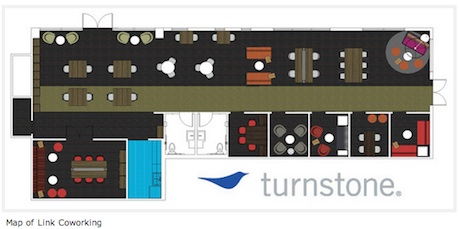
The architectural silos that separate departments will erode. You will know more about what’s happening in other areas of your organization. Open plans will create cafe-like atmospheres and promote creativity and transparency. Office layouts will be more structured for liquid, easy work.

link-coworkiing

New workplace tools like Flockd, unveiled at GCUC, will help people across departments start conversations while increasing productivity.

flockdFlockd offers a new system for people to signal whether they’re free. The available, “Lets Flock,” signal encourages coworkers to interact and connect, while the, “I’m Busy” signal sets clear, healthy boundaries. Better work flow means more free time.

Less Stuff, Less Overhead

Sharing an office means the stuff you need, but hardly use, is also accessible to 100 other companies who share your space. One paper cutter for 100 companies instead of 100 paper cutters. And it means the usual overhead, like rent and heating bills, is split among them too.

Proximal Innovation

FastCompany recognizes the serendipitous, positive function of proximity stimulating innovation. A recent study found “the best, most-widely cited research came from coauthors sitting less than 10 meters apart. ‘How closely they worked mattered as much, if not more, than their affiliation,’ says the study’s author, Isaac Kohane of Harvard Medical School. Coworking’s combination of casual relationships and shared spaces, he suggests, can lead to some of an employee’s most fruitful collaborations.”

OfficeEdited = Smarter Business

As big business comes aboard the coworking revolution, the triple bottom line gets better. American Express recently lowered its carbon footprint by 27.5 percent, citing a decrease in business travel and the creation of centers for virtual meetings. Widely recognized for championing economic development and entrepreneurship is Zappos CEO Tony Hsieh, championing Las Vegas and its Downtown Project to become the coworking capital of the world.

league-of-extraordinary-workspaces

The League of Extraordinary Coworking Spaces (LEXC) has become a resource for such corporations expanding their workplace strategy. The organization’s first corporate customer is Accenture. Good for mobile workers, LEXC offers a new work solution for larger companies.

“Facilities plans have been kept too separate from business plans for far too long,” says Brian Macmahon of Your Office Agent, a commercial agency specializing in leaner work space. “Forward-thinking companies of all sizes are exploring these new models.”

Disclosure: The contributor Marissa Feinberg is the shared office space owner of Green Spaces NY, upcoming member of LEXC, cofounder of Flockd and attends GCUC.

The Nasdaq of Sharing Economy

There’s an economic revolution afoot. The old model of produce, market, consume, trash is proving itself both unsustainable and out of touch with technological advances that allow people to easily access and share existing resources. The new economy–often called the “Sharing Economy“–harnesses existing resources and through smart use of technology, connects suppliers with demanders. One of the main hubs of this economy is Mesh.

The site is based on the book “The Mesh: Why the future of Business is sharing,” by Lisa Gansky. She expands on how Mesh companies operate:

Mesh companies create, share and use social media, wireless networks, and data crunched from every available source to provide people with goods and services at the exact moment they need them, without the burden and expense of owning them outright.

Mesh’s site contains a directory of over 8K companies across 140 countries comprising 25 different categories–from energy to fundraising to kid’s toys. There is hardly any resource that one of Mesh’s companies can’t help you with.

At its heart, Mesh is about the idea of access over ownership. As is often said, what we want is a hole, not a drill. The companies that are part of Mesh’s directory can hook you up with that drill or those clothes or building supplies or anything else. Many of the companies are peer-to-peer like Airbnb, which allow you to buy or use goods and services from private parties; many others are corporations that incorporate this on-demand utilization of existing resources such as Groupon and Zipcar.

Mesh is a great resource for creating a life that has all the stuff you need without the burden of owning it all the time. The popularity of Graham Hill’s recent NY Times op-ed illuminated the extent to which people are becoming overwhelmed by the rate and extent at which we acquire stuff. Inspired by the notion of being stuff-free, many of us might fantasize about offloading all of our worldly possessions. This is great until we need to a take some pictures or go camping or drive out of town for the weekend.

People need stuff. Cavemen needed their hand-axes. Many things that we use all the time like a phone or computer warrant personal ownership. But we don’t need all stuff all the time. Having things around that we seldom or never use like karaoke machines and 10′ ladders tends to lead to clutter and confusion.

What the sharing economy does is create a manageable, cost effective and ecologically sound (less stuff shared by more people) way to have all the stuff you need only when you need it. See more sharing sites on this site and give it a try yourself.

Doing Laundry is Fun

Back in the day, washing clothes was a community-building experience. Folks would go down to the creek, hang out and connect, all while getting massively strong forearms. While this idealized version of the olden-times laundromat might not correspond with the reality (have you ever hand-washed a big load of laundry? In a freezing creek? Not fun.), doing laundry can be a great opportunity to connect with others who find themselves in the same soiled-clothing predicament.

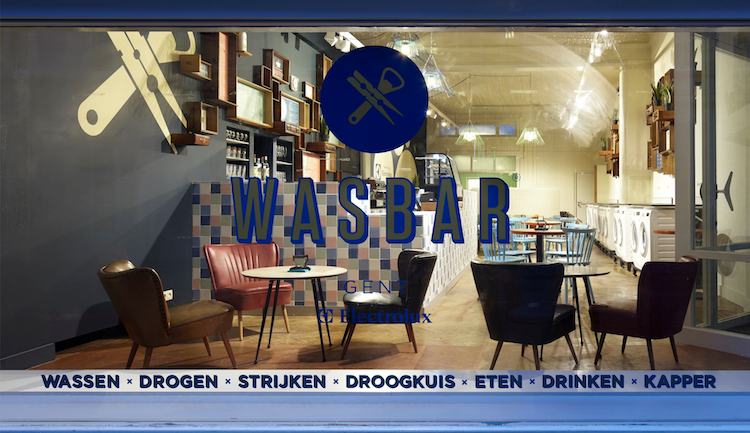
wasbar-interior

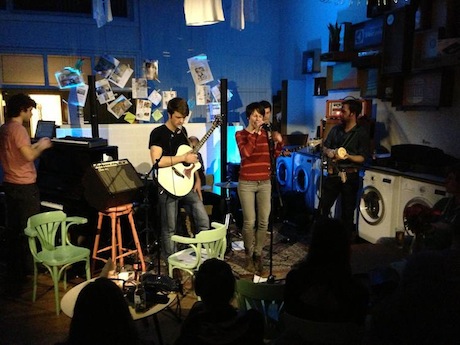
A laundromat in Ghent, Belgium called Wasbar seizes this opportunity, turning the otherwise tedious and time-consuming task of cleaning your clothes into an attractive, fun, social and gastronomically satisfying experience. Rather than the decor consisting of delaminated formica, linoleum and florescent lighting, Wasbar is filled with soft lighting, wood, tile and attractive furniture. Rather than a couple vending machines filled with Pepsi and Funyuns, Wasbar has a beer and espresso bar and buffets serving delicious food. Rather than watching muted episodes of Judge Judy on an overhead TV, Washbar has knitting classes, concerts and a bunch of other programming to keep you entertained while you wait for your laundry (you might not want your cycle to end before the class ends or the encore set).

wasbar-concert

Wasbar is sponsored by Electrolux appliances, Ecover cleaning products and a few other companies. It’s tough to tell whether it’s more than a promotional popup shop, but we like the concept. It plays into the “city as living room” idea we talk about here. It turns an otherwise dull, isolating tasks into an opportunity to connect with your community–all while maintaining your lithe forearms.

Via PSFK

6 Future Blue Chip Companies in the Sharing Economy

A recent article in Forbes called “Airbnb And The Unstoppable Rise Of The Share Economy” gives a great overview of the nascent sharing economy. It tells stories of people like Frederic Larson, who brings in $3K/month renting his home to Airbnb and his Prius through Lyft, or Dylan Rogers, who makes $1K/month renting his BMW out and plans to buy a couple extra cars to make his own micro-rental car fleet. It explains how more and more average people are making and saving dough through resource sharing.

The article is a worthwhile read as it gives a balanced look at the opportunities–the millennials growing receptivity to renting and sharing versus ownership, a southbound economy–and challenges–getting people to share low-cost goods, restrictive commercial regulations–facing the sharing economy

The article also turned us on to a number of sites we didn’t know about. Stahlwarts like Zipcar, Zimride, Neighborgoods and Taskrabbit appeared in the article, but so too did some newer, more specialized sites. Here are a few of them:

  • Parking Panda is a peer-to-peer parking garage. Rent out your vacant parking spot as you would your unused room for Airbnb. PP also allows booking standard garage parking, using their mobile app.
  • Dog Vacay is like Airbnb for dogs. Give your dog to “one of thousands of vetted and insured dog lovers” when you leave town (or need a reprieve from your pooch) for “cage-free” boarding starting at $15/night.
  • EXEC is an on-demand cleaning and errand running service with a lovely web interface. An added bonus is that they use all organic cleaning products.
  • Liquid is a peer-to-peer bike rental service. Rent a bike for $20/day or let your bike out for some extra cash (note: the site is down for the winter).
  • Fon is an international peer-to-peer wifi network with over seven million Fon Spots (aka hot spots). Private wifi providers can make money off people accessing their signal.
  • Zaarly allows you to sell your homemade cookies and other shippable custom goods.

Most of the services seem to have a Left-Coast bias, though ones like Fon and Zaarly have national appeal. And of course, as the article mentions, Airbnb started in San Francisco and can now be found in Peoria, Il. You gotta start somewhere.

Do you have more sharing sites we should be looking at? Let us know in our comments section.

Image via Shutterstock.com

Fit Your Next Car into Your Phone

DriveNow is a car-sharing program launched by BMW and European car rental company Sixt that allows you to locate and rent the nearest car within a given city’s limits via its website or mobile app. What sets DriveNow apart from other car-share services is you don’t need a reservation and you can park and leave the car anywhere you want rather than returning it to a home garage. You could rent a car for 20 mins to drive to work, end your rental, stay at work for eight hours, and rent another DriveNow car to go home.

This flexibility contrasts to services like ZipCar, which require you to make a reservation for a set amount of time and return your car to a specific garage (penalties fees are applied if you don’t return the car by the end of your period).

The service is BMW’s attempt to future-proof itself from the changing nature of car usage and ownership. With car ownership decreasing and urban-living on the increase, having a car that does 150 mph on the autobahn and is parked in your suburban garage will become increasingly irrelevant. Tomorrow’s driver will need a car that can handle 25 mph around town and be easily parked.

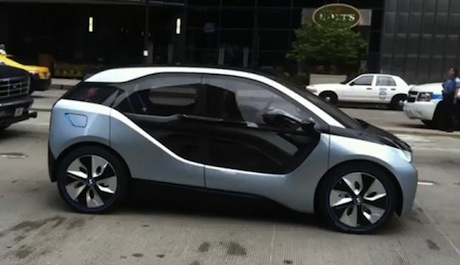
bmw-i3

DriveNow is also connected with BMW’s upcoming i3 electric vehicle (pictured above), which is the company’s first EV geared specifically to city living. In the future, DriveNow will be connected to charging stations around a city for low-emission temporary urban transit.

Here’s the rub: DriveNow is almost exclusively in Germany, with locations in Munich, Berlin, Dusseldorf and Cologne. Currently, their fleets are internal combustion engines, which enables the flexibility of returns (i.e. you can park on the street rather than finding a charging station). Rates are €29 cents/minute for driving and €10 cents/min for parking. These rates include parking and gas; fuel levels are visible when you book your car. DriveNow also includes on their maps proximity to bike share stations.

They have one US location in the Bay Area, whose fleet is made up of BMW’s ActiveE, an all electric version of their 1 Series car. Because of the need to charge, you need to return the cars to one of the designated garages, though not necessarily the one where you picked the car up. All stations are located near BART stations. Rates are $12 for the first half hour then $.32 each additional minute and $90 for the day. There is a one time $39 registration fee.

Ideally, a service like DriveNow would be brand-agnostic–i.e. not attached to a particular carmaker. But we find the idea of on-demand, restriction-free car sharing pretty exciting. Imagine being able to rent any car parked on the street whenever you want. While the per drive expense is surely much greater than car ownership, the lack of overhead and flexibility seems well worth it. And with bigger fleets and costs spread out over more members, the per drive cost would likely go down while available cars increase.

via Metropolis Magazine

Clear Hurdles to Sharing with Yerdle

Yerdle is a new website and mobile platform that allows easy sharing and giving of common items. The idea is very simple: We want or need stuff, the people we know have the stuff we want or need, often unused. Yerdle enables you to get that stuff either to borrow or keep. That’s about it.

Yerdle is connected to your Facebook account. You and your friends post pics of the stuff you’re willing to give away or lend. You can post what you’re looking for and peruse offerings from other yerdle members on their site, Facebook timeline or iPhone.

Yerdle has an impressive team behind it and a lofty mission:

Co-founded by Adam Werbach, former President of the Sierra Club and Founder of Saatchi & Saatchi S, Andy Ruben, former Chief Sustainability Officer and head of Global Strategy at Walmart, and Carl Tashian from the founding team of Zipcar, yerdle was created to offer a sharing marketplace that provides an easy way to reduce consumer waste associated with buying items new. With Americans throwing away an astounding 31 million tons of plastic each year, packaging for new gifts over the holidays will clutter even the neatest home. yerdle’s mission is to reduce 20% of the things people buy through sharing, collectively protecting precious ecological resources.

We asked Adam Werbach a few questions about yerdle specifically and sharing systems in general–about how to get started and how sharing can compete with cheap consumer goods.

LE: What makes yerdle different from other sharing sites out there?

AW: Before supercenters and Amazon.com, the obvious place to get something you needed was from a friend or a neighbor. Need a shovel? Ask a neighbor. Kids need new shoes? Check with the cousins. In the last hundred years though, retail has become hyper-efficient, and it has become easier to buy something new than to borrow it or find it from a friend. Our goal with yerdle is to flip that on it’s head, and to make it easier and more fun to get things from your friends. Here’s how it works, you connect yerdle with your Facebook account and snap a few pictures with your iPhone of items you might be willing to share. Have a baby stroller you don’t need any more? Or an extra thermarest? Yerdle allows you to post items to either give or loan to your friends. The average person who logs on finds about 300 free items from their friends that are immediately available to them.

LE: How do you think technology is changing the face of sharing?

AW: Although sharing has been around forever, we’ve never really applied the advances of software to the sharing economy. The thing that you’re thinking of buying right now is probably sitting unused, and perhaps unwanted, in a friend’s closet or garage. The goal of yerdle is to float that information up to you when you’re considering a new purchase.

LE: How can yerdle compete with an abundance of cheap consumer goods–when it often seems easier to buy something from amazon that it does to browse through a site?

AW: The great thing about sharing is that it saves you money, it builds community and it saves natural resources. That’s a hard set of benefits to beat. Our challenge is to grow the community of folks who are willing to check in with their friends before they give something to Goodwill or buy something on Amazon. It’s not right for everything, but chances are you can save about 25% of the money you’re spending now on durable goods.

LE: What’s the best way to get started if you’re not actively sharing or if there is little sharing going on in your region?

AW: The best way to get started is to take a few photos of items that you are ready to part with. Put them up on yerdle and share them with your friends. You’ll be amazed at how quickly people start talking about what you’re doing. We’ve found that people are as interested in the social relationships as they are in getting something physical. It’s a good excuse to connect with old friends and to help folks.

Couchsurfing.org: Matching People, Couches Across the Globe

Are you someone who loves to travel? Do you love to meet new people? Does a comfy couch sound like a good place to crash? Then Couchsurfing.org is for you. The URL says it all: It allows people to offer and use each others couches, providing a low/no-cost alternative to hotels, hostels and Airbnb. Over its nine year history, the site has built a user base of 5M users across 97K cities.

Rather than mere cheap accommodations, their mission is, “Creating inspiring experiences.” The idea is that there’s a very different experience of a place when you’re crashed out on someone’s couch versus staying in a self-contained room for rent. Hosts often show guests around their cities, host meals and do other things that can give a very authentic sense of place.

What about safety you ask? They have three ways of dealing with safety. First, people can get personal references, sharing what it was like to host, or be hosted by a person. The site offers credit card verification, making sure that a person is who they say they are and lives where they say they live. Lastly, people can “vouch” for one another, whereby a person is recommended by someone who is “extremely trusted by someone who has been vouched for by three other members.” Below is a little video further explaining the process and motivation behind the service.

The site does not charge anything aside from the verification process. This might change soon following the company’s recent controversial move to become a for-profit B-Corporation. It’s not clear how this will affect costs, though it’s reasonable to say it will remain a very low-cost way of finding a place to crash.

Have you used Couchsurfing? What was your experience? Would you use it? Why or why not?

via Unstash.com

image credit: brianthacker.tv

Kick Your Stuff to the Krrb

Selling stuff can be a pain. Most us use one of several channels: Word-of-mouth, yard/stoop sales, Craigslist or eBay. Word-of-mouth is okay for stuff we want to dump, but many us have issues selling stuff to friends, particularly if we want to make money. Yard/stoop sales are a pain in the butt (dragging your stuff in and out, weather, etc) and they hit a limited audience, most of whom want to pay pennies on the dollar. Craigslist has great outreach, but often buyers are super-bargain shoppers and then there are scammers galore. EBay, for most of us, is a intimidating bazaar filled with cutthroat dealmakers.

A site called Krrb provides an answer for the non-professionals and small local businesses to sell their stuff easily. The site describes themselves this way:

Krrb (pronounced ‘curb’) is a hyperlocal, curiously global classifieds made just for you. A most epic scavenger hunt at your fingertips where you can thrift, scavenge, rummage and discover local treasures – in your neck of the woods or over yonder.

With over 24K users in 1130 cities, it beats word-of-mouth and yard/stoop sales; you can also keep stuff posted as long as you want. Unlike Craigslist, there are thumbnail pics of objects to see what you might want to buy. Also, everyone on the site must become a member, which is a great scammer-deterrent. Unlike eBay, there is no bidding; members can civilly negotiate prices if they so choose, but none of that last-second-outbidding that turns so many folks off of eBay.

Other features include a mobile app that shows Krrb objects in your area, a digest of stuff for sale in your area and Krrb Meetups (only in Brooklyn and Paris right now). Posting works on credit system. One post is one credit. Credits cost anywhere from $.50-1.00 (depending on volume you buy) and there are numerous ways of earning free credits (you get 10 free just for signing up). Visit their site to sell your stuff or buy some preowned holiday gifts.