Innovative 19th Century Tiny Apartment Designed Out of Spite

The Japanese are notorious for using odd-shaped land parcels to make amazing tiny homes. In fact, they have a proper name for them: Kyosho Jutaku. The “Lucky Drops” home below is a perfect example. Because of its skinny lot, the home’s frontage was kept at a mere 10′, while it has a very long 96′ depth.

But as innovative as the Kyosho Jutaku homes are, it turns out that an angry American was the forefather of this style of skinny architecture.

In 1882, Patrick McQuade wanted to build some homes at the corner of 82nd and Lexington in New York City. Trouble was, he needed an adjoining parcel owned by Joseph Richardson; that parcel was only 5′ wide, hence McQuade offered what he thought was a reasonable $1K for the land so he could complete his project.

Richardson refused the offer, asking for $5K instead. McQuade, told him to get lost and started building, thinking that the 5′ parcel would simply go unused.

He was mistaken. Richardson later built what would be known at “The Spite House.” The house at its narrowest was 3’4″ wide. Because of a zoning law that allowed bay windows to extend 2’3″ beyond the lot, he was able to eek out a maximum width of 7’3″. The building was 102′ long, 4 stories had 8 suites (2 per floor), one of which Richardson occupied, and, surely pleasing to the man, blocked most of the light to McQuade’s building.
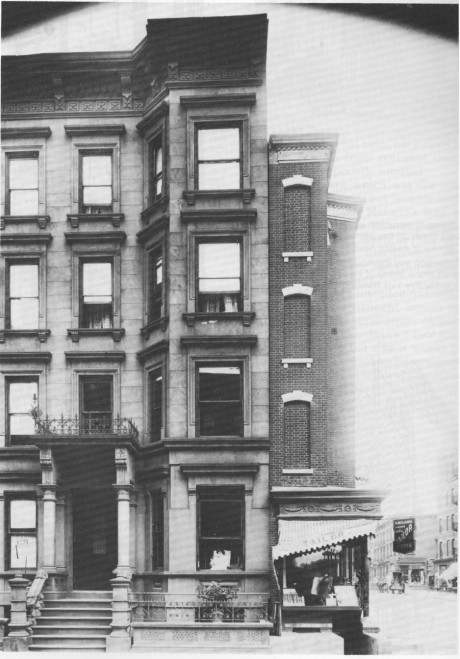
The place wasn’t for everyone according to the indelicate Richardson: “Everybody is not fat and there will be room enough for people who are not circus or museum folk.”

A 1929 article said this of the interior and furnishings:

Only the very smallest furniture could be fitted into the rooms. The stairways were so narrow that only one person could use a stair at a time. If a tenant wished to descend or ascend, from one floor to another, he would, of necessity, have to ascertain that no one else was using the stair. The halls throughout the house were so narrow that one person could pass another only by dodging into of the rooms until the other had passed by. The largest dining table in any of the suites was 18 inches in width. The chairs were proportionately small. The kitchen stoves were the very smallest that are made.

Unfortunately, the home was demolished in 1915 by the venerable Bing and Bing company, so pics of the interiors are nonexistent. But this narrow home, conceived in venom and anger, might have presaged the next generation of smart small homes. Or not.

But as innovative as the Kyosho Jutaku homes are, it turns out that an angry American was the forefather of this style of skinny architecture.

via The Universe of Discourse and nyc-architecture.com

Lucky Drops image credit: Yasuhiro Yamashita
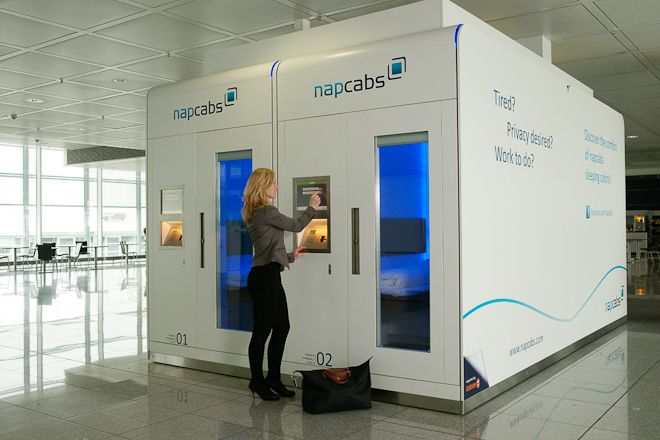
Airport Sleeping Pods Taking Over the World

You have long layover or delayed flight. You’re super spent and want to sleep. You:

  1. Knock your head back, causing drool to run down your face and irreparable neck damage.
  2. Take a nap on the floor–the same floor trodden by thousands of dirty soles, from thousands of lands.
  3. If there is no raised arm rest, you stretch out on some heavily canted airport seats, simultaneously getting marginal sleep and ensuring the growth of the chiropractic industry.

A few upstarts from around the world are tackling this issue of airport sleep deprivation with small sleeping cubes. While they haven’t exactly taken over the world (the 3 here are only in one airport each), they offer minimal sleeping quarters for the beleaguered traveler.

Napcabs (pictured above) is a German-based company with one outlet in the Munich airport (it had 2, but one is being serviced). It features a bed, soundproof walls, wifi, a multimedia screen with flight information and “anti-jetlag” lighting. Bedding is changed by an on-call cleaning staff.

At anywhere from 10-15€/hour, with a minimum 30€ charge, it’s not cheap, though consider if you’re flying overnight, this is a fraction of a hotel room’s cost.

Sleepbox is in the Moscow airport and has very similar features as Napcabs. The one edge Sleepbox has is that it features 2 beds, not 1. According to Wikipedia, they charge $15USD/hour.

Wikipedia also said there are concerns about bed-bugs. Unlike Napcabs, Sleepbox does not explicitly say how linens are dealt with. I am hardly a germophobe, but this seems like a major oversight. A post in Treehugger.com indicates that they originally wanted to use an automated linen changing system, but instead opted for traditional linen. We imagine/hope they have some sanitary setup.

Sleepbox is smartly trying to position itself as a space maximizer for hostels. While airports are a great application, I could imagine these units as replacements for real hotels and hostels, particularly for people who just need a place to sleep.

Snoozecube has 10 sleeping cubes set up in the Dubai airport. The company is from New Zealand, evidenced by the big fern leaf, similar to that of the All Black Rubgy team, emblazoned on their cubes and bedding. Like the others, they cost $16USD, are soundproof, offer wifi and connections to flight info. Their look is not quite as posh as the other 2, but the fact that they are clustered together in Dubai makes them like a makeshift hotel, which seems to make sense as you can have a standing staff and some isolation from the rest of the airport (something I think would be nice even if the cubes are soundproof).

High priced, hourly sleep cubes in airports might not be everyone’s bag. But similar to the Japanese sleeping pods we looked at a while back, these firms are showing an alternative to hotel rooms that feature more–and cost more–than most travelers would prefer.

Have you ever used any of these, or similar, sleeping boxes? What was your experience? We’d love to hear from you.

Take a Very Brief Tour of 105 Sq Ft Apartment

In this short piece from CCTV, we see the interior of Genevieve Shuler’s 105 Sq Ft NYC apartment. Shuler pays $800 for the packed-to-the-gills West Village mico-unit. She has lived there for 8 years and apparently feels there’s more than enough space for her, evidenced by the fact she has a roommate: her cat Ruby.

The tour was part of CCTV’s coverage of the adAPT NYC competition. The segment included Senior Policy Analyst of the Citizen’s Housing and Planning Council (CHPCNY) Sarah Watson. Spearheaded by executive director Jerilyn Perine, CHPCNY was one of the main initiators of the adAPT NYC competition and is the city’s biggest advocate for small-space policy reform.

One of the biggest hurdles facing building small is policy reform. As the segment indicated, the smallest you can build in NYC is currently 400 sq ft. As we see with Shuler and many others, a person can live quite comfortably in far less space. Similarly, no more than 3 unrelated persons can occupy the same space legally (though this author can attest that that policy is seldom enforced). Tenant advocacy is very important but, as is the case in New York, policy is often out of step with tenant needs and advancements in building design.

While Shuler shows that people can–if necessary–live happily in super tiny apartments, we think the best is yet to come in small living; where micro units will be designed from the ground floor to optimize the living experience. San Francisco’s SmartSpace is a great example of that. Before that happens, policy reform will have to take place in many regions. The adAPt NYC competition and CHPCNY are making that look like a likely reality.

Safe For Work Images Make You Want to Quit Your Job

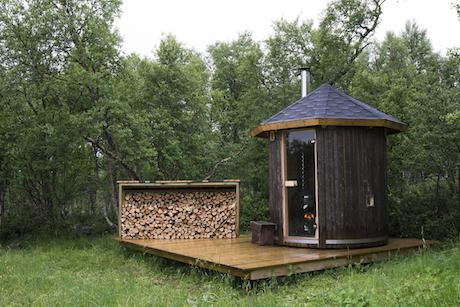
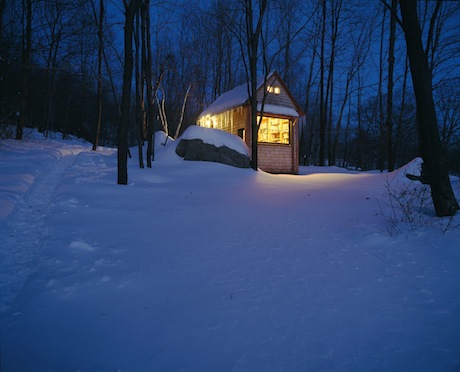
Do you lust after compact homes? Do you fantasize about retreating into nature? Do you love moss and wood beams? If you answered yes to any of these questions, the website Cabin Porn is for you.

image credit: Vegar Moen

The site is little more than an image bank of gorgeous cabins from around the world. Some are big, but the majority are quite modest in size. There’s little in the way of commentary, design motivation, etc.–simply images with which one constructs daydreams.

image credit: Tom Fowlks
Photograph by John Peden
image credit: Jason Warner

See more images on their website: www.freecabinporn.com.

Is Bribery Necessary for Us to Pay Attention?

Let’s get one thing clear: multitasking is a myth. The human mind cannot–will not–pay attention to more than one thing at a time. What most of us consider multitasking is switching back and forth between multiple stimuli. And the more we switch, the more we compromise our ability to switch. Got it?

The harm of multitasking seems obvious with things like driving and texting or walking and texting or…pretty much any movement and texting. But dining has always been a refuge for the so-called multitasker: we talk on the phone and eat, read and eat, watch TV and eat and, increasing, text and eat. But just because we do it, doesn’t mean it’s a good idea. We compromise our gastronomic experience and the social experience by not paying attention to our dining-mates.

A Los Angeles restaurant called Eva is dealing with this issue in a novel way: they are offering 5% off your bill if you check your device at the door. In an interview with KPCC radio, chef and owner Mark Gold explains his reasoning for the offer:

For us, it’s really not about people disrupting other guests. Eva is home, and we want to create that environment of home, and we want people to connect again. It’s about two people sitting together and just connecting, without the distraction of a phone, and we’re trying to create an ambience where you come in and really enjoy the experience and the food and the company.

In other words, Gold isn’t trying to save fellow diners from secondhand cellphone conversations; he’s trying save cellphone users from themselves, getting them to pay attention to their food and the company they keep. Gold says about half the patrons take the discount.

What about you? Would you take the discount or hold onto your phone? Do you have ways to keep yourself mindful at the dinner table and elsewhere? Let us know in the comments section.

Update: Eva has closed for reasons unknown, though we hope it wasn’t because people couldn’t text and eat. 

via PSFK

image credit: Siegel/Daily News

What Can be Done with the McMansion?

Some things seem inherently unedited: SkyMall catalog, Big Gulps, Hummers. And in the housing world, nothing says unedited like a McMansion. Their flabby floor-plans, 4 car garages and 1K sq ft foyers epitomize more-is-less living. That said, now that they’re here, what the hell do you do with them?

A few people are thinking about alternatives uses for the McMansion. After all, nothing is inherently “unedited.” A 10K sq ft home that’s used all the time might be more efficient on a per-user basis than a 500 sq ft space that’s rarely used. A Big Gulp split between 20 is an appropriate treat.

Rainbow Mansion is an example of a smart exploitation of the McMansion’s girth. The house (so named because of its location on Rainbow Dr.) describes itself as “an intentional community of driven, international, passionate, and socially conscious people trying to change the world.” The home benefits from its location in Silicon Valley (Cupertino to be precise), where open-minded, creative folks abound. That said, it still shows the possibilities of re-purposing an otherwise misbegotten architectural conceit in any locale.

Inside Rainbow Mansion. Photo by alexandervandijk on Flickr

The 7 residents of the 5K sq ft space split a $7300 rent and are bound by their beliefs that they can change the world. Since its beginning in 2006, they have had “60 residents from more than 12 countries including 16 folks from NASA, 6 from Google and 5 from Apple.” The space features a library and hosts regular salons. The communal nature and shared philosophy have surely aided the home’s longevity.

Another example lies a bit east of Cupertino at the University of California, Merced, where students are opting out of dorms in favor of sharing foreclosed McMansions, according to an ABC news article. A home they profile houses 6 for $1800–i.e. $300 each, or half the money the dorms cost. While having undergrads in a residential neighborhood might not seem like the best fit, the town had been hit hard by the housing crisis and neighbors and realtors are happy to have the students.

Lastly, a project in Australia–a nation whose homes’ haunches rival the US’s–called Reincarnated McMansion is looking for people who have homes that exceed 360 sq m (3875 sq ft) to volunteer their homes so they can be tore down; two new homes will be made with the materials. While an enticing idea, there’s no indication that anyone has signed up to date.

There are of course limitations to converting these types homes. You can usually only have so many unrelated residents in the same home (code is probably more lax in CA where co-housing is popular). McMansions often have double height rooms that are tough to convert. Also, McMansions are not known for their build quality, so it might strike some as specious to do anything with these monstrosities; Grist suggested we make them wildlife habitats. Nevertheless, these examples show that even things that epitomize excess can be made efficient.

Do you or anyone you know have examples of re-purposing McMansions or other large dwellings? Let us know in our comments section.

[Correction: earlier version incorrectly stated that 5 UC Merced students paid $3300.]

top image credit: REUTERS/Kevin Lamarque

Meeting People is (Not) Easy

We talk a lot about living a life focused less on stuff and space and more on relationships and other things that truly make us happy. The epoch in most of our lives that best embodies that way of life is our college dorm days: days when rooms were small, the conversations were nocturnal and hopelessly interesting, when meeting people and making (and even retaining) friends was easy.

Fast forward a few years. The time spent wiling away hours is spent at work or recovering from work. The once-open hallways, resplendent in conversational possibility are replaced with lawns or vacant hallways in apartment buildings. Neighbors go unknown for years. College friends move to Portland, OR. All of a sudden, we find ourselves with few friends and having a hard time meeting new ones.

A recent post in Apartment Therapy based on a NY Times article called Friends of a Certain Age: Why Is It Hard to Make Friends Over 30? breaks down why meeting people is not that easy for many in the post-post-graduate set. This passage from the latter article explains some of the problem:

As external conditions change, it becomes tougher to meet the three conditions that sociologists since the 1950s have considered crucial to making close friends: proximity; repeated, unplanned interactions; and a setting that encourages people to let their guard down and confide in each other, said Rebecca G. Adams, a professor of sociology and gerontology at the University of North Carolina at Greensboro. This is why so many people meet their lifelong friends in college, she added.

There are other issues. As we get older, we tend to focus on emotional quality of relationships, versus quantity and novelty. That’s great, but what often happens–because of a move, divorce, new job, child, etc.–is the circumstances that foster deepening existing relationships evaporate. In other words, we find ourselves living away from the people we want to go deep with. Many adults find themselves isolated and with few resources to make new friends.

The Times article leaves off on a not-so-optimistic note, though it does point to a big part of the answer for ending isolation: get over yourself and get out. Isolated adults must try new things and meet new people if they want to connect.

They point to a guy who, after a recent move to New York City found himself so lonely that he’d walk his cat in Central Park to initiate conversations. To deal with his isolation, he started a site called The New York Social Network that hooks fellow social New Yorkers around activities. Activity-based social networks are distinct from networks like Facebook, who provide social narrative more than social directives.

Apartment Therapy suggests a few other, non-romantic online resources for meeting friends:

  • Girlfriend Network is a pretty self-explanatory site. It hooks up women looking to connect as friends.
  • Companion Tree connects people looking for friends. Connections are based on your specified interests.
  • Meetup.com is the granddaddy–and probably still the most robust–activity-based social networking.

We would add, Front Porch Forum, which we’ve covered in the past. There is also Nextdoor.com. Both of which connect people based on proximity–still one of the most effective bases of connection.

Google and Yahoo groups are good too as they tend to coalescence real networks.

Take caution though: none of these resources will work if you don’t use them. Meeting people takes effort and a little bit of humility–the willingness to admit we want companionship and taking actions aligned with that desire.

Are you older than 30 and have successfully made and kept new friends? We’d love to hear what you did in our comments section.

image credit: wikipedia

Coolest Small-Space Cans Come from Japan Yo

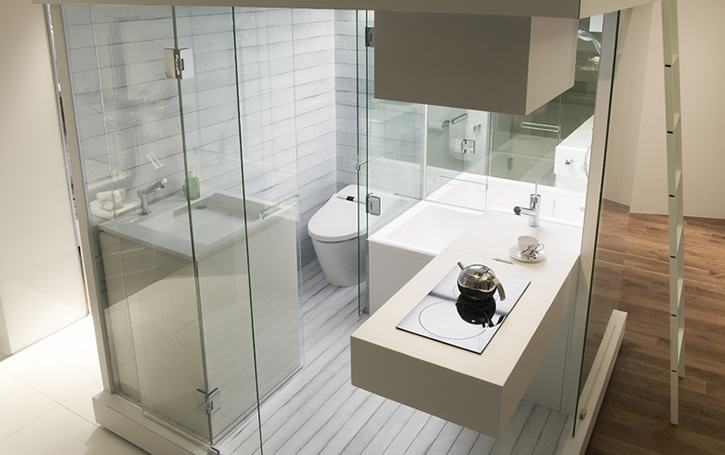
The Japanese have a knack for lending high-end design and materials to spaces Americans typically associate with dorm-rooms and halfway houses. Case in point is the Subaco Sanitary Unit from the Spiritual Mode corporation (we’re confident “spiritual mode” and particularly “sanitary unit” sound more elegant in Japanese). Subaco is an all-in-one bathtub, toilet, wash basin, kitchen, laundry and loft–all of which occupy a whopping 6 x 6 ft (2 x 2m) footprint.

It looks like they have at least a couple varieties: the peekaboo model with glass walls for the WC (don’t throw stones–or anything else–whilst using it) and a model with solid walls. We can see all the bathroom fixtures and induction cooktop, which because of its flat surface and cool-to-touch surface, doubles as a countertop. There even appears to be a fan for the cooktops. We’re curious to see what kind of laundry machine is used.

Presumably, these modular units can be plugged into any space; they look like they’re destined for the wan rūmu manshons we covered a while back.

Most small American apartments employ the Afterthought School of bathroom and kitchen design–knees often knock into tubs and doors while on the can; fridge doors refuse to open in the kitchen; prep space is a joke.

We wonder if Americans were given such sleek and elegant designs in their small-space living options, whether they might be more inclined to scale back on their living spaces?

Image credit: Spiritual Mode

Via Treehugger

Make it Pretty or Make it Disappear: 5 Tips for Tiny Living

We ran across this video from Daily Beast interviewing couple James Casey and Erin Boyle in their 240 sq ft Brooklyn Heights, New York apartment.

Even by Hong Kong standards, 240 sq ft–or 120 per person–is pretty damn small. Fittingly, the couple gave some advice for making the tiny space manageable.

  1. Creative storage. They use existing and nice objects for storage.
  2. Minimize waste. They minimize what comes in and out of the apartment.
  3. Go mini. Household supplies like their trash can and broom are on the small size.
  4. De-clutter. Even in a 240 sq ft space, the couple had a miscellaneous bin, but that bin was kept in a nice old wine box kept underneath their couch.
  5. Adaptability. They pointed to a couple Peshtemal Turkish towels that dry quickly (important when there are only two out at a time) and are pretty enough to be displayed.

Summed up, I’d say their advice is don’t have a lot of stuff and what stuff you do have make it nice, pretty or able to get out of sight.

The best part of the video is the practical demonstration that living an edited life requires no special equipment (there is not one piece of transforming furniture) or enormous budget.

Do you live in a tiny space? What advice would you add?

Via Daily Beast

Go High with DIY Storage System

Even if you’ve pared down your stuff considerably, it doesn’t mean you are stuff-free. You still need that abacus for tax-season or that cricket set for your anglophilic outings. In other words, most of us–save Andrew Hyde–need storage.

A lot of storage takes up valuable floor or wall real estate–a particular waste for stuff you don’t need to access all that often. Ideally, stuff you don’t need that often doesn’t occupy proverbial beachfront property.

We ran across this simple ceiling-mounted storage scheme from The Family Handyman that uses seldom-used vertical space, perfect for seldom-used items.

The site provides a step-by-step guide for constructing the system. The skill level required to make and install it is higher than something like an Elfa system, but it’s surely less expensive for comparably volume (~$100-500). And it’s more versatile; though they use big red bins, we could imagine affixing flanges to the rim of any box for easy sliding; this way you could make the system aesthetically suitable for any room.

Do you have creative storage solutions that use seldom-used spaces? Let us know.

via The Family Handyman