Design your life to include more money, health and happiness with less stuff, space and energy.
Author: David Friedlander
David Friedlander takes care of communications and community at LifeEdited. His background is in writing and event management, having been a regular contributor to Treehugger.com, PSFK and several other publications. He founded Lucid NYC, an event series that has attracted some of the NYC's leading innovators. David has a BA from Columbia University and is interested in the evolution of human consciousness ; he keeps a blog at davidfriedlander.com. He lives an edited life with his wife and two cats in Brooklyn. Follow him at twitter.com/dfriedlander.
david [at] lifeedited [dot] com
A recent article in the NY Times called “The Cult of Disappearing Design” reported on a growing movement toward invisible home furnishings. The “all-invisible aesthetic,” according to the article, “aims for a higher-minded goal: creating unified spaces that flow from room to room and place to place.”
While there is an inherent challenge showing the invisible, we thought we’d add a couple items not included in the Times’ list.
1. Amina Invisible Speakers
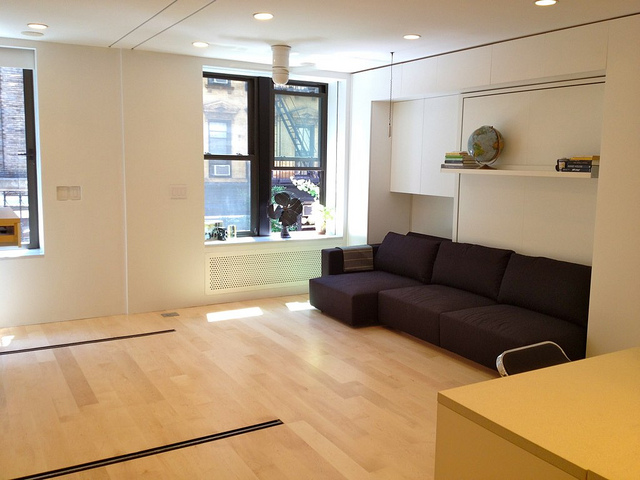
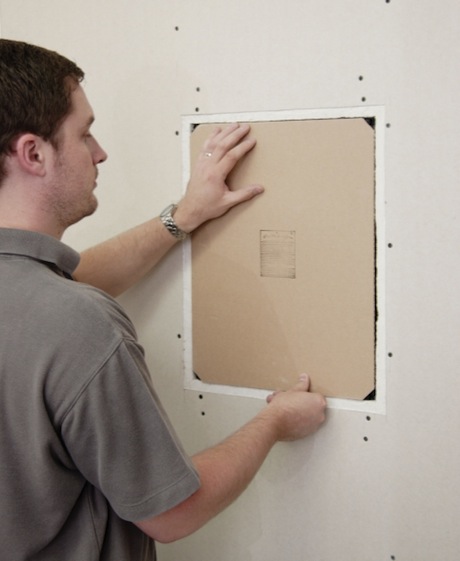
We used Amina high performance invisible speakers in the LifeEdited apartment. Their sound is easy to appreciate, though their beauty is not. The above picture has two large Amina speakers in the ceiling, but you’d never know. They are built into the drywall.
2. Induction Cooktops
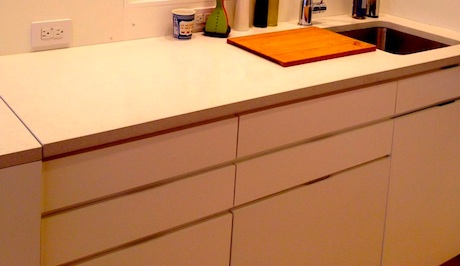
In the LifeEdited apartment, we use Fagor portable induction cooktops, which are invisible in that we can put them in a drawer. Built in models are even more sleek (there’s a Fagor model pictured above). They sit virtually flush with the counter. They only conduct heat with ferrous metal, so they are cool to touch, which makes allows them to be used as additional counter space. They are also 12% more efficient than electric radiant burners.
3. Integrated Kitchen Appliances
While the Times mentions Fisher & Paykel DishDrawer as a disappearing design, there are many dishwashers and refrigerators on the market today are available as “integrated”–i.e. a panel that matches the rest of the cabinetry can be affixed to the front of the appliance. Sorta pictured below is the DishDrawer in the LifeEdited apartment. IKEA makes an integrated dishwasher for about $699. Panels cost extra.
For whatever reason, integrated fridges are more expensive. We used the Sub-Zero 700 BCI stacking drawer fridge, which retails for $3500 and up.
4. Blanco Crystalline Sink
The Blanco Crystalline Sink incorporates such a simple idea: cover you sink when you don’t need it, creating a cleaner look and more counter space. The sink comes with a removable glass cover (available in white or black). Unfortunately, due to code regulations a super-cool retractable faucet is only available outside the US.
Working at home has many perks: no additional office space needed, no commute, no fancy work clothes, less water consumed because you don’t need to take a pesky shower…the benefits go on and on. But are those of us who work from home actually working or are we “shirking” our professional obligations?
A recent study by Stanford University suggests that home-workers are actually more productive and satisfied with their jobs than their officed counterparts. The study involved 13K call-center employees of a Chinese multinational corporation. They found a 13% increase in productivity as well as increased job satisfaction of the study’s subjects. Here is what they said about those findings:
9.5% is from working more minutes per shift (fewer breaks and sick-days) and 3.5% from more calls per minute (quieter working environment). Home workers also reported improved work satisfaction and their job attrition rate fell by 50%.
These are pretty impressive numbers. Impressive enough that the company decided to let all of its employees opt-in to a work-from-home situation. Strangely, of those who volunteered for the study, only half decided to work from home. But those who did opt-in reported a doubled performance impact. This, the study says, highlights “the benefits of choice alongside modern practices like home working.” In other words, people who choose working from home are most likely to be the best home workers.
We wonder how these numbers hold up with different professions. Whereas a call center worker’s work is somewhat dictated to her (i.e. people calling), other professions–writers, designers, salespeople, etc.–require a bit more self-starting. How to they fare at home? Might environments with people around create a social incentive to work?
Even if the home-worker has only the same level of productivity as his office-going counterpart, the exclusion of things like commutes, meal breaks and other small ways traditional workers lose time make working from home a compelling alternative. Saving money and resources on office space shouldn’t be overlooked as well.
Are you one of the 10% of Americans who work at least one day/week from home? Or the 4.3% who work full-time from home? What is your experience? Do you think you are more or less productive? What are the perks and downsides? Let us know.
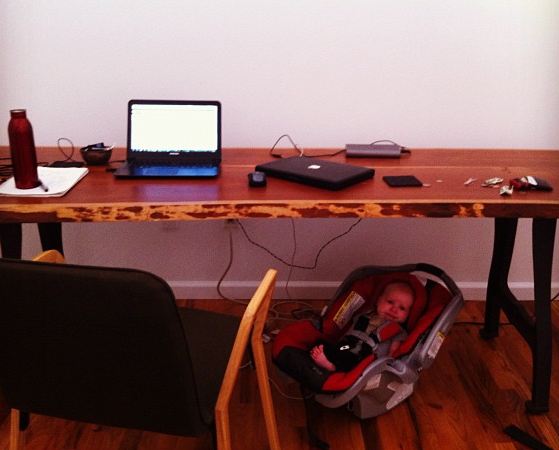
[Full disclosure: This post was written from home, by a full-time home worker, rocking his sleeping baby’s son with his foot. Pictured above.]
Face it, consciously or not, many of us think that more money and stuff will make us happy. We want more money so we can get that iPhone5 or the Kindle Paperwhite or super cool off-grid tiny house or whatever.
Our logic is “As soon as I have enough money, I’ll get_____ and I will be able to _____ and then I will be happy.” So we work extra hard, make more dough (or go into hock) so we can set up our tents outside the Apple Store or go onto Amazon or call the Realtor and fix that iPhone5/Kindle Paperwhite/tiny house deficit. We get that thing and it’s like instant nirvana. Problems solved. Bliss for this lifetime and countless others.
Not exactly. A Harvard/University of British Columbia study shows that spending money on ourselves (antisocial spending) is a far less direct route to nirvana than spending money on others (prosocial).
In one of the study’s experiments, they gave Canadian university students $5 and $20 (US $100/400) to either spend on themselves or others. The students who spent money on themselves reported no increase in their happiness, whereas the prosocial spenders reported an increase. Of note, they found that the amount–i.e. $5 or $20–was less important than the act of giving.
They replicated the experiment in Uganda to make sure that this was not a phenomena limited to affluent Canadian students. It wasn’t. The Ugandans validated the previous findings.
Two of the authors of the study, Elizabeth Dunn and Michael Norton, wrote an editorial in the NY Times saying this:
…typical spending tendencies — buying more, and buying for ourselves — are ineffective at turning money into happiness. A decade of research has demonstrated that if you insist on spending money on yourself, you should shift from buying stuff (TVs and cars) to experiences (trips and special evenings out). Our own recent research shows that in addition to buying more experiences, you’re better served in many cases by simply buying less — and buying for others.
Keep in mind that a positive correlation between money and happiness has been found. But that correlation primarily relates to basic levels of material security; once those levels are exceeded–generally regarded as about $75K/year per household in the US–the increase in happiness with income becomes negligible. Above this level, how the money is spent–pro or antisocially–becomes the main driver in money’s capacity to increase its spender’s happiness.
About Dunn and Norton’s latter point–experiences versus possessions–another study found this:
Experiential purchases tend to make people happier than material purchases…We found that participants were less satisfied with their material purchases because they were more likely to ruminate about unchosen options…that participants tended to maximize when selecting material goods and satisfice when selecting experiences…that participants examined unchosen material purchases more than unchosen experiential purchases…and that, relative to experiences, participants’ satisfaction with their material possessions was undermined more by comparisons to other available options …and to the purchases of other individuals.
In other words, camping outside the Apple store is more likely to make you happy than buying the phone inside it.
While it’s not not spelled out explicitly by either research team, one can surmise that buying experiences for others is a great way of making yourself–and the recipient–happy. It also avoids clogging your friends closets with unwanted gifts ;-).
Beyond giving stuff and experiences, Michael Norton in his TEDx talk (above), shows a strong correlation between happiness and those who give to charities. He suggests Donorschoose.org, which lists projects and needs of low-income schools and their teachers as a possible recipient of that charity. You can help build wells in Africa with Graham Hill’s Charity: Water campaign (it’s his birthday today!). The author gave money to Wikipedia this morning and is already feeling better about himself.
What is your experience with spending money antisocially versus prosocially? On stuff versus experiences? Where do you give? Give us your thoughts (prosocial behavior) in our comments section. It’ll make you happy!
Cuben fiber is a non-woven fiber that’s 15 times stronger than steel and up to 40% stronger than kevlar. According to Wikipedia, its principle applications are “yacht sails, airship hulls, kites and many designs that require extremely strong rip resistance and light areal weight.”
While not many of us are in the market for “airship hulls” (are airships those things from the Jabba the Hutt scene in Return of the Jedi?), the material is being used in a number of more earthbound applications, particularly camping gear: Tents, backpacks, sleeping bags, tarps, stuff-sacks, etc. A 2 person tents such as the LightHeart Duo ($295, above) weighs a mere 2 lbs with stuff-sack–less than half the weight of a standard tent. Other manufacturers include Lawson Equipment, ZPacks, LightHeart, Hyperlite Mountain Gear and Mountain Laurel Designs.
While not everyone is into camping, something like the Zpacks Zero Stuff Sack Backpack (left, $75-115) is a great minimal backpack for anyone. It’s available in 4 sizes and the small one compacts small enough to fit in a quart-sized Ziplock bag. Hyperlite Mountain Gear’s Metro Pack ($128, pictured at top) is another, similar minimal bag.
Lightweight bags like these are a nice change from a lot of today’s luggage, which is often bulkier than the stuff it carries. It also takes the bulk out of camping gear, which is nice to have around, but often takes up a lot of valuable storage space.
Do you have experience with Cuben Fiber? If so, let us know.
Correction: Previous version said Jabba the Hutt scene was in Empire Strikes Back, not Return of the Jedi.
This video from LifeHacker shows what one power-drill and a bit of imagination can do, turning your drill into a blender, beater, scrubber, pepper grinder and Parmesan shredder–all with very minimal modifications. We imagine there are other culinary uses for a power-drill like a handheld blender, food processor or frother.
What this exercise shows is that items we thought were only good for a few purposes–e.g. boring holes, tightening/loosening bolts–can do many.
Granted, using a power-drill this way necessitates keeping it a bit cleaner than you might otherwise (a plastic bag over the drill would probably suffice), but keeping your tools clean is not a bad idea anyway, and getting rid of several single-purpose kitchen tools saves space and money.
Do you have any similar hacks–or MacGyver tips as LifeHacker refers to them? Let us know what they are via email (howdy at lifeedited dot com) or in our comment section.
This video from Fair Companies takes an extensive tour of Richard and Rachel’s school bus home. Unlike René Agredano and Jim Nelson’s mobile living we looked at yesterday, this project is decidedly DIY; most evidenced by the decapitated VW Vanagon that makes up the top 2 stories. Just like the latter couple, Richard and Rachel tout the advantages of living mortgage-free as one of their principle motivations for living this way.
They also liken the project, which has taken them about 6 years so far, to the cardboard forts kids make. They fabricated most of their furniture and even included things like a projection “room” on the second floor. They claim there’s a level of connection and imagination that comes from a hand-built home not usually found when you buy something already built.
There seem to be some concessions to this hacker home, e.g. no plumbing; they use grey water to shower and wash their dishes every few days. They also don’t have RV status, which I suspect is why they didn’t specify their last names or location (though the bay they look upon looks suspiciously like San Francisco Bay).
The upsides they report are many. The have a minimal carbon footprint, using a composting toilet, solar power and even a solar-powered fridge. The bus only cost $12K to build, including a $1200 fridge. They live debt free with only $100/month living expenses. And they enjoy freedom that comes from not living to pay for their lifestyle. This is a common theme from yesterday’s couple and the Tiny House Family we looked at last week.
Do you think you could live on the road like either one of these couples? Have you? What was your experience? Is this something that can be done for longer than 6 years or is this more of a phase? Could a family live like this? Is a mortgage inherently a bad thing? We’d love to hear what you think in our comments section.
Last week, we showed a family living an edited rural life, showing that densely-packed, tiny-apartmented cities aren’t the only environments that support pared-down living. We ran across another version of this way of life that is neither urban, suburban, rural or any of the above: it’s mobile.
images via liveworkdream.com
In 2007, René Agredano and Jim Nelson, inspired by their dog’s diagnosis of bone cancer, quit their corporate jobs, sold their home and most of their possessions, bought a truck and an RV trailer and hit the road with Jerry, their sick doggy to evaluate their lives. After realizing they could support themselves from the road through a combination of online businesses, freelance work and some labor, the trip, meant as a sabbatical, became a lifestyle. They have been going at it for 5+ years with no plan to stop.
We shot René a few questions via email regarding their lifestyle–asking about things like the pros/cons of RV living, their carbon footprint and what landlubbers might learn from their perambulating lifestyle.
LE: What is the best part of your lifestyle?
René Agredano: We can sum up the best part of our lifestyle in one word: Freedom. We have the freedom to live as we wish, work where we want and when we want. Being location independent entrepreneurs gives us the flexibility to go where the weather’s nice and experience all that this great big world has to offer, without sacrificing our need to earn an income.
LE: What is the worst part?
RA: Dealing with the unexpected. When you’re stationery, life is broken up into a series of predictable routines that rarely vary. But when your scenery changes throughout the year, unexpected challenges are always around the corner and there’s a big learning curve in discovering how to cope with them.
Unexpected events ranging from mechanical failures with your rig, to severe weather situations you’ve never experienced before, to something as simple as navigating your way through a new grocery store layout. All of these things challenge your ability to think on your feet and be positive while encountering the unknown.
LE: Can you say something about rising gas prices?
RA: We’re glad we have a diesel pickup and a relatively small fifth wheel trailer (24′ feet), which helps to keep our fuel bill down. And as fuel prices go up, our lifestyle gives us the ability to choose how much or how little we want to drive, unlike people who are tied down by a daily commute or suburban lifestyle.
Rising prices used to scare us, and they really hurt at the pump when we have to swipe our debit card twice! But since we’ve carefully track all of our expenses over the last 5 years, we’ve discovered that on average, we spend less than $400 a month on fuel, which probably less than what the average commuter spends driving to and from work each month.
Also, while we might travel longer distances in one shot while getting from Point A to Point B, we still drive much less frequently than most people. Once we’re in one location, we do little driving other than to the grocery store or sightseeing because we work from our rig.
LE: How do you view the issue of sustainability and your lifestyle? We saw on your blog that something about using bio-diesel. Can you say more about that?
RA: We’re from Northern California, where being an environmentalist is the de facto way of life. Before we started traveling, we were avid backpackers. Whenever we saw a big RV hauling down Highway 101, we would scoff and think “gas hog!” But now that we became one of them, we’ve realized that’s not the case for fulltimers anyhow. If someone is full-timing in their RV, even the biggest 40′ rigs have a smaller carbon footprint than the traditional lifestyle of living in a house or even a small apartment.
For example, as RVers who choose to boondock (forego standard electric, water and sewer hookups) most of the time, we are living off-grid in remote areas with solar power and satellite internet service. By not staying in RV parks unless the weather is exceptionally cold or hot, we’re not consuming a whole lot of resources. Also, we don’t consume stuff on the same level as most people, because with less space we just can’t stock up or buy things on a regular basis. We live in about 100 square feet! Whenever anything new comes into the rig, something has to go to make it fit.
One of the reasons we bought our Dodge Ram diesel pickup, was so that we could make and run biodiesel in it (a mix of veggie & diesel), or eventually convert it to run on waste vegetable oil (WVO). But the practicalities of making our own fuel have eluded us, and these days, finding anyone selling biodiesel is like a needle in a haystack. The industry has just tanked because of the bad rap the palm oil industry has received (there is debate about the ethics of harvesting these trees for fuel instead of using that land for food) and it’s really sad to see. We’re still petroleum-slaves, I hate it.
LE: Do you have a storage unit or did you really get rid of everything that couldn’t fit in you trailer?
RA: When we first hit the road, the plan was to do it for one year, then settle down and get back to “the real world” again. We sold off most of what we owned but kept got a small storage unit for things we didn’t want to have to re-purchase, like basic furniture, as well as some sentimental things. Well, one year turned into two and when we finally returned to that storage unit, we saw that we didn’t get rid of as much stuff as we thought we did. It was scary to realize that our mindset about downsizing was so different when we first hit the road. After living in a tiny space for two consecutive years, now we realize how very little we need to be happy, and it comes down to less than 1/4 of what we left in that unit!
One of our lifetime goals was to own some property, so today we own a very nice paid-for RV site on 5 acres in the Colorado Rockies. It also happens to come with a guest cabin for our visiting friends! But the cabin is off-line and not using any resources for about 10 out of 12 months. We only go there occasionally, since we still love traveling too much.
LE: How long do you plan to continue?
RA: Indefinitely! We’re having too much fun to even think about hanging up our keys.
LE: Any living strategies you can lend the non-mobile?
RA: Yes! Whether you enjoy life on the road or in a stick house, the key to living simply and being happy is to remain debt free. Living unburdened by monthly payments allows you so much more freedom. You can enjoy life to the fullest, be prepared for unexpected expenses and not live in fear of losing your job because you have so many bills to pay. Ever since we became debt free, we aren’t working just to pay bills…we have more time to to pursue our hobbies and interests that may not pay a lot of money, but make us fulfilled, like the Tripawds.com community we founded for canine amputees and their humans!
But when it comes down to it, as Dave Ramsey says, debt is a symptom of insufficient income. We have learned that the best solution to staying financially solvent and able to pursue our passions is to diversify our revenue streams and focus on earning passive, ongoing income. Instead of relying one one business for all of our earnings, we have several different endeavors that each bring in revenue streams each month. Cumulatively they all add up and we’ll never go back to a traditional small business structure again. We believe this is one of the best ways to protect ourselves against economic catastrophe, so now our mission is to help others do the same, through our remote home-based business ebook (www.bit.ly/incomeanywhere) and free coaching at Agreda.com.
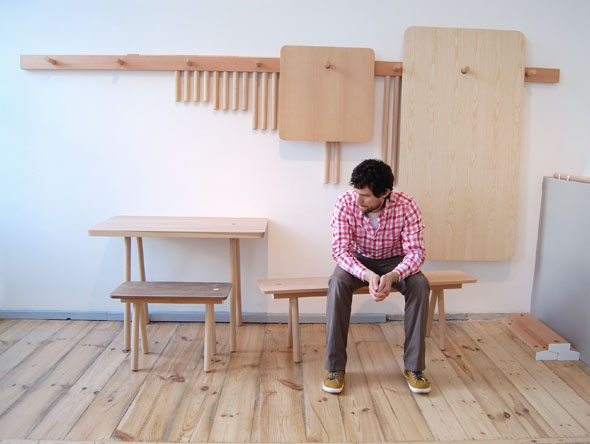
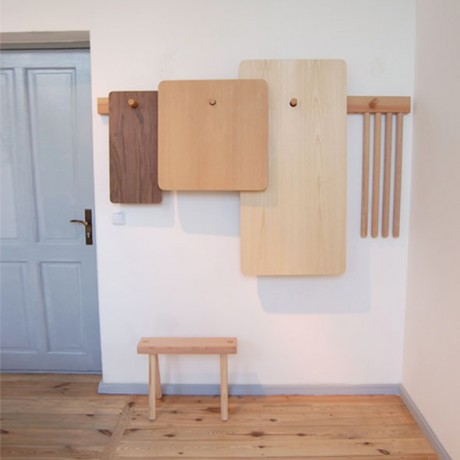
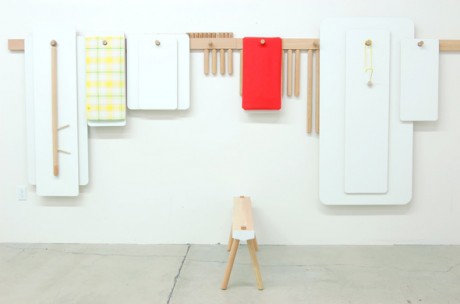
Oregon-based Studio Gorm made this simple, elegant design for transforming, adaptable furniture. There’s not much to the studio’s Peg line: some planks of hardwood with threaded recesses; several threaded legs that can be configured as benches, tables, stools, etc., depending on their lengths; and a hanging rack for storage that makes the assembly look like an objet d’art.
The studio’s site indicates that the collection is available in several types of woods and finishes, leading us to believe that it might be for sale (we are trying to confirm that now).
We have some question about how stable the units are, especially with the longer-legs, but suspect that the wider diameter legs can handle a decent load.
What’s lovely about the design is its mechanical and aesthetic simplicity. There are few moving parts, no hardware, everything is repairable or replaceable and infinitely configurable depending on your needs. It demonstrates that transforming furniture need not have a complicated hardware or a particular aesthetic.
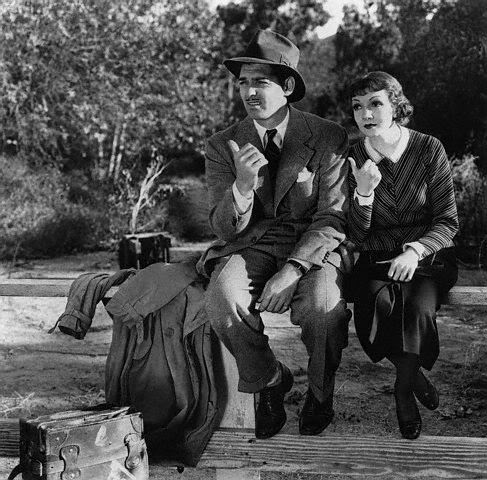
In his youth, my father’s primary mode of cross-country transport was hitchhiking. A thumb and a clean shave were the currency for a ticket anywhere.
A few well-publicized stories about rides gone wrong, the introduction of cheaper, more reliable cars for the masses and some states banning the practice more-or-less killed hitchhiking in America.
San Francisco-based Zimride has a 21st Century answer for this once-loved, now-maligned institution. On their site, people post where they are going, how many seats they have and how much money they want for those seats. Potential riders opt into the ride, which the driver accepts or not. Riders buy a seat and drivers receive the money via PayPal. A sample fare is $35 to get from LA to Vegas; this is not too much more than gas share for a similar ride. While it doesn’t seem to be the primary motivation, drivers can make a little money if they pack their cars.
There are connections to Facebook and profiles of drivers and riders in order to weed out sketchy chauffeurs and passengers alike. Motor-vehicle and criminal records are checked for all drivers.
Zimride’s other features include an iPhone and Android app for booking on the go, and a large university and corporate network, which is focused more on commuting. Midwesterners might be waiting a while for a ride as most of the rides are on one or the other coast.
Zimride has also launched a beta version of an app called Lyft, which searches for nearby non-professional drivers who are willing to give you a ride. As this is system is of somewhat specious legality, riders are expected to “donate” 80% of what they’d pay for a comparable cab ride. If they don’t honor that, drivers can flag riders as a deadbeat. A Techcrunch article reported there are about 100 drivers in San Francisco using Lyft, so it might be a while before you use it.
The average commuter car carries a measly 1.1 passengers according to a 2009 DOT study. Cars everywhere are begging to be filled, but unfortunately informal hitchhiking has acquired too much baggage over the years. And though Zimride doesn’t have that devil-may-care spontaneity of old-school hitchhiking, it does fill cars, giving people lifts to places they need to go for not too much money.
When the recession hit in 2008, the restaurant Hari and Karl Berzins started went under. A year later, they were forced to sell their 3 bedroom, 1500 sq ft house. They were broke, raising a couple kids and forced to take whatever jobs their then Florida home had to offer.
Thinking of ways out of their predicament, they came across the book “Mortgage Free” by Rob Roy; the book promotes the idea of–you guessed it–being mortgage free by buying the best piece of land you can find, setting up a temporary dwelling, then building the home you want on your timetable–all in cash. They found plans from the Tiny House Blog for what their temporary abode would look like.
Karl set about building their 320 sq ft home (a figure that includes a sleeping loft). Like most tiny homes, it began on a trailer bed to avoid building regulations. He started the project in Florida, then moved it to a 3 acre plot of land in the woods of the Blue Ridge Mountains about a year ago. The total cost of the home itself was $12K, greatly offset by scavenged materials.
image via Inhabitat
The couple has been chronicling their journey for the last year in their blog Tiny House Family. They report a higher quality of life. They are back in the black. Both Mama and Papa (their handles on the site) have taken work they love and supports their lives, versus work to pay the bills. The kids are even digging it too (according to the parents).
They have just finalized plans for their next house, a 16′ x 24′ model that will provide considerably more room and room to expand. I get the sense that the extra space is a welcome addition.
LifeEdited tends to focus on the urban side of small space living. City-dwellers usually have smaller physical footprints, use less energy, drive less, have more human interactions and so on.
But what about rural living? [We’ll leave suburbs/exurbs out of the equation for now] On the one hand, it tends to be more spread out geographically, requires more driving, more resources in general and has less unplanned social contact. On the other hand, it can be quite low impact; people like the Berzins grow much of their own produce and use very few resources we can see. Rural homes, while typically larger than a city’s, do not have to be, as evidenced by the Berzins (at least their initial home). Rural human interactions, while not as frequent as the city’s, can often be more intimate and meaningful. Perhaps most important is rural living tends to be free of frenetic urban energy, allowing its residents to lead simpler, calmer lives.
While there is not a city/country binary, it is interesting to see people trying to achieve the same ends–a calmer life, lower overhead, more quality interaction–through very different means. Leaving aside things like jobs, family ties and other considerations, does one environment support this lifestyle better than the other?
What do you think about urban versus rural edited living? Does living in remote locations oppose the less-is-more way of life? Or might the country mouse teach the city mouse a lot about living a simpler way of life? We’d love to hear your thoughts.