Statistics That Will Scare You Sit-Less

After yesterday’s folding chair buying guide, we thought we’d change course and ask about the necessity–or sanity–for sitting at all. Study after study are showing that sitting–“The great leveler” as The Simpsons Mr Burns put it–is a killer. According to a recent study published in the journal BMJ Open, people who sit less than 3 hours a day will live an extra 2 years!

Here are a few other figures:

  • From the Wall Street Journal, “A 2010 study by the American Cancer Society found that women who sat more than six hours a day were 37% more likely to die prematurely than women who sat for less than three hours, while the early-death rate for men was 18% higher.”
  • From the the Atlantic: A sample size of 222,497 Australians by the Sax Institute found that people who sat more than 11 hours a day had a 40% higher risk of dying in the next three years than people who sat less than four hours a day. This was after adjusting for factors such as age, weight, physical activity and general health status, all of which affect the death risk. It also found a clear dose-response effect: the more people sat, the higher their risk of death.

These are just a few figures of the many, well-documented indictments against sitting. And no, vigorous exercise for a half or full hour a day is not sufficient to offset 23-23 1/2 hours of sedentary living.

So what can we do?

  • The first and most obvious thing is stand more. Many of us have desk jobs, so this is easier said than done.  Everything helps. Stand up regularly. Stretch. Go for walks in the middle of your day. Smoke a cigarette (joking, of course). Make up excuses to interrupt long stretches of sitting.
  • Consider a standing desk. You can test one by propping something on your existing desk or buy a proper one. If you’re at your desk for 6-8 hours/day, a standing desk could be the single-most effective way of curbing your sit-time. Hey Donny Rumsfeld does it.
  • Cut back on TV consumption. The average American watches 5 hours of TV…daily! (no figure for recreational computer time, but we’re sure it’s on the rise). Go for a walk, cook, exercise–anything that involves standing and/or movement.
image credit: Disney/Pixar and Wikipedia

10 Folding Chairs to Look at and Sit On

Many people have reached out to us looking for solutions for making their own home an edited home. Often requested is a guide to folding chairs–chairs being a staple piece of furniture for most any home. With a little help from our friends over at Apartment Therapy, we’ve put together this list of 10 folding chairs, ranging from the super inexpensive to the super not-inexpensive.

Let us know what we might have missed in our comments section.

1. Terje Folding Chair from IKEA, $16.99

We’d be remiss to not include the big I. This is one of their several folding chair options. They’re not super sturdy, but boy are they inexpensive. We’ll leave it at that.

2. Mika Natural Wood Chair from World Market, $75 for 2

This chair has a nice look and works inside and out.

3. Cyclone Indoor/Outdoor Chair from Target, $123.89 for 2

If your aesthetic leans toward pop-art, this chair from Target might be your style. It works inside and out.

4. Muji Beech Folding Chair, $70

We really dig this chair. Simple, real-wood, good price.

5. Clarity Acrylic Folding Chair, $150 for 2

Like the Target chair, this one will appeal to a particular aesthetic. The translucency opens up visual space, but acrylic tends to scratch over time.

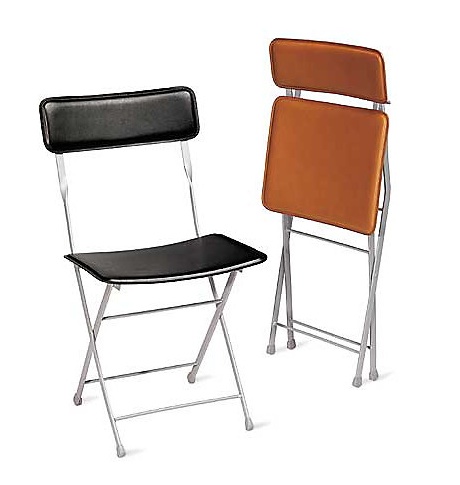
6. Lina Leather Folding Chair by Design Within Reach, $150

We quite like the look of these. They have a very light design, but the leather gives them a touch of luxury. Their legs don’t look super beefy, so might be best for the lither buyer.

7. Flux Chair, $199

We’ve been using a Flux chair for a while and they’re surprisingly comfortable. They work as a lounge or dining chair, but are too slack for an office chair. When unfolded, they lie completely flat. They’re available in several colors.

8. Resource Furniture Pocket Chair, $225-480

These high-quality, Italian-made folding chairs are 3/4″ deep when folded. Unlike a lot of folding chairs, they have a nice, substantial feel. Prices vary depending on finish.

9. Leaf by Folditure, $680-760

We’ll dispense of the alien jokes. In terms of raw functionality and portability, it’s tough to beat the Leaf. They hang in your closet and are built solid enough to withstand your heaviest friend. [Note: the Folditure site has stopped publishing these prices, so check with them to see current pricing.]

10. The April folding chair by Gae Aulenti, $1350

If your tastes lean toward mid-century modern, and your budget leans toward hedge fund manager after a bonus, this chair is probably for you. Solid construction, classic looks, big price tag.

Via Apartment Therapy

Can You be a Collector and Live an Edited Life?

I received a newsletter from The Minimalists entitled “Collecting is Dangerous.” It was a polemic about how collecting is often a veiled form of hoarding. Indeed, as they note, the thesaurus cites “hoard, pile, heap and stockpile” as synonyms for collecting.

Beyond the physical implications of collecting, they wax about its emotional aspects, maintaining that what we collect often becomes entwined with our identities. Likewise, they imply that collecting often serves as a proxy for creating; they point out that there are numerous societies and TV shows that focus on collecting, but few that focus on creating (RIP Bob Ross).

They make provocative points worth considering. We would add a practical question: Is collecting worth it? In order to collect, you need space, whether that’s your home, a garage, a storage unit, etc. You often need a way to present that which is collected–furniture, books, etc. When the day is over, we wonder if you are more satisfied with that State Spoon collection or having a manageable space and living a manageable life?

Even if you’re not a collector per se, things like old photos and tchotchkes picked up while abroad become ersatz collections.  Do their sentimental benefits outweigh their logistic costs?

This is certainly not a one-size-fits all question, but we’d love to hear your opinion. As it happens, we’re considering what flourishes to add to the spartan interior of the LifeEdited apartment. Is it over-edited or less is more?

Please share your thoughts in our comment section.

image credit: modish vintage

Is Swapping the New Shopping?

Part of the allure of shopping and getting new stuff is novelty. Humans like new things–it’s probably a neurochemical. The problem is that new stuff has consequences, some of which we elucidated yesterday.

A site called Swap.com gives a way of satisfying your new stuff jones without maxing out your credit, storage space or ailing planet’s resources.

As the name suggests, the site allows people to swap their stuff. The site has tons of useful items like cell phones, clothes and media. It’s a little like eBay insofar as people make offers on the swap–you wouldn’t trade your car for a cell phone after all. When a swap is agreed upon, the two parties work out the details like shipping and so forth. Swap.com does not take a cut (we’re not sure how they make money actually).

Security is a little dicey. There are user profiles, but the site’s security page suggests that buyer and seller beware to avoid “swap-lifting.” Like eBay, it’s a matter of establishing a good reputation and there are many users who do multiple swaps. They also suggest doing as much as you can locally, which is feasible for people living in places like NYC or SF.

There’s a subset of the swap economy that focuses exclusively on women’s clothes. Sites include Swapaholics, Clothing Swap and Swapstyle. The former two focus on live events and the latter facilitates online swapping.

Some might contend that this type of swapping is a watered-down version of pathological consumerism (a point made quite clear in Nightline feature above). This may be true to some extent, though the consequences of swapping are much fewer than buying new stuff. Just as important is habituating people to find other ways of getting the things we need.

Do you have experience swapping–either with these sites or informally? If so, we would love to hear your tips and experience.

image credit: postconsumers.com

Shocking Exposé on Where Our Stuff Comes From and Goes

We were going to do a post focusing on the “The Story of Change”–the latest video from the “The Story of Stuff” folks about building a movement around less stuff and responsible industrial practices. But then we realized that many people have not seen “The Story of Stuff.”

Directed by Annie Leonard in 2007, “The Story of Stuff” takes a deep and sobering look into the black hole that is our stuff. We talk a lot about the personal tax stuff takes on our lives, but Leonard goes much deeper into the global environmental and social tax our stuff takes. It’s not pretty or easy to watch, though Leonard’s jaunty tone and cartoon illustrations makes it somewhat palatable.

“The Story of Change” attempts to turn SOS’s message into a movement. SOC is not as hard-hitting as SOS, but it nonetheless shows possible pathways out of the consumer quagmire we find ourselves in, likening the call to action with the US Civil Rights Movement and Gandhi’s movement for Indian independence.

SOS.org features other stories about things like bottled water, cosmetics and electronics–all worth watching.

In creating new values and a new society–one that does not blindly adhere to the idea that more, newer and bigger is better–we need to cultivate awareness. Few people in the last decade have done more for bringing awareness to our Stuff-aholic tendencies than Leonard. If you haven’t watched “The Story of Stuff”, take some time to do so.

Connect with Neighbors On and Offline with Front Porch Forums

According to the US Census Bureau, the average American moves 11.7 times in his or her lifetime. As the average life expectancy of that same citizen is 78.2 years, most Americans will move every 6.68 years.

It is perhaps this peripatetic lifestyle and an ever-accelerating pace of life that leads many of us to live those 7 or so years without getting to know our neighbors. We don’t know their names and we don’t rely on them–i.e. the original collaborative consumption.

A website called Front Porch Forum is making getting to know your neighbors just a little easier. The site is like the front porch or town square where people voice their needs, opinions, services–pretty much anything. Your particular forum is determined by your street address and unlike a community site like Craigslist, it is not anonymous. There are real names of real people who live really near you. Unlike Yahoo or Google Groups, you don’t need any special interests–just an address.

One of the site’s FAQ’s is “Has it really come to this? Using computers to talk to people next door?” The answer, they believe, is yes. Here’s what they claim:

In one rural town, we found that half the community had subscribed to FPF after one year and, remarkably, 66 percent had posted….In another study in Burlington, Vt., where half of the city subscribes to FPF, 90 percent reported that their local civic engagement had increased due to this online service.

Their site includes a sample of posts–things like “Found watch – yours?” and “Audubon summer day camp scholarships available.” The kind of casual stuff you’d chat with a neighbor about. Though we cannot attest to it personally, we imagine this online interaction would serve as a catalyst for face-to-face communication.

The site’s newsletter are sponsored with ads. If you’re an idealist, this might strike you as a corrupting force. If you’re a capitalist, this might strike you as practical. The fact is sites like these take time and money; they can either be beholden to volunteers, donors or corporate sponsors.

There is one serious rub to FPF: it is almost exclusively in Vermont (there are couple communities in NY and NH). They are actively looking to expand, but right now that is not the case.

If you are interested in creating a FPF in your area, drop them a line. If you have used FPF, we’d love to hear your experience.

image credit: portlandoregon.gov

Folding Chair Stores Stealthily, Kills Aliens

We ran across this “Leaf” chair by Folditure back in May at the International Contemporary Furniture Fair. It’s made of an aluminum composite panel frame, features stainless steel hinges, aircraft grade stainless steel rivets, and other high quality materials. It can be used indoors or out. It is made with pride in Hoboken, NJ. It folds flat to an amazing 3/4″ and hangs like a jacket in a closet. It’s pretty damn comfortable to boot.

And it looks like something out of a science fiction movie.

The Leaf is an impressive piece of furniture–high quality, functional and very stowable. It just looks a little strange. Regarding the chair’s aesthetics, Folditure’s website claims that “the Leaf is equally at home in a fine parlor or dining room or on your patio. Or aboard your starship!” We couldn’t have said it better.

The Leaf is available on Folditure’s website for $680 with exposed backrest and $760 for the laminated version.

images via Folditure.com

RelayRides: Like an Automotive Airbnb

We’re big fans of Zipcar and similar services. They allow people who don’t need a car full time to have on-demand access to cars when they need them, for as much or as little time as necessary.

A site called RelayRides is trying to get in on that action. Rather than dealing with a corporation however, RelayRides allows peer-to-peer car rentals–sorta like an Airbnb for the automotive world. RelayRides takes people’s slumbering cars and puts them to work as well as making some cash for the owners.

Car owners set their cars price and availability and renters book the cars online. Owners review the request before their car is booked. Protection comes in the form a $1M insurance policy for both owners and renters; 24 roadside assistance comes with the package. Riders are screened to make sure Thelma and Louise don’t rent your convertible.

In terms of money, owners get 60% of the reservation fee. Yep, that’s right–40% go to RelayRide (a hot topic on their comment board). Cars seem to rent for around $7-50/hr, with majority for around $15. Renters cover gas charges.

We wish RelayRides the best, but wonder about their value proposition. Their prices are higher than Zipcar whose prices start at $9/hr in NYC (lower in other regions); oh yeah, this includes gas. RelayRides reservations are not instantaneous and in some cases both parties have to arrange a key exchange (“select” cars can be opened with a cellphone). Zipcar members have a card that allows them to open the door for any reserved car. To be fair, there is a yearly registration fee for Zipcar ($60 in NYC).

I am quite familiar with using Zipcar. I’ve used it for several years, and excepting a few late returns and last-minute reservations switches, I’ve been quite happy with the service.

Have you used RelayRides? What was your experience? Would you recommend it? Are there other similar services we should be looking at? Let us know.

Via Netted by the Webbys

300 Sq Ft Mock-Up for adAPT NYC Dines 8, Sleeps 3

We admit it, we’re pretty thrilled about adAPT NYC, Mike Bloomberg’s initiative to bring smart, small-space living to America’s biggest city. Regardless of what the winning design looks like, the competition serves as an important milestone in bringing this type of dwelling to the forefront of American consciousness.

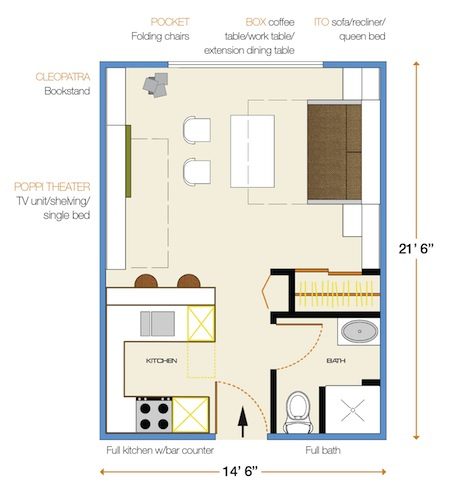
While there haven’t been any official entries–the competition deadline is in September–our friends over at Resource Furniture have installed a mock-up in their NYC showroom to demonstrate what can be done using their furniture in a 300 sq ft space.

While Resource Furniture doesn’t have a lock on transforming furniture, they have the most comprehensive US collection we’ve found. While Murphy Beds are the most common space-savers, Resource offers other important space saving pieces like the Box Table used in the adAPT mock-up; the table converts from a coffee table to 8 person dining table. The Pocket chairs used are only 2″ deep when folded.

In terms of the beds, many Murphy Beds only get the bed out of the way, whereas most RF’s beds use the frontside, like the Ito Bed, which doubles as a recliner/sofa, and the Poppi, which is a bed and entertainment center.

Many people have asked us if we can help them design their own LifeEdited apartment. As every space is different, it’s nearly impossible to create a design without a fair amount of work. Besides showing a compelling model for the adAPT competition, RF’s mock-up shows how much you increase the utility of a compact space without any customization. If you’re in New York City, visit their showroom at 969 3rd Ave.

Airbnb: Changing How and Where People Stay When Away

Several of the LifeEdited team are based in large cities like New York and Seattle, and unfortunately we are cursed with those great city’s myopic worldviews. There are certain things we deal with that we assume everyone deals with, like $2K/month studio apartments, locating reliable public restrooms and knowing cheap places to stay for guests when your place is too small.

For that latter topic, the last few years have seen a revolution in guest accommodation with Airbnb. The company calls itself a “community marketplace for people to list, discover, and book unique accommodations around the world.”

The company, founded in 2008 in San Francisco, lets you book rooms in peoples’ homes in 26K cities and 192 countries, often paying a fraction of what you would in a hotel. Conversely, you can rent out your space to earn some extra money.

Beyond the savings, you can book spaces far more interesting that standard hotel fair–like a cave house in Granada Spain for $63/night (above) or a houseboat in Paris for $125/night. Funny enough, you can rent the 1 Sq Meter Home we covered the other day for $12/night in Berlin. On a more conventional note, you can rent rooms in places like New York City–where average hotel rooms are in excess of $300/night–for less than $100/night.

Airbnb makes money by charging hosts a 3% processing fee and guests a 6-12% service fee (more expensive stays have a lower fee)–nominal expenses compared to a hotel’s overhead charges. Their website provides reviews of hosts and their accommodations, as well as profiles of guests to protect hosts. There are numerous safety measures in place, such as $1M coverage for theft or vandalism for hosts. Their system also allows you to network with your friends, so you can exchange information about various stays from people you know.

Airbnb does require a couple extra hoops to jump through over a conventional hotel, like waiting 24 hours to confirm a reservation and you often have to coordinate a key exchange, so it might not put the hotel industry out of business just yet. That said, it creates a far more affordable, interesting and intimate way to house yourself when you’re away from home.