Get Rid of Dead Spots and Duplicates in Your Music Library

We tend to focus a lot on durable good clutter, but increasingly digital clutter is the nuisance du jour. While you might not need to get a storage unit to house it, it’s still a pain. It hogs RAM slowing down our computers, it makes us get external hardrives or increase our cloud backup for files we don’t need and most importantly, it makes finding files we do need exceedingly difficult.

One of the primary repositories of digital clutter is the music collection. Perhaps you imported a library from somewhere (in a highly legal manner) or you—heaven forbid—pressed “Add File to Library” more than once on iTunes. Suddenly, you have 5 files for “Sympathy for the Devil”—one listed under “Rolling Stones,” another under “The Rolling Stones” and a few as tracks 4, 6 and 11.

A service called TuneUp takes care of this issue, zapping duplicates as well as cleaning up your music library in other ways.

Tuneup offers a few services available bundled or à la carte:

  • Clean your library by fixing mislabeled or missing song information (like “Track 01” or “Unknown Artist”) using waveform recognition.
  • Scan your entire music collection and fill in missing album artwork.
  • Find and remove duplicate music files from your music library using waveform recognition.

The full suite is available for $40 annually/$50 lifetime (includes one computer transfer). All services are available à la carte for $20 annually/$30 yearly. Tuneup is available for Macs and PC’s and works with both iTunes and Windows Media Player.

While this might strike some as steep, consider that digital media is an asset you might keep for a while. And just as you might have bought a CD-rack once upon a time, spending a few bucks to organize your MP3’s might be a worthwhile investment.

269 Sq Ft Apartment with Hiding Tub and Very Cool Chairs

Fair Companies recently released this video of architect Valentina Maini’s 269 sq ft (25 sq m) Barcelona apartment. The tiny space enjoys the benefits of big windows and a terrace–the latter feature was closed off when Maini moved in.

The most obvious wow-factor feature is a bench whose sliding top reveals a bathtub. Other cool things include high-quality, re-purposed sliding cabinets built into her loft-bed and a dining table on casters that slides in and out to create different room configurations.

A less wow-inducing, but nevertheless great feature is her use of Tatami chairs. The Japanese chairs typically sit on the floor, but Maini places them on top of the tub/bench, thereby creating more traditional seating while retaining storage underneath (or in this case a bathtub).

We could envision placing Tatami chairs on any crate or box; this would create flexible, standard-height seating while utilizing all the volume under the seat. You would enjoy the added benefits of being able to easily move the Tatami chairs around or store them away should you want to free up some space.

We found a number of Tatami chairs available online via Ebay, Amazon and Google Shopping.

via Treehugger

The World’s Smallest Home and DIY Bauhaus Furniture

What does a 1 square meter home look like? Actually, it doesn’t look like much–it’s an A-framed box on casters that could easily be mistaken as a dog house.

German designer Bo Van Le-Metnzel made this 1 square meter home not so much as a practical exercise, but as a riff on the concept of home. As a Laotian refugee whose sense of place may be more mutable than most, this concept is near to his heart. His structure asks what does home mean? Are there strictures that dictate what home is and is not? Can a home be rotated on its back?

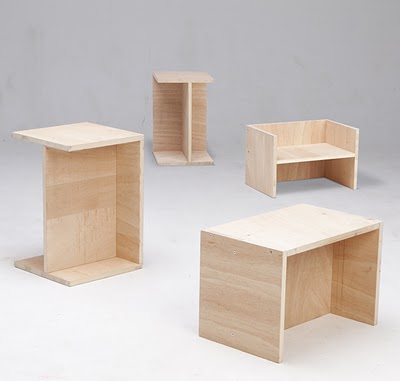
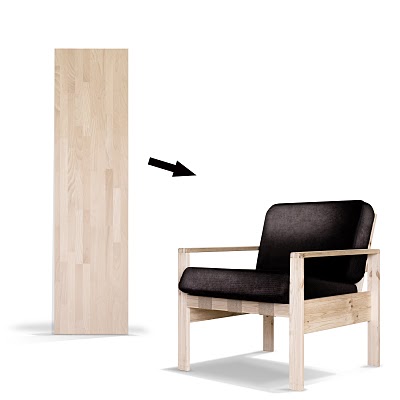
Just as interesting as the nano-home is Le-Metnzel’s website where he gives instructions on how to build high quality, Bauhaus-inspired furniture. The name of the site, Hartz IV Möbel, alludes to the German welfare system (Hartz IV) and furniture (Möbel)–i.e. welfare furniture. Le-Metnzel’s tagline is “Build More, Buy Less.” He aims to offer high-quality design to anyone who wants it; his designs are meant to require minimal skill and tools. Some of his plans include the €24 Chair—an elegant Bauhaus-style chair that can be made for €24 —and the Berlin Stool, which is a modular stool, storage container or toddler desk (both below).

Le-Metnzel’s work is both aesthetic and social, as he explained to BMW/Guggenheim Lab website:

When I did the blueprints for the furniture, for me it was clear that the issue of furniture—a chair—this is not an issue of design. This is a social issue. If you have less money, does it mean that there’s no chance to live largely with nice furniture? My answer to this is no. The smallest apartment can be very fine if you know how to display it, and you know how to put the furniture inside.

Unfortunately for the Anglophonic, most of—if not all—of his plans and his book are in German. Though a good translator link might get you pretty far.

If you have any experience with Le-Metnzel’s designs (or similar DIY projects), let us know.

Images credit: Hartz IV Möbel

Modular Shoes Make Repair a Breeze

How many times have you bought cool and comfortable shoes that are great until their soles wear out? Most shoes today have molded soles that are very comfortable but nearly impossible to fix, leaving us with closets filled with shoes with pristine uppers, but shot soles. And yes, you can buy traditionally-soled shoes that are repairable, but they are not nearly as comfortable as most modern footwear.

A couple shoe companies are doing something about this conundrum–making modular shoes that are easily customizable and whose soles are easily and cheaply replaced.

First is a brand called Urshuz, the brainchild of a Grant Delgatty, a former Vans and K-Swiss designer. Uppers and soles are sold separately (pun unintended). The uppers have multiple rings that loop over channels in the molded sole to bind the two parts (see above). There are multiple upper styles ranging from flip-flops to leather medium-tops. The soles are a uniform shape regardless of upper style; multiple colors are available.

Uppers range from $20-50 and all soles are $25. Considering you can keep the uppers for a much longer time than a standard shoe, and even a modest sole repair is $20, we think that’s a good deal. They look pretty good to boot.

Zipz does a similar thing but with soles that are zipped to the upper. The Zipz styles are similar to popular canvas shoes like Converse, Keds and Vans.

Uppers are around $25-30 and soles are $28. Upper/sole combos are available for $45-50 and there are kids and toddler versions that are a little bit less expensive. As a new pair of Converse is around $30, and often the canvas wears out simultaneously with the soles, we’re not so sure on the value proposition on Zipz, but the idea is nice.

In a world of planned obsolescence and designs that preclude repair, it’s nice to see some companies are making practical products whose life-cycle does not hinge on one of its parts wearing out.

The Media’s Small Home Split Personality

First they ignore you, then they laugh at you, then they fight you, then you win.

Mahatma Gandhi

The world’s spotlight has shown brightly on small living since NYC Mayor Bloomberg announced the adAPT NYC program last week. Articles have been featured in nearly every major newspaper around the world. Suddenly, small living is a big topic.

But what is the nature of the discourse? It seems to oscillate between ridicule to legimacy. Just check out the NY Times, who featured a satirical editorial about micro units called “Microhome, Sweet Home.” Here are a couple passages:

Please keep your coat on. One of Gerald’s friends brought a hat, so unfortunately space is a bit tight in the closet.

And

I had a dream I was in my own coffin last night, but it wasn’t a nightmare so much as a fantasy about the legroom.

In the next breath, they’re publishing a decorating guide to small apartments. Which is it guys?

The Times isn’t the only one. While many publications did straight reporting, the Wall Street Journal called the adAPT units “Lilliputian.” Other publications are asking if anyone would live in such a small space?

This question of whether people can live in such small spaces assumes no on is living in such small spaces. The fact of the matter is small is not new, nor is it unusual. It’s just new to the US. Many–pretty much all–developed countries are, and have been, living in spaces a fraction of the size Americans occupy (can’t say “use”) for years.

Average Floor Space of Newly Built Homes

As the Gandhi quote alludes to, most deviations from the status quo endure several stages of resistance: ignorance, ridicule, active resistance and finally surrender. Perhaps the most important thing is that smaller, smarter living is being talked about and addressed in public policy in tangible ways.

What do you think about this shift? Will compact living remain a novelty in the US forever or can you see a time when compact living will be the standard? We’d love your thoughts.

Info graphic via Apartment Therapy

Image credit: AP/Edward Reed

Reinventing the Dress Shirt with NASA Technology

In a certain way, men’s business suits are pretty great. They have barely changed in the last 100 years. A man can get away with wearing a decent suit over and over, washing it a few times a year.

Men’s dress shirts are different story. They wrinkle in moments. The nice ones tear like tissue. They stain easily–either getting the ring around the collar, pit stains or showing the slightest splash of coffee.

A company called Ministry of Supply is seeing if they can improve upon this fickle article of clothing. The company, which started as a Kickstarter project, has already raised $430K of its $30K goal–leading us to think that guys are looking for superior dress shirts.

The shirts use a “phase change material” similar to that used in NASA space suits. The material stretches, has an anti-microbial coating to cut the stink, resists stains, breathes and wicks moisture and is wrinkle free. The shirts are 100% made in the USA. They look pretty good to boot.

As they have exceeded their Kickstarter goal, Ministry of Supply is taking orders for August and September deliveries. Available are two dress shirts: the Apollo for $105 and the Agent, at $85. There is a t-shirt and base layer available as well; $40 and $30 respectively.

Like the Outlier dress pants we looked at a while ago, Ministry of Supply is bringing smart design and technology to products we all need and regularly replace. While both companies’ prices might seem expensive to some (Outlier pants range from $135-240), consider that their products will last much longer, can be worn more than once, will be more versatile and comfortable than traditional models. A little extra dough up front seems like a good investment to us.

4 Things You Can Do to Save the American Home from Dystopian Future

In 1950 the average size for new homes was 983 sq ft; the average household had 3.37 occupants. In 2010 the average size of new homes was 2,392 sq ft with 2.59 occupants. 317% more space.

According to Nielsen, in Q4 of 2010, the average American watched 34:39 hrs of TV per week. Put another way, that’s 1.5 months per year of continuous TV watching annually.

The outstanding domestic debt of the Household and Home Mortgage Sector in 1950 was $411B (adjusted for inflation). Currently, that same figure is $9.7 trillion. While the population has doubled and home ownership and college attendance have increased, this is still an increase of over 23-times.

Something’s wrong in America.

A new report by UCLA-affiliated social scientists called “Life at Home in the Twenty-first Century: 32 Families Open their Doors” takes a deep look at the lives behind the statistics, entering 32 Los Angeles homes to see how Americans really live. Here are some of their findings:

  • 3 out of 4 of the families garages cannot fit cars because of excessive stockpiling from stores like Costco.
  • 50 of the 64 parents reported not stepping outside in the course of a week.
  • Managing possessions has lead to increased stress hormones in mothers.
  • Most families rely primarily on “convenience foods” even though they only save 11 mins over homemade meals.
  • The majority of leisure time, as the Nielsen statistic suggests, is spent in front of the TV or computer.

A complimentary piece in the Boston Globe that followed Boston families and their consumption patterns suggests that  some of the most pleasurable moments today’s Americans experience is when they are getting rid of the stuff. “I felt so light,” a woman remarked about filling a dumpster with her old stuff following a move.

So what do we do?

Just as we didn’t get into this mess quickly, we might not get out of it so quickly, but there are a few things all of us can do, right now:

  • Challenge the status quo. Many of us have a sense of resignation about over-consumption–as if it’s inevitable that everyone has the latest Macbook or every little girl has a Dora the Explorer Adventure Hut. It’s not true. I use a first generation iPhone that was handed down from my mom. Sure, people snicker, but the phone works fine. We have choices, and though it might mean enduring some screaming, parents can make smart choices for their children. Nothing is inevitable.
  • Think before you buy. From the biggest to the smallest purchase, we should constantly ask ourselves if our purchases are contributing or detracting from our enjoyment of life.
  • Change you behavior. Get rid of clutter, rent stuff instead of buying it, digitize, downsize.
  • Take time to appreciate life every day. Share your meals, get outside, spend time with family and friends, read a book, pay attention to things not coming from a glowing box.

Image credit: Rick Bowmer/AP

Via Boston Globe

LifeEdited on ABC World News in adAPT NYC Roundup

[If you are having trouble viewing video on this site, visit ABC World News homepage]

Check out the LifeEdited apartment in this ABC World News feature about small New York City living spaces. The story is related to Mayor Bloomberg’s adAPT NYC design competition, which is looking for great 275-300 sq ft apartment designs to better house NYC’s 1 and 2 person households.

Perhaps, as the feature suggests, the LifeEdited apartment will factor into the winning design. We’ll keep you posted!

What is Heirloom Design?

A few years ago, inventor Saul Griffith gave his newborn son a Rolex and a Montblanc pen. Why? Because he wanted these items to be the first and last watch and pen his son needed.

The gifts were a demonstration of what he calls “heirloom design”–the principle that we should design, produce and consume timelessly designed stuff that lasts and can be repaired rather than faddy, disposable stuff with built-in expiration dates.

Heirloom design can sometimes seem counter-intuitive. For example, it’s nice to think that the recycled/refurbished/upcycled product is always the right choice, but often this is not the case. Oftentimes it’s better to use things with higher embedded energy (the collective amount of energy it takes to produce a product) that lasts 5-10 times longer than the “eco” product that’ll wear out in a year or two. In this way, a luxury product like a Rolex can be the smartest, most eco watch you buy.

We think the above Le Creuset pot/pan combo is a perfect demonstration of Griffith’s principle: its cast iron construction surely has a high embedded energy, but its durability and function make it worthy of passing from multiple generations.

Some other products he cited to Good Magazine a couple years ago as heirloom quality are:

Bialetti or Bodum coffee makers, Iittala glassware, Vespa motor scooters, the Citroën 2CV, the Volkswagen Beetle, Lego toys, Zippo cigarette lighters, Montblanc pens, the Land Rover (the old aluminum ones before the queen bought one), the older KitchenAid products

The vast majority of stuff Griffith believes shouldn’t be made at all. He says:

The principal and only way to make an heirloom product is to design something that people will need not just this year, but for the next 50 or 100 years. Choose good materials that will last that long; but in essence, don’t even bother making fad products. If you have to design something, choose things that we need as opposed to frivolous things that we might just want for a month or two for bragging rights. In many respects, designing heirloom products means saying no to designing consumer crap that you know will not last very long.

Griffith was also trying to address the issue of electronics, which have notoriously short-lives. For example, he believes things like upgradable firmware can extend the life of our electronics considerably.

Of mechanical items, an heirloom product should be durable and repairable. This iron by designer Samuel Davies–part of a concept he calls “RepairWare”–is a perfect demonstration of that.

Every piece of it is replaceable and repairable. It can be disassembled with a quarter. Bad news is it’s only a prototype.

[divider]

Consider keeping the heirloom design ethic in mind with all you purchases. Ask yourself, “Is this something I would/could hand down to the next generation? Is this timelessly designed or something that will seem old in 6 months? Can I fix or repair this? Etc.”

If the answer is no to any or all of these questions, consider getting something worthy of handing down even if it costs more. If you can’t afford that expensive thing, look into used products–if something is old and still in working condition, it’s likely heirloom quality.

What are your favorite heirloom products?

Via Good

Image Credit: sjdavies.eu

Skillshare Provides Education for the People, by the People

American higher education is an unwieldy institution. An undergraduate degree takes 4 years to obtain, costs tens or hundreds of thousands of dollars that leave many with piles of debt and includes countless classes with no evident practical application outside of cocktail party banter.

Skillshare is trying to change this and establish a different educational model. They describe themselves as “a community marketplace to learn anything from anyone.” They allow anyone to take or make classes they want.

If you’re taking a class, there are numerous, practical professional and recreational subjects–from iPhone app building to Photoshop tutorials to making great French Toast. Prices vary from $10 to a few hundred depending on subject matter and whether they are multi-course or one-offs. Teacher endorsements are featured so you can get an idea of a teacher’s reputation.

If you want to teach a course, you simply sign up on their site. You determine the subject, curriculum, classroom…basically everything. You also determine the price; you pocket all the money less a 15% cut for Skillshare (and no, teaching certificates are not required). Skillshare provides ample support for your class, including a list of possible spaces.

While Skillshare might not slay the traditional educational dragon just yet, they do offer a compelling and affordable alternative. Countless college grads are finding themselves buried in debt, jobless and lacking the specialized skills many employers are looking for. What if you could get the education you want, and only that?

Skillshare also offers an informal and inexpensive way to pick up an extra skill as well as providing an opportunity to leverage your skills to make extra money.