What Do Freedom and Independence Mean to You?

Freedom’s just another word for nothing left to lose.

Kris Kristofferson

In the context of 1776 colonial America, freedom and independence meant being free and independent from the tyranny of taxation without representation, illegal search and seizure and other nasty imperialistic institutions (for the sake of economy, we won’t go into the myriad contradictions of our founding fathers).

Today, there are new forces inhibiting our freedom and independence: Bills we cannot keep up with. Mountains of debt. Constant streams of emails, texts, and hyperlinks begging for our attention. Bloated homes we can neither afford nor maintain. Cultural expectations we can never seem to meet.

At LifeEdited, we promote freedom and independence from unimportant stuff.  When we eliminate (or “edit”) that stuff out, the important stuff–relationships, passions, health, great design–naturally moves in.

To get some other perspectives, we asked a few of our friends what freedom and independence meant to them.

From Francine Jay–aka “Miss Minimalist“–we got this response:

To me, freedom is traveling lightly through life. Each extraneous thing I eliminate—be it an unused item, unnecessary purchase, or unfulfilling task—feels like a weight lifted from my shoulders. Paring life down to the essentials is positively liberating!

Joshua Fields Millburn, one of the 2 guys behind “The Minimalists” gave this appropriately minimalist response:

Intentional awareness.

Ari Meisel, a productivity coach and practictioner of “The Art of Less Doing” says this about freedom and independence:

The ability to head half way around the world tomorrow, with no planning, and not knowing if I’ll have Internet access or not and having confidence that my life and business will run itself without interruption.

What about you? What constitutes freedom and independence to you? We’d love your thoughts. Please share below or on our Facebook page. And have a great holiday!

3 Hiding Beds Not Named Murphy

We love transformable beds. The LifeEdited apartment would not be possible if not for our Resource Furniture ‘Swing’ sofa/bed and ‘Lollipop’ bunk beds. The former allows one room to be living room and master bedroom and the latter enables a couple feet of depth to be a disappearing guestroom.

The ‘Swing’ is ultimately a Murphy bed–albeit one that uses aircraft quality mechanisms and, unlike most Murphy bed’s, has a couch in front of the unit when not in use.

The Murphy bed is the invention of a man named (you guessed it) William L Murphy. He was a San Franciscan who, so the story goes, wanted to woo his wife-to-be but couldn’t bring her up to his bachelor pad, which was effectively a bedroom. A couple hinges and springs later, he was wooing away in his “parlor” and giving himself a prominent place in bedroom-furniture history.

The Murphy bed makes sense. It has one hinge, it can use fairly normal mattresses and stows away nicely. But it’s not the only type of hiding bed out there. Here are a few models that are trying to unseat old Murphy as the king of hiding beds.

1. Zoom Room

One of the bigger gripes with Murphy beds is that they require manual labor–i.e. you have to raise and lower the bed with you arms. This might sound like a petty complaint, but the truth is some of us can’t do this for whatever reason and more of us don’t want to. We want to go to sleep and wake up without lifting a finger.

Zoom Room eliminates this issue by being fully automated and remote controlled. And because the mattress slides out from the bottom, the front-side of unit remains vertical so you can use it for storage, an entertainment center, etc. Prices begin at $4,450.

Zoom Room also makes traditional Murphy beds.

2. Bedup by Decadrages

The self-explanatory Bedup is a French product that uses ceiling space to hide your bed.

Bedup allows you to use very little wall space–a good option for particularly small rooms. Unfortunately, it does not appear to be readily available in US.

3. Resource Furniture LGM

Okay, so it’s kinda a Murphy bed as the bed pivots from the base, but the LGM‘s rotating frame allows the front-side to remain vertical so it can be used for additional shelving or a table/shelving combo (called the LGM Tavolo).

[divider]As many of the above units are highly customizable, it’s tough to give pricing. We can say they are not cheap. Most start well north of $5K. Keep in mind though that if these types of beds allow you to avoid purchasing a home without a spare bedroom–or any bedroom–that cost is quickly offset. In NYC, for example, real estate is easily $800-1K/sq ft. Let’s say a small bedroom is 10′ x 10′–that’s $80-100K! Purchasing a $15K bed unit is the far more economical route.

Do you know of other innovative space-saving beds? Let us know.

2 Lists To Live By

How often have you checked your inbox or the web only to realize it totally short-circuited an important task you were engaged in? How often have incoming calls, texts and/or emails undermined your level of presence with the people you were spending face-time with? How often has your desire to do everything left you too confused to do anything?

If the above problems beset you, strategic adviser Peter Bregman has a simple way to keep on track and avoid distractions. He suggests making and abiding by two lists; he recommends checking them throughout the day. The lists are broken down into two simple categories:

  1. Your Focus List (the road ahead)
  2. Your Ignore List (the distractions)

Though he doesn’t use the phrase, Bregman is describing life as opportunity cost. In order to have certain things (the road ahead), we need to turn down or ignore many others (the distractions). In order to be present with one person, you have to ignore many others. In order to do one thing really well, you have to not do infinite other things. There is a reason no one talks about Picasso’s novels–he chose to be a painter.

What’s unique about his suggestion is the use of active ignorance. It’s not enough to find out what’s important–we have to actively avoid the things–be they communications, tasks, pursuits, purchases, etc–that aren’t aligned with what’s important.

Bregman’s suggestions run counter to our culture that promotes all information all the time. But he’s emphatic about the importance of saying no and the heavy toll of unlimited inclusion. He writes:

Never before has it been so important to say “No.” No, I’m not going to read that article. No, I’m not going to read that email. No, I’m not going to take that phone call. No, I’m not going to sit through that meeting.

It’s hard to do because maybe, just maybe, that next piece of information will be the key to our success. But our success actually hinges on the opposite: on our willingness to risk missing some information. Because trying to focus on it all is a risk in itself. We’ll exhaust ourselves. We’ll get confused, nervous, and irritable. Read full essay here.

We live in an age of amazing tools that enable us to do and have more than ever possible. But our unlimited options often come at the detriment of singular focus and peace of mind. Suggestions such as Bregman’s offer sage advice on how to use these new tools wisely so we can do what’s important while staying sane.

How do you keep on task and combat distraction? Let us know.

Via Life Hacker

Image credit: EE Comics

See the World’s Least Edited Home

Q: What costs $1-2B, has 27 floors, 49K square feet (roughly 117 LifeEdited apartments) requires a staff of 600 people and houses a family of four?

A: Antilia, the world’s largest, most expensive single-family residence.

[nggallery id=8]


Antilia was the vision of Nita and Mukesh Ambani–the couple at the helm of India’s richest family. In a country where the majority of citizens subsist on less than $2/day, in a city that is often called “Slumbai”, the couple wanted to build their own “Taj Mahal of 21st Century India” (seems more like a Graceland to us). If size doesn’t impress, check out these features:

  • Parking for 168 cars
  • 9 elevators
  • 3 helipads and its own air traffic control
  • An ice room with snow flurries
  • The world’s largest collection of antique sewing machines (rumor is that it was originally staple guns).

Perhaps the best part is that the Ambani’s may not even be living in the joint. Vastu Shastra–basically Vedic Feng Shui–says there are not enough windows on the eastern face of the building to greet the morning sun. According to the Daily Mail UK, the family is still slogging it away in their old dump–a 14 story tower.

But watch out Ambani’s. Another mega-rich Indian family, the Jones’, we mean the Singhanias, are close on your heels with their JK house (no, we’re not kidding). While 30 m shorter, it boasts an Antilia-beating museum and 2 pools (Antilia has 1 pool and no museums…pathetic).

While these homes might seem absurd, they can also be viewed as natural extensions of the mindset that if you can build bigger, you do–a mindset that best represented itself on these shores with the McMansion.

Hopefully, these architectural monstrosities represent the pride before the fall, ushering in an era of sane use of space and efficiency…one can hope.

photo of Antilia living room credit: Jonathan Becker for Vanity Fair

5 Great Ways to Optimize Your Gmail Account

We know there are many email providers out there–Hotmail, Yahoo, Earthlink–but let’s face it: the 21st Century belongs to Gmail (so far at least). No other email service offers as much versatility, great spam filters and array of tools as Gmail.

Many of us spend a good portion of our days emailing, and many of us use Gmail. And while we’ve offered suggestions on reducing time spent emailing in general, reduction is not elimination, so why not make our experiences as swift and efficient as possible?

Gmail offers many extensions, plug-ins and add-ons that optimize your account, saving time and energy. Here are 5 user-friendly tools we particularly like:

  1. Canned Responses. This is one of Gmail Labs many great concoctions. It allows you to insert stock responses into emails, be they links, text, phrases etc. This is perfect for repetitive emails. For example you can create text with your address and embed a link to Google maps. Or you can have a stock appointment request and modify details. A dropdown menu appears in your compose window with your various canned responses (see above). To activate–or any other Labs plugin–go to Settings [the little gear on upper right corner of inbox] > ‘Labs’ tab > scroll down to Canned Responses > click Enable > scroll down to Save Changes. (Note: Google warns that Labs “may change, break or disappear at any time”; though we’ve never had an issue).
  2. Google Tasks started off on Labs and is now a permanent fixture on Gmail and Google Calendar. It is a simple window at the bottom of your inbox with a list of things to do. It’s as simple as adding them on and checking them off. It’s like an electronic post it. Click on the large “Gmail” text in upper left hand of inbox and Task pain will pop up.
  3. Google Calendar Gadget is great for the person who’s life rides on Google rails–i.e. using Gmail, Google Docs/Drive, Google Calendar and so forth. Those folks often find themselves switching between their inbox and calendar. With this gadget you can see a calendar view in your inbox and even add new appointments without leaving your inbox. Settings > Labs > Google Calendar Gadget > Enable > Save Changes.
  4. Auto-advance takes care of a small, but annoying issue with Gmail. Sometimes you want to rip through a bunch of emails and when you delete one, Gmail takes you back to your inbox rather than the next message. Auto advance eliminates the unnecessary detour by taking you to your next email. Settings > Labs > Auto-advance > Enable > Save Changes.
  5. Boomerang is a plugin for Firefox and Chrome browsers that has several useful features. One setting allows you to resend an email at a specified time should the person you email not respond; this saves the hassle of remembering or scheduling a followup. Another feature allows you to schedule an email delivery at a later date; for example, perhaps you’re working on a Saturday night but you want your email to land in a client’s inbox Monday afternoon. Lastly, it pings you at a set time should you not hear back from the person you emailed. Oh, it’s free.
Do you have other Gmail (or even non-Gmail) tools that save you time and energy? Let us know in our comment section below.

Ballerina’s Furniture Thinks Inside the Box

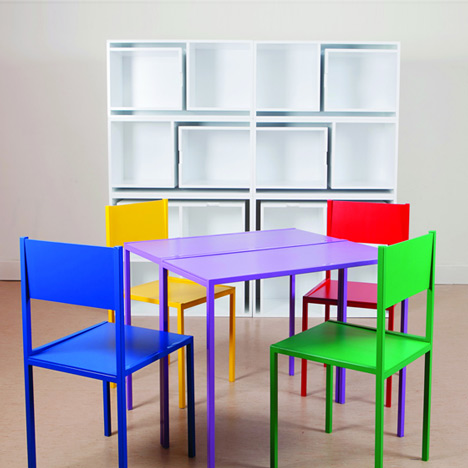
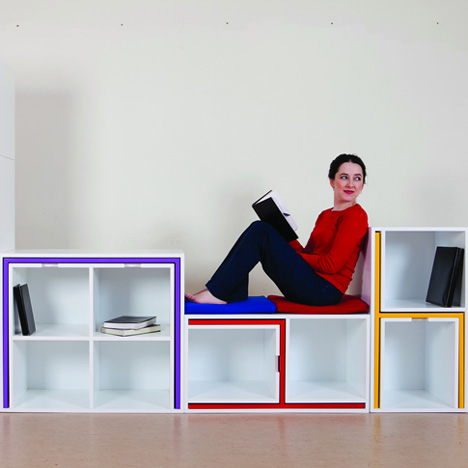
Designer Orla Reynolds has come up with this simple but ingenious “As if From Nowhere” furniture set. By adding just a tiny bit of volume to the shelves, she provides storage for 4 chairs and 2 tables.

Reynolds, a former ballet dancer, found her inspiration from theater. She says:

The movement from bookcase to dining is like a scene change. It transforms the space like props on a stage. The dancers can be seen in the chairs and tables. These are made of such strong material that there is an expectation that they are heavy. But they are lightweight. They are streamlined creating an elegant silhouette.

Reynolds plans to bring the set to production soon. We’ll keep you updated. In the meantime, her design nicely illustrates that space saving design need not be complicated or fussy. Oftentimes, it’s just a matter of using the space we already have in a smarter way.

via Dezeen

Correction: Previous version stated, incorrectly, the name of the collection was “Out of Nowhere.”

The Smartest Dumbbells You Can Get

For those of us who are iron pumpers, having a home gym is not always an appealing option. A serious (or semi-serious) weightlifter needs a good range of weights at his or her disposal as different muscle groups require different loads. Having this weight spread in one’s house necessitates a huge rack of weights. For most of us, a gym–with its ample real estate and wide range of dumbbells and barbells–is the logical way to go.

But maybe there’s no gym near you, or your lifestyle doesn’t permit you to get to one. What then?

A company called PowerBlock offers an alternative to huge personal weight sets. Their dumbbell and kettlebell systems have add-on weights that can be affixed to a base, so units can range anywhere from 2.5 lbs to 175 lbs for each dumbbell (kettlebell weights are a bit lower. Specific weights of all units vary depending on particular configuration). The dimensions of the biggest set is a scant 20.75″ L x 8.5″ W x 8.5″ H; the company claims this largest dumbbell set replaces 55 pairs of dumbbells or 10,075 lbs of free weights, not to mention a 20′ long rack. Sets start at $149 and go to $1098 for the biggest set; larger sets of individual dumbbells with racks easily run in excess of $2K.

While gyms might be a better representation of the LifeEdited ideal as they facilitate access over ownership, sometimes we need our own stuff. And if we’re going to have our own stuff, why not make it the smartest, most versatile, compact stuff we can buy?

Video: LifeEdited on “This Could Be Big”

The other day Bill Weir from ABC/Yahoo News stopped by to tour the LifeEdited apartment as part of his “This Could Be Big” program. While we take gentle exception with the conditional “could”–and “big” for that matter–the video beautifully shows the apartment in its various iterations.

Weir called the apartment “A cutting edge template for anybody who wants to simplify their life without giving up style,” and said the apartment.” We agree.

He did a great job of creating context for LifeEdited in general–mentioning not only the apartment, but product design and larger developments that support this way of life.

Check out the video and let us know what you think in our comment section.

10K Public Bikes Coming to NYC in July

In July, New York City will add its name to the many cities that have public bicycle programs. The Citi Bike program will feature 10K bikes in 600 docking stations around the city, making it the largest such program in the US (the name comes from Citibank, who gave $41M in sponsorship money).

You can either rent bikes by the day, week or sign up for a yearly membership; prices are $10, $25 and $95 respectively. With the yearly, you receive unlimited sub-45 minute rides with nominal charges when that time is exceeded.

Programs like this have been going on for years across the US and the world. Paris has 20K public bikes, London 9K, Montreal 5K, Washington DC 1500 and Hangzhou, China has a whopping 60K+.

Public bikes are ideal for city-dwellers who need to get somewhere quick. The bikes’ upright position and grease-less configuration make them business-attire compatible. They also cover the spaces not covered by public transport. Most importantly, they make biking more accessible and acceptable to larger swaths of the population. They are, as Treehugger puts it, “cycling’s gateway drug”–once you start, you can’t stop.

Do you or have you used a public bike? What was your experience. Let us know.

Via Bloomberg and Treehugger

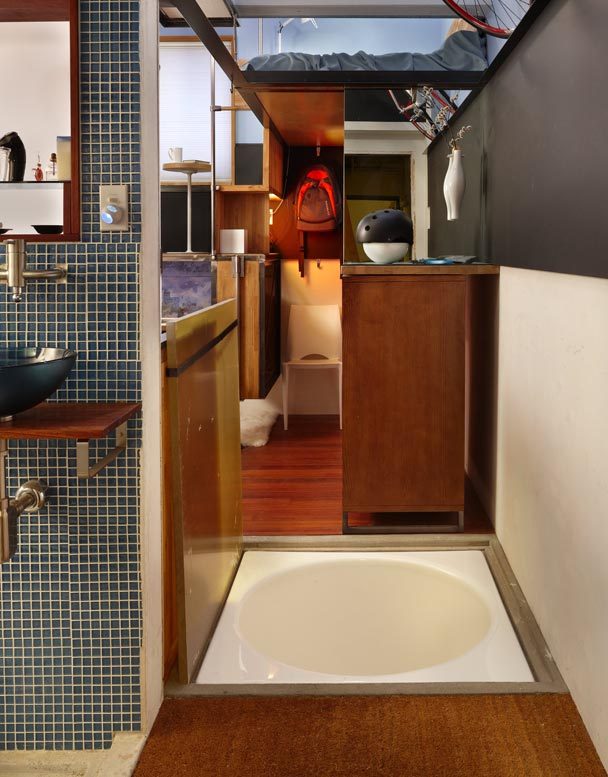
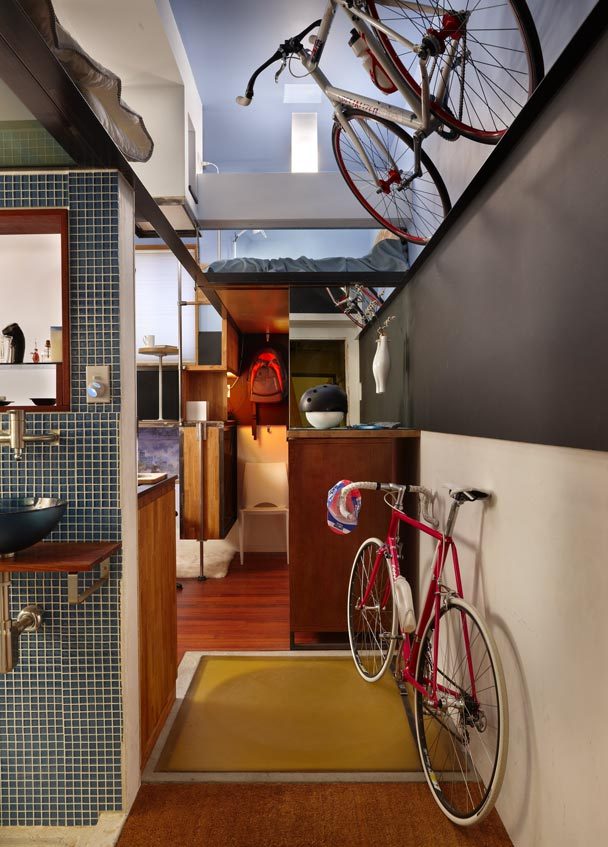
What Does a 182 sq ft Triplex Look Like?

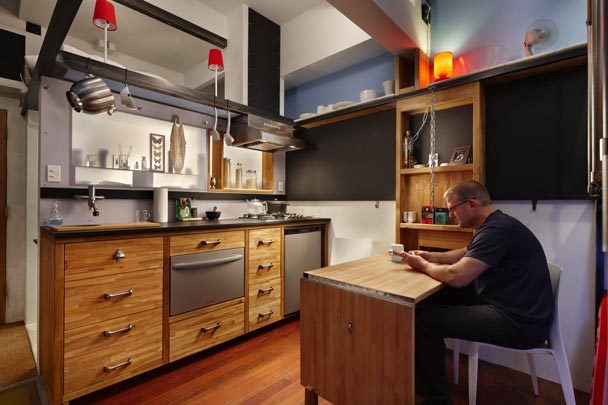
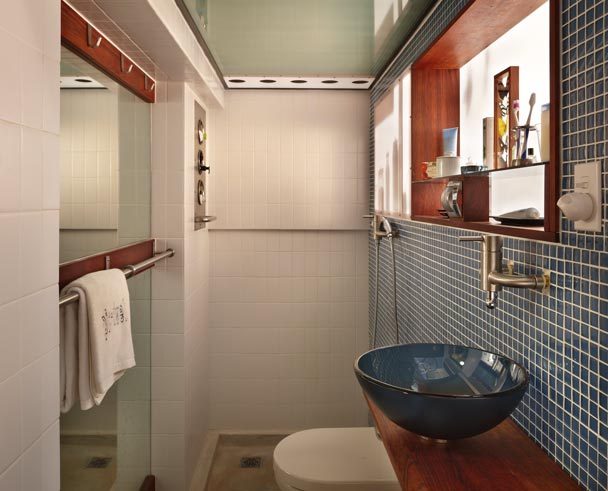
Steve Sauer is serious about efficiency. His 182 sq ft Seattle apartment has virtually no unused spaces and zero redundancies.

Fittingly, Sauer is an interior designer for Boeing and a holder of a Masters in whole-systems design. The genesis of began after he started looking for storage space for his stuff. When he found an available space in a coop building, he realized that with proper design, it could house him and his stuff.

He made a list criteria like being “quick to clean and have” and provide “room for current needs only.” Every decision had to be intentional. He claims that each product represents 10-100 hrs of internet research. What he couldn’t buy he made.

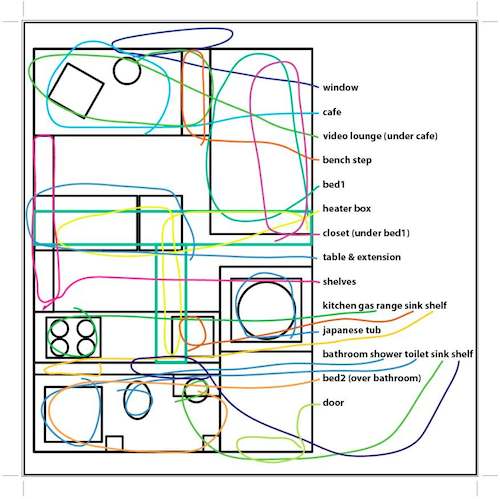
The result, which he duddbed “Pico Dwelling” (pico is 1/trillionth) is an amazingly efficient space featuring two sleeping areas, 3 levels, a recessed and covered Japanese soaking tub, a video lounge, a cafe and many other amenities.

Another intention Sauer had for the space was to “compress my home to squirt me back out to the community.” In other words, the space was so small, he’d have to engage his community. That said, he has had up to 10 guests in the space at a time.

image credit Benjamin Benschneider/Seattle Times

Via Seattle Times and Oixio.com