Tiny House Family and the Edited Rural Life

When the recession hit in 2008,  the restaurant Hari and Karl Berzins started went under. A year later, they were forced to sell their 3 bedroom, 1500 sq ft house. They were broke, raising a couple kids and forced to take whatever jobs their then Florida home had to offer.

Thinking of ways out of their predicament, they came across the book “Mortgage Free” by Rob Roy; the book promotes the idea of–you guessed it–being mortgage free by buying the best piece of land you can find, setting up a temporary dwelling, then building the home you want on your timetable–all in cash. They found plans from the Tiny House Blog for what their temporary abode would look like.

Karl set about building their 320 sq ft home (a figure that includes a sleeping loft). Like most tiny homes, it began on a trailer bed to avoid building regulations. He started the project in Florida, then moved it to a 3 acre plot of land in the woods of the Blue Ridge Mountains about a year ago. The total cost of the home itself was $12K, greatly offset by scavenged materials.

image via Inhabitat

The couple has been chronicling their journey for the last year in their blog Tiny House Family. They report a higher quality of life. They are back in the black. Both Mama and Papa (their handles on the site) have taken work they love and supports their lives, versus work to pay the bills. The kids are even digging it too (according to the parents).

They have just finalized plans for their next house, a 16′ x 24′ model that will provide considerably more room and room to expand. I get the sense that the extra space is a welcome addition.

LifeEdited tends to focus on the urban side of small space living. City-dwellers usually have smaller physical footprints, use less energy, drive less, have more human interactions and so on.

But what about rural living? [We’ll leave suburbs/exurbs out of the equation for now] On the one hand, it tends to be more spread out geographically, requires more driving, more resources in general and has less unplanned social contact. On the other hand, it can be quite low impact; people like the Berzins grow much of their own produce and use very few resources we can see. Rural homes, while typically larger than a city’s, do not have to be, as evidenced by the Berzins (at least their initial home). Rural human interactions, while not as frequent as the city’s, can often be more intimate and meaningful. Perhaps most important is rural living tends to be free of frenetic urban energy, allowing its residents to lead simpler, calmer lives.

While there is not a city/country binary, it is interesting to see people trying to achieve the same ends–a calmer life, lower overhead, more quality interaction–through very different means. Leaving aside things like jobs, family ties and other considerations, does one environment support this lifestyle better than the other?

What do you think about urban versus rural edited living? Does living in remote locations oppose the less-is-more way of life? Or might the country mouse teach the city mouse a lot about living a simpler way of life? We’d love to hear your thoughts.

Make it Pretty or Make it Disappear: 5 Tips for Tiny Living

We ran across this video from Daily Beast interviewing couple James Casey and Erin Boyle in their 240 sq ft Brooklyn Heights, New York apartment.

Even by Hong Kong standards, 240 sq ft–or 120 per person–is pretty damn small. Fittingly, the couple gave some advice for making the tiny space manageable.

  1. Creative storage. They use existing and nice objects for storage.
  2. Minimize waste. They minimize what comes in and out of the apartment.
  3. Go mini. Household supplies like their trash can and broom are on the small size.
  4. De-clutter. Even in a 240 sq ft space, the couple had a miscellaneous bin, but that bin was kept in a nice old wine box kept underneath their couch.
  5. Adaptability. They pointed to a couple Peshtemal Turkish towels that dry quickly (important when there are only two out at a time) and are pretty enough to be displayed.

Summed up, I’d say their advice is don’t have a lot of stuff and what stuff you do have make it nice, pretty or able to get out of sight.

The best part of the video is the practical demonstration that living an edited life requires no special equipment (there is not one piece of transforming furniture) or enormous budget.

Do you live in a tiny space? What advice would you add?

Via Daily Beast

Shocking Exposé on Where Our Stuff Comes From and Goes

We were going to do a post focusing on the “The Story of Change”–the latest video from the “The Story of Stuff” folks about building a movement around less stuff and responsible industrial practices. But then we realized that many people have not seen “The Story of Stuff.”

Directed by Annie Leonard in 2007, “The Story of Stuff” takes a deep and sobering look into the black hole that is our stuff. We talk a lot about the personal tax stuff takes on our lives, but Leonard goes much deeper into the global environmental and social tax our stuff takes. It’s not pretty or easy to watch, though Leonard’s jaunty tone and cartoon illustrations makes it somewhat palatable.

“The Story of Change” attempts to turn SOS’s message into a movement. SOC is not as hard-hitting as SOS, but it nonetheless shows possible pathways out of the consumer quagmire we find ourselves in, likening the call to action with the US Civil Rights Movement and Gandhi’s movement for Indian independence.

SOS.org features other stories about things like bottled water, cosmetics and electronics–all worth watching.

In creating new values and a new society–one that does not blindly adhere to the idea that more, newer and bigger is better–we need to cultivate awareness. Few people in the last decade have done more for bringing awareness to our Stuff-aholic tendencies than Leonard. If you haven’t watched “The Story of Stuff”, take some time to do so.

269 Sq Ft Apartment with Hiding Tub and Very Cool Chairs

Fair Companies recently released this video of architect Valentina Maini’s 269 sq ft (25 sq m) Barcelona apartment. The tiny space enjoys the benefits of big windows and a terrace–the latter feature was closed off when Maini moved in.

The most obvious wow-factor feature is a bench whose sliding top reveals a bathtub. Other cool things include high-quality, re-purposed sliding cabinets built into her loft-bed and a dining table on casters that slides in and out to create different room configurations.

A less wow-inducing, but nevertheless great feature is her use of Tatami chairs. The Japanese chairs typically sit on the floor, but Maini places them on top of the tub/bench, thereby creating more traditional seating while retaining storage underneath (or in this case a bathtub).

We could envision placing Tatami chairs on any crate or box; this would create flexible, standard-height seating while utilizing all the volume under the seat. You would enjoy the added benefits of being able to easily move the Tatami chairs around or store them away should you want to free up some space.

We found a number of Tatami chairs available online via Ebay, Amazon and Google Shopping.

via Treehugger

LifeEdited on ABC World News in adAPT NYC Roundup

[If you are having trouble viewing video on this site, visit ABC World News homepage]

Check out the LifeEdited apartment in this ABC World News feature about small New York City living spaces. The story is related to Mayor Bloomberg’s adAPT NYC design competition, which is looking for great 275-300 sq ft apartment designs to better house NYC’s 1 and 2 person households.

Perhaps, as the feature suggests, the LifeEdited apartment will factor into the winning design. We’ll keep you posted!

Ballerina’s Furniture Thinks Inside the Box

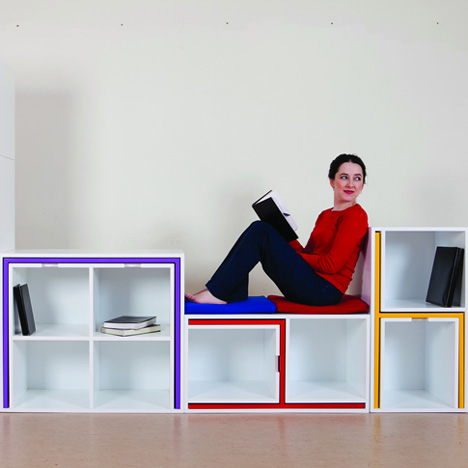
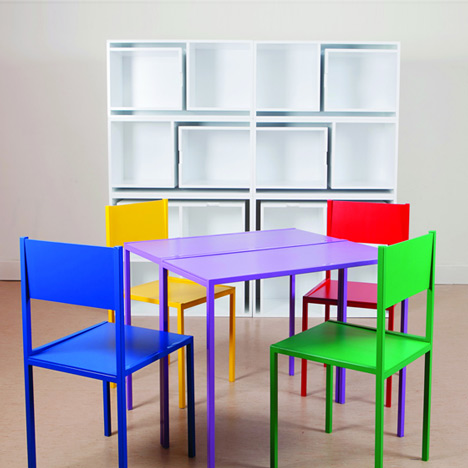
Designer Orla Reynolds has come up with this simple but ingenious “As if From Nowhere” furniture set. By adding just a tiny bit of volume to the shelves, she provides storage for 4 chairs and 2 tables.

Reynolds, a former ballet dancer, found her inspiration from theater. She says:

The movement from bookcase to dining is like a scene change. It transforms the space like props on a stage. The dancers can be seen in the chairs and tables. These are made of such strong material that there is an expectation that they are heavy. But they are lightweight. They are streamlined creating an elegant silhouette.

Reynolds plans to bring the set to production soon. We’ll keep you updated. In the meantime, her design nicely illustrates that space saving design need not be complicated or fussy. Oftentimes, it’s just a matter of using the space we already have in a smarter way.

via Dezeen

Correction: Previous version stated, incorrectly, the name of the collection was “Out of Nowhere.”

Prototype Apartment Pushes the Small Envelope

Yesterday, we asked “how small is too small” for a home? This is not necessarily a simple question to answer. Not all small is created equally. 420 sq ft can be airy and intelligent or dark and dumb depending on its design. For proof, look at the LifeEdited apartment before and after its conversion.

But assuming you design a space optimally, how small can you go? A San Francisco-based firm called SmartSpace is trying to answer this question.

They built a prototype starting with 160 sq ft of living space, which is the minimum legal size for a dwelling in California.

The space, dubbed SmartSpace 1.0, is a lab for what works and what doesn’t in such a tight space. An MIT student served as its guinea pig, living in it for 3 weeks to solicit feedback. Here are a few lessons learned about this ultra-compact home in particular, and, one can infer, small living in general:

  • The Euro-bath “wet” shower (no divided shower) doesn’t jibe with the American audiences–too much mess and water. V2.0 will have separate shower.
  • V1.0’s cute round sink couldn’t handle real-world pasta pots. V2.0 will have larger rectangular sink.
  • They found the portable induction cooktop drawer “too clever by half” and will be keeping it on top in v2.0. Incidentally, they use the same model as LifeEdited apartment.
  • Keep appliances out of site.
  • Air movement is essential even if it’s not heating or cooling. A ceiling fan is installed in v1.0.
  • Ceilings should be at least 9′ to create sense of space.
  • Width of unit should be at least 10′. V2.0 will be 11′ wide.
  • Finishes and materials should be high quality. Detail is much more evident when there are no gaps.
  • Built-in items are preferred to standalone. A lack of cohesion can be overlooked in big spaces, but in tiny ones uniformity and order work best.

To maximize utility, SmartSpace added clever touches like its “Smart Bench,” which is a table on a hydraulic lift. When raised, it acts as a banquette and table; when lowered it is a bench or, with the addition of a pad, a guest bed.

So does this intelligent prototype prove that 160 sq ft is the minimum amount of sq ft a person needs?

Not at all. The answer is there is no answer. Living spaces, like people, have different needs for their lives and homes. SmartSpace is particularly geared toward singles in San Francisco–a city that has many out-of-house diversions that compensate for small quarters.

What this shows is that the amount of space we need can be seriously reduced with an open mind and smart design.

via Fair Companies

Okay, It Is Possible to Have Too Little Space

We’ve looked at some pretty small spaces like Felice Cohen’s 90 sq ft NYC apartment or Japan’s wan rūmu manshons. But these places feel palatial compared to the 16 sq ft “King’s Cube”.

“King’s Cube” is a “luxury” Hong Kong apartment that features “western-style, wood-like flooring” and “space utilization [that] is as high as 100%.” Incredible!

The video is actually a parody made by MFA student Joe Yiu to bring light to Hong Kong’s criminally small living spaces. Hong Kong is one of the densest and most expensive cities in the world. In order to house its population cheaply, apartment buildings like the one shown in the video are divided and divided again until an apartment is nothing but a bed. And as bad as the “reference” apartment is, when the host reveals the real King’s Cube apartment–which is the same size but lacking a window or any decor aside from a few wire hangers–you realize it could get indescribably worse.

While we’re obviously advocates for small-space living, putting candles in a roach motel does not equal luxury. And while it’s possible to live in what is effectively a human cubby hole, it doesn’t mean it’s a good idea. Obviously, there are many political and economic considerations in places like Hong Kong that go beyond the scope of this post, but it raises the question how small is too small?

Via MNN

Combating the Attention-Span Crisis

Just as excessive consumer goods can make our lives more cluttered and complicated, excessive stimulation can make our minds restive and unsettled. And few things deliver excessive stimulation like online media, computers and mobile devices. We text while we pop through our 30 open tabs while we email while we cook dinner.

We came across this 15 min talk by tech entrepreneur and investor Joe Kraus, who explains how our phones and online activity is eroding our already threadbare attention spans. He explains that the human mind cannot multitask–that it shifts its attention from one thing to the next, but it does not and cannot pay attention to more than one thing at a time. Moreover, the more often we shift between various stimuli–i.e. multitask–the dumber we get (-10 IQ pts.) and the harder it becomes to shift in the future. As he says of multitasking, “It’s one of the only things where the more you practice it, the worse you get at it.”

He touches on several other topics like manners and possible solutions to this “crisis of attention” such as weekly media fasts and his SlowTech movement.

In addition to Kraus’ suggestions, here is a comprehensive list from artist/programmer/activist Steve Lambert of online tools that restrain our compulsion to multitask:

  • Self Control. This Mac or PC plugin enables you to block access to email and select websites for a set amount of time.
  • Freedom goes one step further and shuts down your online access altogether for a set time.
  • ColdTurkey blocks access to distracting sites for Windows OS.
  • Spirited Away automatically hides windows you’re not using anymore.
  • Vitamin-R hides applications, uses a timer, encourages goal setting and focus.
  • Concentrate blocks sites, allows sites, launches and quits apps, and more (but you can disable it) by Rocket Software. Free to try, then costs, and not open source.
  • RescueTime scheduled, timetracker, etc.
  • FlexTime is a versatile timer for repetitive activities.

Online media, computers and mobile devices are integral and invaluable parts of our lives. But in a certain way, because they have been introduced so fast, we haven’t had time to cultivate smart habits around their usage. Our primordial minds’ default setting is to get more stuff and receive more stimulation; to think that this setting would be overridden in the 15 or so years we’ve been online is mistaken.

But with consciousness and smart tools, we can start reigning in our attention and edit out useless stimulation for quieter, happier minds.

via Joe Kraus and Steve Lambert

A Big Documentary about Tiny Homes

Kirsten Dirksen and her production company Fair Companies fill a very special niche in the documentary world: they make videos almost exclusively about small homes and the people who inhabit them. We’ve seen some of her work here with Christian Shallert’s 258 sq ft bachelor pad and Felice Cohen’s 90 sq ft NYC “apartment.” She also profiled the LifeEdited project in its early days.

Dirksen has now sewn together many of her videos for a full length documentary called “We the Tiny House People”; it showcases small dwellings and dwellers from across the world.

What’s cool about many of the subjects is their lack of flash. While Shallert, Gary Chang and the LifeEdited apartment show what you can do starting from scratch with a healthy budget, most of Dirksen’s subjects live very modestly–with equally modest small space solutions, like a Barcelona family of 4 who occupies 505 sq ft. They have few special touches outside of a couple folding tables and casters on much of their furniture.

Check it out and let us know what you think.