The Unbearable Lightness of Tiny Living

Each week we are profiling real people who are editing their lives for more freedom and happiness. This week we hear from Jan, who lives in 98 sq ft tiny house. He shares his experience about the freedom of tiny, lightweight living as well as the difficulties of meshing different attitudes about stuff and space in relationships.

Tell us about yourself

My name is Jan. I am 45 and work as a photographer and videographer. I am separated with a 3-year-old boy.

My parents, both children in Germany during the WWII, instilled a non-consumptive, credit free life-style. They modeled buying quality over quantity and only paying cash for what you can afford.

Later, I backpacked for several years, and all through my twenties and early thirties never paid more than $100 rent per month. I learned to build and built my own shelter, or did work-trade for rent. For years I kept my possessions down to what would fit in the back of a small pick-up truck.

In my late thirties I fell in love with a beautiful woman who lived an unedited life. Stuff gave her a sense of security. Clutter was her art form. For six years and through the birth of our son, we tried to blend our lives, but could not. Accepting neither of us would change, I built a 6×9 foot shack in the backyard and moved out. We get on much better now.

What makes your life an ‘edited’ one?

I’ve always been self-employed, so I’m very aware how much effort it takes to earn each dollar. Not believing in credit, each purchase I make is a conscious decision. How much of my life does it take to afford this thing? I’m also aware how much effort is required to own stuff. Where to store it? How to store it? How to care for it? Unnecessary stuff and clutter simply makes my anxious. But that’s not to say I’m non-materialistic. I would argue that I’m hyper-materialistic. I love the look, feel and function of something well made that fits my life perfectly. A pair of shoes I wear every day. Two sharp kitchen knives. A bicycle. A camera. All these things, carefully chosen gives me great pleasure to buy and use daily.

How long have you been living this way, and do see yourself continuing to live this way?

I have always had a minimalist bent, but lately have been refining it with far more awareness. It merges many divergent interests, from macro and micro-economics, environmentalism, self-sufficiency, spirituality, design, art, parenting, and how we will make it as a species in a shrinking world. Presently, how I live is a personal choice. In the future that choice may be forced upon us.

What are the biggest advantages of living this way?

A profound sense of lightness in the world. Every time I discover a way to live more essentially, I feel a surge of freedom. When I refine an elegant solution to a vexing problem, I gain great pleasure each time I engage with that solution. Something as basic as placing a hook into a wall so I can hang my bag and not trip over it on the floor. Or building a composting toilet for a few dollars and taking personal responsibility for my own waste. Or lying in bed at night in a loft that fits me just so. Watching the moon rise and stars turn because I deliberately placed the windows in these precise locations. Or each month doing my bookkeeping and seeing my savings increase to a point where I could live comfortably without working for a few years. And not because I earn a lot of money, but because I have learned how to spend wisely.

What are the biggest challenges?

Trying to meld a minimalist lifestyle with someone who does not share the same interest. It is an exercise in futility and frustration. I had to learn to accept that I can neither change someone else’s life nor repress my own nature.

For families, how has this lifestyle affected the other members of your family?

Thankfully I have a young son who stops me from getting too anal. He helped build the shack and feels it is his as much as mine. He comes and goes as he pleases with his toys, muddy shoes and dirty fingers. I let him climb up ladders, on counters, light stoves, play with tools and knives, and in doing he learns respect, consequence and body awareness. He teaches me to let go and lighten up. If he breaks something we fix it together. If he gets something dirty, we clean together. After all, it’s just stuff. What’s essential is the respect between us.

In terms of partnerships, I think a minimalist lifestyle only works both partners already live this way. I also strongly believe in a shack of ones own. My home only cost me $5000 and three months of work. I’d rather help build a partner their own home than try to blend two incompatible lifestyles together.

What is the number one suggestion you’d give to someone looking edit their lives?

Read the book “Your Money or Your Life” by Vicki Robins.

What item(s) have made your lifestyle easier?

A good bicycle, good tools, a few comfortable clothes that fit well and can be worn in different settings.

Do you have any design or architectural suggestions derived from your lifestyle?

Consider curved rafters. That simple architectural detail made all the difference in turning my loft from a cramped triangle into a spacious cocoon.

This post was originally published November 28, 2012. 

Moving Up Maslow’s Pyramid with Kirsten Dirksen

Since 2006, Kirsten Dirksen and her husband have been producing *faircompanies, a web video series that has evolved to become the world’s most comprehensive archive of compact homes and the people who made and live in them (among other things). Virtually every significant small space–from our own LifeEdited apartment to Nakagin Capsule Tower to many, many others you never heard of, but should have–has been lovingly chronicled by Dirksen.

As her profession dictates, Dirksen’s focus has her looking at others, but we thought it was time to turn the focus on her, finding out more about her and *faircompanies..

David Friedlander: Tell us a little bit about yourself.

Kirsten Dirksen: I live in Fontainebleau, France (40 miles south of Paris). We just moved from Barcelona this fall.

I don’t really have a job title. I used to work in television, then I met my husband in Barcelona and started commuting there between freelance TV jobs in NYC. Once we had kids I began to do more freelance work from Spain, but now I just make videos for our website and youtube channel.

DF: How did *faircompanies begin?

KD: Back in 2006, my husband, Nicolás Boullosa, had the idea to start a website that was a type of 21st-century Whole Earth Catalog. While it has evolved into something a bit different, “access to tools” is still the logline for *faircompanies.

With my videos I try to focus on great stories: people who are building unique homes, creating new vehicles, reinventing gardening, etc. Again echoing Stewart Brand (founder of the Whole Earth Catalog), I believe in the power of basic tools and skills–and the technologies available to us today (e.g. 3D printing, aeroponics, Arduino)–to shape our environments in a way unthinkable a few generations ago. As Brand wrote back in 1968 “we are as gods and might as well get good at it”. (For a taste of all this, I put together a compilation video of some of my stories here).

DF: What is your intention behind making the videos?

KD: I want to explore stories in the way I wanted to film and edit them, but often couldn’t while working for broadcast media. I make videos to examine how other people live. The camera gives me an excuse to ask questions.

What attracts me most to people who have minimized their lives (their possessions, the size of their home, etc) is the shift in focus. Here are people who have decided not to focus on stuff and so that leaves the more interesting topics, namely, my personal favorite: anything related to philosophy of life.

DF: What is or are the favorite videos you’ve produced and why?

KD: I don’t have a favorite video. I feel that each video builds on the others and they’re all part of this trip I’m on of discovery. That journey involves:

DF: Anything else we should know?

KD: I want to be sure to point out that I’m very aware of how easy it is to oversimplify all this. I don’t think a tiny house, or a tiny wardrobe, makes anyone happier, but it might open up more paths toward fulfillment. If you think about it within the framework of Maslow’s hierarchy of needs, those who have chosen to make their physical needs small, and easier to achieve, can move on to working on self-actualization.

Returning to Stewart Brand’s ideas about the incredible access to information we all have at this moment in history, I try to tell stories to help remind people about the great power we all have at our fingertips. I think the Internet has also made it dangerously easy for us to identify with mass movements and, at times, to fall victim to victimhood. I hope my videos inspire people to recognize the great power we all have, even if it’s just to make small, but often significant, changes in our lives.

Flat-Pack Furniture Fuses Form and Function

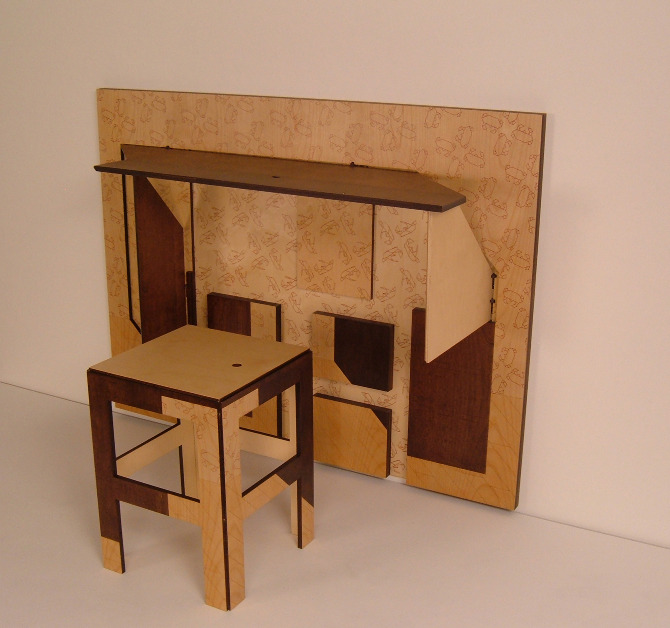
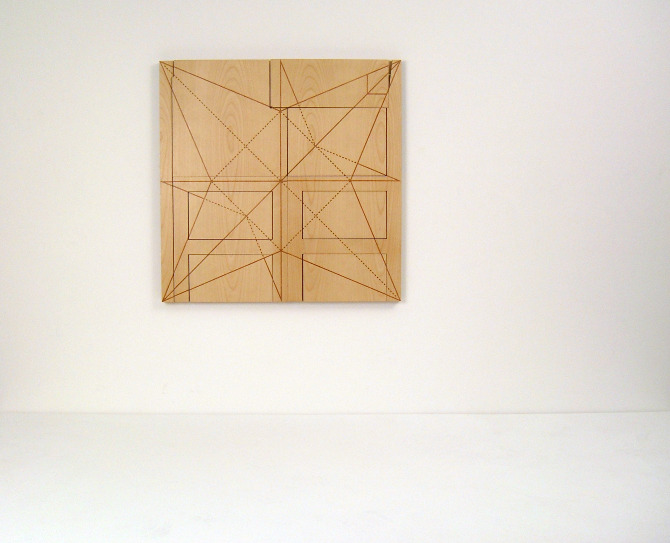
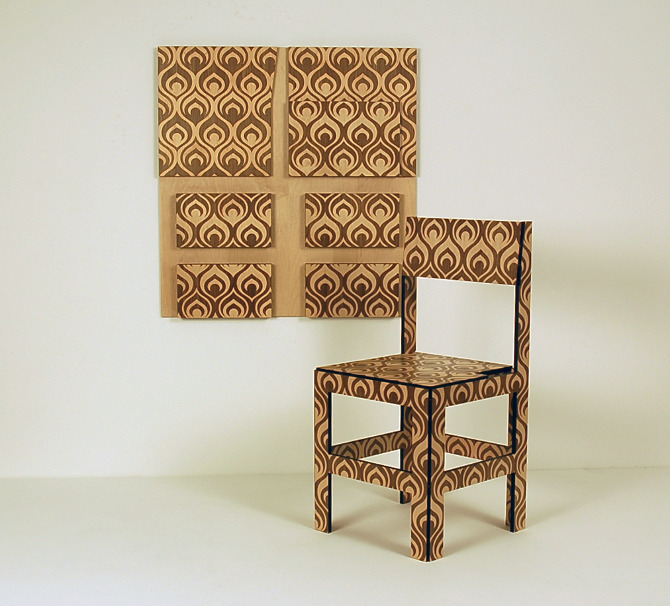
Artist and fabricator Christy Oates is a master at blurring the lines between decoration and furniture. Her origami-inspired pieces have the detail and beauty of traditional wood-working, while her manufacturing processes–which include computer-aided design (CAD) and laser-cut, CNC machines–are decidedly new school. Check above video to see how they are made.

She makes tables, desks, chairs and even lamps that hang flush with the wall. She designed them for small spaces, knowing that even pieces of art can do double duty. See more of her work and get more info at her website: www.christyoates.com

Is Your Home Just a Place to Store Stuff…While You’re Getting More Stuff?

In this lecture, philosopher George Carlin expounds on such topics as the meaning of life (A: finding a place to put our stuff) and the nature of residential architecture (A: creating a place to put our stuff). He even makes the bold declaration that if we didn’t have so much [expletive] stuff, we wouldn’t need homes. We “could just walk around all the time.”

In this it’s-funny-because-it’s-true riff, Carlin highlights how our lives are often centered around the stuff we accumulate, begging the question: what would your life look like without so much stuff? If you had less stuff, could you have a smaller, more manageable, less expensive home? With that less expensive home, might you be able to choose the type of work you want rather than the type needed to afford the house and all its stuff? Might you have more savings and free time? As Tyler Durden from “Fight Club” puts it, might the stuff that you own, own you?

What do you think?

This post originally was originally published in March 2012.

Live in a Sliver Japanese Style

Japanese architecture proves that necessity is the mother of invention. In order to fit their ample population on the space-squeezed island, homes are designed to fill up every sliver of space, however puny. This ABC Nightline tour of Japanese “micro-apartments” gives a nice look at some of these super-slivers.

Not to be pedantic, but these are not micro-apartments, but a class of home called Kyosho Jutaku that use remnant real estate in fantastic ways.

In the video, ABC interviews Japanese architecture expert Azby Brown, who shows off modern interpretations of traditional Japanese architecture like underfoot storage and stowable beds.

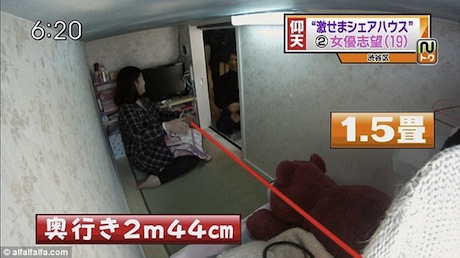
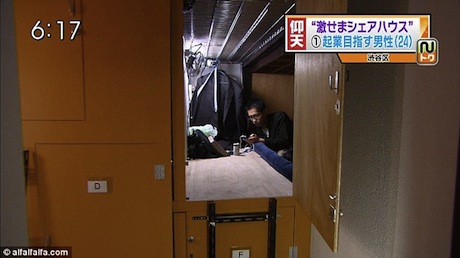
These tiny homes seem downright palatial compared to geki-sema homes, tiny-shared spaces that have been recently called  “coffin-apartments.”

coffin-home-2 coffin-home

These teeny-tiny living boxes are designed for young Tokyo professionals who just need a place to sleep.

What do you think? Are either of these types of dwellings viable living spaces or more or less human storage lockers?

1984 Italian Comedy at the Vanguard of Transforming Design

In the 1984 Italian comedy “Il Ragazzo di Campagna” (The Country Boy), the movie’s protagonist moves into an amazing tiny apartment that, upon initial inspection, looks like a closet, but as the realtor in the scene above reveals, is actually a studio apartment with hidden kitchen, bathroom, entertainment center and bedroom.

The apartment–based on a rudimentary translation done with Spanish/Italian cognates–is meant to show the exploitive and rapacious nature of urban real estate, similar to the King’s Cross video we looked at a while back. While there’s a lot of that going on for sure, we actually find it a cool demonstration of an apartment that does everything in very tight quarters. Could probably use a window or two.

The LuxPod: Micro-Unit from Across the Pond

Japan, with  its one-room-mansions and Kyosho Jutaku homes, gets a lot of attention for small space living, but England deserves recognition as one of the small-space-living world capitals. The country is packed–the densest in Europe in fact.

According to The Guardian England has no minimum space standards! While this doesn’t create a lot room for storage, it does leave room for innovation…or, as The Guardian suggests, developers looking to pulp every dollar from every square foot.

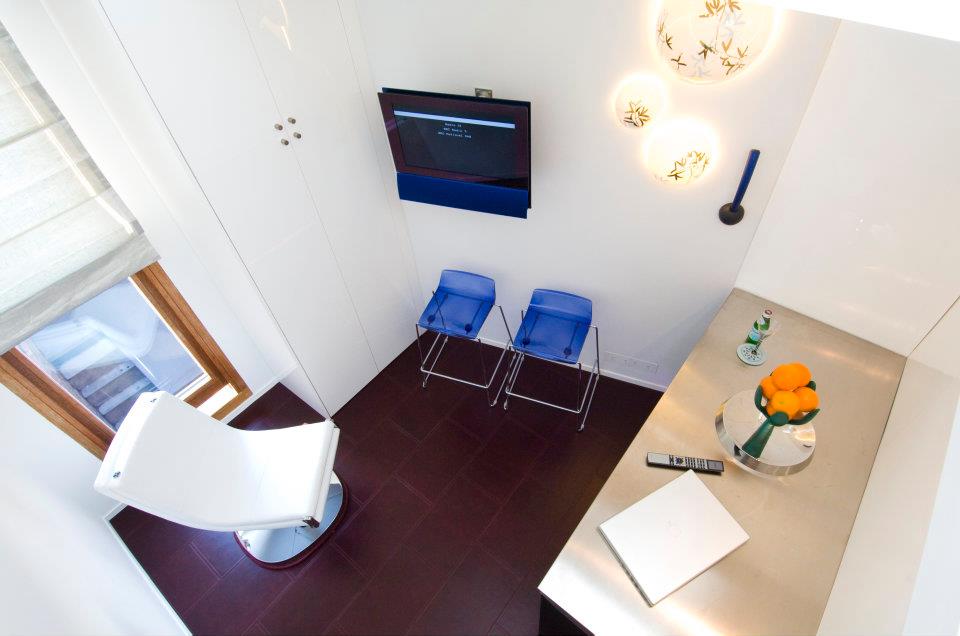
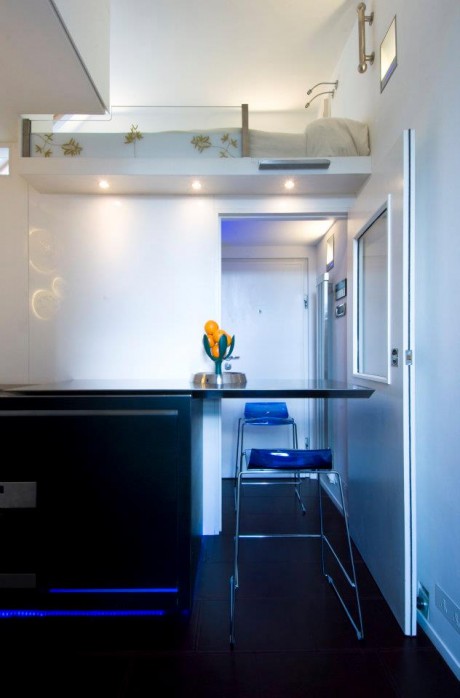
Like the fellow London Yo Home! flat we looked at last week, we think the LuxPod falls in the innovative category. The experimental space was built in 2008. According to LuxPod’s website, it’s 11 sq m/118 sq ft, which is by no means the smallest space we’ve seen, but it’s pretty damn small. It was initially used as a vacation property. It is not clear what it’s being used for now (we’re looking into it).

It’s really an impressive little space. The finishes are top notch. There are a number of cool features like a retracting countertop that creates a dining bar. There’s a cool “wet” bathroom. All of the appliances and furniture look high end. The layout–as far as a 118 sq ft spaces go–is great.

The important thing to note about micro apartments like these is they are not intended for everyone. For example, when this author moved to New York City 11 years ago, 118 sq ft of my own would have been palatial. As there was nothing like this available, I had to share an illegally divided apartment with 4 other people. Two of the bedrooms had no windows.

There is a worldwide market for small spaces. Many people, like my younger self, want a clean space for themselves in major cities and beyond. Now it’s a matter of making them available, livable and affordable for the people who need them.

Photos by David Cowlard © 2008

The Home of the Future or Weird Curiosity?

The England-based Yo! Company is a branding and investment firm that brings Japanese-tinged enterprises to Western territories. Among its holdings are Yo! Sushi, a conveyor belt Kaiten sushi bar in London and Yotel, a Japanese-style hotel with compact-rooms that has locations in London, Amsterdam and New York City.

Now Yo! Co founder Simon Woodroffe is bringing his Japanglo magic to the home market with the Yo! Home. The 800 sq ft London concept home aims to take us out the “agricultural, primitive age” he believes we live in now and into the future–a time when people will ask “do you remember when they had one space and it couldn’t change around?”

The Yo! Home changes around alright. There is a bed that descends from the ceiling and covers up a huge lounge area. There is a dining area that pops up from the floor; the same floor that hides a wine wine cellar. The kitchen hides completely. The guest room has a large sliding door that opens up to increase the area of the main room.

The space relies on a fair amount of automation, some of which broke down during his tour with Channel 4 News (above). To be fair, this is a prototype and breakdowns are to be expected. We do wonder about the long-term implications of an automated home. What happens if you’re really tired and can’t get you bed down?

Woodroffe spent £200K on the Yo! Home (~$325K US), which actually doesn’t seem like a lot seeing as how elaborate the space is. He thinks it’ll initially be for moneyed clients, but believes the technology and designs will eventually trickle down to the greater public.

Our hats are off to Woodroffe and his bold enterprise. Architectural thinking often gets fossilized because structures are imbued with a sense of permanency–so architects and designers avoid risky designs like these; ones that might look weird a few years from now. Concepts like Yo! Home loosen the noose of conventional thinking. They are invaluable idea-generators even if some of its features don’t make the final draft of the home of the future.

What do you think? Is this home the future or a curiosity–something that’ll look weird and overwrought 5 years from now? Let us know what you’re thinking.

Photography is by Ashley Bingham

Via Dezeen

Turn Your Power-Drill Into Multi-Purpose Kitchen Tool

This video from LifeHacker shows what one power-drill and a bit of imagination can do, turning your drill into a blender, beater, scrubber, pepper grinder and Parmesan shredder–all with very minimal modifications. We imagine there are other culinary uses for a power-drill like a handheld blender, food processor or frother.

What this exercise shows is that items we thought were only good for a few purposes–e.g. boring holes, tightening/loosening bolts–can do many.

Granted, using a power-drill this way necessitates keeping it a bit cleaner than you might otherwise (a plastic bag over the drill would probably suffice), but keeping your tools clean is not a bad idea anyway, and getting rid of several single-purpose kitchen tools saves space and money.

Do you have any similar hacks–or MacGyver tips as LifeHacker refers to them? Let us know what they are via email (howdy at lifeedited dot com) or in our comment section.

More Mobile Living: Video of Couple’s DIY 3 Story School Bus

This video from Fair Companies takes an extensive tour of Richard and Rachel’s school bus home. Unlike René Agredano and Jim Nelson’s mobile living we looked at yesterday, this project is decidedly DIY; most evidenced by the decapitated VW Vanagon that makes up the top 2 stories. Just like the latter couple, Richard and Rachel tout the advantages of living mortgage-free as one of their principle motivations for living this way.

They also liken the project, which has taken them about 6 years so far, to the cardboard forts kids make. They fabricated most of their furniture and even included things like a projection “room” on the second floor. They claim there’s a level of connection and imagination that comes from a hand-built home not usually found when you buy something already built.

There seem to be some concessions to this hacker home, e.g. no plumbing; they use grey water to shower and wash their dishes every few days. They also don’t have RV status, which I suspect is why they didn’t specify their last names or location (though the bay they look upon looks suspiciously like San Francisco Bay).

The upsides they report are many. The have a minimal carbon footprint, using a composting toilet, solar power and even a solar-powered fridge. The bus only cost $12K to build, including a $1200 fridge. They live debt free with only $100/month living expenses. And they enjoy freedom that comes from not living to pay for their lifestyle. This is a common theme from yesterday’s couple and the Tiny House Family we looked at last week.

Do you think you could live on the road like either one of these couples? Have you? What was your experience? Is this something that can be done for longer than 6 years or is this more of a phase? Could a family live like this? Is a mortgage inherently a bad thing? We’d love to hear what you think in our comments section.