Low Impact, High Times in the Woods

Individual tiny cabins out in the woods are nifty and all, but the architectural form’s real potential lies in community formation. Magic happens when you throw a bunch of tiny structures and people in a cluster to share resources, meals, skills and lives. This kind of magic has been happening at a 55-acre woodland preserve in upstate New York named Beaver Brook for the last five years. The property was purchased by tech entrepreneur Zach Klein for $280K as a place to commune with nature and friends. The Beaver Brook land came equipped with an amazing off grid cabin, designed by its previous owner, Scott Newkirk. Klein had more than a passing interest in small cabins, having started the appropriately named Cabin Porn blog, the web’s leading repository for gorgeous little cabins set in equally gorgeous natural settings (also a book).

beaverbrook-newkirk

In the ensuing years, Beaver Brook has become an ongoing community and retreat (Klein, incidentally, has since moved to San Francisco). There are now additional cabins on the property, including a space-aged looking one by fellow Brookers Grace Kapin and Brian Jacobs and a bunkhouse built around the frame of a 19th Century barn. There are 20 regular “residents,” including five kids, who either pay a monthly fee for the bunkhouse or camping on the land, $150 and $75, respectively; these folks also help out with regular maintenance of the land doing things like path maintenance, according to the NY Times. Beaver Brook has guest stays, hosts weeklong building workshops and artist residencies as well.

beaverbrook-sauna beaverbrook-bunkhouse

Similar to my post about the need for more small, inexpensive vacation homes, Beaver Brook presents an earthy, low impact, low cost way people can supplement their oft-harried urban lives with an immersion in slow, natural living. 

Images via Beaver Brook

The Hills are Alive with the Sound of Innovation

Started in 2008, Summit Series has established itself as one of the world’s premier events focusing on entrepreneurship, addressing global issues and support artistic achievement. Past speakers include Richard Branson, Bill Clinton and Tony Hsieh. Summit Series is known for its amazing settings; past series have been held in such places as a ship cruising the Bahamas and Squaw Valley.

powdermountain

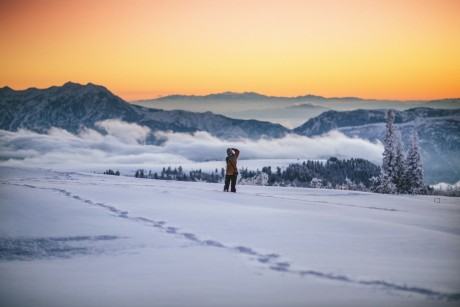
In 2013, Summit, the company who runs the series, partnered with venture capitalist Greg Mauro to purchase Power Mountain, America’s largest ski area, located in Eden, Utah. The intention was to create a permanent home built around the ethos that their community and organization had come to embody and promote. In an effort to create this home, called Summit Powder Mountain, they are developing a village along with a sustainable residential community–think of a smaller version of Telluride. Mauro, now Chairman of Summit Powder Mountain, commented, “We wanted to stop the ‘McMansionization’ of mountain towns that has reached absurd levels–48,000 sq ft houses in some areas–and focus on smaller homes and cabins that preserve the national park feel that exists here. So we limited the number and size of our largest mountain homes to 500 units with a maximum size of 4500 sq ft above ground respectively, and are complementing these with small cabins from 360 to 1500 sq ft.” Working in conjunction with Summit’s architects, LifeEdited was called upon to conceive some of these cabin residences.

INT04INT02

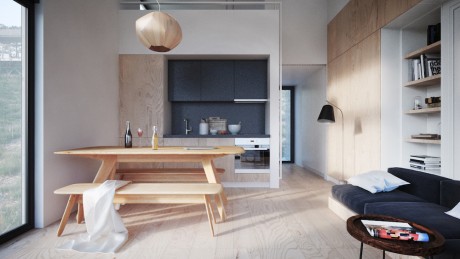
While the terms “compact” and “ski lodge” tend to be mutually exclusive, that’s exactly what we’ve done with the Overlook 360 design. The unit is a split level studio-style dwelling with a main room containing the kitchen, dining area and lounge. With the help of a hiding wall bed/sofa, the living room turns into the master bedroom at night. Above the main room is a loft area, creating an alternative place to hang out. Overlook 360 uses large windows and simple materials to keep the interior bright and open. Built-in storage, the transforming bed and minimal furniture make the space feel larger than its small footprint might suggest. There is a large deck and green roof to exploit and blend into the area’s amazing natural beauty.  

EXT02

One of Powder Mountain’s design objectives is to make its architecture “subservient to the natural landscape,” and one of the easiest ways of doing that is to make the architecture smaller–less home equals more natural habitat. Additionally, Overlook 360 will neither be connected by roads nor have parking spots connected to the cabins. Parking will be in nearby “parking barns” and everything will be accessed via a network of paths. By doing this, the homes will enhance their natural settings and possess a retreat-like quality to the district they inhabit.

Overlook 360, as well as multiple neighborhoods and districts will be developed in the next couple years. For more information, visit Summit Powder Mountain’s website.

Image © LifeEdited 2015

Anyone Up for a Trip to Iceland?

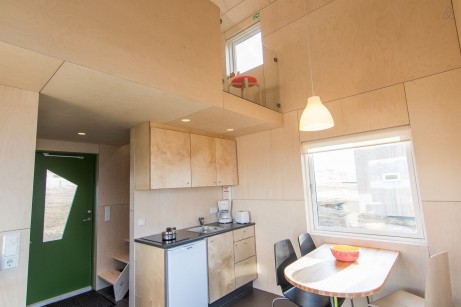
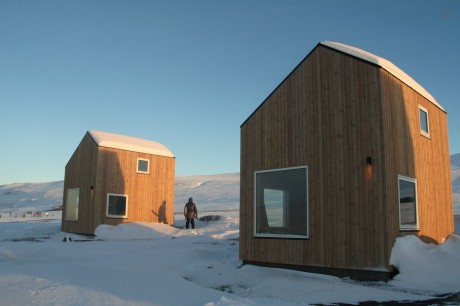
A reader sent me this Airbnb listing featuring three identical tiny cabins available to rent out. Located in the roaring metropolis of Sunnuhlíð, Iceland, these tiny houses look like the perfect place to read, use as a launching pad for sheep shearing tours, and staring out into the distance.

icelandiceland-livingiceland-loft iceland-snow

HT to Sunnuva

New Startup Offers Rent-a-Tiny-House

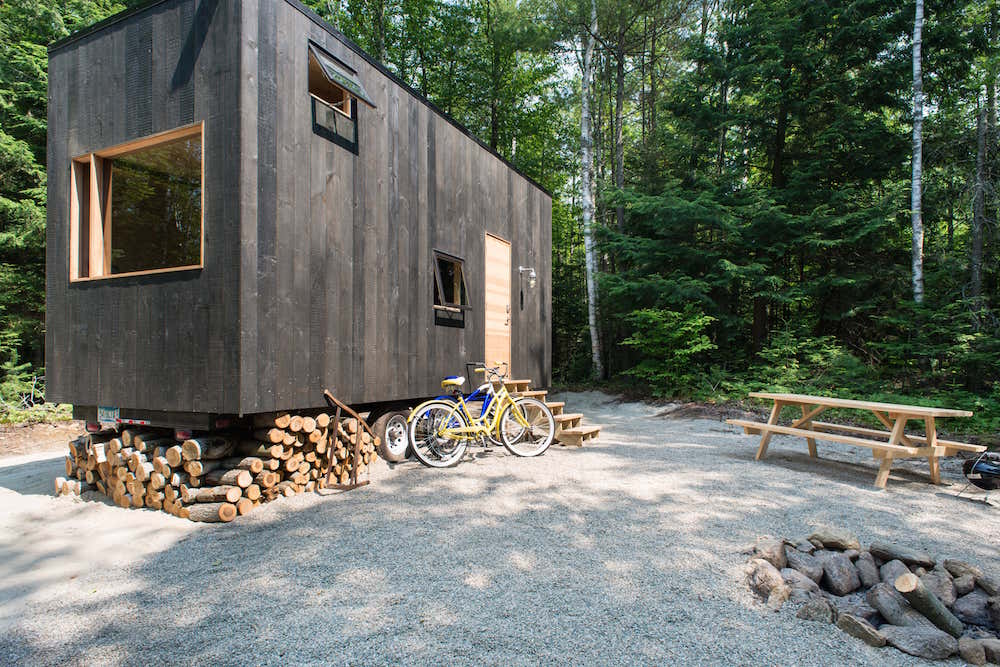
As I brought up a few weeks ago, there is a real need for more small, inexpensive vacation homes, ideally ones that are easily accessed by city-dwellers. City life can be a real grind. Without some sort of retreat, it can be unsustainable. Well the gods have heard my plea. Actually–as is more often the case–a group of Harvard grads heard my plea (but aren’t they the same thing anyway?). Headed by MBA student Jon Staff and Law School student Peter Davis, Getaway House provides an attractive, affordable, off grid tiny house for “folks looking to escape the digital grind and test-drive tiny house living.”

KATARAM_Kitchen

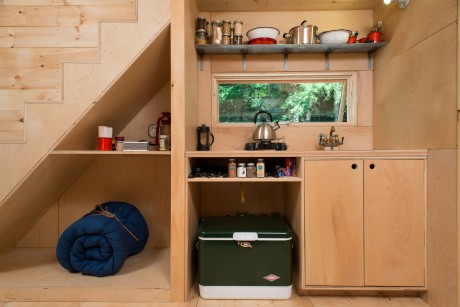
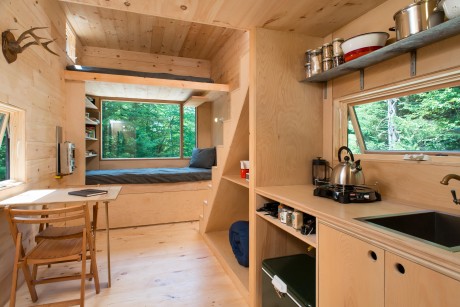
There is currently one completed Getaway House that is available to book by the night. It is dubbed “Ovida” and is located within two hour driving distance from Boston. The place was designed by a group of Harvard Design School grads. This elite-institution provenance shows through in its design. Both its modern interior and exterior are clad with attractive rough cut pine. The interior features built in furniture such as a table that doubles as a window cover and two built-in beds, giving the place capacity to sleep four. All electricity is solar, the toilet is composting and water is handled via a 110 gallon water tank that is refilled via the host house the tiny house shares its land with. Bookings also include fresh linens and available “provisions”–a sort of backwoods mini bar with things like coffee, trail mix, pasta, etc (these cost extra). Ovida is available for a reasonable $99/night for double occupancy.

KATARAM_Inside

Another Getaway House, dubbed “Lorraine” will be available mid-August and they are already taking reservations. A third house is due out in early September. Staff and Davis raised a bunch of money to build the houses with the goal of making them into a replicable model, providing both affordable, sustainable urban retreats and income generator for property host.

Getaway House is actually the first initiative of a project called Millennial Housing Lab, which, somewhat along the lines of what I wrote about yesterday, is trying to develop and realize “fresh housing ideas for a new generation,” focusing “on all sides of the housing experience: architecture, neighborhood design, financing, regulation and community-building.” As I’ve mentioned time and again, for all the hype surrounding tiny houses, micro-apartments, micro-suites and other creative forms of housing, market and regulatory forces often stand at odds with bringing these things into being. While Getaway House is ultimately a tiny vacation cabin, it is also another small step in making tiny, low impact housing a viable housing option for more people.

It’s Your House on a Bike

We feature a number of homes that sit on internal combustion vehicles. Despite what you might think, these homes can be extremely green. First off, standard homes have fuel needs too, from heating hot water heaters to keeping stoves alight to keeping furnaces firing. Stationary homes consume gas, just not for locomotion. More importantly, there’s a dire need for efficiency when you’re moving your home around; everything that isn’t totally needed, whether it’s water for showering or an extra pair of pants, is sacrificed due to very limited space and keeping weight down so your vehicle can keep moving.

But if you’re like me (and I shouldn’t suspect, or hope, that you are) there’s the dream of the nomadic home that doesn’t rely on fossil fuels. In the past, we’ve looked at the Tricycle House as well as the Taku Tanku house–both were bicycle-powered housing options (the former somewhat plausible in its execution, the other not). We can now add a couple more HPNMs (human powered nomadic home…you heard it here first) to the mix.

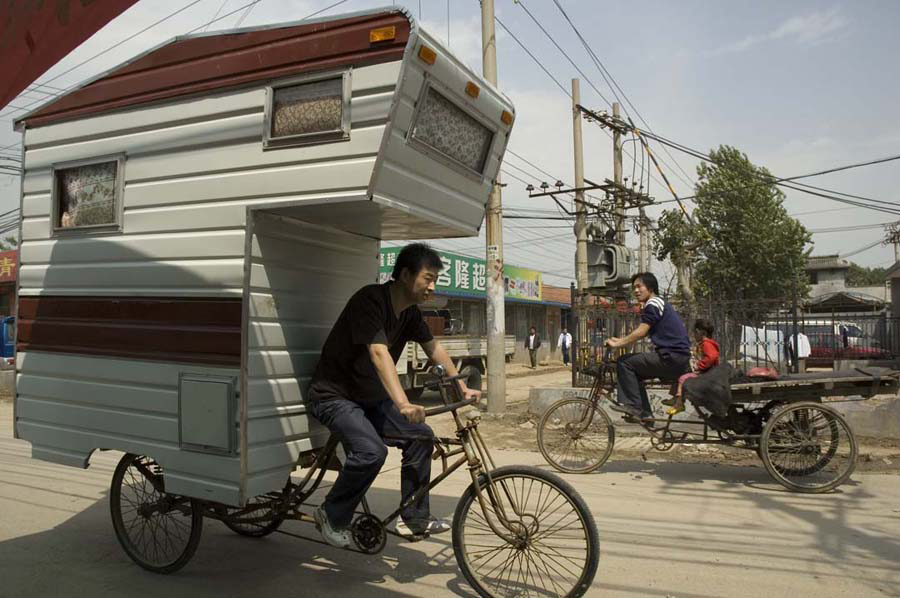
The first is the Camper Bike by artist Kevin Cyr, which resembles a 70s over-cab pickup truck camper. While there are no detailed images of the inside, a sketch shows the over cab portion containing a bed (for a medium sized cat, it appears), a dining table, a TV, some storage and a picture of Mao.
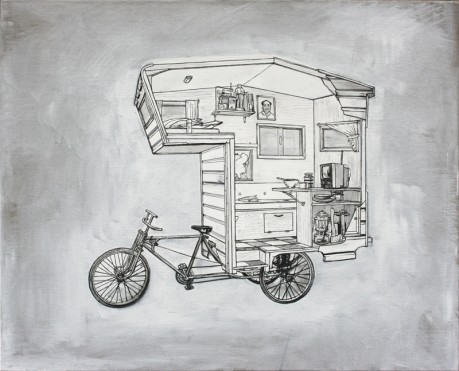
camper-bike-interior

In an interview on Icebike.org, Cyr explains the project:

The idea first came to me while I working in Beijing. I was joking with a friend that the only thing not on the back of bikes in China are houses. I had been seeing people, mostly working class men hauling goods on three wheeled bikes—rickshaws with bamboo flat beds. They were carrying huge loads of foam and plastic for recycling, furniture, and building materials. There were also a lot of food venders at open markets cooking meals on the backs of these bikes, it was very interesting. They seemed to use them in every way imaginable much in the way Americans use pick-up trucks.

He built the Camper Bike, which he describes as a sculpture, over the course of three trips over three years.

Cyr made few concessions to practicality. He used an old, rickety government issue bike as the camper’s host vehicle. The camper is mounted on a wood frame, which is significantly heavier than an aluminum or composite one–Cyr suspects the whole thing weighs a very portly 200 kgs (440 lbs). Cyr said when he climbs up to the bed area, the camper sways and feels as though it’ll fall over. He says if he were to make it again, that’d he rectify these design flaws.
WPC

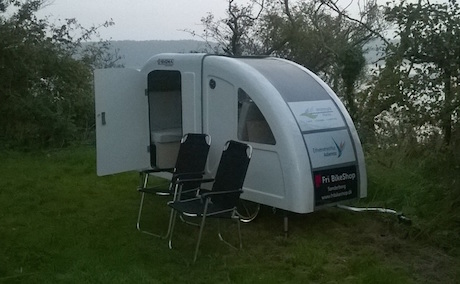
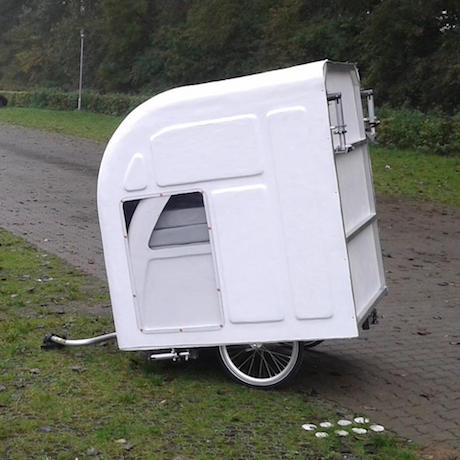
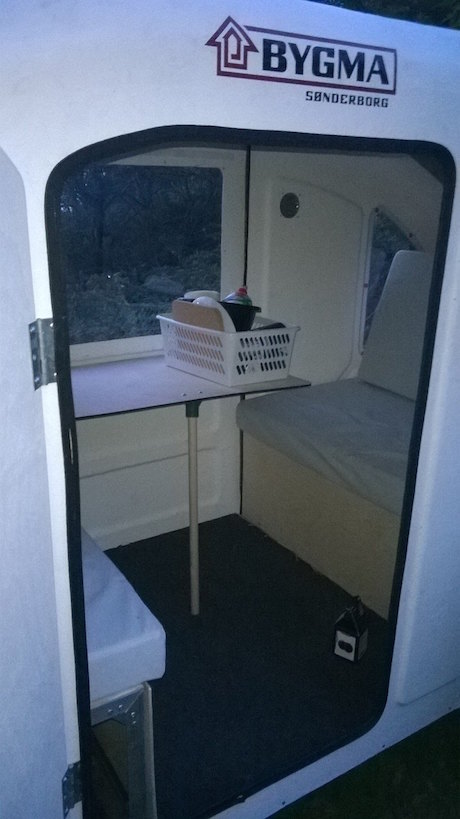
Rectification of those issues is what Dane Mads Johansen has done with his Wide Path Camper (Johansen said he was inspired by Cyr’s project). Unlike the Camper Bike, the WPC is a trailer, so you can choose which bike you want to affix it to. It also uses lightweight materials keeping weight down to a very reasonable 45 kgs (100 lbs). The camper, which has two sections that nest on top of each other when being towed, features a seating area that converts to a bed and offers around 11 cubic feet of storage (a little less than the trunk of a Honda Civic).
WPC-folded WPC-interior

Unlike every other bike-camper we’ve seen, the WPC is not vaporware. Johansen is taking pre-orders and expects to start delivering next month. The basic camper sells for €2000 ($2200 USD) and there are a number of available upgrades like a €600 solar package.

Some of you might be thinking, “Why not just load panniers or a trailer with camping gear, achieve the same result as the camper and save money and weight.” This is a nice idea, but belies the hard truths of bike touring, which often includes inclement weather and a deep desire for comfort at the end of a long day of biking (I’ve bike toured the world extensively including riding 1.5 times across US, so I feel I can speak on the matter with some authority).

At 100 lbs without gear, the WPC is still pretty heavy (my cross-country rig weighed a little over 50 lbs with full camping gear), so I think its best application is limited geography tours or a quasi-living situations–i.e. setting up at a campground or in someone’s yard where there’s access to a toilet and running water. However you use it, it’s a very cool piece of gear.

Many thanks to Mads for the tips!

A Case for Building More Small, Inexpensive Vacation Homes

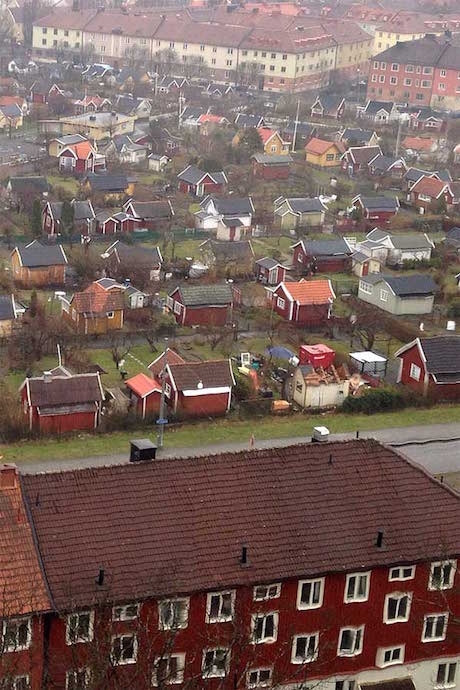
Who knew that Sweden has had tiny house colonies for that last 100 years? Apparently many Swedes knew, but this unimformed American did not. These aren’t “tiny houses” in the modern sense of the term. There are no trailers or composting toilets. But “kolonistuga” houses are indeed tiny, often measuring no more than 215 sq ft and having a porch no bigger than 64 sq ft.

Kolonistugor

Kolonistuga are located in what are called koloniområde, which is a type of vacation colony for working class Swedes that became popular in the early 20th Century. Each property contains the kolonistuga and a small garden, or koloniträdgård. The gardens are actually the reasonkoloniområde exist–following WWI, the colonies were set up for city-dwellers to grow and supplement their food stocks as well as get out of their cramped homes.

slottisburg

To this day, the kolonistuga must adhere to certain building standards, maintaining their diminutive proportions as well as traditional appearance. They are located throughout Sweden, in both the countryside and others, like Slottsskogskolonin in Gothenburg, smack dab in the middle of a city. Each house is individually owned, but the land is rented by owners. Houses are typically vacated during the winter.

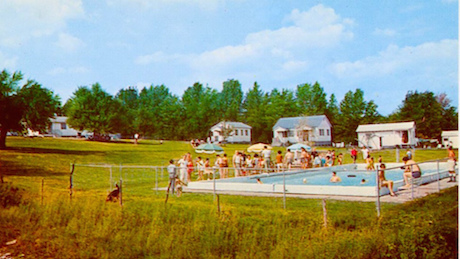
Once upon a time, Americans had something like the koloniområde. Bungalow colonies once flourished in the mid-20th century, mostly around the Catskills and Poconos as well as the shores of New York and New Jersey. Primarily used by Jewish Americans, they provided basic, affordable, community-centric vacation living, largely for city-dwellers looking to beat the heat and enjoy some sustained reprieve.

bungalow colony

Unlike the koloniområde, which are still quite active, the popularity of bungalow colonies waned in the 70s and 80s, killed by cheap airline tickets and destination travel (some still exist though their numbers are few and most are used only by Hassidic Jews).

This diminished popularity is a damn shame for several reasons. First, going to Disney World for a week doesn’t have the same potential for forging lifelong relationships as going to the same place year in, year out. And one off vacations are a little like dabbling with respite, whereas having a bungalow is a commitment to it. Lastly, visiting various locations usually requires expenses like hotels and restaurant meals, all of which can be cost-prohibitive to people living on more modest incomes.

While there is a good deal of focus placed on compact housing as primary residences, it’s worth pointing out that it makes wonderful supplemental housing such as the kolonistuga or bungalows. The time to start building small, efficient and inexpensive holiday homes once again is now.

World’s First Alpine, Micro, All-Wood, Alien-esque Cabin

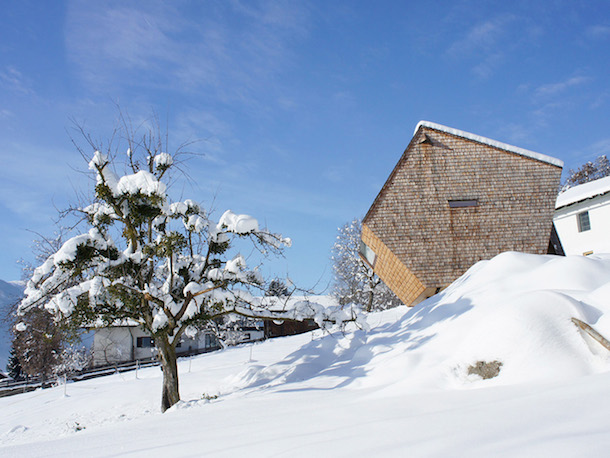
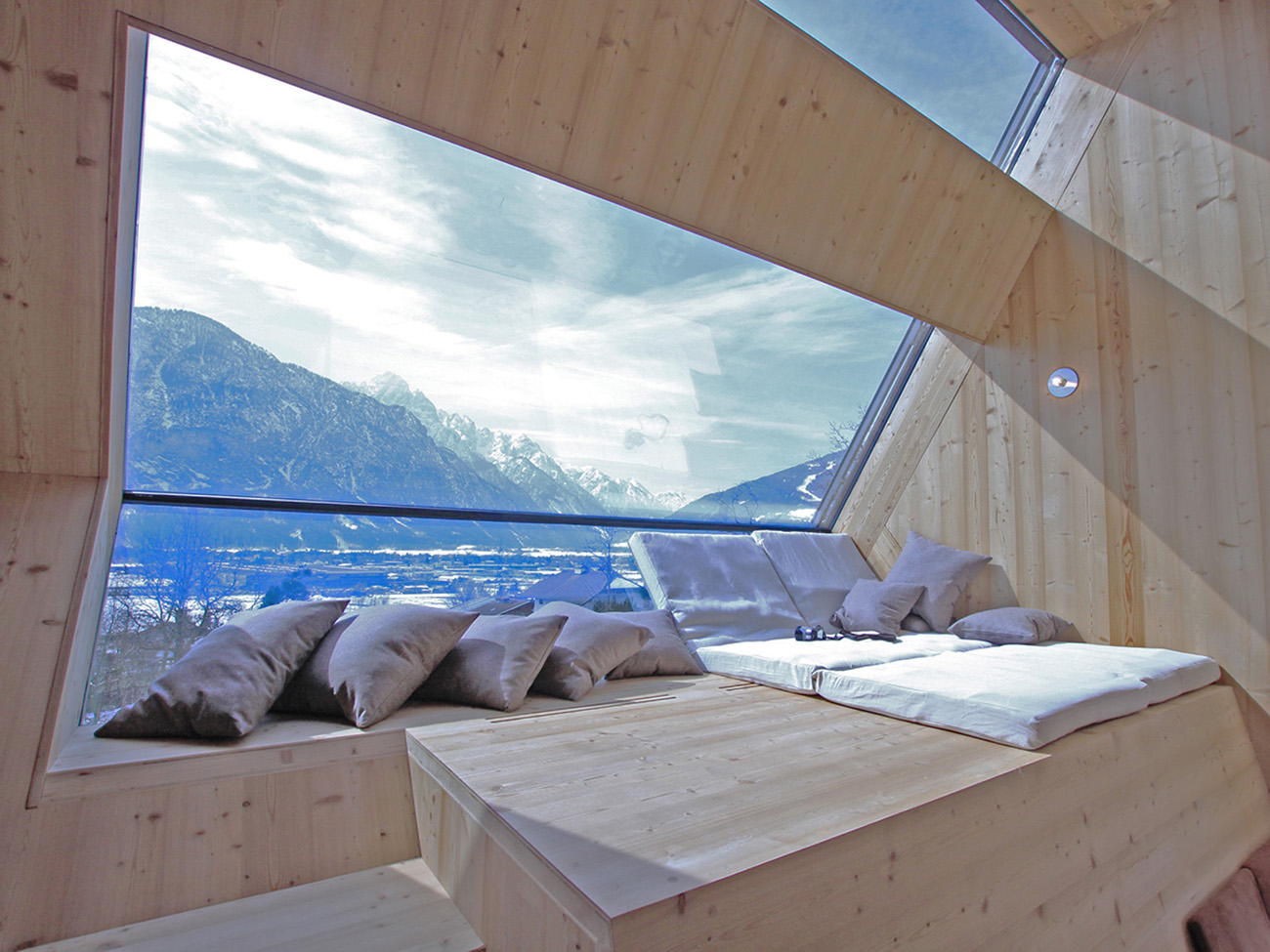
The Ufogel has been making the rounds online as of late, and we thought we’d take a look at this futuristic wooden cabin (capsule?) perched on a slope in the Tyrollean Alps. The name is an alloy of UFO and vogel, the German word for bird–which is apt for the strange-shaped structure that seems to be flying above the ground it inhabits.

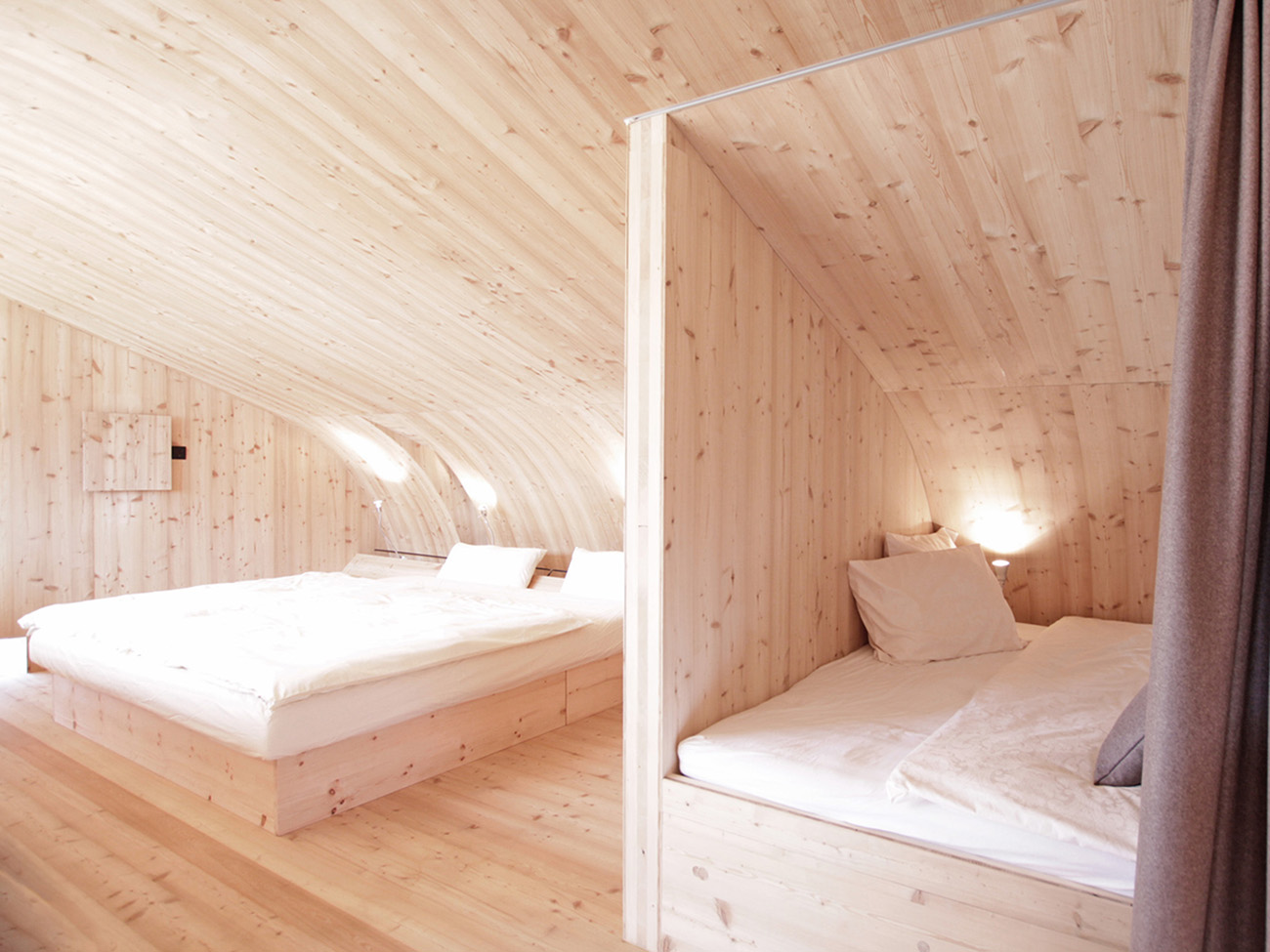
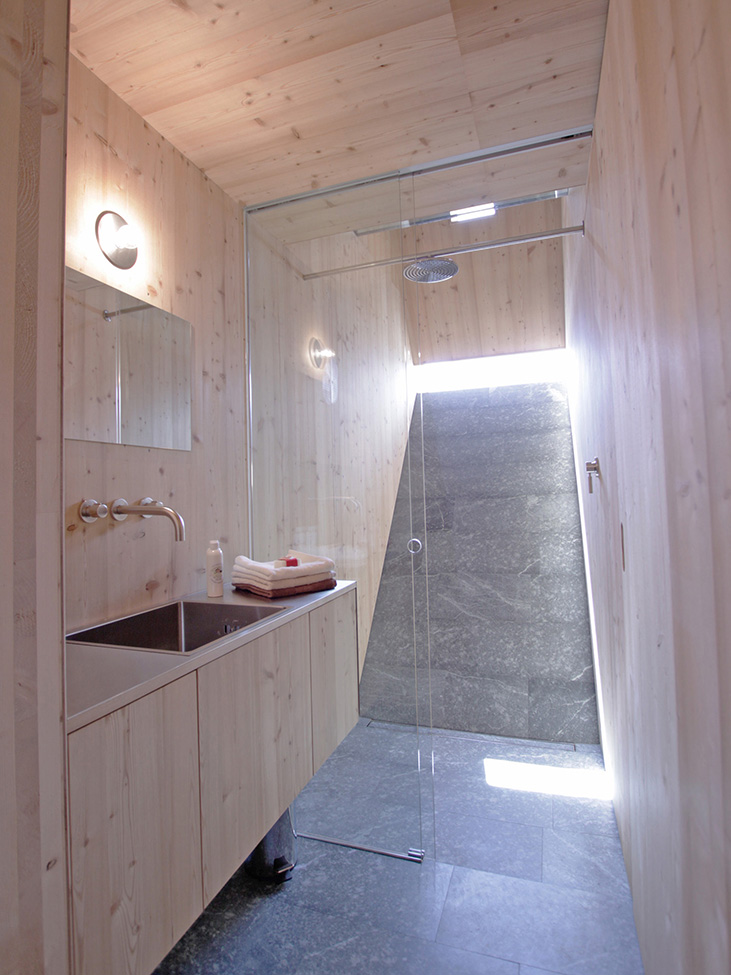
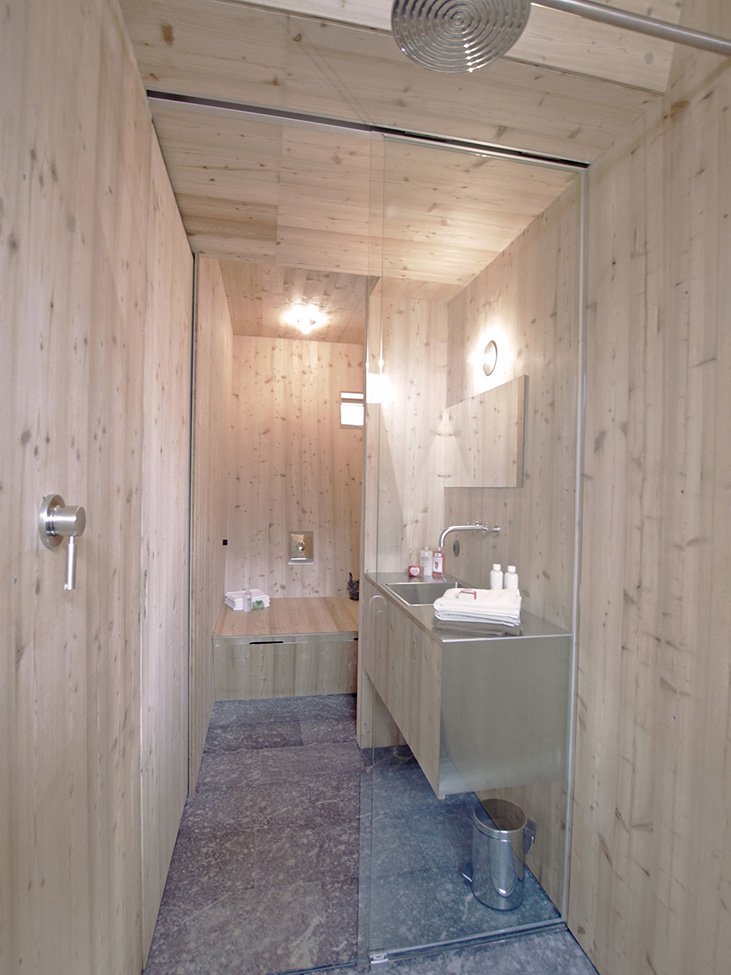
According to its website, the whole structure is made of wood. The pine planks lining the interior make it feel like a sauna (in a nice way). Everything is built-in, including a cantilevered table and bench seating, a sleek, minimal stainless steel kitchen and a couple beds in the upstairs loft. In addition to the radiant heating, there is a wood burning stove to complete the cozy, ski-lodge vibe. The place is much helped along by huge windows that look out onto Alpine landscape.

The cabin is definitely a bit of a gesamtkunstwerk–i.e. you probably wouldn’t want to throw your large sectional couch in there–which is fine considering it’s used by vacationers, people who rarely pack their own furniture. The place is available by the night for what seems like a fairly reasonable €120/night and can accommodate up to five people (NB: there are additional charges for more people and cleaning).

renzo

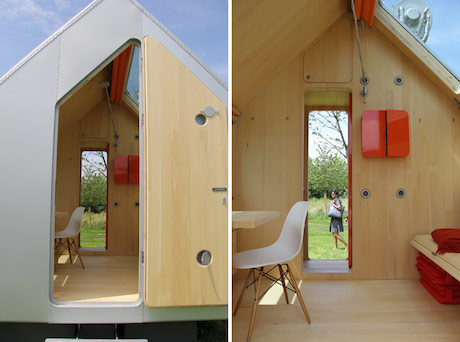
The place is reminiscent of the Renzo Piano designed tiny house built on the Vitra campus we looked at a while back. What’s cool about both of them is that they show tiny houses need not have the neo-Thoreauvian aesthetic that seems to define the genre.

All images via Ufogel.at

My Other Car is a Thumb

Predictability is the promise of the all-inclusive vacation. Show up at a resort, unpack your bags in a clean room with fresh sheets, go downstairs for a daiquiri and a Belgian Waffle buffet (I’m imagining what these places are like as I’ve never been to one), sit by the pool, eat some more, go to sleep, repeat, fly home with a tan. But is predictability such a great thing? Do you want your most exciting story to be about running out of sunblock? If you’re looking for something outside of the predictable, we suggest you check out pro traveler/filmmaker Andrew Grady. For the last four years, he has been traveling the world, hitchhiking and documenting adventures that are anything but predictable.

The Magic Thumb project began in a pub, as many great ideas do, in 2009. The idea was to hitchhike across the globe, documenting the process and show “how, with the right aptitude, resources and optimism, anything is possible, and that really, humankind on the whole, are pretty accommodating.”

Grady has completed two trips so far. In 2010, he hitched from London to South Africa, and in 2012, he hitched from Australia to London. He is currently on his third and final trip from London to Brazil. If you didn’t guess, each destination is related to a major sporting event: two World Cups and an Olympic Games. Grady’s ability to arrive at these events in time provides much of the drama. For example, so far as we can tell, Grady is on a freighter right now somewhere in Alaska, while the Rio World Cup is well underway.

Because it’s hard to hitch a ride in a car across an ocean, many legs of Grady’s travels include hitches on freighters and private sailing vessels. A trip out of Perth, Australia on a man’s sailboat was forced to make a weather-related retreat, putting him back at his point of embarkation 23 days after he began the 98 day trip.

Grady gives regular updates on his website (which I found a little confusing. His Facebook page is easier to navigate). They show his journeys, filled with those “accommodating” people and misadventures. His ultimate plan is to make each journey into a “trilogy of adventures” released in rapid succession in 2015 (see trailer above). He is raising money through an Indiegogo campaign to help offset some of the filmmaking and distribution expenses.

Few modes of transportation outside of walking are as edited as hitchhiking. It allows people to travel great distances using transportation that was going that way anyways. Hitchhiking has fallen out of favor in the US as both daily and long-haul transportation (though it’s still legal in 44 of 50 states). But it is alive and well in many countries; in some, like Holland and Israel, it is even institutionalized with special kiosks and stands for hitchhikers looking for rides.

The big question for most is safety. According to Wikipedia, there is not a good body of data about hitchhiking safety, though a study conducted in 1974 (when hitchhiking was more commonplace) by the California Highway Patrol found that hitchhikers were no more likely to be victims of crime than anyone else. Another German study found that hitchhiking is far safer than what common perception would suggest. We suspect if an incident were to occur to a hitcher or driver whilst hitchhiking, there would be a disproportionate outcry against the practice in general.

Hitchhiking might not be for everyone. For example, hitching a ride with a spouse and kids, though it surely has been done, might prove tricky. But if your lifestyle lends itself to mobility and flexibility, consider hitchhiking as a part of your travel plans. Before you book your weeklong stay at Sandals Corpus Christi, remember that life–at least its interesting parts–typically happens getting from point A and B, stuck in the mire and, occasionally, broken down.

Parkinson’s Law and 3 Ways to Work Less and Get More Done

Australia: 20. Sweden: 38. Canada: 15. Norway: 26. Switzerland: 32. Germany: 25.  The countries are those ranked as having the world’s highest standards of living. The numbers are minimum number of paid leave days employers are legally obliged to give their employees in those countries (note the numbers can far exceed those listed).

Then there’s the United States: bupkis. American employers are not required to give their employees any paid time off. To be fair, 10 days is pretty standard for employees of most big companies. But check this out: a survey by Glassdoor found that 51% of Americans who had paid leave didn’t take it. That’s right, their companies told them to take off, gave em’ some loot to have fun, and these folks said, “No thanks, I got work to do.”

The survey also found that only 25% of employees took all of their paid leave, and that 61% of those who took vacation leave said they worked during those vacations.

This inability to not work might be linked with the American belief that working more means more success and happiness, another study found (a belief celebrated in the above Cadillac commercial). With a belief like this, vacationing and taking time off are stressful events. The Glassdoor survey found that 28% of people feared a vacation would cause them to fall behind at their jobs. 17% feared losing their jobs.

However, the link between working more and more success and happiness is not strong in most other nations. For a good reason: it’s not true. John de Graaf, who runs an organization called Take Back Your Time, told CNN, “There is simply no evidence that working people to death gives you a competitive advantage.” He points to the World Economic Forum Global Competitive Index, where all but two of the top ten economies have workforces with requisite and substantial paid leave (the US and Singapore being the exceptions. And some say Singaporeans are some of the most miserable folks on earth).

Overworking and Parkinson’s Law

This American overworking phenomenon–one that, like obesity and Walmart, will probably travel the world–might have something to do with a “law” set forth by a Brit named C. Northcote Parkinson. Parkinson said that “work expands so as to fill the time available for its completion.” In other words, there will never be enough time to do your work if you have no limits for the amount of time you work. For many Americans, work time is primarily limited, not be vacations, hobbies, leisure, family, etc, but by the interruptions of routine bodily functions.

Okay, perhaps it’s not that bad, but it is bad. Americans have trained themselves to fill their prescribed or self-imposed work-time vacuum in order to satisfy their (um, our) drive for success and happiness. The issue isn’t that this strategy is making us economically successful (the US is #4 on the WEF Competitive Index, though you could argue about the distribution of this success), it’s that our strategy has no positive correlation with success–as evidenced by the fact that many of the most economically powerful nations enjoy ample paid leave. And there certainly isn’t a positive correlation with happiness. According to the JWT Anxiety Index, Americans are more anxious than these other countries who have mandatory paid leave. This is not to say that overworking is the specific cause of the anxiety, but the level of anxiety should call into question the notion that more work = more success = more happiness.

What does this mean to Joe and Jane Six Pack? We have a few suggestions for anyone looking to escape the “don’t have enough time/gotta work more to be more successful” hamster wheel:

  1. Look how inefficiencies might be bloating our punchcard. Remember that the average American spends 4 hrs 15 mins watching TV and 2 hrs 38 mins on his cellphone or tablet per day. Many of us probably waste many hours a day on things that have nothing to do with work, but because we do them while working, it somehow satisfies our desire to fill the work-time slot. For example, 5 hrs work + 2 hrs Facebook + 1 hr fantasy football = 8 hr workday. What if we just did the 5 hrs of work and then went for a run or hung out with our kids?
  2. Impose limits on how long you can work. As any college student with three days to finish a ten page paper will attest, short timetables tend to put things in motion faster than indefinitely long ones. Consider that the addition of leisure time or some other non-work event–one that might make you more than a worker bee–may well drive you to get work done quicker and more efficiently than the addition of time.
  3. Don’t be afraid to work less. Consider that more time is not what you need to be more successful, and that less time may do the trick and leave time to play. We understand there is a deeply entrenched culture of overworking to contend with, but when we focus on quality of work, rather than quantity of time, performance and contribution rather than duration, we may even win over colleagues. Of course, this might not translate to every profession–e.g. a babysitter is paid for her time–but there are many professions where this is quite applicable.

A Slanket for the Active Set

We’ve long been looking for an excuse to do a post on the Snuggie or Slanket. If you’re not familiar with these As-Seen-on-TV specials, they combine all of the comfort and warmth of a blanket, but with sleeves and a hood, they wear like an oversized poncho. Like we wrote about recently, the easiest way to warm your house is to warm your body, and if you’re lounging around, few things beat the Snuggie or Slanket for staying toasty.

snuggie

Color us snobs, but something about the Snuggie and Slanket connotes hours spent sitting motionless in front of the TV–not exactly the type of living we try to promote (though not exactly incongruent with how we behave sometimes either).  So our egos have prevented us from doing a post on these amazing, multifunctional, energy-saving, wonder-garments.

Enter the Napsack by Poler. It’s like a Snuggie or Slanket that aligns with our specious notion that we are consummate adventurers (it’s also a really cool product). Rather than being a big poncho-like thing, only suitable for lounging, the Napsack has the shape and functionality of a sleeping bag. But with a hood, zipper up its front, arm openings that zip up,  and a cinchable opening at the bottom for your legs to go through, it’s adaptable for lounging–whether by the campfire or TV–and even walking around. Put a belt on it and you’ll be a fashion sensation on Bedford Avenue.

napsack-2

The Napsack will keep you warm down to 50 degrees, making it a nice summer weight sleeping bag. If you’re an outdoor enthusiast, you know what a pain it is to store several weights of sleeping bags. The Napsack’s ability to do double duty whilst not in the wilderness is a great asset.

The Napsack is available in four different colors, two lengths and retails for $130.