This video from LifeHacker shows what one power-drill and a bit of imagination can do, turning your drill into a blender, beater, scrubber, pepper grinder and Parmesan shredder–all with very minimal modifications. We imagine there are other culinary uses for a power-drill like a handheld blender, food processor or frother.
What this exercise shows is that items we thought were only good for a few purposes–e.g. boring holes, tightening/loosening bolts–can do many.
Granted, using a power-drill this way necessitates keeping it a bit cleaner than you might otherwise (a plastic bag over the drill would probably suffice), but keeping your tools clean is not a bad idea anyway, and getting rid of several single-purpose kitchen tools saves space and money.
Do you have any similar hacks–or MacGyver tips as LifeHacker refers to them? Let us know what they are via email (howdy at lifeedited dot com) or in our comment section.
Last week, we showed a family living an edited rural life, showing that densely-packed, tiny-apartmented cities aren’t the only environments that support pared-down living. We ran across another version of this way of life that is neither urban, suburban, rural or any of the above: it’s mobile.
images via liveworkdream.com
In 2007, René Agredano and Jim Nelson, inspired by their dog’s diagnosis of bone cancer, quit their corporate jobs, sold their home and most of their possessions, bought a truck and an RV trailer and hit the road with Jerry, their sick doggy to evaluate their lives. After realizing they could support themselves from the road through a combination of online businesses, freelance work and some labor, the trip, meant as a sabbatical, became a lifestyle. They have been going at it for 5+ years with no plan to stop.
We shot René a few questions via email regarding their lifestyle–asking about things like the pros/cons of RV living, their carbon footprint and what landlubbers might learn from their perambulating lifestyle.
LE: What is the best part of your lifestyle?
René Agredano: We can sum up the best part of our lifestyle in one word: Freedom. We have the freedom to live as we wish, work where we want and when we want. Being location independent entrepreneurs gives us the flexibility to go where the weather’s nice and experience all that this great big world has to offer, without sacrificing our need to earn an income.
LE: What is the worst part?
RA: Dealing with the unexpected. When you’re stationery, life is broken up into a series of predictable routines that rarely vary. But when your scenery changes throughout the year, unexpected challenges are always around the corner and there’s a big learning curve in discovering how to cope with them.
Unexpected events ranging from mechanical failures with your rig, to severe weather situations you’ve never experienced before, to something as simple as navigating your way through a new grocery store layout. All of these things challenge your ability to think on your feet and be positive while encountering the unknown.
LE: Can you say something about rising gas prices?
RA: We’re glad we have a diesel pickup and a relatively small fifth wheel trailer (24′ feet), which helps to keep our fuel bill down. And as fuel prices go up, our lifestyle gives us the ability to choose how much or how little we want to drive, unlike people who are tied down by a daily commute or suburban lifestyle.
Rising prices used to scare us, and they really hurt at the pump when we have to swipe our debit card twice! But since we’ve carefully track all of our expenses over the last 5 years, we’ve discovered that on average, we spend less than $400 a month on fuel, which probably less than what the average commuter spends driving to and from work each month.
Also, while we might travel longer distances in one shot while getting from Point A to Point B, we still drive much less frequently than most people. Once we’re in one location, we do little driving other than to the grocery store or sightseeing because we work from our rig.
LE: How do you view the issue of sustainability and your lifestyle? We saw on your blog that something about using bio-diesel. Can you say more about that?
RA: We’re from Northern California, where being an environmentalist is the de facto way of life. Before we started traveling, we were avid backpackers. Whenever we saw a big RV hauling down Highway 101, we would scoff and think “gas hog!” But now that we became one of them, we’ve realized that’s not the case for fulltimers anyhow. If someone is full-timing in their RV, even the biggest 40′ rigs have a smaller carbon footprint than the traditional lifestyle of living in a house or even a small apartment.
For example, as RVers who choose to boondock (forego standard electric, water and sewer hookups) most of the time, we are living off-grid in remote areas with solar power and satellite internet service. By not staying in RV parks unless the weather is exceptionally cold or hot, we’re not consuming a whole lot of resources. Also, we don’t consume stuff on the same level as most people, because with less space we just can’t stock up or buy things on a regular basis. We live in about 100 square feet! Whenever anything new comes into the rig, something has to go to make it fit.
One of the reasons we bought our Dodge Ram diesel pickup, was so that we could make and run biodiesel in it (a mix of veggie & diesel), or eventually convert it to run on waste vegetable oil (WVO). But the practicalities of making our own fuel have eluded us, and these days, finding anyone selling biodiesel is like a needle in a haystack. The industry has just tanked because of the bad rap the palm oil industry has received (there is debate about the ethics of harvesting these trees for fuel instead of using that land for food) and it’s really sad to see. We’re still petroleum-slaves, I hate it.
LE: Do you have a storage unit or did you really get rid of everything that couldn’t fit in you trailer?
RA: When we first hit the road, the plan was to do it for one year, then settle down and get back to “the real world” again. We sold off most of what we owned but kept got a small storage unit for things we didn’t want to have to re-purchase, like basic furniture, as well as some sentimental things. Well, one year turned into two and when we finally returned to that storage unit, we saw that we didn’t get rid of as much stuff as we thought we did. It was scary to realize that our mindset about downsizing was so different when we first hit the road. After living in a tiny space for two consecutive years, now we realize how very little we need to be happy, and it comes down to less than 1/4 of what we left in that unit!
One of our lifetime goals was to own some property, so today we own a very nice paid-for RV site on 5 acres in the Colorado Rockies. It also happens to come with a guest cabin for our visiting friends! But the cabin is off-line and not using any resources for about 10 out of 12 months. We only go there occasionally, since we still love traveling too much.
LE: How long do you plan to continue?
RA: Indefinitely! We’re having too much fun to even think about hanging up our keys.
LE: Any living strategies you can lend the non-mobile?
RA: Yes! Whether you enjoy life on the road or in a stick house, the key to living simply and being happy is to remain debt free. Living unburdened by monthly payments allows you so much more freedom. You can enjoy life to the fullest, be prepared for unexpected expenses and not live in fear of losing your job because you have so many bills to pay. Ever since we became debt free, we aren’t working just to pay bills…we have more time to to pursue our hobbies and interests that may not pay a lot of money, but make us fulfilled, like the Tripawds.com community we founded for canine amputees and their humans!
But when it comes down to it, as Dave Ramsey says, debt is a symptom of insufficient income. We have learned that the best solution to staying financially solvent and able to pursue our passions is to diversify our revenue streams and focus on earning passive, ongoing income. Instead of relying one one business for all of our earnings, we have several different endeavors that each bring in revenue streams each month. Cumulatively they all add up and we’ll never go back to a traditional small business structure again. We believe this is one of the best ways to protect ourselves against economic catastrophe, so now our mission is to help others do the same, through our remote home-based business ebook (www.bit.ly/incomeanywhere) and free coaching at Agreda.com.
We ran across this video from Daily Beast interviewing couple James Casey and Erin Boyle in their 240 sq ft Brooklyn Heights, New York apartment.
Even by Hong Kong standards, 240 sq ft–or 120 per person–is pretty damn small. Fittingly, the couple gave some advice for making the tiny space manageable.
Creative storage. They use existing and nice objects for storage.
Minimize waste. They minimize what comes in and out of the apartment.
Go mini. Household supplies like their trash can and broom are on the small size.
De-clutter. Even in a 240 sq ft space, the couple had a miscellaneous bin, but that bin was kept in a nice old wine box kept underneath their couch.
Adaptability. They pointed to a couple Peshtemal Turkish towels that dry quickly (important when there are only two out at a time) and are pretty enough to be displayed.
Summed up, I’d say their advice is don’t have a lot of stuff and what stuff you do have make it nice, pretty or able to get out of sight.
The best part of the video is the practical demonstration that living an edited life requires no special equipment (there is not one piece of transforming furniture) or enormous budget.
Do you live in a tiny space? What advice would you add?
After yesterday’s folding chair buying guide, we thought we’d change course and ask about the necessity–or sanity–for sitting at all. Study after study are showing that sitting–“The great leveler” as The Simpsons Mr Burns put it–is a killer. According to a recent study published in the journal BMJ Open, people who sit less than 3 hours a day will live an extra 2 years!
Here are a few other figures:
From the Wall Street Journal, “A 2010 study by the American Cancer Society found that women who sat more than six hours a day were 37% more likely to die prematurely than women who sat for less than three hours, while the early-death rate for men was 18% higher.”
From the the Atlantic: A sample size of 222,497 Australians by the Sax Institute found that people who sat more than 11 hours a day had a 40% higher risk of dying in the next three years than people who sat less than four hours a day. This was after adjusting for factors such as age, weight, physical activity and general health status, all of which affect the death risk. It also found a clear dose-response effect: the more people sat, the higher their risk of death.
These are just a few figures of the many, well-documented indictments against sitting. And no, vigorous exercise for a half or full hour a day is not sufficient to offset 23-23 1/2 hours of sedentary living.
So what can we do?
The first and most obvious thing is stand more. Many of us have desk jobs, so this is easier said than done. Everything helps. Stand up regularly. Stretch. Go for walks in the middle of your day. Smoke a cigarette (joking, of course). Make up excuses to interrupt long stretches of sitting.
Consider a standing desk. You can test one by propping something on your existing desk or buy a proper one. If you’re at your desk for 6-8 hours/day, a standing desk could be the single-most effective way of curbing your sit-time. Hey Donny Rumsfeld does it.
Cut back on TV consumption. The average American watches 5 hours of TV…daily! (no figure for recreational computer time, but we’re sure it’s on the rise). Go for a walk, cook, exercise–anything that involves standing and/or movement.
Part of living an edited life is making choices in your home that make sense–putting stuff in its right place near where it can be accessed and is used. Few places is this more true than in the kitchen, and especially true in small kitchens. Justin Klosky from OCD Experience gives practical tips on how you can optimize kitchen logic and organization.
Kitchen Flow…Yo Yo Yo
Like a good song, there needs to be flow and rhythm, which can also be applied to the way you organize your kitchen. When organizing your kitchen think of it in terms of efficiency first then organization. Dishes should be stored in cabinets near the dish washer while pots and pans should be close to the stove. The more efficient your kitchen is setup the more effective you will be when cooking in it. Like the garage the kitchen can become very overwhelming if you don’t grab hold of it, so we gravitate towards organizational products that you can see through which will make things look and feel cleaner. Items like these Square Pop Canisters are great for organizing and storing cereals, pastas and nosh foods. You should also take the time to label these canisters which will make the first glance your last glance. For smaller items that can get out of control we suggest investing into these tea bags storage containers to eliminate the tea boxes and the possibility of tea bags ending up everywhere. Akro bins are your best bet for canned goods, and almost anything else you want to bring order to as they come in all sizes. It also brings clarity into your kitchen when you can see everything you are looking for.
Kitchen Flow Tip: The most important tip when organizing your kitchen is flow. The more you can flow in your kitchen the more fun you will have in it and the more love you will be able to bring to your food. The most used items should be a few steps or arm’s length away.
In the coming weeks, organizational expert Justin Klosky of O.C.D. Experience (Organize and Create Discipline) will be giving practical tips for simplifying and streamlining your life.
Wardrobe Switching and Reorganization
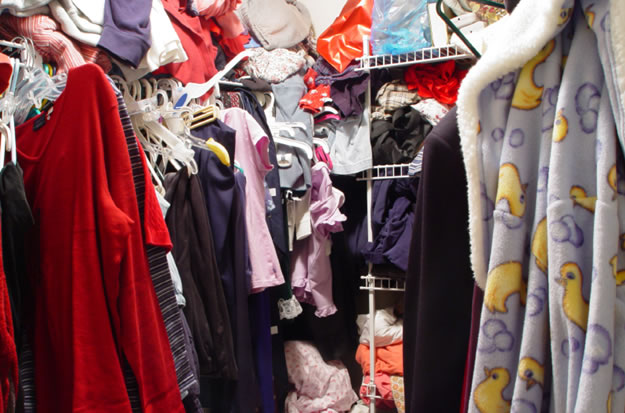
If you live with a closet that may not be big enough to house all of your clothing then reorganizing your closet a few times a year might be familiar to you. The simplest way to do this is:
Organize: Remove everything that you won’t be wearing on a weekly/monthly basis. You can keep a handful of lighter sweaters for those chilly nights, but for the most part remove items and store them in Polypropylene Corrugated Textile and Fabric Boxes. I like these containers because you can still see your clothing in case you need to grab something in storage and they let your clothing breathe!
Create: Always, make a master list of what will be going into these containers and store your clothes with their friends. All like items stick together. Use canvas bins for harder to reach areas of your closet. This is always good for belts, scarves and sweaters to prevent a mess from occurring while picking items out. These items can stay put year round and will just need basic maintenance through the year to maintain organization.
Discipline: through the year discipline yourself to keep the closet from getting out of control. Put away your clothing immediately, toss dirty laundry in the hamper when you’re done wearing the item and always keep an eye out for items that you know you are not wearing and donate throughout the year.
O.C.D. Experience Switch Tip: during the seasonal switch go through your wardrobe and let go of items that have been worn out, have stains or holes in them or just don’t fit you anymore, period. If you have a hard time doing this bring in a trusted friend who you don’t mind being honest with you. Also, if your hangers aren’t uniform, now is the best time to switch them to the Slimline Hangers.
In 1950 the average size for new homes was 983 sq ft; the average household had 3.37 occupants. In 2010 the average size of new homes was 2,392 sq ft with 2.59 occupants. 317% more space.
According to Nielsen, in Q4 of 2010, the average American watched 34:39 hrs of TV per week. Put another way, that’s 1.5 months per year of continuous TV watching annually.
The outstanding domestic debt of the Household and Home Mortgage Sector in 1950 was $411B (adjusted for inflation). Currently, that same figure is $9.7 trillion. While the population has doubled and home ownership and college attendance have increased, this is still an increase of over 23-times.
Something’s wrong in America.
A new report by UCLA-affiliated social scientists called “Life at Home in the Twenty-first Century: 32 Families Open their Doors” takes a deep look at the lives behind the statistics, entering 32 Los Angeles homes to see how Americans really live. Here are some of their findings:
3 out of 4 of the families garages cannot fit cars because of excessive stockpiling from stores like Costco.
50 of the 64 parents reported not stepping outside in the course of a week.
Managing possessions has lead to increased stress hormones in mothers.
Most families rely primarily on “convenience foods” even though they only save 11 mins over homemade meals.
The majority of leisure time, as the Nielsen statistic suggests, is spent in front of the TV or computer.
A complimentary piece in the Boston Globe that followed Boston families and their consumption patterns suggests that some of the most pleasurable moments today’s Americans experience is when they are getting rid of the stuff. “I felt so light,” a woman remarked about filling a dumpster with her old stuff following a move.
So what do we do?
Just as we didn’t get into this mess quickly, we might not get out of it so quickly, but there are a few things all of us can do, right now:
Challenge the status quo. Many of us have a sense of resignation about over-consumption–as if it’s inevitable that everyone has the latest Macbook or every little girl has a Dora the Explorer Adventure Hut. It’s not true. I use a first generation iPhone that was handed down from my mom. Sure, people snicker, but the phone works fine. We have choices, and though it might mean enduring some screaming, parents can make smart choices for their children. Nothing is inevitable.
Think before you buy. From the biggest to the smallest purchase, we should constantly ask ourselves if our purchases are contributing or detracting from our enjoyment of life.
Change you behavior. Get rid of clutter, rent stuff instead of buying it, digitize, downsize.
Take time to appreciate life every day. Share your meals, get outside, spend time with family and friends, read a book, pay attention to things not coming from a glowing box.
Ever notice how the amount of stuff and activity you have to deal with is directly proportionate to amount of space you give it? E.g. if you have 1K sq ft to fill, you fill it. If you have 2 weeks to do something, you use that (even if you could have done it in two days). Today’s guest post is by productivity coach Ari Meisel, who provides a methodology whereby you can leverage that phenomenon to bring more ease, space and time to your life.
About two years ago I created The Art of Less Doing. I teach people how to optimize, automate, and outsource everything in their lives in order to be more effective. Doing more with less has always been a passion of mine and I’m constantly looking for ways to streamline and improve my processes. A long time ago I started imposing artificial and sometimes oppressively restrictive limits on myself just to see if I could make it work, this is the refinement of that process.
In the fundamentals of Less Doing when I talk about Organization I say that in my system it is simply a matter of setting appropriate limits. That limit becomes your benchmark for how the rest of your productivity system is working. Using the limit as your goal and working to do whatever you need to in order for that to happen is an excellent exercise. What would you have to do in order to:
Never have more than 10 emails in your inbox?
Read a book every week?
Travel the world and run your life with nothing more than your iPhone?
Have a 30 page binder that holds all the paper in your life?
Spend $100 on food every month?
The list goes on and on because there are literally hundreds of examples like this. This is NOT the same as setting a goal and working backwards to figure out what steps you need to get there. This is about setting (possibly unreasonable) restrictions on yourself to force you to become more streamlined, and thus more efficient and mobile. In the end less is more.
I’ll give you a really concrete one. A couple of years ago I had a closet in my house full of old electronic junk. In all honesty it was probably all garbage but I couldn’t bring myself to get rid of any of it. Even worse, every time I’d get a new gadget or upgrade a computer, more stuff would go in the closet. In this day and age nobody needs 30 of those 6 foot long telephone cords that come with new phones. So I decided to do something drastic, I got a medium-sized box (about 2 feet by 1 foot by 1 foot) and decided this would be the limit of my electronic debris. Now what would it take for me to make that happen. I donated a bunch of it to a charity that uses circuit boards and related items for arts and crafts projects. I dumped a bunch of stuff off at an e-waste recycling day. I downloaded digital copies of any paper manuals. And finally I was left with just enough stuff to put in the box. Furthermore, going forward, any time I want to put something new in the box, I have to take 2 things out. Since I did this little “cleansing” experiment, I have added two items to the box, and thus removed four.
I started to realize I could apply this to other things in my life and business. Email was a big one as it is for many people. I thought, as I looked at my hundred plus message inbox, if I never had more than 10 emails at a time. What would it take to accomplish this? Make sure to check out my article on Mashable about Dealing with Email Overload for a great start. I needed a better filing system; rather than have hundreds of folders I have one, the optional folder, and everything that is not essential is automatically filtered into that folder. I have autoresponders setup, my virtual assistant deals with certain things, and I got into the practice of answering emails quickly and moving on.
I only use the bookmarks bar in Chrome which holds about 12 saved URLs. I used to have hundreds with folders and sub folders. There were tons of dead links and things I never looked at anymore. If I ever want to add a new bookmark, I either have to think really hard about whether or not I need it or about the one I need to delete to make room for it. In fact, I try to keep as much as possible web-based as it is. If I come across a cool program that requires I download and install it, I’ll look for a web-based alternative or I will figure out another way to accomplish the functionality of that program that doesn’t require an installation. Seem extreme? As a result I have two programs installed on my Mac, Chrome and Dropbox. I am able to accomplish everything I need in life and business via web-based applications whether it’s Google Docs for document creation and management or SignNow for getting contracts signed. It also means that if my computer were to blow up for some reason, I could literally be up and running on a complete stranger’s computer in a matter of seconds without any disturbance to my flow. In this case, the limit is that everything I do must be web based, then I find the systems and setups that fit that guideline.
Over the years I accumulated a lot of paper. Just as I explain in the fundamental on Creating an External Brain, I want people to overuse and overshare when it comes to note and record keeping, you never know when something will be useful. I used to do that with paper and as a result had three filing cabinets, each one six feet wide with double drawers. We are talking about thousands of pieces of paper, hundreds of business cards, and even full-sized architectural plans. I decided that a single file folder that could hold about thirty pieces of paper was acceptable to me. It was quite an undertaking but after scanning hundreds of pieces of paper including seven years of taxes, digitizing business cards and putting them in my contacts, and getting the architectural plans shrunk and scanned into pdfs, I finally shredded and recycled a very satisfying mountain of paper and have never looked back.
Here’s a big one, it was one thing not to install things on my computer but once I became almost completely cloud based I realized I could take things a step further. What if I could run my whole life from my iPad. That day I put my laptop away and started figuring out what apps I would need in order to function. I need FTP access, VPN service, the ability to edit pdfs, the ability to look at CAD files for architectural drawings, Skype, etc…all of it could be accomplished by apps and if not I could email my assistant and have her do it. For the next six months I never opened my laptop again. The only hiccup came with typing but after temporarily using bluetooth to pair my Mac keyboard with the iPad and seeing how well it worked, I got a portable keyboard…problem solved. Of course, the job of trimming the fat is never done. Two months ago I wanted to see if I could do it with just my iPhone. It wasn’t as challenging as I thought and I have now gone on two five-day trips with no laptop, no iPad, and without needing to use a hotel or friends computer. I can operate my business and my life, with full function, using nothing more than my iPhone and THAT means that I am COMPLETELY mobile.
What limits can you set in order to be more effective, and what would you have to add, learn, eliminate, or arrange to make that happen?
Freedom’s just another word for nothing left to lose.
Kris Kristofferson
In the context of 1776 colonial America, freedom and independence meant being free and independent from the tyranny of taxation without representation, illegal search and seizure and other nasty imperialistic institutions (for the sake of economy, we won’t go into the myriad contradictions of our founding fathers).
Today, there are new forces inhibiting our freedom and independence: Bills we cannot keep up with. Mountains of debt. Constant streams of emails, texts, and hyperlinks begging for our attention. Bloated homes we can neither afford nor maintain. Cultural expectations we can never seem to meet.
At LifeEdited, we promote freedom and independence from unimportant stuff. When we eliminate (or “edit”) that stuff out, the important stuff–relationships, passions, health, great design–naturally moves in.
To get some other perspectives, we asked a few of our friends what freedom and independence meant to them.
From Francine Jay–aka “Miss Minimalist“–we got this response:
To me, freedom is traveling lightly through life. Each extraneous thing I eliminate—be it an unused item, unnecessary purchase, or unfulfilling task—feels like a weight lifted from my shoulders. Paring life down to the essentials is positively liberating!
Joshua Fields Millburn, one of the 2 guys behind “The Minimalists” gave this appropriately minimalist response:
Intentional awareness.
Ari Meisel, a productivity coach and practictioner of “The Art of Less Doing” says this about freedom and independence:
The ability to head half way around the world tomorrow, with no planning, and not knowing if I’ll have Internet access or not and having confidence that my life and business will run itself without interruption.
What about you? What constitutes freedom and independence to you? We’d love your thoughts. Please share below or on our Facebook page. And have a great holiday!
How often have you checked your inbox or the web only to realize it totally short-circuited an important task you were engaged in? How often have incoming calls, texts and/or emails undermined your level of presence with the people you were spending face-time with? How often has your desire to do everything left you too confused to do anything?
If the above problems beset you, strategic adviser Peter Bregman has a simple way to keep on track and avoid distractions. He suggests making and abiding by two lists; he recommends checking them throughout the day. The lists are broken down into two simple categories:
Your Focus List (the road ahead)
Your Ignore List (the distractions)
Though he doesn’t use the phrase, Bregman is describing life as opportunity cost. In order to have certain things (the road ahead), we need to turn down or ignore many others (the distractions). In order to be present with one person, you have to ignore many others. In order to do one thing really well, you have to not do infinite other things. There is a reason no one talks about Picasso’s novels–he chose to be a painter.
What’s unique about his suggestion is the use of active ignorance. It’s not enough to find out what’s important–we have to actively avoid the things–be they communications, tasks, pursuits, purchases, etc–that aren’t aligned with what’s important.
Bregman’s suggestions run counter to our culture that promotes all information all the time. But he’s emphatic about the importance of saying no and the heavy toll of unlimited inclusion. He writes:
Never before has it been so important to say “No.” No, I’m not going to read that article. No, I’m not going to read that email. No, I’m not going to take that phone call. No, I’m not going to sit through that meeting.
It’s hard to do because maybe, just maybe, that next piece of information will be the key to our success. But our success actually hinges on the opposite: on our willingness to risk missing some information. Because trying to focus on it all is a risk in itself. We’ll exhaust ourselves. We’ll get confused, nervous, and irritable. Read full essay here.
We live in an age of amazing tools that enable us to do and have more than ever possible. But our unlimited options often come at the detriment of singular focus and peace of mind. Suggestions such as Bregman’s offer sage advice on how to use these new tools wisely so we can do what’s important while staying sane.
How do you keep on task and combat distraction? Let us know.



 Consider a standing desk. You can test one by propping something on your existing desk or buy a