It’s the Little Things That Make A Difference

Unless you’re living in some self-sustaining, off-grid detached house, the fact is that multifamily, multi-storey housing in dense, urban settings–ones that are walkable and have access to public transit–are going to be your best bet for green, low impact living. But here’s the deal: most Americans don’t live in this type of housing–single family homes make up 70% of the American housing stock, and while people may be migrating back into the cities, the vast majority of them can or will not move for various reasons. Which leaves the question: how can we make the single family housing–and the sprawl that tends to come along with it–greener?

A reader tipped us off to the east bay town of Albany, California, which, like its neighbor to the south, Berkeley, has become increasingly hospitable to accessory dwelling units (ADU’s), both as a way to increase density as well as creating an “aging in place” strategy; ADUs can let older, emptied nest adults inhabit small dwellings behind the big homes that they might have once used for their full houses. We found this nice example in Albany on Tiny House Listing of how one family, through the addition of an ADU, turned a fairly typical single family house into a mini compound that housed three generations.

While ADUs are often used to house older generations, this particular one, at least initially, was used to house younger ones. The house owner of 30 years, Judy, invited her daugher and her daughter’s partner and child to come back and live at home. Rather than shacking up in the main house, they built a simple, 442 sq ft L-shaped home where a detached garage and patio once stood.

judys-garden-cottage-1 Judy worked with New Avenue Homes to construct the home (they seem to do a lot of ADUs). Tiny House Listing said this about its construction:

The family considered sustainability and stylishness during design development. They opted for reclaimed and recycled materials, non-toxic paints, solar panels, a large bay window, stained cedar siding, bamboo flooring, and an exposed wood ceiling. The structure is L-shaped and sits in a far corner of their backyard. A garden and walkway connects the main home to the cottage. Construction took around 6 months.

For reasons not explained, the home is now used as a rental investment property, though Judy plans to move in when she retires in a few years, presumably to have a low fuss home with a large rental property helping to keep living expenses very low.

judys-garden-cottage-13

While inserting compact, multi storey housing in the millions of underutilized lots of American single family housing would be ideal, there’s pretty much no way that’s going to happen…at least any time soon. In the meantime, ADUs offer an elegant, livable way of increasing density in areas that might seem like they are immune to density. While Albany might not epitomize the American suburb (it’s near a BART station), Judy’s example shows how this can look, which, with its little pathway and garden, looks pretty good to us.

Growing Old Together and in Style, in the City

Last week I posted about the Cheesecake Cohousing Consortium–an 11 person senior community located in Mendocino, CA. The post proved very popular, but a number of commenters remarked about the dearth of urban housing options that perform many of the same things that Cheesecake does–namely provide affordable, compact, interdependent and social living. In researching Cheesecake, I ran across Durham Central Park Cohousing in (you guessed it) Durham, North Carolina, which seems to fit that bill.

While not a San Francisco or New York in terms of urban density, with its 245K people, Durham is a lively mid-sized city, one that has a booming social, artistic and cottage commercial industry. CP Coho is located right in the middle of town, making it easy for community members to access those assets on foot.

durham-coho-plan

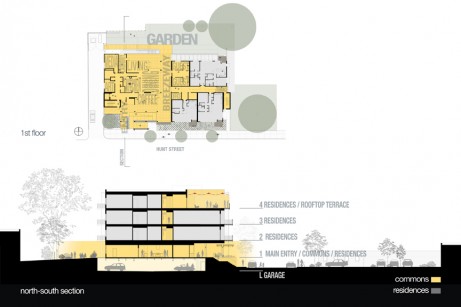
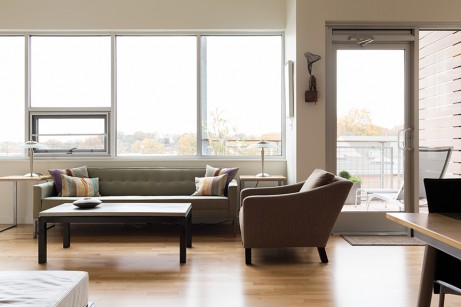
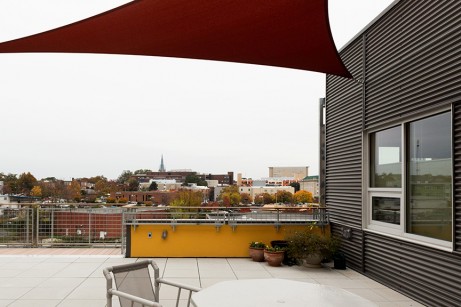
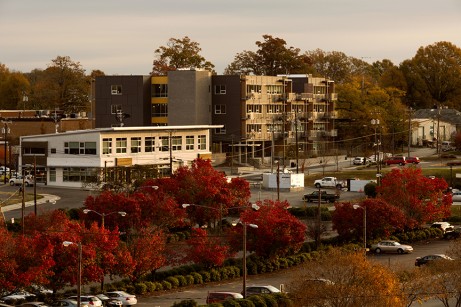
The four story building was designed by Weinstein Friedlein Architects and completed late last year. The first floor is occupied by a common dining room, kitchen, great room, meeting rooms, performance space and gardens. There are also shared guest bedrooms, enabling people to live without dedicated guest rooms in their personal apartments, which are often only used a small fraction of the year. The three upper floors contain 24 units ranging from 850 and 1700 sq ft housing a total 37 people. Each self-contained unit has its own balcony and there is a large shared patio on the roof.

November 13, 2014. Durham, North Carolina. Photographs of the Durham Central Park Cohousing Community for weinstein friedlein Architects.Durham Central Park Cohousing Community

Though not strictly a senior community, judging by pics of its members, the community is made mostly of people of fifty years and older (they do state that a family lives there with one teenager). On their website, they mention that the community is designed around the “aging in place” principle, and the building was designed with universal access to accommodate community members as they become less nimble with age.

Whereas many cohousing communities use existing structures or enlist developers to handle the design and construction of their new building, CP Coho members self-developed their building according to a Citylab article on cohousing and boomers. That said, all units are owned outright as condos. One member told Citylab that the cost of each unit was not affordable per se, but it was comparable to other market offerings. I dug around a little and found most units sold in the low to mid $400K range (I emailed the community for other monthly expenses, but haven’t heard back yet).

CP Coho has a lot going for it. Units are reasonably sized, neither too big or small. The whole building sits on a mere .58 acres, contributing to the urban density and walkability of Durham as a whole. The building itself is pretty good looking and has a number of energy-saving features like solar water heaters. Most importantly, the building has socialization built into its DNA–a critical aspect for people of any age, but particularly older adults, who are more at risk of becoming physically and socially isolated. These merits explain why the building was fully sold out before construction even began. I’ll keep looking for other great project like these (valuable research before I need to start or move into one myself).

Housing an Aging Population

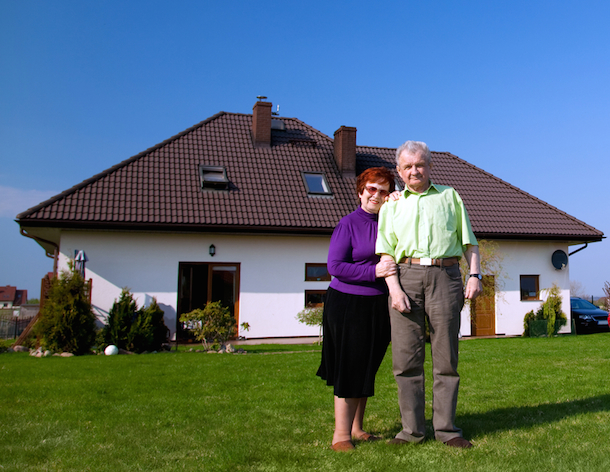
By 2030, it is estimated that there will be 33M more seniors (65+) than there are today. A majority of these seniors-to-be are currently living in big homes in the suburbs. These are homes that require physical capabilities to maintain, financial wherewithal to afford and cars to access–all things that are difficult as one’s physical and financial resources diminish, as they tend to do when we get older. The mismatch of existing housing stock and an emergent aging population (and all that goes along with that) is the subject of a recent report by Harvard and the AARP called, “Housing America’s Older Adults—Meeting the Needs of an Aging Population.”

The exhaustive report details current population demographics and where things are heading in the realm of housing. While we cannot summarize the whole report, here are a few of its key findings:

  • Today, 47% of households under the age of 50 are couples with children under 18 at home or single parents, a share which falls to 9% of households in their late 50s and continues to drop among older age groups.
  • The increase in single-person households is the most dramatic change in household type after age 50–about 1/4 of households in their 50s consist of a single person, a share which rises to 1/3 of those in their 60s, 2/5 households in their 70s, and 3/5 aged 80 and over.
  • Most older adults own single-family homes, including over 2/3 of those aged 50-64, nearly three-quarters of those aged 65-79, and three-fifths of those aged 80 and over.
  • Mobility rates continue to decline among those in their 60s and beyond, with a small increase around age 85. In 2011, 60% of households aged 80 and older and 47% of those aged 65-79 had lived in the same residence for 20 or more years.
  • In 2012, 1/3 of adults aged 50 and over—nearly 20 million households—were cost-burdened, meaning they paid over 30% of their income for housing.
  • Even though most older adults drive, 61% limited their driving to certain hours of the day, and around 21% stated that they frequently or occasionally miss out on activities they like to do because of driving limitations.

To summarize the above points, there is a rapidly growing population of older adults who today live with their kids in the suburbs in single-family homes. These same folks will be empty-nesters in the near future, leaving them with big, mostly empty homes. The likelihood of them downsizing and moving to more accessible housing based on current trends is low–at least before age 80. A high number of seniors today are cost-burdened by their homes, a trend that’s expected to continue given the increasing rates of housing and non-housing debt. Driving becomes a big issue as people get older, making car-dependent living problematic for older adults.

Not to get all bleak about it, but the report suggests a possible future with large populations of older adults stranded in the suburbs, living in needlessly-large, unsafe homes they cannot afford or maintain. The public and personal ramifications could be huge. The report says, older adults will “sacrifice spending on other necessities including food, undermining their health and well-being”; older adults will be isolated from friends and family; and “disconnects between housing programs and the health care system put many older adults with disabilities or long-term care needs at risk of premature institutionalization.”

One might assume that the large homes now occupied by future seniors will eventually be occupied by the Millennial generation, who in 10-20 years will presumably have children, careers and will want more space. Emily Badger of the Washington Post questions whether this will be the case. If current trends among Millennials continue, where centralized urban living is prized above space in the suburbs, the Millennials might end up hogging the centrally-located, amenity-rich housing, driving housing costs higher than most seniors can afford, leaving them to fend for themselves in the burbs.

We won’t suggest that we have an easy answer for this most difficult topic, but we will suggest that micro and other compact housing is one logical direction. Smaller spaces are far easier to maintain than large ones. They are often less expensive. They are often more conducive to social living as they are typically part of multifamily structures. And they are more likely to be centrally-located, obviating the need for car ownership.

The micro-housing conversation is almost invariably linked to young, single people: the ones who just got out of college and need an affordable, centrally located home; the ones who might be living with their parents and need a starter home before shacking up with a nice guy or girl; ones who work and play so much that they just need a place to sleep in between their exciting job at that startup during the day and fashion openings at night. What the Harvard/AARP report suggests is that micro-housing might be just as–or more–relevant to our growing aged populations as it is to young folks. Now it’s a matter of legislators and real estate developers to see this pressing need.

Seniors image via Shutterstock

You’re Getting Older, Where Will You Live?

So often, the spotlight on micro-apartment residents shines brightest on the young. Recent college grads, twenty-something Bay Area startup employees and other unencumbered types are the people we imagine will live in 300 sq ft, Murphy-bed-equipped micro-apartments. But this assumption might be out of step with demographic realities. Empty-nested-baby boomers are retiring en masse and micro-apartments might be a perfect fit for their housing needs.

To illustrate what the US housing market will have to contend with demographically, here are a few stats from a US and World Report article:

  • The age-65-and-older population grew 18 percent between 2000 and 2011 to 41.4 million senior citizens.
  • The median income for people age 65 and older was $27,707 for males and $15,362 for females in 2011.
  • 81 percent of seniors reside in metropolitan areas.
  • The average life expectancy for people turning age 65 is an additional 20.4 years for women and 17.8 years for men.
  • The US Census Bureau projects that by 2040, there will be twice as many Seniors as there are today, with 28 million of them aged at least 80 years old.

In other words, there are more seniors, living longer, with less money, primarily living in and around urban areas. The trend toward building bigger houses, with their huge lawns to mow, interiors to clean and mortgages to pay seems profoundly incompatible with our growing senior ranks.

Not only do larger homes make less sense in terms of convenience and economics, their isolating effects may even have a deleterious impact on senior health. According to the Yale Medical Group, social seniors showed reduced risks of cardiovascular problems, some cancers, osteoporosis, rheumatoid arthritis and Alzheimers. Conversely, antisocial seniors had higher blood pressure and greater risk of death (we thought the risk was the same for everyone).

Retirement communities provide one answer for housing seniors. There has been an increase in “age-restricted” (typically with a minimum age of 50) multifamily housing units recently: In 2012, 225K units were started versus 92K started four years ago. But with 18.5% of the over-65 population still working in 2012, and with many seniors enjoying robust health for many years past 60, the designation of retirement versus non-retirement is getting fuzzier by the day.

Another solution is the “Naturally Occurring Retirement Community” (NORC), which provide a transitional housing model. According to Wikipedia, a NORC is a:

Community that was not originally designed for seniors, but that has a large proportion of residents who are older adults (at least 60 years old). These communities are not created to meet the needs of seniors living independently in their homes, but rather evolve naturally, as adult residents age in place.

NORCs are cropping up all over the US. In NYC, the birthplace of the NORC, there are 27, all of which are Robert Moses-era “towers-in-the park” style apartment high-rises. Other NORCs take form in suburban developments and even rural areas.

What’s great about the NORC is that they use existing buildings and tenants. And unlike retirement homes, young and old live alongside one another. What’s less great is that they’re not purpose built. Some NORCs, because they were built around a full family, are not necessarily the best arrangements for the needs of seniors–people for whom smaller, more manageable spaces are a big plus.

In Seattle, where the micro-apartment controversy continues to brew, there have been reports that seniors are opting for the tiny digs because of their convenience and small price tags. Piggybacking on this trend, we would contend that micro-apartments and other varieties of compact living are perfectly suited for senior populations: They’re easier to manage, generally cost less to rent, buy and operate, they lend themselves to social living, they are typically urban and have applicability to non-senior demographics.

What do you think about this topic? Are you a senior who has discovered a great housing solution? Or are you faced with the scarcity of smart housing? Let us know your thoughts in our comments section.

Senior Woman Image via Shutterstock.com