Furniture You Can Feel Good About Throwing Away

A new company dubbed The Cardboard Guys is making disposable, cardboard furniture. Disposable furniture, you ask? Really? As if our culture weren’t disposable enough. Well you should hear TCG out because their idea makes a lot of sense and, strange as it might sound, is a pretty earth-friendly choice for furnishings.

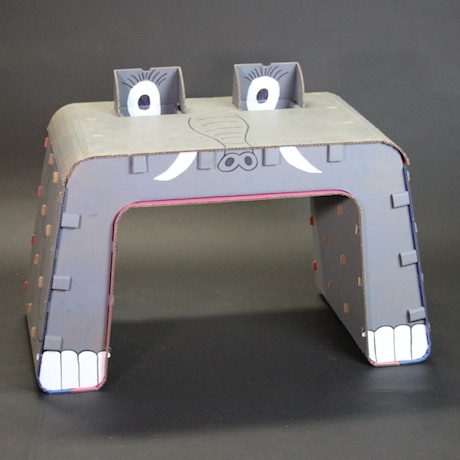
Elephant Desk

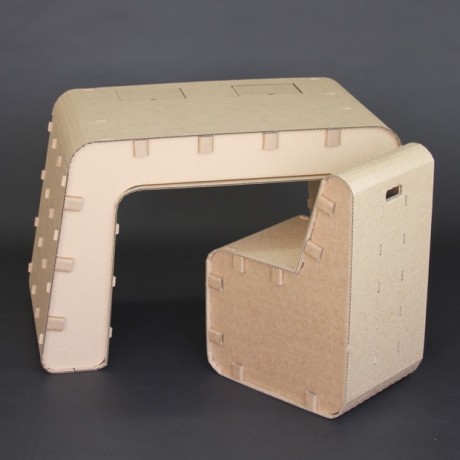
The first thing to know is that TCG are making furniture for children–a demographic known for their ability to destroy and decorate furniture in unintentional ways. By virtue of the TCG furniture’s ephemeral nature, improvised decorations are encouraged, not shunned. Kids can draw and paint on them any way they see fit. Should that artwork get tiresome, flip the panels over for a whole new canvas.

the-cardboard-guys

Though the furniture is made of cardboard, it’s tough. One of their chairs can hold an incredible 500 lbs–which, hopefully your child will never verify. And though it’s not waterproof, they are using a water resistant type of corrugate. “If you spill something on it and wipe it up immediately after, it shouldn’t damage the furniture,” says TCG Co-founder Jake Disraeli. He does say an untended spill might cause damage…it is cardboard.

Regarding the disposable nature of his furniture, Disraeli says, “Kids aren’t kids forever, and over time they will physically grow out of their furniture, making it temporary by nature.” Indeed, most people (at least the ones this author knows) end up buying “real” furniture at IKEA for their children–furniture that more often than not ends up in the trash or on the curb when its utility has expired–a process that is hardly earth friendly.  “Typical furniture is incredibly hard to recycle,” Disraeli says, “which is why 9.8 million tons of furniture ends up in our landfills each year.” On the other hand, TCG furniture is 100% recyclable.

TCG just launched a Kickstarter campaign to ramp up production. A $75 pledge will get you the desk, chair, an extra tabletop and an supply pack (shipping is included), with delivery expected this June.

Furniture Fit for the Modern Nomad

If you haven’t figured it out, we’re pretty enamored by nomadic living here at LifeEdited. It’s not that we want everyone to live a transient existence. It’s just that we think living light, possessing only necessary, cherished and used objects has its advantages whether you’re breaking camp every four days or ev ery four decades. This collection by London’s Tilly Blue Davies is a nice example of lightweight furniture that is portable enough for all but the most nomadic souls, yet elegant enough for full time use.

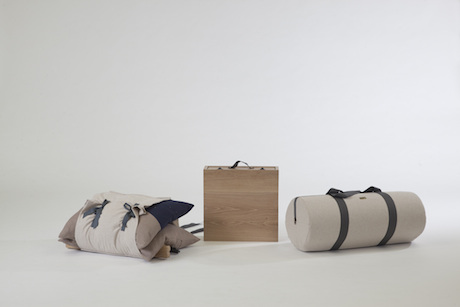
tilly-blue-backpack tilly-blue-travel-closedBlue Davies aptly named “Travel Collection” includes a lounge chair that becomes a backpack, side table that becomes a suitcase and a bed roll that becomes a duffel bag. It’s reminiscent of the IKEA PS 2014 collection and the TRUE ‘IN A BOX‘ collection we’ve seen before, albeit higher quality than the former and less militaristic than the latter.

Via Remodelista

Furniture System is the Center of Entertainment

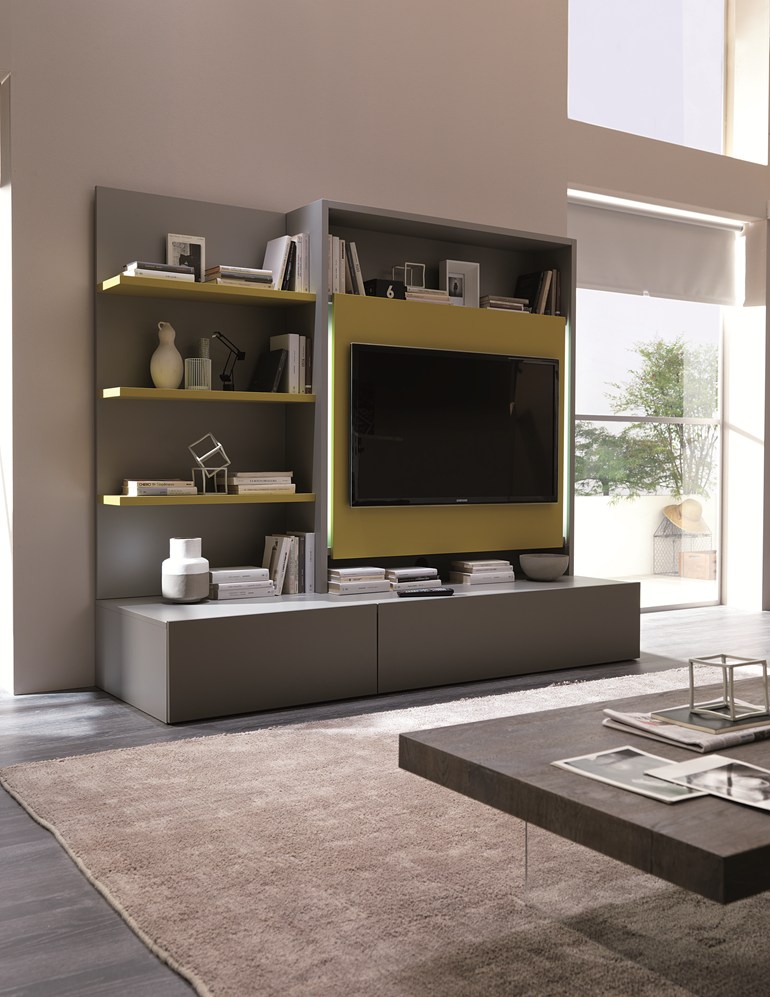
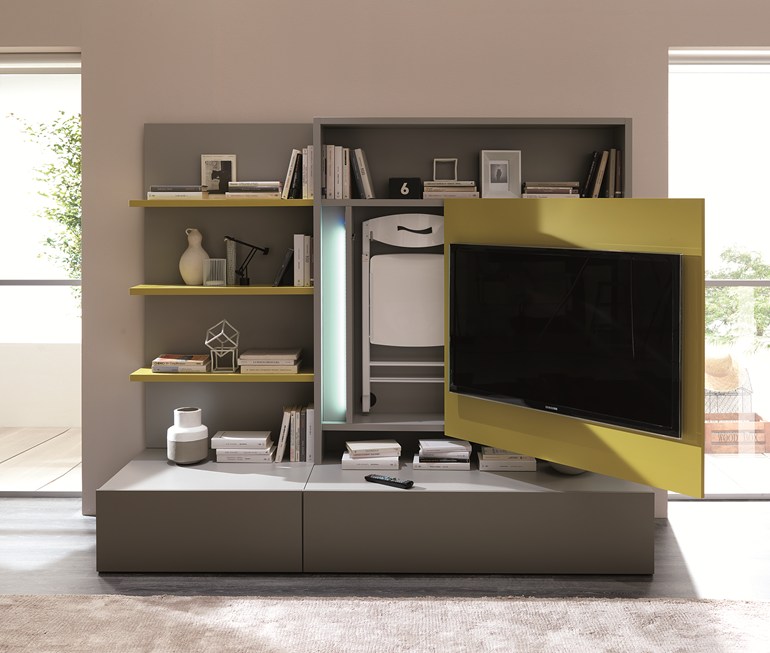
For better of worse, dining has gotten pretty casual in our modern times, with many people taking their meals on a couch, at a small kitchen table or, if we have one, counter. Paying for and maintaining a dedicated dining room whose main function is to be on standby for the occasional dinner party doesn’t make much financial sense. But having the capacity to properly entertain is pretty sweet, which is why the Smart Living TV wall system by Ozzio Design is pretty sweet. Concealed inside the entertainment center are chambers that hold a collapsing dining table and six folding chairs.

The front panel holds a large TV, which swings out of the way to access the chairs. This makes the system ideal for folks for whom the TV is a room’s centerpiece (not a judgment statement, just a fact).

The system is available in the US through Resource Furniture. The TV rack/storage element can be ordered without the side shelving for $5,300 in a lacquer finish. The “Mini Long” table starts at $2,040, and a set of 6 Nobys chairs starts at $960. Grand total: $10,950.

We know some our readers are going to get in a tizzy about the cost. That’s fine. But hear us out post-tizzy. A dedicated dining room is easily 100 sq ft. In cities like San Francisco and New York, price per square foot for an apartment purchase regularly exceeds $1000–i.e. $100K. But let’s say you live in a city like Washington DC, where one and two bedrooms only cost around $500 per square foot. That’s still $50K. Not to mention, any reasonably high quality entertainment center, dining table and chairs is going to run you at least a couple grand. Depending on your priorities and means, this math is way easier to justify than paying for a room that’s used a couple times a month.

4 Pieces of Furniture that Mix Business with Leisure

For today’s work-at-home professional there’s often a fuzzy division between home and work life. Particularly in small spaces without dedicated offices, there’s an imperative to create some division lest we sleep through our workday or work through our sleep day. Multifunctional furniture can do this, creating distinct functions for different duties. Here are a few pieces that shift a room’s focus from work to leisure or vice versa.

BLESS

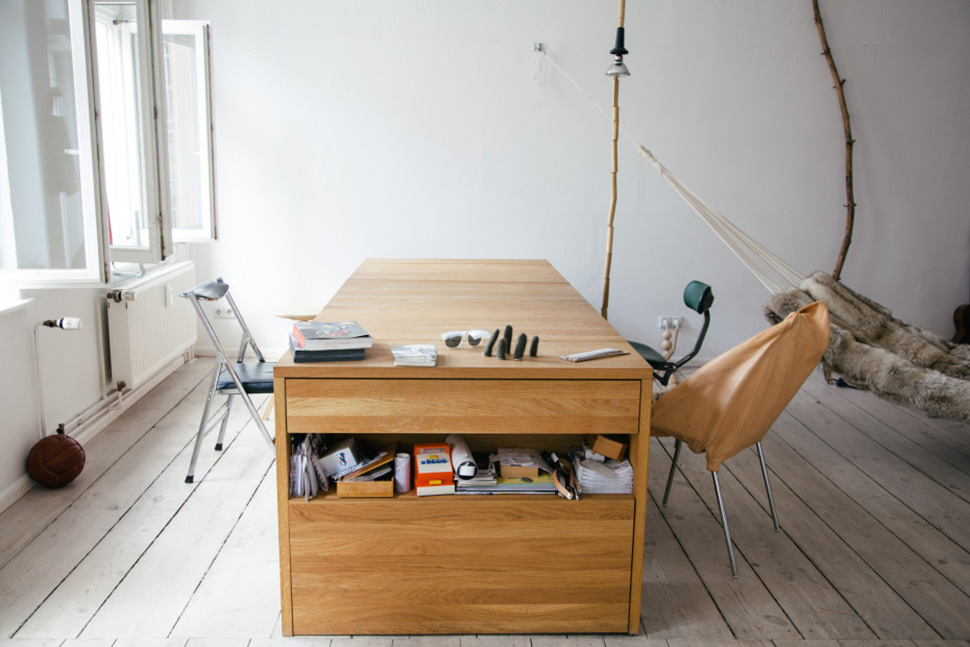
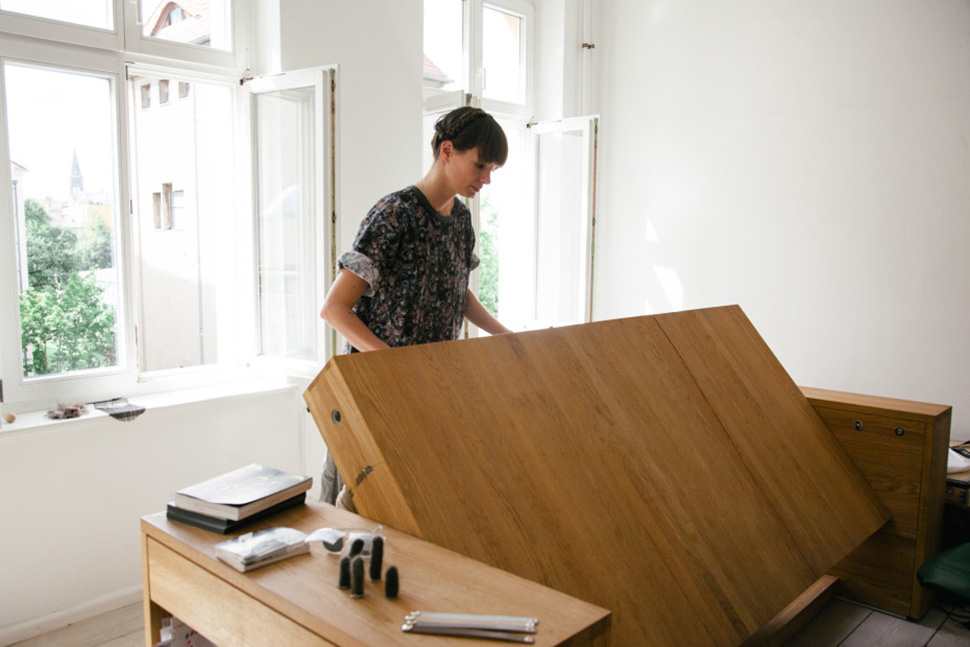
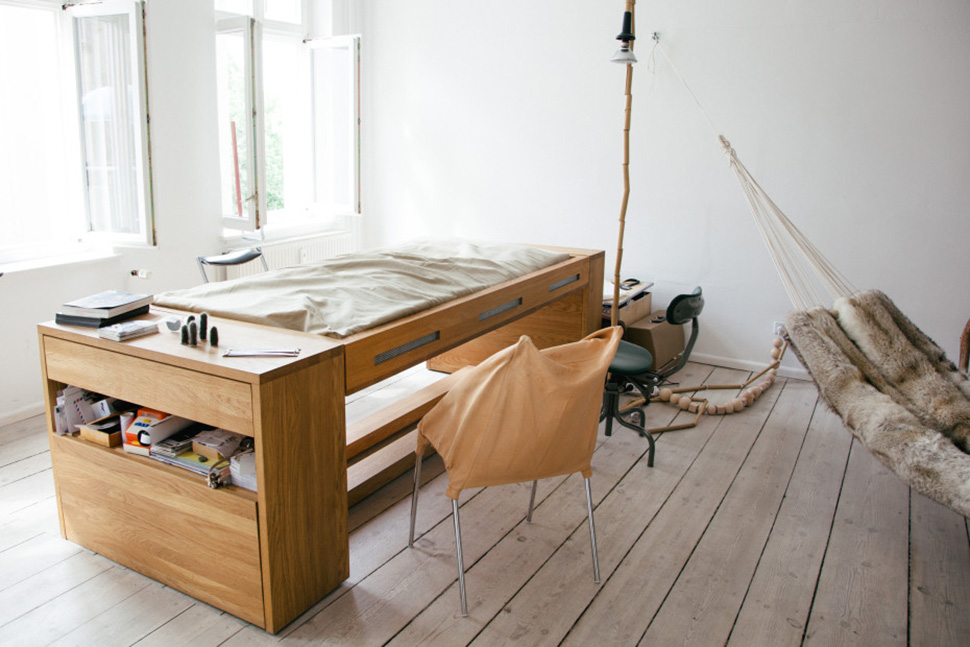
Berlin-based BLESS design studio made this table whose top flips over to convert into a single bed. The table/bed, which features a bunch of storage, would be great for artists who need large work surfaces or for people who have teams. It would also make a good dining table. (It might not be good for people with partners). Gizmodo reports that the unit is available through BLESS’s seldom-updated, confounding website. We’ll take their word for it.

Vitra

vitra

Venerated Swiss furniture maker Vitra will be showing off this cool cubicle concept at this week’s Orgatec tradeshow in Cologne, Germany. Inside the cube is a surface that can raised and lowered to be used as sofa, conventional desk or standing desk. While the piece does have a somewhat office-y vibe, we could imagine having one of these in the house as a dedicated office space. We could also see lengthening it to make a bed.

Resource Furniture Ulisse

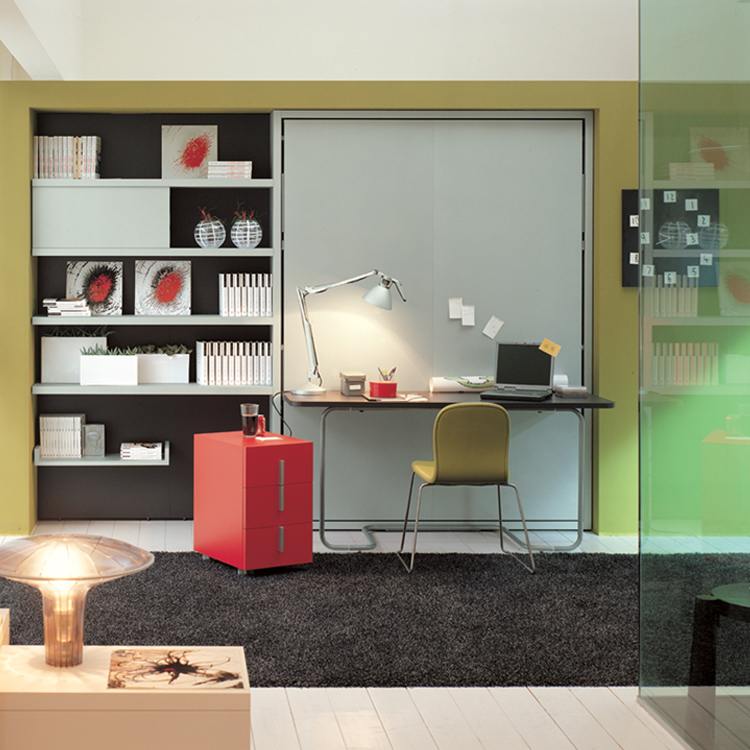
Resource furniture makes a number of wall-bed/desk or tables. It houses a queen size bed and has a desk on the front. Prices start at $4,150.

Studio NL

studio-nl-desk-bed-4 studio-nl-desk-bed

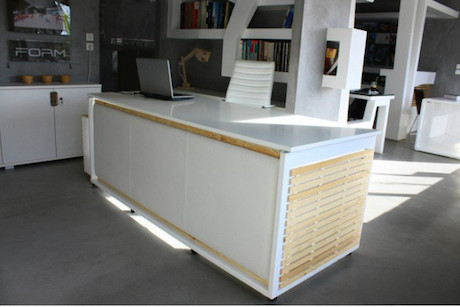
The George Constanza, ahem, 1,6 S.M. of Life line by Studio NL features a single bed underneath a desk top. They’ve included a place for a computer monitor/tv and the head of the desk/bed opens to provide ventilation or something. This design seems best suited for the office worker with a horrible home life.

Multifunctional Sofa Will Blow Your Mind

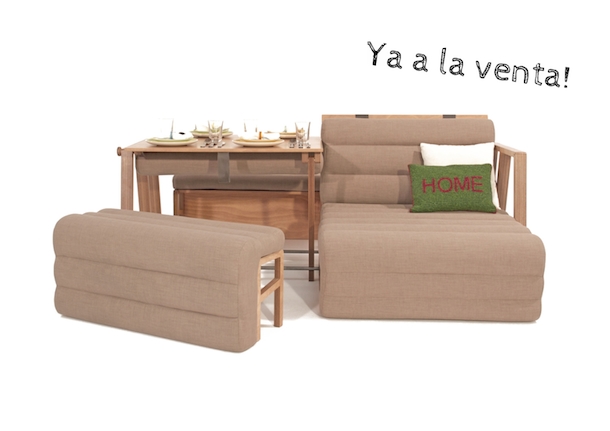
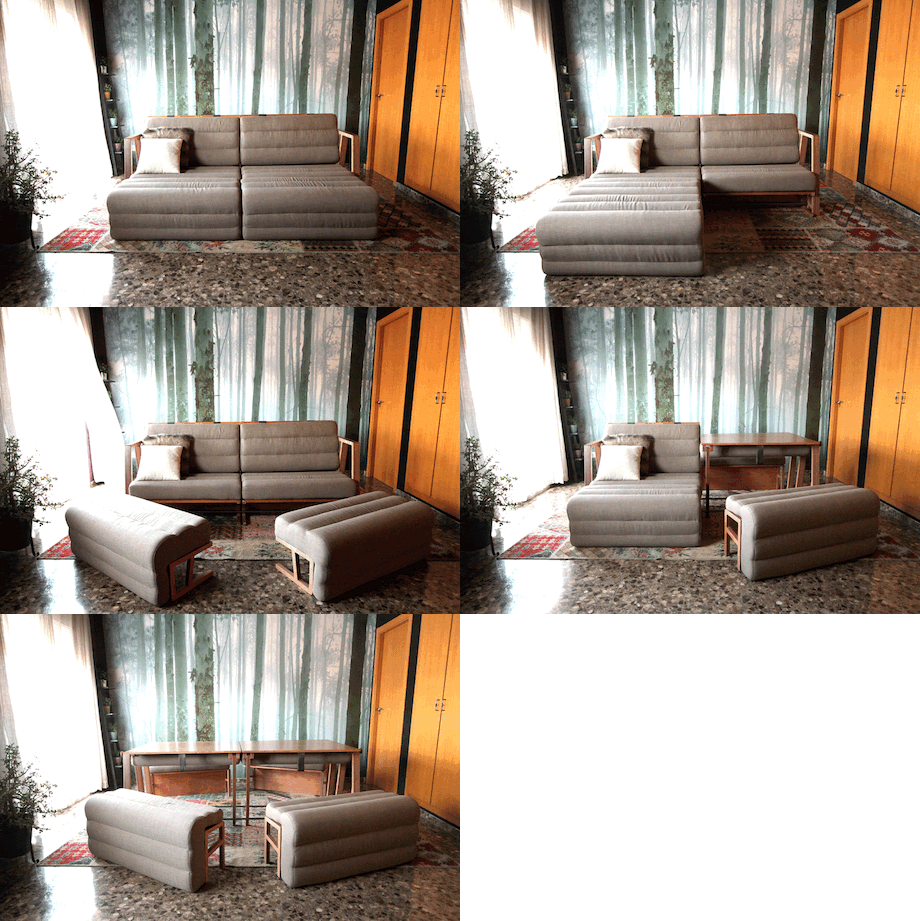
For some, hosting the ability to host dinner parties is a fairly important criteria to meet for their home. But if you’re living in 500 sq ft or less, it can be pretty tough to justify the space to house a proper dinner table, much less the chairs to surround it. Spanish designer Humberto Navarro, founder of UNAMO design studio, has a pretty slick solution for this most vexing problem. It’s called 3MOODS and it’s a sofa that hides a table and bench big enough for an eight person sit-down meal. The sofa is even big enough to sleep a compact person…somnolence being the third mood presumably.

3moods

The 3MOODS frame is made of sturdy bamboo ply and all the hardware is stainless steel. We think it looks relatively nice, though does bear a striking resemblance to your run-of-the-mill futon sofa.

UNAMO is offering the 3MOODs for €2400 ($3050) without tax and shipping (to non-Euros, they said they’ll ship anywhere). Not cheap, but for certain people, this could be a life-altering piece of furniture.

UNAMO is also running an Indiegogo campaign, whose motivation is explained in Google-translator-ese: “We need that 3MOODS is known worldwide, so we must be present in international exhibitions and fairs such as Milan and Paris; promote our product in shops, through advertising…” Basically, they’re trying to get their business together and make prototypes. Given that they’ve raised 75% of their $13K goal with 25 days left, I’d say their chances look good. We look forward to seeing more.

Via Tiny House Talk

Decorate Your Small Apartment DIY Modern Furniture

There is often a rift between one’s tastes and one’s access to–or willingness to part with–the kinda money needed to satisfy those tastes. You might want that beautiful, $8K mid-century modern sofa that you know will last a lifetime, but your budget is $800 and you’re in a rental you’re not sure you’ll be in for more than a year. Rather than selling blood and hocking all of your possessions to afford the sofa, you do what most people do: go to IKEA. IKEA has the right price, their stuff looks good enough, functions well enough and if you have to toss it (which is de rigueur for many IKEA purchases within their first five years), you don’t feel so bad about it. “Less, but better” will have to wait for the next time.

A new book called DIY Furniture 2 might have an alternative to IKEA. Industrial designer Christopher Stuart put this book together, which contains step-by-step instructions for making 30 pieces of furniture from different makers, designers and artist. All of the furniture is made from easy-to-source materials. And the DIY-phobic need not be afraid, most of the designs require little or minimal carpentry chops.

diy-modern-furniture-leaning-rack

We’re particularly enamored of the leaning rack by Love Aesthetics, which reminds us of a piece from the IKEA PS2014 collection, albeit sturdier and sleeker. It shows how a few simple, sturdy parts, along with a coat of paint, can make an elegant piece of minimalist furniture.

diy-modern-furniture-pvc-chair

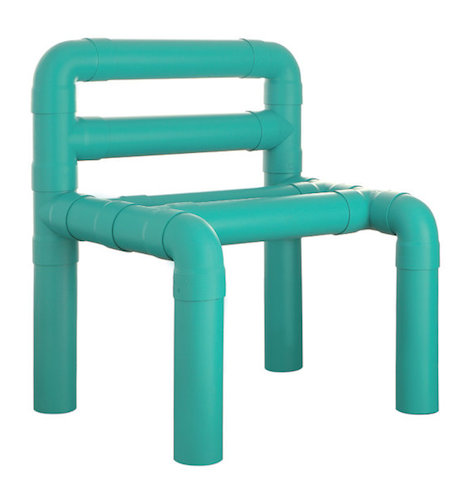
Similarly, Niccolo Spirito’s Diablo Chair is made of common PVC piping, coated in grasshopper-y green paint to give it a funky, modern look. We can’t vouch for its comfort, but it looks pretty cool.

Head on over to Fast Company, where you can see several other of the designs along or pick up the book on Amazon.

7 Ways to Improve Your Small Space with Feng Shui

An NPR story last week told the tale of Lisa Dutton. Her home had been languishing on the market for 30 months with only low-ball offers coming in. The Chino Hills, CA resident was frustrated. She said, “I thought, ‘Wow, my house is beautiful. What’s wrong? Why is someone just walking right out the door?” The reason, she came to find, was the place had bad qi–a Chinese term for energy. To fix this energetic issue, Dutton hired a feng shui expert and in short time had an offer nearly $100K more than her pre-feng shui-ed listing period.

Feng shui is an ancient Chinese philosophy that seeks to harmonize the human experience with our surrounding environment; it’s like UI design for reality. To some, feng shui might seem like soft science, but another way to see it (at least its more mundane aspects) is a codification of those intuitive and intangible elements that make a place feel great or horrible. When dealing with a small space, where there is no room for bad mojo, correcting qi disorders can make all of the difference in making the place a sanctuary or a rattrap.

The feng shui philosophy has been developing over the last 6K years give or take, so we won’t try to give an expert guide to incorporating its principles into your home (there are many consultants if your home has a serious qi deficiency). Furthermore, every house is different in its makeup, and much of feng shui depends on orientation to the sun and poles. That said, we can give a few simple, easy-to-implement suggestions to making your small space–or any space really–feel and flow better:

  1. Make an inviting entranceway. Logically, the entranceway is the gateway for both your body and qi into a home. Keep your entranceway clean, uncluttered and inviting. Paint your door if it’s in bad shape, put some plants and a clean door mat out front. Make an entranceway appropriate for a place you want to enter. The same goes for the interior aspect of the entranceway, which is where energy flows back out. Don’t block it with tons of coats or your gnome collection.
  2. Keep thing flowing. One of the main ideas is that energy should peacefully move through your home. Furniture placed in the middle of your home’s main arteries can clog those arteries leading to a constricted environment. Rodika Tchi says this on About.com about keeping a room’s flow: “Basically, as you stand at the entrance to your living room, visualize energy as water flowing into the room. Would the stream of water flow freely and smoothly? Would it get stuck in many areas of your living room? Will it rush right out the big window or another door aligned with the living room door.” These are important questions as there can be a tendency to cram too much stuff into small spaces. Err on the side of less to keep a space open. Often it’s better to sacrifice some function for flow.
  3. Remove “dangerous” furniture. Feng shui expert Erica Sofrina says, “Anything that you bump your head on, stub your toe or bruise your shins on is unsafe. The message to the reptilian brain is that home is not a safe place to be. Replace sharp-edged furniture with those that have rounded edges and remove from sight anything that is–or even looks like a weapon.”
  4. Clear clutter. You might have rationalized that a messy desk–or table or dresser or countertop–is the hallmark of genius, but feng shui philosophy would say otherwise. Feng shui dictates that we have connections with every physical object in our homes; when those objects are superfluous or represent things not dealt with, they can make our homes stagnant and overwhelming. Clear old clutter away ASAP and continually clear surfaces to keep things flowing smooth.
  5. Balance the elements. Traditional Chinese philosophy holds that there are five essential elements: fire, metal, earth, wood and water. Each element has a corresponding color or hue, e.g. red is passion, blue is relaxation, brown is grounding and so on. Try to not lean too heavily on one color, but rather try to create an elemental balance in your home to have balance in your life. Balance can also apply to décor; more “active” rooms like an office can have more going on than “passive” rooms like the bedroom.
  6. Use mirrors to your advantage. Well-placed mirrors can help transmit the flow of energy. Place them in dining areas to increase the enjoyment of meals or near dark areas to bring light and energy to that space. But don’t put mirrors directly in front of a door, which repels entering energy or near areas where you don’t want to increase something’s quality, e.g. a toilet.
  7. Bring in nature. Evolutionarily speaking, humans are very accustomed to living away from nature. Place greenery around your home accordingly.

Water and elements image via Shutterstock

Via NPR 

The Most Minimalist Furniture There Is

If you’re looking to de-clutter, streamline and create a home that feels open and minimal, Katy Bowman has a decorating tip: ditch the furniture. Katy, her husband and two children, ages 18 months and three years, have a home almost completely free of any furniture whatsoever. Their choice is less aesthetic than physiological. The Bowmans are consultants specializing in biomechanics which, according to Katy, is “the study of living structures (I study the body) and how the forces created by and placed upon them affect how they work.”

Their premise–one we’ve touched on when writing about using standing desks–is pretty straightforward: the human body and physiology did not evolve to sit on its ass nine hours a day. We are a species, like most, designed to be on the go more often than not. Bowman explains her choice in an interview posted on the SlowMama Blog:

I understand the relationship between musculoskeletal function and the immune system, bone robusticity (density and shape), and functions like digestion and breathing. Having furniture isn’t an option for us [her family], in the same way a cupboard full of junk food isn’t an option for many others. Furniture creates a development-crippling environment in that the stuff literally shapes our body, both in the now and in the future.

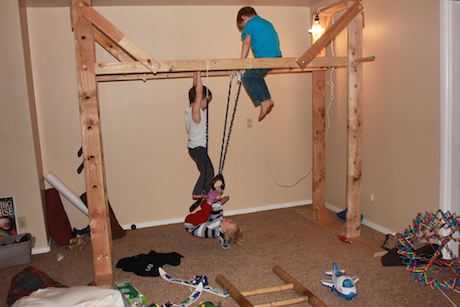
In their home, the Bowmans do have some “furniture”: some cushions on the floor, a low, traditional Japanese-style table and some mattresses. Katy says of the mattresses, “both my husband and I prefer the floor, and we noticed our kids sleep better on the ground as well, so we’ve just started phasing the beds out.” And they don’t even use the table, preferring to spread out their food on a platter placed on the floor middle-eastern style. Unlike many homes, the Bowmans have an indoor monkey bar set for the boys to play on.

monkey-bars

Their motivation to go furniture-less is health-related, but Katy does note the ancillary benefit that her home is “less cluttered, easier to clean, and instead of needing to go to yoga class for permission to get on the floor and sit cross-legged or do a twist, I do these things way more often.” She adds:

This makes all of us happier in general: As a kid, I dreaded all the chores I had to do, like dusting, simply because my mom liked lots of knick-knacks. Living on the floor has made it easy for my husband and I to stay strong and flexible because we’re essentially getting our “workout” all day long, in short and easy doses. It’s perfect for a working and stay-at-home mom and dad who, frankly, don’t have time to drive for 90 minutes to do something for an hour.

We think the Bowman’s choice an interesting and compelling one–one that is a significant deviation from conventional thinking. They beg the question, “what if the best designed furniture was no furniture at all?”

Read the full interview with Katy Bowman on SlowMama and find out more about Katy on her website.

Small Space Stuff at the 2014 International Contemporary Furniture Fair

As I walked down W 35th Street in Manhattan, en route to the Jacob Javitz Center for this year’s International Contemporary Furniture Fair (ICFF), I tried not to be resigned. I tried to not let the memory of past years cloud me from seeing something new and interesting. I tried not pigeonhole high-end furniture makers as people largely catering to customers with unlimited cash and space. I tried to imagine the emergence of a vanguard of furniture makers–they would see their furniture as part of a larger world; a world with an imperative (a moral one no less) to replace excess and ostentation with restraint, modesty and efficiency; this maverick cohort would make furniture that could do as much as it could in as little space as possible. Try as I might, I could not will these things into being.

I’m the problem really. I went in with unrealistic expectations. ICFF is, at its heart, a furniture show for high-end, often “bespoke” stuff (last time this author will use the word “bespoke” on this site). And the fact is–at least judging from the show’s offerings–high-end customers aren’t too concerned about how to fit two bedrooms and a desk in 500 sq ft…unless, perhaps, it’s for their pied-à-terres or nanny apartment.

While there were a few of the usual small-space suspects at the show like Resource Furniture, Urbio and Amina Invisible Speakers, for the most part, there was very little in the way of interesting small-space furniture on display. Here are a few exceptions.

Ecosystems
IMG_2873

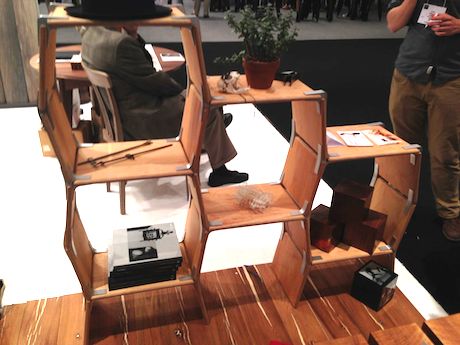
We’ve looked at this Brooklyn-based maker in the past. Their Modos system (used to be called Snugit) allows you to resize and reconfigure furniture without tools (okay, you might need to saw some wood). Given how often people move nowadays, the need for lightweight, reconfigurable furniture is great. Check out their Kickstarter campaign as well.

Fatboy
baboesjka_slide_1

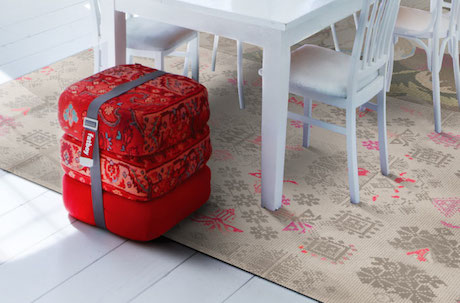
Fatboy is known for their square-shaped, oversized beanbag chairs. They are easy to spot due to their large, red Fatboy labels. I have sat on these and don’t find them too comfortable. But the company makes other stuff, like the Baboesjka (pictured above). It is a cushion/stool, where three individual cushions are strapped together. The cushions can be used together or apart and each can be ordered in its own color. These would be really handy for folks (like me) who like to sit on the floor, and for folks who have two or three friends who enjoy doing the same (bet they’d be very popular with Bedouins). While theoretically you could make something like this with three firm pillows and plus-sized-men’s belt, for $260, we think the Baboesjka makes the whole assembly a lot more foolproof. (I had to rip the picture from their site because my son was attacking an inflatable poodle in their booth).

Flowerbox
IMG_2886

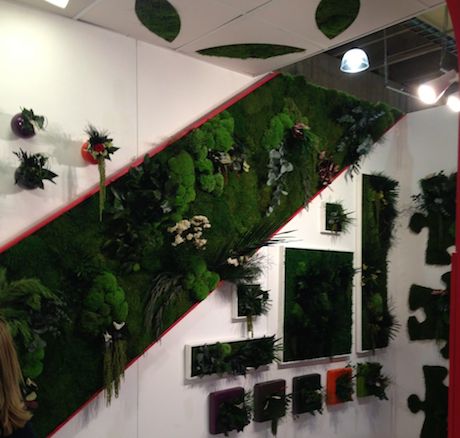
As someone cursed with a black thumb and love of greenery, I was really excited by Flowerbox. Unlike all those wall gardens that require watering and light and attention, Flowerbox offers lush, green walls made of moss that they claim will do without light and water for five years! Even I could maintain that (though I can’t guarantee there’d be a year six). They offer standard sized, preconfigured panels as well as custom pieces, both of which are shippable within the tri-state area.

Umbra Shift
IMG_2878 IMG_2880

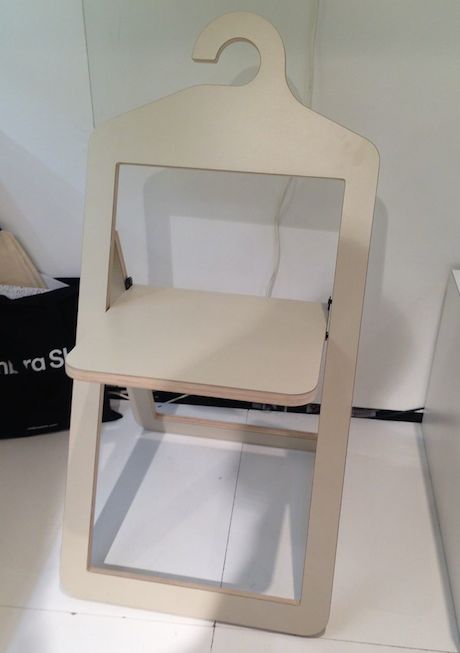
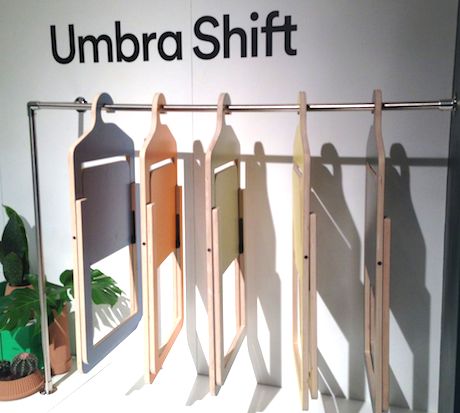
Umbra Shift is the skunkworks of houseware and furniture giant Umbra. They carry this hanging chair, which will retail for $250. Their representive claimed is could support up to 700 lbs–you could stack five normal sized guests on one, further cutting down on space usage. It’s not super pretty to look at whilst unfolded and not that comfortable to sit in, but it will stash away nicely in your closet.

Folditure

IMG_2891 IMG_2893

You gotta hand it to Folditure, they can make some compact furniture. They just released a new chair called the Maya due to its resemblance to Mayan iconography. When compacted, it’s only 1.25″ wide and can be hung in a closet. I sat in it and found it quite comfortable. The styling, shall we say (and as we’ve said) will appeal to a very particular buyer.

Artek
IMG_2882

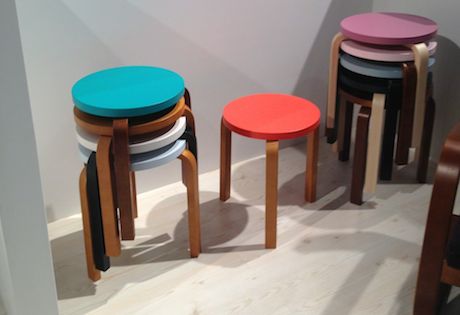
These stools by Artek have been around for a while. No matter, they’re still super hot. They work as stools or as tables or…well just those two things, but still, those are useful thing. They stack nicely and their colors would make great accents without being overly flashy. They cost around $300. Each. I’d buy em if I could.


Forgive me if all of this seems a bit cynical. The truth is, there was a wealth of beautiful furniture at the show (most of which was probably too nice for this English-majored author’s eyes to appreciate), and I’m sure I missed many great space-saving items whilst making my laps of the aisles. Yet I couldn’t shake the feeling that there weren’t many risks being taken–that most of the furniture, though beautiful and demonstrating amazing craftsmanship, was pretty old guard fare.

Furniture has a huge impact on how a home functions. It can crowd out or open up a space. It can eliminate rooms that are seldom needed. It can make spaces function in two or three or four ways, allowing people to live in smaller homes than they might have thought, saving hundreds of thousands of dollars. We hope that in the future, there will be more furniture makers who comprehend these opportunities and direct their talents towards not only making rooms beautiful, but making them work.

Flat-Pack Furniture Fuses Form and Function

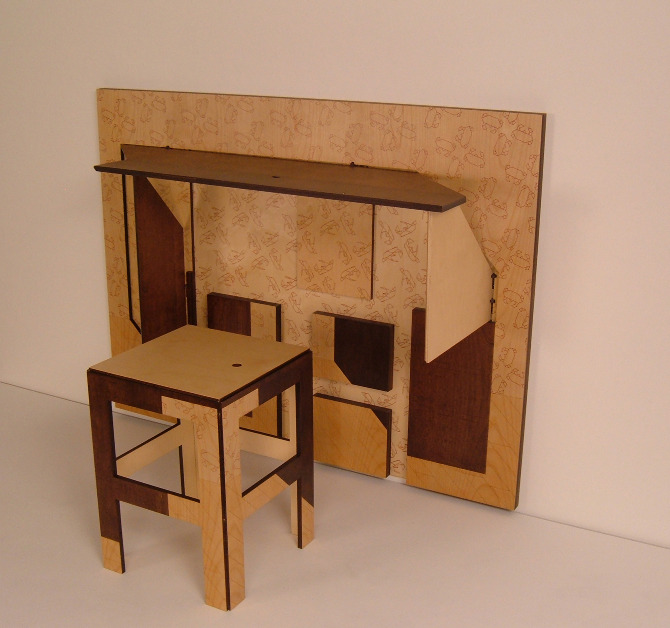
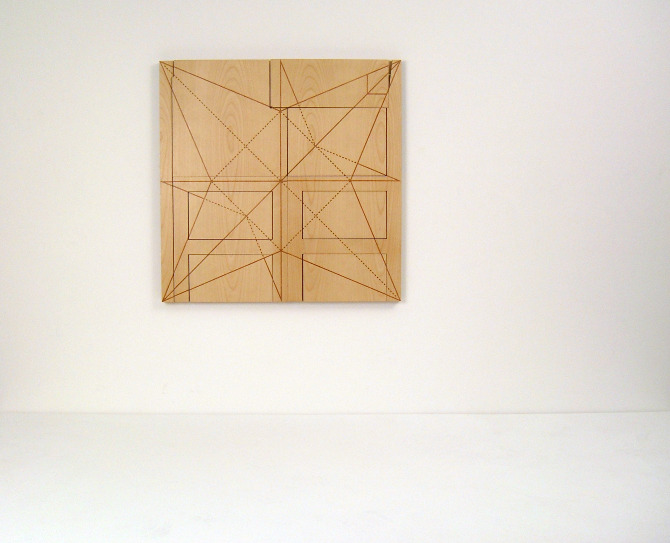
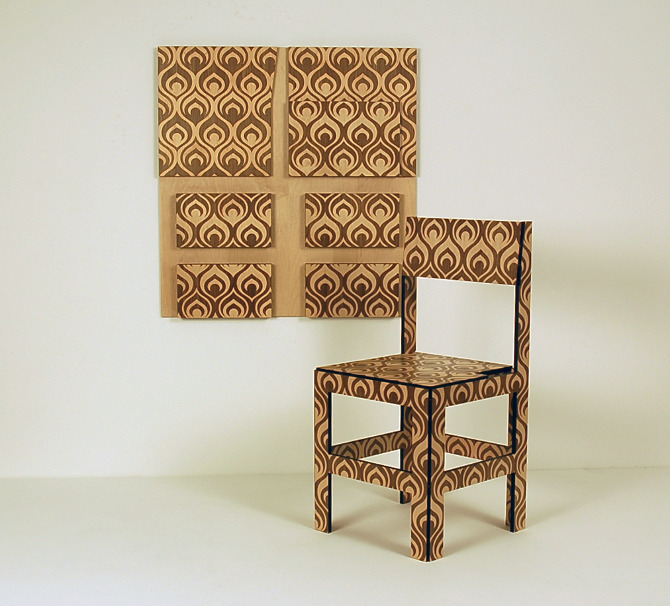
Artist and fabricator Christy Oates is a master at blurring the lines between decoration and furniture. Her origami-inspired pieces have the detail and beauty of traditional wood-working, while her manufacturing processes–which include computer-aided design (CAD) and laser-cut, CNC machines–are decidedly new school. Check above video to see how they are made.

She makes tables, desks, chairs and even lamps that hang flush with the wall. She designed them for small spaces, knowing that even pieces of art can do double duty. See more of her work and get more info at her website: www.christyoates.com