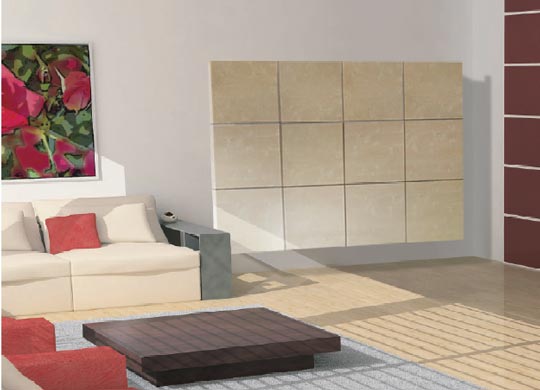
Parisian Apartment Presents Micro Luxury Living

We’ve looked at some pretty small apartments in the past, and while it can be inspiring to see folks occupying such a small footprint, it’s not always an aesthetic treat. Wired Magazine recently looked at a Parisian apartment that is both compact and comely.

Thibaut Ménard’s 130 sq ft Montparnasse apartment is micro-luxury at its best. Architects Marc Baillargeon and  Julie Nabucet built the space–once a master bedroom in a Haussmann multi-story building–with the detail normally reserved for larger, luxury units. They also included a number of innovative small-space solutions like a staircase storage unit that rolls away to create more space; a sliding bed that, when pulled out halfway, serves as a couch; and a split-level layout that stores the bed and gives the space more dimension.

Oftentimes, tiny spaces are associated with worst-case-scenarios; the story goes that someone was so down on his/her luck that he/she had to move into a 130 sq ft apartment. Ménard’s apartment and many others are presenting small living as an active choice, where spaces are optimally designed, not cobbled together with whatever is lying around.

If you know of other tiny homes with big design, let us know.

Images and story via Wired

The Past-Future of Space Saving Design

Joe Cesare Columbo was a prolific Italian Designer from the 50’s, 60’s and 70’s whose furniture designs were compact, modular and able to adapt to any space (versus a space adapting to them). It reminds us of the Metabolism design school, which created modular and adaptable architecture around the same time.

The “Tube Chair” (pictured above) uses the simple cylindrical form to make a highly adaptable and compactable lounge chair; each tube is attached with a U-shaped clip. Pictured below is Columbo’s Mini-Kitchen and Cabriolet Bed, both of which transform otherwise stationary and space-hogging parts of a home and turns them into light and mobile objects.

The Mini-Kitchen has recently been re-released by Italian firm Boffi Spa, making us wonder if Columbo’s prescient designs, which seem increasingly relevant to our mobile culture, will make a big return?

images from Design Boom

Build Your Own Murphy Bed for $275

One of the bigger challenges to starting your edited life is reasonably priced transforming furniture. While we believe the high quality and versatile Resource Furniture used in the first LifeEdited apartment is worth every penny, many of their large pieces are several thousand dollars, putting it outside the price range for many people.

Perhaps no piece of furniture is more important to an edited home than a transforming bed. Beds are huge space hogs, whose utility is only relevant when we’re unconscious. A queen sized bed is about 35 sq feet; why wouldn’t you want to use that space for your 16 waking hours?

A “product” called the Moddi Murphy Bed is the least expensive entry point we’ve found for getting your bed out of the way. The site sells plans for $8, which instruct you how to take easy to find IKEA furniture and other hardware to make a twin or full sized murphy bed for $275 (most pre-builts start around $1500). The finished product–which can be modified depending on which IKEA finishes you purchase–looks pretty great too.

One of the aims of LifeEdited is providing the resources to make simpler, happier lives, no matter your budget. If you know of any other low-cost transforming furniture or hacks, please let us know.

via IKEAhackers

image from Apartment Therapy

Furniture that Moves and Adapts with Your Life

According to the US Census, the average American moves almost 12 times in his or her lifetime; 1 in 6 will move each year. For the dweller on the move, large pieces of furniture that can’t adapt to different spaces often don’t make sense. Ideal furniture design should adapt and scale depending on the living situation.

One firm that is doing this is Ecosystems, whose “Snug-it” system creates highly adaptable furniture design (pictured above). The machined aluminum Snug-it pieces act as instant, tool-free joinery; should you want to scale up or down the size of your furniture, you can easily do so by replacing the piece in the middle. You can also transform a desk into a bench or any other piece of furniture should you choose. They offer an array of pre-designed and custom furniture.

Another idea comes from a new venture called TETRAN. They are launching a line of 100% recycled, modular furniture building blocks. The hollowed out boxes create tons of storage space and infinite changeability. Skins are replaceable to adjust the look; options range from glass to leather.

Tetran hasn’t started production, but will be taking pre-orders through Kickstarter beginning in June. Check out their amazing promotional video below to see its many possible incarnations.

[vimeo http://vimeo.com/39655208]

For people who do not move often, high-quality, stationary furniture makes sense. But for a growing part of the population, moving has become a frequent ritual. Companies like Ecosystems and TETRAN are responding to this reality, providing high quality, durable designs that move and grow with you.

images via Ecosytems and TETRAN

TETRAN story via Treehugger

Past and Present of Transforming Furniture

Our good friends over at Resource Furniture put together this short video showing transforming furniture’s past and present. The vintage footage illustrates this type of furniture is hardly a new idea. People have been designing furniture to maximize the use of space for ages.

In fact, what’s new is NOT maximizing space. Consider that the average new American home in 1950 was 983 sq ft., and the average household had 3.37 people. According the US Census Bureau, those numbers in 2010 were 2,169 sq ft and 2.59 people. That works out to 293 and 837 sq ft/person respectively–almost 3 times as much space per person! Much of this extra square footage, we suspect, is consumed by seldom-used spaces like dining rooms, guest rooms and foyers. What if, by using transforming furniture, we make our rooms do double or triple duty? Combine dining rooms with guest rooms. Make living rooms into bedrooms. Just get rid of the foyer (the parsley sprig of architecture). How much space would we need then?

What if we started living and maximizing smaller living spaces again? They’re cheaper, greener and–for all but a few worst-case-scenarios–provide all the space we need. What ways would you do it–furniture, housewares, etc.? What ways are you doing it? Let us know what you think.

Prefab Home is Like Living in IKEA Showroom

Let’s face it, it’s hard to get away from IKEA. The big blue store is by far the world’s largest furniture retailer and there are few homes that escape its cleanly-design, wallet-friendly wares.

Since the contents of our homes are so defined by IKEA, Oregon-based company Ideabox asks why not the house itself? To answer that question, they have created the Aktiv, a compact, prefabricated home designed around IKEA product systems and ethos of clean, affordable design. $86,500 buys the house, delivery, installation and IKEA spec’d bathroom, kitchen and flooring. I suspect most buyers would finish the place with IKEA fürniture.

This idea is not new. IKEA has been making their BoKlock housing in Europe since 1996. According to its site, BoKlock provides “space-saving, functional and high quality housing at a price that enables as many people as possible to afford a stylish and comfortable home.”

Sounds good to us.

A home made completely around a corporation–particularly a giant like IKEA–might strike some as being impersonal. But consider that many of us end up with homes designed by IKEA by default, because the stuff looks nice and is affordable. Also consider that our homes are often assemblages of handed down furniture or whatever we can afford at the time, neither of which necessarily reflect personal style and taste.

Then there are the many advantages of prefabricated home design and construction, whose processes have a huge edge over one-offs. For instance, the BoKlock is made completely in a large warehouse, making its construction schedule independent from weather.

From a practical standpoint, don’t most of us just want a home that is affordable, comfortable and easy to deal with? Homes like the Aktiv and BoKlock deliver that, sans some personality.

What do you think? Would you live in what amounts to as your own IKEA showroom? What would be the advantages/disadvantages? We’d love to hear what you think?

via Dornob and Ideabox

How Much Space Do We Really Need?

When my parents were kids, their parents slept in the dining room. These were not poor people. They just figured the dining room was so seldom used, why not put it to use?

Fast forward 60 years and for many Americans it’s unimaginable for parents to be without their own room (or in many cases, a child). Suburban sprawl and cheap construction has changed our view of what constitutes an acceptable amount of square footage. The above figure shows the average new home size in the US near its peak in 2006, as well as sizes for several other modernized countries. Keep in mind that these other countries aren’t slumming it; many (if not most) of them are believed to have higher standard of living standards than the US. It’s clear that the space we need is as much cultural as functional.

What if we started fresh and looked at what we actually need from our homes? We would probably end up with much smaller homes, which have the advantage of being less expensive, consuming less energy and being easier to upkeep. Also, by incorporating smart architectural and product design, we can pack amazing utility in small footprints. See this gorgeous 620 sq ft apartment that houses a family of 4 for a perfect example of this new/old way of living (via Dwell).