5 Ways to Get Email Monkey Off Back and Put Him in a Cage

A recent article in Business Insider tells the tale of brothers John and Bert Jacobs, founders of the $100M “Life Is Good” t-shirt company. The brothers felt like they were being completely devoured by email. They write in their book “Life is Good,” “The time we spent daily just shoveling out our email inboxes was daunting. And we were going to bed at night feeling guilty and inadequate because we couldn’t get ahead. The more emails we sent out, the more flowed back in.” In a radical move, the two men ditched email…sorta. They actually delegated all of their email correspondences to other people in their organization. This act allowed them to step up their creative game and focus on high level business decisions rather than getting bogged down in putting out many small fires.

So I know what you’re thinking, because it’s what I’m thinking too: “Awesome! Two CEOs give their underlings all of their annoying, distracting emails. Good for them! I bet life is good. But I do not have any underlings. I am the underling and I can’t deal with my own email. Thanks for sharing.”

While most of us are likely not CEOs, the Jacobs’ experience can still be instructive. And though we might not be able to outsource our email responsibilities, we can, in all probability, find ways to liberate ourselves from asphyxiation by email (and for many of us, texts as well). Here are a five strategies that don’t include auto-responders: 

  1. Stop checking your email the first thing in the morning! For most of us, the morning is the best time to map out our day (if we don’t do it the day before). By checking email first thing in the morning, we start our days in reactive mode, playing whack-a-mole with our myriad responsibilities. By delaying our initial email check, we have space to create our day and decide how we want it to go. Don’t worry, all the fires in our inboxes will still be smouldering when we’re done planning. But chances are, the house will not burn down if we give ourselves 15-30 minutes to figure out what we want to do with the day first.
  2. Things can wait. I learned this concept from Tim Ferriss, who says there are few real emergencies, so we should create certain times to deal with email (aka “batching” email). Think about it. Most of us check our email all the time because we believe something important might be in one of the emails. But is this true? While many emails present things that need to be handled, often those things can be handled in their right time, which, in all probability, is not when the email comes in. Let’s say we’re writing something–a blog post, for example–and our boss asks us to send him a file. Unless that boss is boarding a plane in five minutes, he can, in all probability, wait. No one is going to die. Deals won’t fall through. It is probably a better idea to finish what we’re doing then send the file when ready. Studies actually show that multitasking makes us less productive and stupider. That’s right, when we bounce from thing to thing–writing a proposal to emailing to paying bills and so forth–we bring fewer IQ points to each one of those tasks than we would if we did each one from beginning to end.
  3. Slow the hell down. Have you ever emailed with someone who always responds to emails immediately? Or, worse yet, are you that person? Then one day, that person delays. One minute, two minutes, two hours…nothing. What the hell? Did I do something wrong? Here’s the deal: nothing’s wrong. She probably getting something to eat or do one of the million other things people do in the course of their day. The real problem is setting up an expectation of instantaneous responses. Along the lines of points #1 and #2, sometimes it’s not the right time to respond. It’s okay to respond when it works unless it’s an emergency…and it’s almost never an emergency.
  4. Turn off push notifications on your phone. This is one I don’t practice, but boy does it make sense. Those insidious banners, rings and buzzes on our phone are begging to take us out of the moment and task at hand. Screw em. They can wait. What we’re doing–even if we’re doing nothing–is probably more important.
  5. Create safe spaces from email and texts. At the dinner table, during weekends, in bed–create places and times when you cannot be reached any way other than phone. It’s vital we ensure our days include times when we cannot be reached. I don’t know about you, but anyone who would relay important information has my phone number. So if someone important really needs to relay important information, he or she will call.

If you have other strategies, please share in comments section (i.e. don’t email me ;-).

Can Tech Combat Tech Addiction?

There is a new software system called Phylter developed by a group of scientists at Tufts University. Phylter is meant as an accompaniment to wearable tech, which poses the risk of non-stop notifications of texts, emails, twitter updates and the like. The software uses functional near-infrared spectroscopy to monitor brain activity, which detects whether you’re deep in thought. The system restricts notifications accordingly–if you’re deep in thought, it’ll cut off notifications; if you’re not deep in thought, it’ll send away. As said in New Scientist, you could use the excuse, “SORRY I missed your call. My brain said I was busy.”

It’s a nifty and logical idea, one that is meant to fight the scourge of multitasking. PSFK reported that a study found multitaskers “reported twice the anxiety, committed twice the number of errors, and required up to 25% longer time on a primary task when interruptions arrived during rather than in-between tasks.” As has been said, “Multitasking is the act of screwing up multiple things at once.”

But will Phylter work toward stopping our technology-aided multitasking tailspins? Speaking more broadly, can any technology effectively limit our use of technology?

My experience is no. I have tried to block out sites or web access using the Self Control and Freedom apps. I have tried RescueTime, which monitors web activity, thereby cultivating awareness of my multitasking ways. All of these systems yield the same initial enthusiasm and burst of focus, followed by a cessation of use and/or ignorance of results.

To me, using these apps feel like going on a diet where I’m always resisting the urge to do things that compromise my health and happiness. But if there’s a bag of chips in the house during my diet, I tend to eat them. Likewise, if I want to be distracted and there’s the means to do it, I am going to.

In general, the best way for me to avoid technology is by not having it–either leaving it at home (which, frankly, usually happens by accident), being fully engaged at some event or being out of cell/wifi range. The other method–the one that works most consistently and is most feasible given my professional tech dependence–is not starting down the multitasking path at the beginning of the day. Just as it’s easier for me to eat no chips than it is to eat one, it’s easier for me to never indulge multitasking than it is to reign it in.

But that’s just me. What do you think? Can certain technologies effectively combat the multitasking that other technologies often incite? Have they for you? Let us know in our comments section.

The Land without Cell Service

To most, the idea of being without mobile tech is unthinkable. How will people reach me? What if I’m running late and need to text someone to hold on? How will people know what I ate for lunch if I can’t Instagram it? While the global geography of places without cell service and wifi access continues to shrink, there is one American city where cell and wifi signals are nonexistent. Green Bank WV is a tiny town (pop 143) located in the Blue Ridge Mountains, about one and half hours drive from nowhere. It is the home of the Green Bank Telescope, the world’s largest radio telescope which listens to sounds in outer space and collects data from the solar system. Because of its need for a very hushed environment, the telescope is surrounded by a National Radio Free Zone, a 13K sq mile electromagnetic signal free zone. In the zone, there is a ban on cell service, wifi, radio and even microwave ovens.

Journalist and self-professed “modern day technology junkie” Dan Lieberman spent one week in Green Bank and shared his experience on Fusion.net. Predictably, he had a hard time being without access to instant communication and information. Over the course of his trip, he made list of survival tips for living in world without mobile tech, things such as getting information from real people, not being late for appointments and using a real map.

While initially things were rough going, he had this to say about the end of the trip:

I had finally broken my habit of reaching for my cell phone every chance I got. It took the entire week to realize that being freed from my tech addiction was a good thing. I was listening to people we interviewed, really listening, instead of having one eye on my phone for texts and emails. I was present.

It should be noted that Green Bank, and other places in the Radio Free Zone, are not offline by any stretch. Ethernet and coaxial cables go a long way to keeping people opening new tabs and channel surfing. However, I suspect the instances of people walking and texting down the street are few and far between.


The ability to reach anyone and find out about anything at any time via mobile tech and wifi-enabled devices is indubitably an amazing thing. And every now and again we have an important communication to make or piece of information to obtain. But more often than not the communication and information is not that important. It’s certainly not important enough to justify the approximately 150 times a day the average cellphone user checks his or her phone. It’s stuff that can wait. And it’s stuff that is unlikely to be more important than what’s in front of us, whether that’s a friend, a streetscape or a book. In his 2009 TED talk, Renny Gleeson summed it up well. He said, “When you’re standing with someone, and you’re on your mobile device, effectively what you’re saying to them is, ‘You are not as important as, literally, almost anything that could come to me through this device.’”

Read Dan’s full account here. And today, try putting down your device every now and again. Whoever it is you want to communicate with, whatever it is that you want to know, chances are it can wait.

Reclaim the Your Life From Tech with this Pepper Grinder

It’s becoming harder to ignore the fact that pervasive technology use is having a corrosive effect on our ability to connect with other humans. Current research bears this out. One study found that the presence of a cell phone, even when not used, affected a subject’s ability to connect on a deep level and find empathy for others. Another study by the University of Maryland found that people who used a cellphone, even for a short period, were less likely to engage in behavior intended to benefit another person or society as a whole. And lest it seem like the problem is one rooted in youth culture, a Boston Medical Center study looked at parents and other caregivers cell phone use; they found that 40 out of the 55 parents and other caregivers observed used their phones during meals, resulting in children that were more likely to act out–and the extremity of the child’s acting out was in direct proportion to the level of the caregiver’s absorption with the phone.

The hijacking of mealtime by tech is something pasta sauce maker Dolmio wants to combat with their Pepper Hacker. It’s a full functioning pepper grinder with a tech-disrupting secret. When the grinder is twisted, it shuts down all wifi, cell phone and cable signals, forcing people off their computers, tablets, phones and TVs, leaving them naked with their un-augmented selves.

Dolmio made a pretty hilarious video of the grinder in action. It shows hidden camera footage taken from houses where the grinder is used. The families had predictable fallouts: tantrums and tablets were thrown, cable connections were checked and rechecked. But, alas, the world did not end. And once the initial withdrawal passed, the video showed families laughing and enjoying each other’s company.

dolmio-system-design

It’s not clear whether the Pepper Hacker is real or just a bit of brand-enhancing vaporware. The idea was the brainchild of advertising giant BBDO, however in an article in the Australian marketing journal mUmBRELLA, a BBDO representative said that prototypes were made and that the tech is legit (supposedly, the above diagram proves it). Still, there is zero indication as to whether it will ever be available. Even if it were available, I suspect some tech-savvy tot would trash it in short order. Also, call me pessimistic, but I think it might take weeks, not minutes before families start getting along after tech has been taken out of the picture.

Vaporware or not, the video and the ad campaign effectively highlight the need for the establishment of sacred, tech-free times. Times when our immediate environment and the characters present take precedence over whatever can be seen on a small LCD screen.

Slow TV Taking World by Very Slow Moving Storm

Few words sum up the current pace of modern life like the word “fast.” From processor speed to 0-60 mph automotive times to Amazon Prime package delivery, everything seems to move a lot faster than it did 10 or 20 years ago. Many would argue that it’s too fast. Everything comes at us so fast we are losing the capacity to enjoy anything. One response to this speed is the appropriately named Slow Movement, which “aims to address the issue of ‘time poverty’ through making connections.” The logic follows that it’s easier, for example, to connect with a landscape walking at 4 mph than in an airplane travelling 500 mph. The slow movement includes slow food, travel, money, travel and more. And now you can add another unlikely slowpoke: slow TV.

One example of slow TV comes from Iceland. Their national public broadcaster RUV recently aired a 24 hour marathon of live lambing, celebrating, however slowly, traditional Icelandic farm life.

Iceland was heavily influenced by Norwegian television, which in the last several years has shown programs featuring wood burning and people knitting, both at 12 hour stretches, as well as a 134 hour, narration-free sea cruise from Bergen to Kirkenes. If you have 7:15 hrs to fill, check out the above silent train ride from Bergen Line traveling to Oslo.

In the age where there’s an assumption that faster is better, it’s nice to see there are still bastions of tranquility and purposeful languor.

Don’t Just Do Something, Sit There

For all the wonders the Information Age has afforded us, it has also provided us with infinite possibilities for constant activity and distraction. Whatever gaps of inactivity that might have existed in days before pre-internet (and particularly pre mobile tech)–waiting in line, riding the train, even taking a poop–are, for many of us, now filled with web-surfing, Facebook/Twitter checking, game playing, etc. We will do anything but do nothing and be alone with ourselves. This condition of constant activity–as well as a possible remedy–is the theme of this TED talk by Nick Seaver.

Seaver explains how we’ve become a culture obsessed with distraction and doing, doing, doing–a culture so focused on changing the outside world that we’ve lost track on how to change ourselves. In the interest of the latter pursuit, Seaver and his wife spent 18 months of near-total silent retreat as part of the Samatha Project. As guinea pigs for studying the long term effects of meditation, they would spend 10-12 hours daily in silent meditation, letting, as Seaver said, the snow in the snow-globe in their minds settle down. The physiological effects of the silence were then monitored by scientists in order to get real data about how meditation affects the body and mind.

Seaver has many positive things to say about his experience in particular and meditation in general. I’d recommend watching the talk. But some of it can be summed up by a quote he gives by psychologist Victor Frankl, who said, “Between stimulus and response there is a space. In that space is our power to choose our response. In our response lies our growth and our freedom.” If we are to believe Frankl’s contention and yet continue to fill all of those spaces with flurries of distraction, forever reacting automatically rather than responding intentionally, our growth will be stunted, our freedom limited. On the other hand, if we give time to and permit those spaces, if we start to cultivate the art of doing nothing, we might be less likely of being enslaved by whatever random stimulus enters our mental newsfeed, we might start choosing how we want to live our lives. Seaver recommends ten minutes a day of silent meditation (1% of our waking hours) to regain those spaces, to start changing the world by changing ourselves.

Paying for the Privilege of Being Offline

It’s no big news that we as a species are becoming ever more glued to LCD screens of all sizes–from that big monitor to our little ‘wearables.’ The occasions we find ourselves offline are becoming fewer and farther between. And while this connection has some benefits, it also has some serious hazards: we are losing our ability to connect with others, our ability to focus on one thing, it’s making us horrible drivers and so forth. For these reasons and more, people are now searching for opportunities to be forced offline in the name of defragmenting their megabyte-addled minds.

A recent Wall Street Journal article highlighted families who purposefully chose vacation spots where cell phone and/or wifi connectivity was low or non-existent, either by design or geography. According to the article, in 2014 “American children ages 13 to 17 spend nearly four hours a day online…nearly an hour more than in 2012 [and] more than half have their own smartphones,” creating an imperative to get a bit of offline time. These families chose remote vacations spots like the Black Mountain Dude Ranch in McCoy, CO, whose website promises that “kids will spend a week electronics-free.” The article didn’t sugarcoat the families’ experiences. Some of kids had problems at first with putting down their devices, but after the initial digital DT’s, people–both young and old–realized there was more to life than checking their Facebook newsfeed.

camp-grounded-games

People who aren’t interested in lugging the kids should check out Camp Grounded, a summer camp for adults run by Digital Detox, a company that specializes in retreats for, well, detoxing from digital media. Camp Grounded, according to their website, is a place “Where Grownups Go to Unplug, Get Away, and Be Kids Again.” The camp promises 50+ playshops, arts n crafts, yoga, typewriters, capture the flag, color wars, meditation, swimming, talent show, camp dance, campfires, archery, rockwall, kickball, stargazing, hiking, healthy meals, sing-a-longs, face-painting and analog photography. More than what there is is what there is not: no networking, work-talk, ageism, drugs or booze, wearable and, importantly, dubstep or glowsticks (i.e. it’s not a latter day rave). Fittingly, Camp Grounded is located not too far from San Francisco and Silicon Valley in Mendocino, CA. They hold two weekend camps per summer, both starting in late May. Cost is around $600 for the weekend.

Lastly, if you’re looking for something a bit more exotic, throw yourself in the middle of the Caribbean for the digital detox in St Vincent and the Grenadines, where guests are asked to ‘de-tech’ and hand over their mobile phones and gadgets surrendering themselves to their lack of “connectivity.” It might seem like a lot of effort for something that could ostensibly be achieved by shutting down our computers/phones/tablets, but the fact is most of us don’t do that in our normal environments. It takes what it takes.

Creating Inspiration and Relaxation: No Tools Required

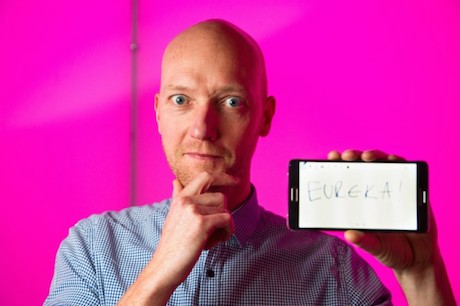
In celebration of its new Galaxy Note 4, the Samsung corporation has set up something called the Eureka! Room. The room, located in London’s Proud Archivist gallery/restaurant/event space and developed by O2 and London Science Museum’s Inventor in Residence Mark Champkins, channels all of the latest research into the ideal conditions for creative inspiration.

Inspiration has been shown to thrive when people are relaxed. Accordingly, the room’s wall are colored “Drunk Tank Pink,” a relaxing hue. There are two soundtracks available to visitors: either a non-repeating birdsong or straight up silence. There is soft lighting and the temperature is set to 71 degrees, the optimum “working” temperature based on analysis by The Lawrence Berkeley National Laboratory.

Attendees are also given “Thinking Gum,” since chewing gum has been found to increase alertness and reaction time by the National Institute of Radiological Sciences (NIRS). People are also given hot chocolate, which the American Association for the Advancement of Science found increases blood flow and oxygen to the brain. Finally, there’s a bath available, to get you totally inebriated on inspiration. In this state, you are encouraged to doodle on the Galaxy Note 4 “phablet.”

eureka-phablet

There’s a tinge of irony in an event designed to incite relaxation and inspiration being sponsored by a behemoth technology company. A few days ago, the NY Times published an op-ed entitled “The Joy of Quiet.” In it, novelist Pico Iyer describes how some of the most world’s most creative minds–people like Phillippe Starck and Stefan Sagmeister–see stillness–the kind that mobile tech and other devices featuring glowing screens have a propensity for shattering–as the chief activator of inspiration. Iyer writes how people are paying hefty premiums and taking many measures for the opportunity (imposition?) to be offline. He writes:

In barely one generation we’ve moved from exulting in the time-saving devices that have so expanded our lives to trying to get away from them—often in order to make more time. The more ways we have to connect, the more many of us seem desperate to unplug. Like teenagers, we appear to have gone from knowing nothing about the world to knowing too much all but overnight.

He continues:

The central paradox of the machines that have made our lives so much brighter, quicker, longer and healthier is that they cannot teach us how to make the best use of them; the information revolution came without an instruction manual. All the data in the world cannot teach us how to sift through data; images don’t show us how to process images. The only way to do justice to our onscreen lives is by summoning exactly the emotional and moral clarity that can’t be found on any screen.

He talks about his own (extreme) measures by which he stokes his creative process. He doesn’t use a cell phone (claims to have never used one), he doesn’t go online until he’s done writing for the day, he doesn’t use Facebook and, oh yeah, he moved from Manhattan to rural Japan. He also take regular retreats to a Benedictine hermitage, where he says he “just take walks and read and lose myself in the stillness, recalling that it’s only by stepping briefly away from my wife and bosses and friends that I’ll have anything useful to bring to them.” Sounds about right.

While we don’t want to poop on the Eureka! Room’s premise, nor make any declarations about the mutual exclusivity of technology and relaxation, we will give a plug for complete disconnection–that the formula for creating stillness and inspiration is not a complex one, but rather the simplest one: doing one thing–whether it’s walking, eating, writing, painting, reading, etc–and only that one thing.

via PSFK

Do One Thing, Write, with Hemingwrite

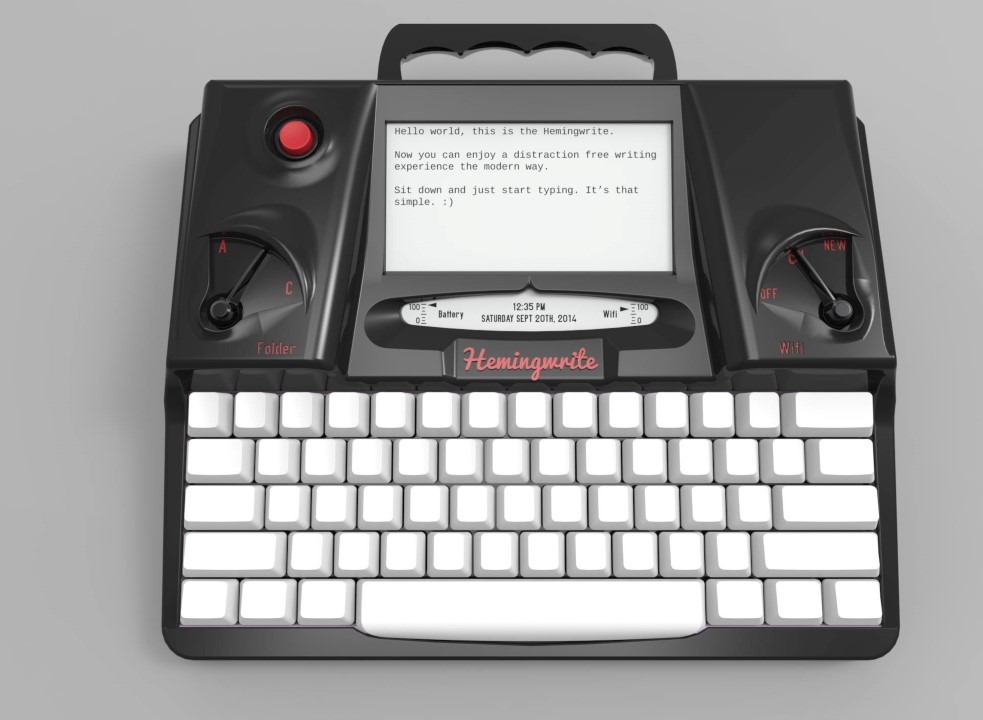
We wonder if Moby Dick, The Great Gatsby and many other canonical books would have been written in today’s technological distraction-fest? Would Melville spent his days clicking on threads linking off the various Wikipedia whale entries? Would Fitzgerald have spent his days posting things on Zelda’s Facebook wall? Many of us long for the days of monotasking technology: of notepads for writing, landlines for calling and not-so-smart TVs for watching. Hemingwrite was born in this spirit of simpler technology. It’s a word processor with a 6″ LCD screen and mechanical-feeling keyboard. It has no web browser, camera or MP3 player. It’s for writing and that’s it.

Despite its old school functionality, it does have wifi, which enables you to back up your words to Google Docs and Evernote. Their website claims you can store up to one million pages on the device itself as well. The battery can last up to six weeks on one charge.

The Hemingwrite is still in prototype mode and the company hasn’t indicated when it will be available or how much it will cost when it is.

While having a tool with such limited capability might seem to contradict the LifeEdited mission of doing more with less, sometimes–actually oftentimes–it’s a good use of space and resources to get things that allow us to do one thing really well. Find out more about Hemingwrite on their website.

Via the Guardian

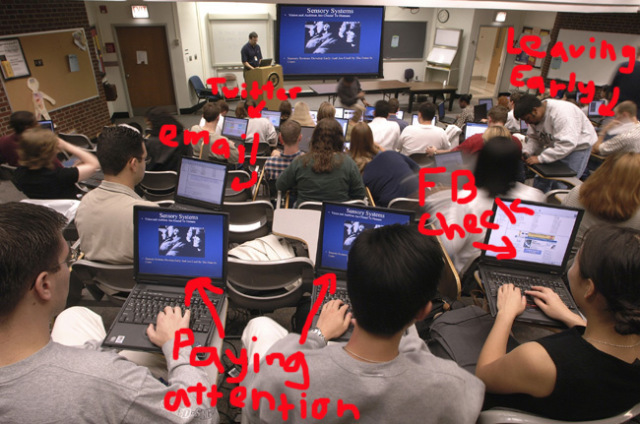
Social Media Professor Bans Social Media in his Class

If you’ve been around the social media, new media sphere for a while, you probably know the name Clay Shirky. Perhaps best known for penning, “Here Comes Everybody: The Power of Organizing Without Organizations,” he is a Fellow at the Berkman Center for Internet and Society at Harvard, and was the Edward R. Murrow Visiting Lecturer at their Joan Shorenstein Center on the Press, Politics, and Public Policy in 2010. He holds a joint appointment at NYU, as an Associate Arts Professor at the Interactive Telecommunications Program (ITP) and as an Associate Professor in the Journalism Department. Shirky is about as authoritative and outspoken as they come regarding the power of new media–which makes his ban of technology in his classrooms all the more interesting.

In a lengthy essay in PBS’s Mediashift, Shirky writes about precisely why he imposed the ban. For one of new media’s greatest proponents, it wasn’t a an easy decision. For many years, Shirky wrote that the inclusion of technology–specifically laptops, tablets and phones–seemed organic, as the devices related directly to the topic at hand. But he said, “The level of distraction in my classes seemed to grow…The change seemed to correlate more with the rising ubiquity and utility of the devices themselves.” In other words, a 2002 Sidekick in the hands of the few was like a musket compared to a Galaxy S5 in everyone’s palm, an AK-47 of distraction-inducing firepower.

Point by point, Shirky highlights the perils of ubiquitous tech, especially in the classroom, and why he decided to ban, not just admonish, their use in his classrooms. He points the myth of multitasking–how it negatively impacts our productivity, our ability to retain information and ability to choose what to focus on.

He writes about the uncontrollable gravitation toward certain emotionally triggering content. As an example, he writes: “‘Your former lover tagged a photo you are in’ vs. ‘The Crimean War was the first conflict significantly affected by use of the telegraph.’ Spot the difference?” One has an immediate emotional payout, the other is more slow-release. The coupling of this content with images makes it doubly distracting. He writes:

Our visual and emotional systems are faster and more powerful than our intellect; we are given to automatic responses when either system receives stimulus, much less both. Asking a student to stay focused while she has alerts on is like asking a chess player to concentrate while rapping their knuckles with a ruler at unpredictable intervals.

In one section, he uses the metaphor of the elephant and the rider, where the emotions represent the elephant and our intellect the rider. Traditionally, the classroom’s focused environment allowed the deliberate rider–i.e. the intellect–to lead. But more and more, the emotional elephant, spurred by a thousand emotionally-gratifying prods from technology, is leading the way and isn’t quite sure where he’s going.

And lastly, he talks about the contagious effects of technology–how studies have shown that not only do people who overuse technology in class perform poorer, but so too do the people who sit near the over-user. It’s second-hand distraction.

The essay is highly informative for people in and outside the classroom. Technology is a many splendored thing, but it also has the capacity to wreak a great deal of havoc on our ability to focus and get stuff done and even enjoy life. We might all take a cue from Shirky and consider not just the potential of technology, but its actual effects on our daily lives. Sure, our phones and other devices can theoretically connect us to vast troves of useful and empowering information, but if we use them in practice to read about the top ten plastic surgery disasters, a lot of the theory’s potential is nullified.  More than anything, Shirky’s mandate has one very obvious implication: that we should put away our tech and tech with greater frequency and pay attention to the subject at hand.

Image credit: the active class