Renzo Piano Makes Micro Modern

More often than not, tiny houses like the ones made famous by Tumbleweed Tiny House Company have a decidedly rustic vibe. If you want to live in one of these basic homes and you’re not into the shack-in-the-woods aesthetic, you might be out of luck. All that might be changing soon. Renzo Piano, one of the world’s leading architects, recently introduced a design that is the modern minimalist’s dream home.

The Diogene house, set up on the Vitra campus in Basel, Switzerland, is named after ancient Greek philosopher Diogenes, who, according to Designboom, “lived in a barrel to exalt simplicity through action, the home is a voluntary refuge that relishes a life outside of an existing infrastructure.” The home measures a mere 215 sq ft (20 sqm). In keeping with its namesake, the Diogene home is meant to provide the most essential elements of life–a sofa bed, small kitchen, shower and toilet. The rest of life takes place outside the home in “civic places” as Piano refers to them.

The aluminum-clad prototype home is intended to be completely off grid with solar water heaters, solar panels, rainwater collectors, a composting toilet, natural ventilation and triple glazed windows for great insulation. Ultimately, Piano sees Diogene being mass produced. Though it’s not trailer-based like US tiny houses, it’s compact dimension and off grid setup would lend itself to regulation-free living in much the same way tiny houses do.

We dig the philosophy of many tiny houses, but at times they can seem a bit monotonous in terms of design. Beyond its inovative features, Diogene proves that small can look any way you choose.

All images © designboom

X Marks the House

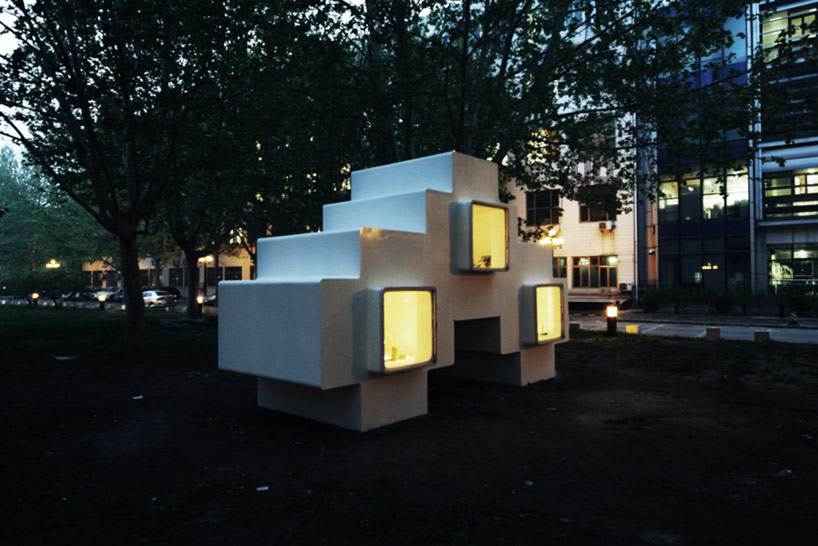
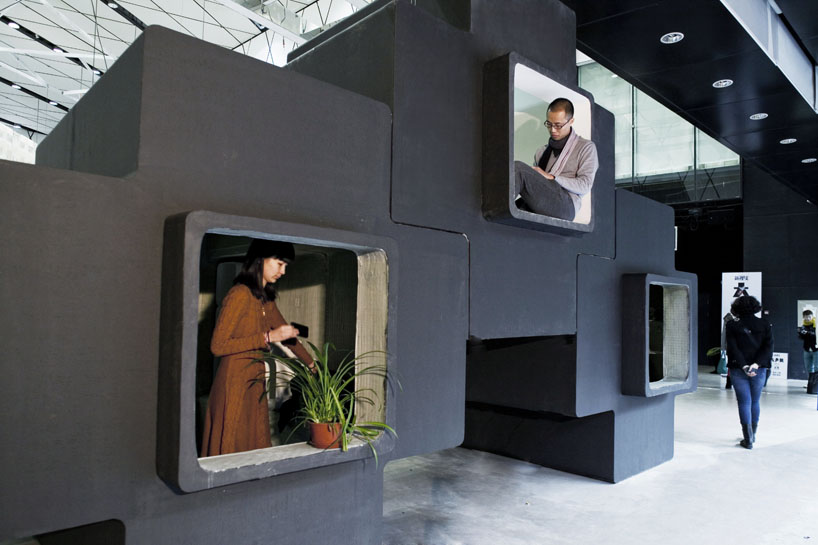
Okay, maybe “t” is the more accurate letter, but any way you look at it, these tiny housing modules show an interesting, prefabricated, highly-scaleable housing solution. We use the term “solution” as their current incarnation might be a tough places to call “home.”

The project, simply dubbed “Micro House,” was designed by Beijing’s Studio Liu Lubin as part of the “Get it Louder” exhibition–the same place where the Tricycle House was featured. Like the latter three-wheeled home, Micro House is one part design study and another part political statement–a reaction to China’s questionable land-grabs and soaring real estate values.

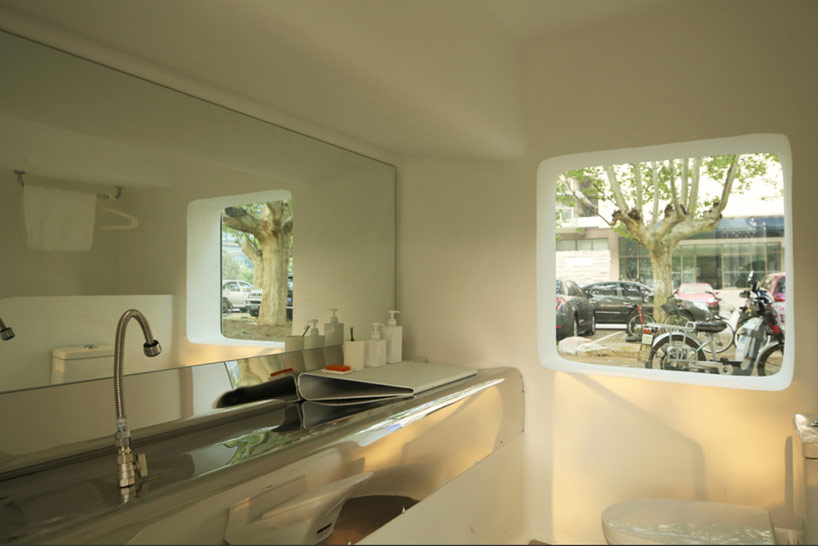
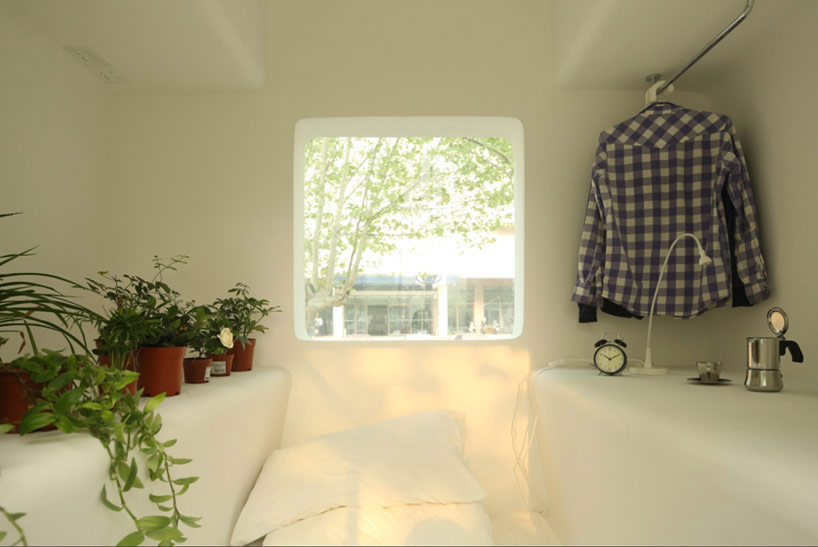
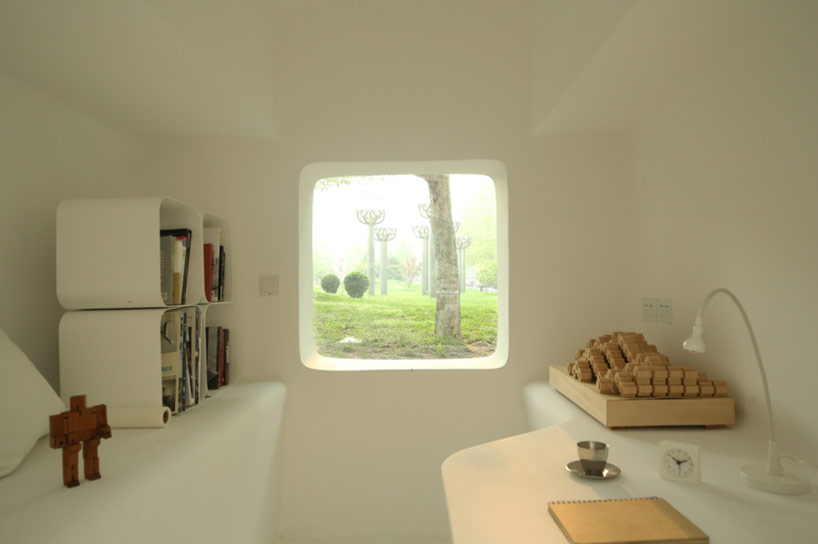
The exhibition model was a three module cluster: one module for living/working, one for sleeping and one for bathing (we’re thinking the cooking module, shown in prototype drawings, might have been nixed as it messed up the symmetry). The module’s t shape enables enough room for an occupant to stand up–though we imagine entertaining might be a bear.

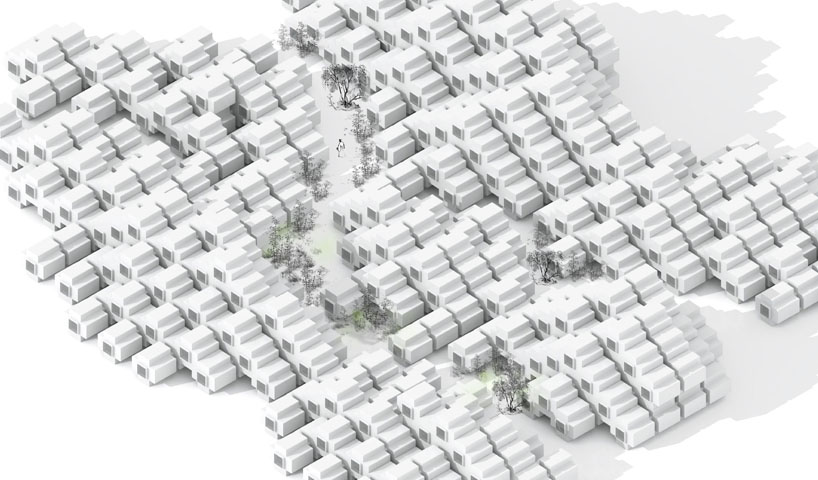
The micro house can be set up individually as it was for the exhibition or, more interesting to us, stacked upon one another to make large housing pyramids. Like any tiny house, the more the merrier, and the interlocking structure seems to lend itself for structurally sound stacking.

There are some (okay, maybe many) drawbacks to Micro House design such as having to go outside to move from one module to another. We’re not sure why they didn’t combine living and sleeping quarters as the latter tends to occupy an inordinate amount of space compared to its usage. The overall module size seems pretty darn small to us, though that might have more to do with the Get It Louder intent, which was to make homes that transport easily. We could imagine a larger version being actually quite livable.

All that said, it’s a concept home and an interesting one at that–one that bucks convention and whose very DNA bespeaks inter-connectedness and efficiency.

Via Rocket News and designboom

All images Courtesy of Studio Liu Lubin

Tricycle House Makes Tiny Houses Look Decadent

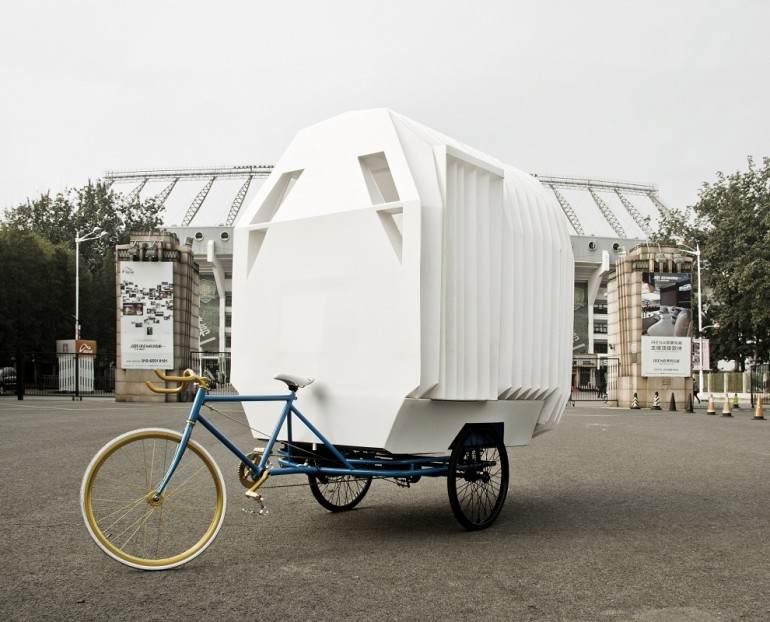
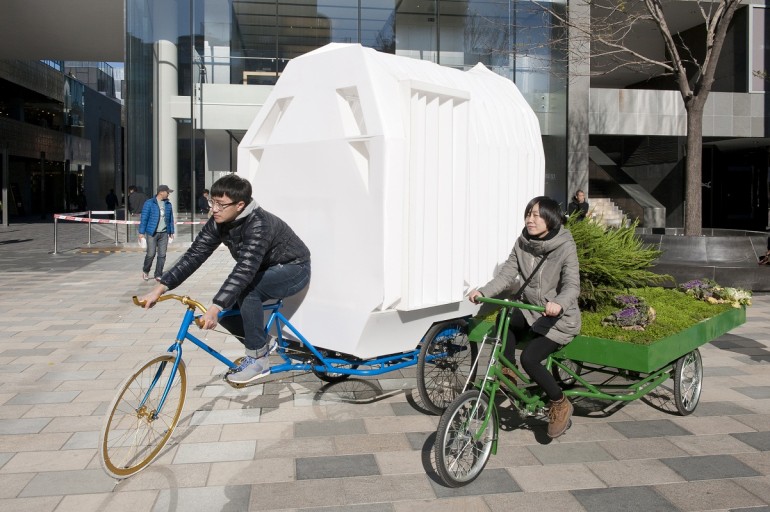
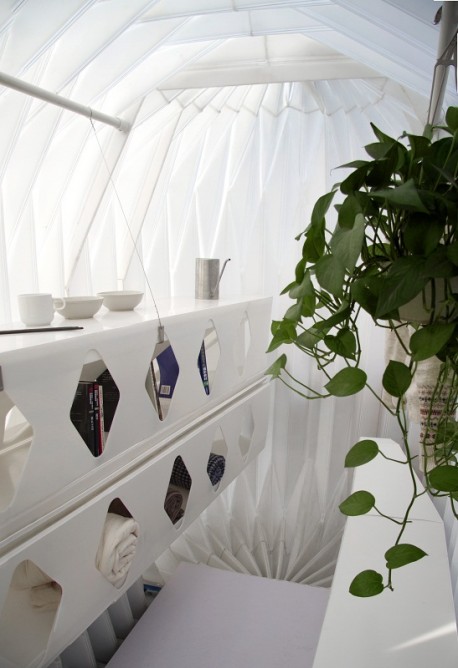
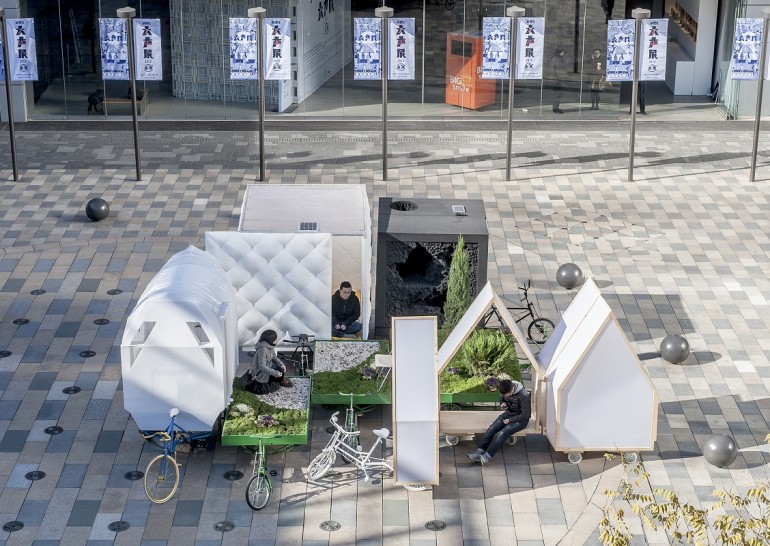
Sure, tiny houses are tiny, but they seem downright palatial compared to the Tricycle House. The project, part of the Get it Louder Exhibition in Beijing, is collaboration between People’s Architecture Office (PAO) and the People’s Industrial Design Office (PIDO). Like Tiny Houses, the house is as much a political statement as it is an architectural one, providing a response to the soaring price of Chinese real estate and government “land grabs” that have displaced many Chinese citizens. The tricycle provides the opportunity for home ownership, albeit on very small scale.

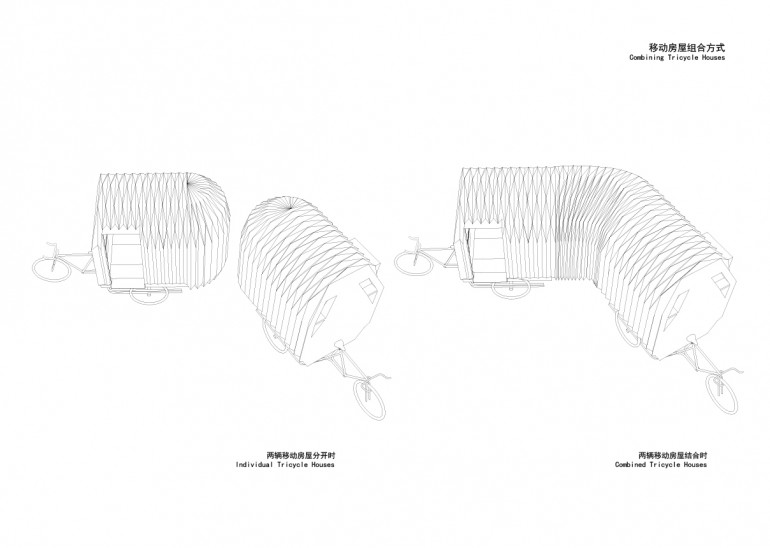
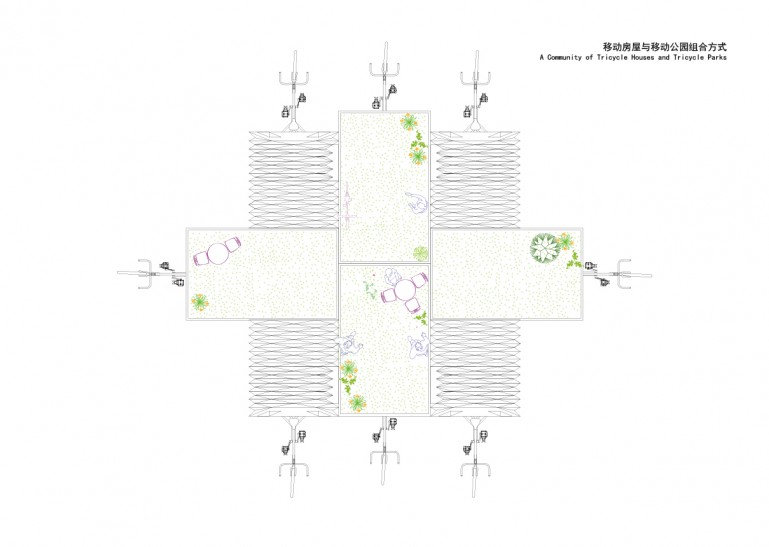
The polypropylene-constructed house is roughly 30-35 square feet and can be used as a dining room, kitchen, bedroom, workspace and bathroom. It boasts some impressive features such as a bathtub and clever folding sink and drawers. Similar to the Napoleon Complex, the house seems best used when coupled with other tricycle houses and tricycle gardens.

We’re not sure if there are any plans to develop the idea beyond concept, but a similar lightweight, off-grid housing structure would make a great edited recreational vehicle.

Via Gizmag and Treehugger

Thanks Susan

One Man Gathers What Another One Spills

Building a home creates an enormous amount of waste. According to the EPA, home construction, remodeling and demolition projects are responsible for 25 to 30 percent of the nation’s annual municipal solid waste. Much of that waste, if one were so inclined, could be used to make other homes. Well there is one who is so inclined–and his name is Brad Kittel.

Kittel runs a company called Tiny Texas Houses, whose tagline is “Building the future with the past.” For the last six years, they’ve been making tiny houses made almost completely out of salvaged and scrap materials. Windows, framing, floorboards, sinks, tubs–everything less nails and electric equipment–has been used somewhere before.

For the moment, Tiny Texas Houses is mostly a Texas phenomenon. They have a 200K sq ft warehouse where they store materials. You can purchase a complete Texas Tiny House starting at $35K (they deliver to Texas and its neighboring states Oklahoma, Louisiana and New Mexico). As a service, they offer “salvage mining” whereby they either remove your old structure for free, or for a fee they will consult you about what’s usable from your old building (available in person and online). Unlike Tumbleweed Tiny Houses, they do not sell plans as available salvaged materials affect the layout of the homes. They run occasional workshops however.

Beyond a mere money and energy saving ploy, Kittel and Tiny Texas Houses are trying to start a movement they call Pure Salvage Living. It is about living off the grid–using a barter economy, avoiding taxes and living a simpler, smaller, more efficient, highly local life.

As he explains in the above video, all the stuff we need is already in existence. We don’t need to extract more natural resources or buy anything new or import anything from China to build our future. We can use existing (or salvaged) resources. Whether we do or not is our choice, he contends.

What do you think about Kittel’s contention? Can we–or is it realistic–to create a future made of salvaged material? Why or why not?

They Don’t Get Any Tinier Than This…But No Solar Panels?

We love tiny houses. The trailer-mounted dinky digs, often less than 100 sq ft, epitomize the spirit of doing more with less. This video shows off one woman’s tiny house that’s a wonder of sustainability and the tiniest we’ve ever seen.

The 2 minute parody was actually made by Dawn Jones for the Portlandia Film Festival in Portland, Oregon (not affiliated with the TV Show FYI). While it pokes fun at the tiny house movement, while “made with great affection for the movement.” The affection shows.

via Treehugger

Will Napoleon Complex Usher in the Era of the Microburb

We love tiny houses, with their tiny, efficient layouts. They truly exemplify the idea of doing more with less. But just because you have a tiny house, doesn’t mean you have a tiny footprint. If you have a 140 sq ft house on a 10 acre lot in the middle of nowhere, your environmental footprint might rival a McMansion’s. Moreover, you might not be enjoying the social and material benefits of neighbors.

Jay Shafer, who recently left Tumbleweed Tiny Houses–the preeminent tiny house company–has an answer for this contradiction. His new company, Four Lights, has developed the Napoleon Complex, which fuses tiny houses with city-rivaling levels of density, efficiency and community potential. In fact, they expect 16-22 homes per acre. To compare, HUD states that median lot size across the US for single-family homes, including mobile homes, is 0.27 acres.

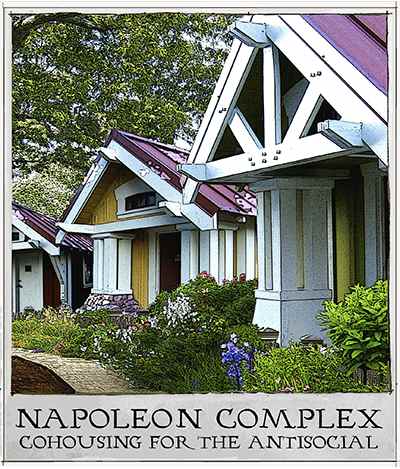
Napoleon-complex-housesThe complex, which will be located in Northern California, is a collection of 40 -70 houses ranging from 270-700 sq ft. Each house will have an individual plot and pay a fee similar to a coop common charge. The homes’ individuation gives them an intentional level of autonomy, explaining the project’s tagline of “Co-housing for the anti-social.” Other amenities include:

  • 800-1600 sq ft common house
  • Private gardens
  • 1.5 parking spaces per house (importantly, separated from the homes).
  • Shared outdoor space
  • Private storage units
  • Prominent pedestrian walkways.

Four Light’s website explains the rationale behind the complex:

In many ways, tiny houses work best in concert with other tiny houses and shared amenities. This is a dream long-shared by many including myself. The place will be zoned as an R.V. park, but will look and feel more like the concept drawings I’m presenting to the left [pictured above]. I’ve used the same design principles that go into each of my tiny house designs to create an environment that feels contained but not confining—vibrant but not at all crowded.

In other words, they’re giving people the best of the suburbs–privacy, quiet, greenery–without the downsides–inefficient homes, sprawl, isolation. Shafer is a master of bypassing building regulation and the complex’s RV designation will likely expedite the expected 2015 completion date. We can’t wait to see it.

Via Treehugger

Images credit: Four Lights

Swedish University Re-Thinks the Dorm

Lund, Sweden is experimenting with replacing its traditional student apartments with self-contained 12 sq meter (129 sq ft) micro-houses. AF Bostäder (AFB), who is behind the project, told The Local that the dwellings would have a distinct economic edge, renting “for 2500 kronor ($370) a month, compared to the average newly built student apartment in Lund which is rented for 4167” ($628).

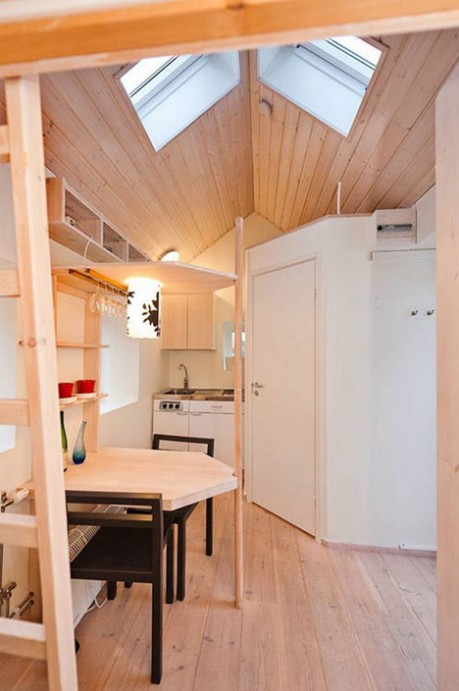
The tiny houses have everything a student could need: A kitchenette, sleeping loft, bathroom and desk; and somehow it has that swank Swedish sheen that masks any motivations to achieve greater thrift.

The project is still an experiment though. In fact, the house doesn’t adhere to strict Swedish building regulation–the same regulation that AFB claims makes traditional student housing so expensive. The house received a three year permit to see how it works out.

AFB is taking applications for a student who is willing to live and blog about living in the apartment, and prove (or disprove) that this is a viable alternative to the status quo.

The house looks great and seems to have all the amenities a student requires. We do wonder about the social aspect of individuated housing. At least in America, the most important location for campus socialization is the dorm; it’s where many relationships are forged and ideas exchanged. We wonder how being separate from other students would affect that? That said, burdensome housing expenses can make people antisocial as well. What do you think?  Would you give up your dorm experience to save a few hundred bucks a month?

Photos by Jan Nordén

Via Dornob

What Happens When Beer and Transforming Apartments Mix

A couple weeks ago, we had Derek “Deek” Diedricksen and Paul Farr from Tumbleweed Tiny House Company stay at the LifeEdited apartment. The pair were in New York City leading a tiny house workshop showing people how to make their own tiny houses. We wanted to know what they thought of the place. They videoed this self-guided tour that gives their thoughts on the apartment (their enthusiasm might have been helped out by a beer or two).

Check out Deek’s blog Relaxshacks.com and Youtube channel for cool pics, videos and news about tiny house construction and living.

Thanks guys!

Europe’s Narrowest House Saves Space, Fights Obesity

Many tiny houses we look at on this site show uncommon ingenuity and creative use of space. Others, like this house for Israeli author Etgar Keret, err on the side of ridiculous. At 5′ at its widest point and 3′ at its narrowest, it is thought to be the narrowest house in Poland and perhaps all of Europe.

To be fair, the home’s design was not purely driven by livability. Keret built the Warsaw home at the site of a former Jewish ghetto as a memorial to his parent’s family died in the Holocaust.

Keret says that he plans to live in it when he’s in Poland however, and the space is fully functioning, with a kitchen, bathroom and bedroom.

image credit: Yasuhiro Yamashita

The home’s sun-drenched interior reminds us of the Kyosho Jutaku homes like the one above, which use optical illusions to create space. Its ridiculously narrow dimensions remind us of NYC’s Spite House.

What are your thoughts on this house? Interesting architectural exercise? Practical living space?

High School Student Builds Own Tiny Home

Few things will make you feel less industrious and patient than watching this video of high schooler Austin Hay and his hand-built tiny house. The Fair Companies video shows two segments: The first when he was a high school junior with his partially complete Tumbleweed Tiny House-designed home; the second segment shows Hay, now a high school senior, giving a tour of the completed home.

Hay matter-of-factly describes how he built the house out of mostly salvaged materials (he shows off the three trash cans of waste generated during the build), how he scrimped and saved to put the place together (he says it cost him $12K), how he did it all without the aid of a shop class, how he built his own day bed, shelving and many other built in features. The place features a composting toilet, on-demand hot water and propane appliances.

One of the more poignent moments is an interview with Hay’s grandfather, who had given Hay a propane stove as a Christmas gift. The grandfather’s tears of pride show that building your own home not only cultivates a deeper connection with your own home, but for all those involved in making it. Kinda makes you want to build stuff.

via Fair Companies