A Guide to Buying a Refrigerator for Small Apartments

For the most part, American appliances, including refrigerators, fall into two categories: Big and nice or small and cheap. In other words, it’s tough to get small and nice if that’s what you’re after. But doing nice and small can be done, even in America. After a few years of research, we thought we’d create a general guide that might help you select the right fridge for your small space.

The Basics

Stating the obvious, what makes small space appliances suitable for small spaces are their size. We’re going to limit our discussion to 18” and 24” wide refrigerators, which are the two most common widths available. 24″ is far more common than 18″. 27” and 30” models, while suitable for some small spaces, are not your most compact option.

There are far more variations in height. Broadly speaking, there are counter height and standard height fridges. The former tend to run around 32-34” so they can fit under a standard 36” countertop. The latter usually range from around 60” to 80”.

Most fridges are counter depth, meaning their overall depth is around 24”, give or take, so they don’t protrude too much beyond the counter,.

Fridges can be Energy Star rated, which means they are 9-10% percent more energy efficient than models that meet the federal minimum energy efficiency standard. Most middle to high end fridges will have this certification, but low ends will not necessarily.

integrated

Perhaps the most important consideration is how the fridge will fit the layout and aesthetic of your kitchen. Most people buy a new fridge because theirs died or they are doing a larger renovation. If you’re in the former category, you might consider finding a model that roughly fits the dimensions of your previous model. If you’re redoing your kitchen, you’ll want to think about how the fridge fits in with your cabinetry (more on sizing in a minute). Especially important is what, if anything, you’re doing above the fridge (keeping it open, more cabinets, etc).

If you have the money, we’d suggest a panel ready fridge, which means it’ll accept custom panels matching the rest of your kitchen’s cabinetry. This is generally only found on premium fridges and the panels aren’t necessarily cheap either. But it creates very streamlined looking kitchen.

Down from panel ready are stainless steel clad appliances, which tend to look and clean up better than painted models, which are how the least expensive fridges are clad. 

Counter Height Fridges

Counter height fridges are great if you want to save space. They take up minimal volume and permit more counter space as the surface isn’t interrupted by a fridge. But they have some notable drawbacks. The first is storage volume. A normal counter height fridge has around 5-6 cubic feet of storage. A fairly standard 60” high model will have two times that. This amount of volume might be fine for a single person who doesn’t cook often or shops every couple days, but for many people this amount of space quickly becomes limiting. 18″ models are available as well, but are mostly suitable for keeping last night’s leftovers cool.
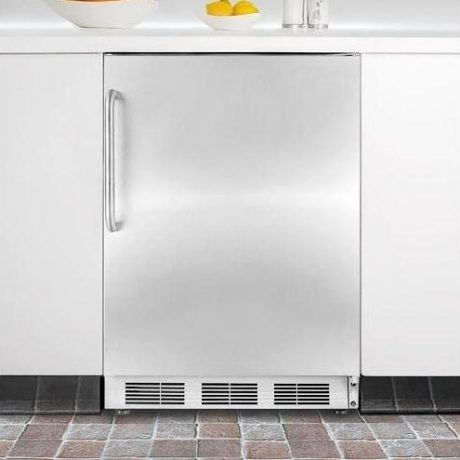
summit-undercounter

The next issue is that most counter height fridges have manual defrost (all fridge models are available if you don’t need a freezer). This means every month or two you must let your freezer compartment thaw out. And up until that point, the compartment get smaller and smaller as layers of ice form around the interior of the compartment. It’s a pain. The Avanti RA3136SST is one counter height fridge with auto-defrost, but because of its size (3 cubic ft), it’s mostly suitable for people with Smurf-like appetites. The U-Line 1000 series will also do the trick…for $2K.

summit-interior

If you’re looking for other non-manual defrost fridge/freezer combo options, you can choose a drawer style fridge. We used the 27” wide Sub Zero 700 BCI in the first LifeEdited Apartment (pictured at top, since discontinued). It looked really nice as it accommodated custom panels. But its limited storage volume and height (you couldn’t stand a bottle of wine upright) limited its functionality. At around $2500, it was also very expensive. In fact, most drawer fridges are more expensive than their standard size equivalents, starting around $1500.

Our overall recommendation is to only go for a counter height if space is really limited and/or you are not a serious cook or you only like dealing with very fresh food. In terms of manufacturers, Summit probably makes the most number of models, though most manufacturers have counter height options.

Standard Height Fridges

If you have a bit more room to play with and you like keeping things on hand that you don’t cycle through very fast (condiments, wine, etc), we recommend going with a standard height fridge. With 10+ cubic feet of storage, they are far more practical for most people. And unlike counter height fridges, almost all have automatic defrost. Finding a model that works for you is mostly a matter of budget and aesthetics.
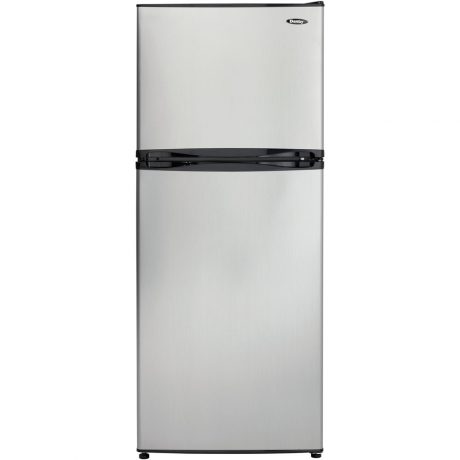
danby

If you’re looking for an affordable 24” compact fridge, there are a number of options. You could pick up the Danby DFF100C1BSLDB for around $500. At 24” x 60”. These and others like it are the kind of fridges most landlords buy. They’re not sexy, but this level of fridge tends to have a reasonable 10 cubic ft of storage and it’ll keep your stuff cold. What more do you need?

Up from there you could get into some nicer stainless steel fridges like the LG LBN10551PS. It’s 24” x 68” and has 10 cubic feet of storage volume. At around $800-900, it’s a little more expensive, but it looks nicer than the Danby-level fridges.

Up from the LG are the more premium European style 24” models. These tend to be between 70-80” high and have more storage. They can be purchased panel-ready, allowing you to seamlessly integrate them into your kitchen.
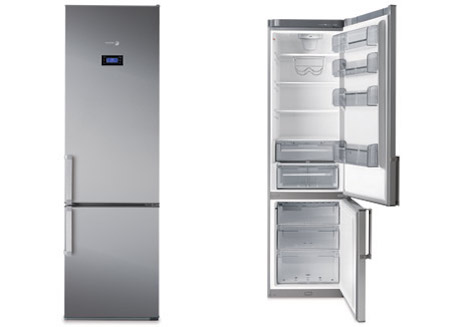
fagor

For one of our projects, we used a Fagor model and it’s worked out great. It measures 24” x 80” and has about 13 cubic feet of storage. Like most other tall skinny fridges, the freezer has pull out drawer which take a little getting used. For example, you can’t toss a big turkey in there and putting ice trays in there is can be trickier than one models with one open volume.

In this tier, there are a variety of nice options, though most will run quite a bit of money. On the bottom end is Blomberg BRFB1042WHN for around $800 (also available as panel ready for $1500) and on the high end is Liebherr BF1061, which is built in to custom cabinetry and will set you back $5700. For our next project, we chose the panel ready Smeg CB300U which retails for about $1900.
Cooking and Dining Kit with the Minimalist in Mind

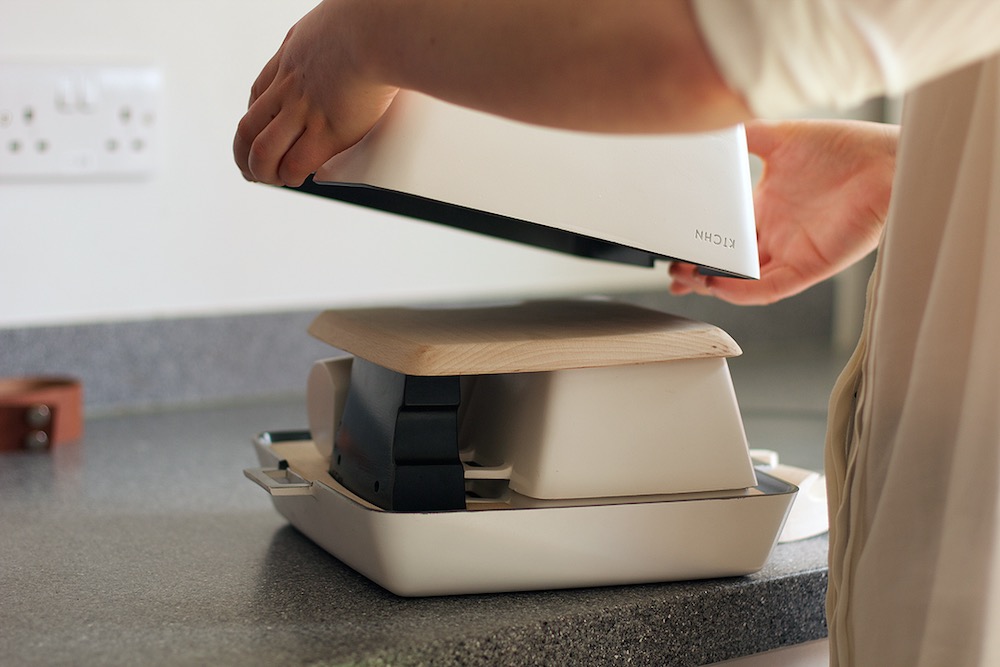
The LifeEdited apartment could do seated dinners for 12, made possible by the Resource Furniture Goliath Table. While having the capability to entertain so many guests is remarkable, it is hardly normal for most people who live in small homes. On a day-to-day level, these people dine alone or with a couple other people at most. For them, having cooking and dining sets for more than a few people is more burden than luxury. What they need is a few staple items that can do double and triple duty and store compactly–exactly the idea behind K T C H N, “a concise kitchenware set designed for the challenge of small space living,” according to designer James Salisbury.

K T C H N was actually Salisbury’s master’s thesis project. He has this to say about the cooking and dining set:

Inspired by the minimalist movements, it focuses on combining effective use of space with sufficiency in selection of items, this set promotes a simplistic, efficient lifestyle. K T C H N contains a select cooking set for two. The product range allows gradual adaptation to more efficient small space living through the use of fewer, multipurpose items.

Most of the items in the compact unit are made of ceramic enameled stainless steel, so they can be used for dining or cooking. In the kit are two plates that also act as pan lids, two bowls that can be used as pans, a large sauce pan, a frying pan, two ceramic cups, two maple cutting boards and two maple removable handles for the pans and lid. Also included are two portable induction hobs, aka burners. All of the items fit together to make a portable unit that is held together by a leather strap.

The whole unit is very elegant and I like the fact that the plates and bowls can be used to cook as well, though I think if I were to use K T C H N at home, I would rarely strap it together. One of the best applications I can see is using the set in a very space deprived setting like a tiny house or RV. It has all the functionality and efficiency of a camping cook-set, but the heft, durability and design of something meant to stay at home.

If you’re wondering, Salisbury has no immediate plans to put K T C H N into production.

IKEA Looks Toward the Future of Food

Whatever your thoughts about IKEA may be, it’s tough to argue with their influence. With 351 gigantic stores in 46 countries, they are a force to reckon with. Given their corporate girth, it makes sense that they are thinking about the future. In a bit of prescient marketing, IKEA teamed up with design consultancy IDEO and design students at Lund University and Eindhoven University of Technology to create a concept kitchen for the year 2025. The concept is a bold move. Rather than envisioning a future characterized by boundless resources, IKEA chose to contend with the more probable future–a future where we will be living compactly in cities and have limited space, where water and energy will be precious commodities, where food prices will increase dramatically, where resource intensive meat will be replaced by “protein”, where on-demand food delivery will become the norm (see all assumptions about the future here).

Concept-Kitchen-2025-at-IKEA-Temporary-Disposing-Thoughtfully

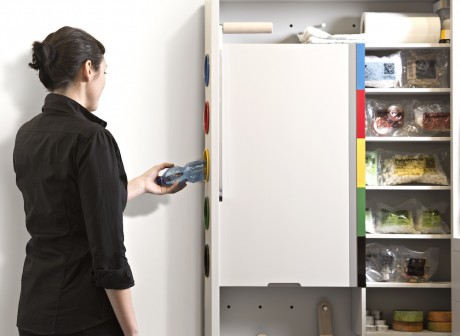
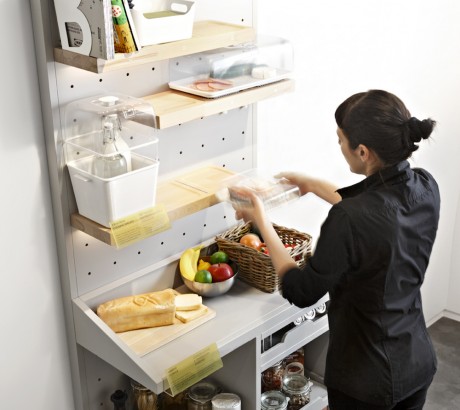
The compact kitchen features a host of innovative ideas. There’s a sink that catches organic matter from the drain; that matter is then composted and formed into pucks that are picked up by municipal waste management. Waste water is recirculated to water plants that sit on top of the kitchen unit. There’s a recycling system that will separate waste by material, then crush and scan the material for contaminants. The waste will then be vacuum packed and sealed in a bio-polymer tube with a thermo-printed label that will record what has been used and whether it can be reused. There are a host of food storage systems that don’t require refrigeration or disposable packaging.

Concept-Kitchen-2025-at-IKEA-Temporary-Storing-Visually-1Concept-Kitchen-2025-at-IKEA-Temporary-Table-closeup

The highlight of the project is the smart table. It’s is a dining, cutting and cooking surface that will be able to identify whatever ingredients are placed on the table. It will then come up with recipes and project them onto the surface. And rather than weighing things out, a built in surface scale will measure for you.

I’m not entirely convinced the smart table is an improvement on the dumb old cutting board, but the other stuff is pretty nifty and makes a ton of sense. Overall, the kitchen is a heartening sign that mainstream corporations might be able to look at the future without closing their eyes.

Korean Designer’s Simple Solutions for Ditching the Fridge

Refrigeration for small kitchens can be tricky. Typically, you have your choice of a humongous full-size fridge or tiny dorm-room model. The former tend to be around 80″ and the latter 30″. Often people trying save space opt for the smaller one, whose size, if you cook a lot, is maxed out quickly.

In the quest to preserve perishables, the question may not be how to increase refrigeration capacity, but how to do without it. An article in Treehugger shows Korean designer Jihyun Ryou‘s systems for preserving food without refrigeration.

Many of her solutions are designed around how perishables actually behave–behavior that often runs counter to our suppositions about the need for refrigeration. For example, many fruits release ethylene when they ripen. When we put them in a refrigerator’s sealed box, it actually traps the ethylene and accelerates spoiling. Accordingly, Ryou’s apple storage system exposes apple tops to the open air so they release ethylene. The ethylene serves the other purpose of preventing sprouting in potatoes, so the bottom half of the apple faces a dark box where potatoes are stored.

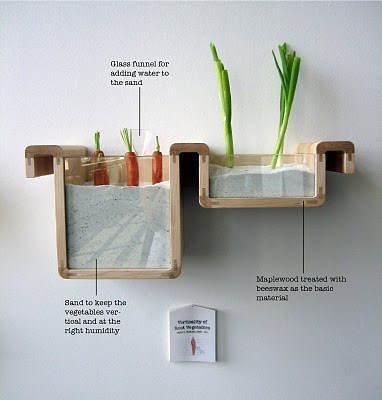
According to Ryou, “keeping roots in a vertical position allows the organism to save energy and remain fresh for a longer time”–so she puts carrots and scallions in wet sand to keep them vertical and maintain optimal moisture.

Americans are about the only people who refrigerate eggs; Ryou’s egg storage leaves them out and features a bowl to submerge eggs to test their freshness (a fresh egg will sink).

In days of yore, necessity dictated that people learn how to preserve food without refrigeration. While refrigeration is a great thing for many varieties of food, there are many instances where traditional food preservation techniques are equal or superior to refrigeration. Now Ryou gives these techniques a modern spin. She shows how a dorm fridge might suffice for even the most ardent gourmand.

Do you have other suggestions for doing without refrigeration? Let us know.

This post originally published June, 5 2012.

Via Treehugger

Image credit Jihyun Ryou

General Electric Gets Specific About Small Space Appliances

Few things are more problematic when decking out a small space than kitchen appliances. The right-sized ones tend to be designed for college dorm rooms–crummy finishes and features, manual defrost freezers. The right-quality and design ones tend to be made for 1000 sq ft McKitchens–doublewide fridges, 16 burner stoves, plate warmers. But some appliance makers seem to be waking up to the growing need for high-quality, high-functioning kitchen appliances suitable for small spaces. GE is one of those companies. They have designed a prototype kitchen that fits into a mere six foot space; they are also holding an open competition to find the best small space kitchen designs the crowds can muster.

The prototype kitchen includes all the appliances you’d expect of a full-service kitchen: induction cooktops, sink, two cooling drawers, dishwasher and microwave/convection oven. The unit was designed so it would only require one water line, which builders will appreciate. The only thing that’s not clear is if there is any storage. But because all of the appliances fit below counter, adding top cabinets would be quite easy. The whole thing will cost around $15K.

As mentioned, the prototype kitchen (video above) is part of a bigger effort by GE, which includes a  competition in partnership with FirstBuild, a crowdsourcing appliance-design platform (bet you didn’t know there was one). The public is being asked to submit designs for a kitchen that fits into a 7′ x 25″ footprint; they must include a refrigerator with freezer, cooktop, oven, microwave, dishwasher and garbage disposal. The Wall Street Journal says GE will release plans for the prototype kitchen later this month, so people can modify and improve upon the design (we’re not exactly sure how this sequence will work as submission deadline for the competition is June 23rd. Why wouldn’t they release the prototype before the competition so designers could work the appliances into the designs? Just sayin’).

GE-micro-kitchen

There are currently 12 submissions like the one above; the top four will receive $2500 each. Following the competition, GE plans to begin production on a one-stop-micro-kitchen as soon as later this year. We’ll keep you posted as that happens.

It’s heartening to see a big company like GE getting on the micro-bandwagon. Just because you choose a small space doesn’t mean you don’t like quality stuff, and it certainly doesn’t mean you don’t like to cook.

Via Wall Street Journal

6 Tips for Creating an Edited Kitchen

When we think about clearing out excess stuff, we tend to think about durable goods like clothes, electronics, furniture and so on. A cassette tape player we haven’t used in 15 years is an easy target for excision and reducing clutter. But there is another, more edible source of residential overcrowding: food. We might be far less likely to get rid of those 15 year old canned peaches crowding our pantries than we are the cassette player. We say to ourselves, “I might eat that someday.” But do we?

Many modern fridges, cupboards and pantries buckle under the strain of excess food stocks–food that takes up valuable household space; food that uses resources and money to produce and purchase; food that often gets tossed after a long, uneventful stay in our kitchens. Consider these food facts:

  • It’s estimated that 40% of America’s food supply ends up in the trash.
  • 10% of greenhouse emissions from developed countries is generated by the production of food that is never eaten.
  • According to the USDA, “In 2008, the amount of uneaten food in homes and restaurants was valued at roughly $390 per U.S. consumer–more than an average month’s worth of food expenditures.”
  • According to ABC news, between the years 1974 and 2004 the average American home’s kitchen doubled in size from 150 to 300 sq ft.

Cutting down on food waste can make it easier to live in a smaller space, reduce clutter in any kitchen, save money and reduce our carbon footprints. It may even improve our health. If you’re interested in editing your food stock, here are a few tips.

  1. Buy only what you need. This is a pretty obvious one, but try to buy the food and the quantities you know you’ll consume from one shopping trip to another. It’s okay to have an empty fridge before you go shopping. If feasible in your area, make more frequent, smaller shopping trips.
  2. Avoid “precious” food. How many times have you bought special cheese, meat, heirloom tomatoes–whatever–and waited to use it for a special occasion, only for that food to end up rotting? Have a plan for your food–either eat it at an appointed time or immediately. Food spoils. Make every day a special occasion.
  3. As a rule, try to purchase most food from the perimeter of the grocery store. Grocers put all of their perishables–fruits, veggies, fresh meat, dairy–on the outside of the store. Aside from their greater nutritional value, perishables have a finite amount of time you need to consume them, creating an urgency for consumption. On the other hand, food from the store’s interior can sit on their (and our) shelves for millennia–food that is often bereft of nutritional value or filled with preservatives. Real food goes bad. Eat more real food.
  4. If you’re trying to get rid of food you already have, create recipes using existing food and schedule meals. If you need to buy extra ingredients, go ahead, as long as it doesn’t add another wave of new, unused food. Not sure what to make? Try the Su Chef app. If there is food you’re sure you’ll never eat, drop it off at a local shelter.
  5. Compost wherever possible. Many local green markets and community gardens have drop off compost bins. Put food scraps in your freezer between drop offs to avoid bugs. Consider your own composter such as the NatureMill automatic composter used in the LifeEdited apartment.
  6. Don’t be afraid to toss. If something is not fit for eating, giving away or even composting, don’t be afraid to toss it. This is especially true of junk food. Some food is healthier in the trash bin. Just resolve to not buy the same stuff again.

image credit My Cooking Magazine

This Little Italian Kitchen Has Spine

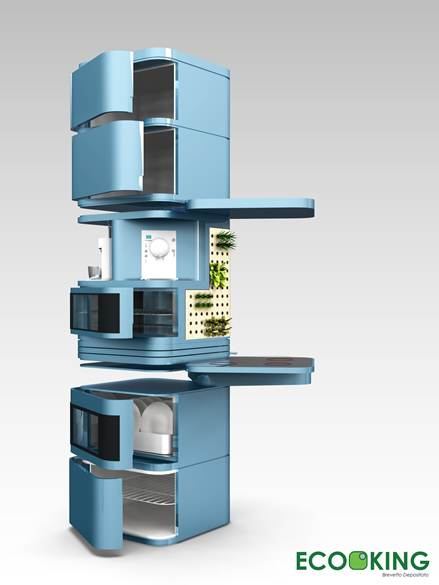
We were turned onto this innovative column-kitchen (not sure if that’s a proper term) that was released at the recent Milan Furniture Fair. It’s called ECooking, designed by Massimo Facchineti and, unlike many concept designs, will be manufactured by Clei, the same folks who make the Swing sofa/bed in the LifeEdited Apartment.

The little unit is packed with features:

  • Kitchen basics: Oven, fridge, induction cooktops, sink, dishwasher and espresso maker (an Italian basic)
  • Multi-stage water filtration
  • Herb garden that uses filtered grey water
  • Built in ventilation and UVA light for your herb garden
  • Counter surfaces that creates seating for six
  • Storage
  • Rendering shows a solar paneled back to power entire house (unconfirmed).

Ecooking-Clei-back

Again, the cool thing about this is the fact that: A. it was made and B. is going to be released. Resource Furniture says it should be available early to mid-2014 (no price or additional details available just yet). We suspect some of the features, like the solar panels, might not carry over from concept, but even the basics are pretty cool.

While ECooking might not be ideal for someone who regularly hosts large dinner parties, it seems like a perfect compliment for a micro apartment where it would significantly reduce the kitchen footprint while providing more than enough function for the small-scale gastronome.

This Valentine’s Day, Become Smitten with Your Tiny Kitchen

This week we’ve looked at a couple teeny-tiny kitchens: Kitchoo’s modular, plug-and-play kitchen as well as Boston’s micro-unit mockup with its wisp of a prep area. Many of us who cook regularly might see these micro-kitchens and think them suitable for removing takeout from plastic bags, but little else. Well, Deb Perelman might have something to say about that.

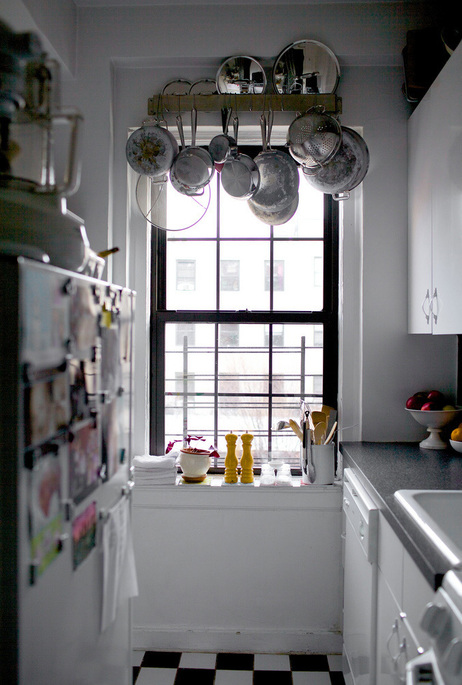
Perelman is the brains and brawn behind, Smitten Kitchen, who is, “Fearless[ly] cooking from a tiny kitchen in New York City.” From her 42 sq ft half-galley, single countered, tiny oven-ed, minimally-equipped kitchen, she whips out dishes like pancetta, white bean and chard pot pies and swiss chard and sweet potato gratin. She has hundreds of recipes spanning many different categories–from breakfast, dessert, veggie and meat. She also has a book.

Perelman is not a trained chef, but rather someone who loves to cook and creatively works within the contraints of her home’s kitchen.

We thought in honor of Valentine’s Day we’d offer Perelman’s “44-Clove Garlic Soup,” a simple soup recipe from her “budget” collection made of ingredients most cooks will have on hand. We thought it was a recipe that, after consumed, says to your beloved “I’ll love you no matter what.”

garlic-soup-deb-perelman

Serves 4

  • 26 garlic cloves (unpeeled)
  • 2 tablespoons olive oil
  • 2 tablespoons (1/4 stick) butter
  • 2 1/4 cups sliced onions
  • 1 1/2 teaspoons chopped fresh thyme
  • 18 garlic cloves, peeled
  • 3 1/2 cups chicken stock or canned low-salt chicken broth
  • 1/2 cup whipping cream
  • 1/2 cup finely grated Parmesan cheese (about 2 ounces)
  • 4 lemon wedges

Preheat oven to 350°F. Place 26 garlic cloves in small glass baking dish. Add 2 tablespoons olive oil and sprinkle with salt and pepper; toss to coat. Cover baking dish tightly with foil and bake until garlic is golden brown and tender, about 45 minutes. Cool. Squeeze garlic between fingertips to release cloves. Transfer cloves to small bowl.

Melt butter in heavy large saucepan over medium-high heat. Add onions and thyme and cook until onions are translucent, about 6 minutes. Add roasted garlic and 18 raw garlic cloves and cook 3 minutes. Add chicken stock; cover and simmer until garlic is very tender, about 20 minutes. Working in batches, puree soup in blender until smooth. Return soup to saucepan; add cream and bring to simmer. Season with salt and pepper.

Divide grated cheese among 4 bowls and ladle soup over. Squeeze juice of 1 lemon wedge into each bowl and serve.

Do ahead: Can be prepared 1 day ahead. Cover and refrigerate. Rewarm over medium heat, stirring occasionally.

Photo credit: Deb Perelman

A Small Space Kitchen that is Not an Eyesore

Kitchens in small apartments can be pretty sucky. For one, because the apartments are often geared toward budget-minded buyers and renters, yellowing and delaminating formica tends to be the building material of choice. Then there are oversized appliances. Since smart, small American apartments are as common as plain-speaking architects, few companies make–or export–good small appliances. As a result, these small spaces are often outfitted with full sized ovens, ranges, sinks and dishwashers. You end up with an otherwise nice space marred by a blemish of a kitchen.

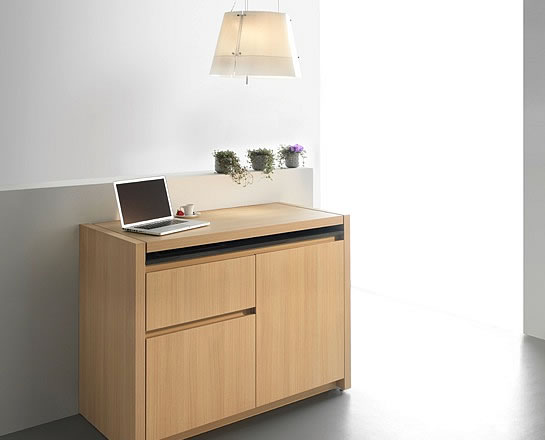
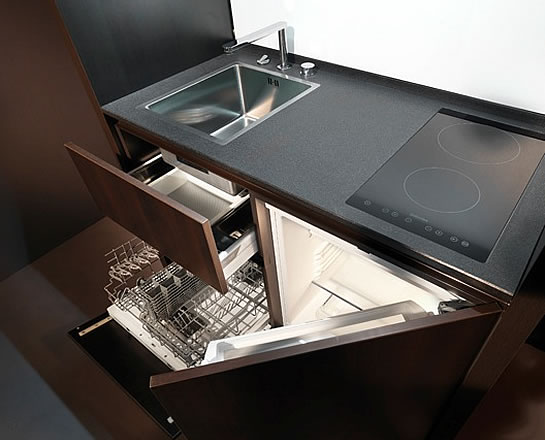
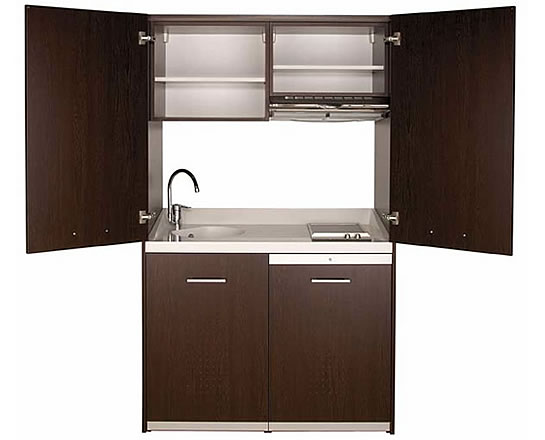
French firm Kitchoo might have an answer for this dilemma. They make elegant, high-quality, small-space-appropriate, all-in-one modular kitchens.

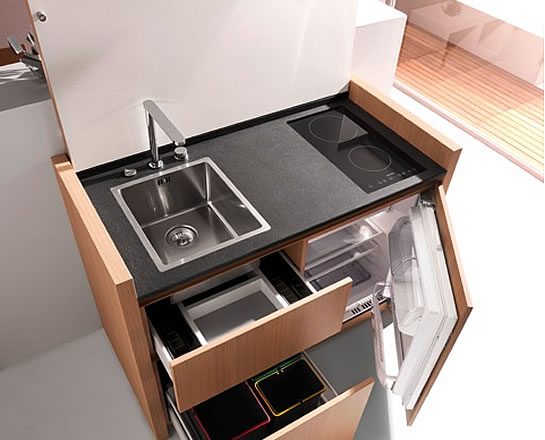
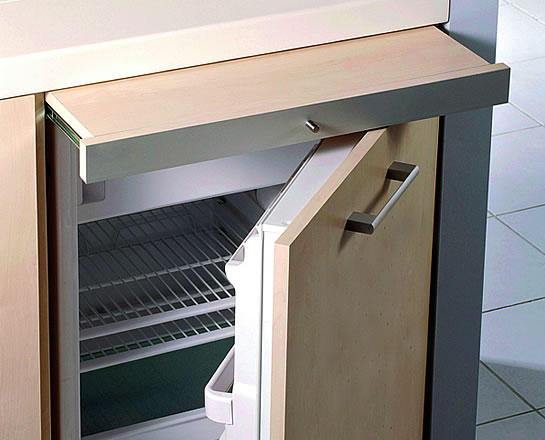
They make two series of kitchens: The K and M series. The K series is the sleeker and more expensive of the two. The K1 is 51″ w x 25″ d (the K1) include two induction burners, a fridge/freezer, a sink with telescoping faucet, a cutlery drawer and optional dishwasher. The K2 has a top shelf that holds an oven and additional storage. All construction materials and appliances are eco-friendly. Prices begin at 5,505 € ($7400).

What’s special about the K series is that when the sink is hidden, it does not look like a kitchen. This is actually quite important for a small space, where it’s valuable to have every piece of real estate able to double duty. The K kitchen could literally be a desk during the day.

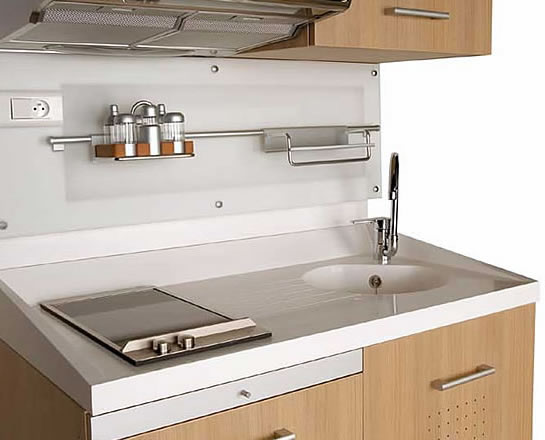
The M series is Kitchoo’s more pedestrian version. The sink faucets do not telescope and rather than the M’s flush induction burners, the M features slightly raised electric cooktops. Besides being less expensive (prices start at 3,833 €/$5143) the M series seems a bit more practical. It features pull out countertops that can double as a table, more storage and, coolest of all, an optional mini washing machine. The M3 (5,500 €/$7379) is the biggest M series and would really be suitable for someone who frequently cooks.

While these prices are a bit on the steep side, compared to the costs of custom kitchens, which easily exceed $10K, it’s not so bad. Granted, this will appeal to buyers more than renters.

Unfortunately (and we realize we’ve been saying this a lot lately), Kitchoo kitchens are only available in Europe. We reached out to them and they told us that they are planning on coming to the States in the near future. We will keep you posted.

We’re hoping with the growing popularity of the micro-apartments and tiny homes, products like Kitchoo and the smart, small appliances they feature, will become more available to American markets.

4 Products that Disappear After You Buy Them

A recent article in the NY Times called “The Cult of Disappearing Design” reported on a growing movement toward invisible home furnishings. The “all-invisible aesthetic,” according to the article, “aims for a higher-minded goal: creating unified spaces that flow from room to room and place to place.”

They featured a couple items we’ve had here in the past like the Folditure “Leaf” Chair and the Bedup hiding bed. They also featured the Fisher & Paykel DishDrawer which is used in the LifeEdited apartment.

While there is an inherent challenge showing the invisible, we thought we’d add a couple items not included in the Times’ list.

1. Amina Invisible Speakers

We used Amina high performance invisible speakers in the LifeEdited apartment. Their sound is easy to appreciate, though their beauty is not. The above picture has two large Amina speakers in the ceiling, but you’d never know. They are built into the drywall.

2. Induction Cooktops

In the LifeEdited apartment, we use Fagor portable induction cooktops, which are invisible in that we can put them in a drawer. Built in models are even more sleek (there’s a Fagor model pictured above). They sit virtually flush with the counter. They only conduct heat with ferrous metal, so they are cool to touch, which makes allows them to be used as additional counter space. They are also 12% more efficient than electric radiant burners.

3. Integrated Kitchen Appliances

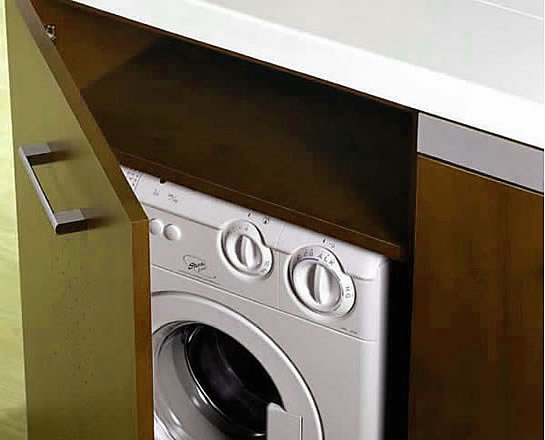
While the Times mentions Fisher & Paykel DishDrawer as a disappearing design, there are many dishwashers and refrigerators on the market today are available as “integrated”–i.e. a panel that matches the rest of the cabinetry can be affixed to the front of the appliance. Sorta pictured below is the DishDrawer in the LifeEdited apartment. IKEA makes an integrated dishwasher for about $699. Panels cost extra.

For whatever reason, integrated fridges are more expensive. We used the Sub-Zero 700 BCI stacking drawer fridge, which retails for $3500 and up.

4. Blanco Crystalline Sink

The Blanco Crystalline Sink incorporates such a simple idea: cover you sink when you don’t need it, creating a cleaner look and more counter space. The sink comes with a removable glass cover (available in white or black). Unfortunately, due to code regulations a super-cool retractable faucet is only available outside the US.