Coolest Small-Space Cans Come from Japan Yo

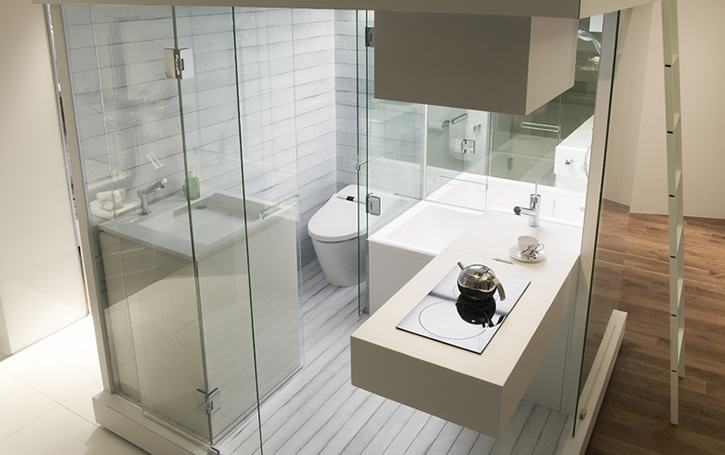
The Japanese have a knack for lending high-end design and materials to spaces Americans typically associate with dorm-rooms and halfway houses. Case in point is the Subaco Sanitary Unit from the Spiritual Mode corporation (we’re confident “spiritual mode” and particularly “sanitary unit” sound more elegant in Japanese). Subaco is an all-in-one bathtub, toilet, wash basin, kitchen, laundry and loft–all of which occupy a whopping 6 x 6 ft (2 x 2m) footprint.

It looks like they have at least a couple varieties: the peekaboo model with glass walls for the WC (don’t throw stones–or anything else–whilst using it) and a model with solid walls. We can see all the bathroom fixtures and induction cooktop, which because of its flat surface and cool-to-touch surface, doubles as a countertop. There even appears to be a fan for the cooktops. We’re curious to see what kind of laundry machine is used.

Presumably, these modular units can be plugged into any space; they look like they’re destined for the wan rūmu manshons we covered a while back.

Most small American apartments employ the Afterthought School of bathroom and kitchen design–knees often knock into tubs and doors while on the can; fridge doors refuse to open in the kitchen; prep space is a joke.

We wonder if Americans were given such sleek and elegant designs in their small-space living options, whether they might be more inclined to scale back on their living spaces?

Image credit: Spiritual Mode

Via Treehugger

Make Your Kitchen Flow Like a Faucet

Part of living an edited life is making choices in your home that make sense–putting stuff in its right place near where it can be accessed and is used. Few places is this more true than in the kitchen, and especially true in small kitchens. Justin Klosky from OCD Experience gives practical tips on how you can optimize kitchen logic and organization. 

Kitchen Flow…Yo Yo Yo

Like a good song, there needs to be flow and rhythm, which can also be applied to the way you organize your kitchen. When organizing your kitchen think of it in terms of efficiency first then organization. Dishes should be stored in cabinets near the dish washer while pots and pans should be close to the stove. The more efficient your kitchen is setup the more effective you will be when cooking in it. Like the garage the kitchen can become very overwhelming if you don’t grab hold of it, so we gravitate towards organizational products that you can see through which will make things look and feel cleaner. Items like these Square Pop Canisters are great for organizing and storing cereals, pastas and nosh foods. You should also take the time to label these canisters which will make the first glance your last glance. For smaller items that can get out of control we suggest investing into these tea bags storage containers to eliminate the tea boxes and the possibility of tea bags ending up everywhere. Akro bins are your best bet for canned goods, and almost anything else you want to bring order to as they come in all sizes. It also brings clarity into your kitchen when you can see everything you are looking for.

Kitchen Flow Tip: The most important tip when organizing your kitchen is flow. The more you can flow in your kitchen the more fun you will have in it and the more love you will be able to bring to your food. The most used items should be a few steps or arm’s length away.

Help Design Jim’s Kitchen. Win Money.

A new competition launched by our friends over at Architizer is looking for the world’s best ideas in small kitchen design. The competition centers around New York media exec Jim Richardson’s 120 sq ft galley kitchen.

The current kitchen (pictured below) looks like it was defeated by the same foe we faced while building the LifeEdited apartment–i.e. the lack of high-quality appliances for compact spaces. There is very little middle ground between huge appliances and rinky-dink, dorm-room models. Jim’s fridge and stove look better suited for a McMansion than a compact NYC apartment. This results in limited counter space, a small sink and little room for people (small detail).

Whereas the LifeEdited competition encompassed the whole apartment, this one’s narrow focus might inspire some great ideas about kitchens. We might suggest going with a small fridge and using systems like we looked at yesterday to handle some of Jim’s perishables.

On the competition site is a brief about what Jim is looking for–ability to entertain, have 2 people prepare food, which appliances he wants to include, etc. The design should be no more than $30K to realize.

The first prize wins $5K and the 2 runners up $1K each. Submissions are due by July 9th, 2012.

What are your great ideas for making a small kitchen work?

Fill Your Home with Fewer, Better, Beautifuler Stuff

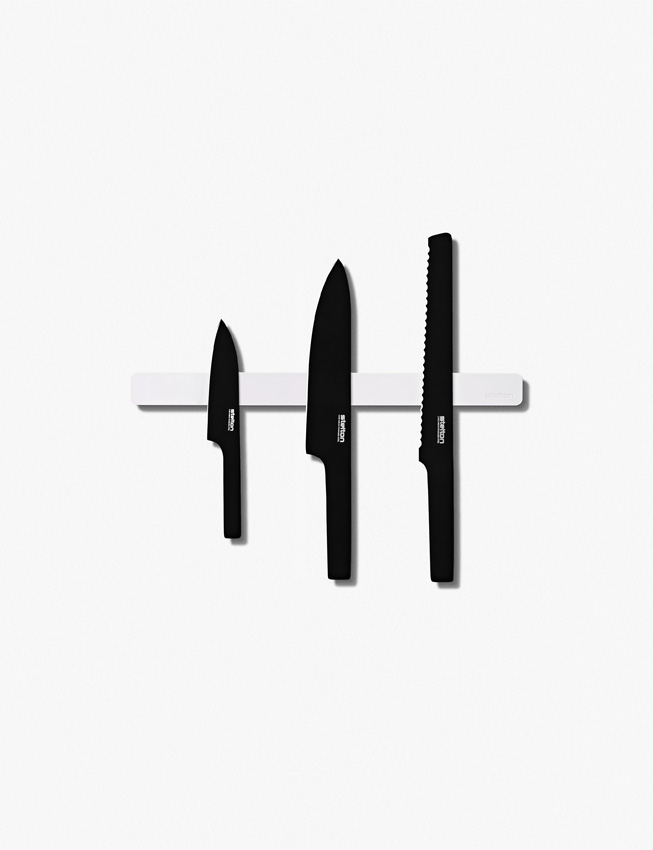
We dig products like these Stelton Knives (so much so we got a set for the LifeEdited apartment). At around $300 for a set of 3, the Danish designed and manufactured knives are not cheap, though the set, which includes a chef’s knife, a serrated multipurpose knife and a small chef’s knife (a more versatile paring knife) cover most tasks a gourmand can throw at them.

Their one piece forged stainless steel construction feels great in your hand, and their heat-treated matte-black finish gives great grip (we do have some questions about the durability of the finish).

Of course, they’re simply beautiful. Their finish and gorgeous shape begs to be displayed, which is easy with Stelton’s accompanying white magnetic holder. This is quite a contrast to the counter-hogging knife block filled with 2-3 knives you use and a whole bunch you don’t.

Products like these beg the question, what if you could be psyched about everything in your home? What if everything in your home were used? With that mission in mind, what would stay from your existing stuff? What would go?

Let us know what indispensable stuff you have in your home—things that marry form, function and high quality?

Image courtesy of Stelton.dk

Why Small Fridges Make Good Cities

Rampant consumerism isn’t limited to clothes, electronics and other durable goods. Many American kitchens can look like doomsday shelters, with their pantries and freezers packed with enough food for weeks or months.

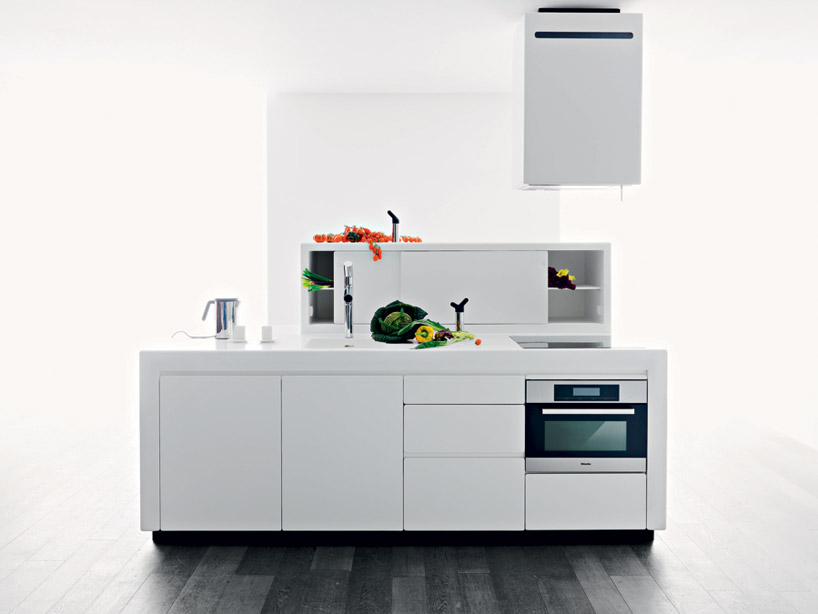
A few years ago, Canadian architect Donald Chong introduced a concept-kitchen called “Small Fridges Make Good Cities.” On his site, Chong asks a provocative question: “Can the choices we make in our own homes make a difference in our neighbourhoods?”

We tend to think our interiors as dissociated from our communities, but what if we saw the inner and outer spaces as inseparable? For example, a kitchen with a small fridge could have personal, community and even global impact from results like:

  • Frequent, small shopping trips. Chong wanted to “heighten the experience of the urban harvest where seasonality, once again, can resume its place in architecture and the city.” Chong is hearkening to a time when people ate with the season and went to the market frequently because food didn’t keep indefinitely via freezing and vacuum packing. Markets weren’t just food warehouses as they are now. They were important community spaces where people shared their lives.
  • Fresher food. I’ve heard, “If your food can go bad, it’s good for you. If your food won’t go bad, it’s bad for you.” Big caches of food that don’t go bad are, by their very nature, not fresh. Small fridges produce high turnover. Of course, the high turnover could be junk food, but as long as you’re at the market, do your body a favor and shop at the perimeter, where all the fresh food is.
  • More eating out. Many of our homes are isolated fortresses of eating and media consumption (TV, internet, etc.). While eating out every night does not make sense for many of us, going out of the house 2-3 times a week and engaging your community is a great way to support local economies and make a vibrant city.
  • Less space. This is pretty obvious, but food takes up real estate.
  • Less energy. Refrigerators account for around 15% of household energy expenditures. A small, Energy Star fridge like the Sub-Zero 700 BCi used in the first LifeEdited apartment, will help mitigate that number considerably.

Of course, many of us live in places where frequent shopping isn’t feasible. And you can get a small fridge and fill it with Hot Pockets or order greasy takeout every night.

But maybe you’re remodeling your kitchen. Consider a slimmer, European style fridge instead of an American double-wide. Or you’re moving into a small apartment with a small fridge. Consider getting to know your farmer’s market.

Do you have a small fridge? What are your experiences with it? How does it change your habits? We’d like to know.

Story via Treehugger and Donald Chong, Image via Designboom

Amazing Single-Serving Dishwasher

It’s bad enough that your parents keep urging you to meet a nice girl/guy. You shouldn’t have to take grief from your appliances as well–that huge, perpetually under-filled dishwasher reminding you of your parents’ petitions. No longer.

The Instant Dishwasher by Robert Lange and Bosch honor your singleness. The experimental, space-saving design provides enough room to clean a couple place-settings, which for most bachelors/bachelorettes (or couples who don’t cook a lot) is all that’s needed on a daily basis.
Via Yanko Design.

Space and Energy Saving Kitchen Shelves

Dish Drying Closet Design

Design is a plan for arranging elements in such a way as best to accomplish a particular purpose. –Charles Eames

This cabinet with drying-rack shelves eliminates that awkward, space-hogging standalone rack that never quite fits in the sink or the counter. Clean dishes go directly from sink to storage versus sink to drying-rack to storage, reducing labor and arguments about whose turn it is to put away the dishes. It also proves that smart design is not rocket science. It’s a willingness to examine the way things are done and see if they can be done better (via Dornob).